
Salt Sugar Fat: Complete Chapter-by-Chapter Summary

Welcome to a journey into the hidden science of our cravings. Today, we're diving into Michael Moss's groundbreaking book, *Salt Sugar Fat: How the Food Giants Hooked Us*. This isn't just a story about food; it's an investigative deep dive into the calculated strategies designed to hijack our biology.
Imagine a world where the food industry didn't just sell products, but engineered addiction. Moss reveals that giants like Coca-Cola and General Mills didn't stumble upon these recipes by accident. They hired top scientists to map out our brain's reward system, identifying the exact "bliss point" where sugar, salt, and fat combine to make us lose control.
The book exposes how these companies use the "bliss point" to keep us coming back for more, whether it's a slice of cheese, a bag of chips, or a sugary soda. It's a fascinating look at how corporate power meets human biology, turning our natural desires into a multi-billion dollar empire.

Imagine a room in Minneapolis on April 8, 1999, where the air was thick with tension and the future of American health hung in the balance. This was "The Secret Meeting of 1999," a clandestine gathering of the CEOs from the nation's biggest food giants: Kraft, General Mills, Coca-Cola, and Mars. Standing on the left, the iconic Pillsbury tower looms, a symbol of an industry that had mastered the science of human desire.
The agenda was stark and terrifyingly honest. Michael Mudd from Kraft and James Behnke from Pillsbury didn't mince words. They presented undeniable evidence of an emerging global obesity epidemic, pointing a finger directly at their own industry's culpability. They warned that the very formulas they were perfecting—driven by the relentless pursuit of profit and Wall Street's demand for endless growth—were fueling a public health crisis.
But here lies the tragedy of that day. Despite the warning, the outcome was a resounding refusal to change. CEOs like Stephen Sanger of General Mills saw the risk but chose the bottom line. They outright refused to alter their highly profitable formulas. Instead of pulling back, they accelerated. The era of extreme food engineering was given the green light to run unchecked.
What happened in that room wasn't just a business meeting; it was a decision to prioritize short-term gains over long-term survival. The industry chose to double down on sugar, fat, and salt, ignoring the biological mechanisms they themselves had exploited to create addiction. That secret meeting didn't just mark a date on a calendar; it cemented the path we are still walking today, where the pursuit of the "bliss point" in every snack and drink has come at a staggering cost to our health.

Imagine a world where food isn't just fuel, but a masterfully engineered trap designed to keep you eating. Today, we're diving into the core of this deception: The Triad of Addiction.
Look at this diagram. It highlights the three foundational pillars that corporate food scientists rely on to override our natural satiety signals. These aren't random ingredients; they are mathematically calibrated tools.
First, we have Sugar. Think of this as the biological hook. It's not just sweet; it's a direct line to your brain's "pleasure zone." Every time you taste it, your brain releases a reward signal, creating an addiction loop that evolution never intended for us to break.
Next is Fat. This is the invisible caloric payload. Unlike sugar, which tastes sweet, fat provides a massive energy hit without triggering the same immediate fullness signals. It's the secret to why high-fat foods feel so satisfying and why it's so easy to eat them without realizing how much you've consumed.
Finally, there is Salt. This is the flavor fixer and preservative. Salt doesn't just make food taste better; it amplifies the effects of both sugar and fat. It acts as a glue, binding these two addictive elements together to create a flavor profile that is impossible to resist.
When these three elements intersect in the center of this diagram, they create what experts call "Maximum Consumption." This is the sweet spot where sugar's hook, fat's hidden calories, and salt's flavor enhancement combine perfectly. The result? A product that feels delicious but tricks your body into ignoring the fact that you are already full.
This is the science behind processed food. It's a formula designed not for your health, but for endless consumption. Understanding this triad is the first step to seeing through the marketing and taking control of what you put on your plate.

Imagine a substance so powerful that it doesn't just taste good—it hijacks your entire brain. This slide reveals the first weapon in the food industry's arsenal: Sugar. It's not just a flavor; it's a biological drive hardwired into our DNA.
Look at that glowing red spot in the brain's Orbital Frontal Cortex. That's your pleasure zone. Evolutionarily, our ancestors were wired to crave sugar because it signaled rapid, life-sustaining energy. Every time we consume it, our brain receives a massive reward signal, creating an addiction loop that is nearly impossible to break.
But the industry knows exactly how to exploit this. They weaponize our biology by placing T13R protein receptors throughout our entire mouth and even our esophagus. These receptors act like triggers. When you taste sugar, your brain's reward centers light up, mimicking the neurological response of mild narcotics.
The real exploit happens when food scientists hide this sugar in unexpected places. Think about it: why does bread or pasta sauce taste so good? Because manufacturers have maximized sugar content there, repeatedly triggering your brain's craving centers. They aren't just adding sweetness; they are manipulating a reflex that has survived for millions of years, turning a simple meal into an irresistible, addictive experience.
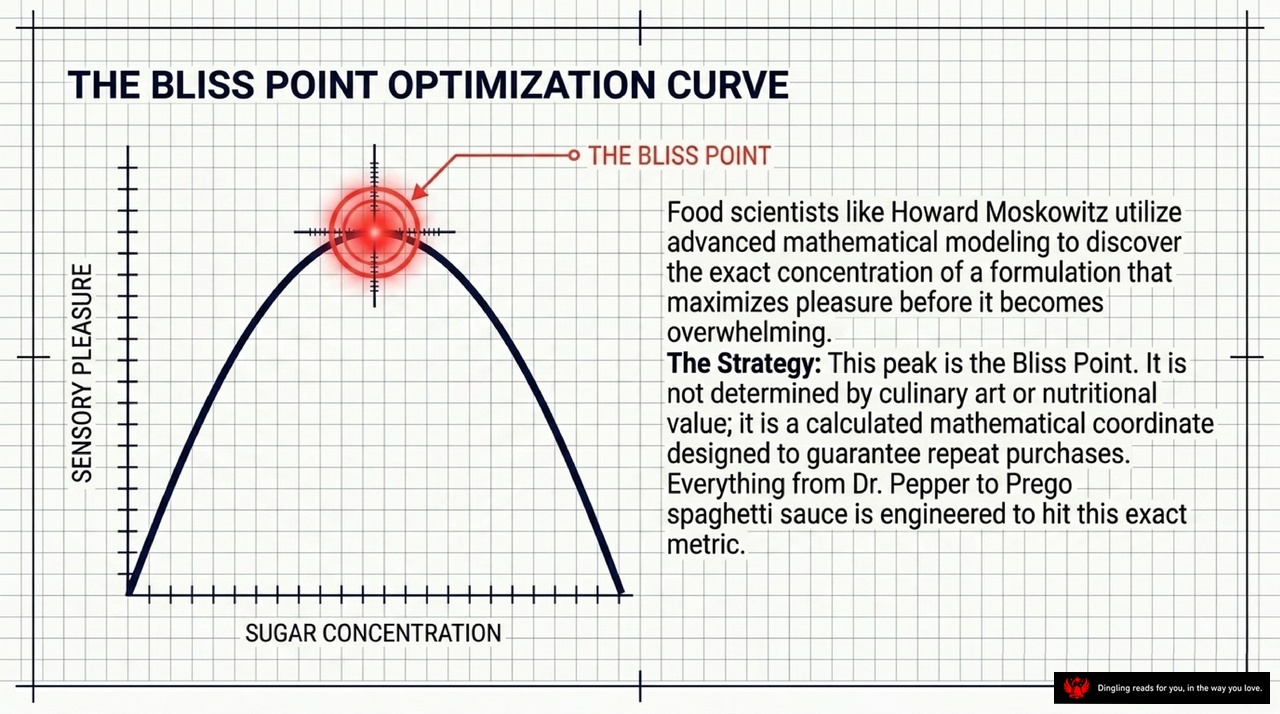
Today's slide reveals the secret weapon behind almost every snack you buy: the Bliss Point Optimization Curve. This isn't just about making food sweet; it's about engineering the perfect hit of pleasure.
As the graph shows, sensory pleasure rises as sugar concentration increases, but only up to a specific peak. This peak is labeled "The Bliss Point." Food scientists like Howard Moskowitz use advanced math to find this exact coordinate. It's not about what's healthy or how a chef tastes it; it's a calculated formula designed to guarantee repeat purchases.
Once you cross that peak and add even more sugar, the pleasure drops. The food becomes overwhelming and less attractive. That's why everything from Dr. Pepper to Prego spaghetti sauce is engineered to hit this exact metric. By staying right at the top of that curve, companies ensure you feel maximum satisfaction with every bite, making it incredibly hard to stop eating.
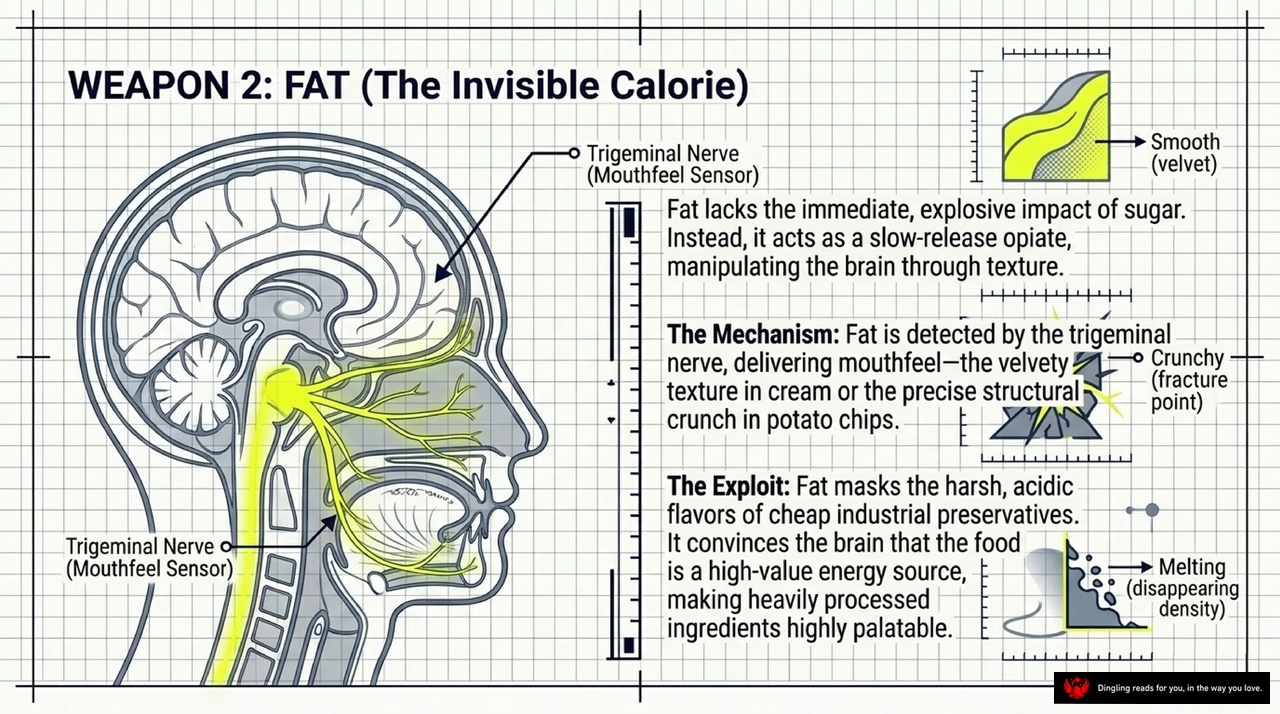
Weapon number two: Fat. While sugar hijacks your brain with a quick hit of dopamine, fat operates differently. It's the invisible calorie, a slow-release opiate that manipulates you through texture rather than just taste.
Here's the mechanism: Fat isn't just a flavor; it's a sensation detected by the trigeminal nerve. This mouthfeel sensor—labeled right here in the diagram—transmits signals about velvety smoothness or that precise structural crunch of a potato chip directly to your brain. It tricks your mind into believing you're consuming a high-value energy source.
But the real exploit? Fat masks the harsh, acidic flavors of cheap industrial preservatives. It convinces your brain that heavily processed ingredients are actually delicious and worth eating. Without fat, those same foods would taste flat and unappealing. That's why removing fat from processed foods often makes them taste worse, even if they are healthier. It's a trade-off between texture and nutrition that keeps us reaching for the bag.
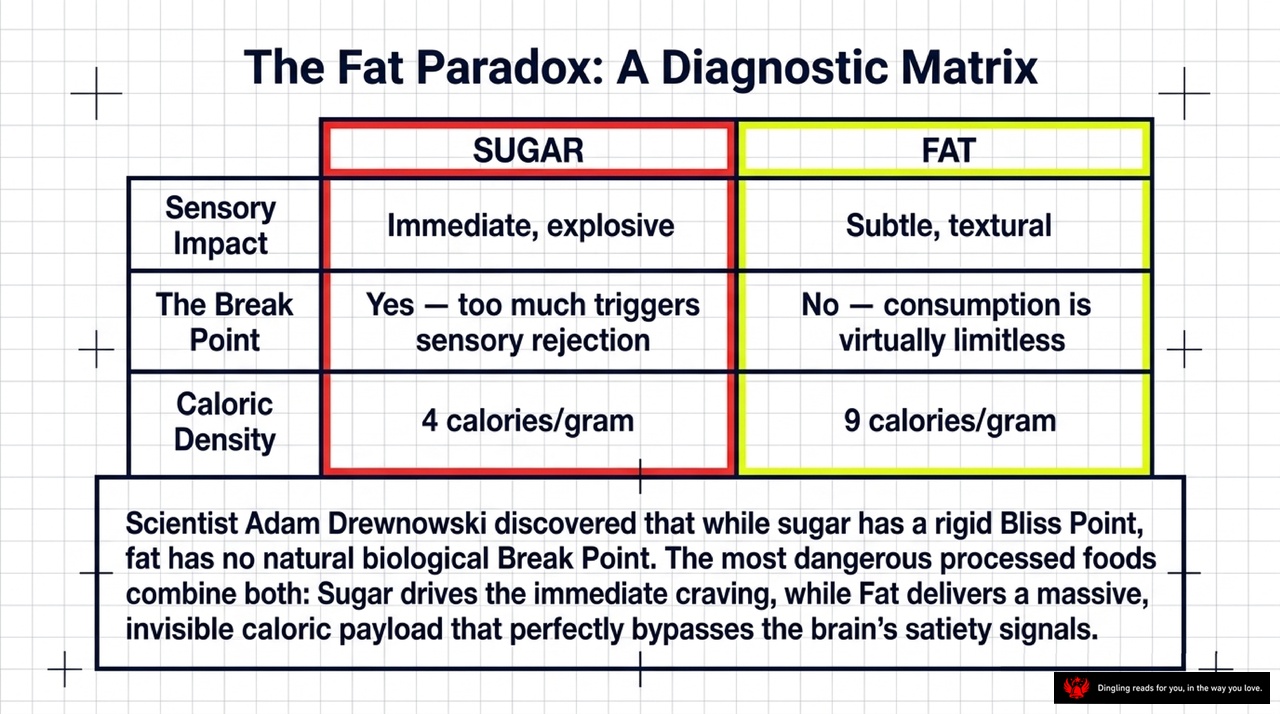
Here is the spoken-word script for the current slide:
"The slide we're looking at reveals the core of the modern food crisis: The Fat Paradox. It's not just about calories; it's about how our brains react to sugar versus fat. Look at the matrix. Sugar hits you with an immediate, explosive sensory impact, but it has a rigid 'Break Point.' Once you hit that limit, your brain says, 'Enough,' and you stop eating. Fat, however, is different. Its impact is subtle and textural, but it has no natural biological break point. You can keep eating it virtually limitlessly because your brain never gets the signal to stop.
The danger lies in the combination. As scientist Adam Drewnowski discovered, the most dangerous processed foods are the ones that merge both. Sugar drives the initial craving with that explosive hit, while fat delivers a massive, invisible caloric payload that perfectly bypasses your brain's satiety signals. This is why a single slice of processed cheese or a bag of chips can lead to overeating so easily—the sugar triggers the desire, and the fat keeps you going long past the point where you should be full. This diagnostic matrix explains why traditional dieting, which often focuses solely on cutting calories, fails so often against these engineered food combinations."

Weapon 3: Salt. Think of it as the industrial fixer, the ultimate glue holding the modern food system together. Without it, the processed food industry simply couldn't exist. Imagine a world where industrial food tasted like cardboard or metal; salt prevents that disaster. It's the miracle worker that makes everything palatable.
But here's the dark secret: salt isn't just for flavor. It's the industry's greatest weapon against bad ingredients. As the slide explains, it acts as a "masking agent," specifically hiding that awful taste known as W.O.F.—Warmed-Over Flavor. That's the rancid, wet-dog smell created when fats in pre-cooked meals oxidize and go bad. Salt aggressively covers up these defects, allowing companies to sell cheap, highly processed ingredients without consumers noticing the degradation.
The scale of this operation is staggering. The industry consumes 5 billion pounds of salt every single year. It's not added merely for taste; it's the ultimate cosmetic surgery for food. It's aggressively applied to mask the flaws of mass production, ensuring that a frozen meal or a packaged snack feels fresh and delicious, even when it isn't. In a world obsessed with convenience, salt is the silent guardian keeping our food from tasting like nothing at all.
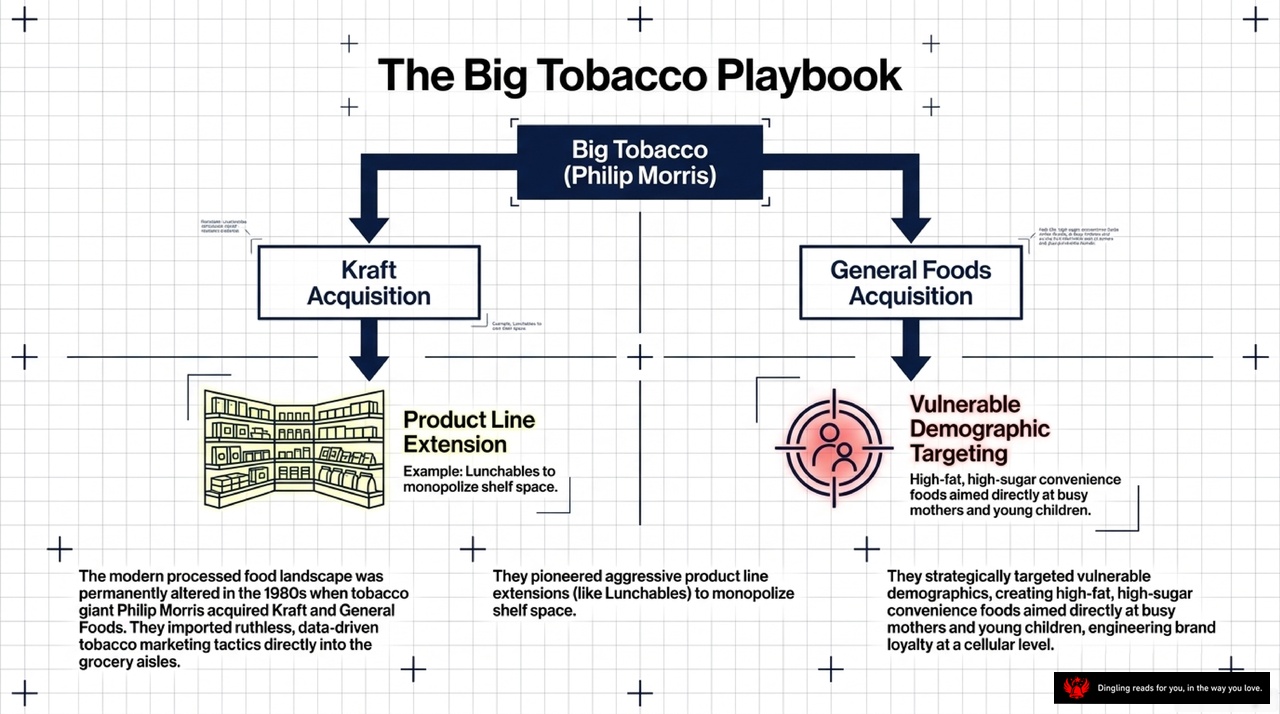
The Big Tobacco Playbook reveals a ruthless strategy that reshaped the American grocery aisle. When Philip Morris acquired Kraft and General Foods in the 1980s, they didn't just buy companies; they imported a data-driven marketing playbook directly from the tobacco industry.
Look at the two paths they took. On the left, through the Kraft acquisition, they pioneered aggressive product line extensions. A perfect example is Lunchables. By creating these pre-packaged combos, they didn't just sell food; they monopolized entire shelf spaces, making it incredibly hard for competitors to get noticed. It was about controlling the physical environment of the store.
On the right, via the General Foods acquisition, they mastered vulnerable demographic targeting. They engineered high-fat, high-sugar convenience foods aimed directly at busy mothers and young children. This wasn't accidental; it was a calculated move to create brand loyalty at a cellular level, exploiting the very real physiological cravings for sugar and fat that we discussed earlier.
The result was permanent. The modern processed food landscape was altered forever. These giants used tobacco tactics to engineer a world where the most addictive, shelf-stable, and targeted foods dominated the aisles, leaving consumers with fewer healthy choices and a diet designed for maximum consumption rather than nutrition.
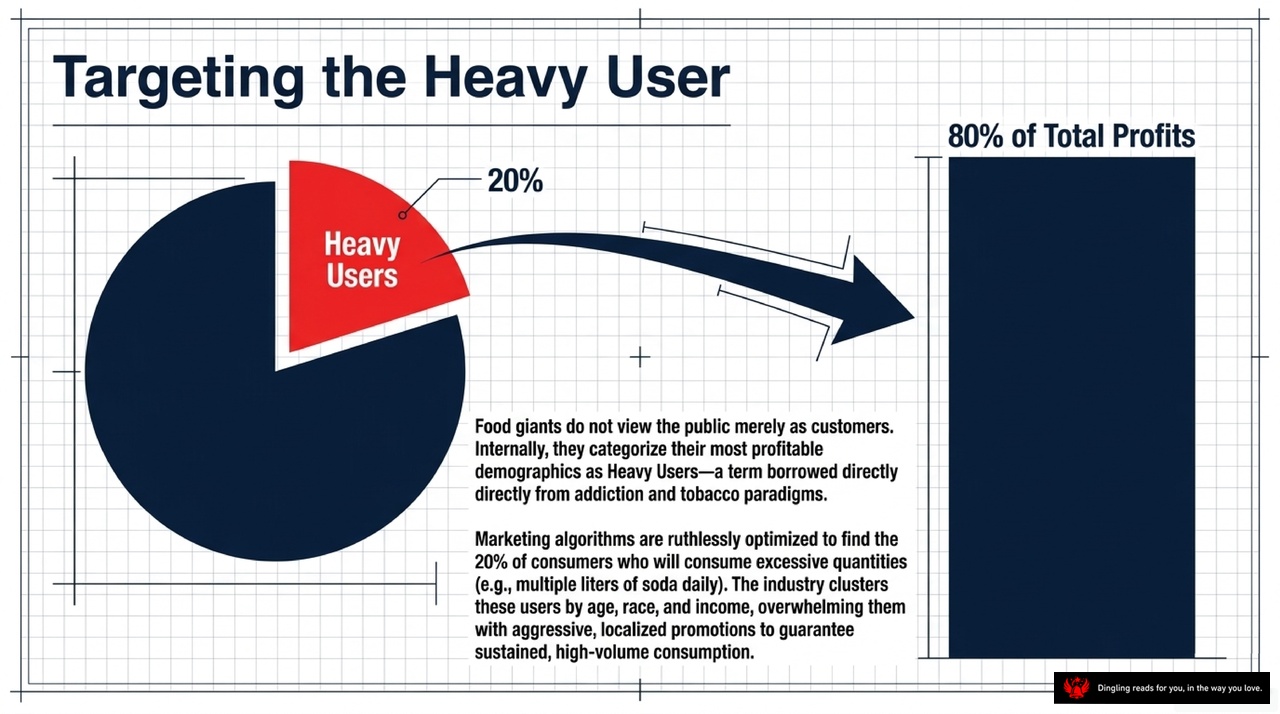
Targeting the Heavy User isn't just a marketing buzzword; it's the absolute core of how food giants operate. Look at the pie chart: a tiny sliver—just 20% of consumers—are labeled "Heavy Users." But that small group generates a massive 80% of total profits. This isn't an accident; it's a ruthless strategy.
Food giants don't see you as a customer; they see you as a data point. Borrowing terminology from addiction and tobacco industries, they categorize demographics to find those 20% of people who will consume excessive quantities every single day. Marketing algorithms are now optimized to identify these specific targets, clustering them by age, race, and income. Once identified, these heavy users are overwhelmed with aggressive, localized promotions designed to guarantee sustained, high-volume consumption.
Think about the soda aisle or the cereal shelf. The industry knows that for a select few, volume is everything. By locking onto these heavy users, companies can maximize revenue with far less effort than trying to convert casual buyers. It's a high-stakes game where the goal isn't just to sell you a product, but to make you a permanent, high-value part of their ecosystem. The 80% profit share belongs entirely to that 20% of us who can't seem to put down the bottle or box.
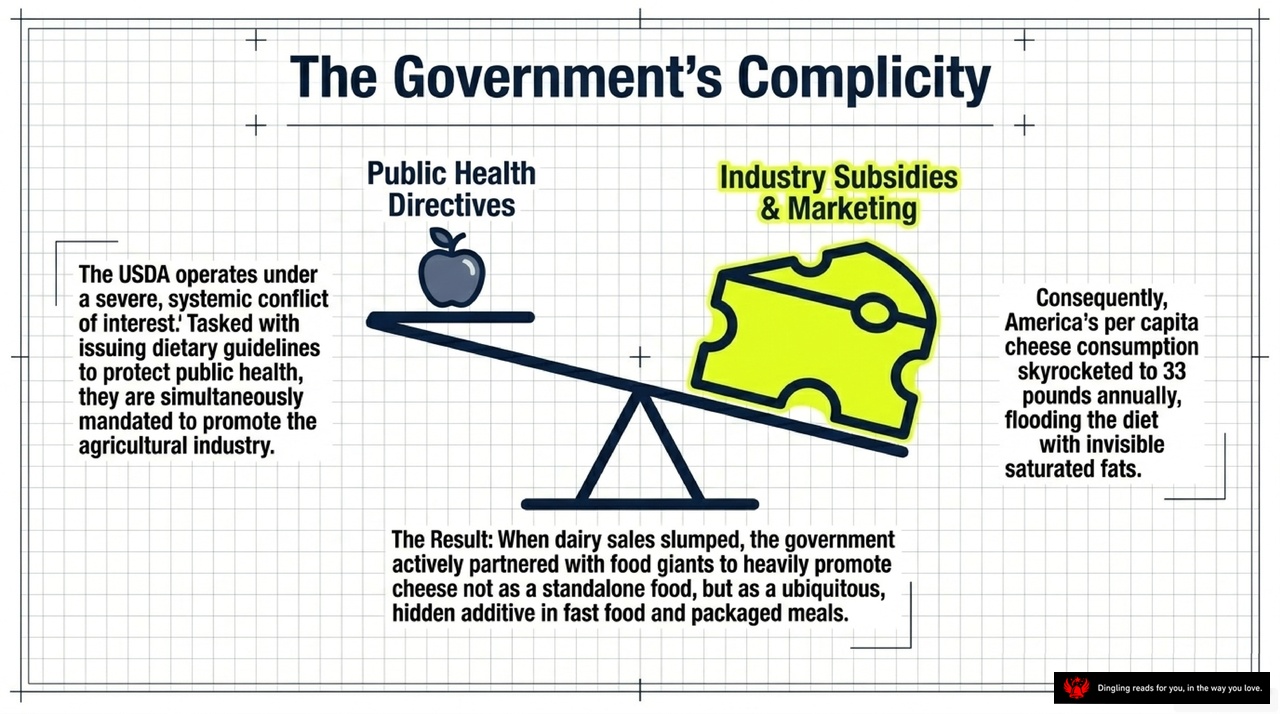
The image on your screen perfectly captures a critical, often overlooked truth about our food system: the government isn't just a neutral referee; it's an active participant in the problem. Look at that seesaw. On one side, you have "Public Health Directives," represented by that single apple, tasked with protecting us. On the other side, you have "Industry Subsidies & Marketing," represented by that massive block of cheese, which is heavily tipped down.
This visual illustrates a severe, systemic conflict of interest within the USDA. While they are mandated to issue dietary guidelines to protect our health, they are simultaneously required to promote the agricultural industry that feeds them. The result is a clear imbalance. When dairy sales began to slump, the government didn't step back to let the market correct itself. Instead, they actively partnered with food giants to heavily promote cheese. But here's the twist: they didn't market it as a standalone food. They promoted it as a ubiquitous, hidden additive in fast food and packaged meals.
This strategy had a direct, measurable impact on our diet. Consequently, America's per capita cheese consumption skyrocketed to 33 pounds annually. We are now flooding our bodies with invisible saturated fats, all while the government tells us we need to be eating healthier. The apple is still there, but the cheese has crushed it. This is the government's complicity: using public health funding to subsidize the very ingredients that are making us sick.
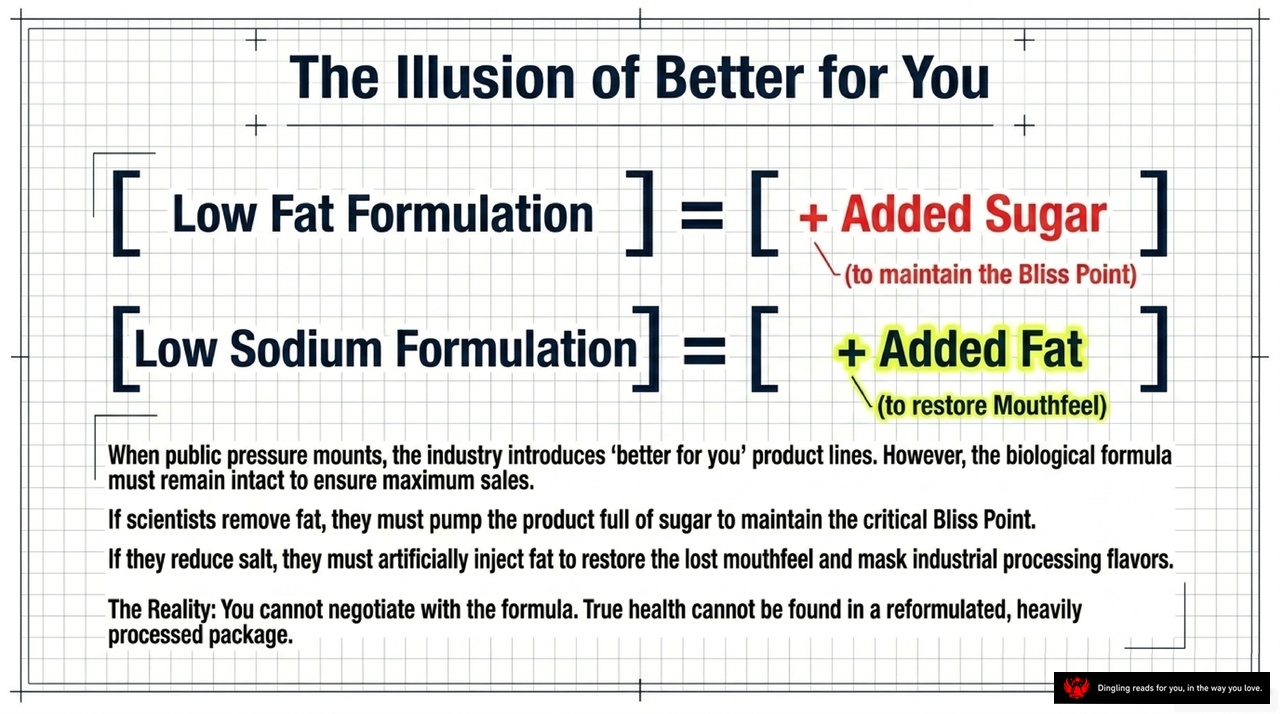
Here is the spoken-word script for Slide 11, tailored for an American audience:
The slide we see right now cuts through the marketing noise to reveal a harsh industrial truth: the "Illusion of Better for You." When the industry feels the heat from public pressure, they don't actually change the biology of their products to make them healthier. Instead, they play a high-stakes game of chemical substitution to keep the sales machine running. Look at the first equation: when they take the fat out, they immediately pump it full of added sugar. Why? To maintain what scientists call the "Bliss Point"—that precise sweet spot where our brains feel maximum pleasure. Without that sugar, the food just tastes flat and unappealing. Then, look at the second equation: when they cut the sodium, they secretly inject added fat. This isn't to make it healthier; it's to restore the mouthfeel and mask the bitter, metallic flavors that come from heavy industrial processing. The reality is that you cannot negotiate with these formulas. If you remove one ingredient, another must take its place to keep the product addictive. True health simply cannot be found in a reformulated, heavily processed package that relies on these hidden swaps to trick our taste buds.
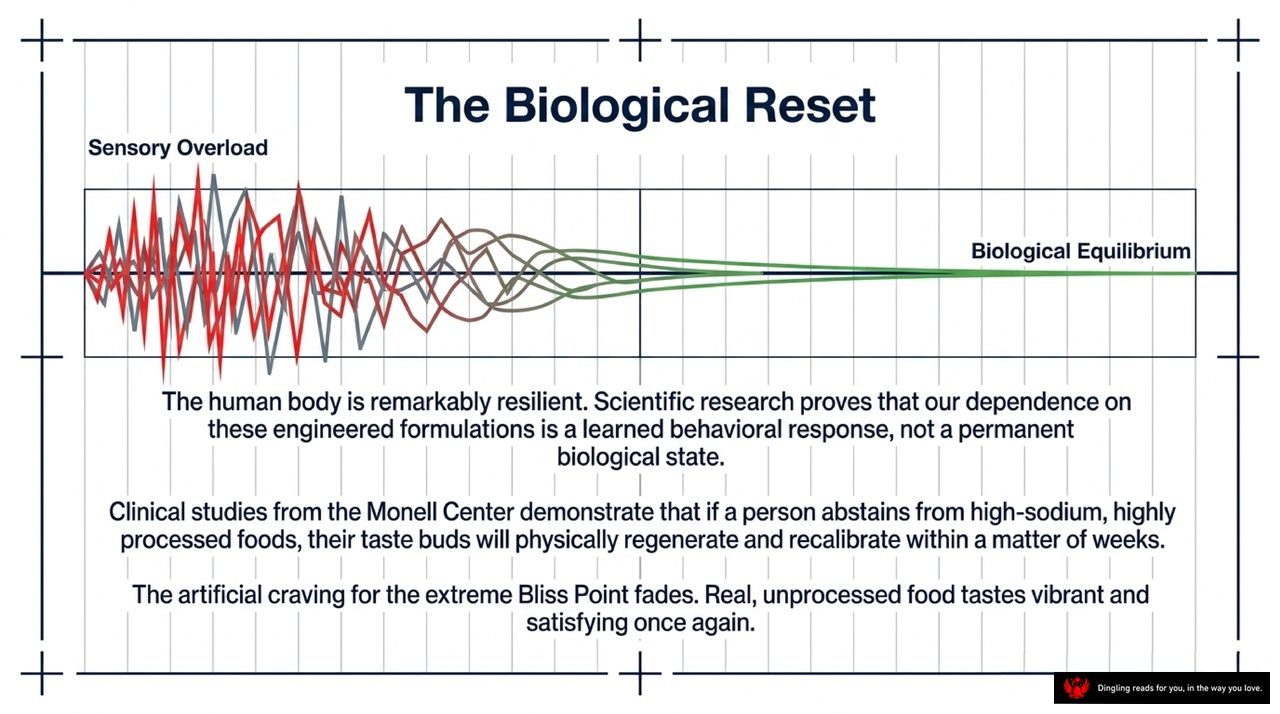
Have you ever wondered why the food you crave today tastes so different from the food your grandparents ate? The answer lies in a concept called "The Biological Reset," which is beautifully illustrated right here on this slide.
Look at the graph. On the far left, you see "Sensory Overload." This chaotic, jagged red line represents our modern reality—a constant bombardment by engineered foods loaded with extreme salt, sugar, and fat. Our bodies are screaming for relief, but we've forgotten how to listen.
But here's the hopeful part: the lines eventually converge into a smooth, green line labeled "Biological Equilibrium." This visual tells us a powerful scientific truth: our dependence on these hyper-processed flavors isn't a permanent biological defect. It's a learned behavior.
Research from the Monell Center proves that if we step away from high-sodium, highly processed foods for just a few weeks, our taste buds physically regenerate. They recalibrate. The artificial craving for that extreme "Bliss Point"—that engineered perfection—fades away. Once that reset happens, real, unprocessed food doesn't just taste edible; it tastes vibrant and deeply satisfying again. Your body is remarkably resilient. It just needs a chance to recalibrate.

Look at this split screen. On the left, we see "The Engineered Trap," a maze where a shopping cart gets lost, representing how the processed food industry turns our grocery store into a battlefield. They weaponize salt, sugar, and fat to hijack our biology and capture our wallets. But on the right, under "Autonomy," there's a clean cart filled with fresh produce like carrots, apples, and broccoli. This represents the moment you reclaim your power.
The text explains that when you refuse to buy their engineered packages, their meticulously crafted formulas, billions in marketing, and precise scientific dossiers lose all their power. It's a stark choice: stay trapped in the maze of convenience and biological vulnerabilities, or step out and choose real food. By rejecting the trap, you aren't just buying different ingredients; you are breaking the industry's hold on your biology and your wallet, turning the tables from a battle they won to a choice you control.
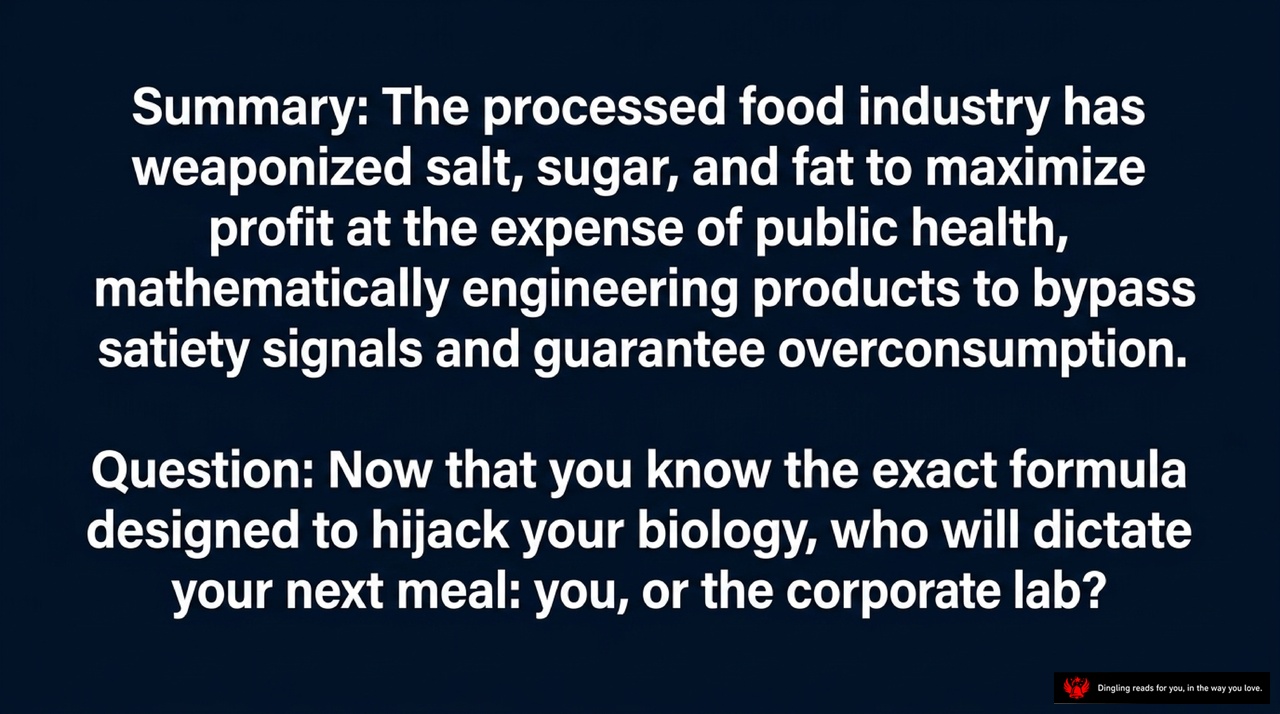
So, here is the final takeaway: the processed food industry didn't just sell us food; they weaponized salt, sugar, and fat to maximize profit, often at the direct expense of our public health. They mathematically engineered these products to bypass our natural satiety signals, guaranteeing overconsumption every single time.
Now that you know the exact formula designed to hijack your biology—how they combine these three elements to create an irresistible "bliss point"—a critical question remains: who will actually dictate your next meal? Will it be you, making conscious choices for your body? Or will it be the corporate lab, continuing to feed you what they know will keep you coming back for more?