
Same as Ever: Complete Chapter-by-Chapter Summary

Hi everyone, welcome. Today we're diving into Same as Ever by Morgan Housel.
Check out that image—a solitary pillar standing steady in the ocean. That image captures the book's core idea. While the world around us is constantly shifting, there are certain truths that remain constant.
We often assume the future is unpredictable, and yes, a single random decision can alter history. But amidst all that chaos, human nature remains constant. Our reactions to fear, greed, and risk stay the same, no matter the era.
This book isn't about predicting the future. It's about finding the constants in a volatile world. We'll look at how history, risk, and happiness follow timeless patterns. So, let's dive in and see what stays the same.

Welcome to this section. Today we are exploring the Core Premise of the Unchanging World. Look at the diagram in front of you. This is the Bezos Principle. It visualizes a very important distinction between what changes and what stays the same.
At the very center of this diagram is the Anchor. This represents human nature. The book explicitly states that no matter how many years pass, the way humans face greed, fear, and risk is always the same. This is the core thesis of the entire argument. It is the bedrock upon which we must build our understanding.
Surrounding this anchor are layers like Technology, Empires, Market Cycles, and Geopolitics. These are the variables that shift constantly. We see concentric circles expanding outward, symbolizing the changing world. But the strategy lies in the center.
Instead of guessing which new technology will dominate, the book advises us to build systems optimized for the immutable human software that will interact with it. Why? Because of the illusion of prediction. People constantly ask what will change in the next 10 years. Almost no one asks what won't change.
This is a critical mistake. We tend to focus on specific events, but the book argues we should predict based on human behavior rather than specific events. Regardless of the years, the way humans face greed, fear, and risk is always the same. Prediction is difficult because we often fail to trace the chain of cause and effect, but the human element is the only reliable anchor.
Look at the box labeled The Static Variables. While medical tech and global dialects transform, human fear, greed, tribalism, and the pursuit of certainty remain perfectly static. This is the foundation of resilience.
So, the lesson is clear. Don't bet on the changing world. Bet on the unchanging human nature. By anchoring your strategy in these static variables, you create stability against the chaos of the changing world. This is the essence of the Bezos Principle.
By understanding that human nature is the constant, you can navigate the shifting tides of technology and empire. It is about focusing on what remains true, rather than what is merely different. This mindset allows you to build for the future without needing to predict the future.
So, remember this: the world changes, but the human response to it remains the same. That is the unchanging world.


Look at this scale. It's tipped heavily to the right. The title says "Stories > Statistics." It's a bold claim, but it's backed by history. On the left, we have "Perfect Data, Logic & Statistics." It looks like a stack of blocks—solid, rigid, but heavy. On the right, "A Compelling Story." It's a glowing sphere. Why? Because stories carry weight.
Let's talk about the first example: "The Masterpiece of Improvisation." Think about Martin Luther King Jr.'s 1963 speech. He had a rigid script written by advisors. But halfway through, Mahalia Jackson yelled, "Tell them about the dream, Martin!" He pushed his notes aside and improvised. That moment created the most famous speech in history. A rigid script would have been boring. The story won.
Then there's "The Delivery of Knowledge." Yuval Noah Harari's *Sapiens* is a massive hit. He admits it has no original research. He just took existing facts and wrapped them in a masterful narrative arc. That's why it sold 28 million copies. The data was there, but the story made it stick.
Here's the kicker: The most correct idea in the world will fail if it cannot be communicated effectively. Good stories make the impossible possible.
Think about it. We live in an age of information overload. We have endless data, charts, and stats. But do we remember them? No. We remember stories. We remember the hero's journey, the underdog, the triumph.
When you present an idea, don't just dump the numbers. Find the human element. Make it relatable. Because as the slide says, good stories make the impossible possible. It's not about being right; it's about being understood.
Even if you have the "perfect data," if you can't connect with the audience, the message gets lost. The scale tips because people need to feel something, not just know something. Stories bridge the gap between the abstract and the personal. They turn cold facts into warm experiences.
So, when you're next time you're presenting, ask yourself: Am I showing data, or am I telling a story? Because the scale tips every time.


Look at this slide. It's titled the "Crazy Genius Trade-Off," and it really captures the essence of what it means to be a true leader or innovator. We tend to separate the good from the bad, but history shows us that they are often inseparable.
Take the Visionary, Elon Musk. On the left, we see the genius. He has the boundless imagination required to fight companies like NASA, Ford, and GM simultaneously to build reusable rockets and mainstream electric vehicles. That is incredible. But look at the "Crazy" side. The exact same trait makes him propose nuking Mars and publicly state that humanity is a computer simulation. It's the same drive pushing him forward that also pushes him off the cliff.
Now look at the Strategist, John Boyd. He was the greatest fighter pilot in history. His Aerial Attack Study revolutionized modern air combat strategy permanently. But the text on the right describes him as "not a normal person." He was notoriously difficult, alienating allies, and operating outside all acceptable norms. His superiors loved his talent but couldn't handle his behavior.
So, what's the takeaway? You cannot cherry-pick traits. The characteristics that generate monumental success are structurally inseparable from the characteristics that cause monumental friction. You must accept the whole package.
Think about your own life. We all want the genius without the crazy. We want the success without the struggle. But this slide reminds us that you can't have one without the other. If you admire the vision, you have to accept the volatility. If you want the breakthrough, you have to accept the friction.
Many of us try to edit people out. We want the talent without the temper. We want the innovation without the chaos. But this slide tells us that's impossible. You cannot cherry-pick traits. The characteristics that generate monumental success are structurally inseparable from the characteristics that cause monumental friction. You must accept the whole package.
As the book puts it, you can't just take the good parts. You have to be willing to make a one-hundred-percent exchange. If you're not willing to accept their downsides, their desires, and their difficult lifestyle, then there's no reason to envy their success. Greatness isn't about perfection; it's about integration. It's about owning the entire spectrum of your potential, even the parts that make you difficult to work with. That's the price of greatness.

We live in an age of data. We believe that if we can measure it, we can manage it. But look at this slide. It shows three gauges: Economic Output, Troop Metrics, and Human Morale. The first two are intact. They look stable. But Human Morale? It's cracked. It's broken. And that tells us everything.
Take the Vietnam War. Secretary of Defense Robert McNamara was obsessed with quantifiable metrics. He tracked daily numbers to prove the US was winning. He tracked everything he could put into a spreadsheet. But he tracked everything except the unmeasurable. He ignored the feelings of the Vietnamese people. You can't put patriotism or fear of losing home into a chart. And that blindness cost us everything.
It's not just war. It's even true in sports. Nobel laureate A.V. Hill thought athletic limits were pure cardiovascular math. He believed it was all about heart rate and muscle function. But he was wrong. He later realized there's a brain governor. It dictates limits based on morale, fear, and motivation. Your body isn't just a machine; it's governed by your mind.
So, what's the takeaway? If you look at the bottom of this slide, there's a rule. It says: If a human element cannot be measured, it is likely the most powerful force in the room. We spend so much time optimizing the things we can count, like money or headcount. But we neglect the things we can't count, like trust, culture, or morale. And ironically, those unmeasurable forces are the ones that actually drive the outcome. Don't let the data blind you to the human element. When numbers don't make sense, it's usually because the most important variable is right in front of you, but invisible.
Think about your own life. How often do you solve problems with a spreadsheet? How often do you ignore the gut feeling of your team? This slide isn't just about history or sports. It's a warning. The most powerful things in the world are often the hardest to measure. If you can't measure it, don't assume it doesn't exist. Assume it's the most critical thing you're missing right now. The invisible forces are the ones that actually move the needle.


Check out this slide, "The Asymmetry of Time." It captures a brutal reality about how creation and destruction operate on completely different timelines.
On the left, you see Phase 1, The Build. Notice how that long, steady upward slope dominates about 90% of the time. This is the hard work. Lehman Brothers took 158 years to build into a global empire. Human evolution required 3.8 billion years of compound selection. Progress relies on compounding thousands of small, unnoticeable wins. It's a slow miracle, built on layers of stability.
Now, look at the right side, Phase 2, The Break. That sharp drop happens in just 10% of the time. A 15-month precipitous drop for Lehman Brothers. Or think about Pearl Harbor and 9/11—those changed the world in a single hour. Destruction requires only a single point of failure. It's a fast disaster.
Why such a massive difference? Because creating progress means you have to overcome resistance, layer by layer. But collapse? You only need one fatal error. Warren Buffett once said building a good reputation takes 20 years, but destroying it takes 5 minutes. It's the same logic. You can't build a strong building in a day, but a sledgehammer can bring it down in minutes.
Also, consider the human element. A human life ends with a single biological failure. One mistake can end a century of work. The text mentions that while we focus on the slow grind of success, we often underestimate how fragile things are. One bad decision, one crisis, and the entire structure crumbles.
Think about the cost. Building requires patience and accumulation. Destruction requires only a glitch. This is why we need to be humble about our success and cautious about our failures.
So, remember this: slow miracles, fast disasters. Don't be fooled by the speed of destruction. It feels sudden, but it's the result of a single failure point. While progress is a marathon of tiny wins, destruction is a sprint triggered by one mistake. That's the asymmetry we have to respect in life and business.


Let's talk about The Power of Incentives. It's a harsh truth: incentives drive behavior, often overriding our better judgment.
Look at the Subprime Crisis in 2005. The slide highlights how pizza delivery drivers suddenly making thousands a day selling subprime mortgages didn't stop to question the macroeconomics. The financial incentive justified the willful ignorance. I recall a similar story from the book. A friend who used to deliver pizzas switched to subprime lending in 2005. One day's income was worth a month of delivery. He knew the business was doomed, but he needed to feed his family. Facing that temptation, it would be incredibly hard for anyone to walk away. This is the first lesson: when incentives are high, honesty often takes a backseat.
But this isn't just about money. It's about the Spectrum of Rationalization.
On the other end of the spectrum, we have The Cult of Heaven's Gate in 1997. Members bought a high-powered telescope to see a UFO trailing a comet. When they couldn't see it, they didn't question their beliefs—they returned the telescope, claiming it was broken. Here, the incentive isn't just cash; it's identity and the need for belonging.
The book reminds us that motives control behavior. When a fundamentally honest person is driven by motives, the world's chaos is often underestimated. If their survival, wealth, or identity depends on believing a lie, they will rationalize it. This explains why even good people can do terrible things when pushed by the right incentives. We often think we're making logical choices, but our hidden motives are steering us. We need to ask ourselves: if we were driven by different motives, would our views change?
The Takeaway is clear: Never underestimate what a fundamentally honest person will rationalize if their survival, wealth, or identity depends on believing a lie.
So, ask yourself: what incentives are driving you right now? Are you ignoring the truth because the cost of admitting it is too high? That's the real power of incentives. We must always question our own motives and understand where our true loyalties lie.

Look at this image. We see a tollbooth in the mountains. It's labeled "The Price of Admission." This metaphor reminds us that success isn't free. There is always a cost.
History reminds us of the Donner Party Disaster in 1846. Seeking to shave a few days off their trek to California, 87 pioneers took an untested shortcut. They thought they were being smart. But that route added a month of brutal desert travel, trapping them in the Sierra Nevada mountains through the winter. Ultimately, it led to infamy and cannibalism. They tried to cut the corner, but they couldn't bypass the toll.
Now, let's look at the modern application. Jerry Seinfeld, the legendary comedian, refuses consulting algorithms to optimize his comedy. He famously said, "If you're efficient, you're doing it the wrong way." Why? Because success demands a price paid in stress, boredom, or pain. You cannot bypass the toll. He knows that if you optimize everything, you lose the human element that makes comedy work.
This connects to the "Myth of the Shortcut." We live in a world that tells us there's a hack for everything. A quick fix for wealth, a shortcut for fitness, a bypass for success. We want the result without the struggle. But the tollbooth metaphor shows us the truth. The price of admission is real. It's not just about money; it's about the effort, the discomfort, and the time you must invest.
Think about your own career. Do you want the quick win? Or do you want sustainable success? The pioneers learned that the easy path leads to a dead end. Seinfeld learned that the hard path leads to greatness. So, when you feel tempted to skip the hard work, remember this image. There is a lock on that gate. You have to pay the price. You have to endure the journey.
In the end, the mountains are always there. The tollbooth is always there. The only way through is to accept the cost. Don't be the pioneers who got trapped. Be the ones who pay the toll and keep moving forward. Because in life, as in business, there is no free ride.

Have you ever wondered why giants eventually fall? Think about companies like Sears or Kodak. They were once the kings of their industries, untouchable and dominant. They had everything: the best stores, the biggest brands, the most loyal customers. But today, they're gone. What happened? It wasn't necessarily a lack of effort. It was a failure to understand a fundamental law of nature: the "Red Queen" Effect.
This concept comes from evolutionary biology. In 1973, a scientist named Leigh Van Valen made a shocking discovery. He found that a species' probability of extinction does not decrease the longer it survives. You do not get safer with age. In fact, the longer you survive, the more vulnerable you become. It's like being a target. The longer you stay on top, the more competitors focus on you.
Van Valen called this the Red Queen Hypothesis, named after a character in Alice in Wonderland. She says, "It takes all the running you can do, to keep in the same place." Imagine you're on a treadmill. You have to run faster and faster just to stay in the same spot. If you slow down, you fall behind.
Now, let's look at the business side. As the text on the screen points out, "Sears was once the untouchable apex predator of retail." It had massive scale and influence. But here's the hard truth: competitive advantages always expire.
Why? Because success breeds complacency. When you're winning, you often stop trying to improve. You become comfortable. And in business, comfort is your biggest enemy. Success turns you into a target. Your competitors are watching you, learning from you, and eventually surpassing you.
The reality is clear: "To survive, you must keep evolving just to survive the baseline." This means you have to keep running. If you stop running, you aren't standing still; you're actually falling behind. The baseline keeps moving. Technology changes, consumer habits change, the world changes. If you don't evolve, you become obsolete.
So, what's the takeaway? Don't get attached to your past success. Embrace the discomfort of change. Whether you're building a business or managing your career, you have to keep evolving just to survive the baseline. If you stop running, you're not safe. You're just waiting to be left behind. Remember, in this game, the only way to stay in the game is to keep moving forward.
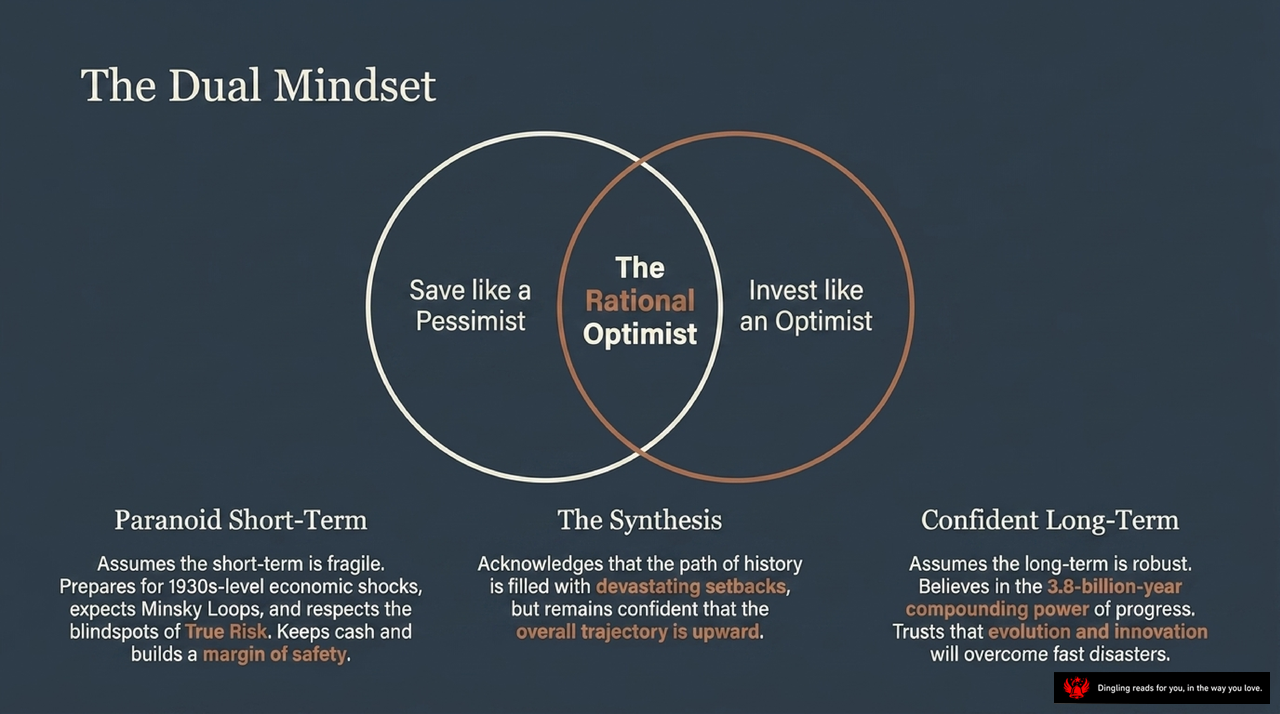
Let's talk about "The Dual Mindset." This Venn diagram shows why you can't just be an optimist or a pessimist. You need to be both, depending on the timeframe.
On the left, we have "Save like a Pessimist." This is the Paranoid Short-Term. We have to assume the short-term is fragile. We prepare for economic shocks, we expect Minsky Loops, and we respect the blindspots of True Risk. We keep cash and build a margin of safety. Why? Because the short-term is unpredictable and dangerous.
On the right, we have "Invest like an Optimist." This is the Confident Long-Term. You assume the long-term is robust. You believe in the 3.8-billion-year compounding power of progress. You trust that evolution and innovation will overcome fast disasters. You bet on the future.
Now, look at the center: The Rational Optimist. This is the synthesis. It acknowledges that the path of history is filled with devastating setbacks, but remains confident that the overall trajectory is upward.
This connects directly to what we discussed about the Stockdale Paradox. You have to dream optimistically, but plan pessimistically. Bill Gates is the perfect example. He was an optimist about the future of computing, yet he was paranoid enough to keep 12 months of cash reserves in the bank. That pessimistic planning allowed his optimistic vision to survive.
As we learned, making progress requires both optimistic and pessimistic mindsets. If you only save, you starve your future. If you only invest, you starve your safety. The Rational Optimist knows that the short-term is messy, but the long-term is powerful. You prepare for the worst, so you can enjoy the best. This balance is the key to navigating a world full of uncertainty. Don't just read the chart, live it. Be paranoid about the short term, but optimistic about the long term.

Let's be honest, the world never stops surprising us. Technology evolves at breakneck speed, empires rise and fall, and the specific details of tomorrow are impossible to pin down. We often think we're predicting the future, but history shows us that the future is just a series of unpredictable variables.
However, here is the constant. While the hardware changes, the software running our world remains untouched by time. It's the human element. We are driven by the same core forces: fear, greed, stories, and incentives. Whether it's 1929 or today, whether it's an empire or a startup, people react to risk and opportunity in fundamentally the same way. No matter how many years pass, the way humans face greed, fear, and risk is always the same.
This is why looking at the past is actually the best way to understand the future. We can't predict the specific event, but we can predict how humans will behave when that event hits. We underestimate the impact of human nature because we think we're more rational than we are. The irony of history is we often know the outcome, but we never truly understand the cause. Think about the 1929 crash or the pandemic. Experts were wrong, but human behavior wasn't. We thought the market would hold, but fear took over. We thought the virus would disappear, but greed drove the response.
So, when you look at your work today, strip away the noise of what might change tomorrow. Ask yourself the hard question: What are you building right now that will still be relevant a hundred years from now? Is it a product, or is it a principle? Is it a trend, or is it a truth about how people actually behave?
If you build based on shifting technology, it will become obsolete. But if you build based on the unchanging human software—understanding what motivates us, what scares us, and what we value—you create something that lasts. The world changes, but we don't. That's the only constant we have to rely on. Remember, the noise of tomorrow doesn't matter if you understand the software of today. We often get distracted by the latest trends, but true longevity comes from aligning with human nature.