
Savage Growth: Complete Chapter-by-Chapter Summary

Welcome to today's session on "Savage Growth" by Feng Lun. This book isn't just a history of Chinese business; it's a raw, unfiltered look at how private enterprises evolved from chaotic beginnings into pillars of society. Think of it as the brutal evolution of a nation's economic backbone, moving from underworld chaos to philosophical greatness.
Feng Lun argues that early private enterprises were born with what he calls "original sin." But he doesn't mean corruption or bribery. Instead, he points to the structural traps of the time: starting with no capital, borrowing from usurious lenders, and being forced to gamble for quick profits just to survive. It was a system designed for risk, not stability. Many companies, like Delong, fell into this trap, betting everything until they collapsed. Others, like Wanda, learned to shrink, cut losses, and survive by admitting defeat early.
The book also tackles the concept of "original sin" in the public eye. While some scholars tried to blame all wealth on past irregularities, Feng Lun champions a "pardon theory." He believes we should forgive the past, focus on the present, and let history settle. True growth comes from evolving the organization itself—moving from a loose "brotherhood" to a professional, rule-based company.
Ultimately, Savage Growth teaches us that survival isn't about avoiding failure, but about having the courage to change, the wisdom to let go, and the discipline to build something that lasts beyond the chaos.

The "Original Sin" of Zero Capital isn't about malice; it's a mathematical trap built into the very foundation of early entrepreneurship. Imagine trying to build a skyscraper without owning the land or the bricks—you have no choice but to borrow at extreme rates, often 25% or higher, just to get started. This creates a deadly debt trap where you are forced into reckless, high-risk gambles just to pay interest and survive. The math demands a 280% gross return just to break even, turning business into a hyper-leveraged game of Russian roulette. One single market fluctuation becomes the tipping point that threatens total collapse. This wasn't a choice; it was the only path available when starting with zero capital and no legal framework. It's the paradox of building capitalism without the capital to sustain it, a cycle that left early entrepreneurs no choice but to gamble everything for a chance to stay alive.

Escaping the "Jianghu" Brotherhood: From Hero Myth to Business Reality
Today, we are looking at a critical turning point for entrepreneurs: the painful but necessary shift from the romantic "Jianghu" brotherhood to the cold, hard logic of professional business. On the left, we see the seductive myth of the Jianghu. It promises freedom, conquest, and a hero's life where loyalty is based on age, past status, or blind faith in "heaven's will." It works for early survival, creating a cult of personality where everyone stays loyal out of emotion. But on the right, we see the brutal reality of modern business. Emotional decision-making paralyzes boardrooms. When everyone has equal voting rights, you get endless gridlock, not progress. And without a framework for failure or civilized separation, a company is trapped until it collapses.
The arrow in the center, "The Merchant's Exit," represents the solution. This is the moment founders stop trying to solve business disputes with brotherhood and start using legal contracts. The turning point for Vantone's founders was realizing that clinging to the brotherhood myth was killing them. They had to abandon the idea that love solves problems and adopt the Western concept of the "Merchant's Exit." By legally breaking up the partnership—selling shares, signing contracts, and letting people leave with dignity—they saved the enterprise. This shift from a non-contractual clan to a professional organization is the only way to survive the long game.

The crushing cost of 'face'—or *guanxi*—is a hidden tax that destroys companies from the inside out. On this slide, we see a stark comparison between two worlds: the "Acquaintance Culture" and the "Stranger Culture."
On the left, under Acquaintance Culture, there's a dangerous illusion: you think a favor is cheap. But the reality is far heavier. It demands endless emotional maintenance and leads to hiring unqualified people simply because you know them. You can't fire them, even if they're incompetent, because you'd lose your face. The result? Internal protocols are destroyed, and efficiency collapses.
On the right, the Stranger Culture offers a different path. Here, the illusion is that paying market rate feels expensive. But the reality is that costs are capped, transparent, and legally binding. When you deal with strangers, you follow the rules, not your feelings. The result is strong institutional discipline.
The scale in the middle tells us the truth: relying too much on acquaintances tips the balance toward chaos. True scale requires the "Stranger Principle." The more a company relies on personal connections, the higher its hidden institutional costs become. To build a lasting enterprise, you must be willing to trade the comfort of 'face' for the clarity of the market.
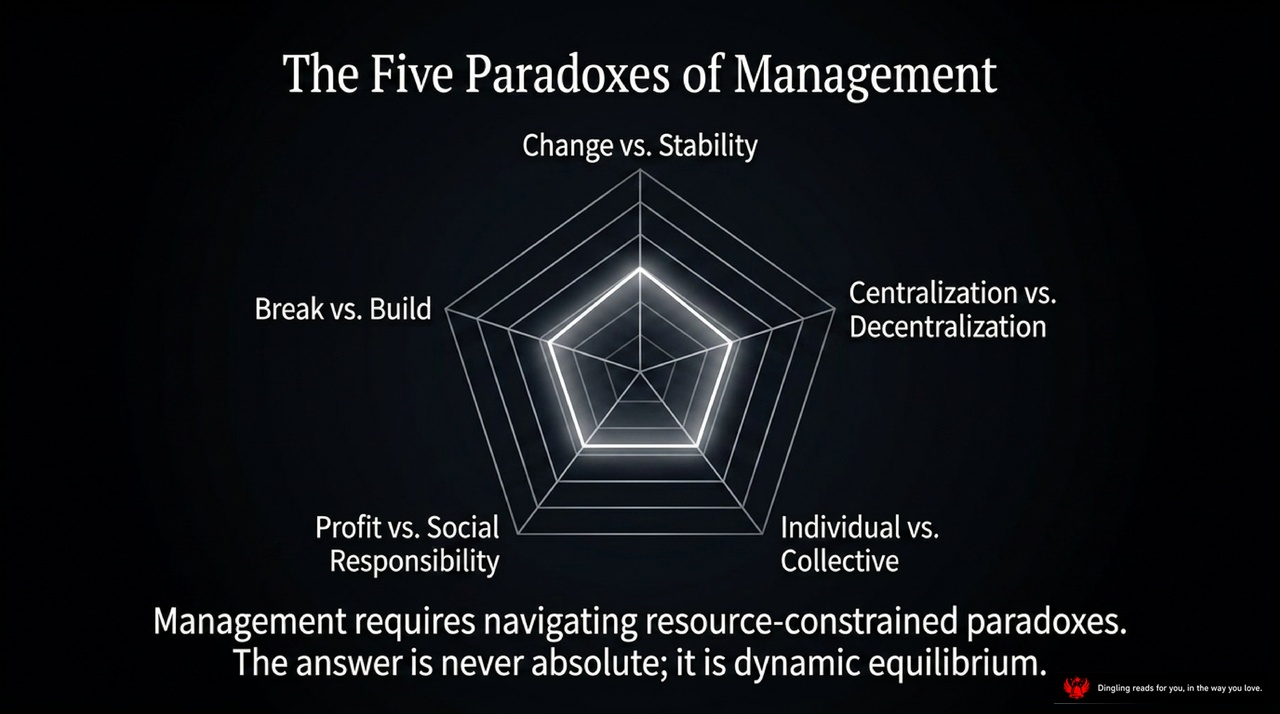
Good morning, everyone. Today, we are diving into the heart of management, and I want to challenge a common assumption: that management is just about controlling people or following scientific rules. In reality, management is the art of making human behavior within an organization move as efficiently as possible to hit a target. Think of a great company like a temple. The customers are the worshippers coming for 1% of the tangible product and 99% of hope; the managers are the monks ringing the wooden fish, delivering that hope; and the founder is the head monk, building the temple and coordinating resources.
But here is the twist: management is defined by paradoxes. You cannot have everything at once. Look at the five tensions we face daily. We are constantly balancing Change versus Stability. When should we innovate, and when do we need the safety of the status quo? It depends entirely on our resource constraints. Then there is Centralization versus Decentralization. Some companies, like Vanke, must decentralize to handle thousands of projects, while others, like ours, chose to centralize to maximize value in specific markets. Both are valid if the performance is good.
We also navigate the tension between Break versus Build. Sometimes, to build a better future, we must break the old structures. We face the conflict between Profit and Social Responsibility. Should we chase maximum returns or focus on our duty to society? And finally, Individual versus Collective. Do we empower the lone genius or rely on the team?
The answer to all these contradictions is never absolute. There is no perfect formula. Management is about finding a dynamic equilibrium. It is the constant art of navigating these resource-constrained paradoxes, adjusting our balance as the world changes around us.

Greatness is Self-Management. Today, we're diving into the core truth that separates the truly great from the merely successful: it all comes down to how you manage yourself.
Look at the slide. It breaks this down into two distinct realms. On the top, we have "Managing Others." This is the easy part. It's about letting your team enjoy comfortable truths and delegating the urgent so they can focus on the important. But here is the hard reality: if you fail to manage your own desires, you instantly forfeit the right to lead.
This brings us to the "Core Insight" right in the middle. You must be willing to suffer the grand ideals so your team can execute daily realities. The truly great leader absorbs the uncomfortable truths—sacrifice, extreme self-discipline, and the pain of falling alone before leading the expedition. They give up immediate gratification for the right to lead the vision.
Contrast this with "Managing Oneself," which is the foundation. While others chase quick wins, the great leader absorbs the great, uncomfortable truths. It's about enduring the falls in silence. As the text suggests, greatness isn't about commanding others; it's about the discipline to wait, to sacrifice, and to stay true to your vision even when it's lonely. If you can't master your own impulses, you cannot lead anyone else. That is the non-negotiable path to greatness.
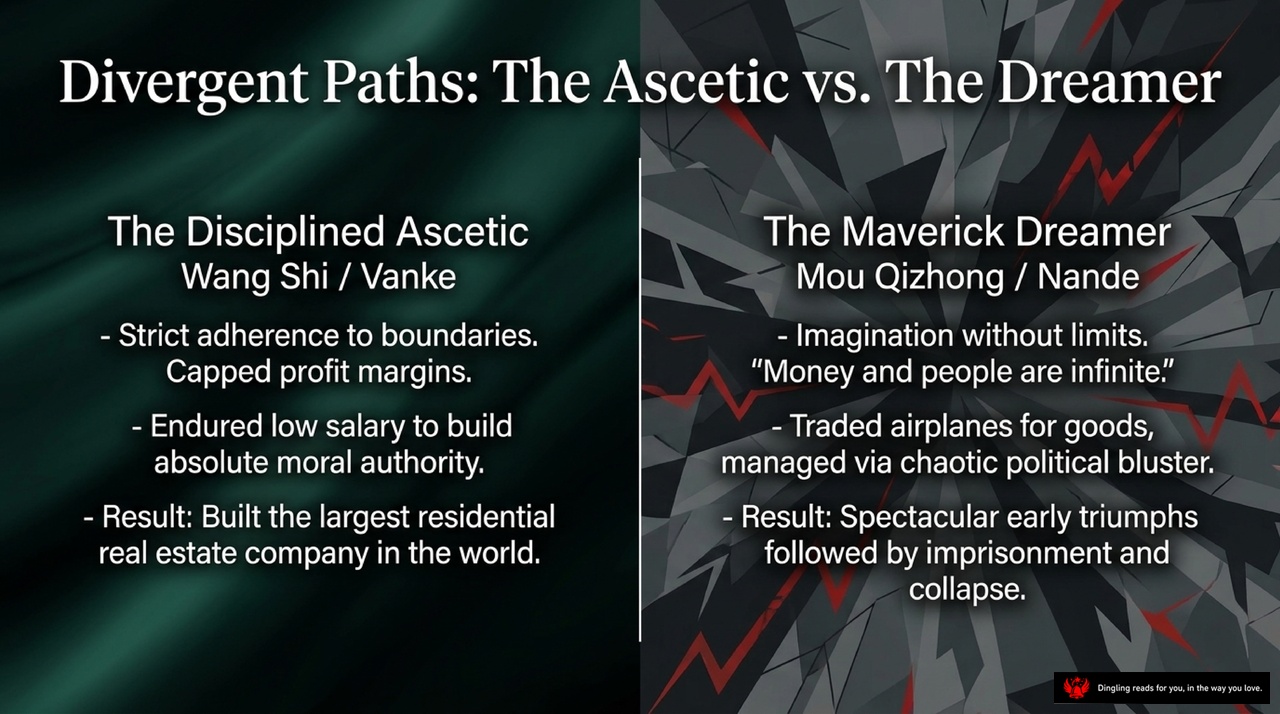
Divergent Paths: The Disciplined Ascetic versus the Maverick Dreamer.
On the left, we see Wang Shi and Vanke, representing the path of the Disciplined Ascetic. He chose strict adherence to boundaries, accepting capped profit margins and even enduring low salaries to build absolute moral authority. This wasn't about being cheap; it was about integrity. The result? Building the world's largest residential real estate company through steady, reliable growth.
On the right, we see Mou Qizhong and Nande, the ultimate Maverick Dreamer. His philosophy was simple yet dangerous: "Money and people are infinite." He operated with imagination without limits, trading airplanes for goods and navigating chaotic political blusters to secure massive early triumphs. But there is a dark side to this path. When the system tightened and the political winds shifted, his lack of boundaries led to imprisonment and total collapse.
The lesson here is clear: you can build an empire on discipline, but you cannot sustain one on chaos. One path leads to legacy; the other leads to the grave.
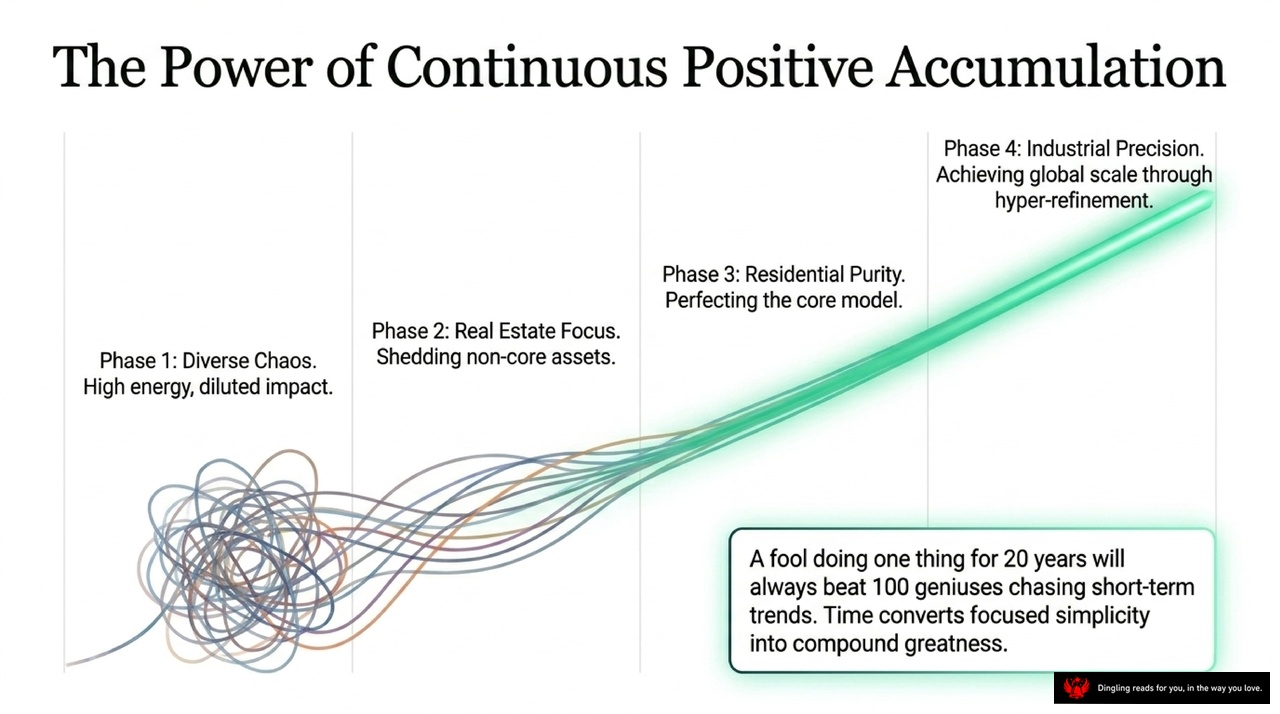
Imagine a tangled mess of colorful threads at the start—Phase 1: Diverse Chaos. High energy, but diluted impact. That's where most entrepreneurs begin, scattered across Beijing, Shanghai, and Changchun, fighting with big phones and conflicting visions. But look at the transformation. As the lines converge, we enter Phase 2: Real Estate Focus. Shedding non-core assets. It's about the courage to say "no" to distractions and say "yes" to one core mission.
Then, the path sharpens into Phase 3: Residential Purity. Perfecting the core model. We stop chasing quick wins and start building a fortress of competence. Finally, we reach Phase 4: Industrial Precision. Achieving global scale through hyper-refinement. This isn't magic; it's the power of continuous positive accumulation.
Remember this profound truth: A fool doing one thing for 20 years will always beat 100 geniuses chasing short-term trends. Time converts focused simplicity into compound greatness. While others are constantly reinventing the wheel, the focused ones are simply compounding their advantage. In a world full of noise, the quiet power of consistency is the ultimate competitive edge.
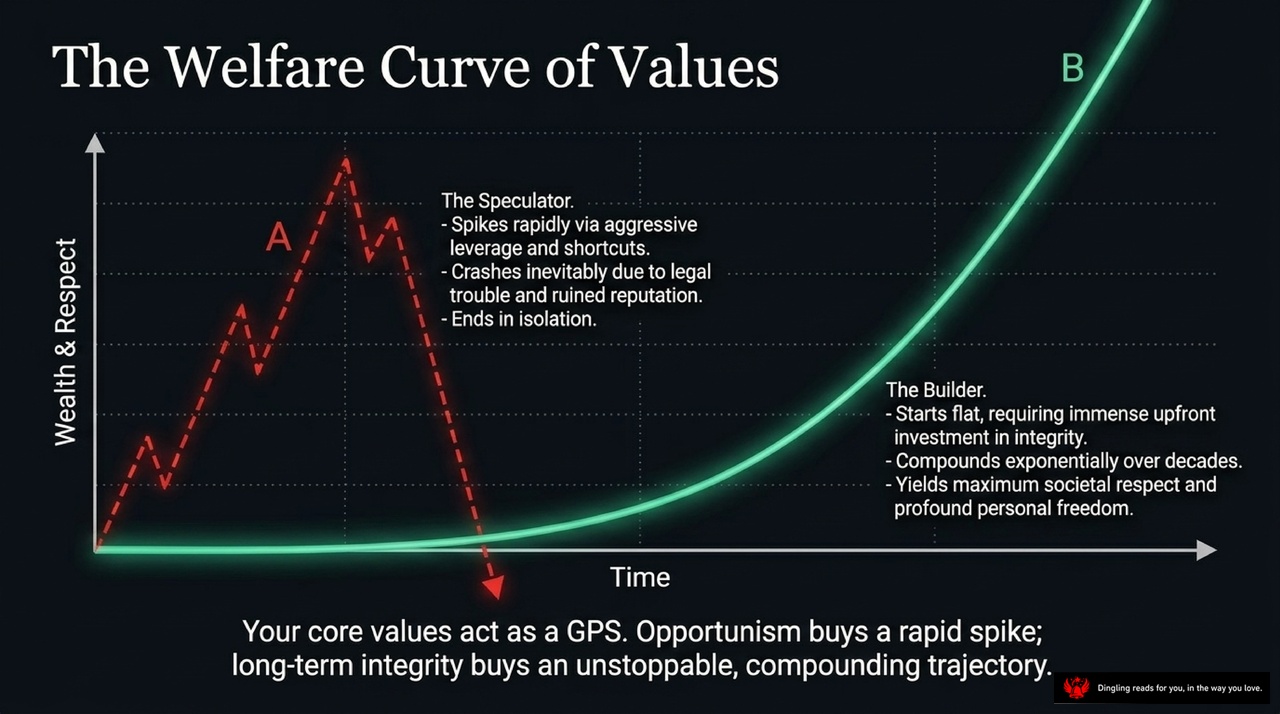
The Welfare Curve of Values isn't just a chart; it's the ultimate truth about how you build your legacy. Look at the red line, labeled A. This is the path of the Speculator. It spikes rapidly through aggressive leverage and shortcuts, promising a quick rush to the top. But inevitably, it crashes. Legal trouble, a ruined reputation, and total isolation are the only destinations. It's a gamble that time always loses.
Now, look at the green line, B. This is the Builder. It starts flat, requiring immense upfront investment in integrity. There are no quick wins here. But over decades, it compounds exponentially. It yields maximum societal respect and profound personal freedom. Your core values act as a GPS. Opportunism buys a rapid spike, but long-term integrity buys an unstoppable, compounding trajectory. In a world full of noise, the only strategy that guarantees survival is the slow, steady climb of doing the right thing, every single day.

Time is the ultimate alchemist, transforming the ordinary into the extraordinary simply by adding the variable of duration. Think about holding a glass of water: for one minute, it's just drinking, worth a few cents. But hold it for ten hours, and it becomes performance art, valued in dollars. Hold it for fifty years, and it transforms into a priceless cultural artifact. This is the power of time.
Greatness isn't a magic trick; it's a function of time. Ordinary actions, sustained with unbreakable patience, are transformed by time into untouchable greatness. Whether you are building a company or crafting your life, the secret to turning a simple act into a legacy is the willingness to endure. Don't just do things; let time do the work for you.

The Equation of Happiness isn't just a philosophical concept; it's a brutal mathematical reality for every entrepreneur. As this slide illustrates, happiness is found only when your **Desires** and your **Capabilities** are perfectly balanced on the scale. When ambition dramatically outpaces your actual capability, the result is catastrophic collapse. We've all seen this play out: desire unbacked by execution leads directly to fraud, anxiety, and eventual downfall.
Look at the image: when the weight of desire is too heavy for the structure of capability to hold, the whole system cracks. The path to balance requires ruthless honesty about what you can actually do. You must either dramatically upgrade your skills to match your grand vision or, more often, actively throttle your desires to match reality. Master your desires, or they will enslave your future. History is full of brilliant minds who failed not because they lacked talent, but because they lacked the discipline to keep their ambitions in check. True success comes from aligning what you want with what you can actually deliver.

Every company, no matter how big or successful, faces an inevitable death. This isn't about a sudden crash, but a slow erosion caused by shifting social trends, economic cycles, or legal crises. When a business fails in silence, leaving behind only debt and resentment, that is what we call a "Wasted Death." But there is a better way.
Imagine a funnel where time and pressure constantly squeeze your enterprise. Instead of letting it crumble into dust, you have a choice. You can transform that failure into something valuable. This is the concept of forging the "Life Diamond." When a failed enterprise is transformed into an honest case study, it stops being a tragedy and becomes wisdom for the next generation.
The highest duty of a dying enterprise is not to hide its mistakes, but to crystallize its failures into a flawless diamond of knowledge. By documenting the lessons learned from the inevitable end, we ensure that the struggles of one generation become the foundation for the success of the next. In this way, even death becomes a creative act, preserving the spirit of entrepreneurship for those who will come after us.
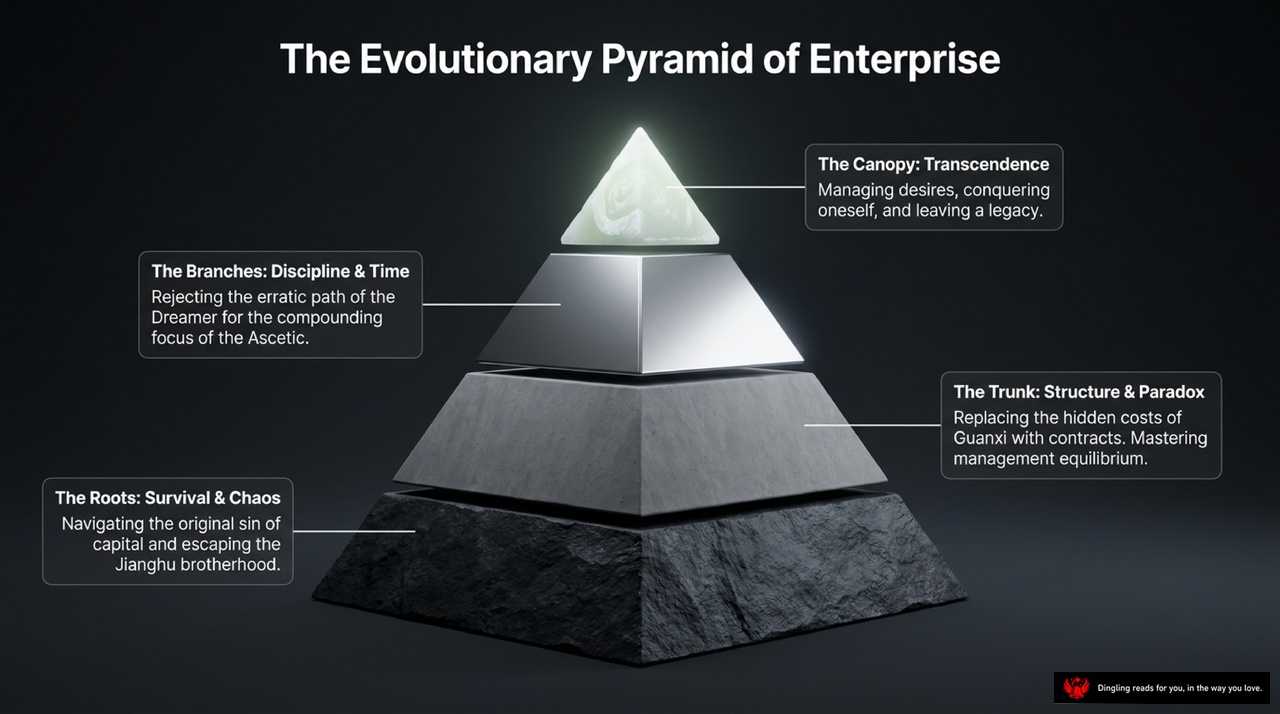
Look at this pyramid, "The Evolutionary Pyramid of Enterprise." It maps the journey of a company from chaotic survival to transcendent legacy.
At the base, we have the Roots: Survival & Chaos. This is where most startups begin—navigating the original sin of capital and escaping the old-school Jianghu brotherhood. It's the messy phase of survival.
Moving up to the Trunk: Structure & Paradox. Here, the company stops relying on hidden costs like Guanxi and starts mastering contracts. It's about replacing chaos with a balanced management system.
Then come the Branches: Discipline & Time. This layer represents the shift from the erratic path of the Dreamer to the compounding focus of the Ascetic. It's about rejecting short-term impulses in favor of long-term consistency.
Finally, at the very top, sits the Canopy: Transcendence. This is the ultimate goal—managing desires, conquering oneself, and leaving a legacy that outlasts the business itself.
This pyramid isn't just a chart; it's the blueprint for evolving from a struggling startup into a timeless institution.
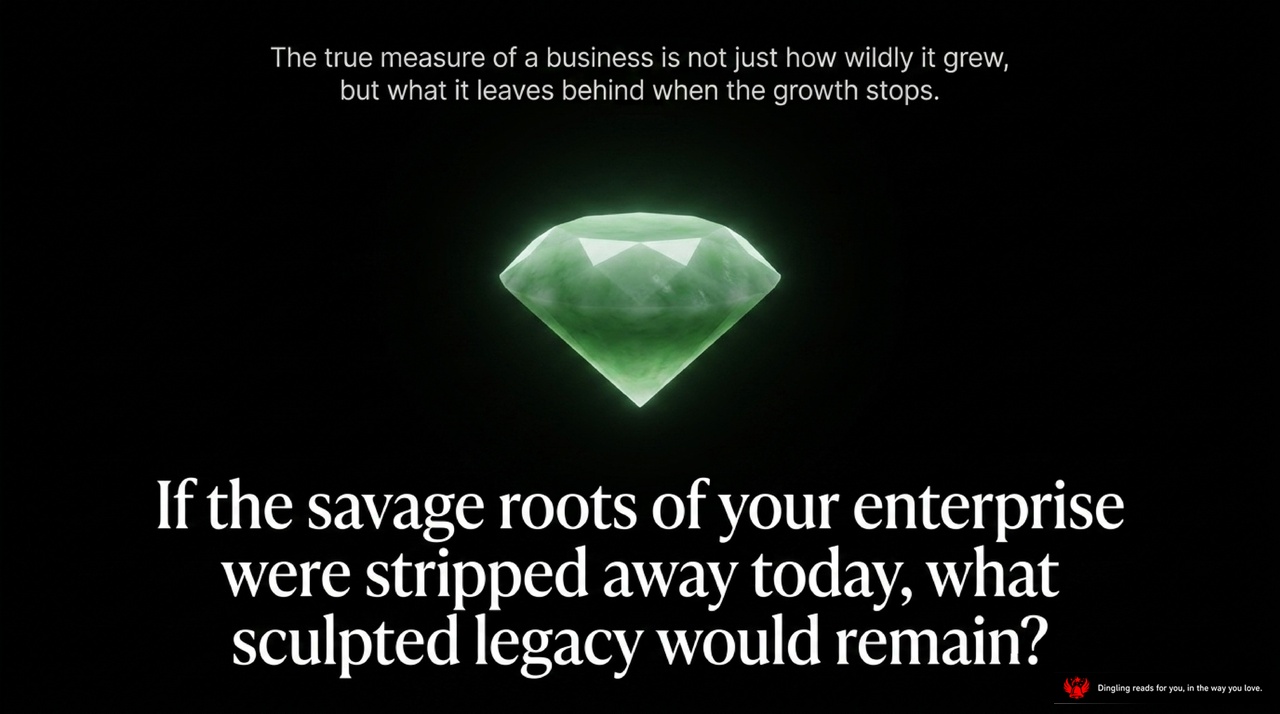
What truly defines a business isn't just how wildly it grew, but what remains when the growth stops. Imagine a glowing green diamond: that's the legacy we leave behind. If you stripped away the "savage roots" of your enterprise today—the risky bets, the early chaos, the desperate struggles—what sculpted legacy would actually remain?
Many entrepreneurs chase the flash of rapid expansion, but true success is measured by the stability of what's left when the fever breaks. It's about transforming that initial, often chaotic energy into something enduring. When the dust settles, do you have a solid foundation, or just a pile of ash? The real test of your enterprise isn't the height you reached, but the value you built that can stand on its own long after you're gone.