
Say Nothing: Complete Chapter-by-Chapter Summary

Welcome to *Say Nothing*, a hauntingly true story by Patrick Radden Keefe about murder, memory, and the ghosts that still haunt Northern Ireland. The image before you sets the tone: a looming, dark apartment complex under a stormy sky, representing the suffocating atmosphere of Belfast in the 1970s. This isn't just a backdrop; it's the prison where ordinary lives were crushed by war. The book opens with the tragic disappearance of Joan McConville, a mother of ten who was kidnapped from her home in this very building. Her children were left behind, terrified and abandoned by a community that turned its back on them. As the story unfolds, we see how the cycle of violence escalated, drawing in figures like the Price sisters, who transformed from students into hardened combatants, and commanders like Brendan Hughes, who fought a desperate war against British forces. But beneath the headlines of bombings and gunfights lies a deeper, more personal tragedy. The conflict wasn't just about politics or religion; it was about families torn apart, secrets buried deep, and the unbearable weight of silence. Through the eyes of Joan's children and the witnesses of history, Keefe reveals how the ghosts of the past refuse to stay dead, continuing to shape the present in ways we are only just beginning to understand.
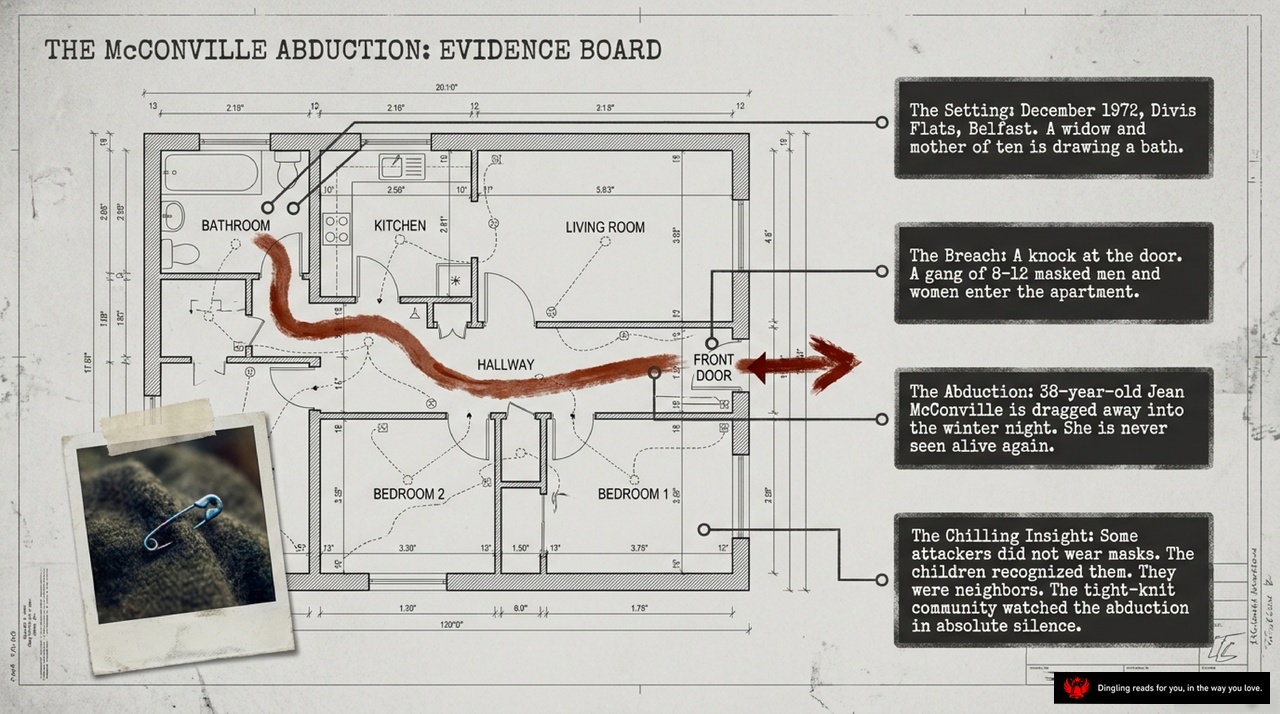
This floor plan tells a chilling story of a perfect crime unfolding on a cold December night in 1972 Belfast. We are looking at the evidence board for the abduction of Jean McConville, a mother of ten living in the Divis Flats. The timeline starts here in the living room and kitchen, where a widow was simply drawing a bath. The breach happened at the front door, where a gang of masked men and women forced their way into the apartment. From there, the path of terror moved through the hallway, leading to the abduction of Jean herself, who was dragged away into the winter night and never seen alive again. But the most disturbing detail isn't just the violence; it's the chilling insight revealed by this layout and the safety pin shown here. Some attackers didn't wear masks. The children recognized them—they were neighbors. This wasn't a raid by strangers; it was a betrayal by the very community that was supposed to protect them, watching the abduction happen in absolute silence.

Welcome back to our deep dive into the Troubles. Today, we're stepping inside the Divis Flats, a place that wasn't just a housing project, but a concrete crucible where a family's life was crushed under the weight of political violence.
Look at this blueprint. On the left, we see "The Utopian Failure." In the late 60s, these 12 interconnected concrete blocks and that 20-story tower were built to solve a housing crisis. But instead of a community, they became a fortress. As the image notes, by the time of the tragedy, it was transformed into an unpolicable stronghold for the Provisional IRA, scarred by British sniper fire and saturated with CS tear gas.
Inside this grim environment, we find the story of Joan McConville. She was a mother of ten, living in what the text calls "The Environment"—a place where over 1,000 children grew up with zero play areas. The kids were forced to treat burnt-out vehicles as playgrounds and internalize war as a daily routine. Joan, a Protestant woman married to a Catholic man, had been ostracized by her own family for her interfaith marriage. She lived in constant fear, yet she was known to have secretly helped an injured British soldier. In this divided society, that act of kindness was twisted into a label of "treason."
This is where the tragedy unfolds. On this specific floor, marked as part of the "Operation Chain," Joan was lured away from her home by masked men. She was told she was just being taken for a talk, but she was never seen again. Her children were left alone, terrified, and abandoned by a community that refused to help them. Joan's story is the ultimate cost of the conflict: a mother erased, and a family broken, all because of the deep-seated hatred that turned a concrete apartment block into a killing ground.

In October 1972, the quiet streets of Belfast were shattered by a coordinated strike on the very heart of British power. It wasn't just an attack; it was a psychological shockwave designed to bring the conflict to London. The IRA, led by Dolours and Marian Price, executed a daring plan to bomb four iconic government buildings: the Army Recruiting Centre, the BBC, Scotland Yard, and the Old Bailey.
The operation was a masterpiece of deception. Using four stolen cars rigged with over a hundred pounds of explosives, the team traveled across the Irish Sea under the cover of a massive traffic strike in London. They parked the vehicles in plain sight, setting timers for late afternoon. But the British police, caught off guard by the chaos of the strike, made a fatal mistake. They rushed to inspect the cars without securing the area, allowing the first bomb to detonate prematurely at the Army Recruiting Centre.
The explosion was catastrophic. The blast wave shattered windows across Whitehall, injuring dozens and killing one man instantly. But the tragedy didn't stop there. The second bomb at the Old Bailey went off shortly after, destroying the historic courthouse and killing a man who had suffered a heart attack from the shock. The third bomb at the BBC caused massive structural damage, and the fourth at Scotland Yard was defused just in time, though the damage was done.
This was no ordinary riot; this was terrorism on the scale the British public had never seen on their own soil. The attacks sent shockwaves through the UK, proving that the conflict in Northern Ireland had spilled over into the British mainland. For Dolours and Marian, the trial that followed would turn them into symbols of the struggle. Charged with conspiracy, they faced the music in a high-security courtroom, where the evidence against them was overwhelming. But their response was not fear—it was defiance. They refused to plead guilty, calling themselves not criminals, but political prisoners fighting for their people's right to self-determination.
When the judge sentenced them to 20 years in prison, the sisters responded with a powerful act of civil disobedience: they began a hunger strike. They refused to eat, demanding to be treated as political prisoners and transferred back to Northern Ireland. Their fast became a global media sensation, with the press dubbing them the "Bomb Girls." Their hunger strike forced the British government to confront the brutal reality of its counter-insurgency tactics, setting the stage for a decades-long struggle for recognition and justice that would echo far beyond the prison walls.
In the shadow of a prison cell, a man named Brendan Hughes played a dangerous game of hide-and-seek. After escaping from Long Kesh in a mattress hidden inside a garbage truck, he reinvented himself as a toy salesman named Arthur MacAllister. With a shaved beard and a new identity, he walked right past the eyes of the British military, even taunting them by claiming he was right under their noses during Easter celebrations.
But the cat-and-mouse game had an end. When police raided his home, they found not just weapons and tapes, but a chilling "doomsday plan"—a blueprint for a full-scale sectarian war. Hughes refused a million-pound bribe to become an informant, declaring that even fifty million couldn't buy his silence.
Yet, while Hughes fought the war from the outside, another battle raged inside the prison walls. The Price sisters, Dohrta and Marian, had begun a brutal hunger strike to demand they be treated as political prisoners rather than common criminals. The British government responded with force, forcing them to eat through tubes while they were tied to chairs. They called it torture; they called it a weapon. For over 200 days, the sisters refused to break, their bodies wasting away while their spirits remained unbroken.
The strike eventually ended only after a young prisoner died, forcing the government to concede. But the cost was high. The sisters emerged physically broken, forever marked by the struggle. Their story, along with Hughes's final confession, would later reveal a dark truth: that behind the political rhetoric and the peace talks, ordinary people like Joan McConville had been sacrificed on the altar of a war that no one truly wanted to end.

Look at this graphic. It lays out the chilling, four-step playbook the IRA used to make people disappear. It starts with **Extraction**: smuggling the target across the border to evade British jurisdiction. Then comes **Shared Guilt Execution**: assembling three shooters, passing the weapon, and firing sequentially so no single person can be held responsible for the fatal bullet. Next is **Concealment**: burying the body in secret, often in isolated peat bogs where decomposition halts, effectively erasing the victim from existence. And finally, **The Cruelty of the Disappeared**: by denying families a body, the IRA creates a permanent state of purgatory, ensuring victims remain paralyzed by hope and terror. This wasn't just murder; it was a calculated strategy to instill fear and destroy the social fabric of the community.

The slide we see now isn't just a timeline; it's a haunting portrait of three distinct fates woven from the same tragic thread. On the left, we have "The Victim," Jean McConville. Her role? A civilian, a widow, a mother of ten. Her motivation was simple survival in a warzone, yet her fate was to be executed and erased from history, leaving her children orphaned and institutionalized.
In the center stands "The Zealot," Dolours Price. An elite IRA operative and hunger striker. Her drive was absolute ideological purity, believing in blood sacrifice for a united Ireland. But her fate was far from heroic; broken by PTSD and disillusioned by the peace treaty, she eventually confessed to the archives before her death, carrying the weight of her past.
And on the right, "The Politician," Gerry Adams. An alleged IRA Commander and Sinn Féin President. His motivation was strategic power and political legitimacy, aiming for an end to the war. His fate? Achieving global statesmanship, all while relying on an astonishing, lifelong denial of ever having been in the IRA.
These three profiles capture the brutal irony of the conflict: the innocent destroyed, the radical consumed by their own cause, and the leader who survived by rewriting the very history he helped create.

Look at this image of a heavy, rusted vault door opening just a crack. Inside, instead of gold or jewels, we see rows of cassette tapes. This visual perfectly captures the central tension of our story: the desperate need to record history when the very people who lived it are sworn to silence.
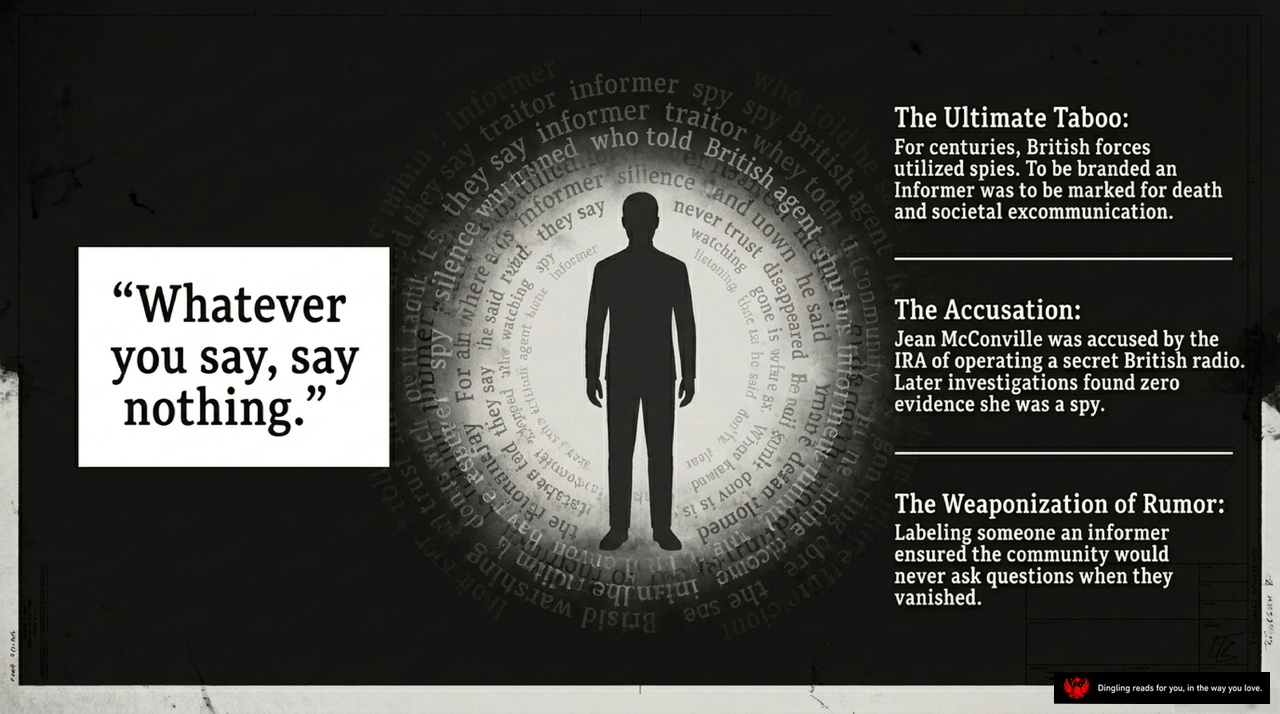
The slide highlights a profound historical dilemma. How do you document the brutal reality of a guerrilla war when the actors are not just afraid, but legally liable for prosecution? In 1972, in the cold, damp streets of Belfast, ordinary people like Joan McCannville were caught in this trap. She was a mother of ten, a woman who had simply tried to help an injured soldier, yet she was labeled a traitor and dragged away into the night. For her family, and for thousands of others, the truth was erased, buried under layers of fear and propaganda.
To break this silence, Boston College launched the Belfast Project in 2001. They created a secret oral history initiative, inviting former paramilitaries to record their crimes. But there was a catch, what we call "The Ironclad Deal." The absolute condition for participation was a guarantee of posthumous release. No tape would ever be heard until the speaker died. It was a sealed time capsule, a way to preserve the truth without endangering the living.
This mechanism allowed figures like Dolours Price and Brendan Hughes to finally speak. They confessed to kidnapping Joan, to the violence they ordered, and to the internal betrayals that fueled the conflict. These recordings, hidden away for decades, eventually became the key evidence that exposed the lies told for thirty years. They forced a confrontation with a dark past, proving that while the vault was sealed, the truth inside was finally beginning to shine its light.
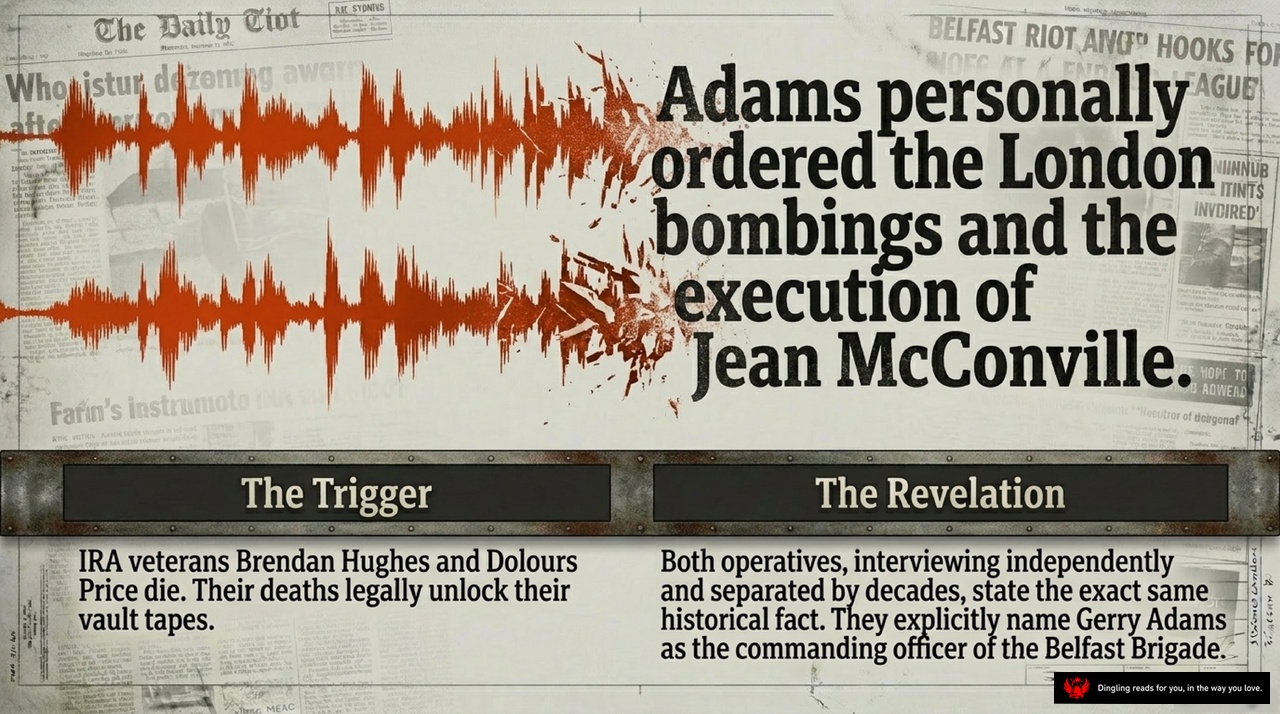
Imagine the shocking headline from 2005: Gerry Adams, the architect of the peace process, personally ordered the London bombings and the execution of Jean McConville. This slide breaks down how that terrifying truth finally came to light, moving from a hidden trigger to a devastating revelation.
On the left, we see "The Trigger." It all started when IRA veterans Brendan Hughes and Dolours Price died. Their deaths legally unlocked their secret vault tapes—audio recordings that had been sealed away for decades. These tapes contained the unfiltered, raw truth of what really happened inside the organization.
On the right, we see "The Revelation." Two operatives, interviewing independently and separated by decades, stated the exact same historical fact. They explicitly named Gerry Adams as the commanding officer of the Belfast Brigade, directly linking him to the kidnapping and murder of Jean McConville and the car bombs that struck London.
This slide represents the moment the veil was lifted. It shows how the silence of the past was finally broken by the courage of the survivors, forcing the world to confront the darkest chapters of the conflict.

On this slide, we see the two sides of Gerry Adams: The Commander and The Peacemaker. This image captures the central paradox of his life. On the left, he is depicted as the tactical mastermind who directed urban guerrilla warfare and authorized the Disappeared, revered by soldiers who bled for his orders. On the right, he transforms into a statesman who led Sinn Féin into the political mainstream and secured the 1998 Good Friday Agreement.
This duality defines his political survival. As the text at the bottom explains, Adams' legacy relied on a lifelong lie. By denying he was ever in the IRA, he abandoned the soldiers who carried out his orders, trading their shared history for political capital. This disconnect between the man who ordered the violence and the man who negotiated peace remains the unresolved tension at the heart of Northern Ireland's story.
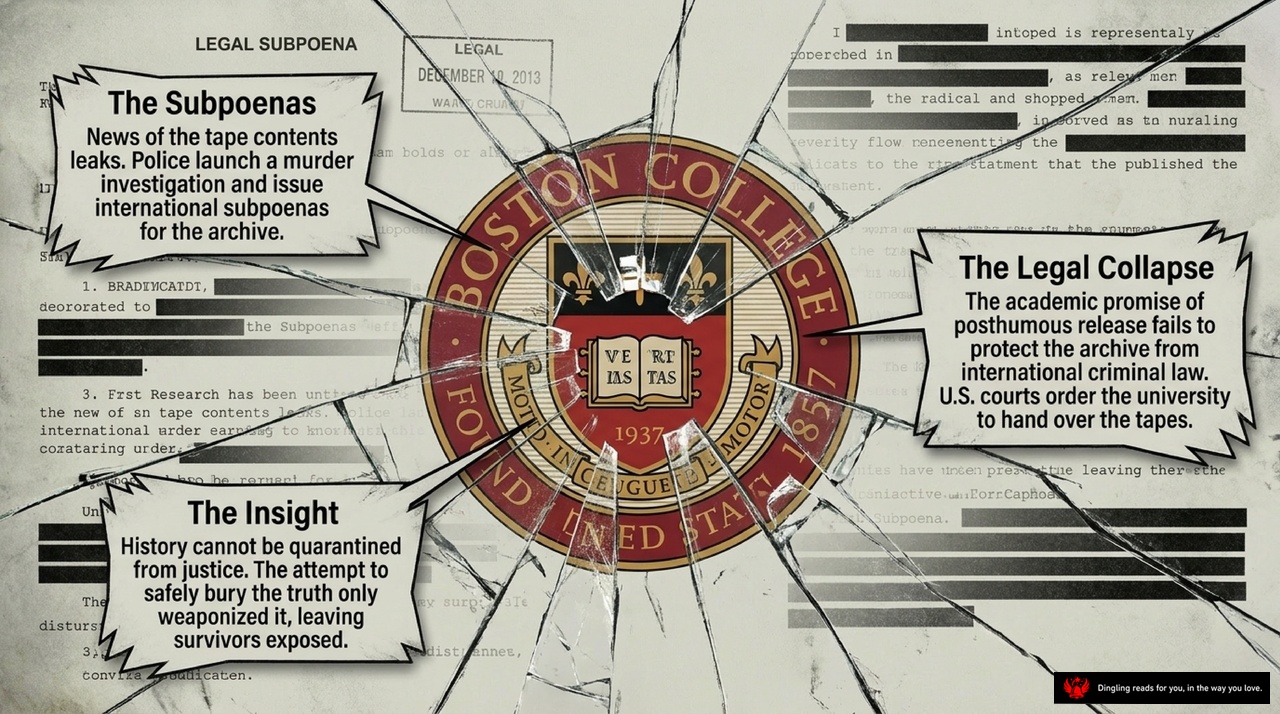
The image captures a pivotal moment in the story: the shattering of legal and academic privilege. At the center, the Boston College seal is cracked like glass, symbolizing how the university's attempt to protect these tapes failed. On the left, we see "The Subpoenas"—the moment news leaked, police launched a murder investigation, and international orders were issued to seize the archive. On the right, "The Legal Collapse" describes how the promise of posthumous release couldn't shield the tapes from international criminal law; U.S. courts ultimately forced the university to hand them over.
This breakdown leads us to the core insight at the bottom: "History cannot be quarantined from justice." The text reminds us that trying to safely bury the truth doesn't protect anyone; it only weaponizes it, leaving survivors like Joan McConville's children exposed. When the Boston College tapes were finally released, they confirmed what the families had suspected for decades: Gerry Adams ordered Joan's kidnapping and murder. The legal system tried to delay the truth, but history, like the glass in this image, eventually shattered. No amount of academic secrecy or political maneuvering could stop the truth from coming to light.

Look at this timeline. It maps the heartbreaking journey of Jean McConville, from her disappearance in 1972 to the discovery of her remains decades later. In 1972, she vanished in Belfast, a victim of the IRA. By 1999, under pressure, the IRA finally admitted to killing her and provided a map to a beach, but sadly, the initial dig yielded nothing. It wasn't until 2003 that a civilian walking a dog accidentally stumbled upon human remains protruding from an eroded embankment. Forensic analysis confirmed it was Jean, with a single gunshot wound to the back of her head. This discovery is just the beginning of a legacy defined by resilience. For 16 officially recognized disappeared individuals, their families spent decades fighting not just for answers, but to reclaim the dignity of a proper burial. Jean's story is a powerful reminder of the human cost of conflict and the enduring fight for truth.
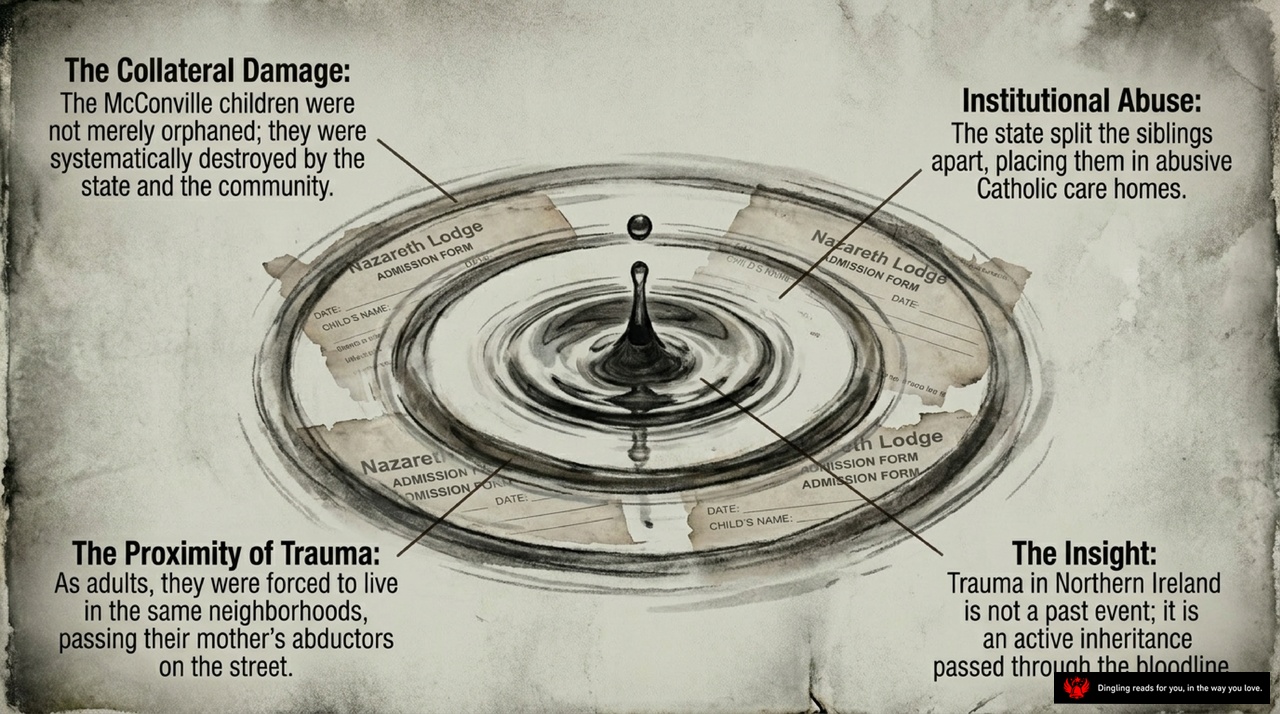
Look at this ripple effect. It's not just about what happened in 1972; it's about how that trauma spread outward, touching every part of their lives. The image shows four critical layers of this pain.
First, we see "Institutional Abuse." The state didn't just lose the mother; it actively tore the family apart, splitting the siblings and placing them in abusive Catholic care homes. This wasn't an accident; it was a systematic destruction by the state and the community.
Then, look at "The Proximity of Trauma." As adults, they were forced to live in the same neighborhoods, passing their mother's abductors on the street. They couldn't escape the very people who took her away.
This is "The Collateral Damage." The McConville children were never just orphans; they were systematically destroyed. They grew up surrounded by silence, suspicion, and the cold indifference of a community that refused to help.
But there is a crucial "Insight" here. Trauma in Northern Ireland is not a past event; it is an active inheritance passed through the bloodline. The pain of that lost mother, the fear of the neighbors, and the betrayal by the system didn't disappear with time. It became part of who they are, a legacy that echoes long after the conflict officially ended.
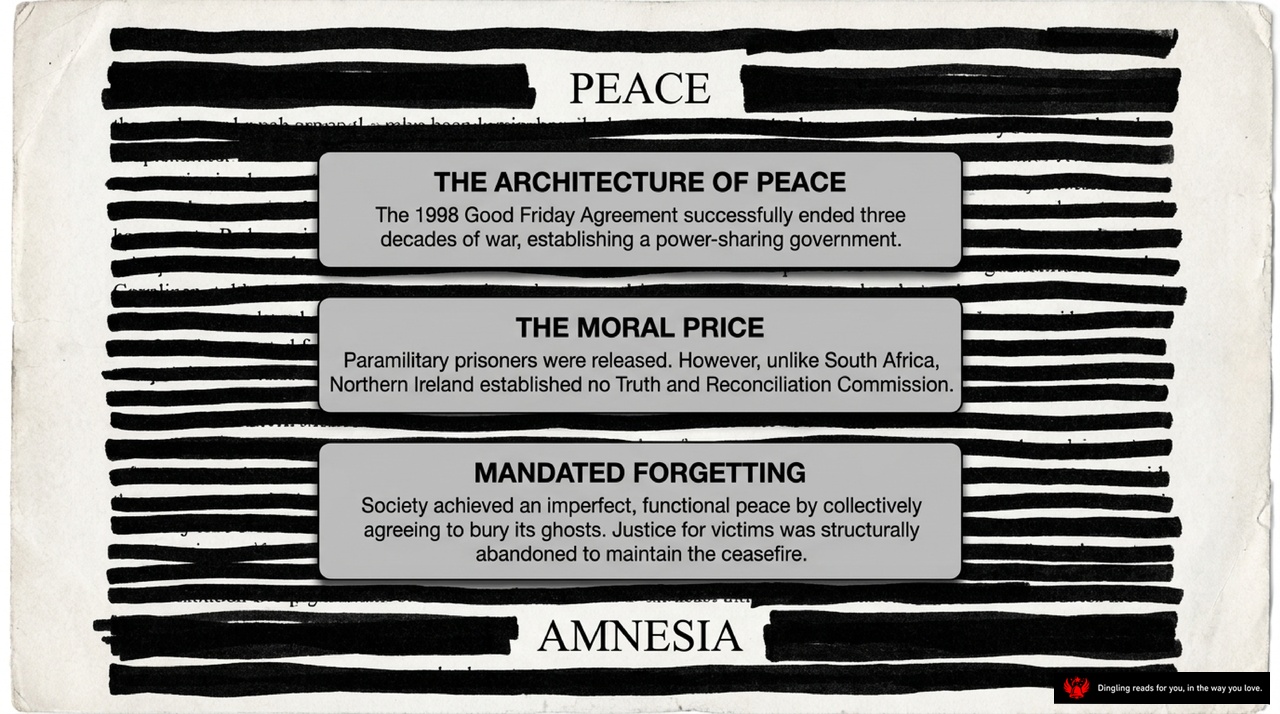
Peace isn't just the absence of war; it is a complex structure built on choices, often painful ones. As we look at the architecture of peace in Northern Ireland, the 1998 Good Friday Agreement stands as a monumental achievement, successfully ending three decades of conflict by establishing a power-sharing government. But this peace came with a heavy moral price. Unlike South Africa, which created a Truth and Reconciliation Commission to heal wounds through truth, Northern Ireland chose a different path. Paramilitary prisoners were released, but the state established no mechanism for justice or truth-telling.
This decision led to a phenomenon we call mandated forgetting. To maintain the fragile ceasefire, society collectively agreed to bury its ghosts. Justice for the victims was structurally abandoned. The result was an imperfect, functional peace, but one built on amnesia. While the guns fell silent, the unresolved pain of those who disappeared or were killed remained, creating a legacy where the past was officially silenced to allow the future to begin.
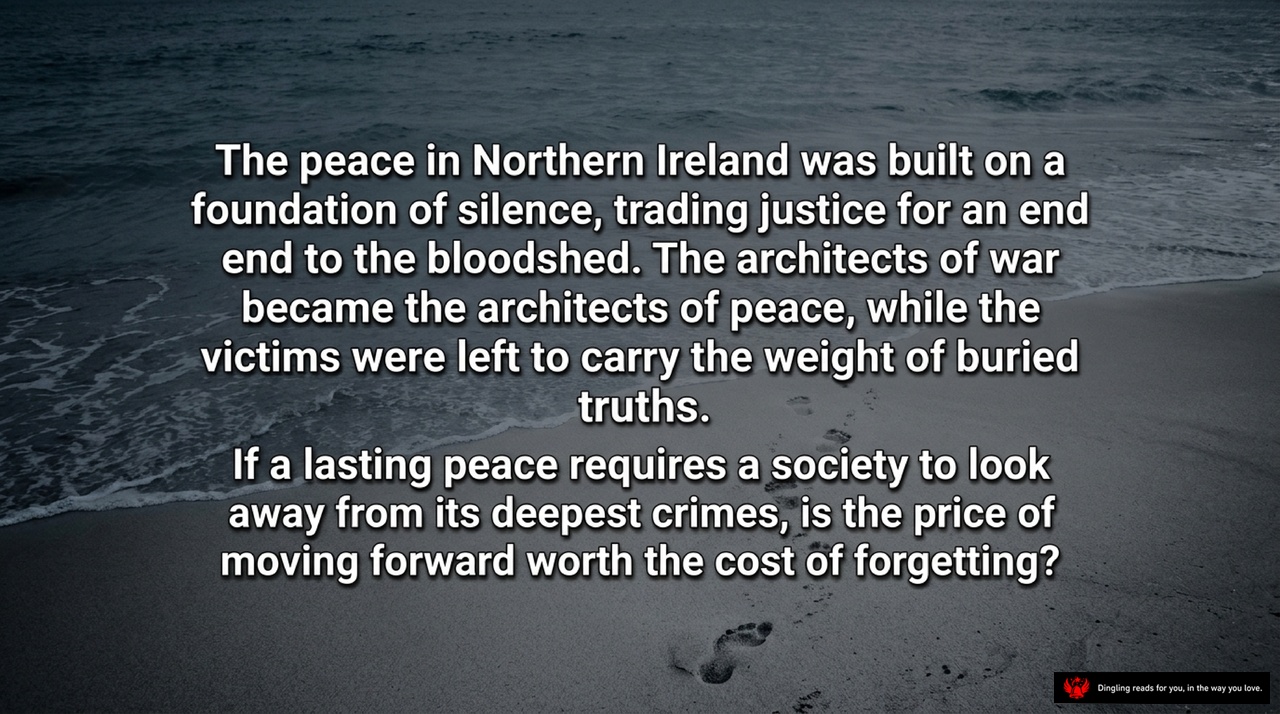
The peace in Northern Ireland was built on a foundation of silence, trading justice for an end to the bloodshed. The architects of war became the architects of peace, while the victims were left to carry the weight of buried truths. If a lasting peace requires a society to look away from its deepest crimes, is the price of moving forward worth the cost of forgetting?