
Scale: Complete Chapter-by-Chapter Summary

Welcome to *Scale*, the book that reveals the hidden mathematics behind everything that grows. Today, we're stepping into a world where a leaf and a metropolis share the same DNA.
Look at this image: on the left, a delicate blue leaf; on the right, a vibrant purple city grid. They aren't just visual metaphors—they are the same system. Both follow universal laws of growth, innovation, sustainability, and the pace of life. Whether it's a cell dividing or a skyline rising, the rules are identical.
We live in an era of exponential expansion. Just as biological organisms evolve from simple to complex, cities are transforming from small towns into global hubs. But here's the twist: while a living body has a hard limit on its size and lifespan, a city never stops growing. It doesn't age and die; it evolves and expands.
This book is your guide to understanding why. We'll explore how scaling up changes everything—why doubling a city's population doesn't just double its resources, but actually boosts innovation and wages by 15%. We'll uncover the secrets of why some systems thrive while others collapse, and how the same math that governs a mouse's heartbeat can predict the future of a megacity.
Get ready to see the world through a new lens. Because once you understand these laws of scale, you'll realize that the future isn't just something that happens to us—it's something we can actually predict and shape.

Welcome to the most counterintuitive truth about our world: life and cities follow completely opposite rules. Look at the left side of this slide. That broken column and the fading leaf represent organisms and companies. They share a strict, biological destiny. No matter how powerful a corporation gets, it inevitably ages, stagnates, and dies. Growth slows, and death is an absolute mathematical certainty. Even the mightiest giants rarely survive past a few decades.
Now, look at the right side. That intricate, expanding city map tells a different story. Cities are fundamentally different. They do not age; they accelerate. While a biological body hits a hard ceiling on its size and lifespan, a city can survive economic collapse, natural disasters, and even atomic bombs. As a city grows, it doesn't get weaker or slower. Instead, it becomes more resilient, more innovative, and more complex. This paradox—that life decays while cities expand—is the core mystery we are about to solve. Understanding this difference isn't just academic; it's the key to unlocking the future of human civilization and finding a path to true sustainability.

Have you ever wondered why a city feels so different from a single animal, yet they both follow the same hidden mathematical rules? Look at these four charts. They reveal a rigid, quantifiable order beneath the chaos of life and history.
On the left, we see biology and urban life. Chart 1 shows that as an animal's mass grows, its metabolic rate increases, but not quite as fast—this is a sub-linear relationship. Chart 3 takes this idea to the city: as a city's population grows, patent production rises even faster. This is super-linear scaling, meaning bigger cities are disproportionately more innovative.
On the right, we see the other side of the equation. Chart 2 reveals a fascinating biological constant: regardless of size, from a mouse to an elephant, every animal has roughly the same total number of heartbeats in its lifetime. It's a universal limit. Chart 4 mirrors this in the corporate world. As a company grows, its net income scales up, but eventually, it hits a ceiling similar to the biological limit.
The message is clear: beneath the overwhelming complexity of life, random evolution, and unique geography lies a strict mathematical truth. Everything scales. Whether it's the energy of a cell, the patents of a metropolis, or the lifespan of a corporation, these systems all obey the same laws of scaling. Understanding this hidden order is the key to predicting the future and designing a sustainable world.
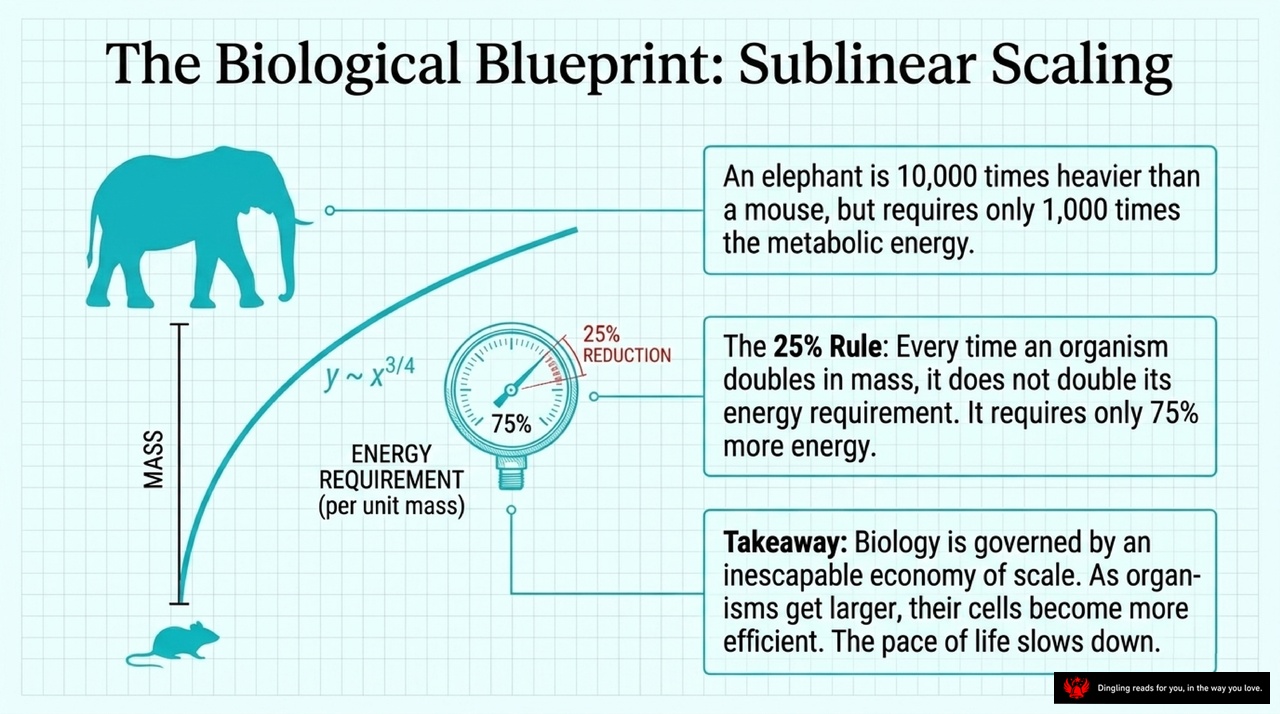
Imagine you are an elephant, weighing 10,000 times more than a tiny mouse. Intuitively, you might expect your body to burn 10,000 times more energy just to keep going. But biology tells a completely different story. As shown in this slide, an elephant actually requires only 1,000 times the metabolic energy of that mouse. This counterintuitive reality is governed by what we call sublinear scaling.
Look at the "25% Rule" highlighted here. Every time an organism doubles in mass, it does not double its energy requirement; instead, it only needs 75% more energy. That 25% reduction is the key to life's efficiency. As organisms get larger, their cells become incredibly efficient, allowing them to slow down their internal clock. This is why elephants live longer and move slower than mice—their biology is simply optimized for scale.
The takeaway is profound: life is governed by an inescapable economy of scale. Unlike our linear expectations, nature operates on a curve where bigger doesn't mean proportionally more intense. Instead, it means smarter, more efficient, and slower. Understanding this blueprint is the first step to grasping how complex systems, from our own bodies to the cities we build, truly function.
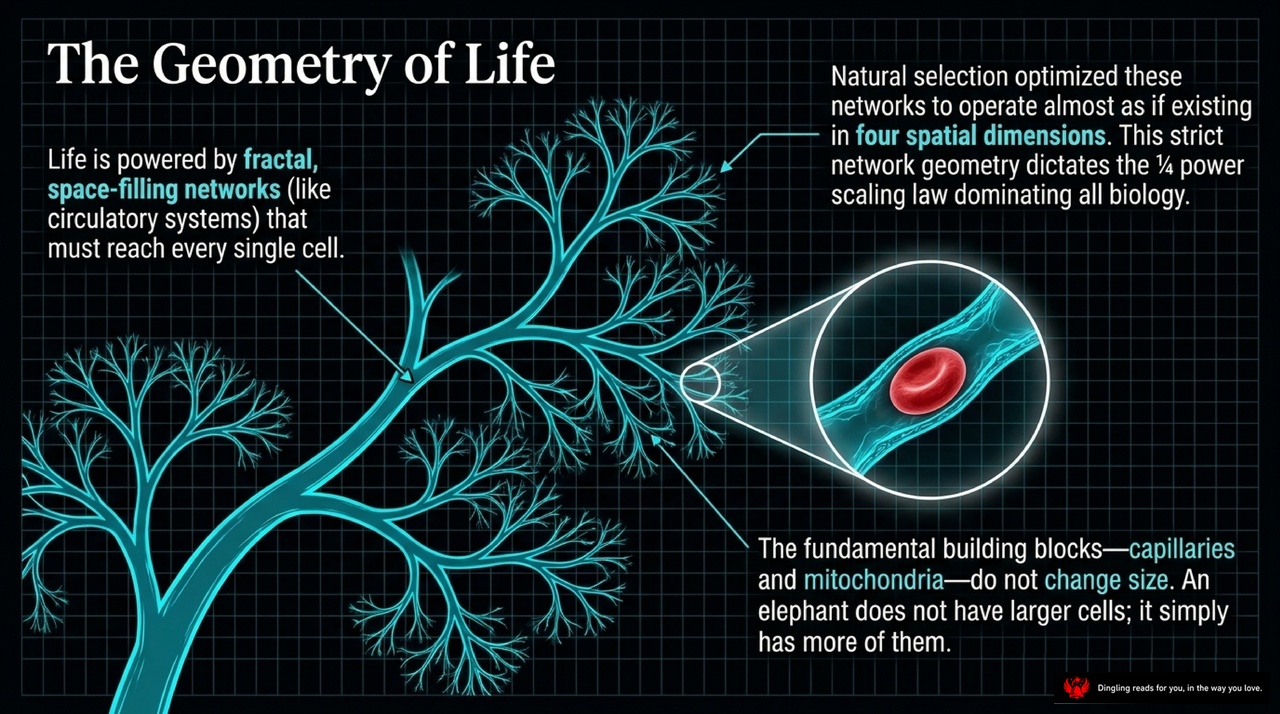
Have you ever wondered why a blue whale and a tiny mouse share such similar circulatory systems? The answer lies in the hidden geometry of life itself. As we see here, life is powered by fractal, space-filling networks—like our circulatory systems—that must reach every single cell, no matter how large or small the organism.
Nature has optimized these networks to operate almost as if they exist in four spatial dimensions. This strict network geometry dictates the famous 1/4 power scaling law that dominates all biology. Unlike simple geometric scaling where volume grows with the cube of length, these biological networks create extra functional surface area, allowing massive creatures to function efficiently.
Crucially, the fundamental building blocks—capillaries and mitochondria—do not change size. An elephant does not have larger cells than a mouse; it simply has more of them. Because the terminal units remain constant while the network branches out to fill space, the metabolic rate scales with the 3/4 power of body weight, not the 1/3 power you might expect from standard geometry. This unique scaling law explains why larger animals have slower heart rates, longer lifespans, and a fundamentally different life rhythm compared to smaller ones. It is the mathematical secret that allows life to thrive across 27 orders of magnitude.
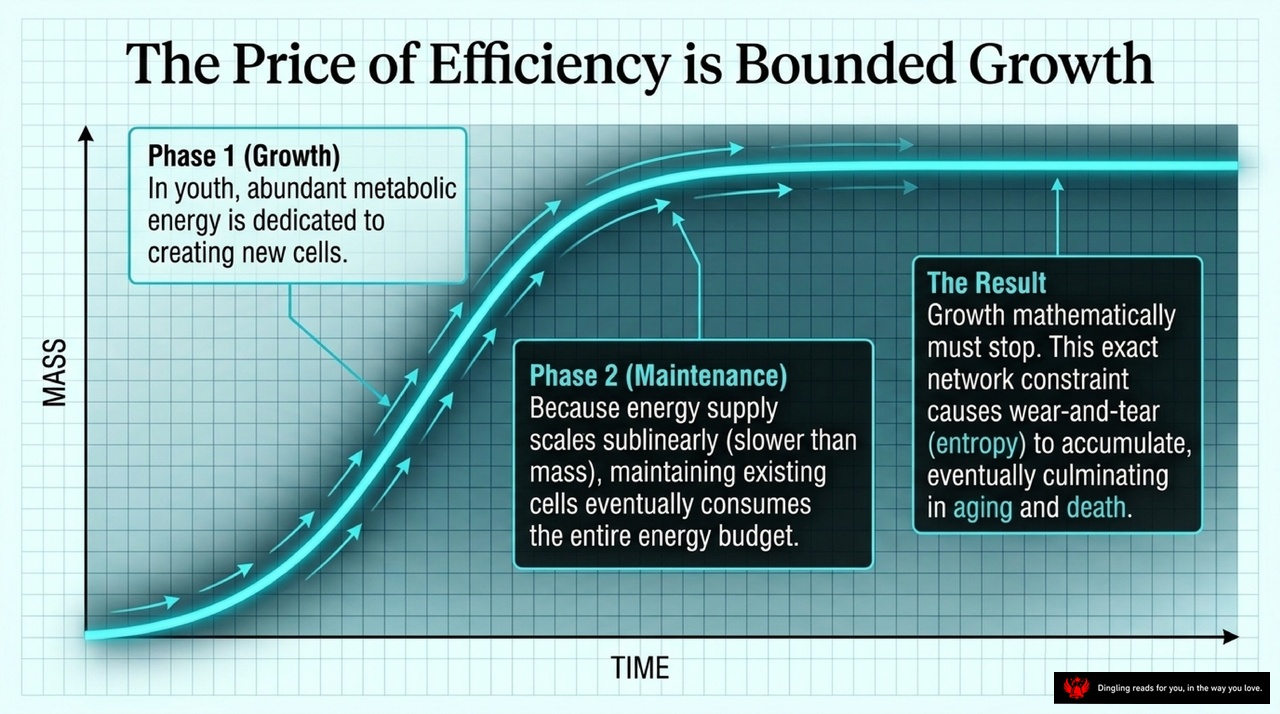
The price of efficiency isn't just about saving money; in the complex systems we build, it often comes at the cost of our future. Look at this curve. It tells a stark story about the hidden limits of our urban world.
In the early stages, what we call "Phase 1," cities are in a frenzy of growth. We pour massive amounts of metabolic energy—think of it as the fuel of our civilization—directly into creating new cells, or in our case, new infrastructure and buildings. It feels like we can expand forever, just like a young organism.
But then, we hit "Phase 2," the maintenance trap. Here is the critical shift: the energy we need to simply keep what we have alive doesn't grow linearly with our size. If you double the size of a city, the roads and utilities needed to maintain it only need to increase by about 85%. That sounds efficient, right? But that efficiency creates a bottleneck. As the city gets bigger, the cost of maintaining the existing network eventually consumes the entire energy budget. We stop building new things because all our resources are just patching up the old ones.
The result is inevitable and mathematical. Growth must stop. When the energy dedicated to maintenance swallows everything, wear and tear accumulates. In biological terms, this is entropy; in urban terms, it's congestion, crumbling infrastructure, and social decay. This exact network constraint leads us directly to aging and death.
The lesson is clear: efficiency in scaling has a hard ceiling. Without a new way to generate energy or innovate our networks, our systems will inevitably plateau and collapse. We can't just keep building bigger; we have to change the rules of the game before we hit this wall.
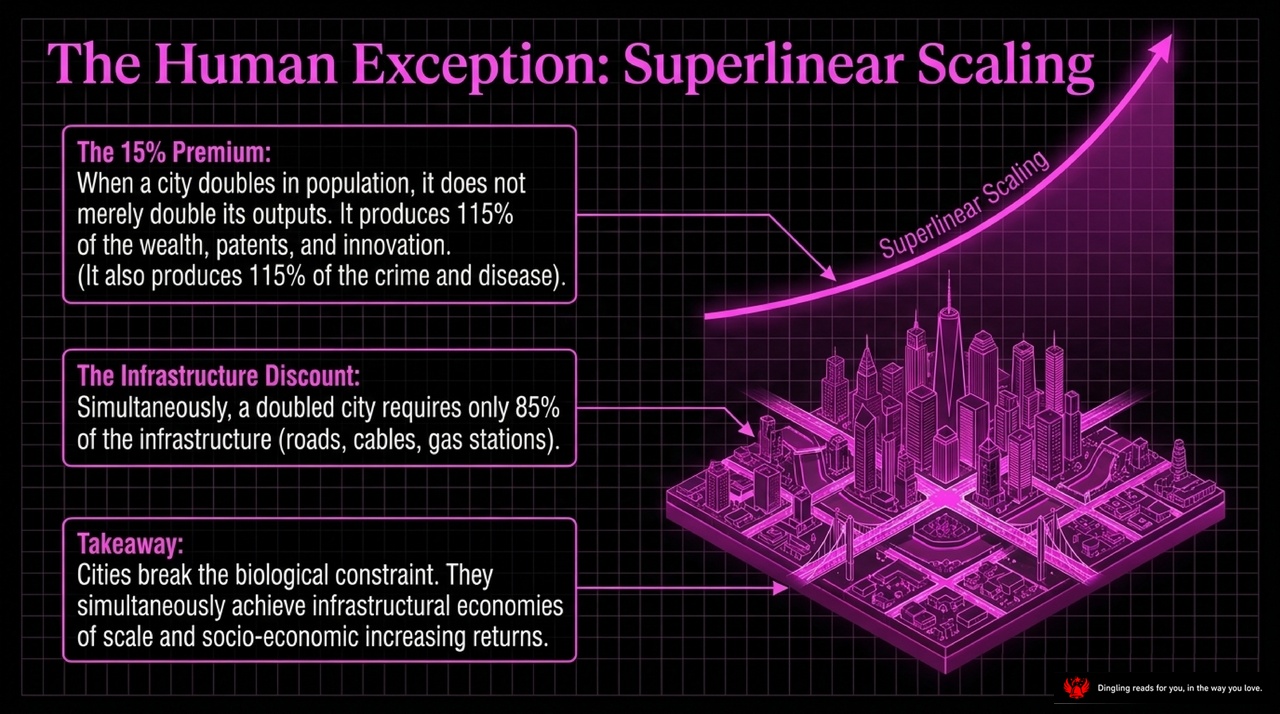
Welcome back. Today, we're diving into the most fascinating concept in urban science: the "Human Exception." While biological life follows strict limits, cities break the rules. They don't just grow; they superlinear scale.
Look at this chart. It illustrates a powerful paradox. When a city doubles in population, it doesn't just produce double the wealth or innovation. It produces 115%. That's a 15% premium. Patents, wages, and cultural output all explode faster than the number of people. It's the ultimate engine of human progress.
But here's the catch. This superlinear growth comes with a hidden cost. The chart also shows that while outputs jump by 15%, the negative side effects—like crime and disease—also grow by that same 15%. We get more innovation, but we also get more chaos. It's a double-edged sword.
However, cities are incredibly efficient. They offer what we call "The Infrastructure Discount." If you double the city size, you don't need double the roads, cables, or gas stations. You only need about 85%. This sublinear scaling means that as cities get bigger, the cost per person actually goes down. We achieve economies of scale that nature simply cannot replicate.
So, what's the takeaway? Cities are unique. They break the biological constraints that limit our lifespan and energy. By combining these two forces—superlinear social growth and sublinear infrastructure costs—cities achieve something impossible for individual organisms: increasing returns on scale. They are the only system on Earth that can keep getting richer, more complex, and more innovative without collapsing under its own weight. This is the secret to the human story.

Let's dive into the engine that powers our modern world: the Social Network Engine. Imagine a city not just as a collection of buildings, but as a living organism with its own metabolism and heartbeat.
Look at this diagram. We see two distinct layers. The bottom layer represents the physical infrastructure—the roads, the pipes, the grid. This is where we see **sublinear scaling**. As a city grows, its physical needs like roads and utilities don't grow at the same rate as its population. In fact, they grow slower, at about 85%. This is the magic of economies of scale; it means a bigger city is actually more efficient per person, using less energy and resources to support everyone.
But now, look at the glowing, vibrant layer on top. This represents the social network—the ideas, the wealth, the innovation, and the interactions. Here, we see **superlinear scaling**. When a city doubles in size, this social output doesn't just double; it jumps by about 15% more. Why? Because proximity breeds interaction. When people cluster together, they spark more ideas, create more wealth, and drive innovation at an accelerating pace. It's a **positive feedback loop**.
This is the fundamental **paradigm shift** we're witnessing. Biological growth is constrained by the physical distribution of energy, which is why a giant animal can't run as fast as a small one. But urban growth is driven by the physical distribution of information and people. Because of this, cities act as massive social incubators. The superlinear growth of our social networks allows us to scale up our creativity and economic power far beyond what our physical infrastructure limits us.
So, while the city's body grows efficiently, its mind and spirit explode with potential. This dynamic tension between efficient physical scaling and explosive social scaling is what makes the city such a powerful, resilient, and ever-evolving force. It's not just a place we live; it's an engine that fuels human progress.

Look at this graph. It captures a fundamental tension shaping our modern world: the clash between biological time and the accelerating pace of urban life. On the left, you see the blue line representing "Biological Time." Here, nature operates on a different rhythm. Larger mammals live longer but slower. Their heart rates drop, and their evolutionary pace drags. It's a system designed for stability and endurance.
But now, look at the pink curve shooting upward. This is "Urban Time." As cities grow, the pace of life speeds up dramatically. The larger the city, the faster we move. This isn't just about walking speed; it's about how diseases spread, how businesses turn over, and how quickly innovation happens. We are on "The Accelerating Treadmill." Innovation demands unbounded, open-ended growth, pushing us to run faster and faster.
The chart shows these two forces crossing paths. While biology seeks to slow down to survive, the city demands we keep accelerating to thrive. This divergence is the core challenge of our era: how do we manage a society that runs on an ever-accelerating clock, without losing the resilience that comes from a slower, more stable biological rhythm?

Welcome back to the book club. Today, we're diving into a critical moment in the story: the inevitable end of the corporate trajectory.
As we've learned, companies don't grow like cities. While cities expand with a "super-linear" boost in innovation and wealth, companies follow a "sub-linear" path. This means that as they scale, their bureaucracy swells, but their product diversity shrinks. They become unidimensional, losing the rich, multi-dimensional complexity that keeps a system alive.
The slide highlights this perfectly. We see the "Myth of Open-Ended Growth" shattered by data. CEOs often dream of infinite urban-style expansion, but the biological reality is that companies scale sub-linearly. As they get bigger, they narrow their focus to optimize margins, effectively collapsing their dimensions.
This leads us to "Dimensional Collapse." When a company loses its diversity and becomes rigid, it stops adapting. It becomes highly optimized for one specific environment, which makes it critically vulnerable to any market fluctuation. Just like an organism that can't evolve, a company that refuses to diversify guarantees its own eventual death.
So, the lesson here is clear: to survive, a system must remain flexible and diverse. Companies must avoid the trap of becoming a single, fragile point of failure. Instead, they need to embrace the complexity that allows them to pivot, innovate, and endure. That is the difference between a fleeting trend and a lasting legacy.
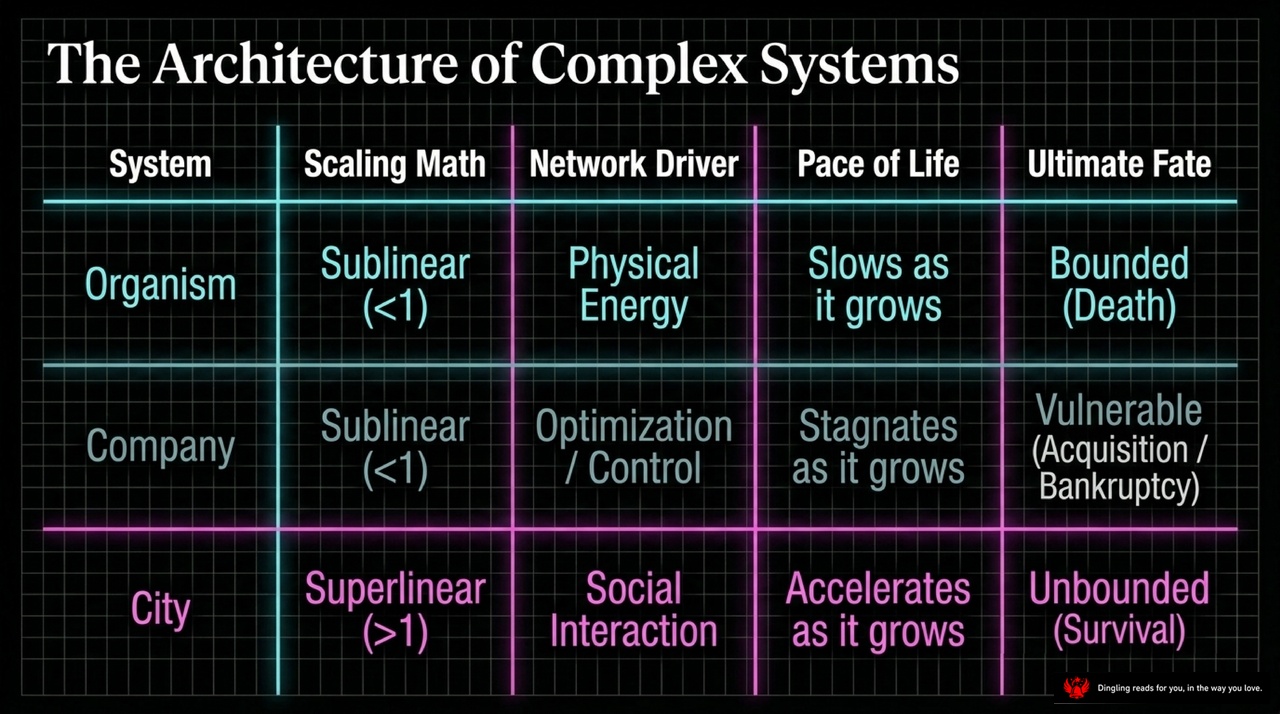
Look at this grid titled "The Architecture of Complex Systems." It's a powerful visual summary that finally connects the dots between life, business, and cities.
On the top row, we have the Organism. Notice how its scaling math is sublinear, less than one. Because its network driver is physical energy, life slows down as it grows. That's why a mouse has a frantic heartbeat while an elephant is calm. The ultimate fate? Bounded by death.
Move down to the Company. Interestingly, companies share the same sublinear scaling as organisms. Their network driver is optimization and control. As they grow, they stagnate, and their ultimate fate is often vulnerability—either acquired by a bigger player or going bankrupt. They are trapped in the same biological limits as living things.
But look at the bottom row, the City. This is where the magic happens. Cities follow superlinear scaling, greater than one. The driver here is social interaction. As a city grows, it doesn't just get bigger; it accelerates. Innovation, wages, and complexity all explode faster than the population. Unlike the organism or the company, the city has no upper limit. Its ultimate fate isn't death or bankruptcy, but unbounded survival.
This chart reveals a profound truth: the difference between a dying organism and an eternal city isn't just size; it's the math of how they scale.

Here is the spoken-word script for the slide:
The J-curve on this slide isn't just a chart; it's a warning about the mathematical trap we face in our modern world. As we look at the steep, glowing line, we see the flaw in our current growth model: superlinear growth. The text on the left explains that for our cities and economies to expand this fast, we need an ever-increasing supply of energy and resources. It's a demand that simply cannot be met linearly.
This leads us to the singularity. The mathematical equations governing urban growth dictate a terrifying outcome: demand will eventually reach infinity within a finite period of time. That red dotted line represents that inevitable crash point. Without intervention, this super-exponential trajectory guarantees a systemic collapse the moment our resources are exhausted.
This isn't just theory; it's the core of the sustainability crisis we are living through. We are trying to run a closed system with infinite growth, and the math says that path ends in failure. The only way out of this trap is to break the cycle before we hit that vertical wall. We need to understand these scaling laws not just as abstract concepts, but as the urgent blueprint for how we must redesign our cities and our economy to survive.

Imagine a staircase rising into the future, where every step represents a major leap in human history. This is the innovation cycle, a rhythm that has kept our civilization from collapsing under its own weight.
Look at the curve on the left, labeled "The Paradigm Shift." It shows a critical truth: to avoid the predicted collapse of a finite-time singularity, humanity must constantly reinvent its metabolic engine. We cannot simply keep growing on the same track; eventually, the system hits a wall. To survive, we must fundamentally change how we produce and consume energy.
Now, look at the steps on the right, under "Escaping the Limit." History proves that this reinvention works. Every time we hit a ceiling, a major discovery acts as a systemic reset. Think about coal, the steam engine, the computer, or the internet. These weren't just incremental upgrades; they completely altered the parameters of our growth equation. They broke the physical limits that once held us back, allowing open-ended expansion to continue under a brand new paradigm.
The graph illustrates a simple but powerful cycle: we grow until we hit a limit, then we innovate to reset the clock, and the cycle begins again. Without these moments of radical innovation, our growth would inevitably crash. But with them, we keep climbing, step by step, into the next era.
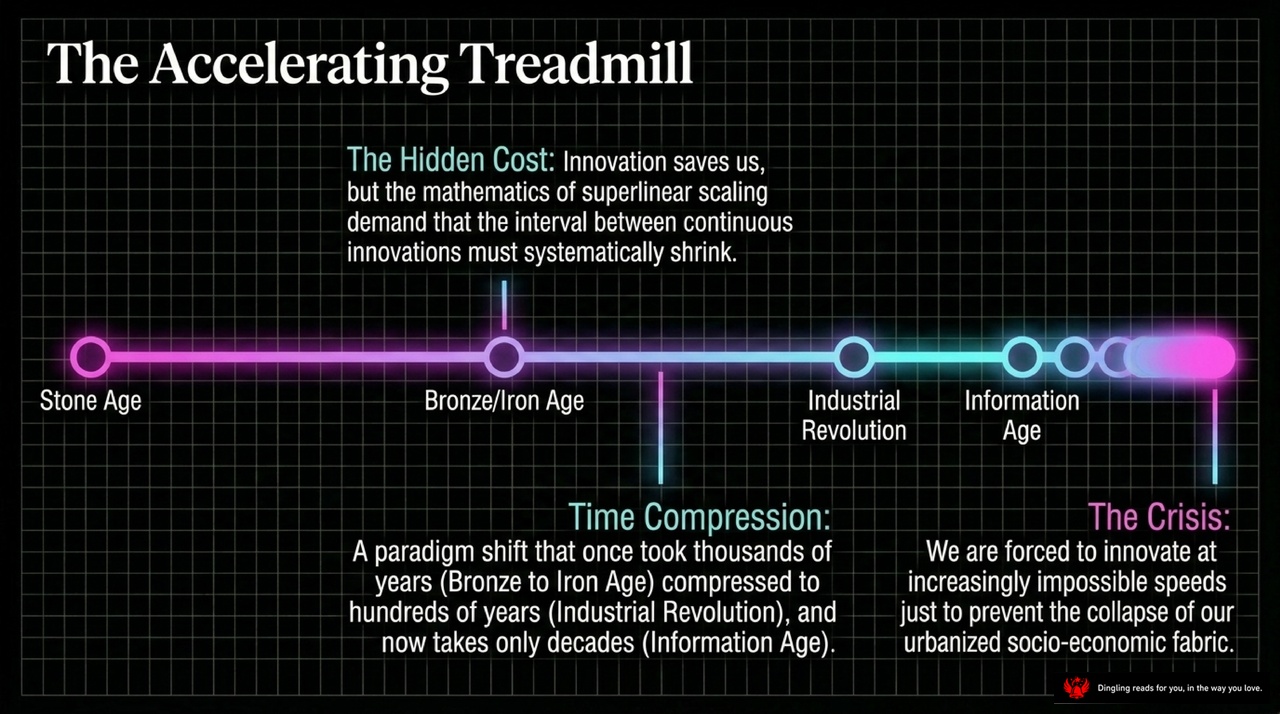
Look at this timeline of human history. From the Stone Age to the Bronze and Iron Ages, then through the Industrial Revolution, and finally into our current Information Age. Notice how the gaps between these major shifts are collapsing. What the chart calls "Time Compression" is the reality we face today: a paradigm shift that once took thousands of years now happens in just decades.
But here is the hidden cost of this acceleration. The text warns us that while innovation saves us, the mathematics of superlinear scaling demand that the time between breakthroughs must systematically shrink. We are running on an accelerating treadmill. As we move into the Information Age, we are forced to innovate at increasingly impossible speeds just to prevent the collapse of our urbanized socio-economic fabric.
This creates a crisis. Our cities and economies are growing faster than our ability to adapt. The speed of change is outpacing our resilience. If we don't understand these scaling laws and the pressure they create, we risk hitting a wall where our complex systems simply can't keep up with the demands of their own growth. The question isn't just about how fast we can build or produce, but whether we can sustain the pace long enough to find the next necessary innovation before the system breaks down.
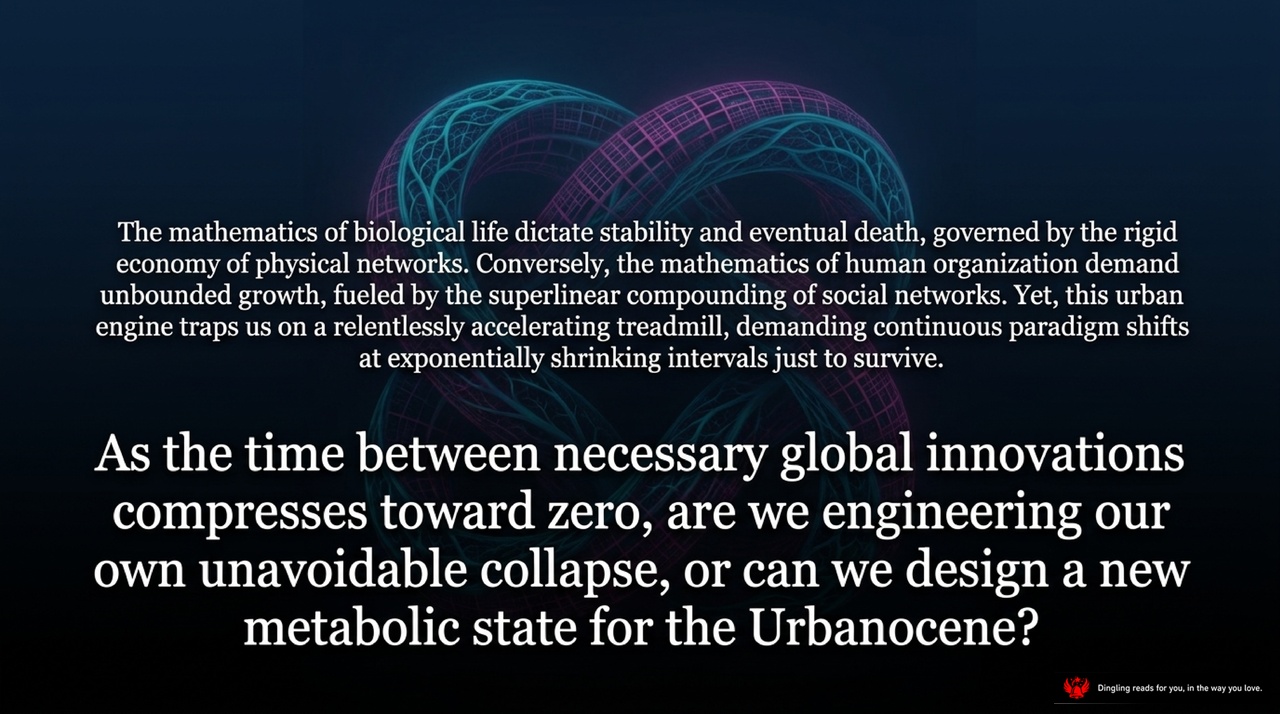
Look at this striking image behind us. It depicts two interlocking loops, one representing the rigid, life-limiting math of biology, and the other the explosive, unbounded growth of human society. This visual perfectly captures the central tension of our era: we are trapped on a relentlessly accelerating treadmill.
The text on the slide asks a profound question: As the time between necessary global innovations compresses toward zero, are we engineering our own unavoidable collapse? Or can we design a new metabolic state for the Urbanocene?
Let's unpack this. For centuries, we've assumed that growth is linear or exponential, but the reality is far more complex. Biological life is governed by stability and eventual death, dictated by the rigid economy of physical networks. Your body has a limit; you must stop growing to survive. But human organization is different. It demands unbounded growth, fueled by the superlinear compounding of social networks. When a city doubles in size, its innovation, wealth, and even its problems like crime and disease don't just double—they grow by 15% more. This creates a feedback loop where the urban engine traps us in a cycle of continuous paradigm shifts.
The slide highlights a terrifying trend: the interval between breakthroughs is shrinking exponentially. What took decades to invent is now happening in months. This acceleration is the price of our connectivity, but it also creates a fragility we haven't faced before. We are running faster than our systems can sustain, risking a collapse not because of a lack of resources, but because of the sheer speed of our metabolic rate.
So, are we doomed to this cycle? The answer lies in rethinking our fundamental operating system. We need to move beyond the current model of endless expansion and design a new "metabolic state" for our cities. This means finding a balance where the superlinear benefits of innovation don't come at the cost of our ecological and social stability. We must engineer resilience into the very fabric of the Urbanocene, ensuring that our growth doesn't lead to an inevitable crash, but to a sustainable, evolving future.