
Scarcity: Complete Chapter-by-Chapter Summary

Welcome to our deep dive into "Scarcity: Why Having Too Little Means So Much" by Sendhil Mullainathan and Eldar Shafir. Today, we're exploring a fascinating cognitive paradox that shapes how we think, decide, and live.
Imagine a single beam of light cutting through total darkness, illuminating just a small circle on the floor while everything else remains hidden. This image perfectly captures the core idea of our book: a cognitive paradox where the psychology of lacking resources hijacks the human brain. When we feel we have too little—whether it's money, time, or even social connection—our attention gets captured by the most urgent things at hand. This focus gives us a "scarcity红利" or a narrow tunnel vision that helps us solve immediate problems efficiently. But this very focus comes at a heavy cost. It blinds us to everything outside that narrow beam, making us ignore long-term risks and important opportunities.
The book argues that scarcity isn't just about objective poverty; it's a mental state that distorts our perception. When our brain is occupied with pressing needs, it suppresses everything else, creating a tunnel vision effect. This explains why we might make short-sighted decisions that seem rational in the moment but lead to bigger problems later. Understanding this mechanism is the first step toward designing systems and habits that help us break free from the trap of scarcity and reclaim our full potential.

Have you ever looked at two very different lives and wondered what truly connects them? On the left, we see the "Time Poor"—the overworked manager buried under piles of paper, staring at a clock that seems to be mocking him. On the right, we see the "Money Poor"—the street vendor counting coins in a bustling market. At first glance, their struggles seem worlds apart. One is drowning in deadlines, the other in debt. But as we dive into the text, a shocking realization emerges: the common denominator is not poor time management or financial illiteracy. It is the universal psychology of having too little.
This isn't just about the amount of resources they possess; it's about a mental state called "scarcity." When our brain is captured by a lack of resources, whether it's time or money, it narrows our focus. This creates a "tunnel vision" where we only see what is immediately urgent. The manager sees only the next deadline, and the vendor sees only the next sale. This focus gives us a temporary "attention bonus," allowing us to handle the immediate crisis with intense precision. But the cost is high. By focusing so hard on the present, we blind ourselves to everything else. The manager ignores his health and family, while the vendor ignores long-term planning.
This mental trap creates a vicious cycle. When we are overwhelmed by the immediate, our cognitive bandwidth drops. We lose the ability to think clearly, plan ahead, or make wise decisions. We start making short-term choices that solve today's problem but create bigger problems tomorrow. It's a psychological loop where the pressure of scarcity makes us less capable, which in turn makes the scarcity worse. Understanding this paradox is the first step to breaking free from it.

Imagine scarcity not as a simple math problem of lacking money or time, but as a powerful shift in your mindset. As this slide illustrates, true scarcity is an iceberg. Above the water, we see the obvious "Physical Lack"—the literal shortage of hours, dollars, or calories. But the much larger, submerged part is "Psychological Capture," where our brain's attention gets involuntarily hijacked by that unmet need.
This is the core definition of scarcity: it happens when an urgent, unmet need captures our subconscious attention, fundamentally altering how we perceive the world and make decisions. It's not just about having less; it's about being mentally consumed by the fear of having less. When our brain gets captured by scarcity, it narrows our focus like a tunnel. We gain a "tunnel vision" benefit, allowing us to concentrate intensely on the immediate crisis, but we simultaneously blind ourselves to everything else. We might solve today's urgent problem, but we completely ignore the risks and opportunities lying right outside our tunnel. This is why scarcity feels so heavy—it traps us in a cycle where we focus only on the fire in front of us, leaving the rest of our lives in the dark.

Imagine a spotlight cutting through the darkness, illuminating a single, intense point of focus. This is what happens when scarcity captures our brain. We get a burst of high productivity and extreme focus on an immediate, urgent threat—what we call "The Focus Dividend." It's like a superpower that allows us to achieve incredible short-term results, much like a chef creating a signature dish under pressure or a team suddenly hitting peak performance when a deadline looms.
But this double-edged sword cuts both ways. While we gain this intense focus, we suffer from "Tunneling." Our vision narrows so drastically that we become blind to everything outside the spotlight. We see the immediate fire but ignore the long-term planning, preventive maintenance, or even our health and family. Scarcity forces us to choose between the urgent and the important, often sacrificing the latter for the former. We get great results right now, but we pay a heavy price later by ignoring the important-but-not-urgent tasks that keep us safe and thriving.

Imagine your brain as a computer with limited RAM. When you're under pressure—facing financial stress, looming deadlines, or a pile of overdue tasks—those background processes consume a massive 80% of your cognitive bandwidth. That leaves you with only 20% of your mental RAM for the things that actually matter: solving problems, exercising logic, and resisting temptation. This is the "Bandwidth Tax."
When scarcity captures your brain, it forces you into a state of "tunnel vision." You become hyper-focused on the immediate crisis, which can actually boost your short-term efficiency—a phenomenon we call the "focus dividend." But that narrow view comes at a steep price. Because your brain is running so many background applications, it leaves minimal bandwidth for patience, future planning, and seeing the bigger picture. In essence, scarcity literally drops your effective IQ. You aren't necessarily less capable; you're just so busy fighting the present fire that you can't see the smoke rising from the house behind you.

Imagine your life as a suitcase. When you have plenty of space—what we call "Slack" or abundance—you pack casually. You ask yourself, "Why not?" You toss in an extra sweater or a book without a second thought. Your mind is relaxed, operating on autopilot with low cognitive load. You aren't stressed because you have room to breathe.
But now, look at the other side: Scarcity. Picture that same suitcase, but this time it's bursting at the seams, vibrating with anxiety. There is no room left. Every time you try to add something, you have to frantically ask, "If I pack this, what must I remove?" This is the mental tax of scarcity. You become careful, anxious, and exhausted. Your cognitive load skyrockets because you are constantly making trade-offs.
The core lesson here is simple but profound: the absence of Slack forces constant, exhausting trade-off thinking. When you lack that unallocated space—whether it's money, time, or mental energy—you lose the ability to be forgiving with yourself or flexible with your plans. Instead, you get trapped in a cycle of high-stakes decisions that drain your brain, leaving you with nothing left for the important things that don't feel urgent right now.

The True Cost of Zero Slack. Look at this visual: a single minor shock, like a flat tire or a delayed meeting, triggers a chain reaction that collapses an entire structure. This isn't just about stress; it's about the catastrophic failure of a system with no room to breathe.
The book explains this perfectly: "When your suitcase is perfectly full, a minor variance isn't an inconvenience—it's a system failure. There is no room to absorb error."
Think of your life or your business as that suitcase. If every hour is booked, every dollar is spent, and every task is critical, you have zero slack. In that state, a small disruption doesn't just cause a delay; it causes a collapse. You have no buffer to fix mistakes, no time to recover from a mistake, and no space to pivot when things go wrong.
The image shows how a tiny crack at the base leads to a total structural failure. Without that extra space—what the book calls "slack"—you are walking on a knife's edge. Any unexpected event becomes a crisis because your system has no elasticity. True resilience doesn't come from working harder or being more efficient; it comes from intentionally leaving room for the unexpected. When you fill every gap, you don't gain productivity; you invite disaster.

The illusion of borrowing is one of the most dangerous traps we fall into. As the hourglass on this slide shatters, it symbolizes how our future literally cracks under the pressure of today's needs. We often think borrowing is a smart shortcut, but in reality, it steals time from tomorrow's projects to finish today's, neglecting maintenance just to save cash right now, and even taking out high-interest payday loans that only deepen our debt. This happens because tunneling leads to borrowing. It buys us immediate relief, but it creates a deeper, compounding deficit for tomorrow. When we are in a state of scarcity, our attention narrows so much that we can't see the long-term consequences. We solve the fire in front of us, but we leave the house unprepared for the next one, setting ourselves up for a cycle where we are always one emergency away from disaster.

Welcome to the final chapter of our deep dive into "Scarcity." Today's slide illustrates what we call "The Scarcity Trap"—a powerful, self-reinforcing cycle that keeps us stuck.
Look at this spiral. It starts with **Scarcity**. When you feel you don't have enough—whether it's money, time, or social connection—your brain gets hijacked. This triggers **Tunneling**, a mental state where your vision narrows. You become hyper-focused on the immediate emergency, ignoring everything else. This leads to **Neglecting non-urgencies**. While you're fighting today's fire, you completely overlook important but non-urgent tasks like saving for the future or maintaining your health.
Because you've ignored those essentials, you eventually face **Shocks and Emergencies**. A car breaks down, a bill gets missed, or an unexpected expense hits. Now, you have no buffer. To survive this shock, you turn to **Borrowing**. You take on debt or cut corners just to get by. But borrowing doesn't solve the root problem; it creates **Deeper Scarcity**. You now have even less resources and more stress than before. And the cycle starts all over again.
As the text on the slide reminds us, people don't fail because they are flawed; they fail because the architecture of scarcity locks them into a perpetual state of firefighting and juggling. The good news is that this cycle isn't inevitable. By understanding this trap and building buffers—what we call "slack"—we can break free from the spiral and move toward a life of abundance.
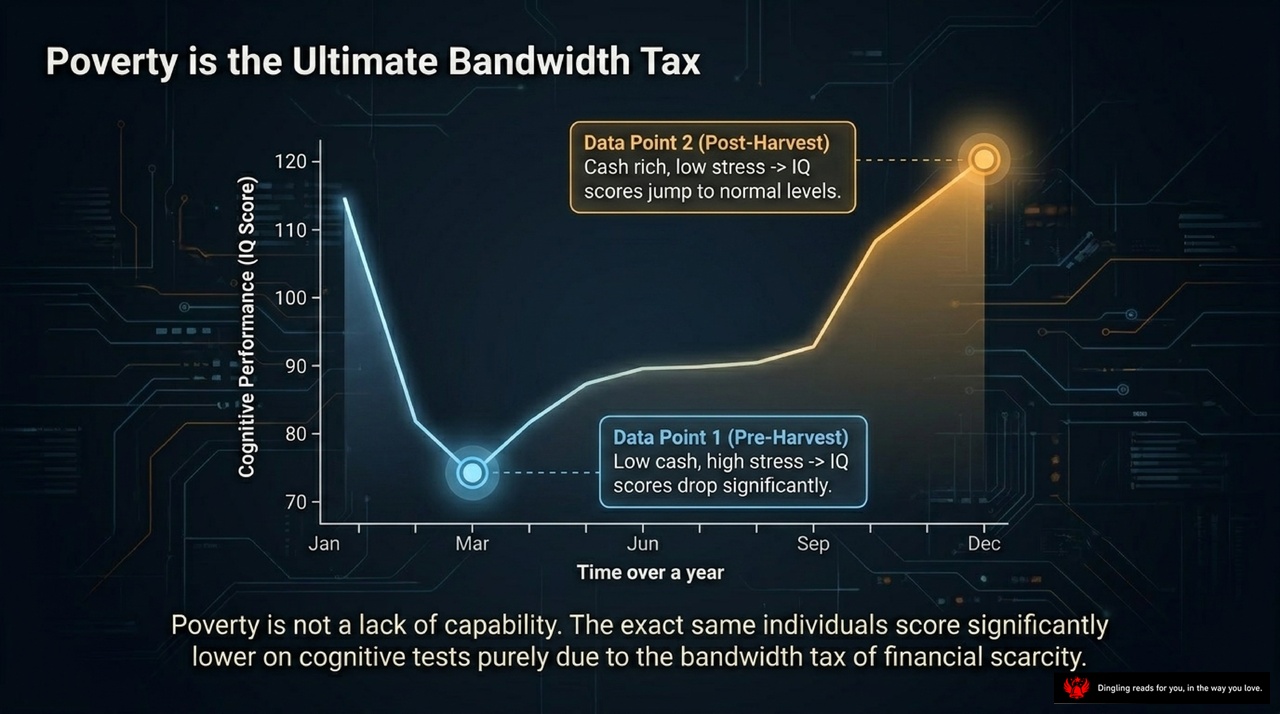
Poverty is the ultimate bandwidth tax. This slide illustrates a fascinating phenomenon: the same individuals score significantly lower on cognitive tests simply because of the financial scarcity they face. Look at this graph tracking cognitive performance over a year. In March, labeled as "Pre-Harvest," cash is low and stress is high. The IQ scores plummet, dropping significantly as the brain is hijacked by immediate survival needs. But by December, marked as "Post-Harvest," the situation flips. Cash is rich and stress is low. The scores jump back to normal levels.
This data proves a crucial point: poverty is not a lack of capability. The exact same people possess the same intelligence; their performance just collapses under the weight of scarcity. When resources are tight, the brain enters a state of "tunnel vision," focusing entirely on the urgent and ignoring the important. This "bandwidth tax" drains the mental energy needed for complex thinking, making it seem like the person is less capable, when in reality, they are just too overwhelmed to function at their full potential. Understanding this shift is the first step to breaking the cycle.
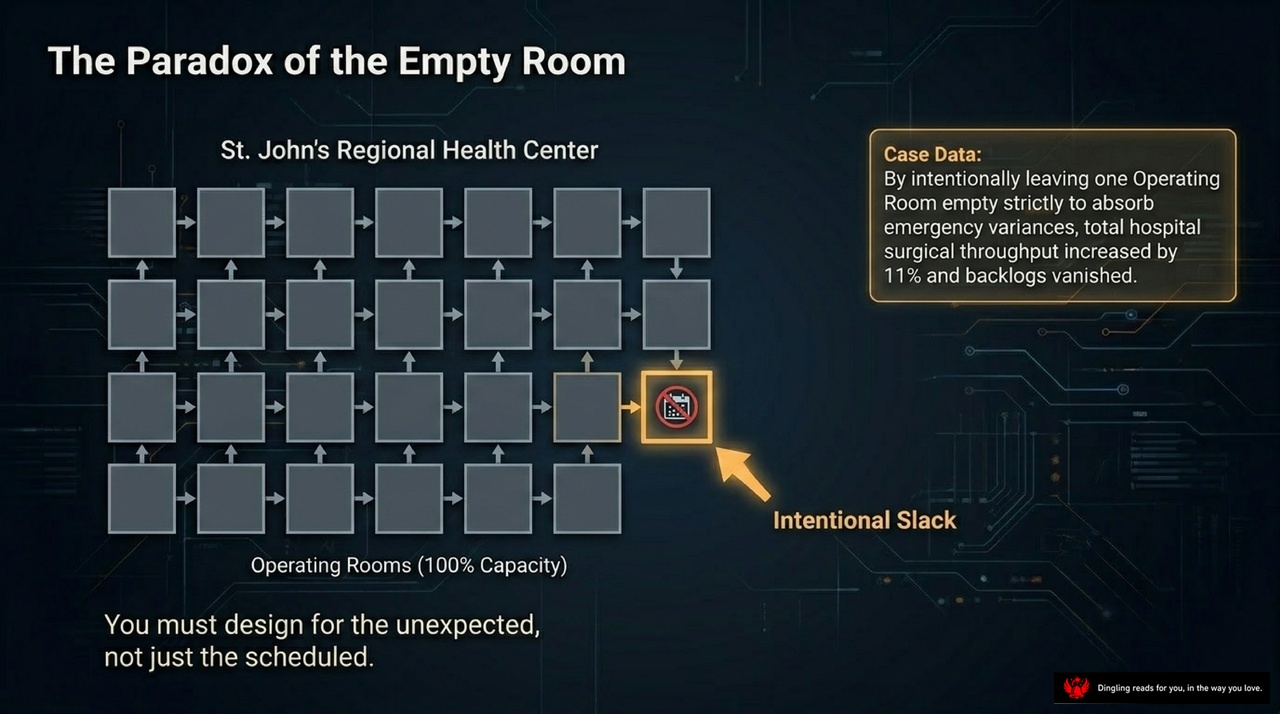
Imagine a hospital where every operating room is booked solid, running at 100% capacity. On the surface, this looks like peak efficiency, but in reality, it creates a fragile system teetering on the edge of collapse. This is the "Paradox of the Empty Room," a concept we explored using data from St. John's Regional Health Center.
When you push a system to its absolute limit, you leave no room for the unexpected. The slide illustrates this perfectly: by filling every single operating room, the hospital had zero buffer. If an emergency arose, there was no space to absorb it, forcing them to cancel scheduled surgeries, create dangerous overtime, and increase the risk of medical errors.
The solution was counterintuitive but powerful: they intentionally left one operating room empty. This wasn't wasted space; it was "Intentional Slack." By creating this single buffer, the hospital could instantly absorb emergency variances without disrupting the rest of the schedule. The result was transformative. Their total surgical throughput increased by 11%, and all backlogs vanished.
This teaches us a critical lesson for managing time and resources: you must design for the unexpected, not just the scheduled. True efficiency isn't about squeezing every last drop of capacity out of your day; it's about building in enough slack to handle the inevitable surprises that life throws at us. Without that buffer, even a perfect plan can quickly turn into chaos.

Imagine your brain as a battery that powers your decisions. When it's fully charged in the morning, you're ready for complex tasks like long-term planning or making tough calls. But as the day goes on and your battery drains, your brain switches into survival mode, relying on automated defaults. Think of it like auto-enrollment in savings or sticking to pre-set routines—these behaviors require zero bandwidth because they don't demand critical thinking.
This is the essence of managing bandwidth, not time. We often think we need more hours in the day, but the real issue is how much mental energy we have left. When your cognitive battery is full, schedule your most important, high-bandwidth work. When it's low, automate the good stuff so you don't have to decide from scratch. By designing systems that respect our natural cognitive limits, we can stop burning out and start getting things done efficiently.
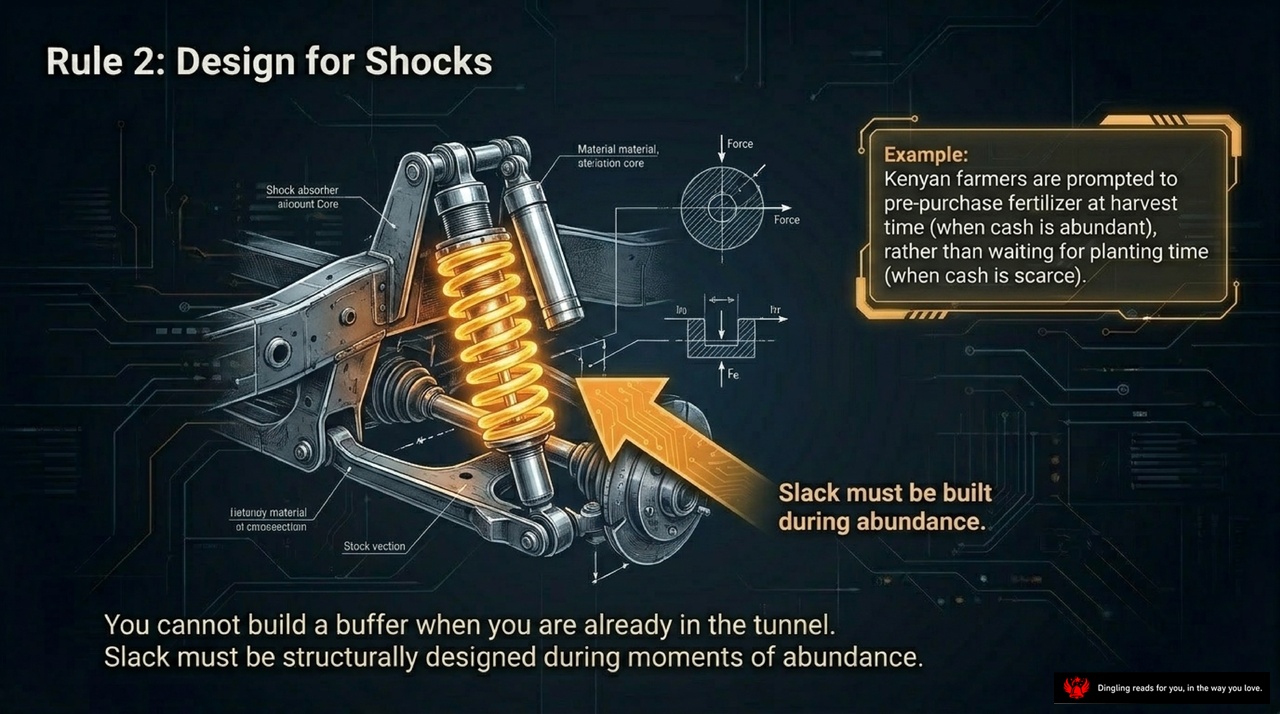
Imagine a car suspension system designed to absorb shocks. That's the core idea behind Rule 2: Design for Shocks. As the image illustrates, slack must be built during moments of abundance. You cannot build a buffer when you are already in the tunnel. This is a critical lesson for both individuals and organizations.
Think about Kenyan farmers, as highlighted in our example. They are often prompted to pre-purchase fertilizer at harvest time when cash is abundant, rather than waiting for planting time when cash is scarce. This simple shift in timing prevents them from falling into a trap of scarcity right when they need resources most.
In business, this principle is equally vital. Consider St. John's Hospital, which was struggling because its operating rooms were booked at 100% capacity. It seemed efficient, but any emergency would cause a cascade of delays. By introducing just one "slack" operating room—a buffer zone—they gained the ability to handle unexpected events without disrupting their entire schedule. This single unit of slack transformed their system from fragile to resilient.
The danger of running at full capacity is that it creates a "firefighting trap." When resources are tight, we inevitably ignore important but non-urgent tasks, like maintenance or planning. We focus only on the immediate fire, but that often leads to bigger problems later. True efficiency isn't about squeezing every last drop of productivity out of your team; it's about designing systems with enough breathing room to handle the unexpected.
So, the takeaway is clear: don't wait for the crisis to act. Build your buffers while you are still in the sunshine. Whether it's cash in your savings account, time in your calendar, or capacity in your workflow, design for shocks now so you don't have to survive them later.
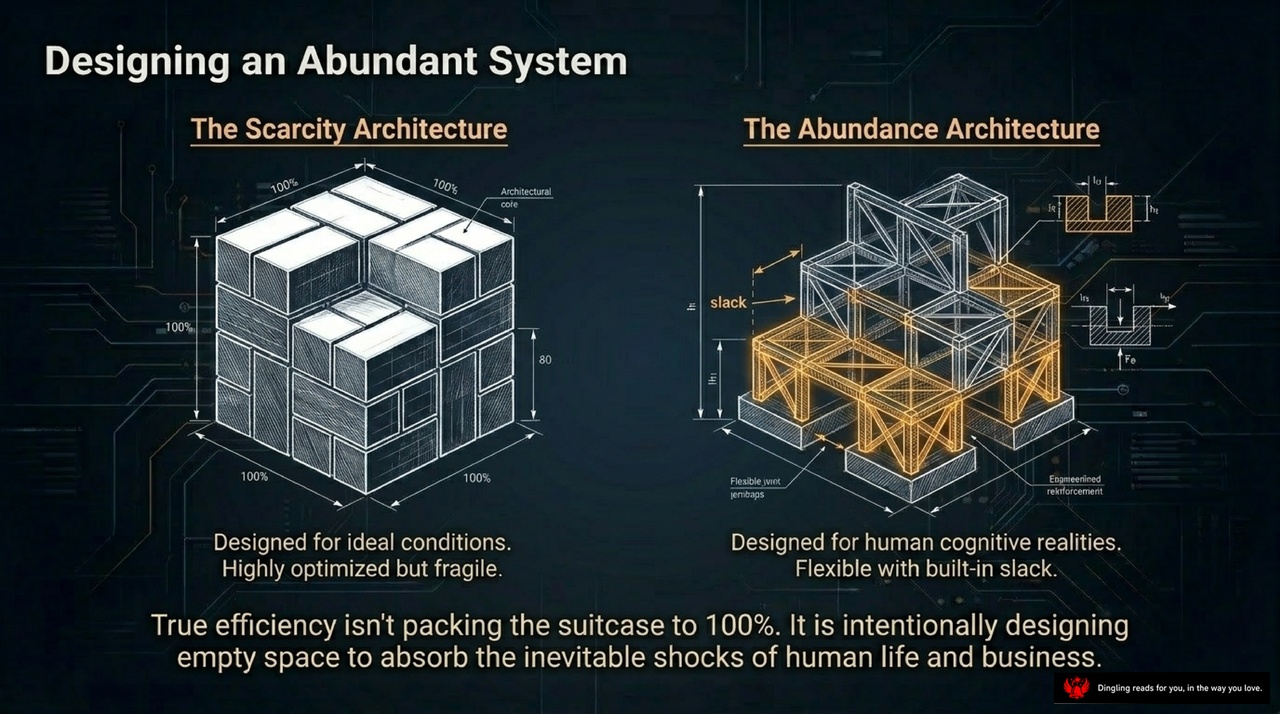
Imagine you are an architect, but instead of building skyscrapers, you are designing the very systems of human life and business. Look at the screen. On the left, we see the "Scarcity Architecture." It looks like a perfect, rigid cube. Every dimension is marked 100%. It is designed for ideal conditions, highly optimized, but incredibly fragile. Just like a suitcase packed to the absolute brim with no room for anything else.
Now, look at the right side. This is the "Abundance Architecture." Notice the golden highlights. It features "slack," flexible joints, and engineered reinforcement. It isn't a rigid block; it's a structure built to breathe. The text at the bottom makes a profound point: true efficiency isn't about packing the suitcase to 100%. In fact, doing that is the recipe for failure.
The real secret to resilience is intentionally designing empty space. Why? Because life and business are not ideal. They are full of inevitable shocks. When you have that built-in slack, you can absorb those shocks without collapsing. Without it, a single unexpected event—a sudden expense, a delay, a crisis—can break the entire system because there was no buffer to catch the impact. So, stop trying to maximize every inch of your time or money. Instead, design systems with flexibility. Build in the space to fail, to learn, and to survive the unexpected. That is the only way to move from a fragile scarcity mindset to a resilient abundance mindset.

Scarcity isn't just a physical limit waiting to be optimized; it is a cognitive tax that drains your mental bandwidth. Think about it: if you push your life and systems to 100% capacity, constantly optimizing every minute, where exactly will you find the bandwidth to survive the unexpected? The answer is nowhere.
This slide highlights a crucial shift in perspective. We often treat scarcity as a simple math problem—just need more money or time to fix things. But the book argues it's actually a mental trap. When your brain is captured by scarcity, it narrows your focus like a tunnel, giving you a temporary "focus bonus" for urgent tasks but blinding you to long-term risks.
If you run at full speed every day, you leave no room for errors. One small surprise—a medical emergency, a car breakdown, or a sudden deadline shift—could knock you off your feet because you have no buffer left. True resilience comes not from squeezing every drop of efficiency out of your day, but from intentionally leaving space. You need slack, a little extra room in your schedule and finances, to absorb the shocks of life without falling into the trap of scarcity.