
Scholars Moving to the Grassroots: Complete Chapter-by-Chapter Summary
Ever wondered how China’s influential local gentry class first took shape? Today we’re diving into Wang Ruilai’s *Elites Moving to the Grassroots: The Song-Yuan Transition and Social Transformation*. This book unpacks a pivotal moment in history: when marginalized elites shifted south during the Song and Yuan dynasties. Their move didn’t just change their own lives—it laid the groundwork for the modern local gentry society that shaped later eras. Let’s explore how this unexpected shift reshaped China’s social fabric.
Ever wonder what life was like for scholars who passed the imperial exam in the Southern Song Dynasty? You might picture them striding into grand government halls, but the reality was far harsher. Most ended up as "selectees"—the lowest rung of the official ladder, stuck in a system that seemed designed to keep them down.
Take Yang Wanli, the famous poet who wrote the beloved "Little Pond." Even after passing the exam, he spent years as a selectee, living in poverty. He once lamented in a poem: "I didn’t get famous late, but now I’m still a lowly official." And it wasn’t just meager salaries; the biggest barrier to advancement was getting recommendation letters. To move up to a higher rank, you needed five letters from senior officials—the first called "breaking white" (a zero-to-one breakthrough), the last "capping the尖" (finishing the set). Some scholars waited 17 years just for that first letter, and others never got it at all.
Corruption made things worse. Officials sold recommendation letters for 300 guan each, and clerks at the Ministry of Personnel extorted money at every step. There was a popular saying back then: "Without 500 thousand coins, don’t go near Lin’an (the capital)." No wonder so many scholars gave up on their official dreams.
What did they do instead? Some turned to farming—like Zang Qingzu, who managed a large estate and spent a month each year collecting rent. Others taught in rich families’ private schools or became clerks (even though traditional scholars once scorned this path). A few ventured into business, and some even joined rebellions when they had no other way to survive.
This shift wasn’t just about individual choices; it transformed society. When scholars left the capital to settle in local areas, they brought their knowledge and skills to the countryside. They became community leaders, teachers, and entrepreneurs, laying the groundwork for the social changes that shaped the transition from the Southern Song to the Yuan Dynasty. It’s a powerful reminder that sometimes, the paths we don’t take end up shaping the course of history more than the ones we do.
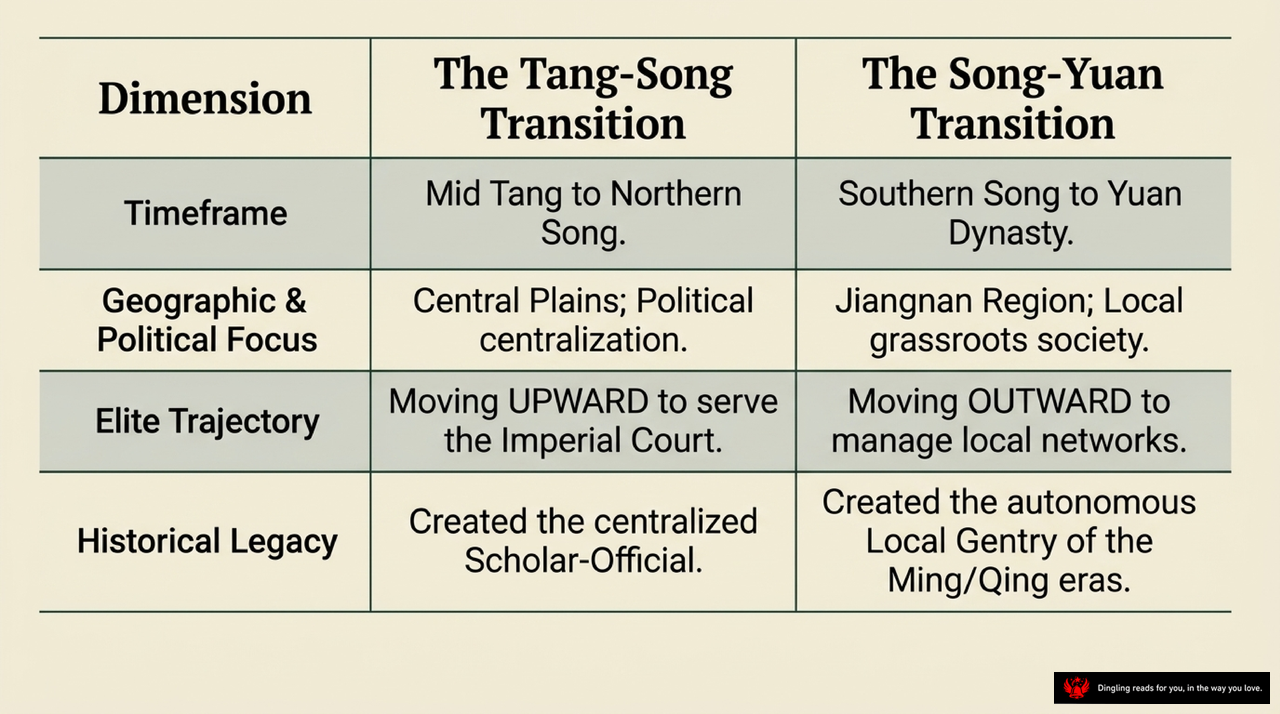
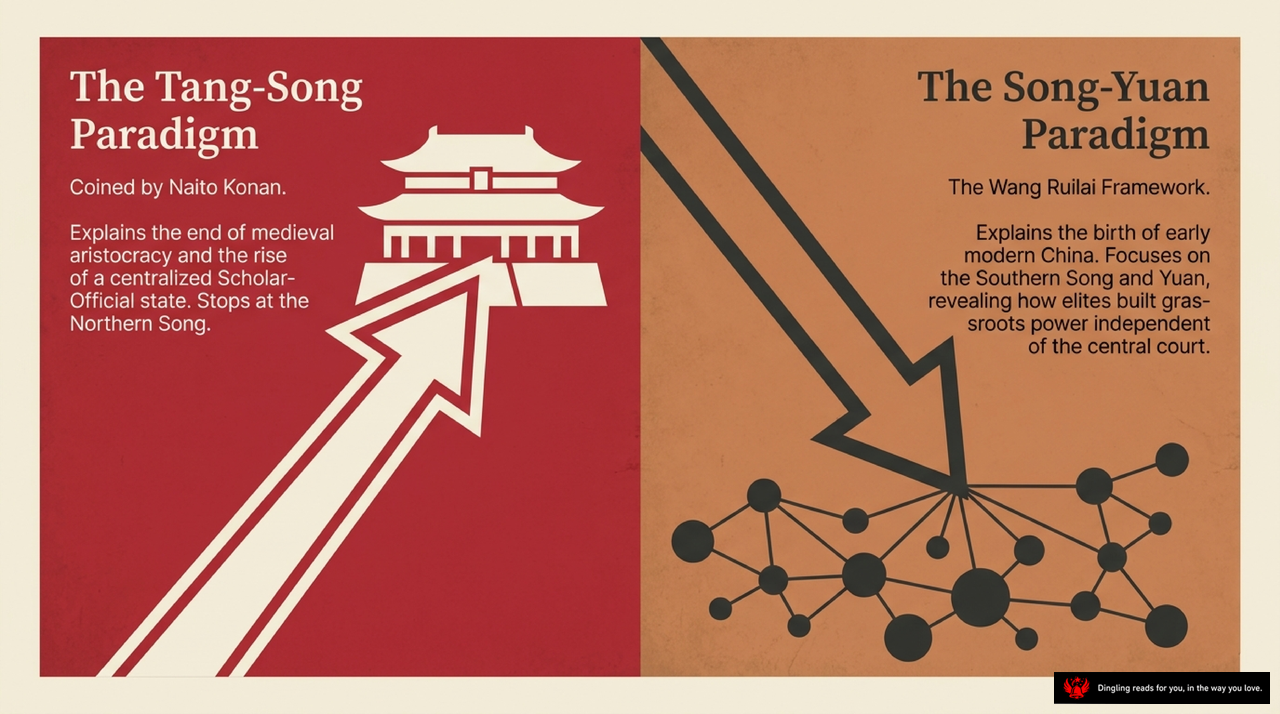
Alright, let’s dive into two critical shifts in Chinese history that reshaped how power and elites operated: the Tang-Song transition and the Song-Yuan transition. These aren’t just dry dates—they’re stories of how society’s focus and elite ambitions changed.
First, the Tang-Song transition: This unfolded from the mid-Tang to the Northern Song dynasty. Back then, all the action was in the Central Plains, the traditional heartland of Chinese civilization. The big trend here was political centralization—like the federal government in Washington DC consolidating power. For elites, the dream was simple: climb the ladder to serve the imperial court. If you wanted to matter, you headed to the capital, passed those tough exams, and joined the centralized scholar-official system. That system became a legacy that defined governance for ages—think of it as the blueprint for how to run a big empire.
Now, the Song-Yuan transition: This was from the Southern Song to the Yuan dynasty, and it flipped things on their head. The focus shifted south to the Jiangnan region—those lush, wealthy areas around the Yangtze Delta, where rice paddies and trade flourished. Instead of fixating on the central court, people started paying attention to local grassroots society. Elites changed their game too: instead of moving up to the capital, they moved outward to manage local networks. They became the backbone of their communities—organizing irrigation projects, resolving neighborhood disputes, or even running local schools. This shift didn’t just stay in the south; it laid the groundwork for the autonomous local gentry class that dominated Ming and Qing rural life. These were the influential families who held sway in their hometowns, even when the emperor was miles away.
These two transitions show a huge evolution: from a system where all power flowed to the center, to one where local leaders and communities took center stage. It’s like watching a country go from a top-down corporation to a network of thriving local businesses, each with its own voice and influence.

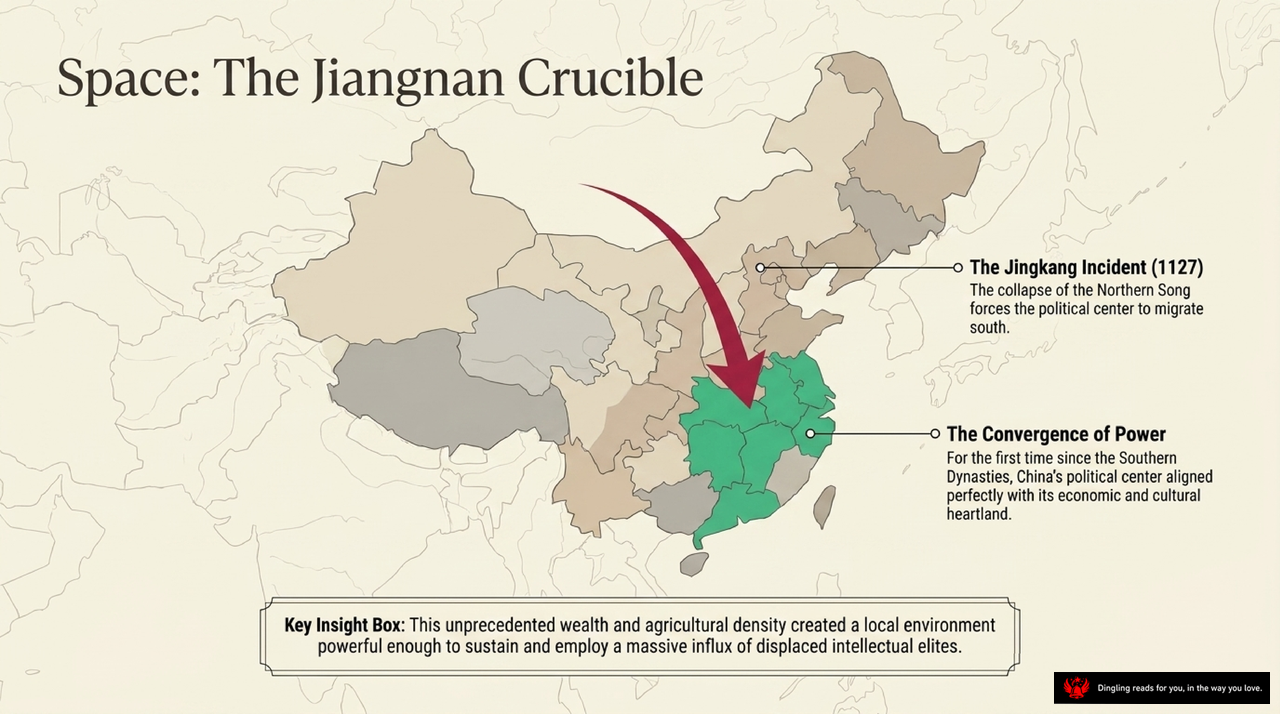
Ever notice how some of the biggest societal shifts start when talented people stop chasing the "traditional" success path? That’s exactly what we’re looking at here—this slide breaks down the engine behind early modern China’s transformation.
First, let’s talk about space: Jiangnan was the crucible. It wasn’t just a region—it was where the south’s geographic and economic power consolidated, like a melting pot of resources, ideas, and influence that became the heartbeat of the area. Think of it as the Silicon Valley of its time, drawing people and power together into a hub of innovation.
Then there’s the engine itself: the intellectual elites, or Shiren. Instead of climbing the imperial court ladder, they were systemically diverting away from it. Take Zeng Anqiang’s family: they spent years grinding for the civil service exam, but even with success, their careers were filled with struggles and setbacks. Or Huang Gongwang—he’d trained his whole life for the exam, but the Yuan Dynasty scrapped the system. So he pivoted, became a painter, and left masterpieces that are still studied and admired today.
And time? The Yuan Dynasty was the accelerator. Their historical disruptions—like ditching the civil service exam for decades—didn’t just pause things; they finalized that grassroots transition. It pushed more elites to look beyond the court: people like Guan Daosheng and Zhao Mengfu, a power couple who focused on art instead of politics, creating works that still take our breath away.
This wasn’t just a passing trend—it was a fundamental shift. When these elites turned their talents to local communities, art, and other fields, they reshaped China’s social fabric, setting the stage for centuries of change that would ripple through history.
Let’s dive into how ideas and local reputation shifted during the Song-Yuan transition—this was a time when old notions of success got a major shake-up. Take Su Shi, the iconic Song poet: even though he’d made it big through the imperial exam, he told his nephew something radical: “Don’t chase wealth to get by, don’t study just to land an official job.” Back then, everyone thought the only path to success was passing the exam and climbing the government ladder, but Su Shi sensed a change—society was opening up to more options. By the Southern Song, with the south booming economically and local communities growing stronger, more scholars started looking beyond officialdom. Folks like Zeng Minxing quit the exam at 20 and lived by Su Shi’s words, focusing on books, art, and divination instead of chasing a government post.
Then there’s the idea of “equal status.” Once, it meant strict social hierarchies, but during the Southern Song, peasants like Zhong Xiang and Yang Yao shouted “equal status for all” in their uprisings. Why? Old noble families were fading, the exam let common people climb up, and the economy blurred class lines—suddenly, equality didn’t seem so far-fetched.
Another key shift was local reputation, or “xiangping.” Back in the Eastern Han, there was the “Yuetan Review,” a monthly ranking tied to getting government jobs. But by the Southern Song, this became about how your community saw you, not just your career prospects. Zhou Bida, a Southern Song prime minister, swore by this—he said a person’s good or bad deeds couldn’t hide from local opinion. When a local scholar named Li Ciyu passed away, Zhou noted his village reputation was rock-solid: everyone knew he was a wise scholar and kind neighbor. Even officials who left home cared deeply about what their hometown thought of them.
These changes didn’t happen overnight—they brewed in the Northern Song and exploded during the Song-Yuan transition, pushing society toward new horizons. It’s like today, when people don’t just want a 9-to-5; they seek meaning and community. Back then, scholars were figuring out the same thing: success isn’t just about being an official—it’s about how you live and how your community remembers you.
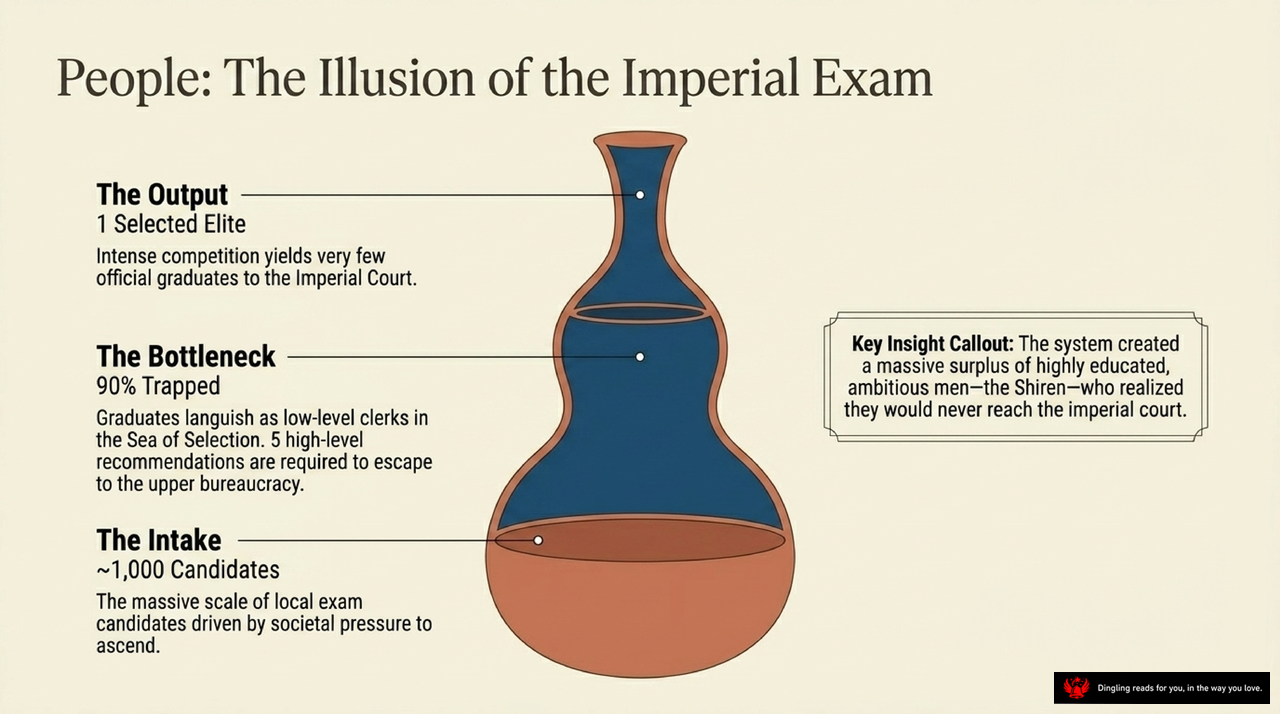
Ever felt like you’re caught in a rat race—like applying to top colleges where thousands compete for a handful of spots, or vying for that dream job with hundreds of applicants? The Song dynasty’s imperial exam system was the ultimate historical version of that, and it was full of illusions, as our slide here shows: “People: The Illusion of the Imperial Exam.”
Let’s break down this vase analogy. At the bottom, the wide base is the intake: around 1,000 candidates. Back then, societal pressure to climb the social ladder was intense—everyone bought into the idea that passing the exam was the only ticket to success. But here’s the harsh truth: most never make it past the narrow neck, the bottleneck. 90% of those who did pass the exam got trapped as low-level clerks, stuck in what they called the “sea of selection.” To escape this bottleneck and move up to the upper bureaucracy, you needed five high-level recommendations—something nearly impossible for anyone without powerful connections.
And what about the top? Only one selected elite makes it to the imperial court. The competition was brutal—like in Fuzhou, 16,000 candidates fought for just 62 spots once. That’s why the key insight here hits so hard: this system created a massive surplus of highly educated, ambitious men called the Shiren. These guys realized they’d never reach the imperial court, no matter how hard they tried.
So many talented people were stuck at the bottom, which shifted the course of society. Instead of chasing that impossible dream of court positions, they started turning to other paths—teaching, farming, or becoming local leaders. It’s a reminder that even the most “promising” systems can leave most people behind, forcing them to carve out new ways to thrive.
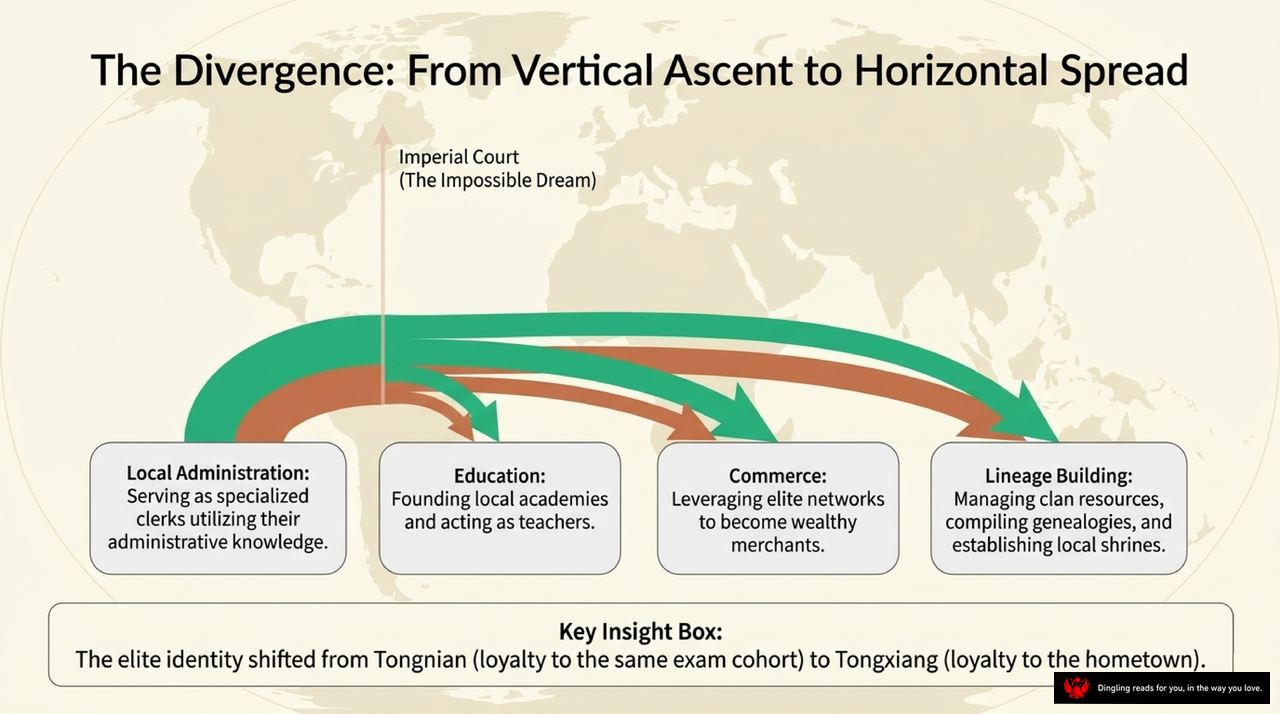
Take a look at this slide: The Divergence—From Vertical Ascent to Horizontal Spread. For most Song Dynasty scholars, the vertical climb to the imperial court was an impossible dream. So instead of fixating on that distant, out-of-reach goal, they turned their attention to four horizontal paths right in their local communities.
Some put their administrative expertise to use as specialized clerks in local government, serving their hometowns with the skills they’d learned. Others dedicated themselves to education: founding local academies and taking on teaching roles to pass knowledge to the next generation. There were those who ventured into commerce, leveraging their elite social networks to become prosperous merchants. And many focused on lineage building—managing clan resources, compiling family genealogies, and setting up local shrines to strengthen community bonds.
The key insight here is a shift in elite identity. Before, their loyalty was tied to Tongnian—fellow scholars who passed the same imperial exam cohort. But now, their loyalty shifted to Tongxiang, their hometown. This wasn’t just a change in where they lived; it was a fundamental shift in where they rooted themselves and invested their energy. They were no longer just chasing a position in the capital—they were building up their local areas, laying the groundwork for the social transformations that would unfold in the Yuan and Ming dynasties. This divergence marked a turning point in how scholars saw their role in society, moving from a narrow focus on court advancement to a broader commitment to their local communities.
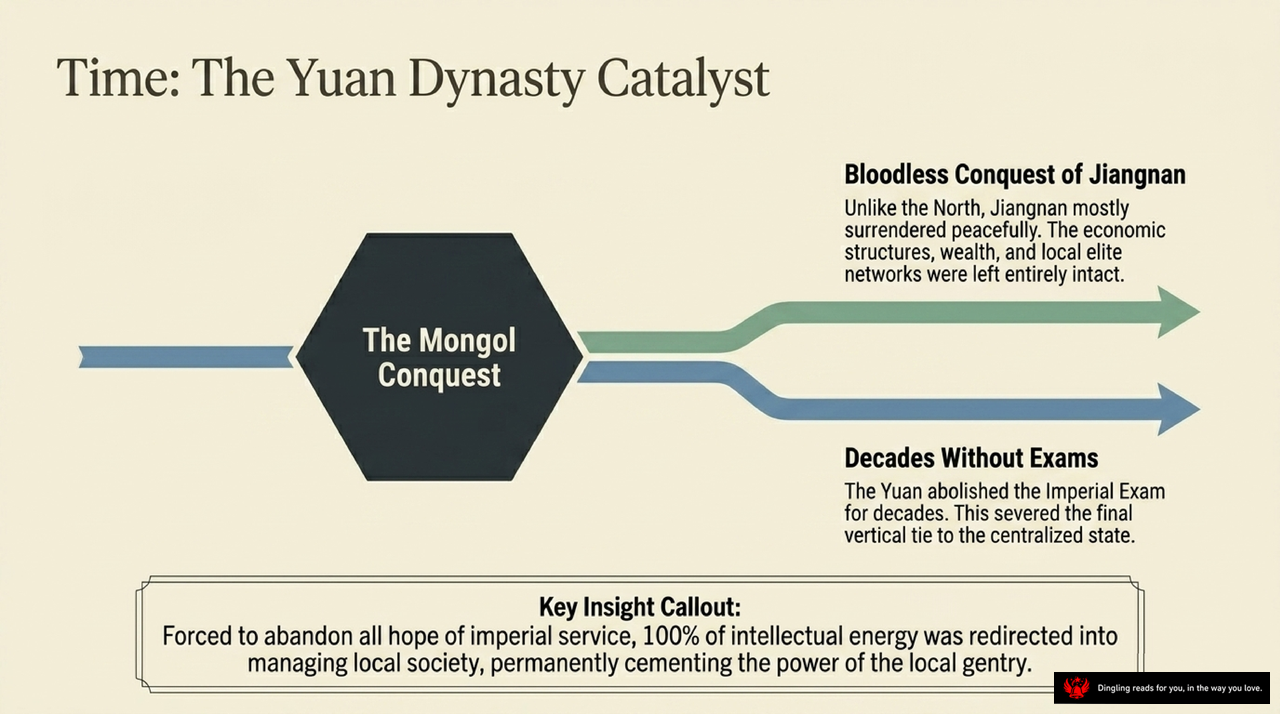
Today, we’re diving into how the Yuan Dynasty acted as a catalyst for some major shifts in Chinese society. Let’s start with the Mongol Conquest. When the Mongols took over, their approach to Jiangnan—China’s wealthy southern region—was pretty unique. Unlike the north, where there was heavy fighting, Jiangnan mostly surrendered peacefully. The Mongols left the area’s economic structures, its wealth, and even the local elite networks untouched. That meant the region’s prosperity and social fabric stayed intact, which was crucial for what came next.
Then there’s the game-changer: Decades Without Exams. The Yuan Dynasty did away with the Imperial Exam for years. For generations, this exam had been the golden ticket for scholars to join the government. So when it was gone, that final connection between intellectuals and the central state was severed.
So what did all those educated people do? They couldn’t pursue official careers anymore, so they turned their full intellectual energy to their local communities. They started managing local affairs, leading community projects, and building up their influence right at home. This shift didn’t just affect their lives—it permanently cemented the power of the local gentry. Those local leaders became the backbone of their towns and villages, and this change shaped how Chinese society operated for hundreds of years after that. It’s amazing how one dynasty’s decisions could redirect the course of intellectual life and community power in such a lasting way.
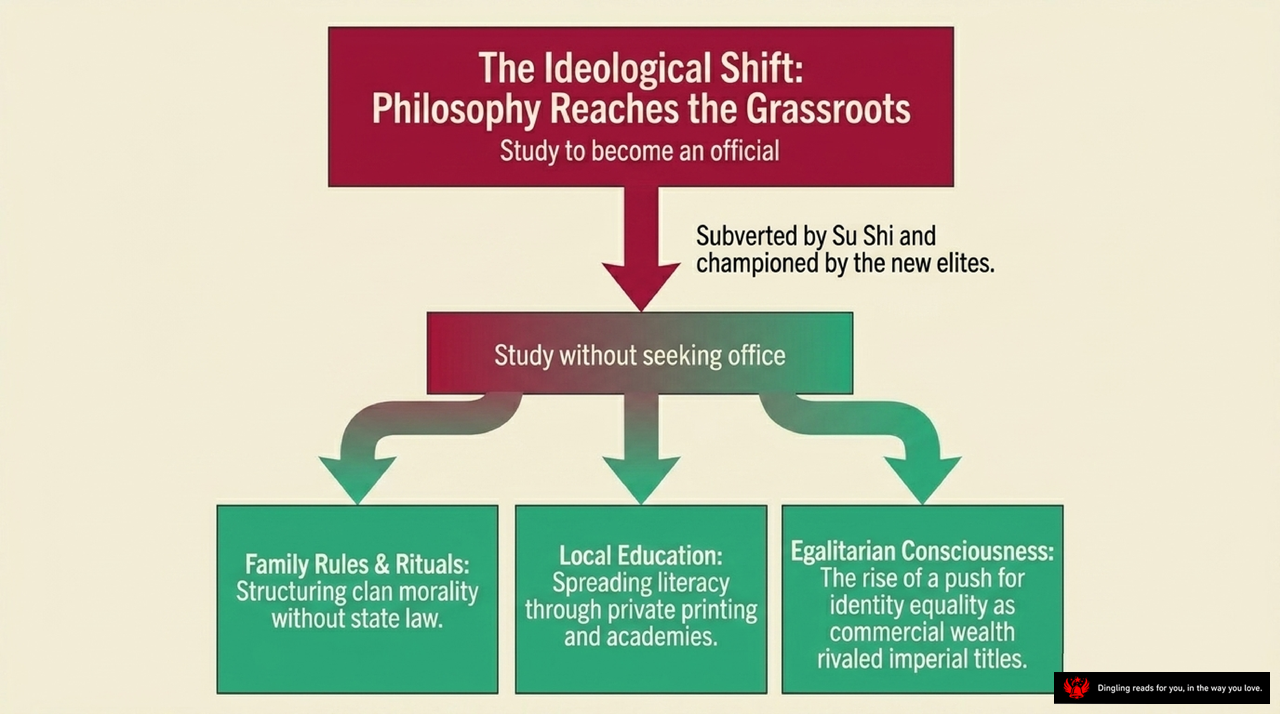
Let’s dive into today’s core theme: The Ideological Shift—Philosophy Reaches the Grassroots. For ages, the unwritten rule for scholars was “Study to become an official”—that was the only way to move up in society, right? But this mindset started to crack, thanks to voices like Su Shi and a new wave of forward-thinking elites.
Su Shi, the iconic Song poet and thinker, once told his nephew: “Don’t study just to get rich, don’t read only to land a government job.” That was a game-changer. And many new elites ran with this idea—they realized there was more to life than chasing a bureaucratic title.
So what came out of this shift? Three key developments. First, Family Rules & Rituals: Scholars began structuring clan morality without relying on state law. Texts like Zhu Xi’s *Family Rituals* gave families a roadmap to govern themselves—from weddings to funerals—rooted in Confucian values but tailored to local needs, no government interference needed.
Second, Local Education: With fewer official spots available, scholars turned to spreading literacy through private printing and academies. They set up schools in their hometowns, taught kids who’d never had a chance to learn, and kept knowledge alive at the grassroots level.
Third, Egalitarian Consciousness: As commercial wealth boomed, it started to rival imperial titles. A successful merchant could now have the same status as a low-ranking official, blurring old class lines and pushing for a more equal sense of identity.
All these changes meant philosophy wasn’t just for the court or the elite anymore—it seeped into every corner of society, reshaping how people lived, learned, and connected with each other. This wasn’t just an ideological shift; it was a revolution that brought ideas down to the people.
Hey everyone, let’s talk about the transition from the Song to Yuan dynasties. Most of us might picture it as a dark, stagnant period—but as our slide points out, it was actually a vital crucible that shaped early modern China.
Back in the Southern Song, even if you managed to pass the brutal imperial exam (thousands competing for just a few spots), you’d often get stuck in the “sea of selection”—the bottom layers of bureaucracy where moving up was nearly impossible. Years of hard work, and you’re still a low-level official with no way forward.
So these frustrated intellectual elites did something unexpected: they shifted horizontally. They moved to Jiangnan, the thriving southern region, and left their dreams of imperial power behind. Instead, they became powerful local gentry—building schools, managing community resources, setting up local norms. These are the people who laid the grassroots structures that defined China for centuries, through the Ming and Qing.
Now, here’s the slide’s big question: If early modern China’s bedrock wasn’t built in the halls of imperial power but in local villages by these disillusioned elites locked out of the system… where are the unseen architects of our next great societal transformation today? Are they in small towns, community projects, or places we’re not looking? That’s a question worth pondering, don’t you think?