
Security Analysis: Complete Chapter-by-Chapter Summary

Welcome to the definitive guide on how to stop gambling with your money and start investing with discipline. Today, we are looking at the cornerstone of modern finance: *Security Analysis* by Benjamin Graham and David Dodd. As the title suggests, this isn't about predicting the future or chasing hot tips; it's about rigorous, scientific valuation. Think of it as the blueprint that transformed investing from a chaotic game of chance into a reliable profession based on facts and logic.
The core idea is simple yet revolutionary: you must distinguish between the market price, which is often driven by panic or greed, and the intrinsic value, which is grounded in the company's actual assets and earnings. You don't need to calculate the exact value of a stock, just like you don't need to know a woman's exact age to know if she is old enough to vote. You only need to be sure she meets the requirement. Similarly, you just need to know if a stock's price is low enough to offer a margin of safety.
However, this path isn't without obstacles. Markets are often irrational, acting like a voting machine in the short term rather than a weighing machine. Data can be incomplete, and the future is inherently uncertain. That is why professional analysis is non-negotiable. It allows you to cut through the noise, identify when a stock is genuinely undervalued, and protect your capital when the market turns against you. This book teaches you how to build a fortress around your investments, ensuring that even when the world goes crazy, your portfolio remains secure.
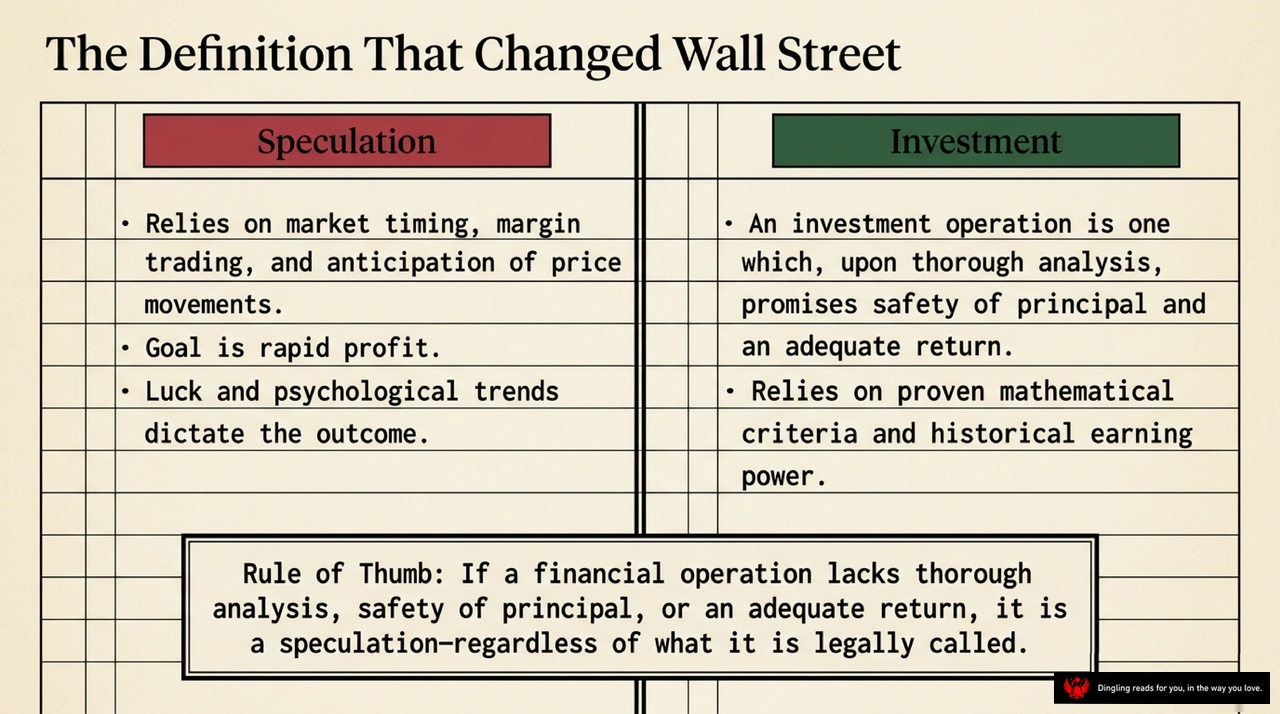
The definition that changed Wall Street isn't about the name on a certificate, but about the math behind the decision. As we see on this slide, the line between speculation and investment is razor-thin, yet the consequences are worlds apart.
On the left, you have **Speculation**. This isn't about analyzing a company's future; it's a gamble on timing. It relies on margin trading and guessing where prices will go next. The goal? Rapid profit, often driven by luck or psychological trends. If you're betting on a market crash or a sudden spike without knowing the underlying value, that's speculation.
On the right, we have **Investment**. This is the only path where professional analysis actually matters. An investment operation is one that, after thorough analysis, promises the safety of your principal and an adequate return. It doesn't rely on luck; it relies on proven mathematical criteria and historical earning power.
Here is the golden rule at the bottom: If a financial operation lacks thorough analysis, safety of principal, or an adequate return, it is speculation—regardless of what it is legally called. Many people buy "stocks" thinking they are investing, but if they bought them at a price that destroys their capital, they are speculating. True investment requires a deep understanding of the asset's value, not just a hope for a quick gain.

Think of security analysis as a three-part machine, where each gear drives the next. The first gear is **Descriptive**. It's all about gathering facts and presenting the vital data of a security—like assets, earnings, and dividends—in a clear, cohesive manner without any bias. This is the foundation; you can't make a good decision without first understanding the raw reality of the numbers.
Once you have those facts, the machine moves to the second gear: **Selective**. This is where you start making judgments. You aren't just looking at what happened; you are determining whether to buy, hold, or sell based entirely on comparative value rather than just following market sentiment. It's about asking, "Is this actually worth what it's selling for?"
Finally, the third gear engages: **Critical**. This step protects the investor. It involves auditing corporate policies, checking accounting methods for fairness, and evaluating management decisions to ensure your capital is truly safe. Together, these three gears—Descriptive, Selective, and Critical—form the complete anatomy of analysis, turning raw data into a robust investment strategy.

The chart on your screen perfectly captures a fundamental truth about investing: we often chase the "illusion of exact value," but the market rarely works like a precise scale. As the slide illustrates, the market is actually a "highly emotional voting machine," not a weighing machine. While the green band represents the "Range of Approximation" for intrinsic value—derived from real assets, earnings, and dividends—the actual market price jitters wildly above and below it due to human emotion.
This is why you don't need a perfect scale to know if someone is overweight; you just need to know if they are significantly over the limit. Similarly, an analyst doesn't need to calculate the exact dollar value of a stock. Instead, the goal is simply to determine if the value is "adequately higher or lower" than the current price. If the market price is far below that range of approximation, the opportunity is clear, regardless of the precise number. By focusing on this relationship rather than getting lost in exact calculations, you avoid the trap of thinking the market has found the one true price, when in reality, it's just reacting to the collective mood of the moment.

Imagine the market not as a precise machine, but as a voting machine where human emotion often overrides logic. As we see on this slide, this "Market Irrationality" is one of the three biggest hazards investors face. The danger here is clear: prices can drift incredibly far from their true underlying value, and the correction might take a long time—or worse, the value itself might change before the price finally snaps back.
So, how do we navigate this? The slide suggests a powerful countermeasure: demand an unbreakable Margin of Safety. This isn't just about buying cheap; it's about ensuring that even if the market stays irrational for years, or if the company's fundamentals shift, your investment remains secure. While the other two hazards—Inadequate Data and Future Uncertainty—require us to scrutinize reports and rely on industry stability, dealing with market irrationality requires a different mindset. It means accepting that you might be right while the world is wrong, and having the discipline to stick with your analysis until the odds inevitably shift in your favor.

When we talk about selecting fixed-value investments, the process is fundamentally one of elimination. To avoid the traps that nearly wiped out investors in the early 1930s, we must apply strict, non-negotiable safety standards to filter out anything that doesn't qualify. Think of it as a rigorous vetting process where the goal isn't just to find a bond, but to find a bond that can survive a depression.
First, let's address a common misconception regarding bond security. Many believe that a bond is safe simply because it has a specific type of collateral, like a first mortgage. However, history proved this dangerous. When a company fails, the value of its assets often collapses, and legal delays in liquidation can turn a seemingly secure asset into worthless paper. True safety doesn't come from the legal priority of your claim; it comes from the company's actual ability to pay. A strong, unsecured bond from a healthy giant is far safer than a mortgaged bond from a struggling company.
Second, you must always evaluate bonds based on how they would perform during a depression, not during a boom. A bond that looks perfect in good times might be worthless when earnings shrink. We need to look at the industry's stability and the company's "margin of safety"—the buffer between its earnings and the interest it must pay. For example, while a railroad might need a safety margin of two times its interest to be safe, an industrial company might need three times that buffer to withstand the same shock.
Third, and perhaps most counter-intuitively, chasing high yields by sacrificing safety is a guaranteed path to ruin. The idea that high interest rates automatically compensate for high risk is mathematically flawed and emotionally dangerous. You cannot trade your principal for a higher coupon. If a bond offers a tempting return but lacks a solid safety margin, it is essentially a speculative gamble, not an investment.
So, how do we actually screen for quality? We start by setting a hard floor for safety. If a bond doesn't meet this minimum threshold, we reject it immediately, regardless of how high the yield looks. For instance, when looking at industrial bonds, which are inherently less stable, we shouldn't just look at the numbers; we should restrict our choices to the top six companies in the industry. Similarly, for municipal bonds, we shouldn't just rely on a country's past history; we should demand stricter quantitative tests for revenue coverage.
Finally, we must look closely at the specific terms and calculations. Don't be fooled by flawed methods that calculate safety for lower-priority bonds by ignoring the interest paid on senior bonds. Always use the "total deduction" method, which looks at the company's ability to pay *all* its interest obligations. We also recommend looking at a seven-year average of earnings rather than just the last year, to smooth out temporary fluctuations. By combining these principles—focusing on the company's true strength, testing against a depression scenario, refusing to trade safety for yield, and using rigorous, total-debt coverage ratios—you build a portfolio that stands firm when the market turns against you.
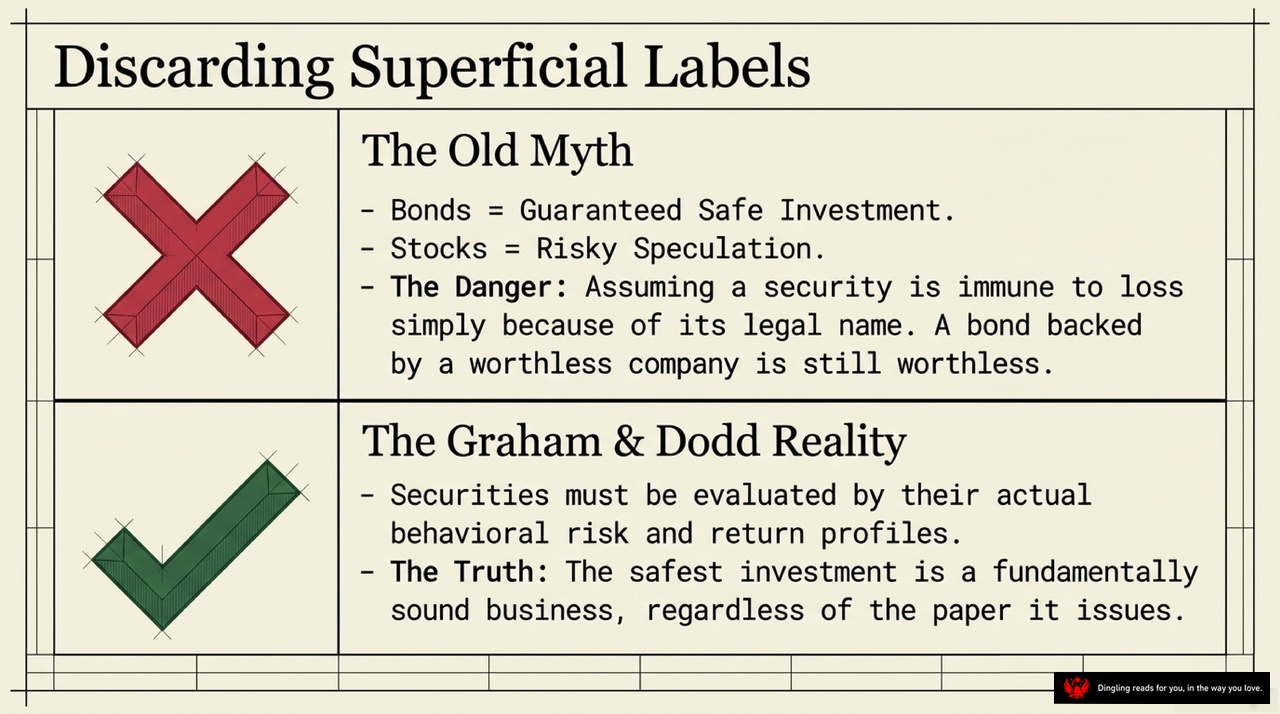
Most investors are taught to think of bonds as a "safe haven" and stocks as "risky speculation." This slide, titled "Discarding Superficial Labels," challenges that comforting but dangerous myth. The old belief that a bond is automatically safe simply because it's called a bond is a trap. As the text warns, assuming a security is immune to loss just because of its legal name is fatal. If a company is fundamentally worthless, its bond is worthless too, regardless of the "First Mortgage" or "Senior" label on the paper.
The reality, according to Graham and Dodd, is that you must evaluate securities by their actual behavioral risk and return profiles, not their titles. The safest investment isn't a specific type of paper; it's a fundamentally sound business. The slide illustrates this with a red X next to the "Old Myth" and a green checkmark next to the "Graham & Dodd Reality." It reminds us that while traditional textbooks classify bonds as safe and stocks as risky, the market doesn't care about these labels. What matters is whether the underlying business can generate enough cash to cover its obligations during tough times. A high-yield bond from a failing company is far riskier than a lower-yield bond from a resilient giant. So, before you buy, look past the name and analyze the substance.

Today's slide breaks down the "Behavioral Classification System," a framework that moves beyond the traditional labels of bonds and stocks to focus on what actually matters: the risk and return profile of your investment.
On the left, you see **Class I: Fixed-Value**. These are high-grade bonds and preferred stocks. Think of these as the "safe haven" of the portfolio. The goal here is absolute safety of your principal and steady, predictable income. You aren't buying these for a home run; you're buying them for a reliable, long-term ride.
In the middle is **Class II: Variable-Value Senior**. This category includes lower-grade bonds or convertibles. These carry noticeable risk, but they offer a crucial upside: the potential for capital appreciation if the company improves. It's a middle ground where you trade some safety for the chance of higher growth.
Finally, on the right, we have **Class III: Common-Stock Type**. Here, the investor acts as a direct business partner. You share in the maximum risk, but you also unlock unlimited upside potential. This is where the real wealth creation happens, but it comes with the highest volatility.
The key takeaway from this diagram is that the name of the security—whether it says "bond" or "stock"—doesn't define its true nature. What matters is how it behaves. A bond trading at a low price might behave like a stock, while a preferred stock in a strong company might act just like a bond. By understanding where your investment falls on this spectrum from Fixed to Variable, you can align your assets with your actual risk tolerance and goals.

Let's talk about the hidden traps in bond investing that most people miss. The slide on the left highlights a critical mistake known as the "Collateral Fallacy." It warns us that relying on specific collateral, like railways, factories, or bridges, is dangerous because if a business fails, the value of these physical assets can plummet instantly. Foreclosure is often costly and delayed, meaning bondholders rarely get paid in full. The image clearly shows this crumbling structure to illustrate that tangible assets aren't a reliable safety net.
In contrast, look at the right side of the slide, which emphasizes "Corporate Earning Power." True safety comes from the issuer's ongoing ability to generate cash flow and fulfill obligations seamlessly. This is the "Earning Power Reality." The rule at the bottom drives this point home: a primary bond from a weak company is infinitely worse than an unsecured bond from a dominant, highly profitable company.
So, here is the takeaway for your investment strategy: stop chasing collateral and start chasing earnings. Don't be fooled by a company's assets; focus entirely on its ability to keep printing money. A strong, profitable company can handle unsecured debt better than a struggling one with full collateral. This shift in perspective is the key to protecting your capital and finding truly safe investments.

Rule 2: Surviving the Worst. Think of your investment portfolio not as a snapshot of today's boom, but as a stress test against history's worst crashes. The chart on the left illustrates this perfectly: during a boom, prices soar, but your true safety lies in that green line—the "Safety Margin." You can't judge a security's strength during prosperous years; you must test it against the deepest busts. If your earnings stay well above that line even when the market crashes, you have a buffer. If they dip below, you're dangerously exposed.
On the right, we see the "Hierarchy of Stability." Not all industries are created equal. Public utilities sit at the top; they are the most stable, least impacted by sudden demand shocks. Below them are railroads, moderately stable but still vulnerable. At the bottom are industrial companies, which are the least stable and highly susceptible to sudden economic collapse. The lesson is clear: different industries require different safety margins. A 30% drop might be a routine correction for a utility but a catastrophic failure for a cyclical industrial firm. So, don't just look at the current price; look at the depth of the moat protecting your capital when the storm hits.
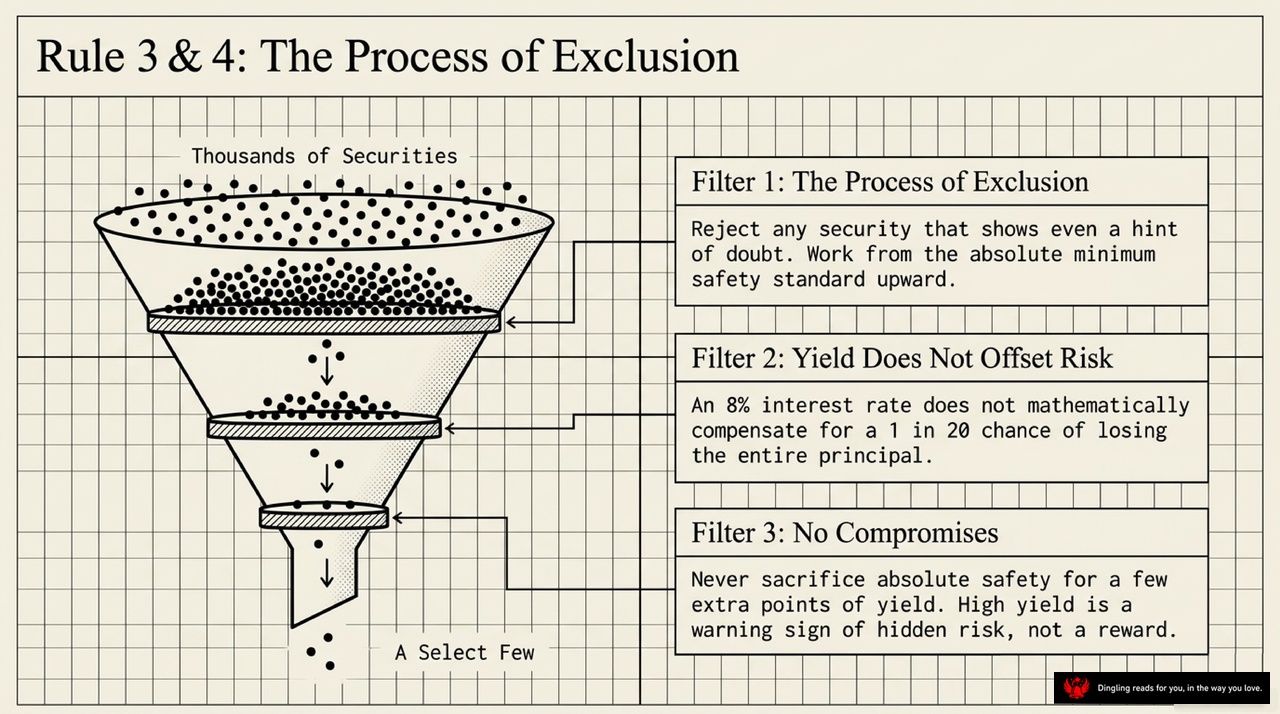
Think of investing as a high-stakes funnel. At the top, you have thousands of securities pouring in, but by the time they reach the bottom, only a select few remain. This slide perfectly illustrates the rigorous "Process of Exclusion" that defines true investing.
The first filter is about doubt. If there is even a hint of uncertainty, you reject the security immediately. We don't just look for safety; we work from an absolute minimum safety standard upward. If you can't be 100% sure, it doesn't belong in your portfolio.
Next, we face a critical reality check: Yield Does Not Offset Risk. Just because a bond offers an 8% interest rate doesn't mean it's safe. Mathematically, that 8% cannot compensate for a 1 in 20 chance of losing your entire principal. High yield is often a warning sign of hidden danger, not a reward. Never sacrifice absolute safety just to chase a few extra percentage points.
Finally, we apply the rule of "No Compromises." We are not here to gamble. We are here to find a select few securities that offer both safety and a reasonable return. If a security fails any of these three filters, it is excluded. This disciplined approach ensures that what remains at the bottom of the funnel is truly worthy of your hard-earned money.

Setting the Minimum Standards is where we move from theory to the hard reality of bond investing. This slide outlines the non-negotiable rules we use to filter out risky securities before we even look at the numbers.
First, look at "The Method." We always calculate coverage based on Total Deductions—that means all fixed charges, not just senior interest. Why? Because a weak junior bond can threaten the entire corporate structure. If the company can't pay everyone, the senior bonds go too. We also calculate this over a 7-year average, including the worst years, to ensure we aren't just looking at a lucky streak.
Now, "The Minimum Standards." These are our red lines. For Public Utilities, we need a minimum 1.75x Earnings-to-Interest. For Railroads and Transport, it's stricter at 2.00x. And for Industrials, which are inherently more volatile, we demand a minimum 3.00x.
Finally, pay close attention to the "Bottom Rule" highlighted at the bottom. If a security fails this ratio, we reject it. There are no exceptions for good qualitative prospects. No matter how great the management or the industry looks, if the math doesn't pass these minimums, the security is out. This discipline protects us from the very real possibility of total loss.

True investing isn't about gambling on market psychology; it's a meticulous process of determining intrinsic value, demanding an unbreakable margin of safety, and systematically excluding risk regardless of the promised yield. Think of the market as an irrational voting machine designed to tempt us with daily price fluctuations. The real question is: do you have the discipline to ignore the crowd and rely entirely on the math?
This slide captures the essence of our entire discussion. Instead of chasing the noise, we must focus on the facts. As we've explored, this means rigorously analyzing a company's ability to survive a downturn, ensuring its earnings comfortably cover its interest obligations, and verifying that its debt levels are sustainable. We look for that "margin of safety"—the gap between what a stock is worth and what it's selling for.
When the market panics and prices crash, that's when the math works in your favor. But only if you've done the homework. You need to know the difference between a solid business with a temporary setback and a fundamentally broken company. True investing requires you to be the calm counterweight to the emotional crowd, sticking to your analysis even when everyone else is running for the exit. It's about protecting your capital first, and letting profits follow from that solid foundation.