
Seeing Like a State: Complete Chapter-by-Chapter Summary
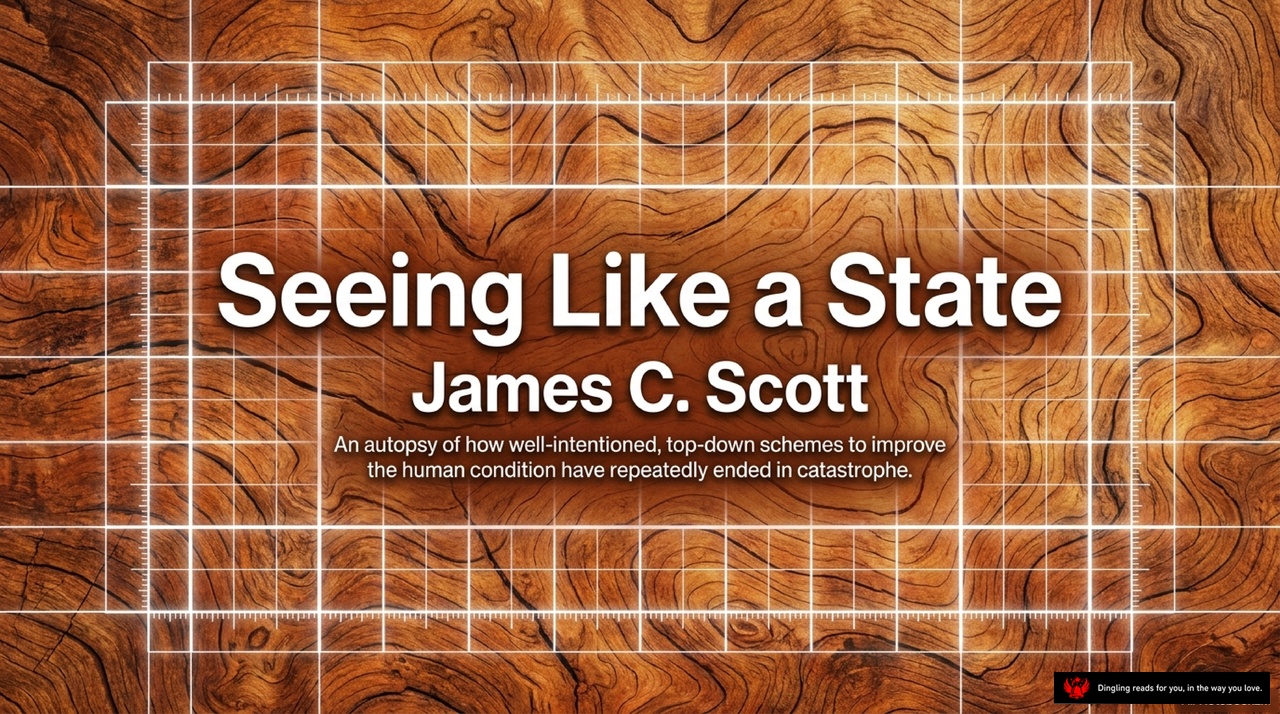
Welcome to our book club session on *Seeing Like a State* by James C. Scott. Today, we're diving into a powerful concept that challenges how we think about progress and control.
The cover image beautifully captures the book's essence: a wooden texture overlaid with a rigid, white grid. This visual metaphor represents the central argument of the book—an autopsy of how well-intentioned, top-down schemes to improve the human condition have repeatedly ended in catastrophe.
Scott argues that when states try to simplify complex realities into clear, manageable systems, they often cause unintended harm. Think about forests. For centuries, local communities saw forests as complex ecosystems providing fuel, food, and medicine. But the state viewed them only as "fiscal forests"—resources to be measured, counted, and maximized for profit. This led to the creation of uniform, industrial plantations that were easy to manage but ecologically fragile, eventually causing soil depletion and mass forest deaths.
This logic of simplification extends far beyond nature. The state needs to turn messy, diverse social life into something legible and controllable. It does this by imposing standardization—whether that's uniform land measurements, fixed surnames, or a single official language. While this makes governance easier for the state, it often destroys local knowledge, cultural diversity, and the very resilience of the communities it claims to help.
In short, *Seeing Like a State* teaches us that the drive for clarity and control often blinds us to the complexity and richness of real life, leading us down a path where the pursuit of order creates chaos.
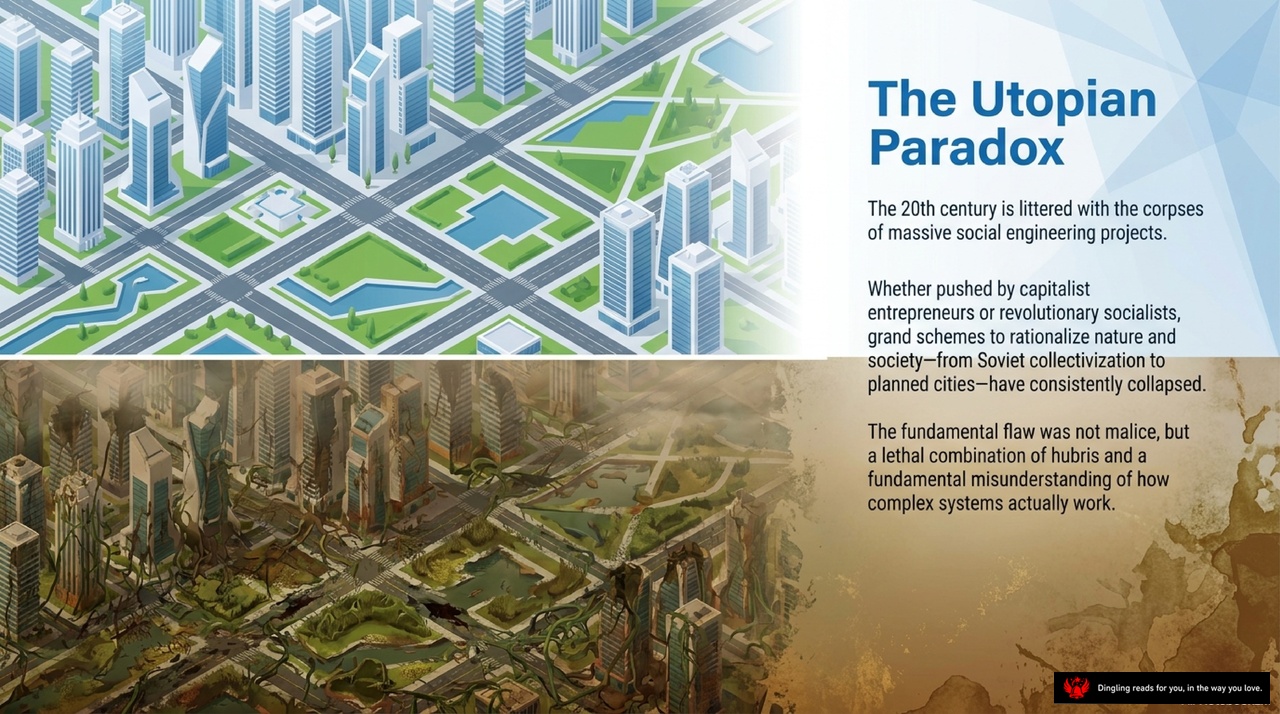
The 20th century was littered with the corpses of massive social engineering projects. Whether driven by capitalist entrepreneurs or revolutionary socialists, grand schemes to rationalize nature and society—from Soviet collectivization to planned cities—have consistently collapsed.
The image you see perfectly captures this tragic irony. On the top, we have the pristine, orderly ideal: a geometric grid of skyscrapers and parks, representing the "Utopian" promise of control. But below it, the reality has crumbled. Nature has reclaimed the city; vines strangle the buildings, and the structured landscape has devolved into chaos. This isn't just a visual metaphor; it's the historical outcome of trying to force complex systems into simple boxes.
The fundamental flaw wasn't malice. It was a lethal combination of hubris and a fundamental misunderstanding of how complex systems actually work. When planners tried to simplify the world—whether by turning forests into single-crop timber farms or cities into sterile machine-like grids—they stripped away the very complexity that allowed those systems to survive. They traded resilience for efficiency, and in doing so, they engineered their own failure.
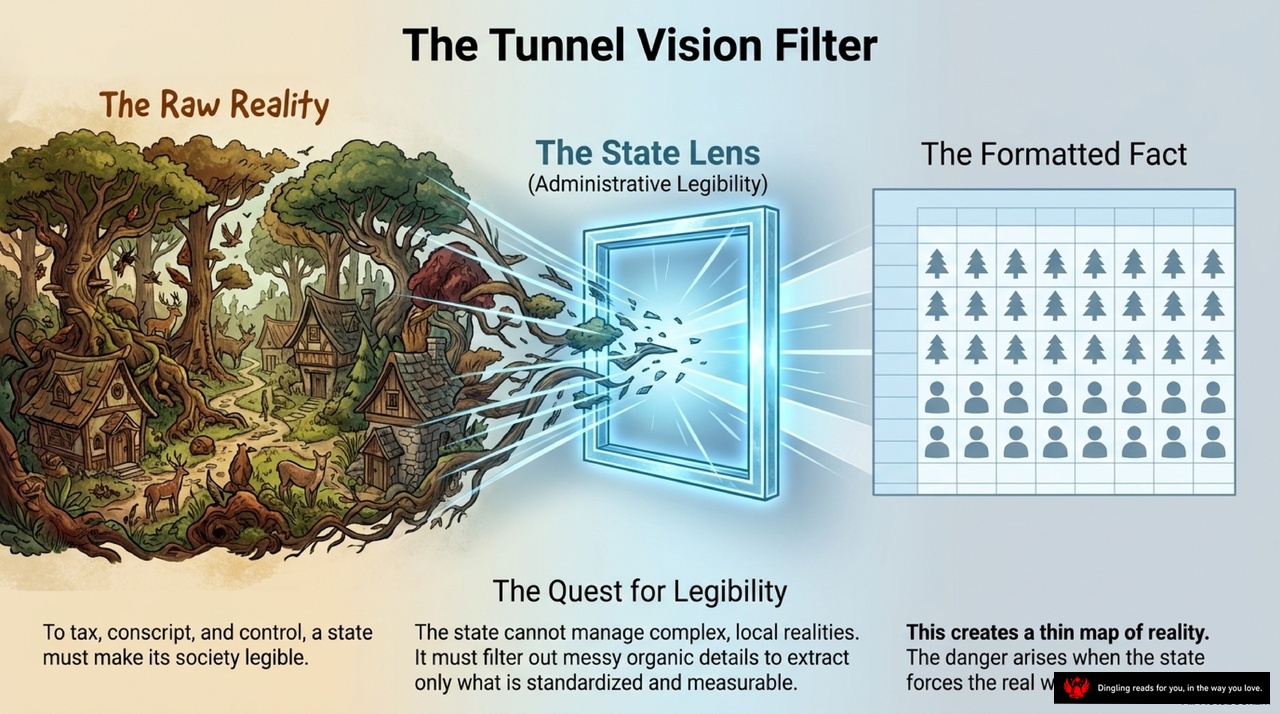
The slide illustrates a powerful concept known as the "Tunnel Vision Filter," a mechanism where the state distorts raw reality into manageable facts. On the left, we see "The Raw Reality"—a complex, organic forest teeming with diverse life, local homes, and intricate ecological relationships. This is the messy, vibrant world as it truly exists. However, the state cannot easily govern such chaos. To tax, conscript, and control, it needs order. This is where "The State Lens" comes in. Represented by the blue prism labeled "Administrative Legibility," this lens filters out the unmeasurable details. It strips away the unique trees, the animals, and the cultural nuances, reducing them to standardized data points.
On the right, we see the result: "The Formatted Fact." The complex forest has been transformed into a grid of identical icons—uniform trees and generic human figures. The state has created a "thin map of reality," a simplified version that is easy to count and manage but fundamentally disconnected from the truth. The text on the slide highlights the core problem: the state forces the real world into a rigid, standardized shape. While this simplification boosts efficiency for the government, it ignores the ecological and social complexities that actually sustain life. This "tunnel vision" doesn't just happen in forests; it permeates how nations handle everything from land ownership to language, systematically erasing the diversity and autonomy of local communities in favor of a clear, controllable, but ultimately fragile official narrative.

The equation of disaster isn't just a random accident; it's a specific formula. When you look at this slide, you see four distinct ingredients that, when combined, create catastrophe. It starts with Administrative Ordering—taking a messy, complex world and forcing it into rigid, simplified boxes. Then comes High-Modernist Ideology, the dangerous belief that science and technology can solve everything if we just apply the right logic. Add to that an Authoritarian State with the power to enforce these plans without question, and you have a Prostrate Civil Society—people who have lost the ability to resist or offer feedback.
This is the trap. Disasters don't happen because of one thing. They happen because the state simplifies nature and society into manageable numbers, arms that simplification with coercive power, and unleashes it on a population that has been stripped of its agency. We've seen this play out time and time again, from the Soviet Union's forced collectivization to Tanzania's village resettlement projects. In every case, the planners believed they were building an efficient, rational utopia. But by ignoring the messy, unpredictable reality of human life and local ecosystems, they built fragile systems that eventually collapsed under their own weight. The blueprint was perfect on paper, but it shattered in the real world.
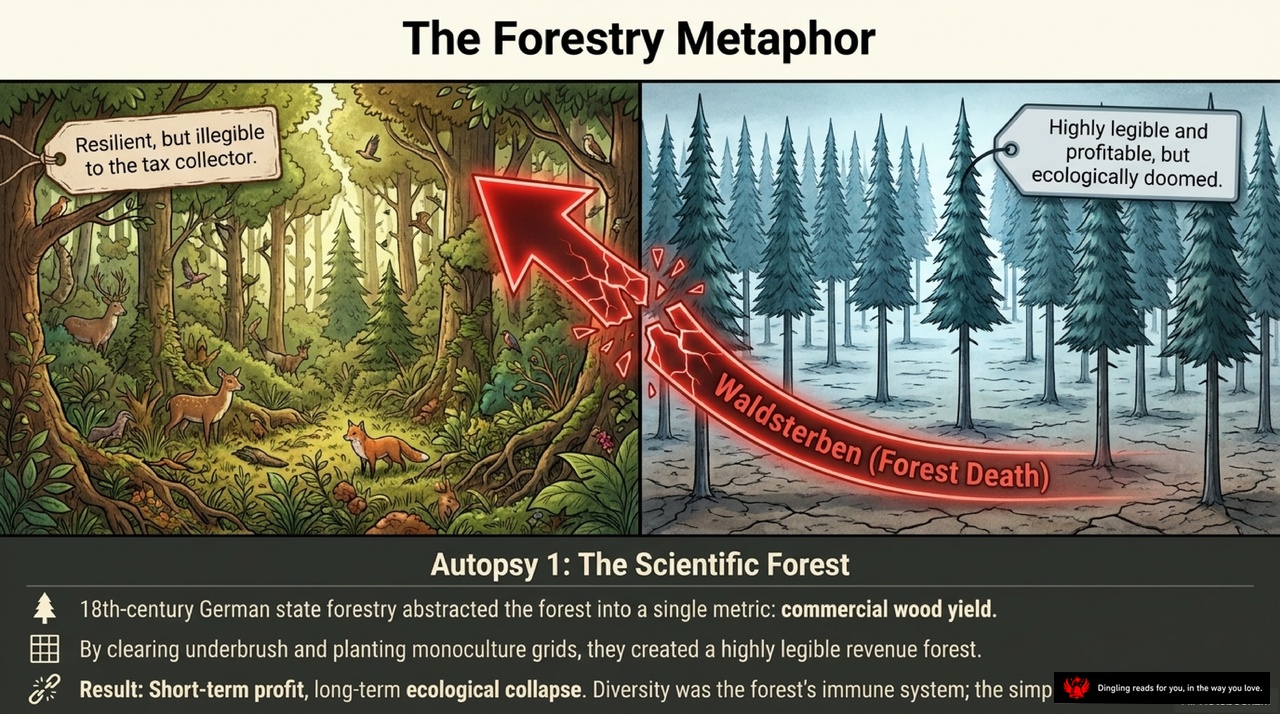
The image on your screen, "Autopsy 1: The Scientific Forest," perfectly illustrates the dangerous allure of simplifying complex systems for the sake of control. On the left, we see a resilient, diverse forest—rich with life, animals, and hidden value. But to the 18th-century German state foresters, this complexity was a problem. It was "illegible" to the tax collector. They couldn't easily measure or profit from it.
So, they made a radical choice: they stripped the forest down to its single most profitable metric—commercial wood yield. By clearing underbrush, planting monoculture grids, and turning the wild landscape into a neat, factory-like production line, they created a "highly legible" revenue forest. As the slide notes, this approach was "highly legible and profitable" in the short term. It worked like a charm for decades, boosting timber output and state income.
But look at the arrow breaking in the middle. That's the turning point. This scientific simplification came at a terrible cost. By removing the forest's immune system—its biodiversity and ecological complexity—they created a system that was "ecologically doomed." The result, labeled in German as *Waldsterben* or "Forest Death," was a long-term collapse. Soil fertility plummeted, pests ran rampant, and the once-vibrant ecosystem died.
This isn't just a story about trees. It's a blueprint for modern governance. The state, much like those foresters, constantly tries to abstract the messy, diverse reality of human society into clear, standardized facts—whether it's land deeds, census data, or uniform laws. While this makes things easier to manage and tax, it often blinds us to the very systems that keep us alive. As we move forward, remember this lesson: when we sacrifice complexity for clarity, we might just be building a machine that destroys the very world it's meant to serve.
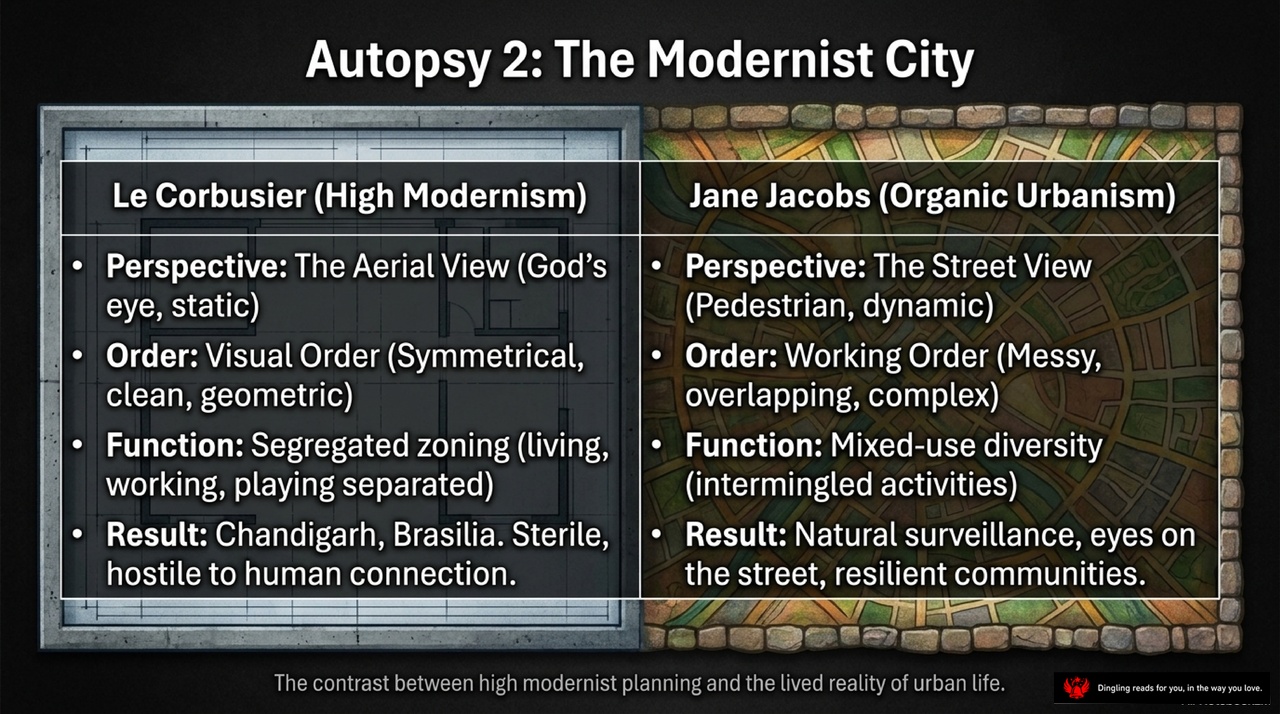
So, we've seen how the dream of the "Modernist City"—championed by Le Corbusier—collapsed under the weight of reality. The slide highlights the fatal clash between two visions: the sterile, top-down order of High Modernism versus the messy, organic vitality of Jane Jacobs' Organic Urbanism.
Le Corbusier believed in the "God's eye" view. He wanted to impose a static, geometric order on the city, treating it like a machine where living, working, and playing are strictly segregated. He famously called himself the "dictator" of the city, believing that only a single, rational authority could fix the "chaos" of the old world. The results? Brutalist masterpieces like Brasília and Chandigarh. On the surface, they look clean and efficient. But in practice, they created sterile environments hostile to human connection. By cutting out the streets and squares where real life happens, they erased the "eyes on the street" that make a community safe and resilient.
Then, we have Jane Jacobs, representing the street view. She argued that a city's true order is a "working order"—messy, overlapping, and complex. She championed mixed-use diversity, where shops, homes, and offices intermingle. This creates natural surveillance and fosters the spontaneous social networks that define a thriving city.
The tragedy of the Modernist city is that planners tried to design a perfect society from above, ignoring the lived reality of the people below. As we've seen with agricultural collectives and forced villagization, this top-down approach simply doesn't work. Real cities, like real forests, are ecosystems, not machines. They thrive on diversity and adaptability, not on rigid zoning and geometric perfection. The lesson is clear: you can't engineer a city the way you engineer a factory. You have to nurture the organic, unpredictable, and messy complexity that actually makes urban life possible.
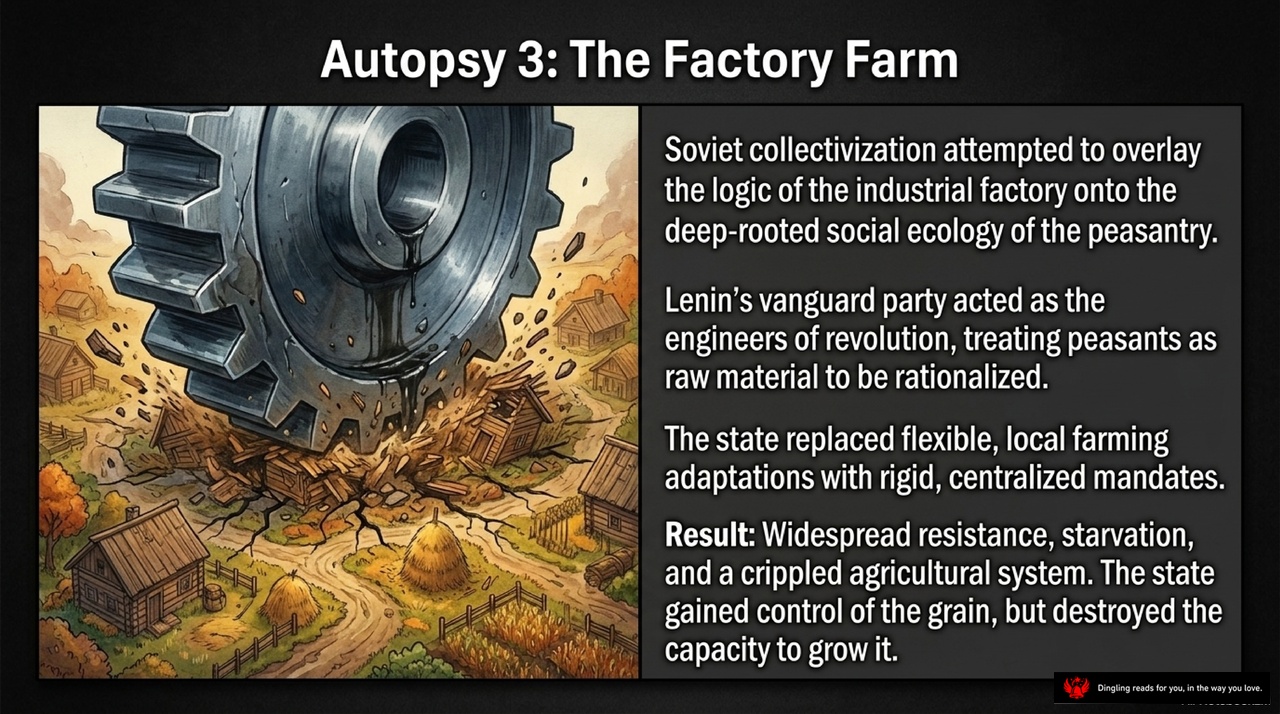
Autopsy 3: The Factory Farm. Look at this image. A massive, industrial gear is crushing a traditional village, scattering homes and hay bales into the dust. This visual perfectly captures the tragedy of Soviet collectivization.
The book explains that this wasn't just a policy change; it was an attempt to force the logic of an industrial factory onto the deep, organic social ecology of the peasantry. Lenin's vanguard party acted like engineers of revolution, treating peasants not as partners, but as raw material to be rationalized and processed.
The state replaced flexible, local farming adaptations with rigid, centralized mandates. It ignored the fact that Soviet agriculture spanned vast, diverse climates and soils. Instead, it tried to overlay a single, standardized model onto a complex reality.
The result, as the slide shows, was catastrophic. We saw widespread resistance, mass starvation, and a crippled agricultural system. The state gained control of the grain, but in doing so, it completely destroyed the capacity to grow it. This is the ultimate failure of extreme modernism: when you try to simplify a complex, living system into a machine, you don't get efficiency. You get a broken system that collapses under its own weight.
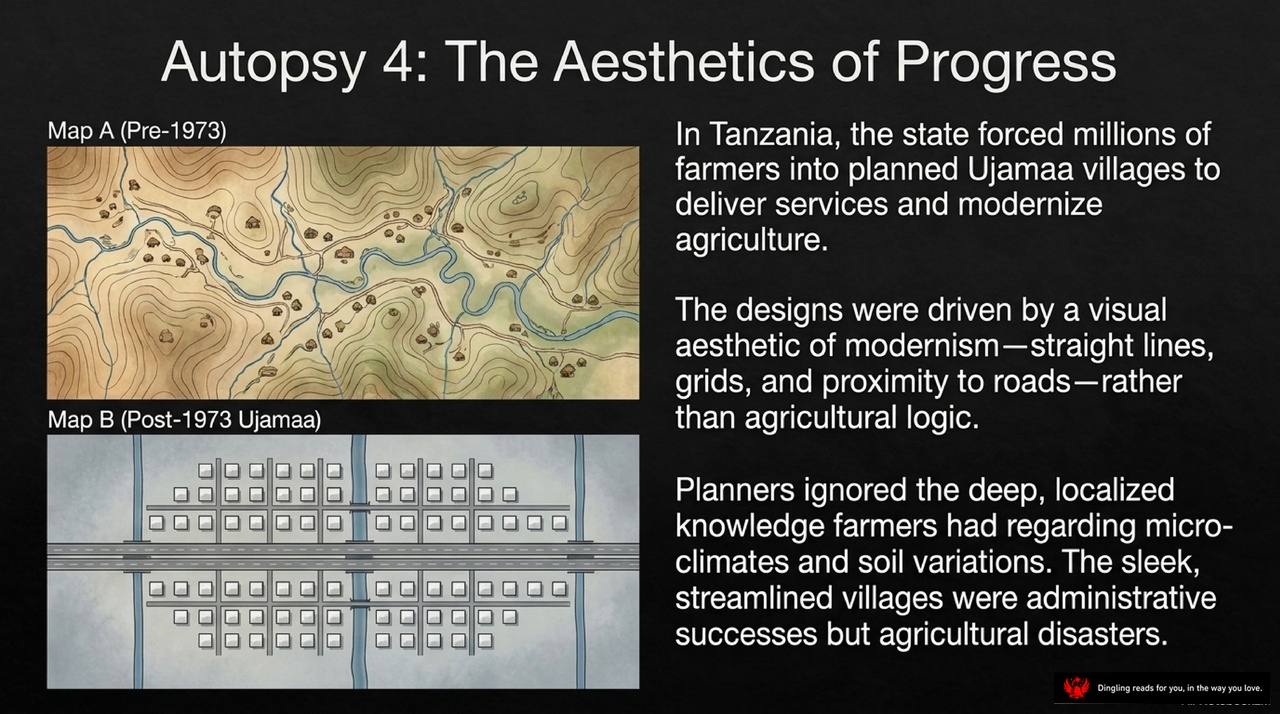
Autopsy 4: The Aesthetics of Progress. Look at these two maps. Map A shows Tanzania before 1973, a landscape of organic curves, winding rivers, and scattered homes that followed the land's natural logic. Map B shows what happened after the Ujamaa villages were forced into place. Suddenly, that organic terrain is replaced by a rigid, sterile grid of perfect squares and straight lines.
The text on the right explains the tragedy behind this visual shift. The state didn't move these farmers because of agricultural logic; they moved them because of an "aesthetic of modernism." The planners were obsessed with straight lines, grids, and proximity to roads. They wanted a sleek, streamlined village that looked efficient on paper, ignoring the deep, localized knowledge farmers had about micro-climates and soil variations.
The result was a classic failure of top-down planning. These villages were administrative successes—clean, orderly, and easy to count—but they were agricultural disasters. By forcing millions of farmers into these standardized boxes, the state destroyed the complex, resilient systems that actually fed them. This is the ultimate lesson of extreme modernism: when you prioritize a beautiful, simplified design over the messy, complex reality of human life, you don't build progress. You build a trap.

Have you ever wondered why the most rigid, "scientific" plans often crumble the moment they hit real life? Today, we're diving into the missing link that almost every modern planner, from foresters to urban designers, has overlooked: a concept called *Mētis*.
As you can see on the screen, *Mētis* isn't just a word; it's a living root system intertwined with our reality. It represents practical, local knowledge acquired through experience and adaptation. Think of it as the difference between reading a map and actually feeling the waves. A farmer doesn't just rely on a yield chart; they know the soil. A navigator doesn't just follow coordinates; they sense the current.
The image beautifully illustrates this. We have the "roots"—the deep, local practices that hold us up. We have "innovation adaptation," showing how we tweak things based on what works right now, not some abstract theory. And look at the vines labeled "hand knowledge" and "nature practices." These are the infinite variables of the real world that formal schemes simply cannot encode.
The tragedy of extreme modernism is that it tries to strip away all this complexity to create a clean, controllable blueprint. But as the slide warns, "The blueprint is brittle without the roots." When you ignore the messy, intuitive wisdom of *Mētis*—the kind of knowledge you can't write down in a textbook—you end up building structures that look perfect from above but fail the moment people try to live in them. True resilience comes from respecting the roots, not just drawing the lines.
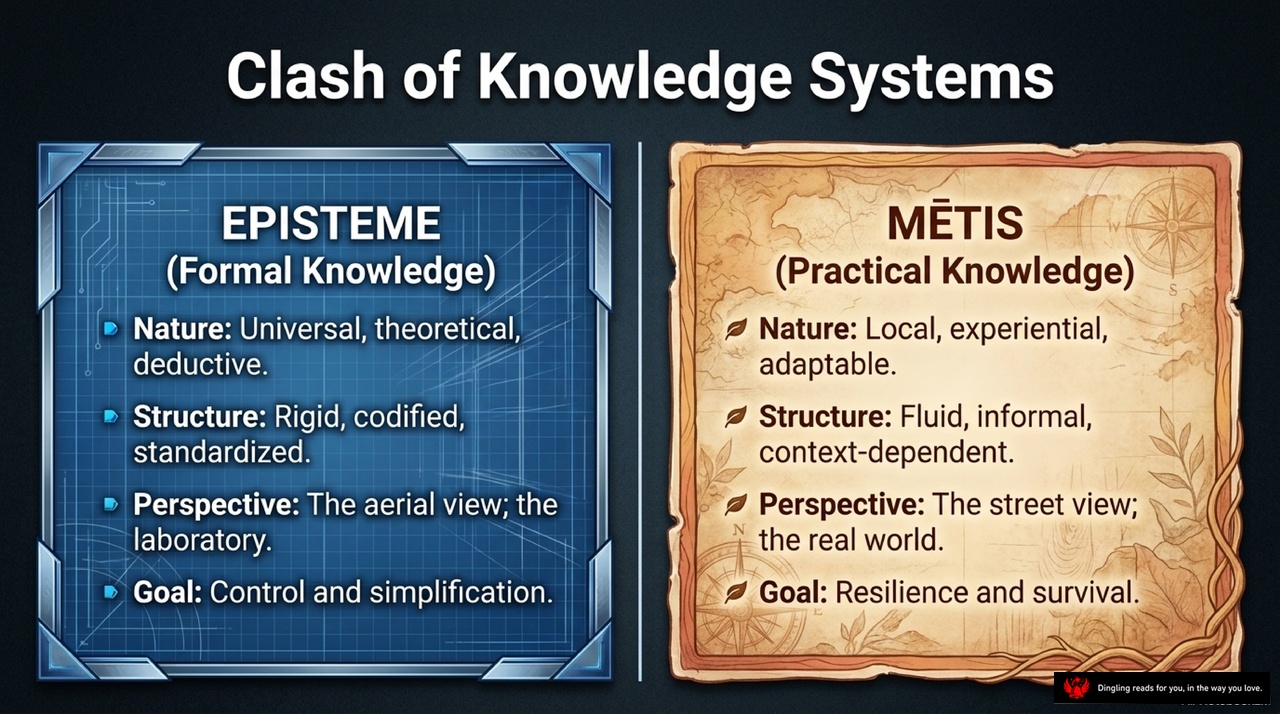
We've reached the final chapter, where we confront the core tension between two distinct ways of knowing the world: Episteme and Metis.
On the left, you see Episteme, or formal knowledge. It's universal, theoretical, and deductive—like the aerial view of a laboratory. It seeks rigid, codified structures to achieve control and simplification. Think of it as the blueprint of the modern state, the kind of thinking that turned forests into timber farms and societies into calculable machines.
On the right is Metis, practical knowledge. It's local, experiential, and adaptable—grounded in the street view of the real world. Its structure is fluid and context-dependent, designed not for control, but for resilience and survival.
The tragedy of the 20th century's extreme modernism was its obsession with Episteme while systematically erasing Metis. From the Soviet collective farms to Tanzanian village projects, planners tried to impose a single, simplified formula on complex, diverse realities. They ignored the farmer's intuition, the city's organic chaos, and the ecosystem's hidden resilience.
But as we've seen, when you strip away the messy, unpredictable details of life to fit a neat model, the system inevitably breaks. The real world always finds a way back. Metis isn't just an alternative to formal knowledge; it's the essential glue that holds complex systems together. True wisdom lies not in dominating nature with a perfect plan, but in learning from it, adapting to it, and respecting the intelligence that lives within it.

Look at this striking image: "The Parasite of Formal Order." It visualizes a powerful truth about how our systems actually work. Above the water, we see "Formal Order"—the rigid rules, plans, and grids that governments and corporations build. But beneath the surface, anchoring the entire structure, are the "Informal Order" roots: the *Métis*, the workarounds, and the local practices that people create on their own.
The slide makes a crucial point: formal plans do not exist independently. They are parasitic on informal processes. Think about it. Just as a "work-to-rule" strike can paralyze a factory by blindly following the official manual, any rigid social plan collapses if it's stripped of the improvisational skills of its people. Top-down planners often try to suppress these informal roots, unknowingly destroying the very foundation that keeps their system alive.
This is the lesson from the book: whether it's Soviet collective farms, Tanzanian village projects, or modern corporate structures, the most successful systems aren't the ones with the perfect blueprints. They are the ones that leave room for *Métis*—that intuitive, situational knowledge that allows people to adapt when things go wrong. Without those hidden, flexible roots, the beautiful structure above the water will eventually sink.
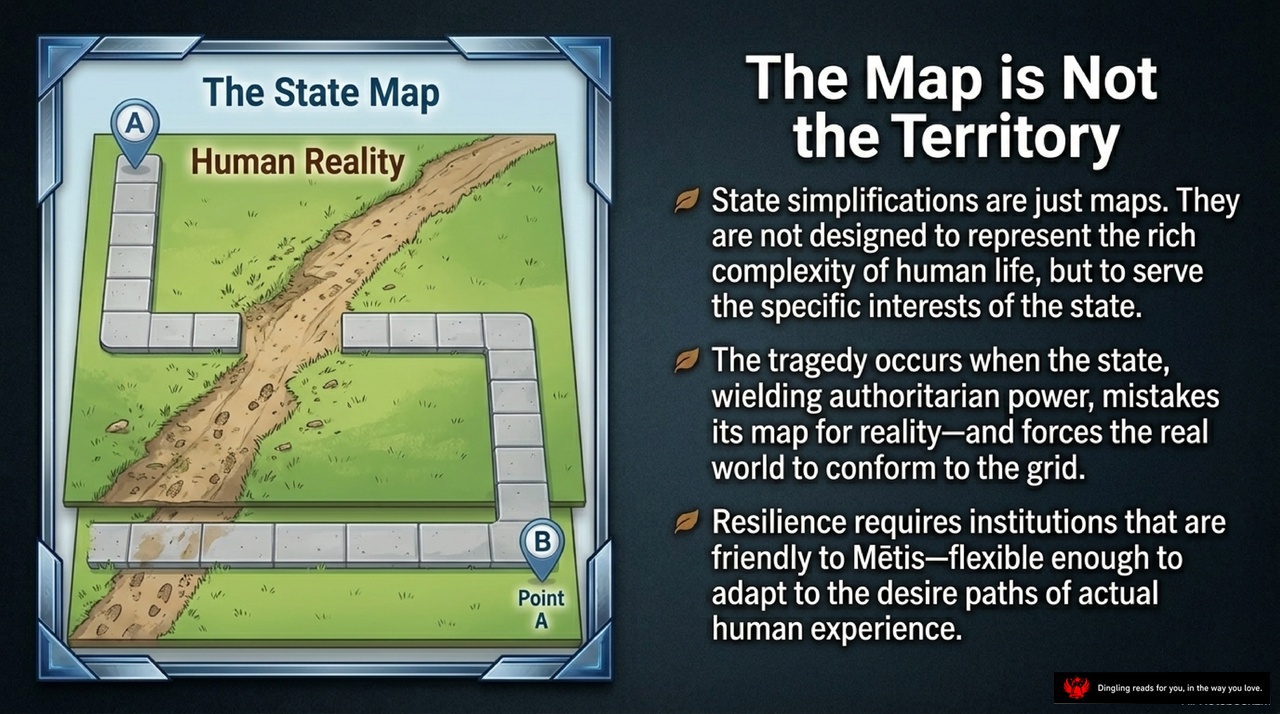
Look at this map on the left. It contrasts a rigid, grid-like path with the messy, winding reality of human life. The slide title, "The Map is Not the Territory," captures a profound truth: state simplifications are just maps. They aren't designed to represent the rich complexity of human life, but to serve the specific interests of the state.
The tragedy occurs when the state, wielding authoritarian power, mistakes its map for reality—and forces the real world to conform to the grid. We've seen this time and again, from Soviet collective farms to Tanzanian village projects. Planners tried to impose perfect geometric order on chaotic, living systems, ignoring local knowledge and ecological nuance. But as we learned, complex social and natural systems cannot be reduced to simple formulas.
True resilience requires institutions that are friendly to what we call Metis—flexible enough to adapt to the desire paths of actual human experience. Instead of forcing everyone onto a single, straight road, good governance should allow for the winding trails of real life. It's about creating space for local wisdom, improvisation, and the messy, unpredictable creativity that keeps society alive. When we stop treating people as data points on a chart and start respecting their lived reality, we build systems that don't just survive, but thrive.
The great tragedies of high modernism occurred when authoritarian states wielded rigid, simplified blueprints to reshape society, systematically crushing the local, practical knowledge (Mētis) required for true resilience. A successful society cannot be engineered like a machine; it must be cultivated like a complex ecosystem, blending formal planning with the messy, vital improvisations of human experience. If the pristine blueprint requires the suppression of human reality to survive, who exactly is the design serving?