
Self-Breakthrough: Complete Chapter-by-Chapter Summary
Welcome to the story of a life defined by courage, vision, and an unyielding belief in the power of ideas. Today, we turn our attention to a memoir titled *Self-Breakthrough*, written by Shi Yigong. This book is more than just a personal account; it is the inspiring journey of a realistic idealist who dared to forge entirely new paths in science and higher education.
Against a backdrop of cosmic wonder, Shi Yigong's story begins with a family deeply rooted in the fabric of China's history, from the revolutionary spirit of his grandmother to the sacrifices made for a better future. Born in 1967, his name, "Yigong," was chosen with a profound purpose: to serve the public heart and mind. His childhood was marked by resilience, navigating the challenges of the era while finding warmth in the simple kindness of strangers and the unwavering support of his father.
But this memoir is also about the relentless pursuit of excellence. From his early days in the classroom to his groundbreaking work in the United States, Shi Yigong embodies the spirit of innovation. He shares intimate details of his academic struggles, the joy of discovery, and the profound impact of mentorship, drawing inspiration from giants like Yang Zhenning and the late Wu Rui.
As we dive into his narrative, we see how he transformed personal adversity into a driving force for national progress. Whether it's the quiet dedication of a student or the bold vision of founding a new university, Shi Yigong's life teaches us that true breakthroughs come from combining deep knowledge with a commitment to serve society. Join us as we explore the chapters of his life, where every challenge was a stepping stone toward a brighter future for science and education.

Imagine standing beneath the vast, star-filled canopy of the cosmos, feeling the weight of a 13.8-billion-year journey. This is our macro perspective—the grand timeline of the universe. But here is the mind-bending truth: every single atom in your body, from the beat of your heart to the air you breathe, was forged in the fiery hearts of ancient stars, under unimaginable heat and pressure. This is the micro origin of us all.
When we connect these two realities—the vast cosmic history and our tiny atomic beginnings—a profound synthesis emerges. Recognizing that we are literally made of stardust doesn't just satisfy curiosity; it transforms how we live. It dissolves the paralyzing fear of failure. If our bodies are the debris of dying stars, then our fleeting lives are not a mistake, but a miracle. This realization fuels a relentless, unstoppable drive to create lasting value during our brief existence. We are the universe experiencing itself, and that is a responsibility we cannot afford to ignore.

Today's slide reveals the three-dimensional anatomy of a realistic idealist: breakthroughs in circumstances, knowledge, and systems. Let's dive into this powerful framework.
First, we look at the breakthrough of circumstances, focusing on the roots. This isn't just about personal history; it's about transforming deep personal grief into unyielding social responsibility. It's the story of rising from humble beginnings, facing sudden family tragedy, and choosing to carry that pain forward to serve others.
Second, we examine the breakthrough of knowledge, where the focus shifts to the scientist. This journey involves moving from a safe, exam-oriented path to pioneering high-risk structural biology. It's about rejecting the comfort of the known to explore the unknown, embracing the uncertainty that defines true discovery.
Finally, we reach the breakthrough of systems, focusing on the educator. Here, the narrative involves relinquishing the American Dream to return home and reform higher education. The outcome is founding an institution like Westlake University to incubate top-tier global talent, proving that the greatest impact comes not just from individual achievement, but from building the systems that empower the next generation.
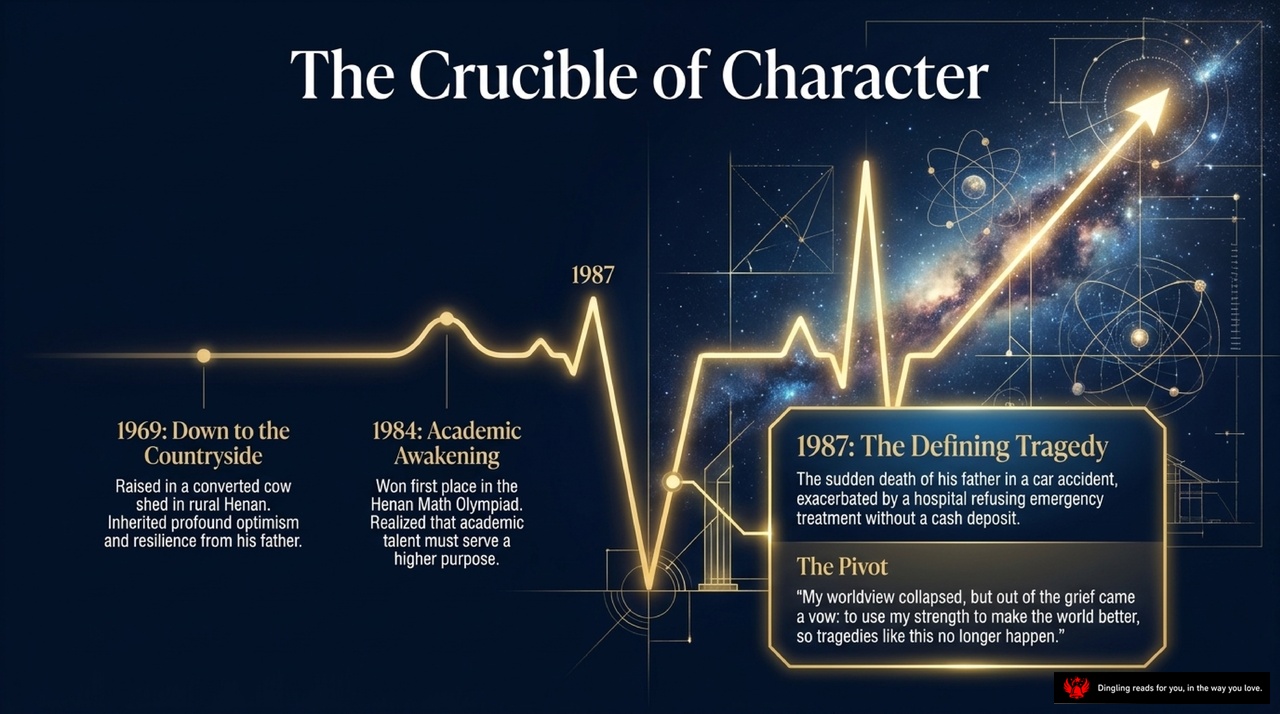
The Crucible of Character isn't just about surviving tragedy; it's about how we rebuild ourselves from the ashes. Look at this timeline: it starts in 1969, deep in rural Henan, where I was raised in a converted cowshed. My father taught me that resilience isn't a choice; it's inherited. When I won the top spot in the Henan Math Olympiad in 1984, I realized my talent had to serve something bigger than just personal glory. But the true test came in 1987. My father died in a car accident, and the system failed us because the hospital refused emergency treatment without a cash deposit. That moment was my defining tragedy. My worldview collapsed, but out of that grief came a powerful vow: to use my strength to make the world better, so tragedies like this never happen again. That pivot from personal loss to public purpose is the heart of character. It's not about avoiding the storm; it's about deciding what you build when the rain stops.

The Starting Line Fallacy isn't just a metaphor; it's the reality of life. As this slide illustrates, life isn't a 100-meter sprint where early speed dictates the finish; it is an ultra-marathon where the true winners are those who find their rhythm later. Look at Line A versus Line B. Line A represents the traditional path of early academic dominance, while Line B shows the trajectory of those who start slower but accelerate with relentless momentum.
Consider the stories here. Craig Mello, a future Nobel Laureate, struggled academically through the 8th grade, relying on intrinsic curiosity rather than test scores. Chai Jijie started as a paper mill worker and only embraced delayed academic training later to become a tenured Tsinghua Professor. Then there is Li Pingwei, a middle school teacher with no undergraduate degree who self-taught his way to becoming a Texas A&M Professor. These aren't exceptions; they are proof that the true differentiators aren't your starting position, but your self-belief through failure, your intrinsic motivation, and, most importantly, the stamina to accelerate after the 30-kilometer mark. Don't worry about the first few miles. What matters is how long you can keep running and how hard you push when the race truly begins.
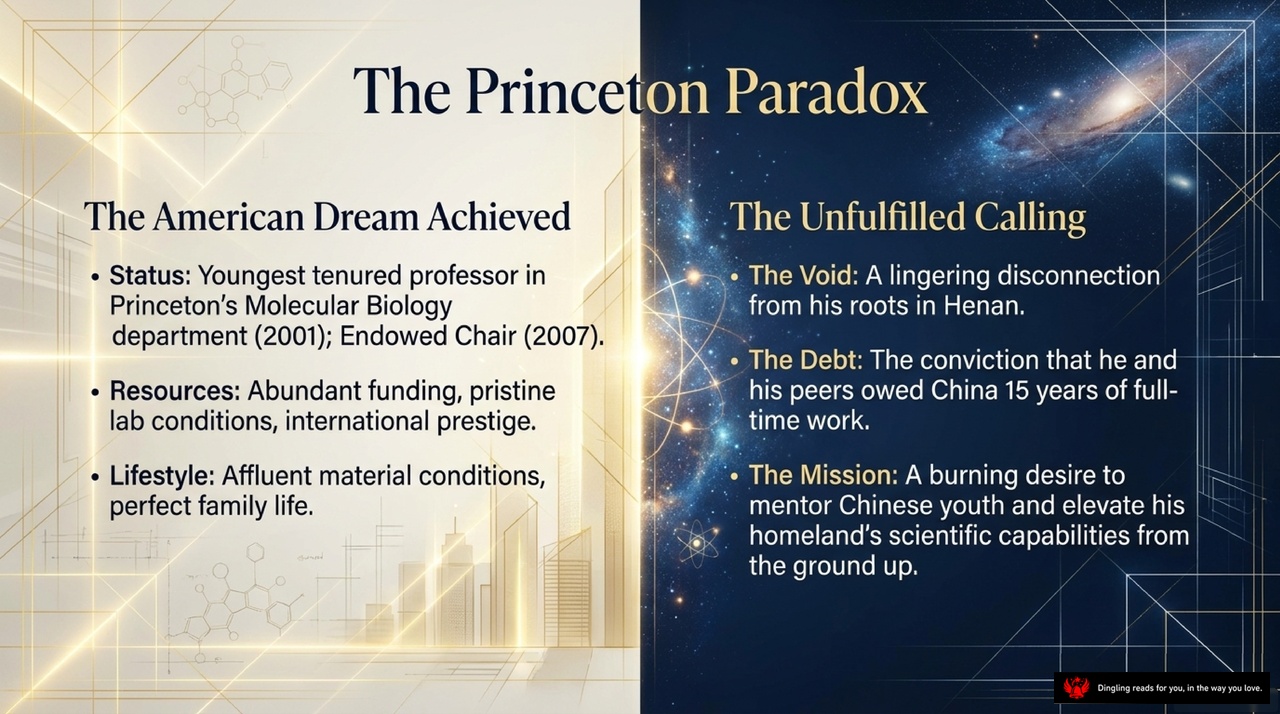
On this slide, we see the heart of my journey: "The Princeton Paradox." It captures the tension between two worlds. On the left, "The American Dream Achieved"—I became the youngest tenured professor in Princeton's Molecular Biology department by 2001, holding an endowed chair, surrounded by abundant funding, pristine labs, and a perfect family life. It was the pinnacle of success. But on the right, "The Unfulfilled Calling," lies the void. There was a lingering disconnection from my roots in Henan, a deep sense that my peers and I owed China fifteen years of full-time work, and a burning mission to mentor Chinese youth and elevate our homeland's scientific capabilities from the ground up.
This paradox defined my life. I had everything in America, yet my soul kept pulling me back. That unfulfilled calling eventually became my compass, leading me to leave Princeton and return to Tsinghua, where I could finally align my personal success with my responsibility to my country.
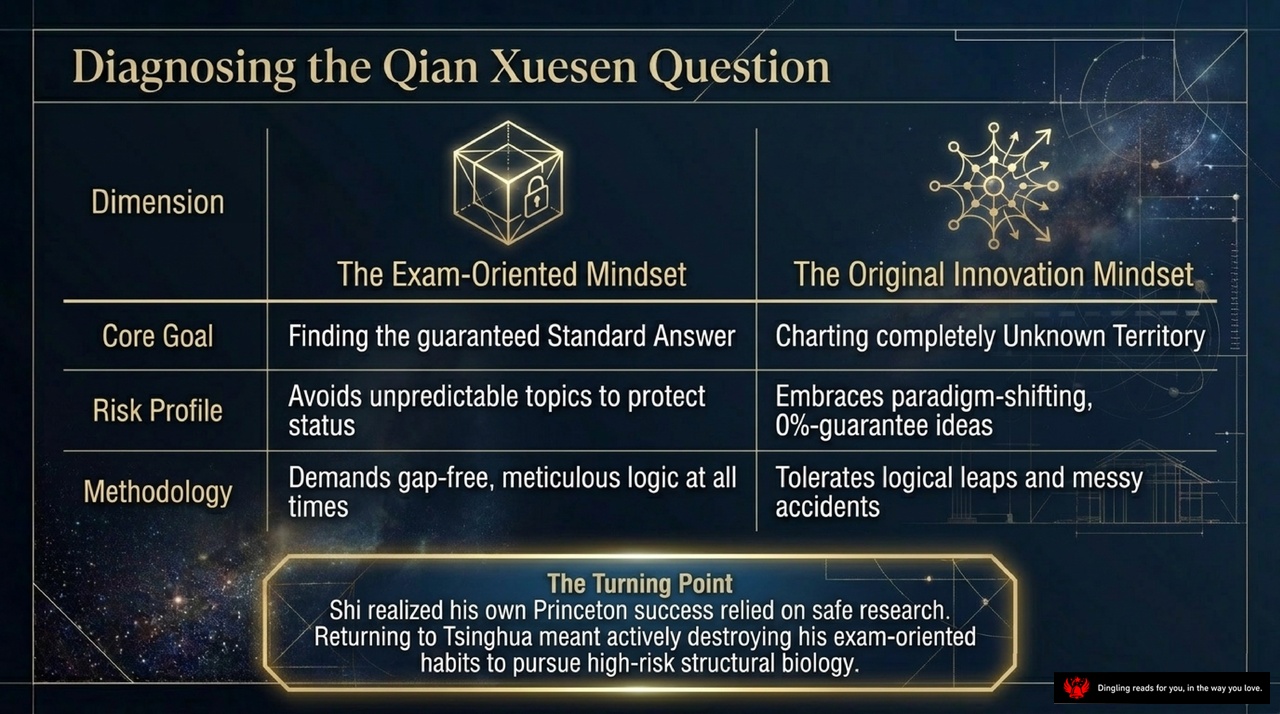
Let's talk about the real heart of scientific inquiry. It's not about piling up hours or blindly following rules; it's about the courage to question everything we think we know.
Think about the "Qian Xuesen Question" shown here. It contrasts two mindsets: the Exam-Oriented one, which chases guaranteed standard answers and fears any risk, versus the Original Innovation Mindset, which dares to chart completely unknown territory. Shi realized that his success at Princeton wasn't built on safe research, but on actively destroying those exam-oriented habits to pursue high-risk structural biology.
In the lab, we often face negative results. Instead of getting discouraged, we must treat them as essential data that eliminates wrong paths. We also have to fight the trap of perfectionism. As my mentor once reminded me, don't obsess over perfect intermediate steps; push your experiment to the finish line first. If the result fails, that's a clue that your hypothesis might be wrong.
True scientific integrity means respecting raw data, even when it contradicts our expectations. History shows us that even giants like Fermi made mistakes, but as long as they reported their findings honestly, their contributions remain valid. We must also distinguish between honest error and academic fraud. Furthermore, remember that science isn't democracy; it's not about majority rule. It's about a few brave minds using rigorous logic to break through the noise and find the truth, no matter how unpopular their ideas may be initially.
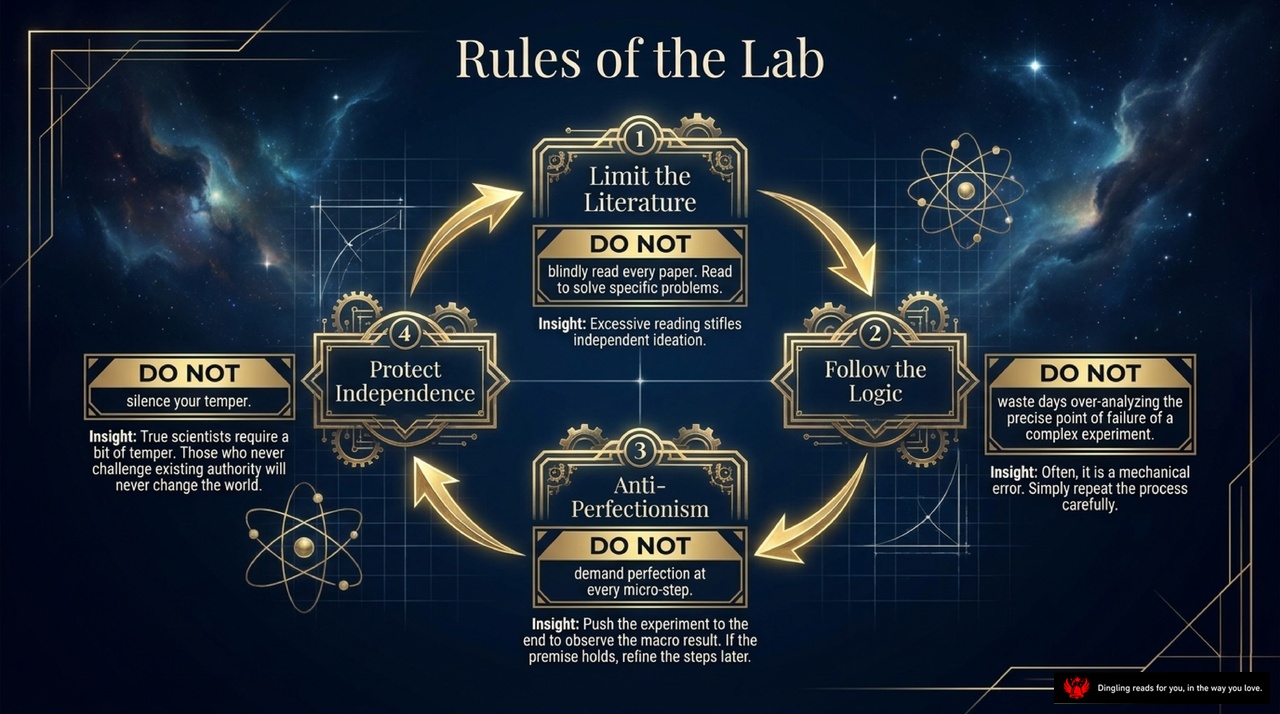
Welcome back to the lab. Today, we're diving into the "Rules of the Lab"—the non-negotiable principles that separate a good scientist from a great one. Think of these as the operating system for your research career.
First, let's talk about literature. The rule is simple: Limit the Literature. Do not blindly read every paper just to feel busy. Read with a specific purpose to solve a problem. Why? Because excessive reading can actually stifle your independent idea generation. You need to stop consuming and start creating.
Next, follow the logic. Don't waste days over-analyzing the precise point of failure of a complex experiment. Often, that failure is just a mechanical error. Don't get stuck in the details; simply repeat the process carefully until the machine works.
Then, embrace anti-perfectionism. Do not demand perfection at every micro-step. Push your experiment to the end to observe the macro result. If the premise holds, refine the steps later. If the whole thing fails, rethink your hypothesis. Perfectionism is the enemy of progress.
Finally, protect your independence. Do not silence your temper. True scientists require a bit of temper. Those who never challenge existing authority will never change the world. You need that spark of rebellion to push boundaries.
These four rules—limit reading, follow logic, reject perfection, and protect your independence—are the foundation of real scientific discovery.

The Tsinghua Decade (2008-2018) wasn't just about time; it was about building a world-class ecosystem from the ground up. Look at the time allocation rule: more than 50% of the effort went into institutional building—designing disciplines and recruiting globally. Only 15% was dedicated to frontline research like lab work and writing. This shift was intentional. To lead, you must first build the stage.
On the right, we see how this ecosystem was engineered. We pioneered a tenure-track system that matched international standards, breaking old barriers. We recruited over 120 outstanding global scholars to return to China, creating a critical mass of talent. We established world-class cryo-electron microscopy platforms, giving researchers tools they never had before. These moves transformed Tsinghua's life sciences into a dominant global force. It wasn't about working harder; it was about designing a system where excellence could thrive.

Advocacy Beyond the Lab isn't just a slogan; it's a necessary evolution for modern science. Let's look at the reality: despite their immense contributions, Asian scientists have historically faced systemic glass ceilings, blocked from leadership roles and top editorial positions in Western institutions. This isn't just about talent; it's about representation.
So, what was the action? Scientists like Shi, alongside peers such as Wang Xiaofan and Rao Yi, didn't just stay silent. They actively challenged major institutions like ASBMB and the Society for Neuroscience. They demanded accountability, forcing these organizations to confront the lack of Asian representation. This pressure was crucial in securing leadership roles in prestigious journals like the Journal of Biological Chemistry.
But why go through this trouble? It comes down to a deeper philosophy. A scientist's responsibility extends far beyond publishing papers. It demands actively advocating for a fair, meritocratic global community. It's about clearing the path for the next generation, ensuring that science truly belongs to everyone, not just a select few. This is how we move from exclusion to inclusion.

The vision of Westlake University is not just a blueprint on paper, but a bold declaration for the future of higher education. It all began in 2015, born from a collaborative dream to create an institution free from bureaucratic inertia, serving as a special experimental zone for reform. This was the genesis—a high starting point designed to be small, refined, and relentlessly research-oriented.
By 2018, the university reached a critical milestone: it was officially established as China's first social-force-funded, state-supported research university. This unique model breaks the traditional mold, proving that innovation can thrive with diverse support systems.
But the ultimate goal goes far beyond building a campus. Westlake aims to generate original theoretical breakthroughs and invent critical future technologies. It seeks to gather the world's most brilliant minds to tackle humanity's greatest challenges. In a world full of noise, this vision stands clear: to be a beacon of pure inquiry, where the pursuit of truth drives everything we do.
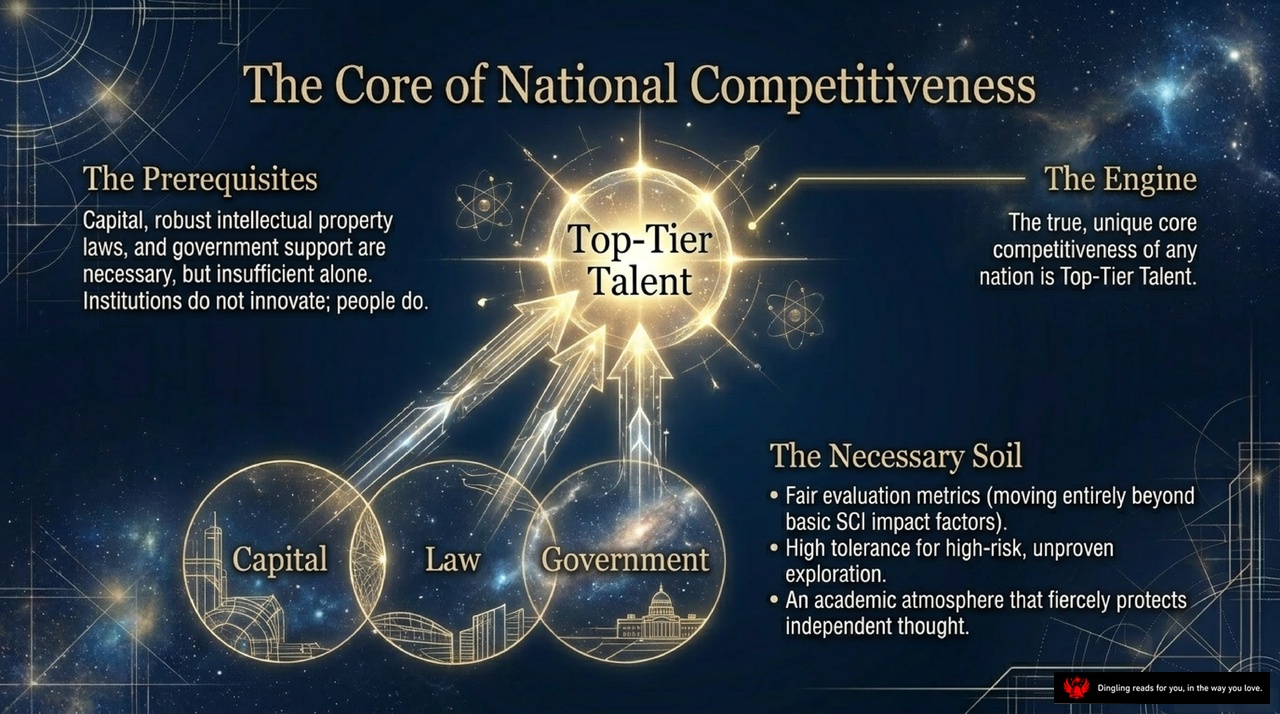
The slide we see here breaks down the absolute core of national competitiveness into a clear, three-part framework. At the very center shines "Top-Tier Talent." The presentation argues that this isn't just another factor; it is the true, unique engine that drives any nation forward. While institutions, laws, and capital are vital, they are merely the soil and the prerequisites. As the text emphasizes, institutions do not innovate; people do.
To make that central talent thrive, we need what's labeled "The Necessary Soil." This goes far beyond basic metrics like SCI impact factors. It requires a high tolerance for high-risk, unproven exploration and an academic atmosphere that fiercely protects independent thought. Without this fertile ground, even the best talent will struggle to take root.
Finally, on the left, we have "The Prerequisites": Capital, robust intellectual property laws, and government support. The slide is clear that these are necessary but insufficient alone. They provide the foundation, but the engine that actually moves the nation forward is the human mind itself. This logic challenges us to stop just building better systems and start cultivating the brilliant, independent minds that can actually reshape the future.

True breakthrough demands the courage to leave the safety of what we know behind. Shi Yigong's journey—from rural Henan to the global peaks of structural biology—proves that scientific mastery must be paired with an unyielding sense of social responsibility. We are merely stardust existing for a fleeting moment in cosmic time, yet our choices can alter the trajectory of human knowledge and societal progress. So, the question remains: Will you choose the safety of the well-trodden path, or will you risk failure to become a pioneer of the unknown?