
Sensibel: Über moderne Empfindlichkeit und die Grenzen des Zumutbaren: Complete Chapter-by-Chapter Summary
Welcome to today's session on "Sensitivity and Resilience" by Svenja Flaßpöhler. This book offers a profound philosophical exploration of a defining fracture in our modern society: the tension between the paralysis of absolute vulnerability and the cruelty of impenetrable armor.
We are living in an era where sensitivity has become both our greatest asset and our most dangerous liability. On one hand, we celebrate the ability to feel deeply, to recognize the pain of others, and to demand justice for the marginalized. On the other, we find ourselves trapped in a culture of fear, where a single misstep in language or behavior can trigger a crisis, and where the need for safety has turned into a fortress that isolates us from one another.
The core question this book asks is not whether we should be sensitive, but how we navigate the fine line between empathy and fragility. How do we remain open to the world without being crushed by it? How do we honor our own humanity while respecting the boundaries of others? As we move forward, we will unpack these complex dynamics, looking at how our history, our language, and our very definition of resilience shape the way we live today. Let's begin by understanding the roots of this modern condition.
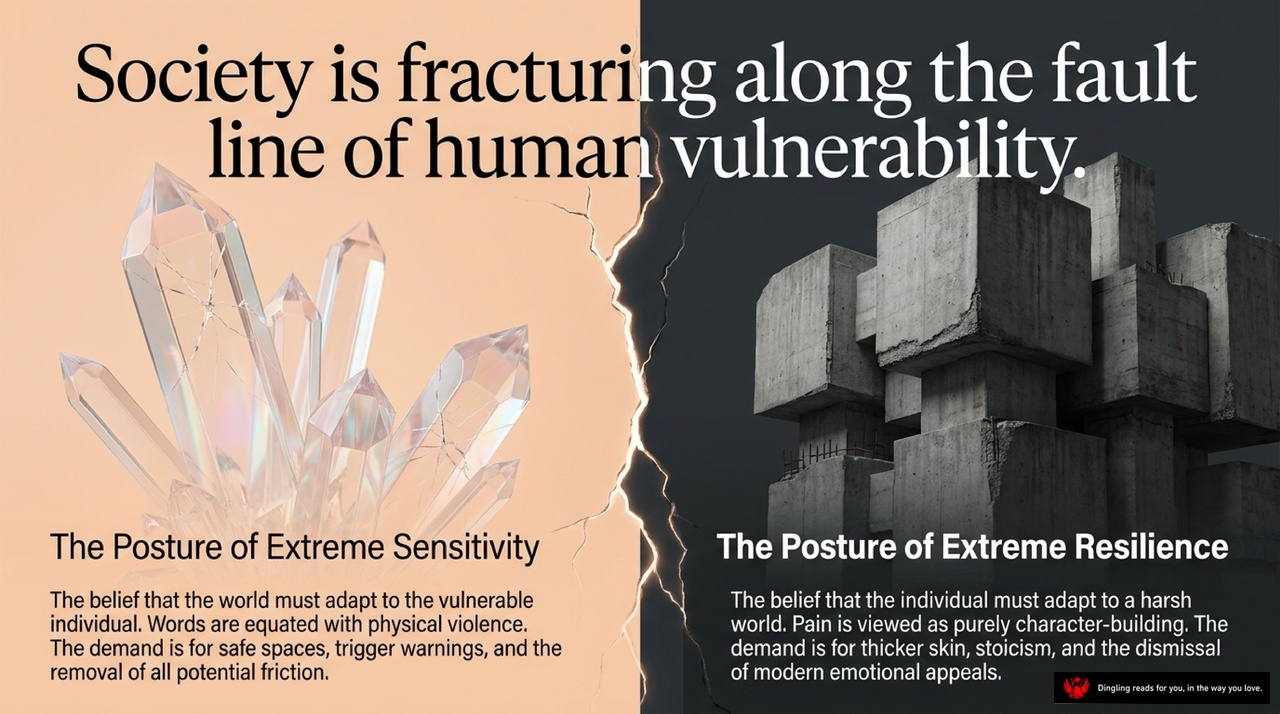
Society is fracturing along the fault line of human vulnerability. This image captures a profound divide in how we live today. On the left, we see the Posture of Extreme Sensitivity, represented by these delicate, fragile crystals. This mindset believes the world must adapt to the vulnerable individual. It equates words with physical violence and demands safe spaces, trigger warnings, and the removal of all friction.
On the right, we see the Posture of Extreme Resilience, symbolized by these heavy, brutalist concrete blocks. This perspective believes the individual must adapt to a harsh world. It views pain as purely character-building, demanding thicker skin and stoicism, often dismissing modern emotional appeals.
We are currently living in a tension between these two poles. One side argues that our sensitivity is a sign of moral progress and a necessary defense against harm, while the other warns that an over-protective society is eroding our ability to withstand life's inevitable challenges. The question isn't which side is right, but how we can find a balance where our sensitivity protects us without paralyzing us, and where our resilience helps us endure without crushing our humanity.
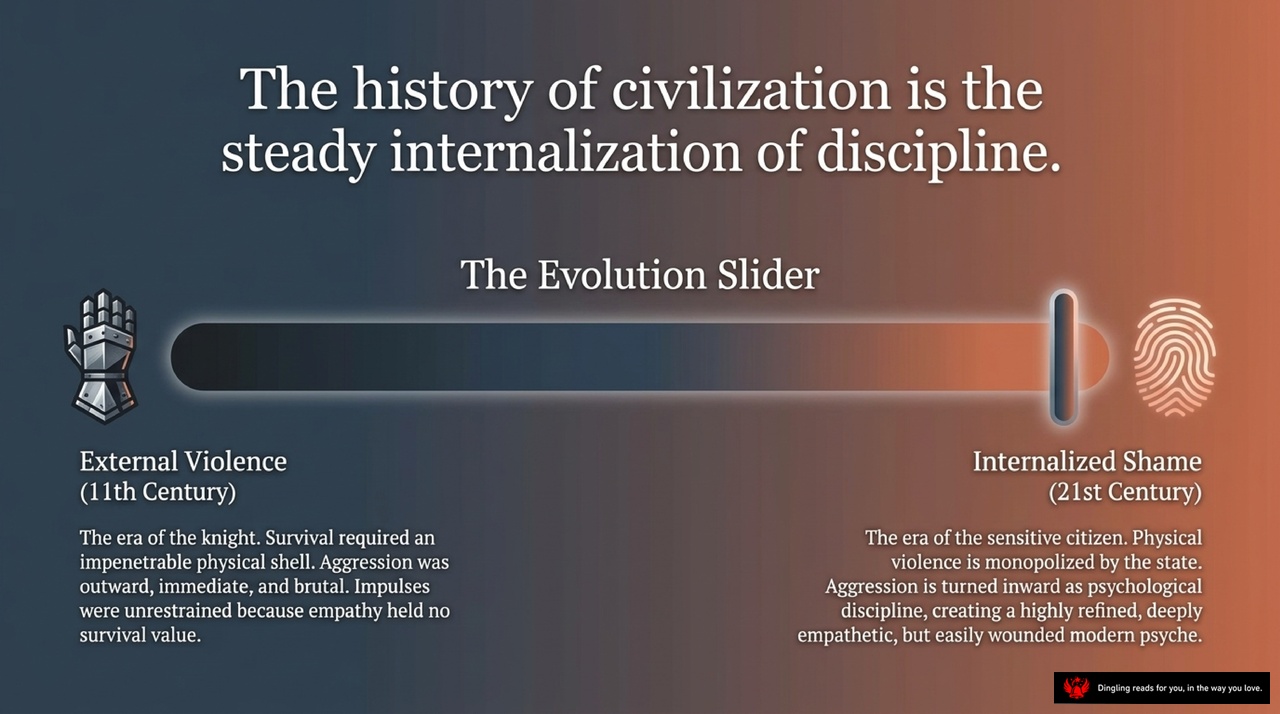
The history of civilization is essentially the steady internalization of discipline. Think of it as an evolution slider moving from the 11th century to the 21st. On the far left, we have the era of external violence, symbolized by a knight's gauntlet. Back then, survival required an impenetrable physical shell. Aggression was outward, immediate, and brutal. Impulses were unrestrained because empathy held no survival value. It was a world where you could be ruthless without consequence.
Fast forward to the right side of the slider, and we arrive at the era of internalized shame, represented by a fingerprint. This is the 21st century, the age of the sensitive citizen. Physical violence is now monopolized by the state, meaning we rarely have to fight with our bare hands. Instead, aggression is turned inward as psychological discipline. We have created a highly refined, deeply empathetic psyche. However, this comes with a cost: we are easily wounded. Our sensitivity, once a tool for survival, has become a source of vulnerability. We no longer hide our impulses behind armor; we hide them behind masks of politeness and internalized guilt. The sword of violence has been replaced by the sharp edge of social judgment, and the battle is now fought within our own minds.

Today's slide contrasts two opposing philosophies that define the extreme poles of the modern human condition: Friedrich Nietzsche, representing the armored self, and Emmanuel Levinas, representing the naked face. On the left, Nietzsche champions the idea that trauma is raw material for growth. His core philosophy suggests that what doesn't kill us makes us stronger, transforming psychological scars into power. However, the danger of this extreme is that absolute resilience can breed a cold, fascist detachment devoid of human solidarity. On the right, Levinas argues the opposite: the vulnerability of the Other demands our empathy. To be human is to be fundamentally exposed, not hidden behind armor. His view of the wound sees it not as something to absorb, but as a threshold that must remain open to prevent humanity from becoming blind to suffering. Yet, the danger here is that absolute sensitivity can lead to paralysis, reducing humans to helpless victims requiring constant protection. We must navigate between these two extremes, finding a balance where we are strong enough to act, yet open enough to feel.

The slide we're looking at today is titled "The Multidimensional Examination of Language Sensitivity." It captures a pivotal shift in how we think about words: language isn't just a mirror of reality anymore; it actively constructs it.
As Ferdinand de Saussure argued in the early 20th century, the link between a word and its meaning is arbitrary. There is no natural reason why "table" means what it does. Meaning is created by the system itself, through differences and oppositions. This realization opened the door for thinkers like Judith Butler to argue that gender, too, is something we "do" through repeated linguistic acts, rather than just something we are born with.
But if language has the power to build our identity, it also holds the power to destroy it. Butler warns that if language can sustain a body, it can also threaten its existence. When a slur like "Nigger" is used, it doesn't just insult; it attempts to erase the victim's very being, linking them to historical death and non-existence. This is why the push for gender-neutral language and anti-racist phrasing feels so urgent today. We are trying to reshape the symbols we use to prevent them from reinforcing harmful hierarchies.
However, this brings us to a complex tension. Critics often label these new norms as "political correctness," arguing they stifle free speech. But Butler herself cautions against rigid rules. She believes that stripping away all offensive words might actually rob marginalized groups of the power to reclaim them. Think of the word "queer," once a slur, now a badge of pride. Or "schwul" in German, reclaimed by the LGBTQ+ community. The power of a word lies in its fluidity and context, not in a static ban list.
The real challenge lies in the boundaries of identity. When we try to create perfect, inclusive grammar for every possible identity, we risk creating new exclusions. Adding symbols like underscores or stars might feel like progress, but it can also highlight the "silence" of those who don't fit the new template. Language thrives on ambiguity and play, not on rigid, top-down enforcement.
Ultimately, we must ask: how much can we truly step into another's shoes? Can someone who hasn't experienced trauma really understand the depth of another's pain? The slide reminds us that while language sensitivity is a tool for justice, it shouldn't become a weapon that silences dissent or creates new divisions. True empathy isn't about forcing everyone to speak the same way; it's about finding common ground amidst our differences, keeping language open, and resisting the urge to control every single conversation.
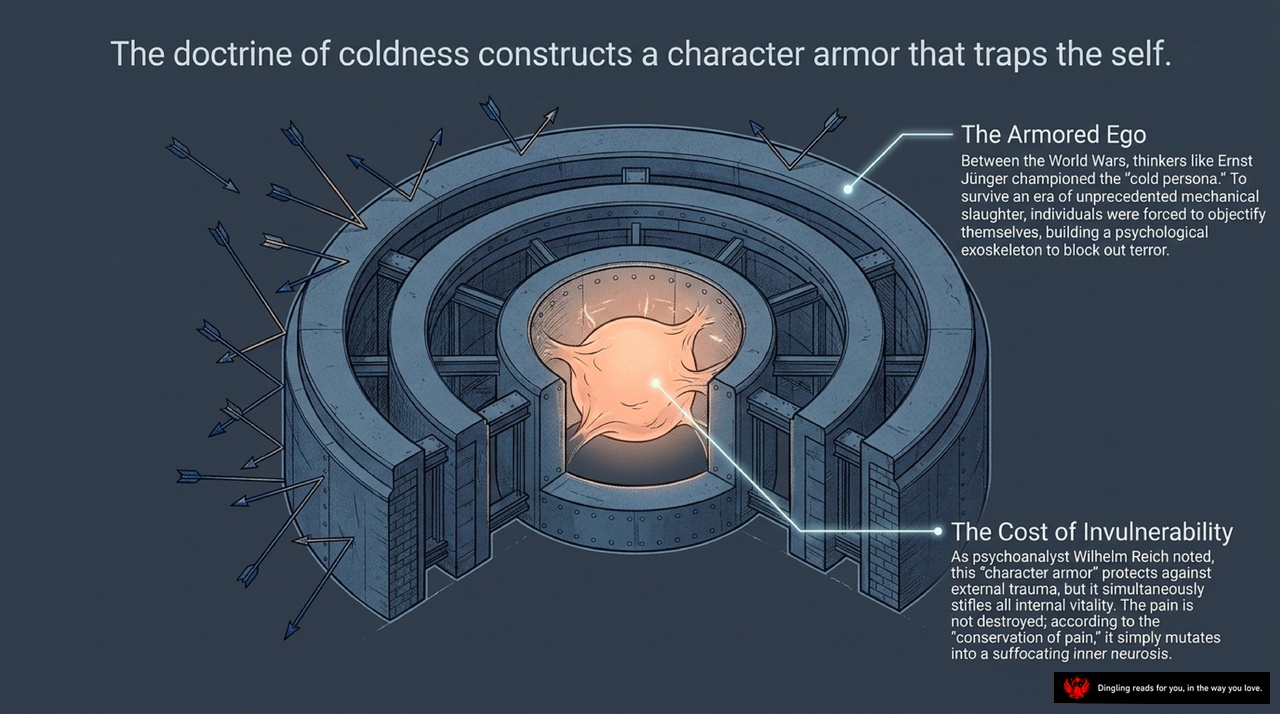
The doctrine of coldness constructs a character armor that traps the self. As we've seen, this armor isn't just a shield against the outside world; it's a prison built from the inside out. Think back to the "Armored Ego" we discussed earlier—originating from thinkers like Ernst Jünger in the interwar period. People built psychological exoskeletons to block out terror, turning themselves into cold, unfeeling observers to survive an era of unprecedented mechanical slaughter. But here lies the fatal flaw: this very armor creates a "Cost of Invulnerability."
As psychoanalyst Wilhelm Reich noted, while this "character armor" protects against external trauma, it simultaneously stifles all internal vitality. The pain isn't destroyed; instead, according to the "conservation of pain," it simply mutates into a suffocating inner neurosis. We are left with a paradox: by trying to become invulnerable, we have actually become fragile. We've traded the ability to feel and grow for a sterile, defensive shell that isolates us from the very life force we need to thrive.
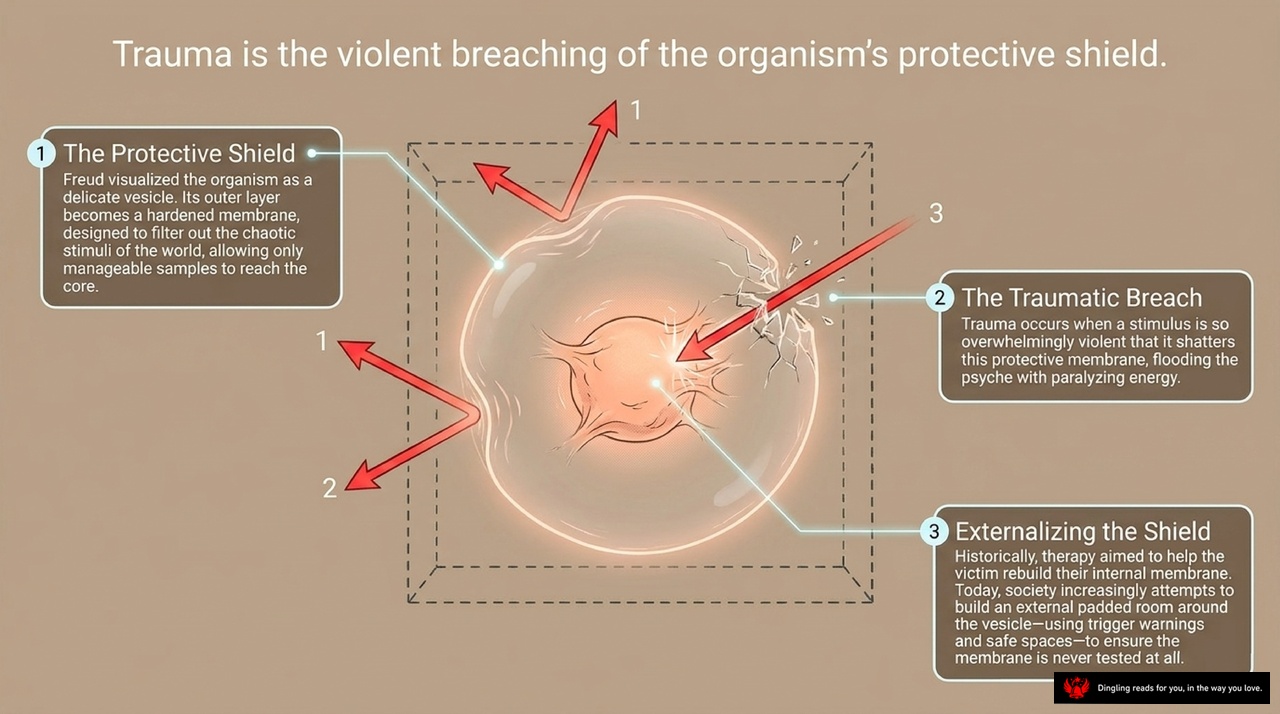
Trauma is defined as the violent breaching of an organism's protective shield. To understand this, we must first look at the shield itself. Sigmund Freud visualized the human organism as a delicate vesicle—a fragile bubble with a hardened outer membrane. This layer acts as a sophisticated filter, designed to block out the chaotic stimuli of the world and allow only manageable samples to reach the core, keeping our inner world stable.
However, trauma occurs when a stimulus is so overwhelmingly violent that it shatters this protective membrane. When this breach happens, it floods the psyche with paralyzing energy, leaving the core exposed. But how do we deal with this vulnerability? Historically, therapy aimed to help victims rebuild their internal membrane. Today, society increasingly attempts a different approach: externalizing the shield. Instead of strengthening the individual, we try to build an external padded room around them. We use trigger warnings, safe spaces, and censorship to ensure the membrane is never tested at all. While well-intentioned, this trend risks preventing us from ever developing the resilience needed to withstand the inevitable shocks of life.
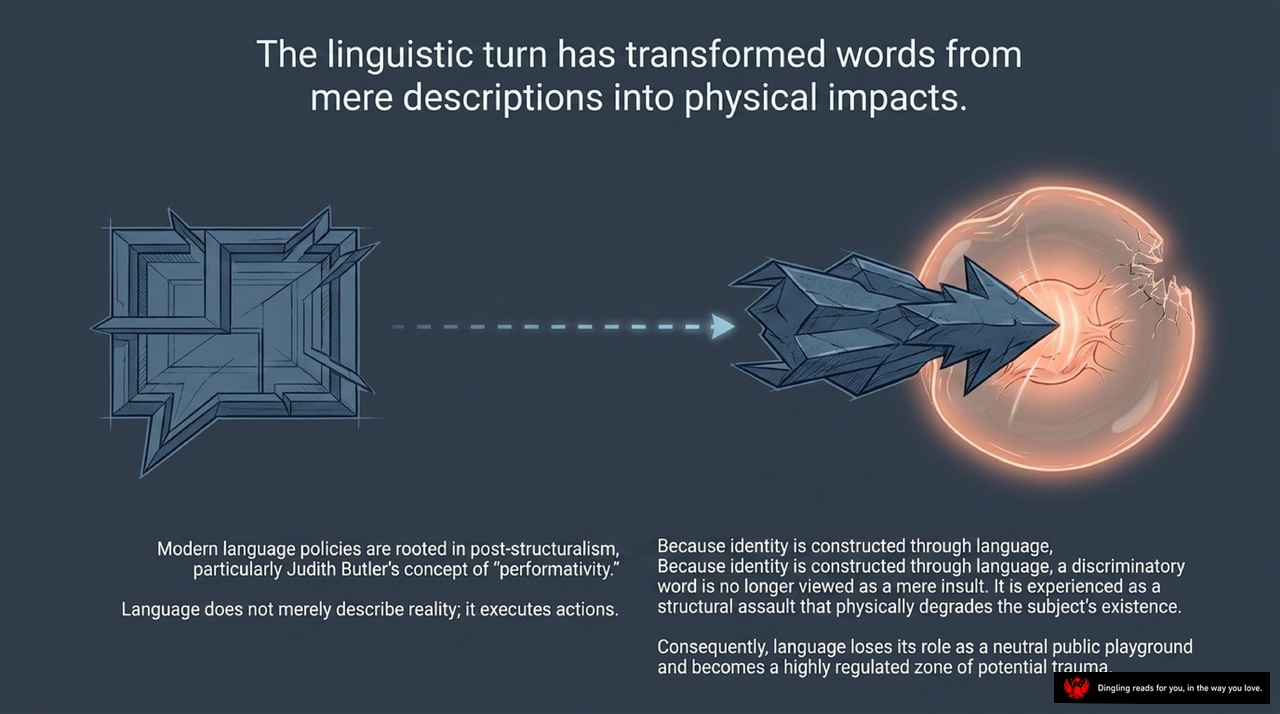
The linguistic turn has fundamentally reshaped our reality, transforming words from mere descriptions into powerful, physical forces. As the slide illustrates, language has evolved from a static box of definitions into a sharp projectile capable of causing deep, structural damage. This shift is rooted in post-structuralism, particularly Judith Butler's concept of "performativity." The core idea is profound: language does not simply describe the world; it executes actions. It constructs our very identities.
Because identity is built through language, a discriminatory word is no longer viewed as a simple insult. It is experienced as a structural assault that physically degrades a person's existence. When someone is called a slur, it's not just about semantics; it's an attack on their being. Consequently, language loses its role as a neutral public playground. Instead, it becomes a highly regulated zone of potential trauma. Every word carries weight, and every conversation is a negotiation of safety and dignity. This is why modern language policies are so contentious—they are attempts to manage this new reality where words have the power to wound or heal.

The slide presents a powerful Venn diagram illustrating the limits of empathy. On the left, we have Thomas Nagel's famous "Bat Argument," which warns us against the hubris of universal empathy. Just as a human can never truly know what it feels like to be a bat, an unaffected individual can never fully inhabit the subjective pain of a marginalized group. This unbridgeable gap is the core of the diagram.
On the right, we see Standpoint Theory. This theory argues that while the gap exists, it actually validates the perspective of victims of systemic oppression. Because they live within that specific reality, they possess an exclusive, objective clarity about their suffering that outsiders simply cannot access.
The intersection of these two ideas reveals a critical tension. While Standpoint Theory gives us a reason to listen to marginalized voices, the diagram also warns of a danger: elevating the victim's perspective as the *only* valid truth risks "epistemic closure." In other words, if we only listen to one side, dialogue is replaced by isolated echo chambers. True understanding requires acknowledging that while we cannot fully feel another's pain, their lived experience offers a unique, necessary truth that we must respect without trying to completely appropriate it.
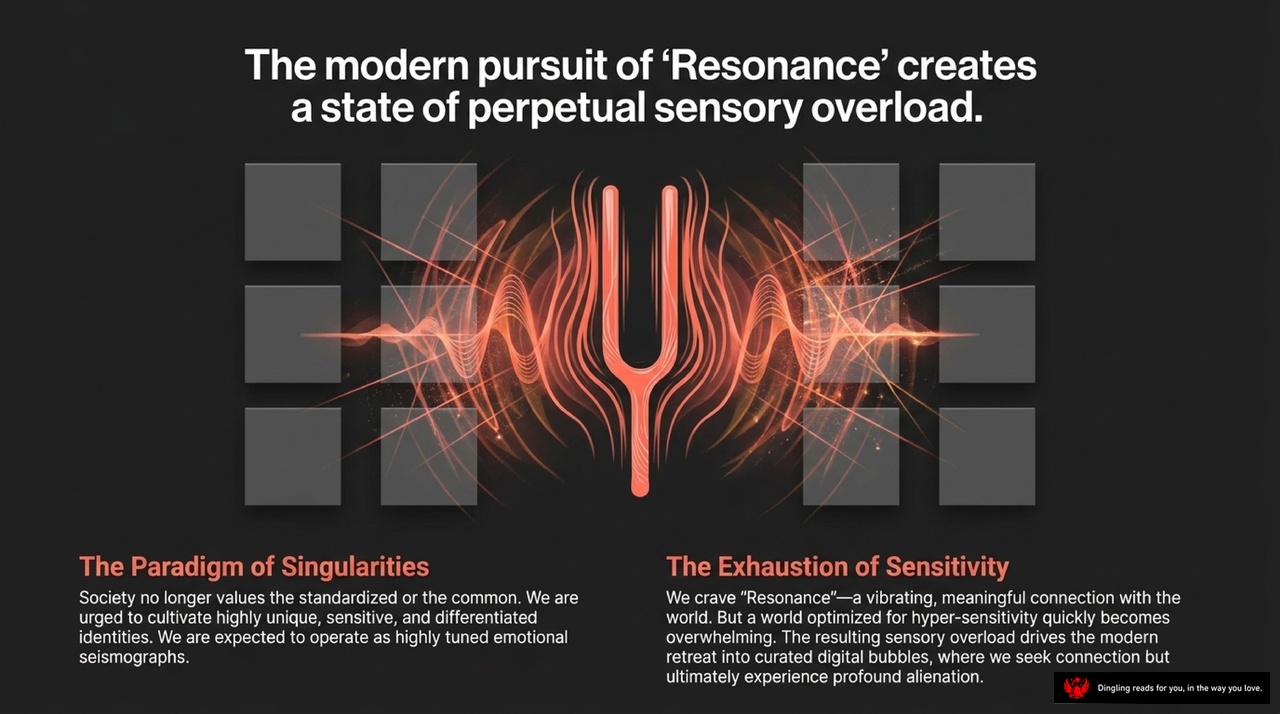
In today's world, we are constantly chasing what we call "Resonance"—that deep, vibrating connection with the world that makes us feel truly seen and understood. We crave a meaningful link, a sense that our unique inner lives matter. But here is the paradox: the very pursuit of this perfect resonance is driving us straight into a state of perpetual sensory overload.
Look at the image before us. That tuning fork in the center represents our desire to be "highly tuned," like a sensitive instrument picking up every nuance. We are urged to cultivate identities that are highly unique, sensitive, and differentiated. Society no longer values the standardized or the common; instead, we are expected to operate as finely calibrated emotional seismographs, ready to detect the slightest shift in the social atmosphere.
However, when a world is optimized for this hyper-sensitivity, it quickly becomes overwhelming. We are drowning in signals. This relentless drive to avoid any form of discomfort or offense pushes us to retreat into curated digital bubbles. Inside these bubbles, we seek connection, yet we ultimately experience profound alienation. The more we try to tune in perfectly, the more disconnected we feel from the messy, unpredictable reality of being human. We are exhausted by the demand to be constantly in sync, and in doing so, we lose the resilience to simply be ourselves.
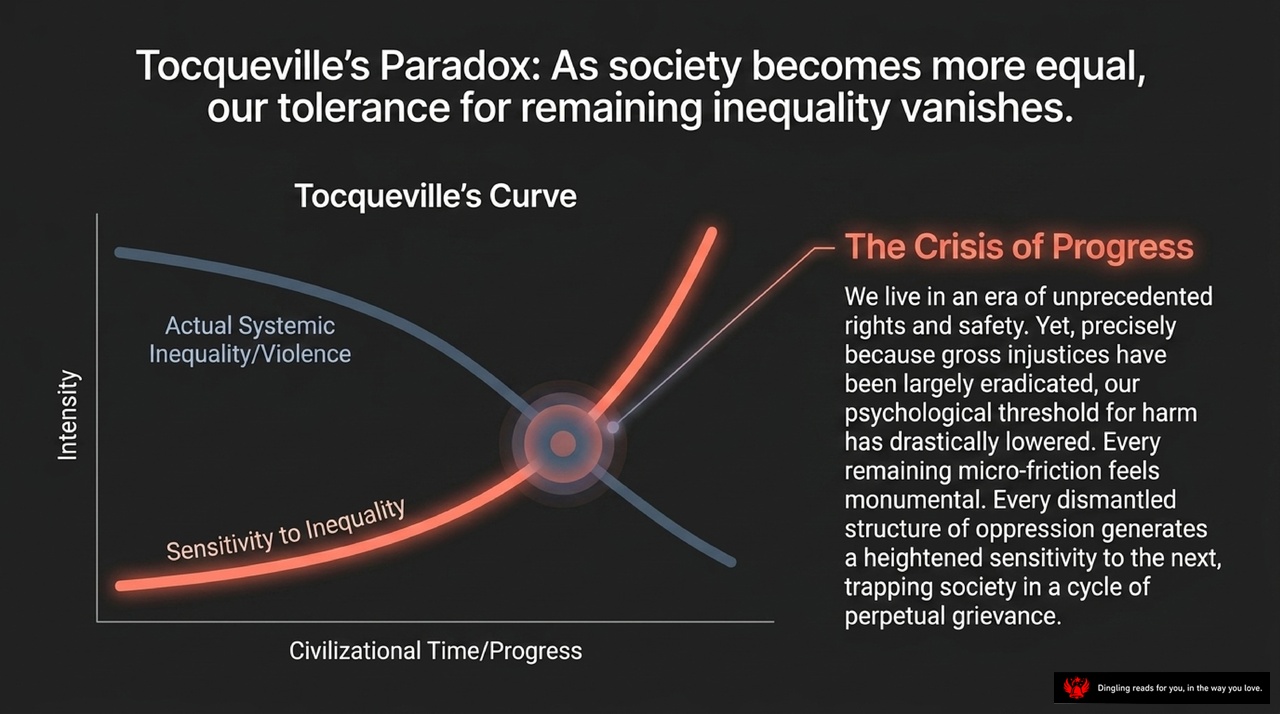
Tocqueville's Paradox reveals a profound irony of our time: as society becomes more equal, our tolerance for the remaining inequalities vanishes completely. The graph illustrates this tension perfectly. You see the blue line representing "Actual Systemic Inequality" steadily declining as civilization progresses, while the red curve, our "Sensitivity to Inequality," shoots upward. This is the Crisis of Progress.
We live in an era of unprecedented rights and safety. Yet, precisely because gross injustices have been largely eradicated, our psychological threshold for harm has drastically lowered. Every remaining micro-friction feels monumental to us today. As we dismantle one structure of oppression, we generate a heightened sensitivity to the next, trapping society in a cycle of perpetual grievance.
This paradox means that in a more equal world, we become less forgiving of difference. The very progress that removes large-scale violence makes us hyper-vigilant against the smallest slights, turning minor disagreements into existential battles. We are no longer used to inequality, so even a whisper of it feels like a catastrophe. This isn't just about politics; it's about how we perceive reality itself. We are living in a world where the absence of major evil has made us unable to tolerate any minor injustice, creating a fragile, high-strung society that is constantly on the lookout for the next offense.

The New Alliance: Moving beyond the fracture. Look at this Venn diagram. On the left, we have Absolute Resilience, which leads to coldness, cruelty, and isolation. On the right, Absolute Sensitivity, which results in paralysis, victimhood, and the tyranny of intimacy. The text below explains that the former repels the world, while the latter collapses under it.
But the future requires a dialectical synthesis: Sensitized Resilience. This is the sweet spot where we cultivate profound sensitivity to recognize the vulnerability of others, paired with the internal fortitude to navigate a world that will never be entirely free. We must stop choosing between being a fortress or a victim. Instead, we need the courage to feel deeply while standing firm. True resilience isn't about ignoring pain; it's about holding space for it without letting it break us. This balance is the key to moving forward together.

True progress isn't about erasing all friction or pretending other people's pain doesn't exist. Instead, real advancement comes from building a resilient sensitivity—one that can endure the world's harshness without losing our humanity.
So, the big question remains: Will we keep building thicker walls and retreating into safer, isolated spaces? Or will we finally learn to navigate the beautiful, yet dangerous, friction of living together? The answer defines whether we evolve or simply hide.