
Seveneves: Complete Chapter-by-Chapter Summary

Welcome to the world of *Seveneves* by Neal Stephenson. Imagine this: it's a perfect night, the moon is full, and suddenly, without a single warning, it shatters. The image you see here captures that terrifying moment—the Moon splitting into seven massive fragments, drifting apart above our planet. This event, known as the Moon Break, isn't just a cosmic accident; it's the end of the world as we know it.
When the Moon shatters, it doesn't just disappear. It fragments into seven large rocks and countless smaller pieces, creating a deadly cloud of debris that will rain down on Earth for years. This is the "Rubble Storm," a period where nothing on the surface can survive. The story begins with this brutal reality: humanity must act fast, or we will all be buried under tons of rock.
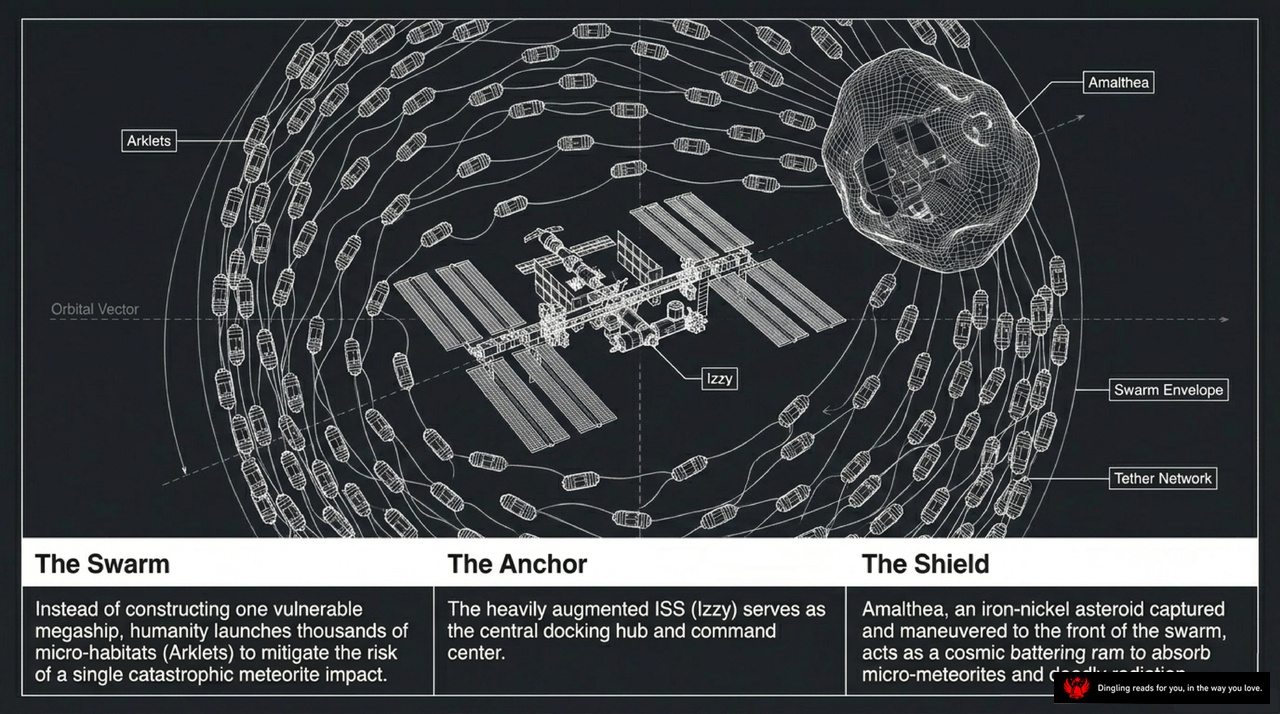
So, what do we do? We build an ark. The plan is called the Cloud Ark, and it's the only hope for our species. Instead of staying on Earth, we have to move everything we need into space. We'll use the International Space Station as the core, then launch hundreds of new modules called "Yan" to expand our home. We'll freeze our embryos, store our culture, and carry all the knowledge we have, taking it all into the stars.
But building an ark in space is harder than it sounds. We face radiation, micro-meteorites, and the constant threat of the Moon's debris. Every decision matters, from how we design our ships to how we manage our limited resources. This is a story about survival, innovation, and the incredible courage it takes to keep the human flame alive when everything around us is falling apart. Join us as we explore how seven pieces of rock changed the course of human history forever.

Look at this split screen. On the left, we see "The Agent" slicing through the Moon at a precise moment—UTC 05:03:12. No warning, no explosion, just a clean, terrifying tear that shatters our night sky into seven massive fragments. On the right, we see "Orbital Certainty." It's a beautiful illusion of safety, isn't it? At first glance, those fragments just look like a harmless constellation, locked in their original orbits, spinning peacefully around a vacuum. But the reality is far more brutal. Gravity and orbital mechanics don't care about our hopes; they dictate an absolute outcome. Those fragments are destined to collide, fracture further, and multiply exponentially, turning the sky into a deadly storm of debris. This moment, labeled A+0.0.0, became the true origin point for human civilization. It wasn't the birth of humanity, but the moment our old world ended and the struggle for survival truly began.

The moon didn't just break; it shattered into a cloud of debris that now threatens to swallow us whole. Look at this graph: within just two years, the volume of this orbital junk explodes exponentially. That's the "Exponential Threat." The fragments grind against each other, creating millions of new meteorites.
But the danger isn't just impact; it's the atmosphere itself. This debris cloud will become so dense it turns our sky a blinding white, trapping the sun's heat and boiling our oceans. That's "The White Sky." And for the next 5,000 to 10,000 years, we face "The Hard Rain"—a relentless bombardment that incinerates everything on the surface. Survival probability drops to absolute zero.
This isn't a movie scenario; it's the reality we're facing. The curve on the right shows the "Bolide Fragmentation Rate." Once that tipping point hits, there's no going back. We have to act now, before the sky falls down.
Imagine a ship not built of steel, but of ice and hope. This is the *Imlay*, a colossal vessel carrying the last hope for humanity's water supply. But as it approaches Earth, disaster strikes. The engine fails, the ice begins to crack, and the crew realizes they are running out of time.
Inside the command center, the atmosphere is heavy with dread. Sean, the brilliant but reckless leader, lies in a sleeping bag, his face pale, lips cracked. He's fighting radiation poisoning, yet he keeps sending orders: "Don't worry about us... prioritize the reactor... water is the future." His team has sacrificed everything to bring this ice ship home, but now they are dying one by one.
Back on the *Izzy* space station, Dana watches the telemetry screens, her heart breaking as she sees the radiation levels spike. She knows the *Imlay* is in critical condition. But the real crisis isn't just the failing ship; it's the fracture tearing through her crew.
Julia, the former President, has been secretly rallying a faction of scholars and citizens. She believes the Earth is lost, that the *Imlay* will fail, and that the only path to survival is Mars. She argues that Marcus's plan to push the *Imlay* into a stable orbit is a gamble with everyone's lives. Her supporters begin to dismantle the docking mechanisms, preparing to hijack ten modules and launch a new ship, the *Red Hope*, straight for the Red Planet.
It's a moment of pure chaos. The *Imlay* is crashing, the Earth is burning, and the people meant to save humanity are turning on each other. Dana steps into the command room, the noise of argument dying instantly. With the weight of the entire species on her shoulders, she delivers a chilling ultimatum: "The *Imlay* still has a chance, but we need everyone's support. Now isn't the time for infighting. Either we live together, or we die together."
But as the tension peaks, the *Imlay* finally manages its last engine burn. The massive ice ship slows down, its orbit shifting dangerously close to the *Izzy*. Yet, the damage is done. The *Izzy* itself is battered by fireballs, its main wheel destroyed, and a significant portion of its crew has been lost or taken by Julia's rebellion. The survivors huddle in the safe zones, looking at the burning Earth with a mixture of grief and determination.
Dana, watching the *Imlay* drift closer, knows the situation is dire. The ice ship is damaged, the reactor is compromised, and the *Izzy* is barely holding together. But she also sees the *Imlay*'s robotic arms activating, preparing to jettison the reactor to save the rest of the ship. It's a desperate move, a final gamble to save the water that could rebuild humanity.
As the *Imlay* finally docks, the true cost of their survival becomes clear. The *Izzy* is a wreck, the *Red Hope* has fled into the void, and the few survivors left are exhausted, traumatized, and terrified. But amidst the ruins, there is a glimmer of hope. The ice is here. The water is here. And for the first time since the Moon shattered, humanity has a chance to rebuild its home, piece by piece, in the cold silence of space.

Imagine a world where the sky is no longer just a backdrop, but a living, breathing ecosystem of engineered forests and genetically adapted life. This is New Earth, five millennia after the apocalypse. Our protagonist, Cassie II, wakes up in a tent overlooking a lake formed in an ancient crater. The air is fresh, the trees are tall, and for the first time in human history, the ground feels like home again. But it's not a perfect paradise. It's a carefully managed experiment, a result of the "Earth Reshaping Project" led by the Seven Daughters.
As Cassie prepares her glider to return to space, she spots something that doesn't fit the narrative: a mysterious figure in camouflage watching her from the tree line. This small detail triggers a chain of events that will take her on a journey across the globe. She meets a diverse team representing the seven distinct human races that evolved over the last 5,000 years. These aren't just different looks; they are fundamentally different species with unique genetic traits. The Mo race has skin that blends with nature, the Te race are hardened warriors, and the Zi race possess sharp, analytical minds.
Their mission is to investigate this mysterious figure and uncover the truth about what's happening on the surface. They travel to the White Land Bridge, a contested border between the Red Zone, which embraces radical technological evolution, and the Blue Zone, which fears it. Along the way, they encounter remnants of humanity that chose to stay behind. There are the "Bottom People," descendants of Rufus McGarry who hid underground during the "Hard Rain," and the "Deep People," who have lived in the ocean depths for millennia, preserving technology in the dark.
The confrontation that follows is brutal and unexpected. When the team tries to make contact peacefully, violence erupts. An ancient truck from before the disaster is found, a symbol of the past that the new world has tried to bury. But the real shock comes when they realize the Red Zone is actively manipulating these underground survivors, using them as pawns in a larger geopolitical game. The boundaries between the zones are blurring, and the old divisions are being replaced by a new, more complex reality.
In the end, the team realizes that the future of humanity doesn't belong to the Red Zone or the Blue Zone. It belongs to everyone. They propose a new alliance, a "Nine-Race Embassy," that includes the underground survivors and the deep-sea dwellers. It's a hopeful vision of unity, suggesting that after so much division and destruction, humanity finally has the chance to heal and move forward together, learning once again how to live on this fragile, beautiful planet.
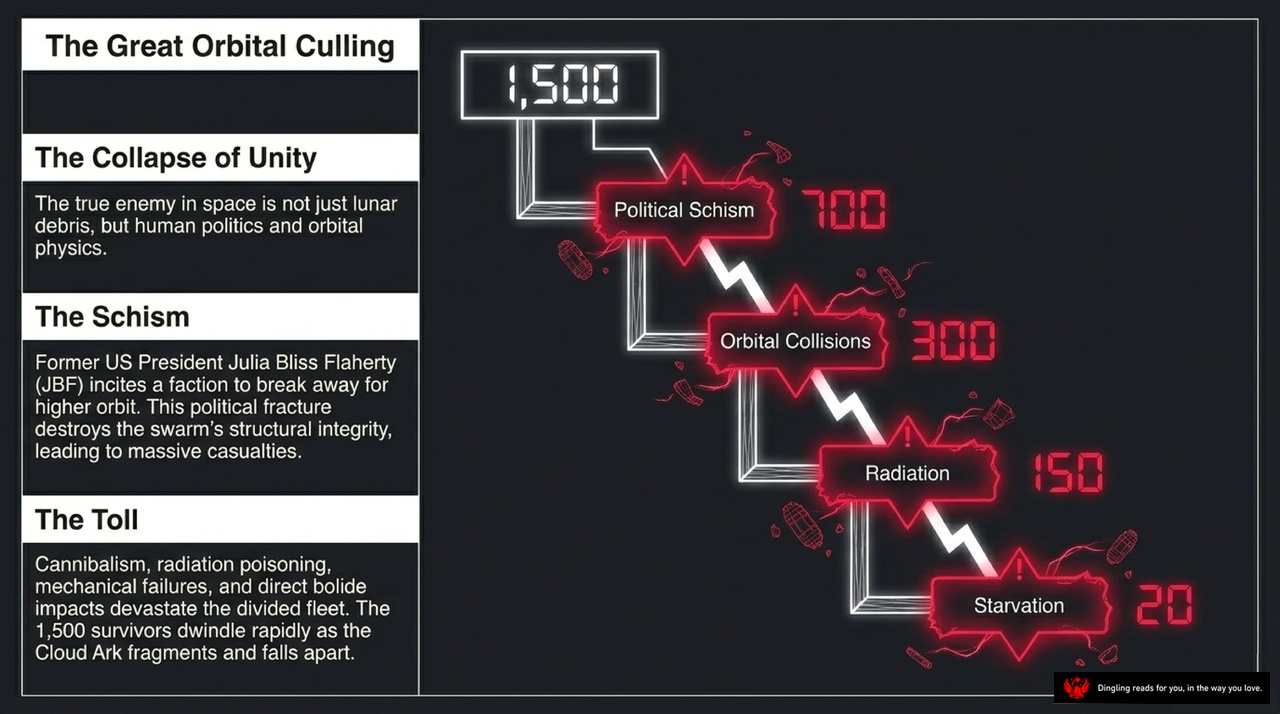
The Great Orbital Culling isn't just about debris; it's about the moment human unity fractures under the pressure of politics and physics. Back in the Cloud Ark, a 1,500-person fleet was on the brink of collapse. Former President Julia Bliss Flaherty—let's call her JBF—didn't just lead a government; she incited a rebellion, convincing a faction to break away for a higher orbit. That political schism destroyed the swarm's structural integrity, turning a coordinated rescue into a death spiral.
As the numbers plummeted from 1,500 to 700, then 300, the real enemy wasn't just lunar debris. It was the chaos of human division. Without a unified command, orbital collisions became inevitable, followed by a cascade of radiation poisoning, mechanical failures, and direct bolide impacts. Cannibalism and starvation set in as the Cloud Ark fragmented. By the time the toll hit 20 survivors, the 1,500-strong fleet was nothing but a ghost story, proving that in the void, a divided humanity is a doomed one.
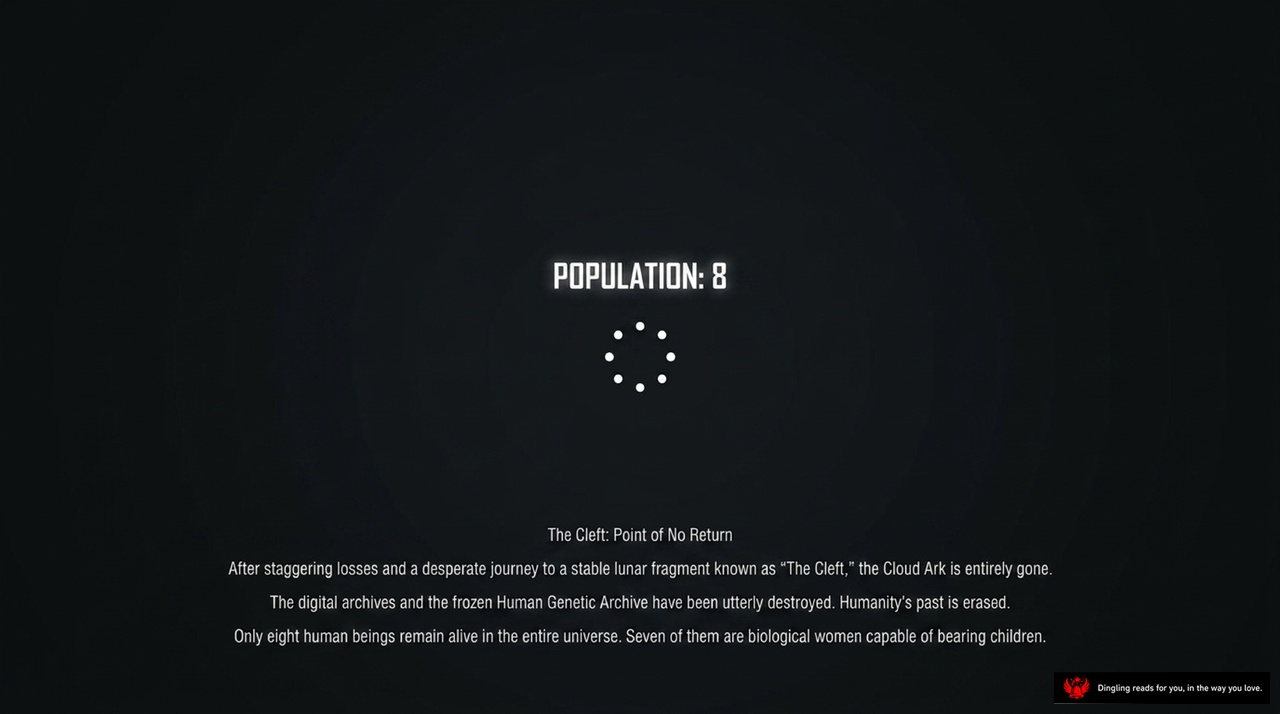
Imagine a world where the moon doesn't just rise, but shatters into seven massive, drifting rocks, leaving humanity with a terrifying new reality: only eight people remain alive in the entire universe. Seven of them are women, and one is a man. This is the desperate starting point of *The Cleft: Point of No Return*, a story that begins not with a bang, but with a catastrophic silence.
After losing everything—the Cloud Ark, the digital archives, and the frozen genetic future of humanity—these eight survivors must become the entire species. The stakes couldn't be higher. With no past to look back on and a future hanging by a thread, they face an impossible mission: preserve the human genome, master the stars, and rebuild civilization from scratch.
But survival is just the beginning. As they launch their fragile ark, a deadly storm of lunar debris, known as the "White Cosmos," begins to rain down on Earth. Then comes the "Meteor Rain," a barrage of fireballs that wipes out almost everyone left on the planet. What remains is a grim struggle for existence, where internal politics, radiation sickness, and the harsh laws of physics threaten to extinguish the last flame of humanity before it even has a chance to burn.
From the icy depths of a frozen comet to the claustrophobic corridors of a rebuilt space station, this is a tale of resilience, sacrifice, and the sheer will to live. It asks us a fundamental question: if we are the last humans left, what kind of future will we choose?

Imagine a lineup of seven vials, each glowing with a distinct color of liquid, representing a radical new chapter for humanity. This is the scene of the "Council of Seven Eves," a pivotal moment born from a desperate necessity.
It all starts with a terrifying reality: with no viable male DNA remaining after the lunar catastrophe, geneticist Moira proposes a radical solution. She suggests modifying the women's own ova to allow reproduction without fertilization—a process known as parthenogenesis. But this isn't just about survival; it's about choice. To ensure long-term survival, Moira offers each woman the power to manually edit the genome of her offspring. Each Eve is permitted to select one defining genetic enhancement for her entire bloodline.
The result? The Eves intentionally vote to separate their lineages rather than blending back into a single species. Instead, they forge seven distinct human subspecies, each carrying a unique genetic advantage. This strategic divergence ensures that humanity isn't a monolith vulnerable to a single flaw, but a diverse, resilient collection of seven branches, ready to face whatever the future holds.

Look at this "Seven Races Matrix." This isn't just a chart; it's the genetic blueprint for humanity's survival after the Moon shattered.
Imagine the original seven "Eves"—Dinah, Ivy, Tekla, Moira, Camila, Julia, and Aida. Each one carried a specific genetic trait that defined their entire race. Dinah, coded in blue, gave us the Dinans: heroic engineers who are fiercely loyal. Ivy, in green, birthed the Ivans—highly intelligent academics who are physically capable. Tekla, the green-blue hybrid, created the Teklans: disciplined, militaristic warriors who are physically imposing.
Then there's Moira, the purple shapeshifter. Her descendants, the Moirans, are the ultimate adapters, capable of changing their form to survive any environment. On the other end of the spectrum, we have Camila, the yellow-coded Camilans. They are the empathetic peacemakers who hate conflict. Julia, in orange, produced the Julians: manipulative political masters who control minds and situations. Finally, Aida, the red-coded Aidans, are aggressive, resilient, and fiercely opportunistic survivors.
These seven lineages didn't just survive the apocalypse; they evolved into distinct civilizations. From the loyal engineers of the Dinans to the adaptable shapeshifters of the Moirans, this matrix shows us exactly how humanity split and thrived in the ruins of the old world.

Five thousand years into the future, humanity has transformed the scars of our past into a thriving new world. Imagine a colossal ring, stretching 84,000 kilometers around our planet, housing three billion people. This is the Habitat Ring, a megastructure built from the shattered remains of the Moon and captured asteroids. It's no longer just a space station; it's a new Earth, divided into eight distinct arcs where seven different human races coexist, each shaped by their unique genetic histories.
While the ring orbits high above, the surface below has been reborn. Through centuries of terraforming, ice comets were steered into the atmosphere to refill the oceans and seed life back onto the scorched crust. Today, forests stretch across continents, and large predators roam the wilds, a testament to our resilience.
But this peace isn't without its tensions. The ring is split between two factions: the Blue Zone, which prioritizes caution and technological restraint, and the Red Zone, which pushes for rapid innovation and expansion. A physical wall separates them, and the tension between these ideologies echoes through the corridors of this new civilization. Yet, despite these divisions, the descendants of the Seven Eves have multiplied and thrived, proving that even after the moon was torn apart and the world was reset, the human spirit finds a way to rebuild, adapt, and flourish among the stars.
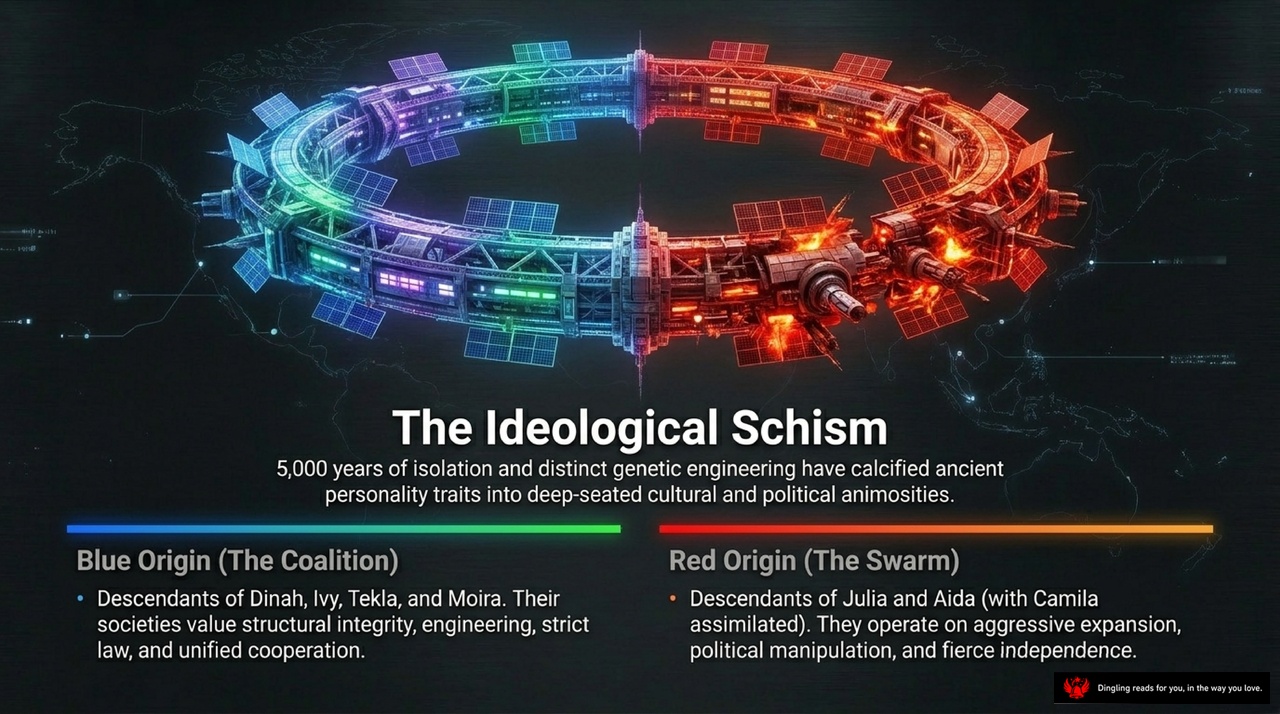
Welcome back to the story of *The Moon is Missing*. Today, we're diving deep into the ideological fracture that tore humanity apart and reshaped our destiny. Look at this striking image: a massive ring in space, split down the middle. One side glows with cool, structured blue light; the other burns with chaotic, aggressive red fire. This is the visual representation of "The Ideological Schism."
Five thousand years of isolation and distinct genetic engineering have calcified ancient personality traits into deep-seated cultural and political animosities. This isn't just history; it's the DNA of our future conflict.
On the left, we have the **Blue Origin**, known as **The Coalition**. These are the descendants of Dinah, Ivy, Tekla, and Moira. Their societies value structural integrity, engineering, strict law, and unified cooperation. They are the architects of order, the builders who believe in rules and stability.
On the right, we see the **Red Origin**, called **The Swarm**. These are the descendants of Julia and Aida, with Camila assimilated. They operate on aggressive expansion, political manipulation, and fierce independence. They are the disruptors, the ones who believe that to survive, you must conquer and adapt at any cost.
This split defines the entire narrative of the new Earth. It explains why the Blue and Red zones are in a state of cold war, why the walls between them are so heavily fortified, and why every decision made in the Council Hills is a battle of ideologies. The Blue side wants to rebuild Earth with careful planning and scientific precision, while the Red side pushes for rapid, often reckless technological leaps and expansion.
As we move forward in the story, remember this: the fate of humanity doesn't just depend on the technology we build or the resources we find. It depends on whether The Coalition and The Swarm can find a way to coexist, or if their fundamental differences will drive them into a final, catastrophic war. This schism is the engine that powers every plot twist from now on.

Look at this underground city, a sprawling network of tunnels and chambers carved deep into the Earth's crust. This is the home of "The Diggers," also known as "The Rooters." While the orbital Spacers up in space believe they are the sole inheritors of humanity, they are profoundly wrong. As the Hard Rain fell, a small faction—descendants of the miner Rufus Macquaries—survived by endlessly tunneling inward, seeking refuge in the planet's crust.
Governed by an authoritarian system and preserving their knowledge through memorized encyclopedias, these survivors have endured five millennia in brutal, cramped darkness. They are the forgotten survivors, the true ancestors of our future, waiting patiently in the shadows while the world above them crumbles.

Imagine a world where humanity didn't just survive the apocalypse, but evolved into something entirely new. Look at this image: we aren't looking at aliens anymore, but at the "Pingers," or the Sea Dwellers. These are the descendants of military submariners who dove into the deepest ocean trenches right before the surface seas boiled away. They didn't just hide; they transformed.
Using rogue genetic engineering, these pioneers adapted their very bodies to withstand the crushing pressure of the deep ocean. They isolated themselves from the surface world, evolving over five thousand years into a species that lives completely beneath the waves. They communicate through sonar and have completely altered aquatic physiology, living in a silent, underwater civilization that has evolved separately from the sky dwellers and the rock diggers.
The image captures this eerie, beautiful reality: advanced submersibles and human figures swimming freely in a deep-sea cave system, monitored by a green, radar-like grid. These "Pingers" represent a branch of human survival that we often overlook. While others fled to the sky or the stars, a part of us went down, deeper than ever before, to ensure the flame of humanity never went out. It's a powerful reminder that when the world ends, life finds a way, no matter how dark or deep the ocean gets.

The ultimate conflict isn't about surviving the cosmos anymore; it's about whether these alien branches of the same family tree can finally share a single planet. This slide captures the dramatic convergence of humanity's scattered paths. Look at the central Earth: it's no longer just a rock we fled, but a stage for a historic reunion. On the left, the Diggers—descendants of the original miners who hid underground—are breaking the surface, represented by those rugged, gear-driven tools. On the right, the Pingers emerge from the seas, symbolized by that fluid, aquatic arrow, representing the deep-sea survivors. Above them, the orbital Spacers finally descend to terraform the world, bringing the high-tech civilization from the sky.
This moment is the "Reunion," where the fragmented tree of humanity begins to grow back together. But remember, the "Fragmented Tree" was created by the Hard Rain, which shattered us into isolated species divided by gravity, rock, and water. Now, we face the "New Paradigm." We are no longer fighting for survival against the universe; we are fighting for the right to coexist. The question isn't if we can live, but if we can learn to live together on one world.

Imagine a future where humanity didn't just survive a catastrophe, but fundamentally rewrote its own destiny. Picture a ring-shaped city, stretching 84,000 kilometers wide—seven times the diameter of Earth itself. This is the new home for over three billion people, a civilization born from the ashes of a lunar apocalypse.
Look closely at this landscape. We are no longer just one race; we are seven. The original genetic experiments of the "Seven Eve" have evolved into distinct species, each with unique traits and territories. From the bio-engineered Mo to the tech-savvy Te, and the genetically optimized Ai, humanity has fractured and then reassembled itself into something entirely new.
But here's the twist that changes everything: the walls between these groups are crumbling. A new movement called "Universal Breeding" has emerged, breaking down the old barriers of isolation. For the first time in five millennia, these disparate groups are merging, their genes blending to heal the defects of the past. The population is exploding, not just in numbers, but in unity.
Yet, beneath this utopian surface lies a hidden tension. The Red and Blue zones remain locked in a cold war, separated by a deadly isolation wall. While the upper ring celebrates fusion, the surface below is a battleground where ancient secrets are being unearthed. When our investigator, Cassie II, descends to the ground, she finds a world that is both beautiful and terrifying—a place where nature has reclaimed the earth, but where old enemies and new mysteries are waiting to be discovered.
This isn't just a story about survival anymore. It's a story about what happens when we finally stop fighting each other and start building a future together. The question remains: can a fractured humanity truly heal, or will the ghosts of the past always try to pull us apart?