
Single Point Breakthrough: Complete Chapter-by-Chapter Summary

Welcome to today's session on "Single Point Breakthrough." In the brutal arena of early-stage startups, trying to do everything at once is a recipe for failure. You have limited resources, so the only absolute law of survival is to hyper-focus on a single, penetrable node.
As we open our book by Zhang Benwei, Zhao Xin, and Yang Yanhua, remember this: you cannot win a war by spreading your forces thin. Many founders fail because they pick the wrong direction or waste time solving fake problems. Your most valuable assets are time and cash flow. So, adopt the principle of "watch slowly, strike fast." Spend your preparation phase deeply researching, but once you move to execution, act with speed. Never let your resources bleed out while you hesitate.
This slide captures the essence of our first chapter: finding that one critical point where you can break through. Instead of chasing vague concepts like "big data" or building impossible platforms from day one, look for a specific, narrow entry point. Whether it's a single customer or a specific pain point, focus your entire energy there. When you concentrate your limited resources on one spot, you can build a real competitive barrier before the giants even notice you. Let's dive into how to find that single point.

The Platform Trap is a myth that kills early startups. The slide on the left shows a founder firing scattered shots at a massive block labeled "Incumbents," hoping to break through with a multi-sided platform. That's the illusion. Claiming to be a platform from day one requires massive scale on two fronts simultaneously—a luxury only tech giants can afford. Most founders fall into this trap, wasting limited resources trying to connect supply and demand before they've even mastered one side.
But look at the right side. That's where the real breakthrough happens. The Single Point Law reveals the truth: startups are fundamentally weak, and multi-point connection equals death. Instead of trying to be everything to everyone, you must distill your business to the extreme. Focus on one core customer, one core need, and one core product function. This laser-focused approach allows you to punch a hole through the market with precision, building a competitive moat before the giants even notice you're there. Stop spreading your energy thin; stop chasing the fake platform dream. Instead, find that single, undeniable point of value and dominate it completely. That is the only way to survive and eventually thrive against the odds.

Today's slide, "Finding the Breakthrough Node," lays out the exact playbook for escaping the startup graveyard. It all comes down to one powerful framework: "Look at the Customer, Look at the Industry, and Look at the Team."
First, we look at the customer. This is about the pull. Instead of guessing, you need to pinpoint a rigid need within a hyper-specific sub-segment. Don't try to solve everyone's problems; find the one group that is desperate for a solution and build for them first.
Next, examine the industry. This is where you analyze the wind and resistance. You must position yourself in a massive market trend but navigate around the incumbents who are already there. Don't fight the giants head-on; find the gaps where the market is hungry but underserved.
Finally, look at your team. This is the engine. You need to build a squad whose specific core competencies perfectly match the chosen breakthrough point. If your team's skills don't align with the opportunity you've identified, no amount of market potential will save you.
The breakthrough happens only when these three elements align: the customer's need creates the gravity, the industry trend provides the momentum, and your team's capabilities supply the power. Master this triangle, and you stop guessing and start winning.

Most entrepreneurs chase the holy trinity of "must-have needs, painful problems, and high frequency," but here's the hard truth: truly rigid C-side markets are almost exclusively dominated by giants in essentials like food, housing, and education. For a startup, those red oceans are death traps.
So, how do you survive? You pivot to non-rigid markets. But don't mistake "non-rigid" for "unprofitable." The formula for demand rigidity is simple: Intensity times Frequency. A funeral service has massive intensity but zero frequency, making it hard to sell new solutions. Lunchtime wait times have moderate intensity but high frequency, creating a rigid pain point.
The real opportunity lies in building demand where it doesn't naturally exist. You have two powerful levers. First, narrow your audience to increase intensity. Focus on a niche group with a burning need, like AKB48 did by targeting lonely otaku men who craved real human connection. By creating exclusive handshake sessions and voting mechanisms, you turned a small, intense desire into a massive cultural phenomenon before expanding to the general public.
Second, increase frequency to wake up the need. For low-frequency, high-cost items like home renovation, you don't just wait for the customer to decide. You construct the scenario. You constantly remind them of the pain and the ideal outcome, effectively turning an elastic desire into a perceived necessity through repeated exposure.
Remember, demand isn't just a biological fact; it's a cultural construct. In a society obsessed with comparison and status, you can turn a "want" into a "need" by framing it as the key to belonging or success. Your job isn't just to find a problem; it's to engineer a situation where your solution becomes the only logical answer.

In the early days of your startup, growth isn't just a buzzword—it's your only metric for survival. And here's the hard truth: the old playbook of splitting channels into "online" and "offline" is completely obsolete. The reality is far simpler. You only have three ways to get customers: one-on-one private chats, mass broadcasting, and social sharing.
Think of your customer acquisition journey as two distinct phases. First, you need to manually hunt down your "seed customers." These are the people whose identities, touchpoints, and needs perfectly match your ideal user profile. You can't automate this; you have to talk to them one by one. They are your product's "gold standard," providing the raw, unfiltered feedback you need to iterate before you ever launch publicly.
Once you've validated your product with these seeds, it's time to scale. This is where you leverage your three core channels. Private chats are your sales team—think ground teams or cold calls. To make them work, you must know exactly where your customers are and what their pain points are. Broadcasting is your media strategy. It's not about spamming; it's about crafting compelling content that wakes up a sleeping demand, pushing it to a large audience so they feel compelled to pay attention. Finally, sharing is your viral engine. This happens on social media, but it only works if you give people a reason to share. Whether it's an emotional connection, valuable content, or a tangible reward, you need to build a mechanism that turns your users into your marketers.
But here's the catch: acquiring customers isn't just about adding numbers. You have to manage the "Iron Triangle" of cost, speed, and quality. Cost means keeping your Customer Acquisition Cost (CAC) low enough so you don't bleed cash. Speed is about how fast you can grow; in a hot market, being slow means missing the window. And quality? That's about precision. Don't just grab anyone; grab the right people who actually have the pain and the money to pay.
Take the example of Lockin China, a recruitment platform for overseas talent. They didn't cast a wide net. Instead, they used "touchpoint tags" to find where their customers were densely packed. For talent, they targeted overseas university career centers. By focusing their 3-person team on just 50 universities across five countries, they got 60,000 resumes for only 350,000 RMB. Their cost per customer was under 9 RMB—less than a tenth of their revenue. They didn't try to be everywhere; they went where the density was highest.
Then there's Changba, the karaoke app. They realized that a simple tool was easily copyable. So, they built a community. They made the experience so good that users wanted to share their hits, and they built leaderboards and online duets that turned users into a connected tribe. Within 80 days, they hit 10 million users. They didn't just sell a tool; they sold a social experience that people couldn't get anywhere else.
Your goal isn't to do everything at once. It's to master these three channels, balance your cost-speed-quality triangle, and use data to find the highest density of your specific customers. When you do that, you stop guessing and start growing.

In the early days of your startup, growth isn't just about making money—it's about proving you can actually acquire customers. And let's be honest: the old divide between "online" and "offline" marketing is dead. Today, there are only three real paths to your first 10,000 users: Private Chat, Broadcast, and Sharing.
Think of it like this. Path 1 is Private Chat. This is your precision strike. It works best when you know exactly who your customer is—when your touchpoint tags are crystal clear. You're doing direct, manual outreach to a dense, hyper-specific cluster of users. It's the lowest cost, highest conversion route, but it requires you to be the salesperson yourself.
Then you have Path 2: Broadcast. This is where emotion takes the wheel. If your specific touchpoints are still a bit blurry, but you have strong emotional tags, this is your moment. You aren't selling a feature; you're planting a flag with a manifesto, relatable media, or a sharp viewpoint. You let the audience find you because you've made the value undeniable.
Finally, Path 3 is Sharing, or the viral route. This is the zero-cost social spread. It works when your intrinsic need or value tags are strong enough that people *have* to share it. You give them an irresistible reason to show off or gain rewards, and suddenly, your users become your sales force.
The magic happens when you combine these. You use private chat to get those first few loyalists, broadcast to wake up the broader market with a compelling story, and sharing to let the momentum carry you to scale. Mastering these three paths is the difference between a startup that survives and one that takes off.

The chart you see right now perfectly captures the single most important rule in modern business: speed. It contrasts the "Long Cycle" of the traditional way—waiting months for a perfect macro-loop that almost guarantees failure—with the "Short Cycle" of the Agile approach, which slices the user journey into tiny, two-day micro-loops.
In the traditional model, you wait for everything to be perfect before moving forward. But in the Agile world, we break a 30-day service into 15 micro-tasks. This allows us to pivot instantly. As the bottom of this slide shows, this speed transforms our entire workflow: from rapid Data Collection to immediate Analysis, leading to faster Decision-making and Product Iteration.
The core message is clear: don't just collect data; analyze it immediately. Don't just make a decision; iterate the product right away. By compressing these cycles, we stop guessing and start learning from real results in real-time. In a fast-moving market, the only metric that truly matters is how quickly you can close this loop.

Imagine you're standing at a crossroads, staring at four distinct paths that can turn a small market shift into a massive macro-trend. The slide breaks this down into four powerful levers. First, think about **New Customers**. It's not just about finding anyone; it's about demographic shifts and generational transitions. Picture Generation Z rejecting legacy social networks to build their own distinct platforms. They aren't just users; they are a new tribe with unique values.
Next, look at **New Needs**. This is where consumption upgrades happen. We've moved far beyond just functional survival. Today, people buy things for emotional signaling and brand aesthetics. It's no longer about "what does this do?" but "what does this say about me?" This shift creates entirely new markets where products become extensions of identity.
Then, consider **Product Restructuring**. This is about upgrading the medium itself. Think of the transition from physical goods to "Atoms + Bits." We've seen this with the shift from physical classrooms to digital knowledge platforms. By changing the delivery medium, you can drastically improve efficiency and accessibility, effectively reinventing the product for a modern world.
Finally, there's **Value Chain Restructuring**. This is the most disruptive path. It's about cutting out middlemen entirely to drastically lower costs and redistribute profit directly to the edges. Instead of letting intermediaries take a cut, you connect the producer straight to the consumer, capturing value that was previously lost in the system.
These four paths—New Customers, New Needs, Product Restructuring, and Value Chain Restructuring—are the engines of growth. Understanding which one applies to your situation is the key to unlocking the next big trend.

Deconstructing the Industry: How to Flip the Table on Giants
Today's slide breaks down the ultimate strategy for disrupting an established industry: completely reorganizing how value is distributed. Look at the top row, the "Traditional Chain." It's a long, expensive relay race. Value starts at Creation, moves through an Agency, gets stuck in a Distributor, slows down at a Retailer, and finally reaches the Consumer. Every stop along the way adds overhead, taxes, and margins that eat up the value the creator actually built.
Now, look at the second row. This is what we call "Jigsaw Restructuring." Notice the red scissors cutting out the Distributor and Retailer. The goal here isn't to remove everyone, but to optimize the internal steps. By killing legacy overhead costs, you can pass ten times the savings directly to the user. It's about efficiency within the existing structure.
But the real game-changer is the bottom row: "Table-Flipping Restructuring." Here, we don't just cut out middlemen; we eliminate the central hub entirely. Instead of a long chain, we build a massive red "Direct Platform Bridge" that connects the Creator straight to the Consumer. This is the essence of the modern internet economy. By bypassing the traditional middle layers, independent creators can capture the full value of their work, while consumers get products at a fraction of the cost. This shift from a linear chain to a direct bridge is what allows startups to disrupt giants who are weighed down by their own complex, outdated structures.

Navigating Incumbents isn't about fighting head-on with giants; it's about choosing your battlefield wisely. Today, we're looking at three distinct strategies to survive and thrive when the big players are already in the room.
First, Drastic Disruption. This is the high-stakes game of total market replacement. The goal is to completely overhaul the value chain, offering a tenfold cost advantage that destroys the incumbent's legacy model. It's a winner-takes-all scenario with massive risk, but for those willing to go all-in, it offers the chance to rewrite the rules entirely.
Second, Niche Evasion. When you can't beat them, you serve a hyper-specific sub-segment they simply ignore. The goal here is pure survival and defense. By offering bespoke products to a tiny, overlooked group, you create a fortress. Giants can't adapt to these narrow niches without alienating their massive mass-market base, leaving you safe in your corner.
Finally, Ecosystem Integration. Instead of trying to build a rival platform, the goal shifts to mutual, symbiotic growth. You become an indispensable, specialized node within the giant's existing open platform. Think of it as becoming the best partner in their house rather than trying to build your own.
Your choice of strategy depends on your resources and your vision. Whether you're looking to disrupt, hide, or integrate, understanding these three paths is the key to navigating the competition.

Welcome back. Today, we're diving into the anatomy of a winning startup team. As we've seen, finding a market gap is only half the battle; executing on it requires the perfect crew.
The slide highlights a concept called "The Minimum Viable Team." Think of it as the principle of "Man and Sword Unification." Your founder's deep expertise must align perfectly with the specific market gap you are attacking. If your skills don't match the opportunity, you're just building a sword for the wrong enemy.
So, how big should this team be? The rule is simple: keep the founding team to a maximum of three to five people. Why? To maintain lethal execution speed and preserve equity. You don't want to dilute your ownership or slow down your decision-making with too many voices early on.
But within that small group, you need a specific dynamic, known as "The Triad." First, you need the Product visionary—the one who controls the field and shapes the core offering. Second, you need Operations, or "The Tank." This person takes the hits, pulls the users, and executes the grind. They are the muscle that keeps the company moving forward. Third, you need Technology, or "The Executioner." This role silently builds the backend infrastructure, ensuring the product actually works.
Finally, there's a crucial note about the CEO. The founder must play the role of the "healer." This means constantly recruiting top talent and securing the capital needed to keep the engine running. Without this, even the best product and team will stall.
In short, a successful startup isn't about having a huge team immediately. It's about assembling a small, focused group where the founder's skills, the team's size, and the specific roles of visionary, tank, and executioner all align to attack a single, clear opportunity.
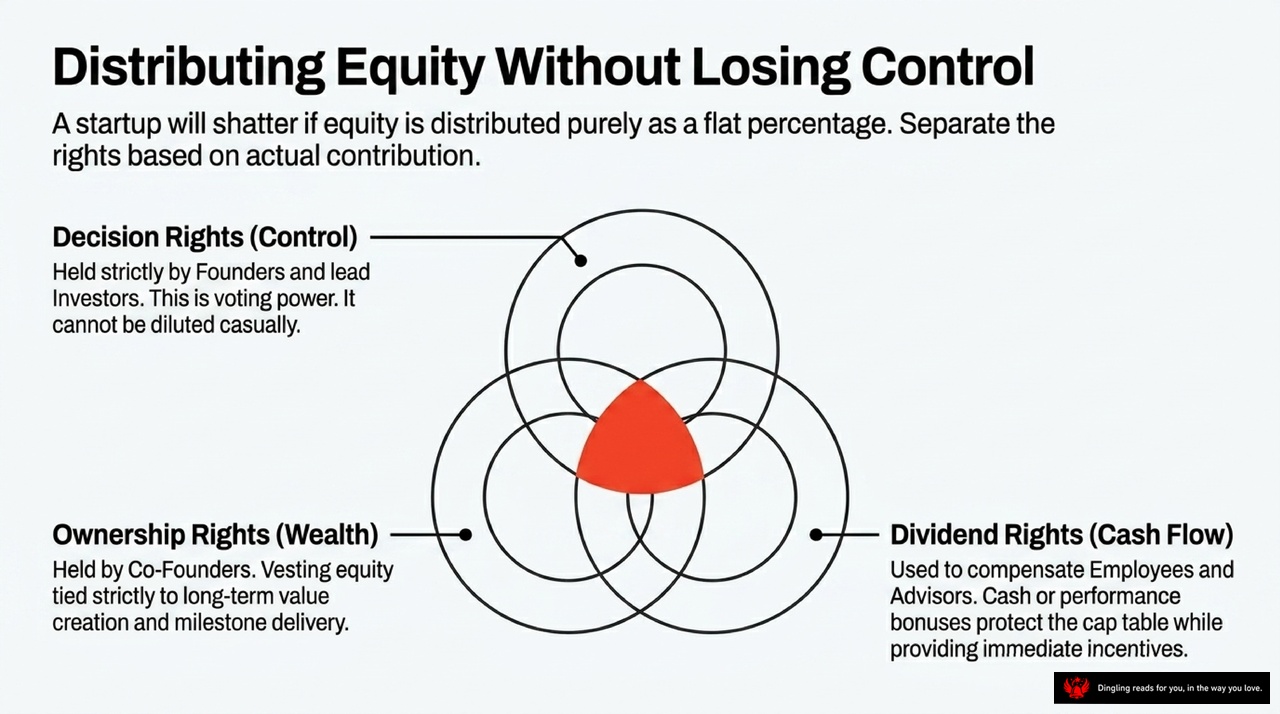
So, here's the reality check: if you try to split equity equally just based on percentages, your startup will shatter. You can't treat all rights the same way. You have to separate them based on actual contribution to keep the ship steady.
Look at this diagram. It breaks equity into three distinct circles. First, Decision Rights, which is pure control. This voting power belongs strictly to the founders and lead investors. It cannot be diluted casually, or you lose the steering wheel. Second, Ownership Rights, which represents your wealth. This is for co-founders, tied strictly to long-term value creation and milestone delivery through vesting. Finally, Dividend Rights, which handle your cash flow. These are used to compensate employees and advisors with cash or performance bonuses. This protects your cap table while still giving immediate incentives to the team.
The key takeaway is simple: separate the rights. Don't give everyone the same keys to the kingdom. Keep control in the hands of those who steer, reward long-term builders with ownership, and pay short-term contributors with dividends. This structure lets you distribute equity without losing control, ensuring your startup survives the early chaos and scales properly.

The playbook isn't just about efficiency; it's about knowing exactly where to aim. Lean Startup gives you a compass to avoid waste, but it doesn't tell you which direction to head. That's where the missing link lies. You need a map, not just a compass.
This map is built on a single point of breakthrough. Think of it as locking a crosshair onto a specific target. Once that target is locked, you deploy the Lean Startup scientific method—Build, Measure, Learn—to test that precise node iteratively.
But what defines that target? It's the synergy of three forces. First, the customer. You need a single point breakthrough that provides a profound commercial map, understanding specific value chains and hyper-specific psychographics. Second, the industry. You must see the macro-winds and the market's supply-demand gaps. Third, the team. Your core strength must align perfectly with that specific opportunity.
When these three align, you stop guessing and start executing. You identify the rigid demand that pulls you forward, catch the industry wind that pushes you up, and leverage your team's unique advantage as the engine. This isn't about doing everything; it's about focusing on the one node where all these forces converge, turning a vague idea into an unstoppable force.

Before you pour a single dollar into building a startup, stop and run this mental audit. The difference between a fleeting flash in the pan and a lasting empire often comes down to one thing: data over guesses.
Look at this checklist. It's not about vague ideas; it's about hard answers. First, can you name your single, specific customer? Not "everyone," but one exact person. Second, do you know their rigid, high-intensity need? Third, who are the incumbents, and where is their structural weakness? You need to find the gap they can't fill.
Then ask yourself: What is your unique solution? Does your team have the core competency to execute this, or is it just a wish? What is your exact value proposition? Finally, look at the macroeconomics. Is there a wind blowing in your direction right now that is accelerating growth?
If you can't answer these seven questions with field-tested data, don't spend capital. The market will punish hesitation and guesswork. Stay focused, stay grounded, and only move when the data speaks clearly.
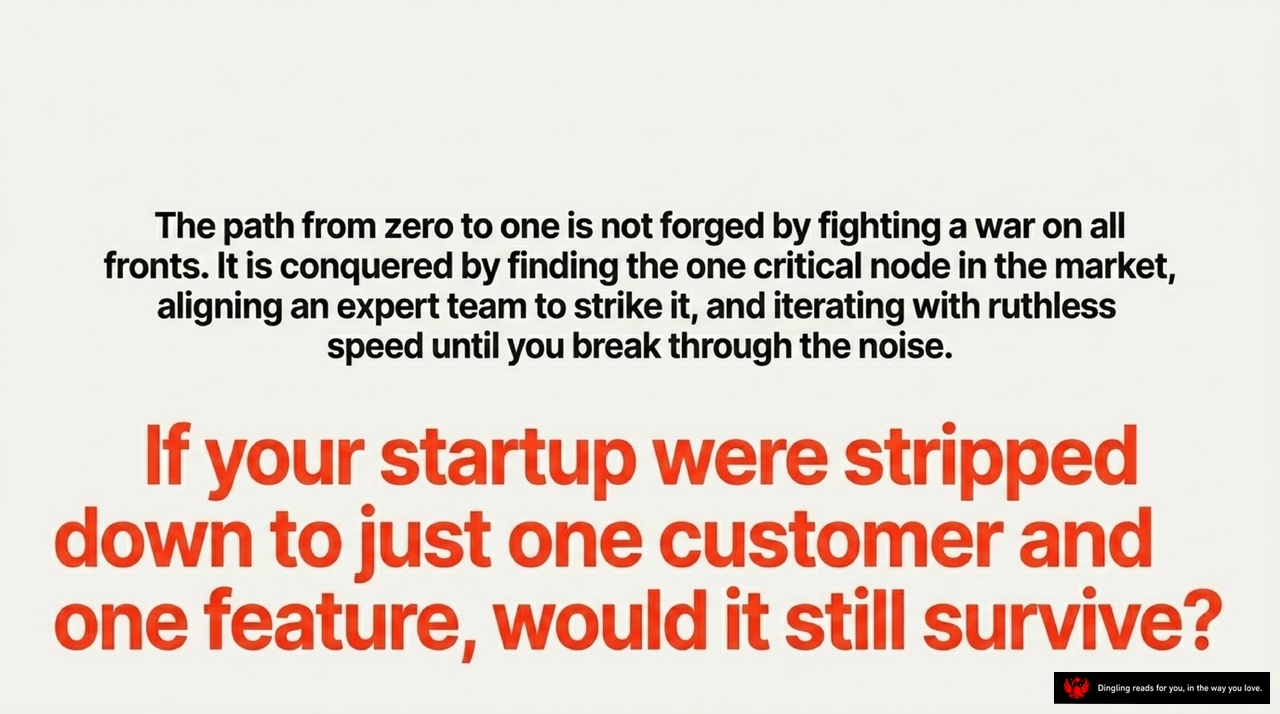
Most founders think winning means fighting on every front, but the truth is, you only survive by finding that one critical node in the market and striking it with ruthless speed. The path from zero to one isn't about a full-scale war; it's about aligning an expert team to hit a single target until you break through the noise.
So, let's put your startup to the ultimate test: if you stripped it down to just one customer and one feature, would it still survive? This question forces you to cut away the fluff and ask the hard truth. If your business can't stand on its own with a single user and a single value, then your current strategy is just a distraction. You need to stop trying to be everything to everyone and instead focus on mastering one specific pain point for one specific person. That is where your real competitive advantage lies.