
Skin in the Game: Complete Chapter-by-Chapter Summary

Welcome to a journey into the heart of uncertainty. Today, we are diving into Nassim Nicholas Taleb's masterpiece, *Skin in the Game*. This isn't just another book about risk; it is a fundamental framework for understanding how to survive in a complex, often chaotic world.
At its core, Taleb argues for a simple but powerful principle: symmetry. To get a reward, you must bear the risk. If you want to profit from someone else's loss, you must be willing to lose yourself. It's the ancient idea that you cannot ask others to take the bullet for you.
Think of the myth of Antaeus, the giant who drew his strength from the earth. As long as his feet touched the ground, he was unstoppable. But when Hercules lifted him into the air, separating him from his source of power, Antaeus lost everything. Taleb uses this story to explain knowledge itself. Knowledge without practice, without real-world consequences, is like Antaeus in the air—it becomes weak and useless. True wisdom comes from "pathemata mathemata"—learning through pain. You only understand the cost of a decision when you are the one paying the bill.
This concept of "skin in the game" challenges the modern obsession with abstract theories and experts who give advice without facing any consequences. It demands that we align our rights with our responsibilities and our profits with our risks. Whether it's a doctor, a banker, or a parent, if you aren't willing to lose what matters to you, you have no right to make decisions for others.
In a world full of uncertainty, the only true currency is your willingness to share the burden. That is the essence of *Skin in the Game*.

The Law of Symmetry isn't just a catchy title; it's the ultimate filter for survival. Look at that scale: on one side, we have making the decision, and on the other, bearing the consequence. These two sides must be perfectly balanced. If you separate them, the entire system collapses.
History taught us this lesson 3,800 years ago. Under Hammurabi's Code, if an architect built a house that collapsed and killed the owner, the architect was put to death. This was the ancient standard: your risk had to match your reward. If you want the upside of an outcome, you must be exposed to its downside.
But today, we have a massive deficit. We've separated knowledge from practice. We live like the myth of Antaeus, who lost his invincibility the moment he was lifted off the ground. Systems detached from consequences become fragile. We publish advice without holding the bag, we take loans without risking our own capital, and we detach ourselves from the real world.
This creates a dangerous imbalance. When you don't bear the consequence, you lose the incentive to avoid the risk. The only way to restore stability is to bring decision-making and consequences back into symmetry. Stop hiding behind others' risks and start standing on your own two feet.

The "Bob Rubin" trade isn't just a phrase; it's a deadly cycle that destroys entire systems. Look at this diagram. It starts when a banker takes a high-risk bet. When things go right, those short-term profits get privatized into massive bonuses. The architects of ruin keep their wealth. But when the system crashes—what we call the "Black Swan"—the losses get socialized. Taxpayers absorb the bailout losses, while the decision-makers who shielded themselves from consequences simply blame an "unforeseeable" event and walk away.
This is the core failure of our modern economy: we have privatized gains but socialized losses. It creates a perverse incentive where bureaucrats and bankers collect huge rewards during good times, but when the inevitable crash happens, they blame the public for the fallout. The result is a fragile system where the people who created the risk don't bear the cost. True stability requires symmetry: if you want the upside, you must be willing to stand in the middle of the storm when the downside hits. Until we enforce that, systemic ruin is just a matter of time.

Who actually bears the risk? That's the question we're tackling today. Look at this chart. It breaks down four distinct archetypes and asks a simple but critical question: do you have upside, and do you have downside?
First, we have The Bureaucrat, or what the author calls the "Intellectual Yet Idiot." They are safe, they dictate rules, and they learn nothing from reality. Notice the red X marks here: they have no upside and no downside. They are completely insulated.
Then, there's The Crony Banker. They extract wealth and transfer risk to the public. They get a huge upside, but look at that red X in the downside column. They have no downside. They take the profit, but they never take the loss.
Next is The Artisan or The Entrepreneur. This is what the book calls "True Skin in the Game." They learn via direct feedback. Here, you see green checkmarks in both columns. They have high upside and high downside. They are fully exposed to reality.
Finally, we have The Hero. They take on risk for the sake of the collective. They have no upside for themselves, but they bear a high downside. That is the definition of "Soul in the Game."
The core lesson here is symmetry. If you want the reward, you must accept the risk. If you want to avoid the loss, you must give up the gain. Those who enjoy the upside without accepting the downside are breaking the fundamental rules of a stable society. They are the ones who will eventually lose everything, just like the mythological Antaeus who lost his strength when lifted off the ground. True wisdom comes from having your own skin in the game.
Let's talk about the true cost of control. The slide breaks it down perfectly: the difference between a formal employee and a contractor isn't just about contracts; it's about who actually bears the risk.
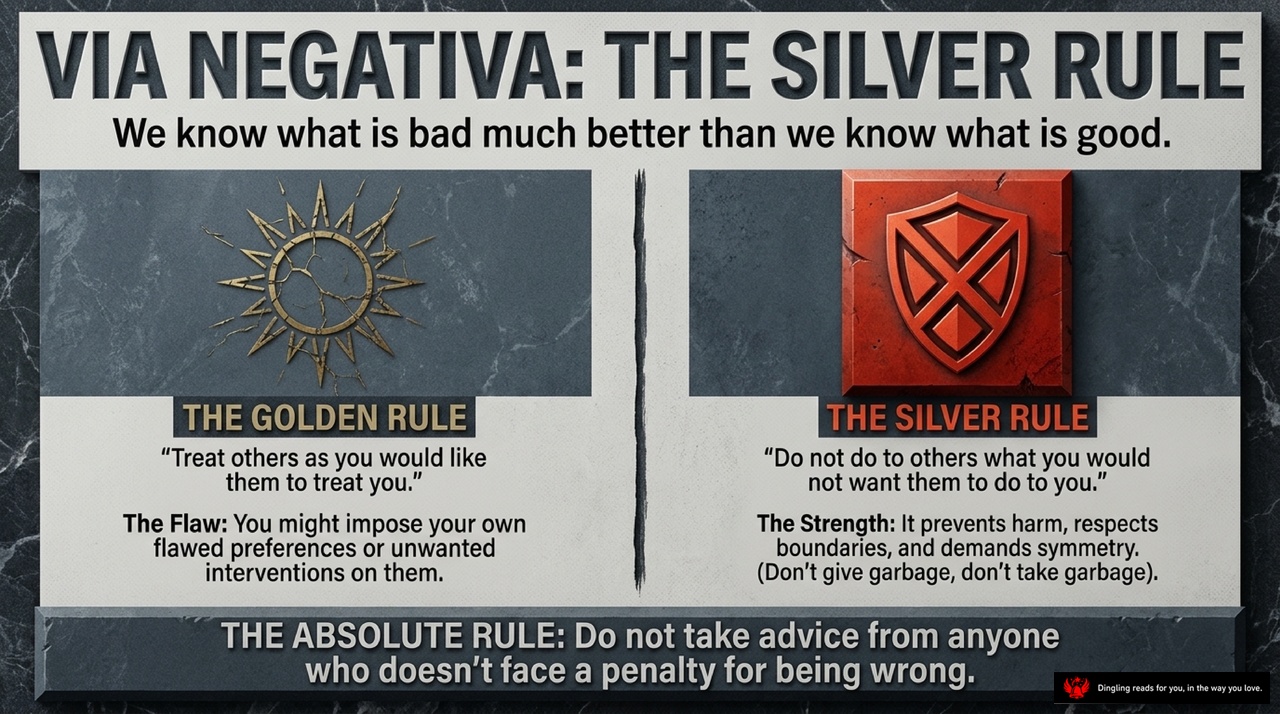
On the left, we see the "Golden Rule"—treat others as you want to be treated. But the slide rightly points out its flaw: you might impose your own flawed preferences on someone else. It's like telling a barber to cut your hair exactly how you'd cut it yourself; you're forcing your specific taste on them, which often leads to disaster.
On the right, we have the "Silver Rule": do not do to others what you would not want them to do to you. This is the real strength. It protects boundaries and demands symmetry. Think of it as the "don't give garbage, don't take garbage" principle. It prevents harm by respecting what you know you don't want to experience.
But the ultimate takeaway is at the bottom: The Absolute Rule. Do not take advice from anyone who doesn't face a penalty for being wrong. This is the core of skin in the game. When a banker gets a bonus for a risky deal but leaves before the crash hits, they are breaking this rule. They are living in a simulation where the consequences don't land on them. True control comes from building a system where everyone shares the risk. If you don't share the risk, you aren't truly in charge—you're just passing the buck to someone else, and eventually, that debt comes due.

True wisdom isn't found in a textbook or a polished suit; it's forged in the fires of real consequences. As the slide reminds us, learning doesn't happen primarily through education; it happens through filtering. The system improves not because humans inherently learn from mistakes, but because it eliminates those who make fatal errors. Think about it: if pilots don't die in crashes, bad pilots keep flying. Without the risk of personal loss—what we call having "skin in the game"—there is no evolution.
We often confuse high intelligence with true wisdom. The "white knowers" in our world are smart but detached. They love theories, but they refuse to take the barbell's weight themselves. They hide in safe corners, using complex jargon to avoid the messy reality of decision-making. But the real experts? They are often the ones who look out of place. A doctor who looks more like a butcher than a surgeon often has the real skill because they've survived the risk of failure. A wealthy person who lives simply understands value better than someone who buys a mansion just to prove they can afford it.
This principle applies to everything, even our food. We crave the "real thing" because we know the fake stuff is just a simulation. Religious sacrifice, for instance, requires real blood and real pain; only then does the faith carry weight. In business, we prefer the "tough guy" over the polite salesman because the former has something to lose. In life, the only thing that matters is whether you can survive the long run. As the Lindy Effect teaches us, the longer something has survived, the longer it will likely last. True wisdom is what survives the test of time and the sting of reality.

How a tiny 3% can actually dictate the choices of the entire 100%. It sounds counterintuitive, right? But look at what's happening here. We have a stubborn minority, just 3%, who refuse to compromise. Then there's the spread, reaching 30%, and finally, the flexible majority, which eventually conforms to 100%. This isn't just a math game; it's the core mechanism of how complex systems actually work.
Think about it: if a stubborn 3% of the population strictly demands Kosher, Halal, or non-GMO food, the flexible majority will eventually eat that too. Why? Because it is simply cheaper for supply chains to standardize than to carry dual inventories. The minority holds the veto power. They say "no" to anything that doesn't fit their rigid rules, and the majority, being flexible, simply adapts to avoid the conflict.
This is the insight we need to take away: a complex market is not the sum of all its participants. It is driven by the most extreme, uncompromising actors who refuse to adapt. Whether it's language, religion, or food choices, the system shifts to accommodate the few who absolutely cannot be accommodated. So next time you see a trend sweeping the world, ask yourself: who was the small group that refused to budge? Because often, they are the ones pulling the strings.

So, here's the hard truth: don't let a person's appearance fool you into thinking they're an expert. Look at this slide. On the left, you have "Surgeon A," the Theorist. He looks like a Hollywood actor—perfectly tailored suit, refined speech, all the right aesthetics. On the right, you have "Surgeon B," the Butcher. He looks overweight, disheveled, with a thick accent, holding a cleaver.
Intuitively, you want the polished surgeon, right? You want the one who looks like he belongs in a boardroom. But the slide tells you to "Choose the Butcher." Why? Because in the real world, aesthetics are often just a costume. Surgeon A might just be good at playing the part, while Surgeon B had to overcome massive headwinds to reach that elite rank. His clinical results must be undeniably exceptional just to survive the filter of a skeptical public.
This is the core lesson of "Skin in the Game": never be fooled by the aesthetic of expertise. True competence is proven by results and the willingness to share the risk, not by how sharp your tie looks. The butcher isn't a butcher because he looks rough; he's a butcher because he actually does the work and stands by it.
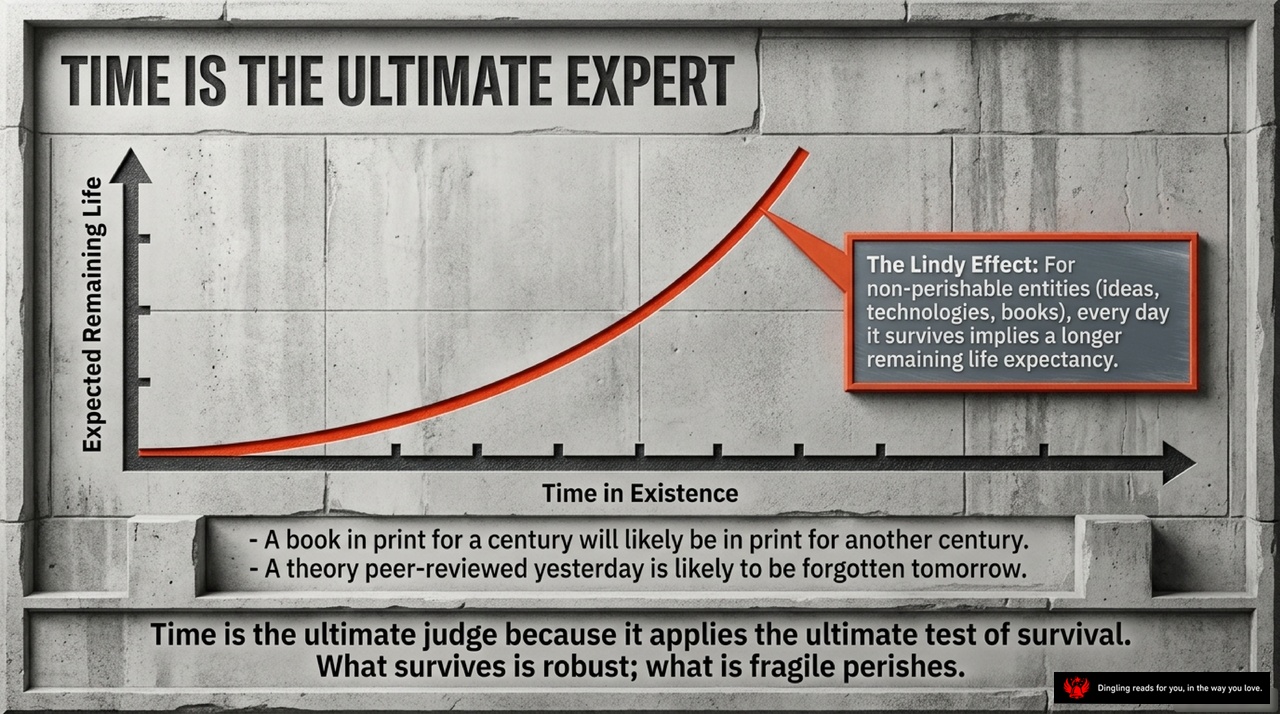
Time is the ultimate expert. As the slide illustrates, the longer an idea, a book, or a technology survives, the longer its expected remaining life becomes. This is known as the Lindy Effect. Think of it as nature's most ruthless filter: time applies the ultimate test of survival. What endures is robust; what perishes is fragile.
Look at that curve. A book in print for a century will likely stay in print for another. Conversely, a theory peer-reviewed yesterday is probably destined to be forgotten tomorrow. This isn't just about age; it's about resilience. In a world full of noise and fleeting trends, the only true validation is staying power. The ancients knew this instinctively. Their wisdom—like the principle of "do not do to others what you do not want done to yourself"—survived because it helped people navigate real risks over millennia. Modern theories that fail to survive the test of time are often just intellectual fads. So, when you're evaluating any claim or innovation, ask yourself one simple question: has it stood the test of time? If it has, trust it. If it hasn't, it's likely just another fragile thing waiting to be left behind.

Imagine a world where inequality isn't a frozen photograph, but a living, breathing cycle. This slide brilliantly contrasts two ways of looking at wealth gaps: the static view versus the dynamic reality.
On the left, we see the "Static Inequality"—a rigid pyramid. This is the bureaucrat's view. It measures who is rich and poor at a single frozen moment in time. It's like taking a snapshot and declaring the story over. But on the right, we see "Dynamic Inequality," represented by those swirling arrows. This is the ergodic reality. It doesn't just look at who has money today; it measures the probability that the rich will lose their wealth and the poor will gain it over a lifetime.
True equality, as the bottom text reminds us, isn't about everyone having the exact same bank balance. That's an illusion. Real equality exists when the top 1% lives under the constant, terrifying risk of falling out of that group. If you can lose it, you have a fair shot. If the rich are insulated from failure and the poor have no path to success, that's not a society—that's a trap. We need to stop fearing the gap and start respecting the flow.
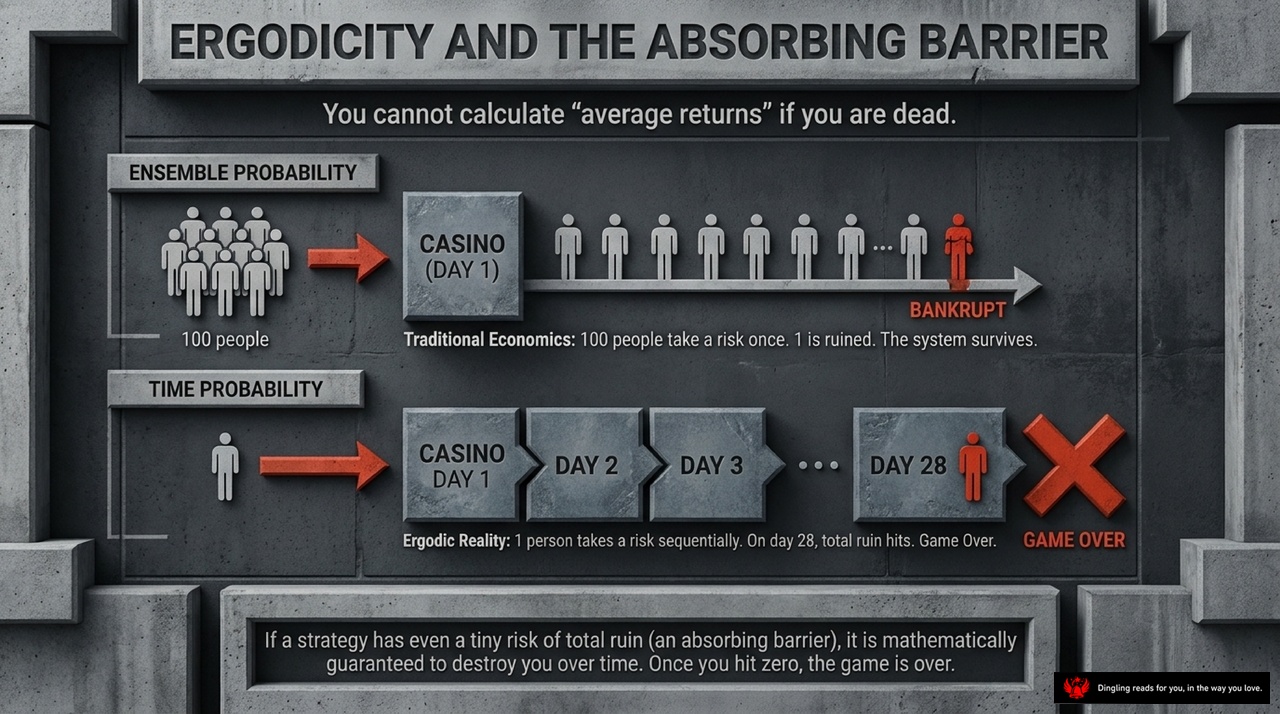
The slide clearly contrasts two worlds: the abstract safety of "Ensemble Probability" versus the brutal reality of "Time Probability." It highlights a terrifying truth: you cannot calculate average returns if you are dead.
In the top section, we see the "Casino" view. Traditional economics looks at a group of 100 people taking a risk once. Mathematically, if 99 win and 1 loses, the average return looks positive. The system survives. But this is a lie for the individual.
Now, look at the bottom section. This is the "Ergodic Reality." Here, one person takes the risk sequentially, day after day. By Day 28, that single person hits the "absorbing barrier"—total ruin. Once you hit zero, the game is over. You cannot play again. No amount of future winning matters if you are already bankrupt.
This is the core lesson of traversability. If your strategy has even a tiny risk of total ruin, it is mathematically guaranteed to destroy you over time. You might be safe in the average of a group, but you are doomed in the timeline of your own life. The moment you hit the absorbing barrier, the game ends forever. That is why true rationality isn't about maximizing an average; it is about ensuring you stay in the game long enough to see the results.
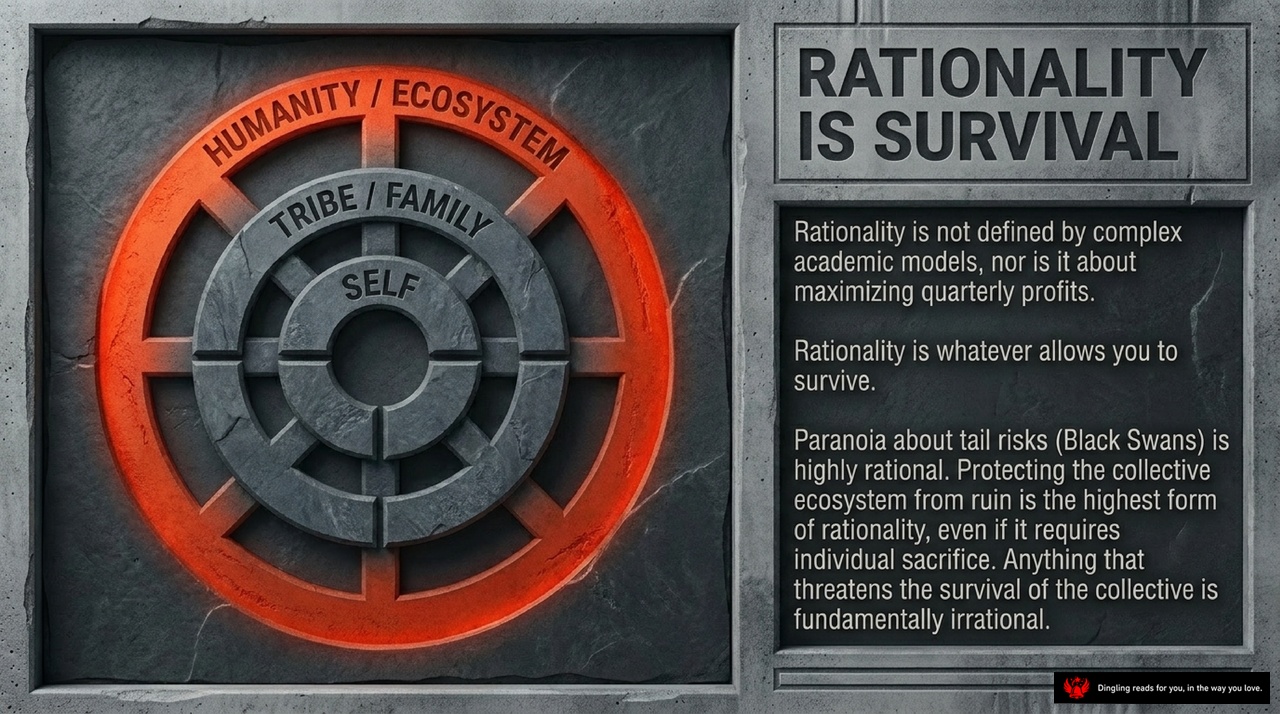
Look at this concentric circle diagram. It visually maps out a hierarchy of survival, moving from the individual self, out to the family and tribe, and finally to the entire human ecosystem. The bold text on the right declares a simple but profound truth: "Rationality is Survival."
The slide challenges the modern obsession with complex academic models or chasing quarterly profits. Instead, it argues that true rationality is whatever allows you to survive. In fact, being paranoid about "Black Swans"—those rare, catastrophic tail risks—is actually highly rational. Why? Because protecting the collective ecosystem from total ruin is the highest form of rationality, even if it requires individual sacrifice.
Think of it this way: anything that threatens the survival of the group is fundamentally irrational. If you prioritize short-term gain over the long-term health of your tribe or society, you are acting against the very logic of survival. This aligns with the book's core principle of "Skin in the Game." You cannot ask others to bear the risks while you keep the rewards. Whether it's a family, a community, or humanity as a whole, the system only works if everyone shares the burden. If you threaten the collective's future, you are destroying the foundation that supports your own existence. True rationality isn't about being smart in a vacuum; it's about making choices that ensure you and your community don't get wiped out by the inevitable shocks of reality.
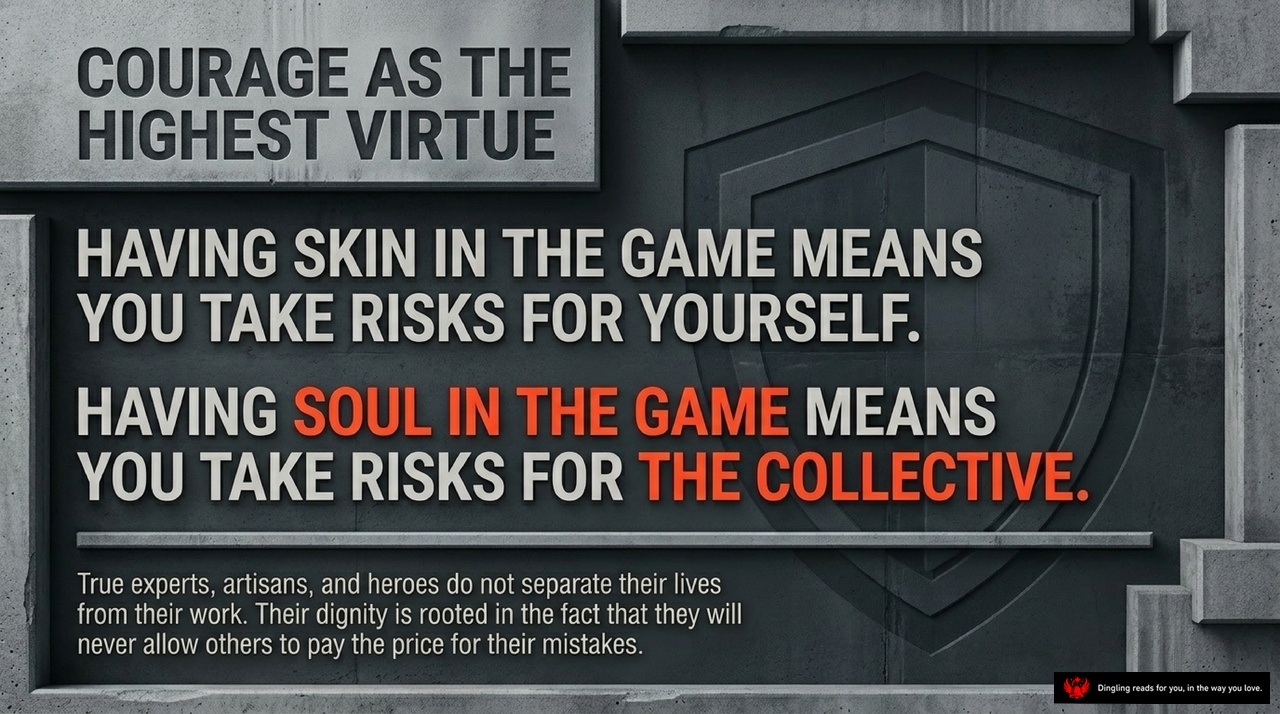
Courage as the highest virtue isn't just a slogan; it's the only way to survive in a world full of uncertainty. Look at this slide: it draws a sharp line between two types of risk. Having "skin in the game" means you take risks for yourself. But having "soul in the game" means you take risks for the collective. That distinction is everything.
True experts, artisans, and heroes do not separate their lives from their work. Their dignity is rooted in the fact that they will never allow others to pay the price for their mistakes. Think about it: if a doctor, a pilot, or an investor is truly responsible, they are willing to lose their own money, reputation, or even their freedom if things go wrong. That's what creates trust.
In contrast, those who only want the reward without the risk are destroying the system. They are the ones who give dangerous advice but never bet their own life on it. As the text reminds us, real wisdom comes from those who are willing to expose themselves to the consequences of their decisions. When you have soul in the game, you aren't just protecting your own interests; you are standing up for everyone else who relies on your judgment. That is the essence of courage and the foundation of a fair society.

Look at this structure. We are standing on the foundation of reality itself, supported by four massive pillars: Ethics, Society, Knowledge, and Math.
On the Ethics side, we have symmetry, specifically "Do no harm." This is what we call the Silver Rule. It's the most practical guide we have because we can always feel pain ourselves, unlike others.
In Society, the Minority Rule dictates the flexible whole. You might think the majority always wins, but in reality, it's often the stubborn 3% who hold the power. They have the veto; they are the ones who refuse to compromise, and that non-negotiable stance eventually shapes the entire group.
Then we have Knowledge, governed by the Lindy Effect. Time is the ultimate filter. It relentlessly removes the fragile. If a book, an idea, or a practice survives for a long time, it is because it has already absorbed the risks of the past and is ready for the future.
And finally, Math brings us to Ergodicity. This is about avoiding the absorbing barrier of total ruin. In a real-world system, if you hit a wall that stops you forever—like bankruptcy or death—no amount of average gain matters. You are out of the game.
But here is the common thread tying all of these together, highlighted in red at the bottom: None of these function without the presence of real, personal risk. You cannot have symmetry, society, knowledge, or mathematical stability unless you are willing to put your own skin in the game.
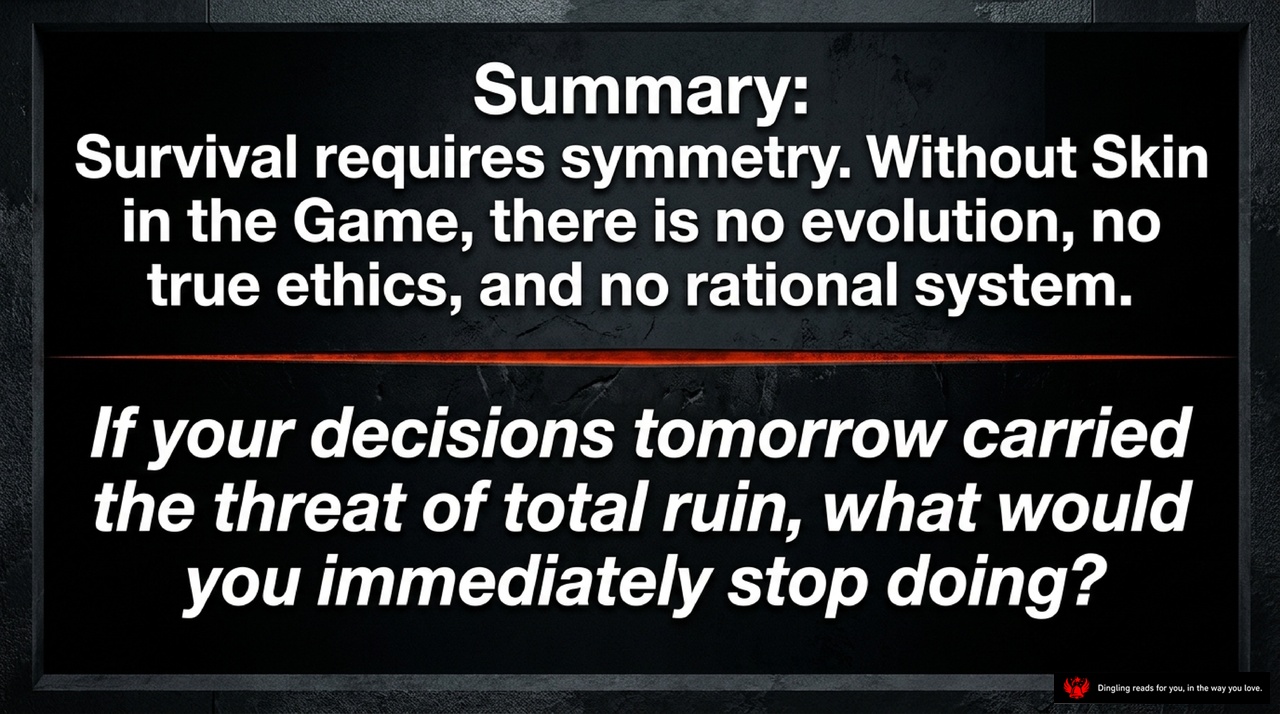
Survival isn't about being right; it's about staying in the game. The core lesson here is simple but brutal: symmetry is the price of existence. Without skin in the game, there is no evolution, no true ethics, and no rational system. Think about it: if you can reap the rewards of a decision without ever facing the possibility of total ruin, you have no incentive to be careful. You become a player who never risks losing, which means you never truly learn or grow.
Look at the question on the screen: "If your decisions tomorrow carried the threat of total ruin, what would you immediately stop doing?" This is the ultimate test of symmetry. It forces us to confront the reality that every action has a cost. When you have nothing to lose, you can't make rational choices because you have no stake in the outcome. True wisdom comes from those who are willing to bet their own lives on their ideas, because only then do they care enough to get it right. If you want a system that actually works, you need to ensure that everyone who benefits from the rules also bears the consequences if those rules fail. That is the only way to build a world where survival is possible for everyone.