


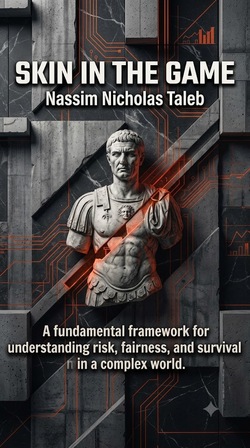
I finally understand why having skin in the game is the only way to fix our broken financial system and stop reckless behavior.
Your Review
I finally understand why having skin in the game is the only way to fix our broken financial system and stop reckless behavior.


The 2008 crisis hit hard because bankers took huge bonuses while taxpayers paid the bill for their risky bets.

The book makes it clear that experts who don't share the risk of their advice are useless, like the traders who sold green lumber without understanding the real meaning, proving that credentials mean nothing without actual skin in the game.

The 2008 crisis example hits hard.

The 2008 crisis example shows perfectly why bankers needed skin in the game to act responsibly.

Taleb argues that when decision makers have no skin in the game, they prioritize short term gains over long term stability, creating fragile systems prone to sudden collapse.

The 2008 crisis story where bankers got bonuses while taxpayers paid the bill perfectly illustrates why lacking skin in the game destroys trust in our financial leaders.

The green lumber fallacy story proves textbook experts often fail while traders succeed because only those with actual risk exposure gain the wisdom to navigate real market demands.

The book argues that true wisdom comes from facing real consequences, not just having fancy degrees or theoretical models. Taleb illustrates this with the 2008 financial crisis, showing how bankers took massive risks for short-term bonuses while taxpayers bore the long-term costs. This lack of 'skin in the game' created a system where reckless decisions were rewarded, leading to catastrophic instability. The text also highlights how this principle applies beyond finance, pointing out that politicians and academics often dictate policies without ever experiencing the hardships their rules cause ordinary people. By contrasting the 'Silver Rule' with the flawed 'Golden Rule,' Taleb suggests that fairness isn't about equal outcomes but about equal accountability. He uses historical examples like Hammurabi's Code, where architects faced death if their buildings collapsed, to show that ancient societies understood the necessity of symmetric risk. While some might find the myth of Antaeus or the discussion on Jewish dietary laws interesting, the core message remains clear: without personal risk exposure, expertise becomes detached from reality and dangerous. The book challenges us to apply this logic to our own lives, whether choosing a job, seeking financial advice, or voting on public policy. Ultimately, Taleb's framework provides a powerful lens for spotting broken systems and advocating for ones where everyone shares both the rewards and the burdens.
Hammurabi's Code showed ancient architects faced death if buildings collapsed, enforcing risk symmetry long before modern bankers could hide behind credentials to avoid consequences for the public.

Taleb's idea of risk symmetry explains why the 2008 crash happened, because bankers had no skin in the game while we paid the bill for their reckless bets and lost homes.

The idea that people should share both rewards and risks is simple but essential for a fair society.

The story of Antaeus perfectly illustrates why ideas need real risk exposure to have any weight in the real world.

Taleb argues that experts without skin in the game create fragile systems. He contrasts white intellectuals who dictated COVID lockdowns from safe home offices with restaurant owners who lost their livelihoods and savings. This asymmetry allowed elites to impose harmful policies without facing the real consequences, proving that avoiding personal risk leads to decisions that destroy the very communities they claim to protect. The book shows how this broken symmetry in education and politics makes systems vulnerable, whereas those who share the risks make better choices. By ignoring risk symmetry, we allow reckless behavior to go unchecked, ultimately harming the most vulnerable who cannot shield themselves from the fallout of unaccountable experts.

Taleb exposes how Wall Street bankers took massive bonuses in 2008 while taxpayers bailed out their risky bets, proving that zero skin in the game destroys trust and stability for everyone.

Taleb hits hard on how bankers profited while taxpayers lost everything in 2008.

Taleb argues that risk symmetry is essential because people who don't share the consequences make reckless choices that hurt everyone else, using the 2008 financial crisis and the story of Antaeus to show how knowledge without real-world risk exposure is weak and disconnected, ultimately leading to systemic fragility when decision-makers are shielded from the pain of failure while reaping the rewards of success, which erodes trust in institutions and leaves ordinary people feeling betrayed by leaders who never have to live with the results of their own decisions.

Taleb's personal story about selling toxic assets at his own bank perfectly proves why experts fail when they don't share the risk.

Taleb exposes how Wall Street bankers took massive bonuses while leaving taxpayers to cover the losses from their risky bets during the 2008 crash, proving that a system without risk symmetry is inherently broken and dangerous.

The story of Antaeus perfectly illustrates why experts fail when lifted from the earth, as their knowledge lacks the weight of real risk exposure and they cannot withstand reality's chaos.