
Small Data: Complete Chapter-by-Chapter Summary

Welcome to the world of Small Data. Today, we're diving into a book by Martin Lindstrom that changes how we see the invisible forces shaping our lives. The cover image you see here—a worn shoe sole—is a perfect metaphor for our journey. Just as a shoe leaves a unique footprint, every tiny clue in our daily lives leaves a mark that reveals huge truths about human behavior and hidden desires.
The core idea is simple yet powerful: small data uncovers huge trends. While big data tells us what people are doing, small data reveals why they are doing it. It's about finding the tiny clues that fulfill hidden human desires. Whether it's the specific arrangement of spices in a kitchen, the way a child interacts with a screen, or the subtle cultural rules governing how we stand in an elevator, these micro-details hold the key to understanding the macro world. We aren't just collecting numbers; we are decoding the human story written in the smallest of moments.

Imagine a corkboard pinned with the stark reality of our digital age: ninety percent of the world's data has been generated in just the last two years, yet companies are still failing to connect. Why? Because Big Data tells us *what* is happening, but it lacks context, empathy, and subtext. It's a map without a compass.
In contrast, look at the photos below—these represent Small Data. While Big Data tracks the numbers, Small Data tells us *why*. It reveals the emotional DNA driving human behavior. It's the difference between knowing a refrigerator is full of food and understanding the memories attached to the magnets on its door, or knowing someone is stressed by the way they tie their shoes.
True connection isn't built on massive datasets; it's built on the tiny, human details that Big Data misses. By shifting our focus from the overwhelming scale of information to the intimate nuances of individual lives, we finally unlock the ability to understand people—not just predict them.

On the left, we see a stark line graph labeled "The Big Data Prediction," showing a steady decline from 3,416 down to 7.22. The red note attached to it reads: "Hypothesis: Digital natives demand instant gratification. Lego must dumb down." This was the conventional wisdom that told us kids just wanted easier, simpler toys because they were used to the fast pace of the digital world.
But look at the right side: "The Small Data Truth." There's a photo of a worn-out, muddy Adidas sneaker, with a yellow note saying, "The Epiphany: A symbol of mastery and social currency." This image reveals the real story. Kids don't actually want things to be easier; they crave the struggle. They want to master a difficult skill. When the ultimate reward is social proof among their peers, they are willing to spend hours mastering something hard.
Lego ignored the big data trend of "dumbing it down" and instead reverted to harder, smaller bricks that required more skill and patience. By listening to the small data of how children actually play and what they value, Lego became the world's number one toy maker. It proves that while big data tells you what people say they want, small data reveals what they truly need.

So, what exactly is "Small Data"? Forget the massive, impersonal spreadsheets that define the modern business world. Instead, let's look at the messy, unpolished reality of everyday life. Small data is about those seemingly insignificant, everyday behavioral observations that we often ignore. Think about the bathroom counter: a tube of toothpaste squeezed out, leaving a messy ring on the shelf. That isn't just trash; it's an unconscious indicator of an unfulfilled emotional desire. It reveals the messy offline reality that often contradicts our polished online personas. While we curate perfect lives on social media, small data captures the authentic, chaotic truth of how we actually live, offering a window into the human experience that big numbers simply can't see.
Imagine you're standing in a pool, the water washing away your worries. That's the secret to unlocking the best ideas. We call these moments "Water Moments." Think of it like this: when you're stressed, your brain gets stuck in a loop, obsessing over the past or the future. But the moment you get into the water—whether it's a shower, a swim, or just standing by the pool—your focus shifts to the present. The noise fades, and your subconscious starts working overtime.
I learned this the hard way while trying to solve a problem for McDonald's. I was stuck on how to make their kids' meals more exciting. Then, I found myself at a pool in Milson's Point, watching children happily munching on carrots. Suddenly, the image clicked. I saw three swimming lanes in my mind: one for tomatoes, one for carrots, and one for cauliflower. Why couldn't we turn these vegetables into an adventure?
With the help of a creative team in Denmark, we transformed a boring meal into a story. We designed a "Little Dragon Burger" where kids could climb a staircase made of tomato, cucumber, and carrot slices to find Shrek or Fiona inside. We even built a spaceship where the tomato was the cockpit and the carrot was the door, hidden behind a secret code. It was magic. Kids would light up, and parents would finally feel proud.
But here's the catch: despite everyone loving the idea, McDonald's never actually launched it. Why? Because the company was too big and rigid. Changing the menu required planning 18 months in advance, buying new machines, and retraining thousands of employees. The logistics of using fresh vegetables made it impossible. Yet, that failure taught us a massive lesson about innovation. True creativity often needs the freedom of a "Water Moment"—a space where rules dissolve, and the only limit is your imagination. Sometimes, the best ideas are the ones we almost let go of, because they might be the ones that change the world.

Welcome back. Let's dive into the Middle East, a region where the battle for health is being fought on two fronts: the rising tide of obesity and the desperate need for emotional relief.
In Saudi Arabia, the clues are stark. We see extreme heat and restrictive rules creating a unique pressure cooker. To cope, families turn to water paintings and rescue toys—fire trucks and ambulances lining the floor. These aren't just playthings; they serve as psychological relief and expressions of protection in a world that can feel overwhelming.
But the struggle isn't just about coping; it's about the food itself. In the West, we often hide high-calorie snacks in secret spots, driven by a cycle of hope and disappointment with diets. Yet, in places like the Middle East, the solution lies in reimagining the very act of eating.
Think about the power of water. It's the ultimate "incubator" for creativity and relaxation. When we step into a pool or stand by the water, our minds shift from planning the future to living in the present. This mental shift is exactly what a fast-food giant needed to break through.
Imagine a children's meal that doesn't just look like a burger, but tells a story. We could design a "swim lane" theme where a child climbs a staircase made of tomatoes, carrots, and cucumbers to find a hidden character inside a Little Dragon burger. Or a spaceship where the tomato is the cockpit and the carrot is the door. Suddenly, vegetables become the adventure, and the meal transforms from a chore into a moment of magic.
This approach works because it taps into a deeper human need. Whether it's a weight loss program using "bead strategies" to celebrate small wins and offer forgiveness, or a beer brand turning a bar into a "church" to replace fading religious rituals, the secret to success isn't just better food or products. It's about creating a "permission zone"—a space where people can feel safe, connected, and free to be themselves. In a world of rules and restrictions, that simple shift from survival to celebration is everything.

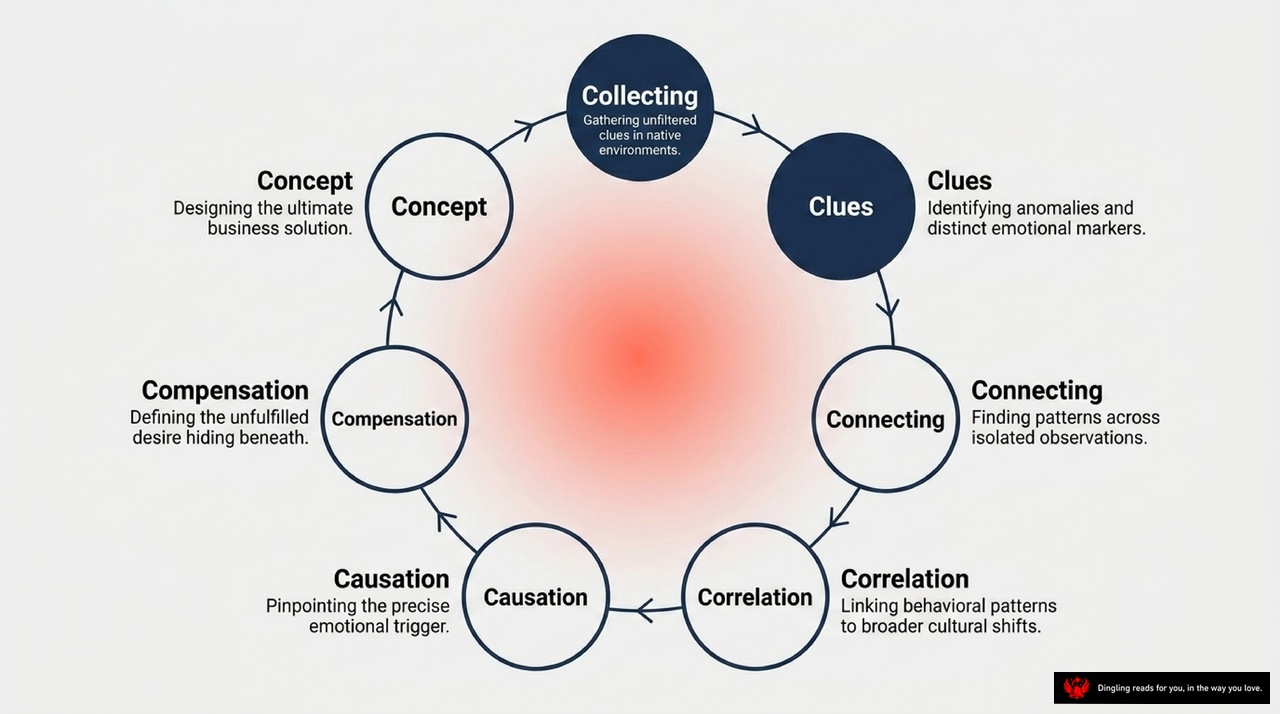
Let's dive into the final piece of the puzzle: how we turn raw observations into a winning brand strategy. Think of this as your master control room for understanding people. We call it the 7C Framework. It's not just a list; it's a journey from simply seeing things to truly understanding the human heart behind them.
It starts with **Collection**. You have to drop your own biases and build a new map. Talk to the "cultural observers" who know the neighborhood best, like barbers or bartenders, and interview people who represent the past, present, and future of your brand. Don't just look at the surface; get inside the homes and look at the private spaces like the fridge or the closet, because that's where the real truth hides.
Next, you move to **Clues**. Look for those tiny details that trigger an emotional reaction. Is there a collection in the living room showing an ideal self, or a hidden item in the kitchen revealing a secret desire? Ask questions like, "What are you most proud of?" or "What are you most afraid of?" and look at their photos and playlists to find the emotional threads connecting their life.
Then comes **Connection**. You need to weave these clues together to find patterns. If you notice a community avoiding physical touch and then see empty streets at 5 PM, you've connected the dots to a deeper issue: a lack of community. Just like we did with the toy company, realizing that loneliness was the real problem behind their sales slump.
Once you have your connections, find the **Association**. Identify the key moments in life where behavior changes—marriage, having a child, getting divorced. Bring in friends and family to interview them, getting a 360-degree view of what really matters to them.
Now, dig into the **Cause**. Step into their shoes and ask, "What emotion actually triggered this action?" If you hit a wall with cultural differences, bring in an expert to help you translate. This is where you move from "what they do" to "why they do it."
After that, look for the **Compensation**. What deep desire is going unmet? Maybe they need a sense of belonging in nature, or a feeling of connection with a group. Look at their happiest moments in their photo albums and find the gap between that ideal and their current reality. That gap is your golden opportunity.
Finally, you arrive at the **Concept**. This is where the magic happens. You take these ordinary elements and combine them in a fresh, unique way to create a solution. It's like how Lego combined bricks with chips, or Uber combined car rentals with social media. These breakthrough ideas often happen when you're relaxed, like while swimming or cycling, letting your mind wander freely.
This framework transforms small data into a powerful strategy, helping you build brands that don't just sell products, but truly resonate with people.

Welcome to the backstage of the human mind, where the real magic happens. We often think we make decisions with our brains, but the truth is far more physical. It all starts with how we feel our bodies. Hold a hot coffee, and suddenly strangers seem warmer; grip an ice drink, and you feel distant. Even our posture shifts: we lean forward when thinking about the future and lean back when remembering the past. This is the power of embodied cognition.
But it goes deeper than just posture. Our clothes are not just fabric; they are the tools we use to switch identities. When we put on a suit in the morning, we aren't just covering our bodies; we are mentally transforming from our private self into our social role. This is why young girls today spend hours curating their bedroom and taking selfies. Their rooms have become command centers for identity, and their photos are a way to negotiate their place in the world, seeking validation from their peers.
To truly understand these hidden desires, we need a better map than big data. Big data tells us what is happening, but small data reveals why. By observing the tiny details—the messy closet, the specific password, the way someone moves—we can unlock the emotional drivers behind their actions. This is the essence of the 7C framework: Start with observation, find the emotional clues, connect them to find patterns, and finally, create a solution that speaks directly to the human heart. It's about seeing the person behind the data.

The image on your screen breaks down a brilliant strategy for keeping weight-loss clients from quitting. Let's look at the four key parts.
First, we see the problem: clients often quit entirely after gaining just one pound, paralyzed by deep personal shame. This is the exact moment where most programs fail.
Then, we look at the inspiration. The concept borrows from Middle Eastern worry beads and charm bracelets. These aren't just jewelry; they are physical anchors for anxiety and identity. They give people something tangible to hold onto when they feel overwhelmed.
This leads us to the core concept: the "Absolution Bead." Modeled after the Jenny Craig approach, this bead is given specifically during setbacks. Its purpose is to transform that isolating moment of shame into a shared ritual of forgiveness. Instead of feeling alone in their failure, clients receive a physical token that says, "It's okay, we forgive you, and we keep going."
Finally, the result is clear and powerful: client retention doubled. By turning a negative emotional trigger into a positive, shared ritual, the program stopped the bleeding of churn. It proved that sometimes, the best way to help someone lose weight is to help them forgive themselves first.

Welcome to the Cultural Diagnostic Matrix. Think of this as your ultimate cheat sheet for spotting hidden business opportunities in different markets by simply observing the "small data" around you.
Let's break down the three distinct cultural landscapes shown here.
First, look at Russia. The imbalance here is a stark lack of color and high societal skepticism. You'll see this in the refrigerator magnets placed at a child's eye level, which aren't just decorations but a secret hope for travel and escape. The business opportunity? Creating a trusted, colorful online community for mothers, like "Mamagazin," to fill that emotional void.
Next, the USA. The imbalance is hyper-regulated, isolated suburban living. Notice how plush toys are proudly displayed in the homes of 50-year-old women; they are reclaiming playfulness. The opportunity lies in designing "Permission Zones"—retail spaces that embrace fun and break the rigid rules of daily life.
Finally, China. The imbalance is a high-speed, high-pressure society. The small data clue is children crashing Lego cars head-on without slowing down, reflecting a cultural desire for directness. The business opportunity is frictionless product design that prioritizes speed and immediate results.
By reading these subtle clues, you stop guessing and start understanding exactly what each culture is secretly craving.

True innovation happens right in that gap between who we pretend to be and who we actually are. Look at this Venn diagram: on the left, we have the "Idealized Self"—the curated mask we project to the world, filled with the perfect living room, the luxury handbag, and the heart-emoji approval we crave. On the right lies the "Real Self," the unfiltered, messy truth of survival, represented by the open fridge stocked with essentials, the search history for medicine, and the medicine cabinet holding our reality.
The magic happens in the overlap, "The Innovation Zone." You cannot rely on Big Data because it largely tracks the Idealized Self, the polished version we show everyone. Instead, true breakthroughs come from mining the Real Self to uncover Unfulfilled Desires. It's about finding the space where our curated expectations collide with our raw, unspoken needs. That's where the real opportunity lives.

Have you ever noticed how life hits pause buttons at specific moments? When a teenager finally shuts their bedroom door for the first time, or when a parent faces the quiet reality of an empty nest, something profound shifts. These aren't just random events; they are critical "entry points" where identity transforms.
As we saw on the timeline, these transitions—from moving out for college to divorce or empty nesting—create what we call emotional vacuums. It's that sudden feeling of being obsolete or lost when the old roles no longer fit. That's exactly when consumers are most vulnerable, and that's also when they are most open to redefining themselves.
This is where powerful brands step in. Think about charm bracelets. When a mother feels her identity fading as her child grows up, she doesn't just buy jewelry; she buys a way to restore her sense of self. These pieces become anchors, helping her navigate the uncertainty of these life chapters. The lesson here is clear: the brands that truly win aren't the ones that just sell products. They are the ones that identify these exact transitional moments and support their consumers through them. By stepping in at these precise entry points, companies don't just capture a sale; they capture lifelong loyalty.

Big Data tells us *what* is happening, but it rarely explains *why*. Look at this slide: it perfectly captures the gap between correlation and causation. On the left, we have Big Data. It's like a powerful algorithm scanning millions of transactions. It can spot a behavioral anomaly instantly—like detecting that a customer is rapidly moving funds out of a joint bank account. It finds the correlation at scale, but it stops there. It sees the symptom, not the disease.
Then, we add Small Data. This is represented by the magnifying glass with the fingerprint. This is where the human element kicks in. While Big Data flags the action, Small Data digs into the humanity and emotion behind it. It asks the real question: Why? In our example, it reveals that the customer isn't angry about interest rates; they are going through a painful divorce. Big Data sees the money leaving; Small Data sees the heart breaking.
When you combine these two—the cold, hard scale of Big Data with the deep, nuanced understanding of Small Data—you get what this slide calls "The Ultimate Marketing Machine." It's not just a brain with gears; it's a living, breathing insight engine. It allows us to move beyond just reacting to trends and start understanding the true drivers of human behavior. In a world drowning in data, the ability to find the story behind the numbers is the only competitive advantage that truly matters.

In a world obsessed with analyzing billions of data points, we often miss the profound human truth right in front of our eyes. While big data connects the dots, it's small data that reveals the human desires behind them. By observing the tiny, overlooked details of daily life, we uncover the cultural imbalances and unfulfilled emotional needs that drive true innovation.
Think about it: in a society where we constantly track every metric, what deep-seated longing are we ignoring? Whether it's the color of a spice jar, the layout of a bedroom, or the ritual of a meal, these small clues tell a story about what people truly crave. It's not just about what they buy, but why they feel the need to buy it at all. The most powerful innovations don't come from massive datasets; they come from noticing the quiet, unspoken moments where life feels just a little bit off, and then fixing it.