
Small Voice of History: Complete Chapter-by-Chapter Summary
Welcome to the first chapter of our reading journey, titled "The Small Voice of History" by Wang Di. This slide sets the stage for a profound exploration spanning thirty-seven years of deep reading. It promises a voyage through time, revealing how the untold stories of ordinary people shape the grand narrative of human civilization. As we begin, remember that history is not just about empires and dates, but about the quiet, powerful lives that make up our world.

Reading as Self-Shaping isn't just about consuming information; it's about actively sculpting who you are. As we move through the cycle, we start with relentless input. Imagine a scholar reading from Marx and Lu Xun in a dim brick factory, absorbing the collective memory of humanity. This isn't passive; it's about diving into the raw material of human experience to find the truths that matter.
But input alone isn't enough. The next step is the process of critical independence. This is where you refuse to be confined by orthodox thought or traditional imperial narratives. You have to question the silences in the texts and escape the narrow confines that others have built for you. If a scholar abandons this critical thinking, their academic life is effectively over. It is only through this rigorous questioning that reading grants the independence of thought required to find hidden truths.
Finally, this journey leads to output: historical reconstruction. Here, we shift the gaze from elites to the marginalized, writing history with social responsibility and empathy. We are no longer just observers; we are co-creators of the narrative. By connecting these three elements—relentless reading, critical independence, and empathetic reconstruction—we transform our understanding of the world and, in doing so, reshape ourselves.

Stories are far more than just entertainment; they are the very engine of our survival. Imagine a split path: on one side, we have biological evolution—slow, individual, and driven by genetic mutations. On the other, we have cultural evolution—rapid, collective, and fueled by the stories we tell. As the slide illustrates, while our bodies adapt over millennia, our culture accumulates knowledge in moments through shared narratives.
This is the core insight from Gayle Vince's *Human Evolution: Fire, Language, Beauty, and Time*. She argues that storytelling is humanity's collective memory bank. Without it, we would lose our survival strategies, and our culture would stagnate. Think of the Aboriginal "Songlines" that guided tribes across the Australian outback for thousands of years, preserving water sources and survival rules long before written maps existed. These stories didn't just entertain; they kept entire civilizations alive.
The science backs this up. When we listen to stories, our brains react in ways that help us empathize and cooperate. We don't survive as lone geniuses; we thrive because of our accumulated narratives. Whether it's the myths that bind a nation together or the cautionary tales that prevent us from repeating mistakes, stories reduce the energy cost of learning. They allow us to stand on the shoulders of giants, avoiding the fatal mistakes that might have wiped out our ancestors. In short, to tell a good story is to ensure the survival of our species.

Look at this slide titled "The Paradigm Shift in History." It perfectly captures the revolution happening in how we understand the past. On the left, we see Traditional Macro-History, which has long focused on Emperors, Elites, and Heroes, tracing the rise and fall of Nations, Wars, and Dynastic Cycles through Official state archives and political treatises. The goal was always to discover grand Historical Laws.
But the right side shows the breakthrough: Micro-History, or New Cultural History. This approach turns the spotlight away from the powerful and onto The Marginalized, Peasants, and the Ordinary. Instead of studying whole nations, we zoom in on a single village, a local teahouse, or a peasant family. We stop relying solely on official records and start digging into Inquisitorial records, folklore, literature, and daily ledgers to uncover the inner mental and cultural world of the individual.
This shift isn't just about changing who we study; it's about changing how we see history. By listening to the voices of the forgotten, we realize that history isn't just a list of great events, but a rich tapestry woven from the lives of ordinary people. It's a move from the top down to the ground up, making the past feel real, personal, and deeply human.

So, we're talking about the "Long Middle Period"—a concept that challenges the idea that history is just a series of isolated events or a straight line from ancient to modern times. Think of it as a bridge connecting the deep past with our present, where cultural patterns and social structures evolve slowly over centuries, shaping who we are today.
Take the city of Ma Cheng in Hubei, for example. For nearly 700 years, this small place has been caught in a cycle of violence and resistance. It's not just about random fights; it's deeply rooted in the local culture, geography, and collective memory. The region's strategic location made it a battleground, but it was also the local traditions—folk songs, martial arts, and stories of heroes and outlaws—that fueled the conflict. For centuries, the powerful clans and the local elites played a complex game, sometimes using violence to maintain control, other times turning to self-defense when pushed too far.
Then there's the story of the Dongshan Rebellion in the late 1600s. It wasn't just a local uprising; it was part of a larger national struggle during the Three Feudatories' Rebellion. The rebels used old stories and legends to inspire the people, claiming they were fighting against an oppressive government. But the outcome was tragic. The local leaders, who had initially supported the rebels, eventually turned on them, leading to a brutal crackdown. Many innocent people were killed, and the rebellion was crushed.
This event, and the decades that followed, show how deeply history is woven into the fabric of everyday life. The way people remember the past, the stories they tell, and the symbols they use all play a role in shaping their identity and their actions. It's a reminder that history isn't just something that happens to us; it's something we actively create and reinterpret, over and over again.
In the end, the "Long Middle Period" teaches us that history is not a distant, abstract concept. It's alive, breathing, and constantly evolving, shaped by the choices and experiences of ordinary people. It's a complex tapestry of culture, politics, and human nature, woven together over centuries. And by understanding this, we can gain a deeper appreciation for the richness and diversity of human history.
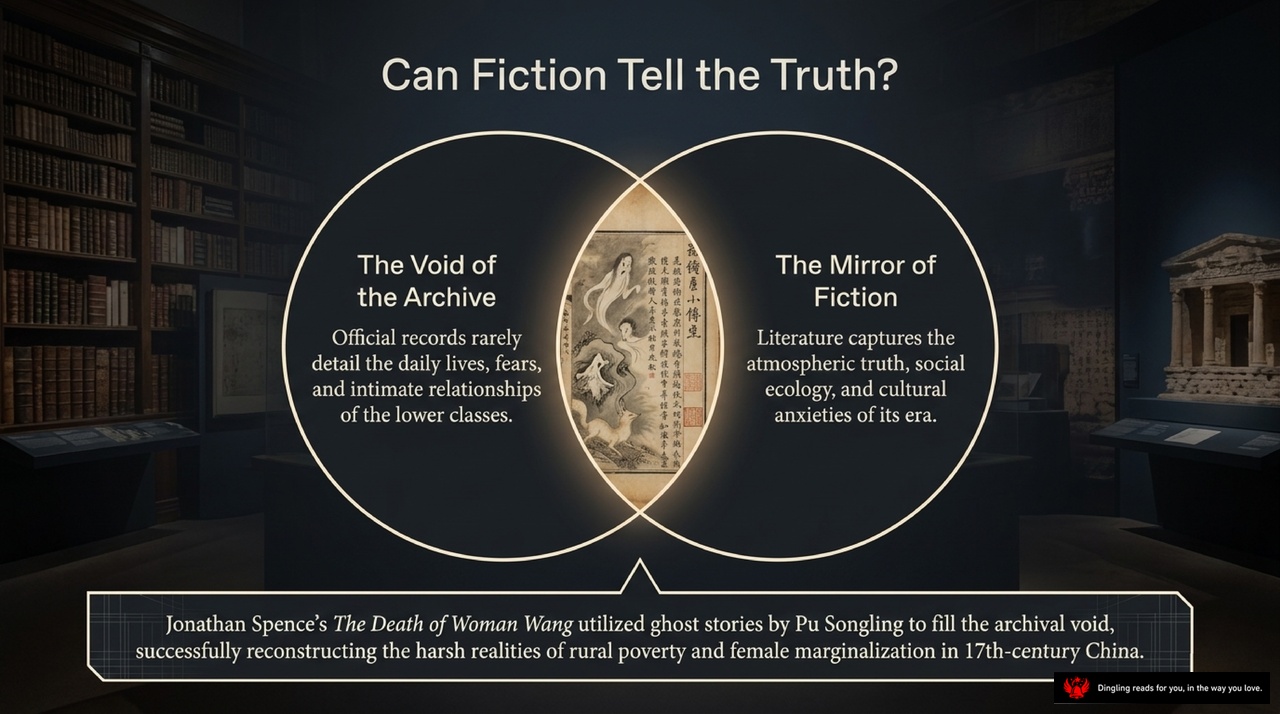
Imagine history not as a dry list of dates and emperors, but as a living tapestry woven from the voices of ordinary people. Today, we explore how modern historians are breaking down the walls of the "great narrative" to listen to the whispers of the past.
Look at the Venn diagram on your screen. On the left, we have "The Void of the Archive." For centuries, official records focused almost exclusively on elites, leaving the daily lives, fears, and intimate relationships of the lower classes in the dark. It was a silence that lasted too long. But on the right, we see "The Mirror of Fiction." Literature, ghost stories, and even novels like Pu Songling's tales were never just entertainment; they captured the atmospheric truth and social anxieties of their era, preserving details that bureaucrats simply ignored.
This is where the magic happens in the intersection: the reconstruction of truth from the margins. Take Jonathan Spence's *The Death of Woman Wang*. By using these ghost stories, he didn't just write fiction; he filled the archival void, successfully reconstructing the harsh realities of rural poverty and female marginalization in 17th-century China. Similarly, Carlo Ginzburg's *The Cheese and the Worms* lifts a miller named Menocchio from the footnotes of history to the center of the stage, revealing a unique worldview that official documents never recorded.
We also see this in the study of plague and space. Bankei's work on the 19th-century plague shows how communities, not just the state, responded to disaster. And consider the city itself as a character: from Nanjing's transformation into a modern capital to the night life of Shanghai, which shifted from a colonial hub to a site of political resistance and then to a symbol of global modernity. Even something as simple as chopsticks tells a story of cultural diffusion and social change, bridging China, Japan, and Korea.
The lesson is clear: true history isn't found only in the grand halls of power. It lives in the stories of the forgotten, in the details of the everyday, and in the courage of historians to look where the archives have looked away. By listening to these micro-voices, we finally understand the full, messy, and human reality of the past.
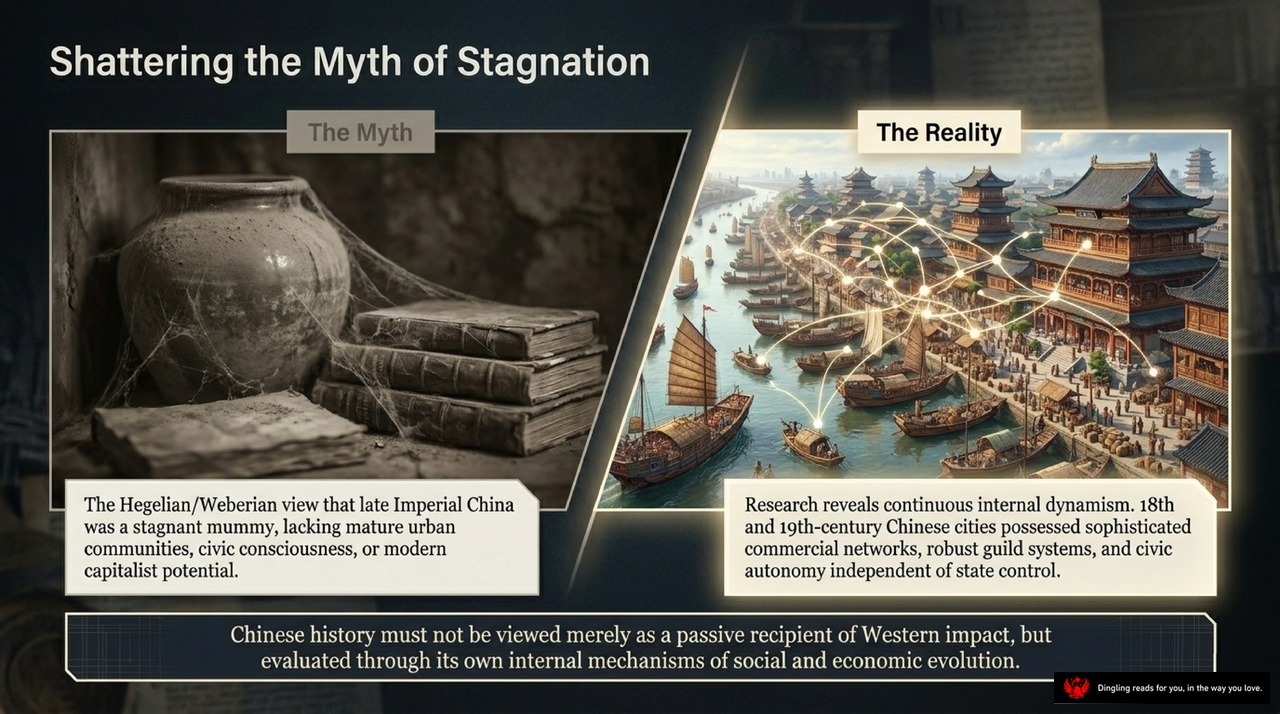
Shattering the Myth of Stagnation: The Reality of Late Imperial China
For centuries, a powerful narrative has dominated our understanding of Chinese history: the idea that late imperial China was a stagnant mummy, trapped in a cycle of tradition with no room for growth. This is the "myth" often associated with Hegelian and Weberian views, depicting China as a society lacking mature urban communities, civic consciousness, or the potential for modern capitalism. It paints a picture of isolation and decay, a passive recipient waiting for Western impact to shake it awake.
But what if that picture is entirely wrong?
Research reveals a startlingly different reality. The 18th and 19th centuries were not a time of decline, but of continuous internal dynamism. Chinese cities during this period possessed sophisticated commercial networks, robust guild systems, and a surprising degree of civic autonomy that operated independently of direct state control. Imagine bustling ports filled with cargo ships, intricate markets connecting vast regions, and communities self-organizing to solve their own problems. This wasn't a dying empire; it was a vibrant, complex system adapting to its own internal logic.
This slide isn't just about correcting a historical record; it's about changing how we see the past. Chinese history must not be viewed merely as a passive recipient of Western impact, but evaluated through its own internal mechanisms of social and economic evolution. We need to stop looking for stagnation where there was actually innovation, and stop assuming that without Western influence, progress was impossible. The truth is far more dynamic, and far more interesting, than the myth ever allowed us to see.

Have you ever wondered why certain rural areas in China became hotbeds for continuous, extreme violence, eventually leading to revolution? It wasn't just about political shifts; it was about the local soil. As the slide illustrates, political revolutions do not emerge from a vacuum; they grow from deep-seated, localized cultures of violence cultivated over centuries.
This cycle is driven by three interconnected forces. First, there is Collective Memory. Generations are raised on a normalized tradition of violent dispute resolution, where conflict is settled not through negotiation, but through force. Second, we see Weak State Control. In these regions, order wasn't maintained by a strong central government, but relied on local militias and strongmen who held the real power. Finally, there is Cultural Normalization. Martial arts, local operas, and folklore glorify rebellion and banditry, turning violence into a celebrated part of the cultural identity rather than something to be feared.
When you combine these elements—a population trained to resolve disputes violently, a state that cannot or will not enforce order, and a culture that romanticizes the outlaw—you create a perfect storm. This isn't just history; it's a feedback loop where each factor reinforces the others, making it incredibly difficult to break the cycle without addressing the root causes embedded in the community's very fabric.

The image on your screen illustrates a profound historical paradox: the Qing Dynasty didn't fall when it was weakest, but when it tried to grab all the power for itself. Think of that Jenga tower. At the top sits absolute central authority, and at the bottom are the masses. But look closely at the middle—the buffer zone. That's where the local gentry and societal autonomy used to live. When the Qing tried to strip them away, they removed the very shock absorbers that kept the state stable.
Total centralization doesn't make a regime stronger; it makes the entire structure brittle. By taking power from local elites, the state lost its ability to absorb shocks. Suddenly, every local issue became a direct conflict with the center. There was no middle ground, no negotiation, no flexibility. The result was inevitable collapse. This teaches us a crucial lesson for governance today: a healthy society needs layers. It needs those intermediate groups to act as a bridge between the people and the state. Without them, you don't get stability; you get a fragile tower waiting to fall.
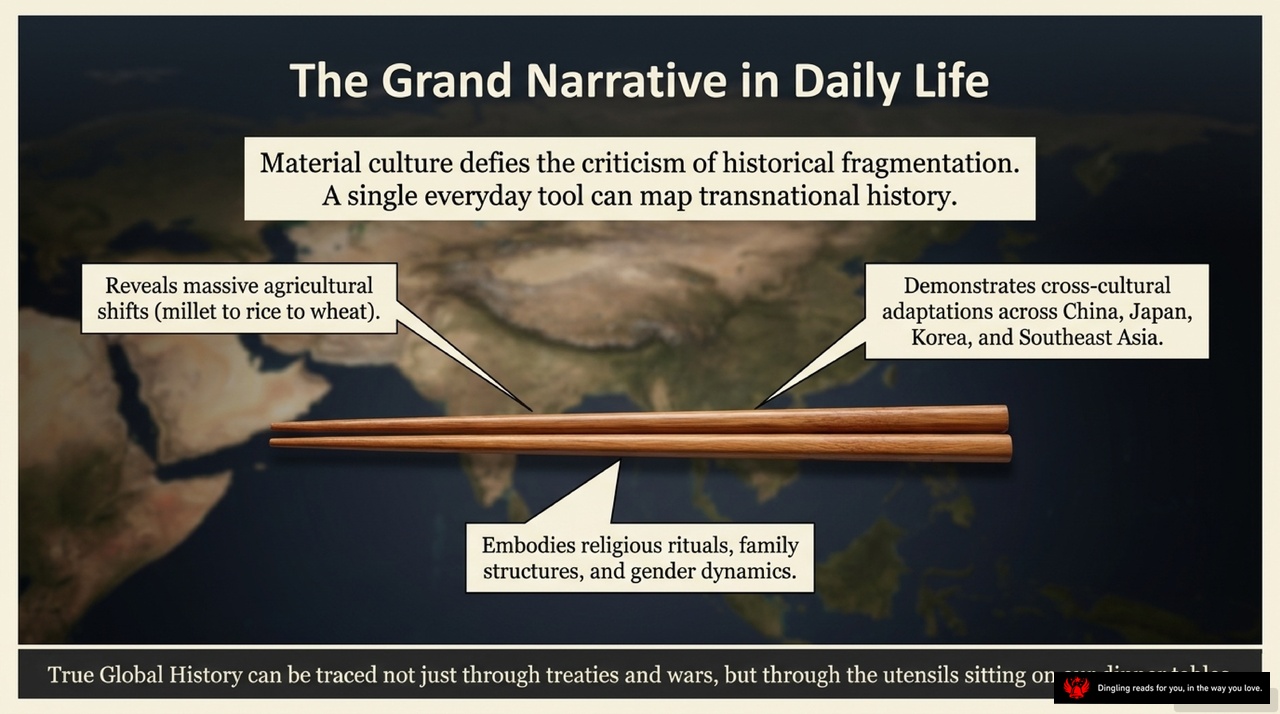
The chopsticks resting on the map are more than just utensils; they are a silent witness to the grand narrative of human history. As the slide suggests, material culture like these simple tools defies the criticism of historical fragmentation. A single everyday object can actually map transnational history, revealing how our daily lives are deeply interconnected across borders.
Look at the agricultural shifts they represent. These tools traveled with the migration from millet to rice to wheat, tracking massive changes in how we feed ourselves across Asia. They also demonstrate cross-cultural adaptations as they spread from China to Japan, Korea, and Southeast Asia, adapting to local diets while keeping their core form. Beyond just eating, they embody religious rituals, family structures, and even gender dynamics, shaping the very fabric of social life.
True global history isn't just found in treaties and wars; it's traced through the utensils sitting on our dinner tables. These humble objects connect us all, proving that the story of humanity is written not only in grand events but in the quiet, shared practices of daily life.

History has no set trajectory, and believing that historical laws dictate the future is nothing more than a dangerous illusion. This slide challenges the "deterministic view" of history, which often tries to force individual lives into a grand, pre-ordained purpose. Instead, we must embrace the reality of history: it is an unrepeatable organism.
Consider the "Butterfly Effect Box." A sudden storm, a momentary hesitation, or even the birth of a child can alter the fate of millions. Take the Taiping leader Shi Dakai, for instance. He delayed crossing the Dadu River by just one day to celebrate his concubine giving birth. That single day of delay allowed a rainstorm to swell the river, destroying his entire army. This is the reality of history.
We can study the past to cultivate wisdom and empathy, but we cannot confidently engineer the future. History does not follow a straight line; it branches out like the complex, glowing patterns you see here. Every small detail matters, and the past remains unique, resisting any attempt to be repeated or controlled.
History is not a predictable trajectory dictated by grand empires or heroic conquerors; it is a complex, fragile tapestry woven from the unpredictable, everyday lives and faint voices of ordinary people. This shift in perspective is at the heart of what we call microhistory—a movement that challenges the traditional focus on elites and instead listens to the marginalized voices we so rarely record.
When we look at the history of China through this lens, we see stories that were once silenced. Take the story of Menocchio, a humble miller in 16th-century Italy. He believed the universe was like cheese eaten by maggots. Though he was executed for heresy, his unique worldview reveals a vibrant, independent mind that official records tried to erase. Similarly, in 19th-century Sichuan, the "street culture" of the teahouse became a public sphere where ordinary people debated politics and society, shaping history from below rather than waiting for emperors to decree it.
But why does this matter today? Because if the true drivers of human civilization are these marginalized voices, whose silence are we failing to listen to? In our own time, we often celebrate the "great men" of business or politics, ignoring the workers, the immigrants, and the everyday citizens who actually built our world. By studying the small—the food we eat, the spaces we occupy, the stories we tell—we don't just learn about the past; we gain the tools to understand our present and imagine a future where everyone's story counts. It is in these quiet, often overlooked moments that the real history of humanity unfolds.