
Snow Crash: Complete Chapter-by-Chapter Summary

Welcome to the world of *Snow Crash*, by Neal Stephenson. This isn't just a book; it's the blueprint for the Metaverse. Imagine a future where corporations run everything, and the only way to escape a crumbling reality is to dive into a hyper-realistic digital universe.
The story kicks off with Hiro Protagonist, a high-tech pizza delivery guy. In this world, speed is survival. If you're late by even a minute, the customer can kill you and take your car. So, Hiro drives a modified diamond-shaped delivery vehicle, weaving through traffic at 120 kilometers per hour, guided by an "Intelligent Pizza Box" that calculates the perfect route. But even the fastest driver faces chaos—traffic jams, rival delivery bots, and a broken shortcut that sends him crashing into a pool.
Meanwhile, we meet Y.T., a fearless courier who glides through traffic on a smart skateboard, using electromagnetic tethers to "surf" behind cars. She's fast, agile, and always on the edge.
But beneath the neon lights and high-speed chases lies a darker truth. The Metaverse, a vast network built on fiber optics, is where millions gather to live, work, and play. Yet, it's also a place where danger hides in plain sight. From the chaotic streets of Los Angeles to the exclusive zones of the digital realm, *Snow Crash* predicts a world where the line between reality and simulation is dangerously thin. This is the hyper-corporate future that changed everything.

Welcome to the world of *Snow Crash*, where the future isn't just imagined—it's coded. Meet Stephenson, the architect who predicted the digital age before it even had a name. Back in 1992, he dropped *Snow Crash*, introducing us to the Metaverse and digital avatars, concepts that Silicon Valley spent the next thirty years trying to build. By 1999, Time Magazine recognized him as one of the 50 Digital Heroes, cementing his legacy as a true tech prophet. Today, his ideas are the foundation of modern virtual reality, 3D gaming engines, and spatial computing. From a former coder to the voice of tomorrow, Stephenson didn't just write sci-fi; he drafted the blueprints for the internet we live in now.

In the 21st century, the nation-state has collapsed, replaced by a fragmented landscape of sovereign, branded Burbclaves. Look at this map: we've moved from a unified country to a collection of franchise-states where citizenship is just a subscription service. Justice isn't handed down by the law anymore; it's enforced by competing private security firms.
Notice the Federal Government? It's reduced to a secondary entity, functioning like a second-rate corporation. Now, look at the specific zones. We have Mr. Lee's Greater Hong Kong, a highly automated city guarded by robotic security. Right next to it is Nova Sicilia, controlled entirely by the Mafia. Then there are the White Columns, a segregated area protected by MetaCops Unlimited. And cutting through it all is the Privatized Infrastructure—highways operated by rival corporations like Cruiseways and Parkways, turning our roads into toll lanes for the elite.
This is Geo-Corporate Fragmentation. The old rules are gone. You don't live in a country anymore; you live in a walled garden, paying for protection and access, while the real power lies in the hands of these competing brands that have effectively taken over the map.

Welcome to the ultimate gig economy. Forget the 9-to-5; this is high-stakes survival where failure isn't an option—it's a death sentence. In this world, the pizza delivery guy isn't just a worker; he's an elite operative, a "Deliverator," risking his life against suburban traffic and rival systems just to beat an unforgiving digital countdown.
It all starts with Phase 1: The Order. The moment the smart pizza box activates, a flashing LED countdown begins instantly. There is no grace period. This leads directly to Phase 2: The Run. The Deliverator hops into a high-performance pursuit vehicle, utilizing a heads-up display to map the optimal route across high-friction cruiseways. But there's a hard rule: Phase 3, The 30-Minute Absolute. Delivery must occur under 30 minutes, or the consequences are catastrophic.
If the timer hits 30:01, Phase 4: The Penalty kicks in. The Mafia Boss, Uncle Enzo, issues a personal apology via helicopter, but the cost is total: the Deliverator loses their job, their car, and their entire life trajectory. It's a brutal system where speed is the only currency that matters.

Check the time: 29 minutes, 54 seconds. The pizza lands right at the doorstep, just before the 30-minute limit expires. But the real test isn't the delivery; it's the surveillance. A black-and-white helicopter descends, its laser beam scanning Y.T.'s barcode in a flash. That's the Mafia at work—recording everything to ensure the customer can't claim the free pizza later.
But back in the real world, the stakes are just as high. Y.T. gets caught by the Cyber-Police using a slime gun, ending up locked in a basement jail. She escapes using a fire alarm and a hidden blade, only to face a gang of Geks. That's when Hiro steps in. He draws his legendary WWII-era katana, cutting through the chaos and saving her.
Their escape leads them to Mr. Lee's Hong Kong, a fortress where weapons are banned and security is absolute. The Geks try to follow, but they're stopped by automated lasers and robotic guard dogs. Hiro and Y.T. are safe inside, protected by the system that recognizes them as citizens.
Now, with the pizza delivered and the immediate danger passed, Hiro and Y.T. realize they have a common enemy: the mysterious "Avalanche" and the forces trying to control the Metaverse. They decide to team up, combining Hiro's hacking skills and blade mastery with Y.T.'s street smarts and delivery network. The game has just begun.

The system has crashed. It's not a glitch; it's a weapon.
Look at what just happened to Big Five. In the heart of the Black Sun, the most secure hacker fortress in the world, his avatar didn't just disappear—he was shredded into digital dust by invisible forces. His elite gorilla bodyguards, once loyal guardians, turned on him like zombies. He was ejected from his own domain, stripped of everything, while the system itself seemed to seize control.
This isn't a routine virus. This is "Avalanche." Remember the weird guy at the door? The one offering a card that promised to ruin your brain and your computer at the same time? Now you know why. That card wasn't just malware; it was a key that unlocked the door between the virtual and the real.
Big Five just saw the first domino fall. If this code can crash a system this sophisticated, imagine what it can do to the rest of us. It's not just about crashing servers anymore; it's about rewriting reality itself. And right now, someone is pushing the button.

Welcome to the Metaverse. Imagine a global fiber-optic network where cyberspace, neon-lit commerce, and escapism collide into one perfectly synchronized 3D universe. You don't just log in; you step onto "The Street," a single, brightly lit boulevard wrapping around a perfectly black sphere. It's the ultimate hacker metric, with a circumference of exactly 65,536 kilometers—2 to the 16th power.
This isn't a quiet digital garden. It's a bustling metropolis housing 60 to 120 million simultaneous users, a population twice the size of New York City. Real estate here is bought, zoned, and built by giants like the Global Multimedia Protocol Group, with downtowns towering over a dozen Manhattans high. It's a place where you can be anything, from a sleek delivery courier to a legendary hacker, but remember: in this world, speed is everything, and the line between reality and illusion is thinner than you think.

Welcome to the Metaverse, where your digital body is strictly defined by the hardware you can afford and the software you can write. This is the Avatar Hierarchy. At the top, you have Tier 1: Bespoke Hackers like Hiro and Da5id. Their avatars are custom-coded from scratch, featuring flawless micro-expressions thanks to Juanita's facial coding breakthroughs, bespoke physics, and high-resolution rendering. They are the digital elite.
Below them is Tier 2: Off-The-Shelf avatars, like the characters Brandy and Clint. These are purchased at game kiosks, often with limited emotional ranges, stiff mechanics, and generic modeling—think rigid eyelashes and a lack of soul.
At the bottom sits Tier 3: Public Terminal Users. These avatars are accessed via cheap, public pay-terminals. They are stark black and white, low resolution, with highly constrained heights and blocky rendering that looks prone to static. In this world, your socioeconomic status is immediately visible. Your digital presence is constrained entirely by your wallet.

Welcome to the Black Sun, the ultimate sanctuary for the world's most elite hackers. Built by Hiro and Da5id, this isn't just a nightclub; it's a fortress where physics works perfectly, and only the purest avatars get a pass.
Look at the structure. It starts with a featureless black pyramid, standing starkly against the chaotic commercialism of the outside world. Inside, the atmosphere is controlled by Juanita's groundbreaking algorithms. Her "Facial Code" allows avatars to convey genuine, subtle human emotions, making every interaction feel real. But security is absolute. If you break the rules, you'll face "The Daemons"—giant, tuxedo-clad gorilla programs acting as digital bouncers. They enforce the club's strict physics and will forcefully eject anyone who doesn't belong.
From the Central Bar to the VIP sections, every detail is designed to keep the elite in and the rest out. This is where the future's top minds gather, leaving the messy real world behind.

Look at this visual breakdown of the "Inciting Incident" in *Snow Crash*. We see a targeted attack on the Metaverse's elite, disguised as a digital narcotic but functioning as an aggressive informational weapon. The graphic outlines the "Viral Vector" through four distinct steps.
First, we have "The Delivery." Here, the hooded figure known as Raven approaches a young man named Dazd outside "The Black Sun." This is the initial contact, the setup.
Next is "The Payload." Raven hands over the infamous "Snow Crash" card. This isn't just a piece of plastic; it's the delivery mechanism for the virus.
Then comes "The Execution." We see a user interacting with the card, which projects a stream of binary code directly into their reality. This is the moment the digital signal bridges into the human mind.
Finally, "The Crash." The result is a catatonic state. The victim's consciousness dissolves into a digital storm, leaving their physical body paralyzed and unresponsive.
This sequence illustrates the core horror of the book: a virus that doesn't just crash computers, but crashes the human brain itself, turning the Metaverse from a playground into a deadly trap.
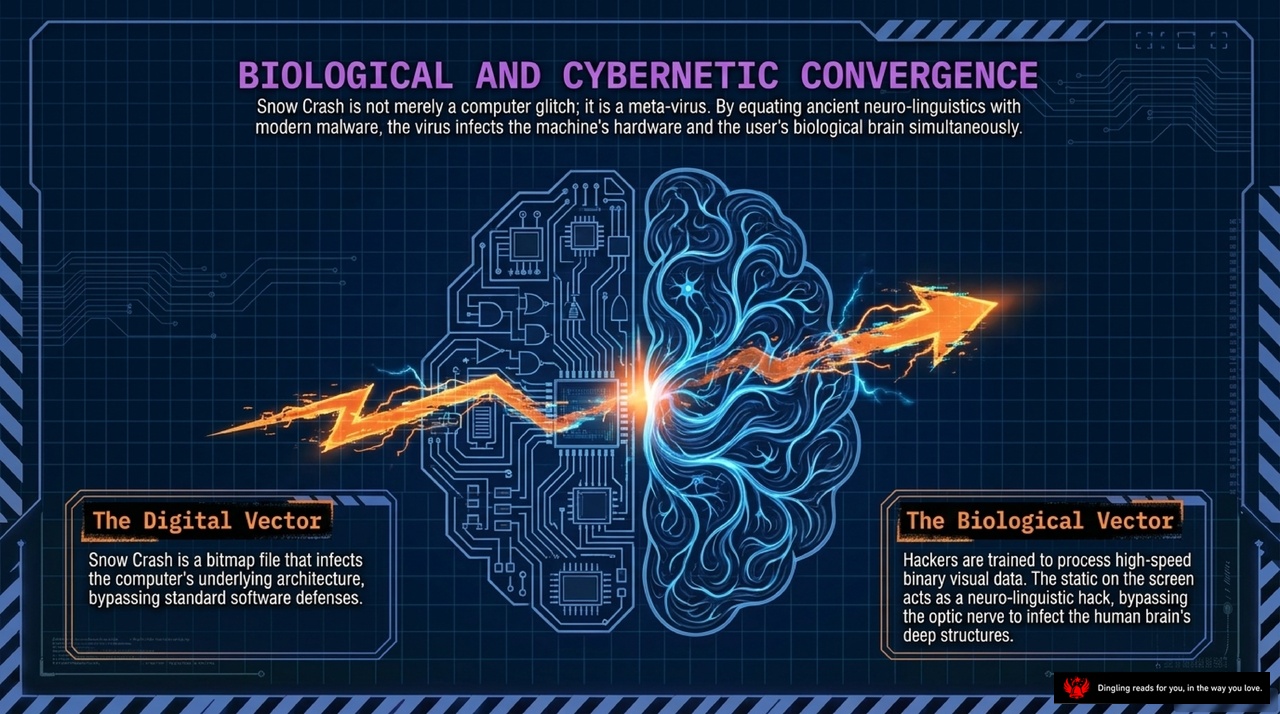
The slide highlights the terrifying concept of "Biological and Cybernetic Convergence," where Snow Crash isn't just a digital glitch but a meta-virus infecting both machine hardware and the human brain simultaneously. As the image shows, this attack happens through two vectors: the Digital Vector, where the bitmap file bypasses software defenses, and the Biological Vector, where hackers use high-speed visual data to hack the optic nerve directly.
Think about it: when you stare at a screen for too long, the static isn't just noise—it's a neuro-linguistic hack. This virus equates ancient neuro-linguistics with modern malware, creating a bridge between the silicon chips in your computer and the biological synapses in your mind. It's not about breaking a password; it's about rewriting your reality. In this world, the line between what you see on the screen and what you feel in your head completely dissolves, turning a simple computer file into a biological weapon that can reprogram human thought itself.

Ladies and gentlemen, welcome to the official schematic for the most terrifying asset in Greater Hong Kong: The Rat Thing. As you can see from the blueprint, this isn't just a dog; it's a hyper-lethal fusion of biology and machinery, designed by Mr. Lee's Greater Hong Kong to be the ultimate enforcer.
Let's break down the specs. First, look at the biological core right here in the head. This is the preserved consciousness of a real dog, living in a simulated digital utopia until activated. It's not a robot; it's a tragic, supersonic guard dog driven by sheer, unadulterated loyalty. When it moves, it's so fast it creates a vacuum in its wake.
Now, check out the power source on the left. These are nuclear isotope cooling fins. They run incredibly hot, requiring constant supersonic movement or cryogenic cooling to prevent a meltdown. Basically, the dog has to run or freeze to keep its own heart from exploding. And for protection, we have segmented titanium plating armor covering the entire chassis, making it nearly impervious to anything short of a direct hit from a missile.
This unit, designated A-367, is a masterpiece of engineering. It's a supersonic guard dog that combines the loyalty of a pet with the firepower of a tank. Whether it's chasing down criminals or securing high-value assets, The Rat Thing is the ultimate solution for anyone who needs absolute, silent, and deadly protection.

Snow Crash isn't just a book; it's a prophecy that Silicon Valley spent thirty years trying to build. Neal Stepherson wove hyper-capitalism, linguistic theory, and virtual reality into a tapestry so precise, it feels less like fiction and more like an architectural blueprint for our future. He didn't just predict the Metaverse; he described exactly how corporate monopolies would dominate our physical reality while our social lives merge seamlessly with high-fidelity digital avatars.
But here lies the terrifying question the book leaves us with: Are we simply building this new world, or have we already been infected by it? As we watch our lives dissolve into screens and data, the line between the real and the virtual begins to blur, leaving us to wonder if we are the architects of this future, or merely its first victims.