
Soft Skills: Complete Chapter-by-Chapter Summary

Welcome to today's session on "Soft Skills," a concept championed by Luo Zhenyu, Tuobuhua, and thirty leading thinkers. Today, we're diving into why soft skills are the ultimate lever to multiply your hard technical capabilities and expand your enduring influence in a complex world.
Think of it this way: hard skills get you the interview, but soft skills are what get you the promotion, the trust, and the ability to shape your own destiny. It's not about being soft or weak; it's about mastering the invisible forces that drive real results. Whether you're navigating a high-stakes negotiation, leading a diverse team, or simply trying to connect with someone new, these skills are the difference between being stuck and soaring ahead.
In a world where everyone has access to the same information and similar technical tools, your unique blend of empathy, adaptability, and strategic thinking becomes your true competitive advantage. We'll explore how to cultivate these skills to not just survive, but to thrive in an ever-changing landscape. Let's get started.
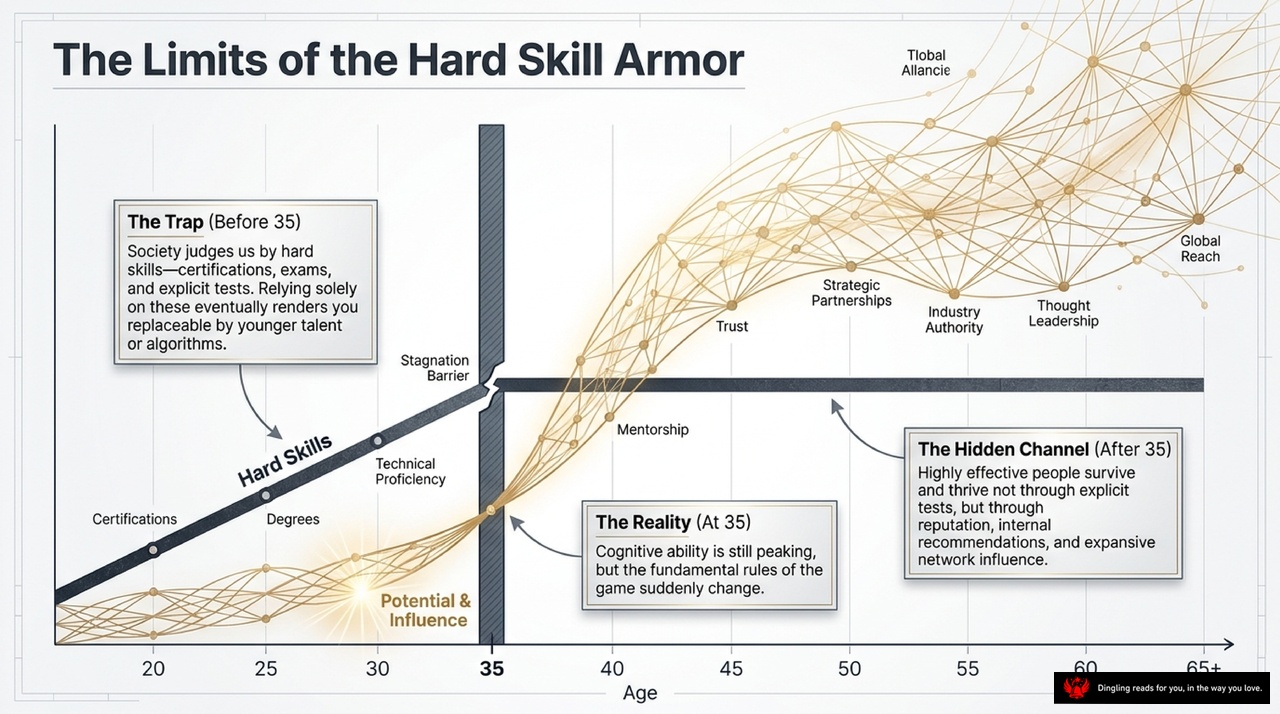
The Limits of the Hard Skill Armor isn't just a catchy title; it's a stark reality check for anyone trying to build a career. Look at that graph. Before you hit 35, society tells you to armor up with hard skills—certifications, degrees, and passing explicit tests. That's the trap. You think you're safe, but relying solely on this makes you replaceable. Younger, cheaper talent or algorithms can do the same technical work, and suddenly, your "armor" is useless.
But here's the shift that happens right at age 35. That vertical bar in the middle? That's the stagnation barrier. It's not about your cognitive ability peaking anymore; it's about the rules of the game changing completely. If you stay on that left side, you hit a ceiling. But if you move to the right, you enter the hidden channel. This is where highly effective people actually survive and thrive. They stop relying on explicit tests and start leveraging reputation, internal recommendations, and an expansive network.
Notice how the golden web expands after 35. It's no longer just about technical proficiency; it's about trust, strategic partnerships, industry authority, and thought leadership. These are the things that create global reach. While hard skills get you in the door, they are only the entry fee. The real multiplier for long-term success is building these invisible connections. So, don't just focus on what you know; start figuring out who you know and how you can become an indispensable part of that network. That's the only way to break through the barrier and build something that lasts.

Imagine your career not as a single point, but as a living, breathing web. Today, we're looking at the powerful evolution from a solitary skill to a connected web of influence.
The journey starts with **Skills**, which we call "The Point." Think of it as that single black sphere on the left. It represents accumulating individual capabilities. In the early stages of your career, the rule is simple: the more you know, the better. It's about building your unique value proposition, one skill at a time.
But a single point is static. To grow, you need to expand into **Resources**, or "The Disk." Visualize the middle structure. This is about maintaining spatial connections. It's no longer just about what you know, but where you stand. It's about structuring your environment, connecting with mentors, and positioning yourself within a network. The more structured your connections are, the more leverage you gain.
Finally, you reach **Influence**, which is "The Force." Look at the right side, where the isolated disk is now surrounded by a vast, golden web. This represents extending your impact over time. When your skills and resources are woven together, they create a force that can move things. It's about sustainability. The more sustainable your influence becomes, the greater your ability to shape the world around you.
So, don't just hoard skills in isolation. Start connecting them. Build your resources, and watch how your influence expands from a single point into a powerful, connected web.
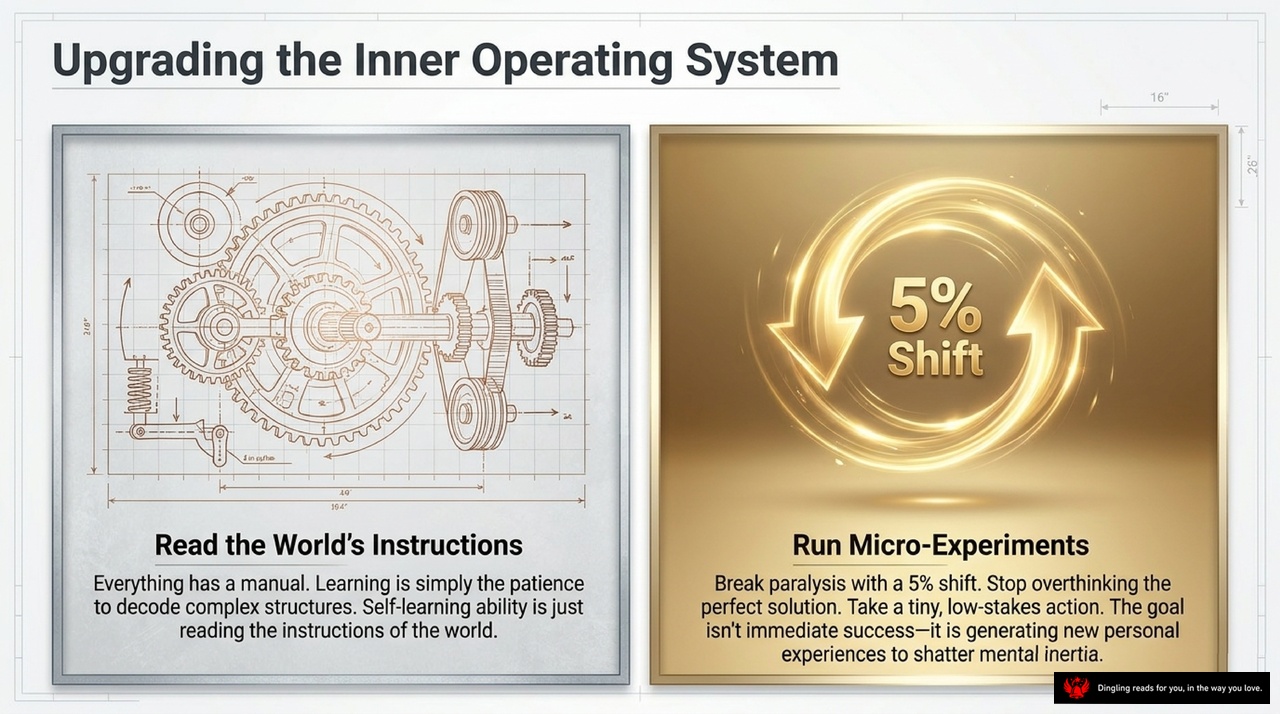
Have you ever noticed that the most effective people aren't necessarily the ones with the most technical skills, but those who can read the "manuals" for life? Today, we're diving into the soft skill of "Reading Instructions"—a concept popularized by Li Xiaolai, which suggests that true self-learning is simply the ability to find and understand the instructions for everything around you.
Think beyond the physical manuals in a box. The road signs on your commute, the map in your navigation app, and even the help files in your software are all "instructions" waiting to be read. Many of us ignore these free resources, preferring paid tutorials or relying on "dumb navigation" that doesn't teach us how to read a map. But consider the story of Xu Wei, a father who, after his son was born with a rare genetic disease, had to teach himself complex biochemistry and gene editing from scratch. Without knowing English or having a lab, Xu Wei treated medical papers and experimental guides as his survival manual. By reading these "instructions" with relentless dedication, he successfully performed gene therapy on his son.
This mindset transforms how we approach the world. When you treat life's challenges—whether it's learning a new language, understanding how your brain works, or mastering time management—as a series of manuals to be decoded, you unlock the ability to master any field. It's about shifting from passive consumption to active decoding. Instead of just skimming what you like, you learn to read the underlying logic of any system. This skill doesn't just help you learn faster; it empowers you to become the architect of your own life, capable of navigating complexity with clarity and confidence, no matter what field you step into.
When you step into a leadership role, especially in today's complex workplace, you'll quickly realize that authority alone isn't enough. In fact, relying solely on titles often fails to ignite real passion in your team. The true core of leadership is relationship—connecting deeply with people, the organization, and the resources around you.
Think about building these relationships using Maslow's hierarchy of needs. It's a powerful tool. For every key person on your team, ask yourself: What do they need right now? Is it security, recognition, or perhaps the chance to grow? If an employee craves professional development, sending them a cutting-edge book works far better than a generic gift card. If a team member is stressed about their family's medical bills, solving that practical problem builds trust instantly. Remember, needs change over time, so you must stay attentive. A small kindness today can become the foundation of a lifelong partnership.
Managing organizational dynamics requires focusing on two critical intersections. First, align your team's goals with individual aspirations. When employees see how their personal success ties into the company's mission, motivation skyrockets. Second, look at your own position within the larger structure. As you climb the ladder, stop getting lost in daily details and start thinking about systems and policies. For instance, if two departments are constantly clashing, maybe the solution isn't more meetings, but restructuring the workflow so their goals naturally support each other.
Don't forget resource connection. As a leader, you must strategically map out who and what you need. Identify the top 30 people who truly matter in your core circle and prioritize building those specific connections. If you lack a necessary expert, that's your signal to act. Also, recognize your own unique assets and use them as leverage to unlock other resources.
Finally, never underestimate the relationship you have with yourself. The ability to let go is essential for overcoming greed and maintaining balance. Cultivate a habit of deep reflection to prevent arrogance. You might even build a personal "board of directors"—a group of mentors and friends from different fields—to challenge your thinking and keep your perspective grounded. True leadership isn't about commanding from above; it's about understanding people, caring for details, and leading with an authentic, resilient character.
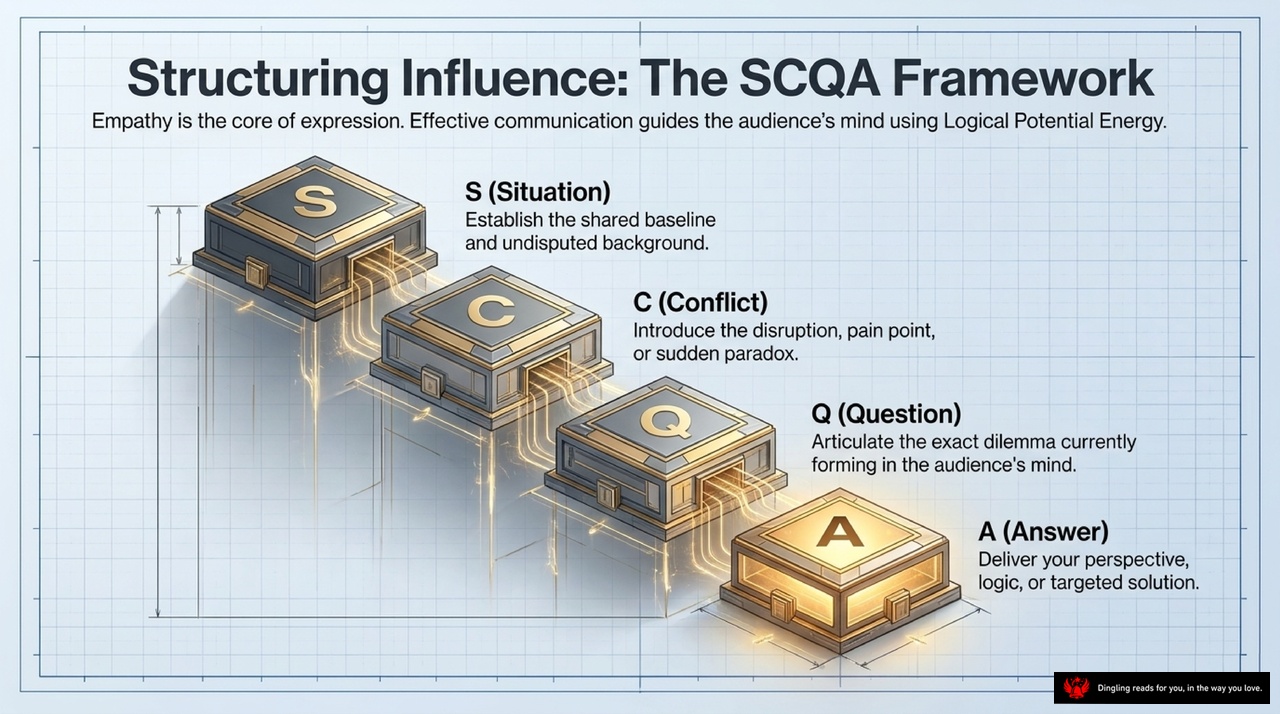
Today's slide introduces the SCQA framework, a powerful tool for structuring influence. At its heart lies a simple truth: empathy is the core of expression. Effective communication doesn't just share information; it guides the audience's mind using logical potential energy.
Let's break down these four building blocks, visualized here as stepping stones. First is **S for Situation**. This is about establishing a shared baseline. You need to create an undisputed background that everyone agrees on before moving forward. Without this common ground, your message will hit a wall immediately.
Next, we hit **C for Conflict**. This is where the disruption happens. You introduce the pain point, the sudden paradox, or the problem that breaks the status quo. If you don't create a conflict, the audience won't feel the need to listen.
Then comes **Q for Question**. Here, you articulate the exact dilemma currently forming in the audience's mind. You make the problem personal and urgent, forcing them to ask, "What do we do now?"
Finally, we arrive at **A for Answer**. This is where you deliver your perspective, your logic, or your targeted solution. You provide the relief the audience was waiting for, offering a clear path out of the conflict you just highlighted.
Mastering this flow—Situation, Conflict, Question, Answer—transforms your communication from a monologue into a compelling narrative that truly influences minds.

Let's dive deep into the iceberg of intimacy. Most of us fight over the surface level—the "Fact Event." Think about it: your partner forgot to reply to an email or missed a deadline. You're immediately angry, arguing over logistics and facts. But here's the hard truth: that's just the tip of the iceberg.
Beneath the water lies the "Relationship Event," the submerged reality where the real friction happens. When that email isn't answered, it's not just about the message; it's a signal asking, "Do you respect my time?" or "Are you rejecting my authority?" When a deadline is missed, the question isn't about the project; it's, "Do we trust each other?"
High-quality relationships don't fix the surface; they address the submerged roots. If you only argue over the "what happened," you're stuck in a cycle of misunderstanding. Instead, you need to respond to the "what does this mean for us?" Stop debating the facts and start decoding the emotional signals hidden underneath. That's how you move from a power struggle to a genuine connection.

Think of the BRAVE Blueprint for Adult Friendships as a sturdy structure built on five golden pillars. As the slide illustrates, true deep connection isn't about intrusive probing; it's about quickly decoding the subtext people naturally broadcast to find your overlap.
Let's walk through these five pillars together. First, look at Belief. What underlying systems actually give them energy? Second, consider Ritual. What daily routines or habits do they hold sacred? These small, repeated actions often reveal more than big words ever could.
Next is Allegiance. To whom or what groups are they fiercely loyal? Understanding their loyalty helps you understand their values. Then, look at Value. What are their non-negotiable standards for right and wrong? This is the bedrock of any lasting relationship. Finally, there is Emotion. Which specific life experiences hold deep emotional weight for them?
All of these pillars rest on a solid Slate Foundation. By mastering these five dimensions—Belief, Ritual, Allegiance, Value, and Emotion—you stop guessing and start connecting. You learn to see the person behind the persona, building relationships that are not just polite, but genuinely profound and resilient.
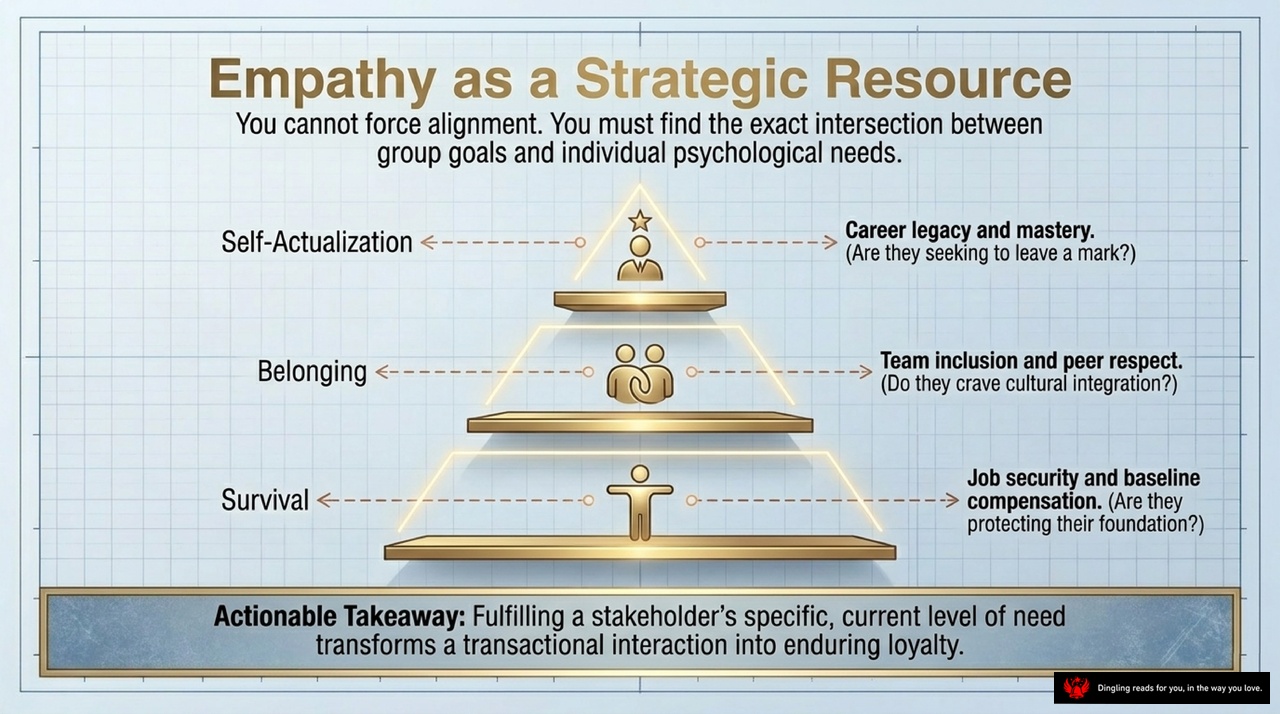
Look at this pyramid. It maps out the hidden architecture of empathy. We often think empathy is just about being nice, but as this slide suggests, it's actually a strategic resource. You cannot force alignment in a team; instead, you must find the exact intersection between group goals and individual psychological needs.
Let's climb this pyramid together. At the very bottom, we have Survival. This is the foundation. On the right, it translates to job security and baseline compensation. Are your stakeholders protecting their foundation? If you don't address their fear of instability, nothing else matters.
Moving up to the middle layer, we find Belonging. This corresponds to team inclusion and peer respect. Do they crave cultural integration? People need to feel they fit in and are valued by their peers. Without this sense of belonging, talent will drift away.
Finally, at the peak, we reach Self-Actualization. This is where career legacy and mastery live. Are they seeking to leave a mark? This is the drive for growth and impact.
The actionable takeaway at the bottom is crucial: Fulfilling a stakeholder's specific, current level of need transforms a transactional interaction into enduring loyalty. Don't just try to meet everyone at the top; first, ensure their survival, then their belonging, and finally, help them achieve their potential. That is how you build real loyalty.
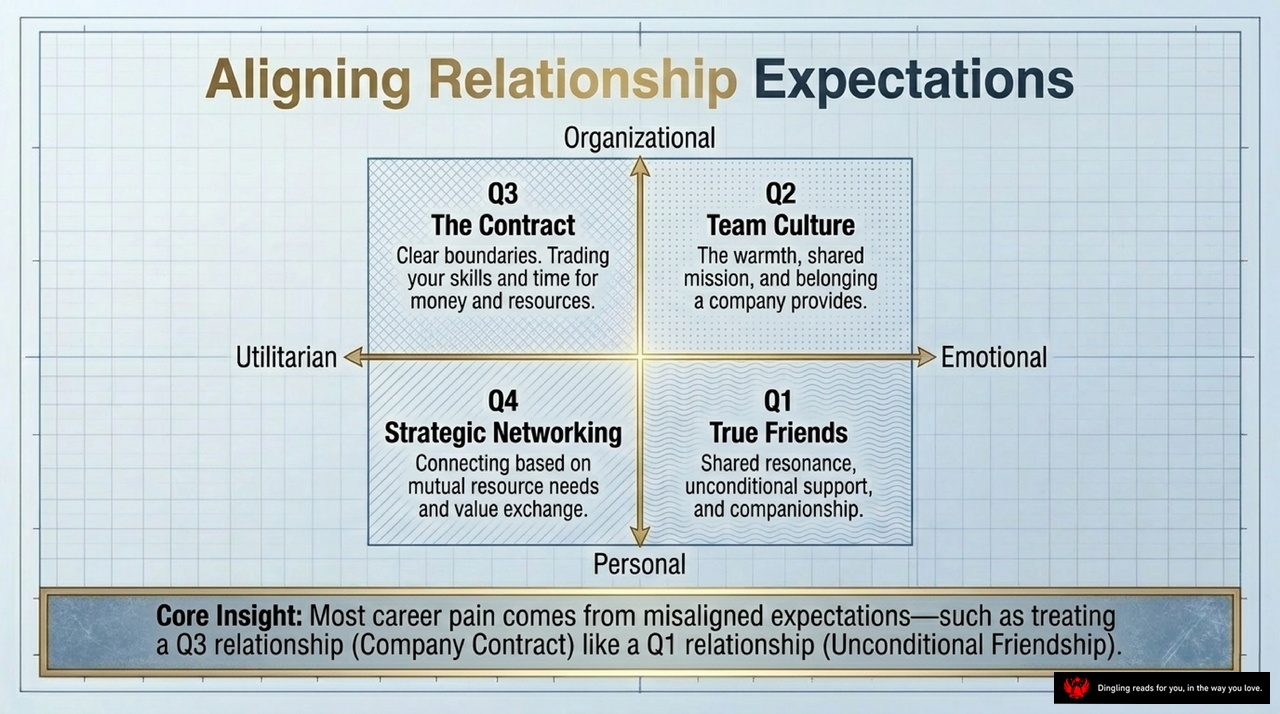
Most career pain doesn't come from a lack of skills, but from misaligned expectations. Think of your professional life as a four-quadrant map. On one axis, you have the emotional versus the utilitarian; on the other, the personal versus the organizational. This creates four distinct relationship types.
In the top right, we have Q1: True Friends. These are built on shared resonance and unconditional support. It's like a family, where you belong simply because you are there. In the top left is Q2: Team Culture. Here, the connection is about warmth, a shared mission, and the sense of belonging a company provides. It's emotional, but still within an organizational structure.
Now, move to the bottom left. This is Q3: The Contract. This is pure utilitarianism within an organization. It's clear boundaries where you trade your skills and time for money and resources. Think of it as a straightforward business deal. Finally, in the bottom right, we have Q4: Strategic Networking. This is personal but utilitarian. You connect based on mutual resource needs and value exchange, like connecting with a mentor who can help you land a job.
The core insight here is simple yet powerful: most of your frustration stems from treating a Q3 relationship like a Q1 relationship. You might expect your employer to offer you unconditional friendship and emotional support, when in reality, they are only offering you a contract. When you treat a transactional arrangement as if it were a friendship, expectations get shattered, and pain follows. Aligning these expectations is the key to navigating your career with clarity and peace.

True leadership isn't about the title on your business card; it's about the magnetic pull you have over people without needing formal authority. Think of yourself as a leader with no rank, guiding peers, managing bosses, and aligning external partners purely through influence.
At the heart of this is Integrity. It's the absolute foundation. Without it, your ability to influence others instantly collapses. If people don't trust your character, your ideas don't matter.
Next, you need Clarity of Goal. In a noisy world, your superpower is the ability to constantly align your limited resources with your strategic priorities. Don't get distracted by the noise; focus relentlessly on what truly moves the needle.
Finally, master the Zero Principle. This is about maintaining the ultimate leverage: the undeniable capability to thrive independently, even outside the current system. True leaders don't just wait for the organization to give them resources; they build the capacity to succeed on their own terms.
When you combine integrity, strategic clarity, and the freedom to operate independently, you stop waiting for permission to lead. You become the force that shapes the outcome, regardless of your title.

Imagine a world where chaos is just raw data waiting to be refined. This slide captures that exact transformation: the "Probability & Trend Filter." On the left, you see a storm of scattered dots and arrows—chaos, noise, and uncertainty. But look at what happens when that chaos hits the golden filter in the center. Suddenly, the scattered noise aligns into a single, powerful beam of direction on the right.
This visual perfectly illustrates the two soft skills we've been discussing. First, the "Probability System." Think of it as shifting your mindset from fearing a single loss to building a resilient system. Instead of obsessing over whether one decision wins or loses, you focus on creating a decision-making framework that wins mathematically over a lifetime. You stop getting distracted by temporary setbacks and start trusting the long-term logic of your choices.
Then, look at the "Trend Vision" at the bottom. This is about stepping out of your comfort zone. True macro trends don't start in the center where everyone is safe; they begin at the margins, among the youth, and where different disciplines collide. By spotting these early signals, you can filter out the noise and align yourself with the future before it becomes obvious to everyone else.
So, the lesson here is simple but powerful: don't just react to the chaos around you. Use probability to build a winning system, and use trend vision to spot where the world is actually going. That is how you turn scattered uncertainty into a clear, unstoppable path forward.
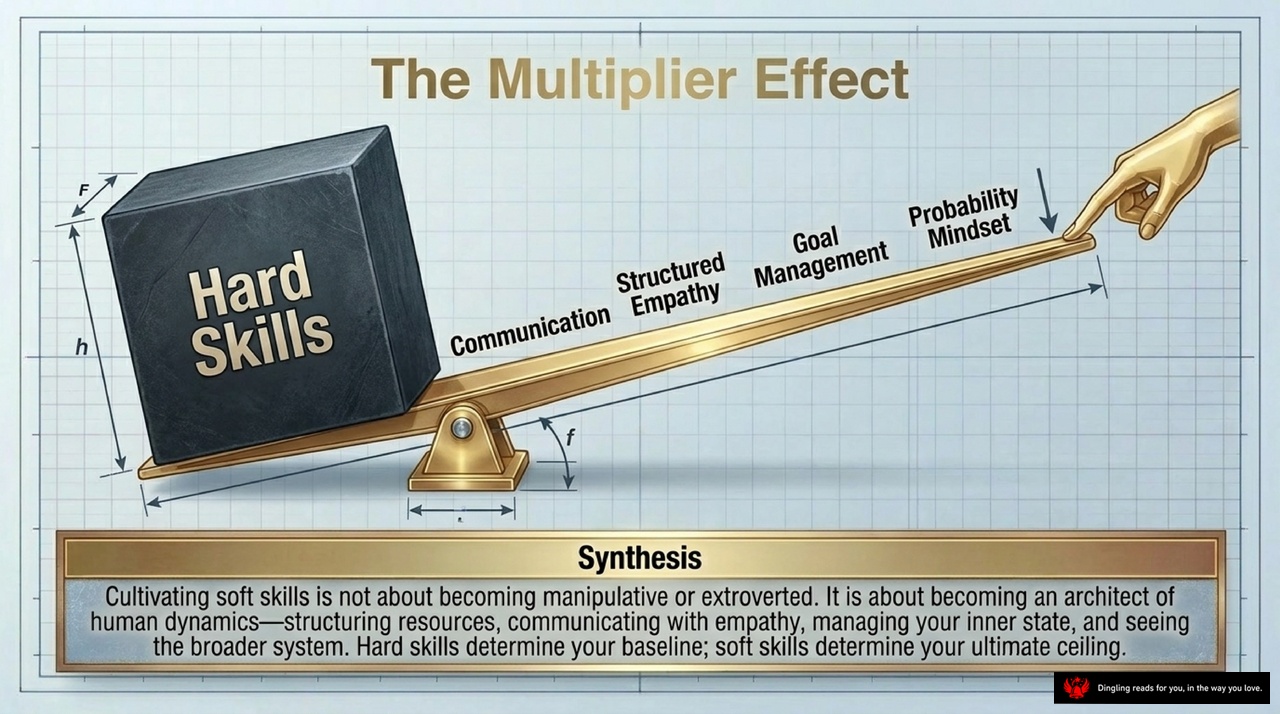
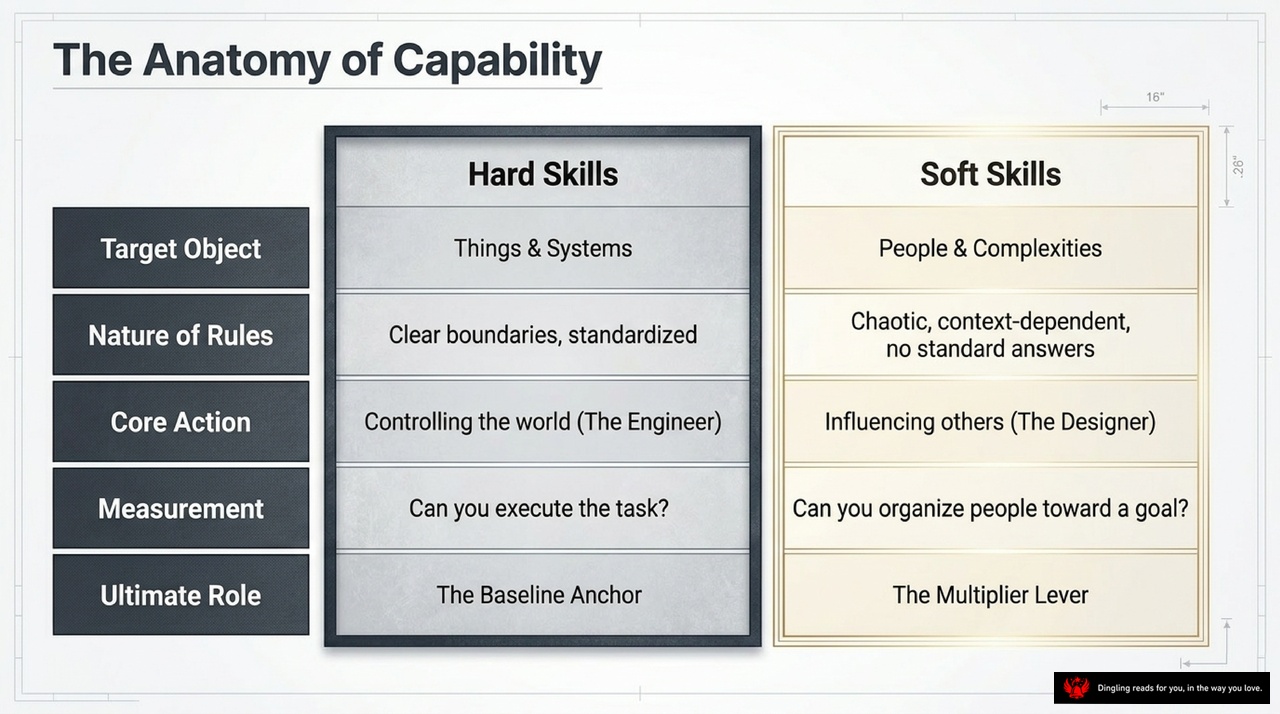
The Multiplier Effect isn't just a catchy title; it's the blueprint for your career ceiling. Look at this seesaw: on one end, we have "Hard Skills." They are heavy, foundational, and they set your baseline. But on the other end, a single finger pushes up on "Soft Skills"—Communication, Structured Empathy, Goal Management, and a Probability Mindset. That tiny push creates a massive leverage, turning your potential into a multiplier.
Here's the hard truth: Hard skills determine where you start, but soft skills determine how high you can fly. As the synthesis at the bottom reminds us, cultivating these skills isn't about being manipulative or just extroverted. It's about becoming an architect of human dynamics. It's about structuring resources, communicating with genuine empathy, managing your inner state, and seeing the bigger system.
Think about it this way: if your hard skills are the foundation of a house, your soft skills are the engineering that decides if it can withstand a storm or reach the sky. In a world where AI is automating tasks, your unique value lies in these human-centric skills. So, stop focusing only on what you know, and start mastering how you connect, decide, and lead. That's where your ultimate ceiling lives.

Throughout our early careers, we often forge ourselves into sharp, reliable points of technical expertise. We pride ourselves on being the expert in the room, the one who can execute the code or close the deal. But the true inflection point of such success arrives when we must evolve from a solitary point into an expansive network. This is where soft skills become the essential connective tissue of this evolution.
By mastering self-management, deploying structured empathy, understanding the invisible dynamics of human relationships, and leading without formal authority, we unlock the leverage required to multiply our impact. Soft skills are not just tools for survival; they are the operating system for a thriving, influential life.
So, if your hard skills have already secured your place at the table, what specific soft skill will you cultivate today to ensure you end up leading the room? It's time to stop just being a point of expertise and start becoming a hub of influence.