
Soulstealers: The Chinese Sorcery Scare of 1768: Complete Chapter-by-Chapter Summary
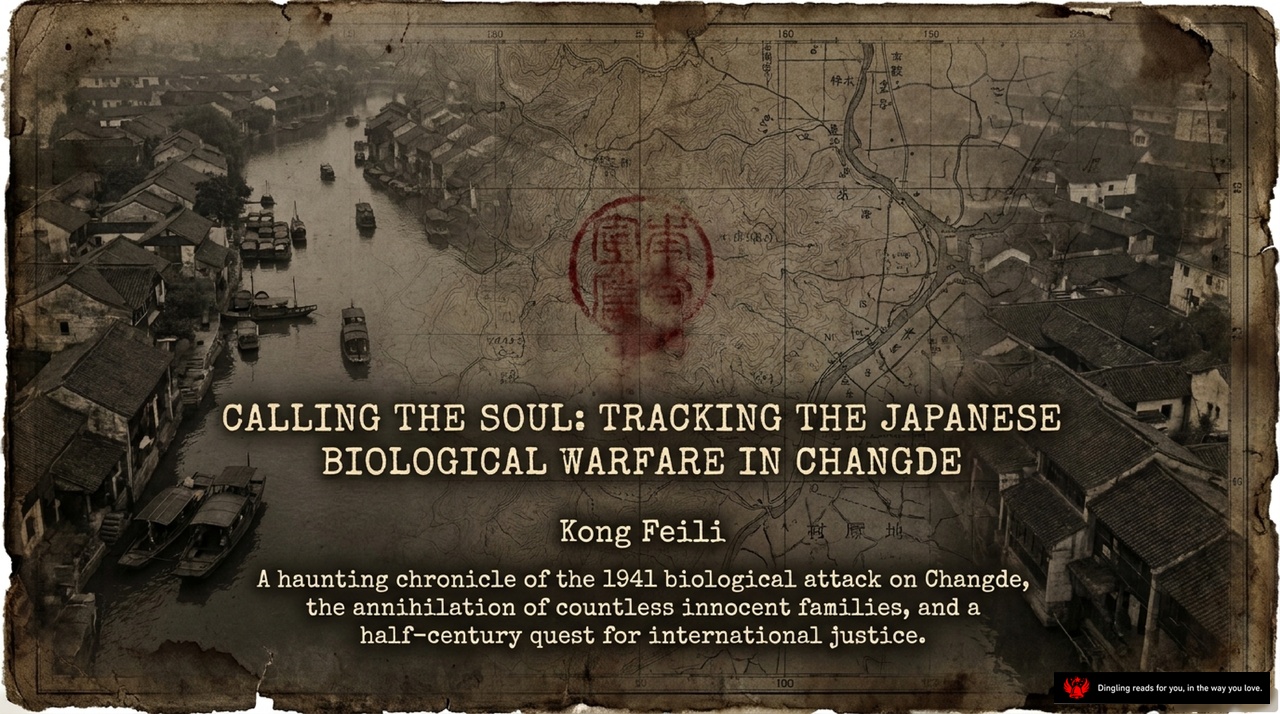
Calling the Soul: Tracking the Japanese Biological Warfare in Changde. This isn't just a title; it's a promise to remember the unspeakable. In November 1941, the city of Changde, once a thriving hub of commerce and culture, became the target of a nightmare orchestrated by the Japanese military. They didn't just bomb the city; they dropped infected grains and fleas from the sky, unleashing a plague that would turn a vibrant community into a graveyard. This book by Kong Feili chronicles that horrific attack, the annihilation of countless innocent families, and a half-century-long struggle for truth and justice. It tells the story of how ordinary people, from doctors to students, fought back against overwhelming odds, not just to survive, but to ensure that history would never forget the cruelty of biological warfare. Join us as we uncover the dark chapter of Changde and the enduring fight for international justice.

On July 13, 1998, a historic moment unfolded in Tokyo. Three men—Fang Yunsheng, Li Angu, and Huang Yuefeng—stood before the courtroom, carrying the weight of thousands of souls lost to the plague. They had embarked on a 57-year quest for justice, finally bringing their case to light. That morning, before stepping into the court, Fang knelt in his hotel room, facing west toward his homeland. He wrote a letter to his brother, who had died decades earlier, promising, "I have come to Japan to clear your name." As they faced the judges, they sang the Chinese National Anthem through tears, a powerful declaration of their resolve. This was not just a lawsuit; it was a reckoning for a dark chapter of history that had been buried for half a century.

On November 4, 1941, just before dawn, the sky over Changde turned a terrifying shade of gray. It wasn't a natural storm, but a calculated strike by Major Masuda and his Unit 731 crew. As the image shows, their aircraft silently dropped a "payload" that would soon unleash hell upon the city. But here's the chilling part: it wasn't bombs or fire. The citizens expected explosions, yet all they heard was a soft rustling on their roofs.
The real weapon was invisible. That 36-kilogram drop consisted of nothing more than wheat, grains, raw cotton, and shredded cloth—carrying the deadliest plague in history. This was a silent, invisible weapon designed specifically to evade immediate detection. By the time the horror hit, it was already too late. Within days, the disease took hold, turning a bustling city into a graveyard. This wasn't just an attack; it was a masterclass in cruelty, using biology as a weapon to break a nation from within.

Look at this graphic: "The Anatomy of a Bacterial Strike." It breaks down exactly how the Japanese military weaponized nature to destroy Changde. It starts with **Delivery**: seemingly harmless airdrops of wheat and cotton, actually seeded with infected fleas. Next, the **Vectors**: native rats and curious civilians interacting with that contaminated grain on the streets. Then comes the **Pathogen**: flea bites transmitting *Yersinia pestis*, the deadly bacteria responsible for the Bubonic Plague. And finally, the **Outbreak**: a rapid-spreading, uncontrollable epidemic within a highly concentrated civilian population.
This wasn't just an accident; it was a calculated biological weapon. The text describes how, on November 4, 1941, Japanese planes dropped these infected supplies over the city. Within days, the first victim, a 12-year-old girl named Cai Taoer, fell ill. Her symptoms matched the plague perfectly. When doctors confirmed the bacteria under a microscope, the horror was undeniable. The disease didn't stop at the city limits; it spread like wildfire to nearby villages like Liyou's hometown, wiping out entire families and even whole clans within weeks. The graphic shows the chain reaction clearly: from the initial drop to the final, devastating collapse of society. It was a strategy designed to turn the enemy's own population against itself, leaving nothing but death and despair in its wake.
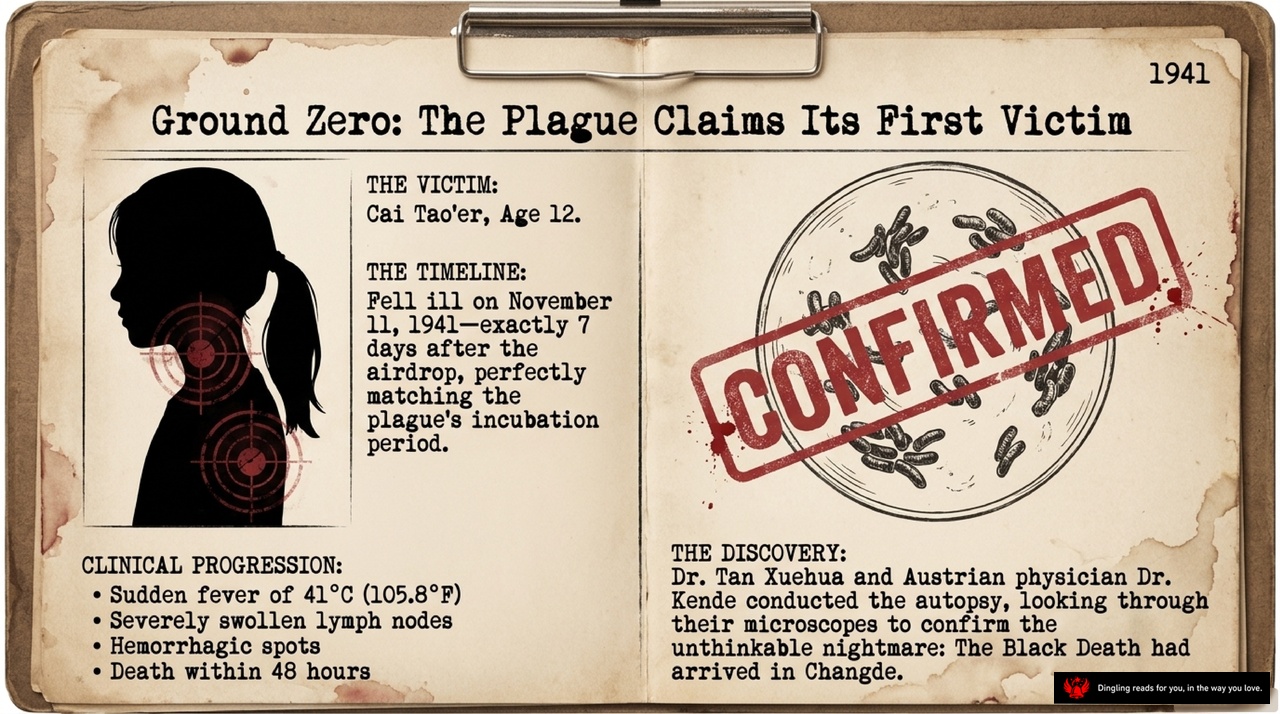
The plague didn't just spread; it exploded into a terrifying second wave. After the initial horror, the disease jumped from rats to humans, mutating into the deadliest form: pneumonic plague. Dr. Berlis delivered a chilling update: the infection rate in the rat population skyrocketed from 19% to nearly 49% in just two weeks. Worse, this new strain didn't need fleas to survive; it traveled through the air, carried on droplets, with a 100% mortality rate.
This shift turned the crisis into a true catastrophe. The virus moved from the streets into homes, claiming victims like Zhang Guiying, a young woman who died within 24 hours, her eyes wide open in a final, silent scream against fate. Entire families in the Jiege Alley were wiped out overnight. The isolation hospitals were overflowing, and the quarantine lines were crumbling under the pressure of sheer despair.
For Dr. Tan Xuehua, this was the moment his career as a healer hit an impossible wall. He walked past the alley where Zhang Guiying had lived just days ago, seeing a ghost town where life had once buzzed. He realized too late that the war's true enemy wasn't just the Japanese army outside the gates, but this invisible, airborne killer inside the city. With no effective vaccine and supplies running dry, he stood helpless, watching the plague consume everything, including his own hope for a future.
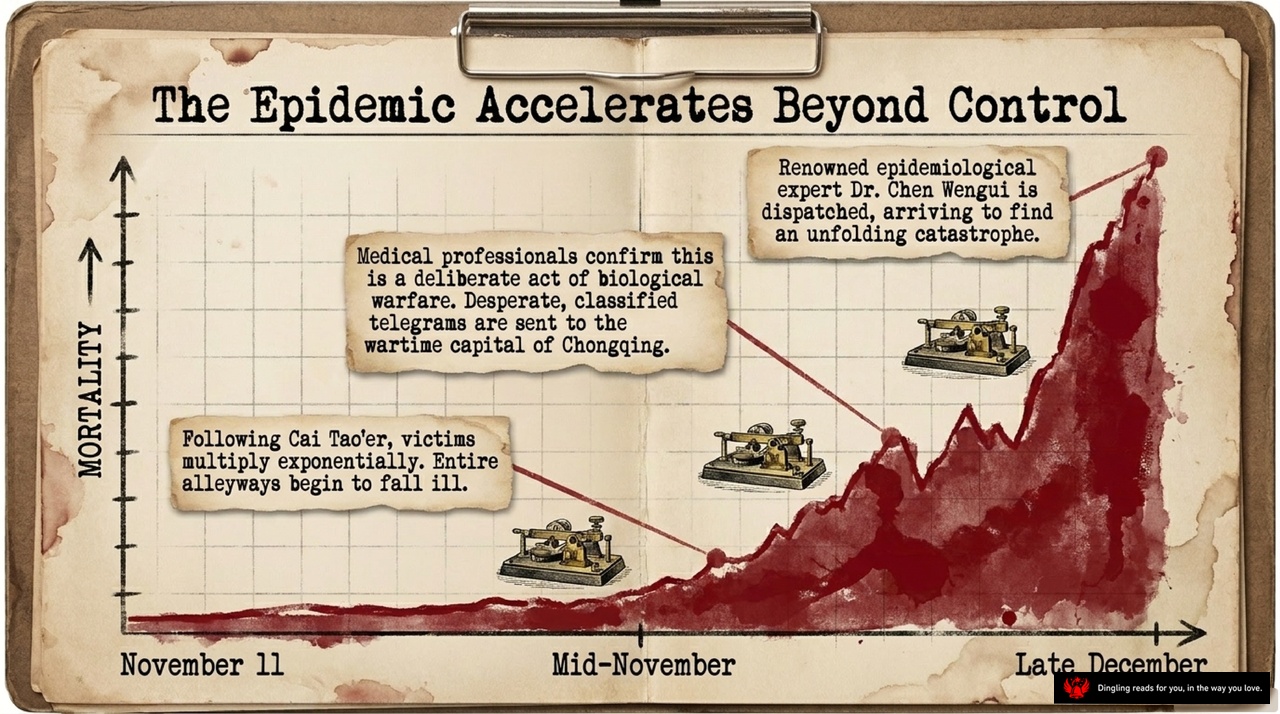
The graph before us tells a terrifying story of a catastrophe that spiraled out of control. Look at that steep, blood-red curve. It starts flat on November 11th, but by mid-November, the line begins to climb. By late December, it shoots straight up into the sky. This isn't just a rise in numbers; it's an exponential explosion of death.
As the chart shows, mortality was accelerating beyond anyone's ability to stop it. Following the initial attack, victims began to multiply rapidly. Entire alleyways, like Jiege Lane, fell ill. The red ink on this graph represents real lives lost—thousands of innocent people who vanished into the plague.
The situation became so dire that it was no longer just a medical crisis; it was a declared act of biological warfare. Medical professionals confirmed this, and desperate, classified telegrams were sent to the wartime capital of Chongqing. The stakes were too high for the enemy to ignore, but for the people of Changde, there was no time to wait.
Recognizing the unfolding disaster, the Chinese government dispatched a renowned epidemiological expert, Dr. Chen Wengui. He arrived to find a city already consumed by the plague. But by the time help could arrive, the epidemic had already taken its hardest toll. The graph captures that final, tragic moment: the point where the city's defenses failed, and the death toll became unstoppable.

Look at this map. What you're seeing here is Ji'e Alley, once the beating heart of Changde, a bustling commercial hub full of life. But look at those red X's covering every single building. Within just 48 hours, that vibrant neighborhood was completely silenced. Young wives, grandfathers, and children began collapsing one by one. Entire families, like the Zhang and Cheng clans, were systematically eradicated.
It started with a single spark: an infected rat dying in the Cheng family courtyard. That tiny spark ignited a firestorm. Within days, the entire alley was cordoned off by desperate police as the death toll mounted uncontrollably. What was once a thriving community transformed into a ghost town overnight. This wasn't just a tragedy; it was a calculated act of war that left an indelible scar on history.
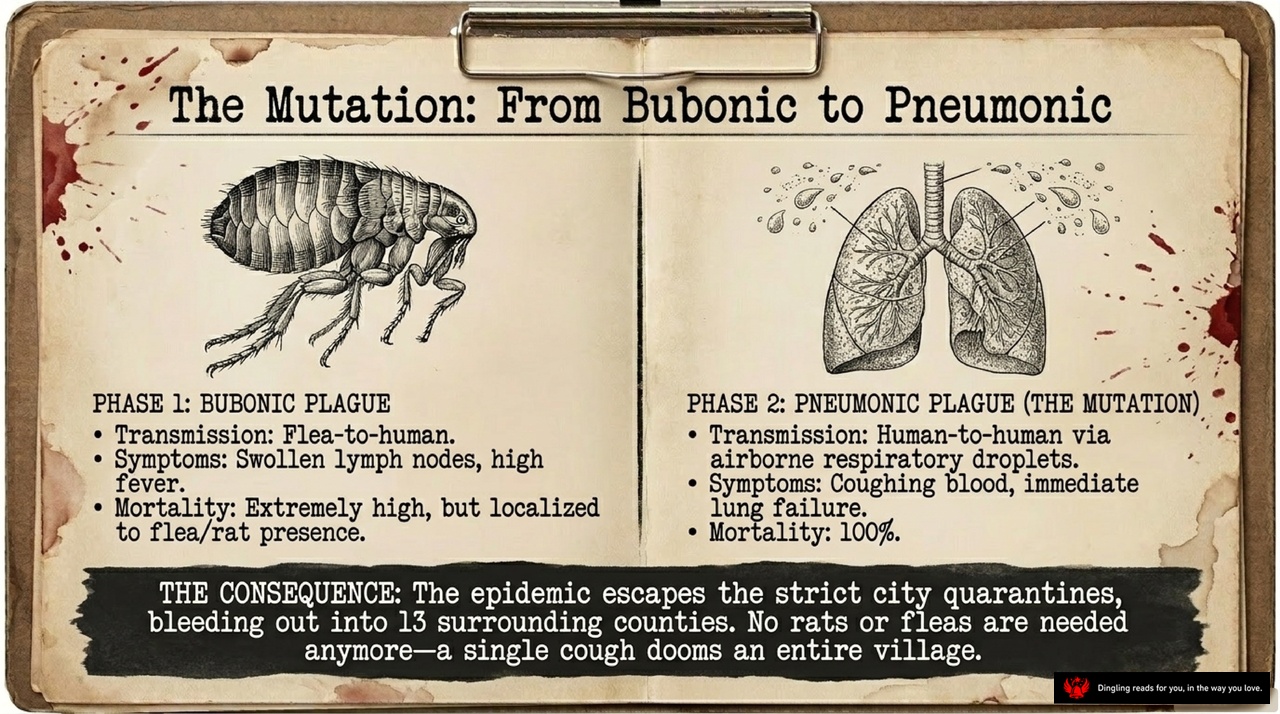
The slide we see here marks a terrifying turning point in the history of the Changde Plague: the mutation from Bubonic to Pneumonic. On the left, we see the flea, the original vector for the bubonic plague, which spread from rat to flea to human. The symptoms were swollen lymph nodes and high fever, and while deadly, it was somewhat localized to areas where rats and fleas were present. But look at the right side: this is the mutation. The transmission method changed entirely. It shifted from human-to-human via airborne respiratory droplets. The symptoms became coughing blood and immediate lung failure, and the mortality rate hit a staggering 100%. This was no longer just a disease carried by animals; it was a biological weapon that could travel through the air. The consequence, as written at the bottom, was catastrophic. The epidemic escaped the strict city quarantines, bleeding out into thirteen surrounding counties. No rats or fleas were needed anymore—a single cough could doom an entire village. This mutation turned a contained tragedy into an unstoppable force, making the suffering in Changde even more absolute and inescapable for the people who lived there.

Look at this chilling map of the Zhu family compound in Wujiaping. What we see here is the total eradication of a clan. This isn't just a diagram; it's a map of a massacre.
On the left, the scale is terrifying: a multi-generational clan of 600 people. But the breach started with a single infected water-seller, Zhu Tang'er. He was just trying to make a living, carrying water to support his family. Yet, on that fateful day, he became the unwitting vector for the plague.
The devastation was absolute. Within weeks, 201 family members were dead. Look at this tree diagram; the red crosses represent lives extinguished. It wasn't just one person; it was entire branches of the family wiped out. The infection spread through the compound like a wildfire, turning a home into a graveyard.
And the final command is what breaks the heart most. As the patriarch, Zhu Ruien, lay dying in front of the ancestral shrine, his last order to the few remaining survivors wasn't to mourn. It was to remember the blood debt. He knew that for his family, there would be no future, only a haunting memory of the cruelty inflicted upon them. This was the Japanese military's strategy: not just to kill, but to erase an entire lineage.

Imagine a scene that would make your blood run cold: a traditional Chinese wedding ceremony, but not in a temple or a home. Instead, it takes place in a morgue, surrounded by the cold, silent bodies of the very family the couple was supposed to honor. This is the haunting reality depicted in our slide, titled "A Wedding Vow in the Morgue."
The setting is the Ding family home in Shigongqiao, a place that has just become a graveyard. The tragedy is absolute: Ding Xuzhang returns home one day before his wedding, only to find that his parents, his sister, and extended relatives have all been killed by the plague. The image captures the moment of this horrific realization, with the couple standing amidst rows of coffins, their faces etched with grief and terror.
Faced with the fear that their bloodline will be extinguished, the surviving village elders force a heartbroken bride and groom to hold their ceremony immediately. They stand amidst the corpses of their own family, exchanging vows that are now filled with nothing but despair and a vow of survival. This image perfectly encapsulates the cruelty of the biological warfare unleashed upon them, turning a moment of joy into a funeral for their entire world.
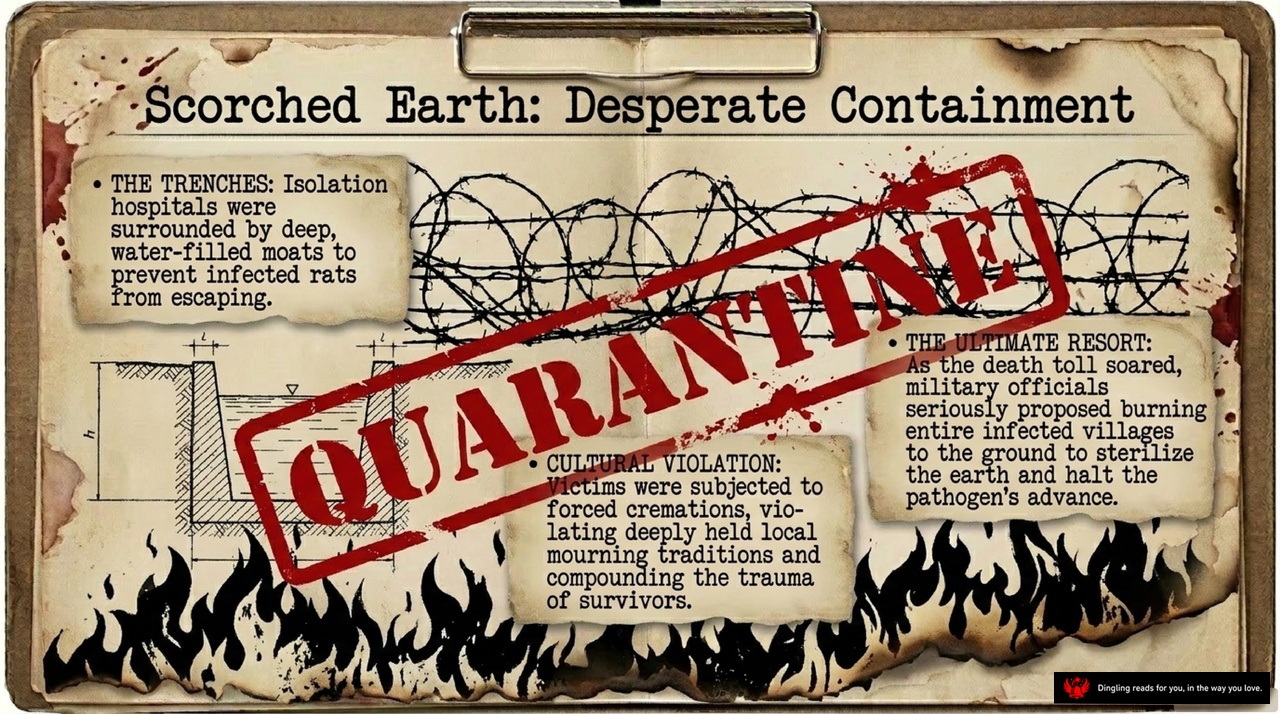
Imagine a scenario where the only way to stop a plague is to burn the entire village to the ground. This is the terrifying reality of "Scorched Earth: Desperate Containment," a strategy employed when all other options have failed. As the death toll soared, military officials seriously proposed burning entire infected villages to sterilize the earth and halt the pathogen's advance. It was an act of cultural violation on a massive scale. Victims were subjected to forced cremations, violating deeply held local mourning traditions and compounding the trauma of survivors who had already lost everything.
This brutality wasn't just about disease control; it was about erasing humanity. The image of the "Cultural Violation" box highlights this cruel truth: traditions of grief were replaced by the smoke of destruction. But the horror didn't stop there. Look at the "Ultimate Resort" section. As the situation deteriorated, the decision was made to treat human lives as expendable. Entire communities were marked for destruction, turning neighbors against neighbors and leaving a legacy of silence where there should have been remembrance.
This slide captures the darkest moment of the Changde bacteriological war—a point where the enemy's tactics crossed from warfare into genocide, leaving scars that time has yet to heal.
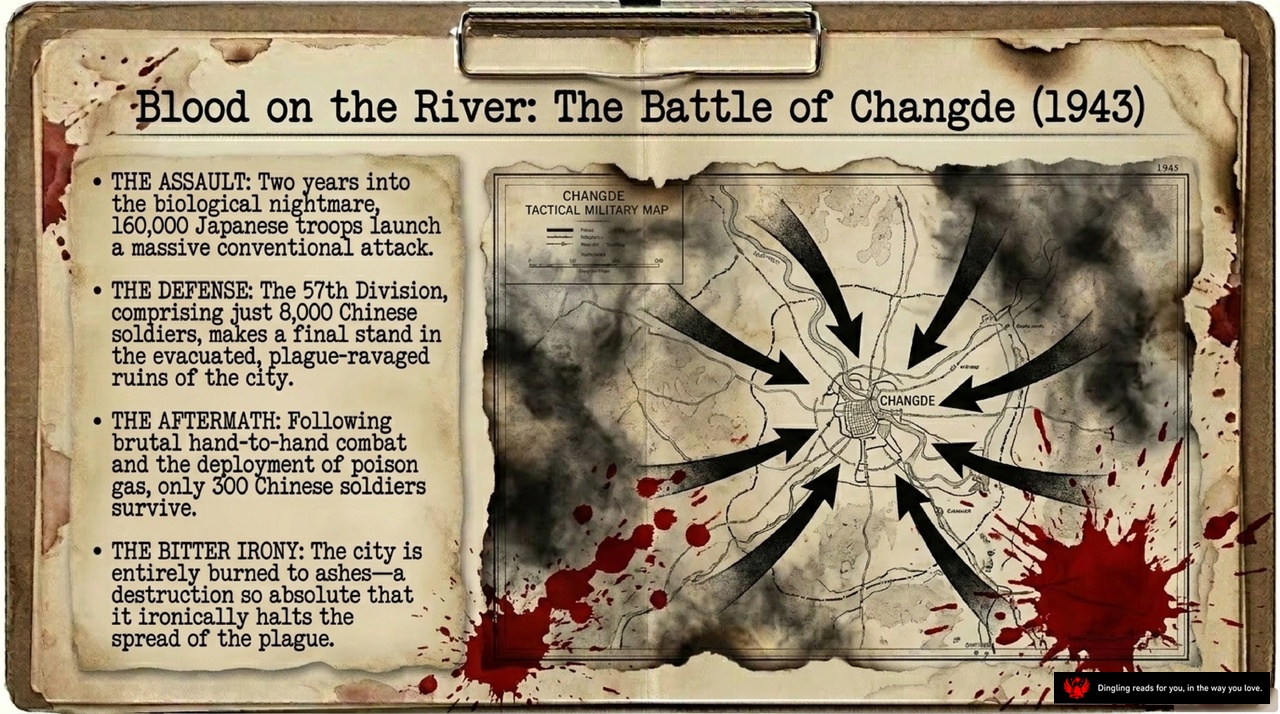
Today's slide, titled "Blood on the River: The Battle of Changde (1943)," captures the most harrowing chapter of the Sino-Japanese War—a story of overwhelming odds and absolute sacrifice.
Look at the map on the right. It shows the Japanese tactical assault in 1943, with arrows converging on Changde from all sides. This was "The Assault": two years into the biological nightmare, 160,000 Japanese troops launched a massive conventional attack to crush the city.
Facing this tsunami of enemies was "The Defense." The 57th Division, comprising just 8,000 Chinese soldiers, made a final stand in the evacuated, plague-ravaged ruins of the city. They were fighting not just for land, but for every remaining breath of life in a city already decimated by the plague.
The slide outlines "The Aftermath." Following brutal hand-to-hand combat and the deployment of poison gas, only 300 Chinese soldiers survived. It was a slaughter where the enemy's numbers simply overwhelmed the defenders' resolve.
And finally, "The Bitter Irony." The city was entirely burned to ashes—a destruction so absolute that it ironically halted the spread of the plague. While the Japanese sought to destroy the city to end the plague, they inadvertently achieved their goal through total annihilation, leaving behind a landscape of ash and silence.

Unit 731: The Architects of Terror. While Changde burned and bled, Shiro Ishii and his officers safely monitored the results of their biological field test from afar. They didn't just observe; they engineered a massive, systematic factory of death, manufacturing pathogens and testing them on living human beings. This wasn't an accident; it was a calculated atrocity. Following the war, these architects of biological terror were granted immunity from prosecution, shielded by a decades-long international silence that prioritized geopolitical data over human justice. The blueprint for this horror remains declassified, but the cost was paid in blood by thousands of innocent victims who were denied even the right to a trial.

The 2002 Tokyo Verdict: Fact vs. Justice
This slide captures the bittersweet reality of a landmark legal battle. On one side, the court finally admitted the truth: Unit 731 intentionally dropped plague-infested grain on Changde, violating international law under the Geneva and Hague conventions. They validated the horrific historical record, confirming that at least 7,643 innocent people were murdered. That acknowledgment was a crucial first step toward healing.
However, the other side of the scale tells a different story. The court denied everything else. It rejected all demands for an official government apology, refused to grant any compensation to the survivors, and shielded the state behind "State Immunity" laws. While the facts were finally spoken aloud, justice remained out of reach. This verdict highlights a painful truth: acknowledging a crime does not always mean punishing the criminal. It was a victory for historical record, but a devastating loss for the victims seeking restitution.

Over 7,643 innocent lives were extinguished by a deliberate, invisible weapon of mass destruction, their suffering buried by decades of political silence and a legal system that admits the crime but denies the restitution. When a court of law acknowledges the slaughter of thousands but refuses to hold the perpetrators accountable, does the verdict serve as a closure of the past, or an invitation for history to repeat itself?