
Speaker for the Dead: Complete Chapter-by-Chapter Summary


Look at this slide. On the left, we have Comforting Lies. On the right, Liberating Truth. This is exactly the core conflict in the book we are discussing. Think about how we treat the dead. Usually, we want to make them perfect. We erase their flaws to mythologize them. We turn a complex human into a static saint. In the story, the humans on the colony did this with Peabo. When he died, they wanted to protect the living's comfort. They pretended he was a victim of a monster, ignoring the truth that he was trying to understand the Piggy. We prioritized comfort over reality. We flattened a complex human into a static saint. We erased the fact that Peabo's son, Lebo, was actually the father of the children. We hid the truth about the Piggy's reproduction. We hid the fact that Macon was the abusive husband who took the children away from their real father.
But look at the Liberating Truth side. This is where Ender comes in. He exposes the totality of a life. Peabo wasn't a perfect saint; he had flaws, he made mistakes, he loved the Piggy deeply. Ender refuses to judge the Piggy as just monsters. He sees their motives. He realizes the Piggy killed him not out of malice, but out of a misunderstanding of ritual. This truth provides closure. It's absolute and unvarnished. It doesn't hide the pain of the death. It doesn't hide the complexity of the Piggy's society. Ender realizes the Piggy's death was a misunderstanding of their ritual of planting trees. He sees the Piggy's need for metal and knowledge.
This shift from lies to truth is what saves the colony. When we stop comforting ourselves with simple stories, we can actually understand the other. Ender helps the Piggy understand humans, and humans understand the Piggy. It's hard, it's painful, but it's the only way to move forward. Without this truth, we are just living in a fantasy where the dead are saints and the living are safe. But the truth is messy. And that messiness is what makes life real. So, when we face our own dead, do we want the lie, or the truth? We must choose the truth to survive. Because in the end, the only thing that matters is not how we remember the dead, but how we live with the truth of who they were.


Welcome back. Today, we're diving into a concept that changes everything about how we see the universe: Demosthenes' Hierarchy of Foreignness. It’s not just about biology; it’s about how we draw the line between "us" and "them."
Look at this timeline. It starts with the Utlänning, or the Stranger. That’s someone on the same planet, just a different city. Then, we move to the Främling, the Alien—same species, but a different world. These are easy to relate to. But then, things get complicated. We hit the Raman, or "The Other." This is a different species, but one capable of coexistence and communication. Finally, we reach the Varelse, the Monster. A different species where coexistence is impossible, and they are totally incomprehensible.
Here’s the critical part. Demosthenes argues that this classification isn't objective. When we decide to accept someone as a "Stranger" or an "Alien," we are actually the ones crossing the threshold. We define the boundary.
Now, apply this to the planet of Lusitania. The central conflict here is terrifyingly simple. The humans are desperate to keep the local species, the Pequenos, classified as Raman. Why? Because if they are classified as Raman, they are seen as "The Other"—something we can talk to, something we can live alongside. But if they slip into the Varelse category, they become Monsters. And if they are Monsters, the human military intervention becomes justified.
The stakes couldn't be higher. The humans are trying to force a classification that keeps the Pequenos safe, preventing a massacre. But the Pequenos have their own culture, their own rituals, and their own ways of seeing life that the humans don't understand. When the Pequenos act in ways humans don't recognize—like killing a human to plant a tree—it looks like murder to the humans. It looks like a Monster's act.
This is why the Speaker for the Dead, Andrew, has to go there. He has to bridge the gap between Raman and Varelse. He has to show that these creatures are not monsters, but a civilization with their own logic. It’s a desperate attempt to keep a door open before it slams shut. Because once the humans label them as Monsters, the door is gone, and the only thing left is destruction.
So, the real question isn't what the Pequenos are. It's what we are willing to do to protect our own idea of humanity.

Take a look at this split world. It perfectly captures the deep divide between humanity and the Pig People of Lusitania. On the left, we have the Human Settlement. It's rigid and structured, defined by strict rules, religious dogma, and deep, unhealed generational trauma. Specifically, it's defined by the Order of the Children of the Mind of Christ. It's a place of control, where the Starways Congress laws dictate everything. Think about how humans view themselves as the masters of the universe, yet they are trapped by their own history and fear.
On the right, we see the Pequenino Territory. It looks organic, almost like a tree. These aren't just animals; they have complex languages, primitive tools, and a biology that humans simply couldn't understand. To the humans, they were just 'beasts.' To the Pequenos, they were something else entirely. They have their own rituals, their own way of life, completely alien to our logic.
Between them stands the 100-Volt Electric Fence. This isn't just a physical barrier; it's a symbol of human fear. Enforced by law, it was designed to prevent 'cultural contamination.' But it did the opposite. It created a vacuum of misunderstanding. It forced the Pequenos to become violent to survive, while humans remained ignorant.
In the story, this fence is where the tragedy begins. Humans like Pip and his son Lio tried to cross it, to understand, and they paid the ultimate price. Their deaths were a result of this barrier. The Pig People, trapped behind it, had to kill humans to survive, thinking it was a ritual.
Andrew, the Ender, arrives here. He sees the truth. He realizes the fence is the real enemy, not the Pig People. He has to decide whether to break it.
This slide captures the core conflict: Is the barrier protecting us, or is it killing us? The humans are trapped in their own dogma, while the Pequenos are trapped in their isolation. The fence separates them, but it also isolates humanity from the truth.
Andrew's mission is to bridge this gap, to show that the 'contamination' humans fear is actually the key to their survival. It's a choice between safety and understanding, and the cost of that choice is high. He must convince the humans that the Pequenos are not a threat, but a potential ally, if they can just open the fence. This is the moment where humanity must choose between fear and growth.

Look at this green energy swirling in the center. This is the Descolada. It's not just a virus; it's the reason life exists on Lusitania. In Portuguese, 'Descolada' means uncoiled, and that's exactly what it does. It's a highly adaptive, aggressive force that constantly mutates. Its job? To force genetic material to cross-pollinate between every single form of life on the planet. There are no boundaries here. Flora and fauna blend together, creating a unified biological network.
But for us, humans, it's a nightmare. It's lethal. It causes excruciating biological disintegration. If we aren't careful, we break down. The only reason we still stand is because of a daily suppressant in our water supply. It's a toxic trade-off. We survive, but we're constantly fighting a war against our own biology. It's like living in a collapsing house where you must take a daily pill just to keep the roof from falling. Every sip of water is a reminder that we are infected.
Yet, you have to understand the bigger picture. This isn't just a disease; it's the Planetary Core. It is the essential biological engine of all life on Lusitania. Without it, the planet stops functioning. It binds the ecosystem together in a way that makes traditional species concepts irrelevant.
This is the backdrop for the tragedy we see in the story. When the Descolada was first discovered, it nearly wiped out the colony. Eight years ago, it took hundreds of lives, including a young girl named Maria. But it also created the Piggybackers, the creatures we call them, who rely on this virus to survive and evolve. The virus forces them to share DNA, to grow together. It's a cruel system where life is shared, at a terrible cost for those who resist it.
So, when we talk about the Descolada, we aren't just talking about a pathogen. We are talking about the fundamental rule of this world. It dictates how they live, how they die, and why humans are forced to hide. It's the uncoiled truth of Lusitania, a virus that is also the lifeblood of the planet. And that's why the conflict is so inevitable. We are trying to survive in a system designed to keep us dependent, while the true masters of this planet are the ones who embrace the Descolada.

Here we see the Descolada Life Cycle. On the left, The Human Experience. It starts with infection, followed by genetic unraveling and extreme agony, ending in grotesque death and bodily destruction. We see this as a tragic, painful end. But look at the right side, The Pequenino Experience. It follows a different path. Step one is the First Life, childhood. Step two is the Second Life, adulthood. But Step three is where the magic—and the mystery—happens. It is called The Ritual Vivisection. To us, it looks like murder. The body is cut open, and a sapling is planted in the organs. But to the Pequeninos, this is the bridge to the Third Life. The Descolada fuses the dying alien with the tree, granting eternal life and wisdom as a Fartree.
The conflict arose because humans couldn't see past their own definition of death. We thought this was the Descolada plague destroying an ecosystem. But the Pequeninos were actually honoring their dead. When Andrew finally decoded this truth, he realized that what we saw as murder was actually a sacred transformation. It wasn't about killing; it was about becoming something new. This shift in understanding allowed them to move from war to a peace treaty, proving that sometimes, the most terrifying act is actually the most profound act of life. Andrew's story shows us that understanding another culture's rituals can save lives. What looks like violence to us might be the highest form of respect to them.

Welcome to the Diagnostic Dossier. This slide captures the tragic misunderstanding that defines the conflict on Lusitania. Look at the split screen. On the left, the Human View. To us, the deaths of Xenologists Pipo and Libo look like a brutal crime scene. We see them pinned to the ground, chests cut open, organs exposed, left to die in agony. Our conclusion is harsh: The Pequeninos, known as Varelse, are dangerous, brutal animals. They killed their greatest human advocates. We interpret their actions through our own lens of violence and survival.
But now, look at the right side. The Alien View. To the Pequeninos, this isn't murder; it's the Highest Honor. The data shows the sacrifice of Pipo and Libo. Why? Because they brought great wisdom. The Pequeninos attempted to gift them the Third Life by planting trees in their bodies. It was a sacred ritual of rebirth, a way to extend their life into the forest, becoming part of the ecosystem. They didn't see violence; they saw a ceremony.
So, what went wrong? The conclusion at the bottom right explains it all. It was a tragic failure of biology. The Pequeninos didn't know that humans lack the Descolada symbiosis. They simply die when cut open. They tried to perform a sacred ritual, but our biology couldn't survive it. We are biologically incompatible with their version of immortality.
This misunderstanding cost Pipo and Libo their lives. They died not because they were hated, but because they were fundamentally misunderstood. The Pequeninos saw a gift; we saw a slaughter. This slide reminds us that truth is often relative, depending on who you are. It sets the stage for the rest of the book, where we must bridge this gap before the entire colony is destroyed. The tragedy isn't just in the death, but in the inability to understand the other side until it's too late. We are looking at the same event, but seeing two completely different realities. This is the central puzzle that drives Ender's journey forward. The gap between our biology and theirs is the gap between our lives.


Let's dive into this slide. We're looking at Macro versus Micro: The Anatomy of Incomprehension. On the surface, humans and the Pequeninos seem like total strangers. The barrier here is the Descolada Virus. Because of this virus, humans see the Pequeninos as savage murderers. They label them Varelse—enemies to be feared and destroyed. But look at the bottom row. This is the Micro level. It's about Novinha's family. The barrier here isn't a virus, it's encrypted secrets, deep trauma, and a loveless marriage. The result? Her family members view each other as incomprehensible enemies.
Here's the twist. The text tells us trauma functions exactly like alien biology. It builds walls of incomprehension that turn spouses and children into strangers. In the book, Novinha's husband, Macao, is actually a beast to her. He abused her, and she had to hide the truth that her children weren't his. She viewed him as a monster to protect her son from the dangerous secrets Pip left behind. Pip's death changed everything, and Novinha's guilt over Lipo's death made her even more isolated. Meanwhile, the Pequeninos view humans as Varelse—enemies to be feared.
So, what's the connection? The human family in Milagres is as alien to one another as they are to the Pequeninos. Think about it. Just like the virus made humans fear the aliens, Novinha's hidden trauma made her family fear and hate each other. They couldn't understand each other's pain. Novinha thought she was protecting her son by hiding the truth, but it only created a wall of silence. Macao thought he was the provider, but he was the abuser. They were trapped in a cycle of misunderstanding, just like humans and the Pequeninos were trapped by the virus.
This slide drives home a powerful point: sometimes the enemy isn't out there. It's right inside the walls of our own homes. Trauma acts like a virus, isolating us from the people we love most. The Pequeninos might not be monsters, but we are monsters to ourselves when we refuse to see the truth. That's the real alien biology at play here. It reminds us that the greatest distance between us isn't space or biology, but the secrets we keep locked away. We often fight the battle of the world, when the real war is happening in our living rooms. The slide concludes that the human family is just as alien to one another as they are to the Pequeninos. We are all trapped in our own versions of incomprehension, waiting for someone to finally understand us.

So, we are standing right at the climax of the Speaker's journey. This is the moment everything changes. The first step is bypassing the dogma. For years, the Starways Congress and the Bishop have told Andrew to stay away from the Piglets, to keep the status quo. They want to protect humanity by hiding the truth. But Andrew? He cares about the raw truth. He decides to ignore the rigid rules and face the reality head-on, even when it puts him in danger. He refuses to let the Church dictate what is right, even when the Bishop gets angry and tries to stop him. He goes to the Square to speak the truth.
Next, he needs to decrypt the data. That's where Jane, his AI companion, steps in. She helps him unlock Novinha's hidden biological files. These files reveal the terrifying truth about the Descolada. It's not just a virus; it's a carrier that lives in everyone. But this data is dangerous, which is why Andrew has to be careful. He uses Jane to break the encryption, revealing the secrets that Novinha tried to hide to protect her son. Novinha locked the files away because she knew what they contained could kill the next person who found them. She was protecting him from the same fate as her father. Jane helps him access the data before the Congress can delete it.
Finally, he reframes the crimes. This is the emotional core of the story. We thought Pipo and Libo were murdered. But Andrew realizes the truth. The Piglets didn't kill them out of malice. They were trying to honor them. In the Piglet culture, becoming a tree is a way to continue life. Pipo and Libo's deaths were a failed attempt at profound love, a misunderstanding between two worlds. The Piglets wanted to save them, but the humans saw it as murder. Novinha had to live with the guilt, thinking she killed her father. But Andrew sees the love behind the tragedy. He understands the Piglet's ritual.
This is the moment Andrew stops being a victim of the system and becomes the Speaker. He chooses truth over safety. He chooses love over fear. And in doing so, he saves not just himself, but the future of humanity and the Piglets. The Speaker has entered the arena, and the truth is finally out. This is where the story truly begins.

Welcome back to our book sharing session. Today we are at a critical turning point in the story. Let's look at what this slide tells us. It's titled "The Speaker's Truth," and it shows a stark contrast between how the community saw Marcos versus the reality we uncover. To the townspeople, Marcos was just a lazy, abusive husband and a cruel father. They saw a monster. But when the Speaker steps in, he reveals an unvarnished reality that changes everything.
The truth is, Marcos was a deeply flawed, sterile man. He couldn't have children of his own. So, he made a choice. He agreed to raise his wife's illegitimate children to protect her from the community's judgment, suffering in silent, bitter agony. He loved her so much, even knowing she didn't love him back. He took the blame for their sins to save her dignity. During the speech, Andrew listed names. He said the third name was "beast." That's what the town called him after seeing him beat his wife. But then he spoke the truth. He revealed that Macon was naturally sterile. He revealed that Noinha's six children were actually hers and Li Bo's. He revealed that Macon agreed to this, just because he loved Noinha so much, even knowing she didn't love him. The crowd went wild. Noinha's son Jin jumped up and cursed the speaker. But Noinha kept her head down, didn't deny it. This silence was louder than any denial.
By exposing the brutal, absolute truth of Marcos's sacrifice and Novinha's secrets to the entire community, the walls of trauma are shattered. It's not just about facts; it's about healing. The children finally understand their parents. They see the love behind the abuse. And this moment of clarity is the turning point. It's the moment the Varelse becomes Utlaning. The transformation of the people is tied to the transformation of the truth. When the truth comes out, it breaks the cycle of fear and lies. It allows the community to move forward. This story reminds us that perception isn't always reality. Sometimes, the most dangerous people are the ones who do the most for you in silence. And sometimes, the hardest truth is the one that saves us all. As we move forward in this story, we'll see how this revelation impacts the entire colony, leading to a new path for everyone involved.
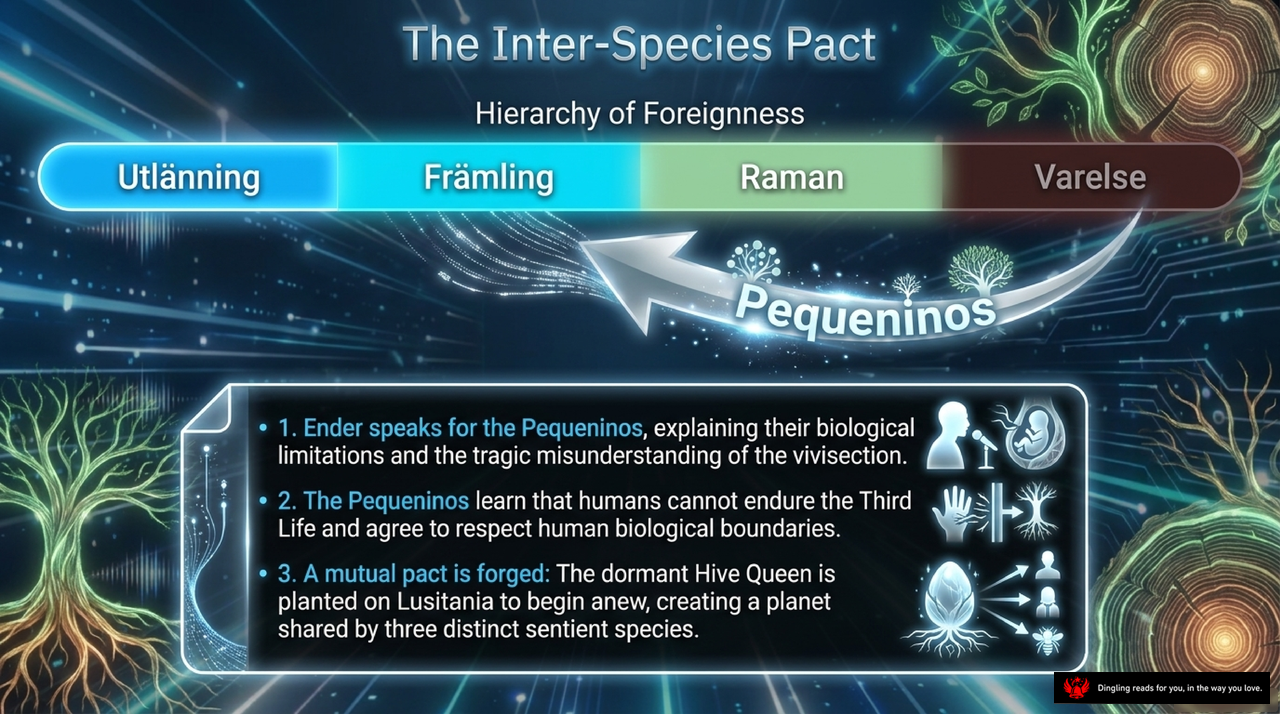
Welcome to the climax of our journey on Lusitania. Today’s slide captures the ultimate resolution: The Inter-Species Pact.
Look at that bar at the top. It represents the 'Hierarchy of Foreignness,' moving from Utlänning to Varelse, from strangers to relatives. But notice the arrow pointing back to the Pequeninos. This visual tells us that the Pequeninos are not just moving through this hierarchy; they are integrating into it.
Let’s break down how this happened in three key steps.
First, Ender speaks up. He acts as the Speaker for Dead. He explains the tragic misunderstanding regarding the Third Life. The Pequeninos believed they were honoring their dead by turning them into trees. But Ender reveals the biological limitations: humans simply cannot endure that transformation. It was a cruel misunderstanding, essentially vivisection, not a gift.
Second, the Pequeninos learn the truth. They realize humans cannot survive the Third Life. In response, they agree to respect human biological boundaries. This is a massive shift in their culture, acknowledging that not all life forms are the same.
Third, a mutual pact is forged. The dormant Hive Queen is planted on Lusitania to begin anew. This creates a planet shared by three distinct sentient species: humans, Pequeninos, and the Hive.
This moment is powerful. It moves us from the 'Hierarchy of Foreignness' to true coexistence. We stop viewing the Pequeninos as enemies or monsters. Instead, we see them as neighbors with different rules. It’s a reminder that peace isn't about being the same; it's about understanding differences.
After so much tragedy, this pact offers a new beginning. Lusitania is no longer a battleground. It’s a home for everyone. Think about the weight of this moment. For centuries, humans and Pequeninos lived in fear. Now, the barrier is gone. It’s a circle of life finally closed.
This is where the story finds its peace, and a new chapter for humanity begins.


We've just reached the heart of the story. *Speaker for the Dead* isn't just a sci-fi adventure; it's a profound lesson on empathy and the devastating cost of misunderstanding. Think about the Pig People on Lusitania. To the humans, they were monsters. To the Pig People, humans were invaders. The tragedy happened because neither side spoke the other's language. Literally, they couldn't communicate. But metaphorically, they couldn't understand each other's values. Humans saw the Pig People's ritual of turning bodies into trees as murder. The Pig People saw humans as invaders threatening their existence.
Andrew, the Speaker for the Dead, had to bridge that gap. He realized that the humans thought they were saving a life, but the Pig People were actually honoring their dead by turning them into trees. It wasn't murder; it was a different kind of immortality. Andrew had to step into their world, not to judge, but to understand. He eventually made the ultimate sacrifice himself, becoming a 'third life' to seal the peace. It was a terrifying moment, but it was the only way to save everyone. Without that willingness to learn, the conflict would have continued for centuries.
This brings us right back to the text on your screen. True peace, whether across lightyears of space or across a dining room table, can only be achieved when we stop demanding others be like us. We have to learn to understand them as they are. That's the hard part. It requires humility and the willingness to let go of our own definitions of right and wrong. We often assume our way is the only way, but that is the path to destruction.
The slide ends with a question that hits home. Who in your life have you condemned as an alien, simply because you refuse to learn their language? Maybe it's someone who thinks differently, or acts differently. We often label them as 'other' to protect our own comfort. But as Andrew learned, that wall is what destroys us all. The only way forward is to listen, truly listen, and find the shared humanity underneath the differences. Don't let fear turn your neighbor into an enemy. The choice is yours, but the cost of getting it wrong is far too high.