
Steppenwolf: Complete Chapter-by-Chapter Summary

Welcome to *Steppenwolf*, a profound journey into the fractured soul of the modern man, written by Hermann Hesse. Imagine a cracked mirror resting on a cobblestone street, reflecting a starry night instead of your own face. That broken glass represents the protagonist, Harry Haller, a man torn between being human and a wild "steppenwolf." He despises the comfortable, predictable life of the average citizen yet cannot escape it. His story is a terrifying and liberating descent into the Magic Theater, a place where the boundaries of reality dissolve, and he finally confronts the chaotic, multi-faceted nature of his own soul. This is not just a book about loneliness; it is a map for anyone who feels they don't quite fit in the world, a guide to finding the eternal amidst the chaos of our daily lives.

Look at this split image. On the left, we see a pristine hallway with a perfectly trimmed Norfolk pine and soft, warm light—it represents the bourgeois world of safety, order, and the comforting illusion of normality that Harry Haller desperately craves. It's the scent of floor wax and quiet domesticity, a refuge born from his agonizing childhood nostalgia.
But look at the right side. It's a chaotic attic filled with towering stacks of books, scattered papers, and the smoke of cigars mingling with the sharp scent of turpentine. This is the reality of Harry's inner life: isolation, intellectual rigor, and existential dread. He is a wild beast trapped in a cage of his own making, despising the very society that houses him yet unable to truly escape it.
This is the core tragedy of Harry Haller. He is torn between two worlds. On one side, he hates the "common man"—the citizens who trade their intense lives for comfortable mediocrity. On the other, he cannot survive in the true wilderness of his own soul. He is tethered to the edges of both, unable to fully belong to the civilized world or the wild, untamed self. He is stuck in the liminal space between the safety of the home and the chaos of the mind, trapped in a scent of despair that never fades.

Harry has built a prison for himself with a lie he tells every day: the lie that he is split in two. On one side sits "The Man"—spiritual, moral, and obsessed with Mozart and Goethe, yet secretly sentimental, cowardly, and desperate for society's approval. On the other side roars "The Wolf"—raw instinct, wild vitality, and a cruel indifference to human compromise. Harry believes these two forces are locked in a brutal, life-destroying war, convinced that his soul is nothing more than these two variables. But this is the error of simplification. The treatise he reads, and the reality of life itself, reveals this as a naive misdiagnosis. The human soul cannot be reduced to a mere binary. It is not a battlefield of good versus evil, but a chaotic, infinite collection of thousands of tigers, foxes, and parrots. Harry is trying to cage a universe in a box, and in doing so, he is only killing the very thing he claims to be saving.

Look at this chart. It maps the terrifying yet strangely liberating journey of Harry Haller, the "Wilderness Wolf." The graph tracks a shift from "Despair" over time, moving from the past into the future.
It starts with **Hypersensitivity**. In the past, Harry's ego felt utterly exposed and threatened by the friction of existence. Every single interaction felt like a battle. He couldn't just exist; he had to defend himself against the world, and every interaction caused pain.
But then, we see the turning point: **The Consolation**. This is the psychological "emergency exit." The comforting, almost dark knowledge that death is available at any moment. Harry isn't just suicidal; he lives with the certainty that he can choose to leave. This availability of an exit makes the pain bearable. He knows he doesn't have to suffer forever.
And that leads us to the final, paradoxical state: **Paradoxical Strength**. Because he has agreed to die on his 50th birthday, he actually gains the endurance to survive today's suffering. That "escape hatch" becomes a reason to stay. The ability to quit gives him the strength to endure.
So, the lesson here is profound. Sometimes, the only way to survive the unbearable pressure of life is to give yourself permission to leave. It's not about giving up on life; it's about realizing you hold the ultimate power over it. That realization transforms despair into a strange, paradoxical strength.

Look at this slide, "The Compromise of the Middle Path." It visualizes a fundamental tension in human life: the struggle between the burning intensity of the extremes and the comfortable, lifeless safety of the middle. On the left, we have the Saint or the Martyr, representing absolute devotion to spirit and asceticism. On the right, the Profligate, embodying raw instinct and unbridled passion. Both sides burn with a fierce, destructive intensity.
But in the center sits the Bourgeois—the middle class, the very group we often admire but that Harry despises. The slide explains their goal perfectly: self-preservation, comfort, and the absence of pain. Their sacrifice? They trade the burning intensity of the soul for a pleasant, room-temperature existence. They survive not by their own strength, but by capturing and tempering the vital energy of the outsiders—the saints and the wild ones—trapping them in their gravitational pull.
This is the tragic compromise. As Harry realizes, the true "human" isn't a balance between good and evil, but a terrifying, infinite collection of souls. The middle path is a lie that keeps us safe but alive in a coma. To truly live, one must dare to burn, to embrace the chaos of the wild or the purity of the saint, rather than settling for the dull, safe warmth of the crowd.

Welcome to the final chapter of our journey into Harry Haller's fractured soul. Today, we deconstruct the very idea of the "Ego"—that single, unified "I" society tells us we are. The image before you reveals the truth: the illusion of a single self is a societal fiction, a myth designed to keep order by simplifying the complex human experience into something manageable, like a judge versus a murderer. But reality? Reality is the deconstruction of the ego.
Look at that onion at the center of the slide. The human soul isn't a single entity; it is an intricate web of hundreds, thousands of distinct personas. Just like an onion, our identity is built from countless layers—some labeled here with whimsical terms like "Plantal layers" or "Economical layers"—representing every contradictory part of us. We are not just one thing. We are not just the civilized "Man" or the wild "Wolf." We contain the fox, the dragon, the tiger, the monkey, and even the bird of paradise. As the text reminds us, the human soul is a narrow, perilous bridge between nature and spirit.
The tragedy of Harry, and perhaps of us all, is that we try to live as a single, unified character, pretending to be only the "good" parts while suppressing the "bad." But true freedom comes from embracing the chaos. It means acknowledging that the beast within is just as real as the saint, and that the comedy of life often lies in the absurdity of trying to be perfect. We must stop fighting our own nature and instead learn to dance with the madness of our own souls. Man is an experiment and a transition, and only by accepting our multiplicity can we finally stop the war within ourselves.
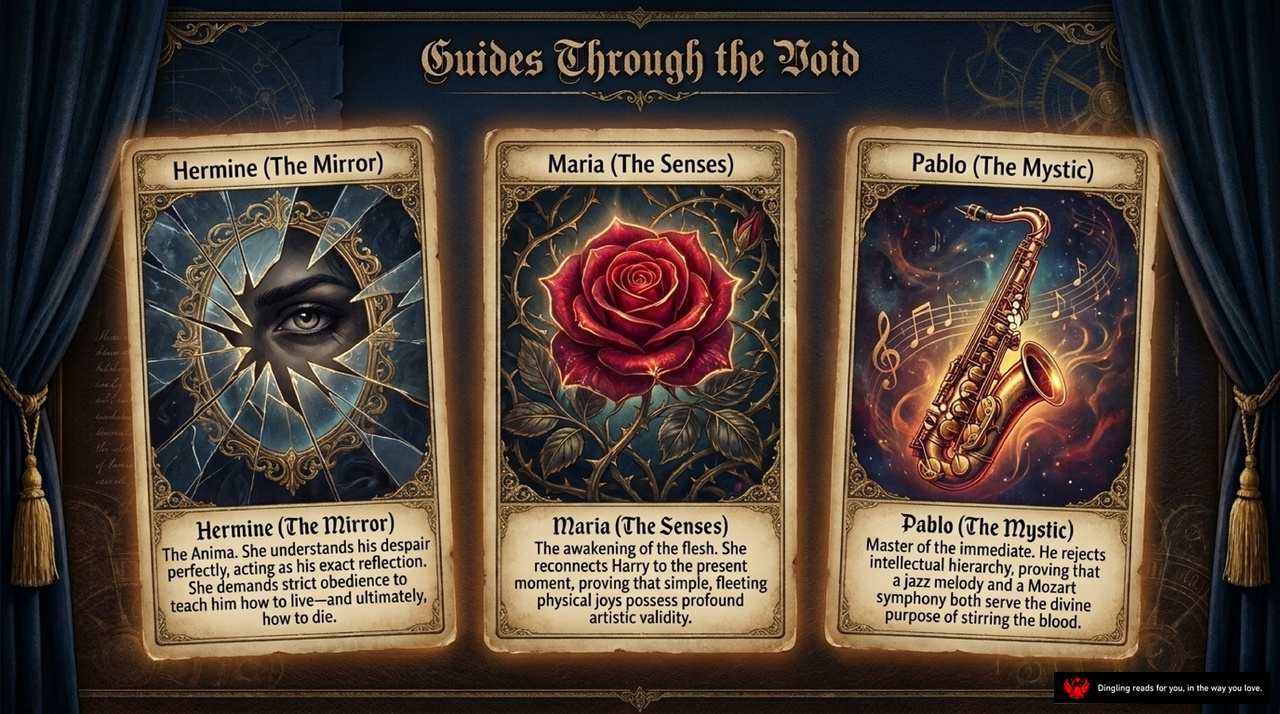
Welcome to the final chapter of Harry's journey, where the void reveals its true face. Look at these three cards: Hermine, the Mirror; Maria, the Senses; and Pablo, the Mystic. These aren't just characters; they are the guides who pull Harry out of his despair.
First, Hermine. She is the mirror, the Anima. She understands Harry's pain perfectly because she is his exact reflection. But she doesn't just comfort him; she demands strict obedience. She teaches him how to live, and ultimately, how to die. She forces him to face the terrifying truth that he cannot hide from himself anymore.
Then there is Maria. She represents the Senses and the awakening of the flesh. For Harry, a man who has spent his life in books and philosophy, Maria is a revelation. She reconnects him to the present moment, proving that simple, fleeting physical joys possess profound artistic validity. She shows him that beauty isn't just in the distant stars, but in the warmth of a touch and the taste of food.
Finally, Pablo, the Mystic. He is the master of the immediate. He rejects intellectual hierarchies, proving that a jazz melody and a Mozart symphony both serve the divine purpose of stirring the blood. Pablo teaches Harry that life is a game, a "Life Magic" where everything is possible.
Together, these three figures shatter Harry's rigid worldview. They show him that the human soul is not a simple conflict between man and wolf, but a thousandfold constellation of possibilities. They guide him through the void, transforming his suffering into a cosmic play. As Harry realizes, the only way to save himself is to laugh at the absurdity of it all, to stop taking himself so seriously, and to embrace the game of life with all its chaos and joy.

Welcome to the Magic Theater. As the neon sign flickers against the brick wall, remember this: it is not for everyone. It is for madmen only.
Harry Haller has finally found the door. After years of feeling like a "wilderness wolf" trapped in a cage of ordinary citizens, he was told that the only way in was to lose his mind. The ticket price? Your mind itself.
Inside, the rigid constraints of his ego dissolve completely. The theater isn't a physical place; it is an externalized landscape of his psyche. Here, the strict boundaries that defined him as either "human" or "wolf" vanish. He enters a world where the logic of reality no longer applies, a liberated space where he can finally confront the thousands of souls living within him.
This is the ultimate freedom, but it comes with a terrifying cost. To enter this realm of eternal play, Harry must be willing to lose his sanity, to let go of the fear that has held him hostage for so long. He steps through the threshold, ready to play the game of life on his own terms, no longer bound by the rules of the mundane world.

Look at this board. It's not a game of checkers; it's the architecture of the soul. The image shows a massive, dark hand reaching down to rearrange tiny figures on a chessboard. These figures represent the fragmented pieces of Harry Haller's personality: the boy, the old man, the lover, the cynic, the intellectual. This is the core mechanism of *The Demons*: the "Builder."
The text on the right explains that this builder demonstrates how to take these shattered fragments and arrange them into endless new games, new relationships, and entirely new lives. The rule on the left is crucial: if the soul is shattered, it need not be put back together in the exact same configuration. We don't try to glue the pieces back to how they were before; we rebuild.
This leads us to the profound takeaway at the bottom. Schizophrenia is reframed here not as a disease to be cured, but as the raw material for infinite psychological artistry. Harry realizes that his internal chaos is actually a vast palette. By stepping into the Magic Theater, he learns to play these different roles consciously. He stops being a victim of his split self and becomes the artist who constructs his own reality. It's a terrifying but liberating idea: we are not fixed entities. We are the players who get to decide how to move our own pieces on the board of existence.

Welcome to the final chamber of the Subconscious. Here, we see three distinct portals, each representing a different facet of Harry Haller's fractured soul.
On the left, we have "The Automobile War." This door, blazing with fire and a burning tire, represents a joyful, anarchic rebellion. It's the release of deeply repressed violence and anti-industrial rage. Harry isn't just angry; he's yearning to smash the sterile modern world and the very machines that enslave him.
In the center stands "The Taming of the Wolf." This is a terrifying role-reversal where the "Man" acts as a groveling, subjugated beast, while the "Wolf" becomes the cruel, commanding master. It's the terror of suppressed instincts taking the wheel, showing us the dark side of our nature that we try to keep at bay.
Finally, on the right, is "All Girls Are Yours." This golden door symbolizes a return to the agonizing, sweet, and potent desires of youth. It's about experiencing every lost love and missed connection in a timeless, eternal present. Harry is finally able to embrace the chaotic, sensual flow of life he once rejected.
Together, these three doors show us that Harry isn't just one thing. He is the rebel, the beast, and the lover all at once. He realizes that true freedom comes not from choosing one side, but from embracing the whole chaotic spectrum of his existence.

Look at this pyramid. It perfectly captures the duality of our existence. On the ground lies "The Earthly Realm"—a place driven by time, war, greed, and that frantic, bloody cycle of creating and destroying. It's a world plagued by extreme seriousness and agony, where we are trapped in a narrow bridge between raw desire and high ideals.
But look up. Above the pyramid floats "The Dimension of the Immortals." This is the realm of Mozart and Goethe, suspended in crystalline perfection, existing beyond time itself. The text tells us a profound truth here: true greatness does not survive through earthly fame. Instead, the Immortals escape time altogether. They watch the agonizing thrashing of human existence with a divine, crystalline, and smiling detachment.
This isn't just about being cold; it's about seeing the eternal within the fleeting. We spend our lives trying to be serious, trying to find meaning in the struggle, but the Immortals know that the only way to touch the divine is to laugh at the tragedy. They realize that life is a game, a "life game" where we are the players, and the only way to win is to learn how to laugh at the absurdity of it all. That smile of detachment is the key to unlocking the immortal realm.
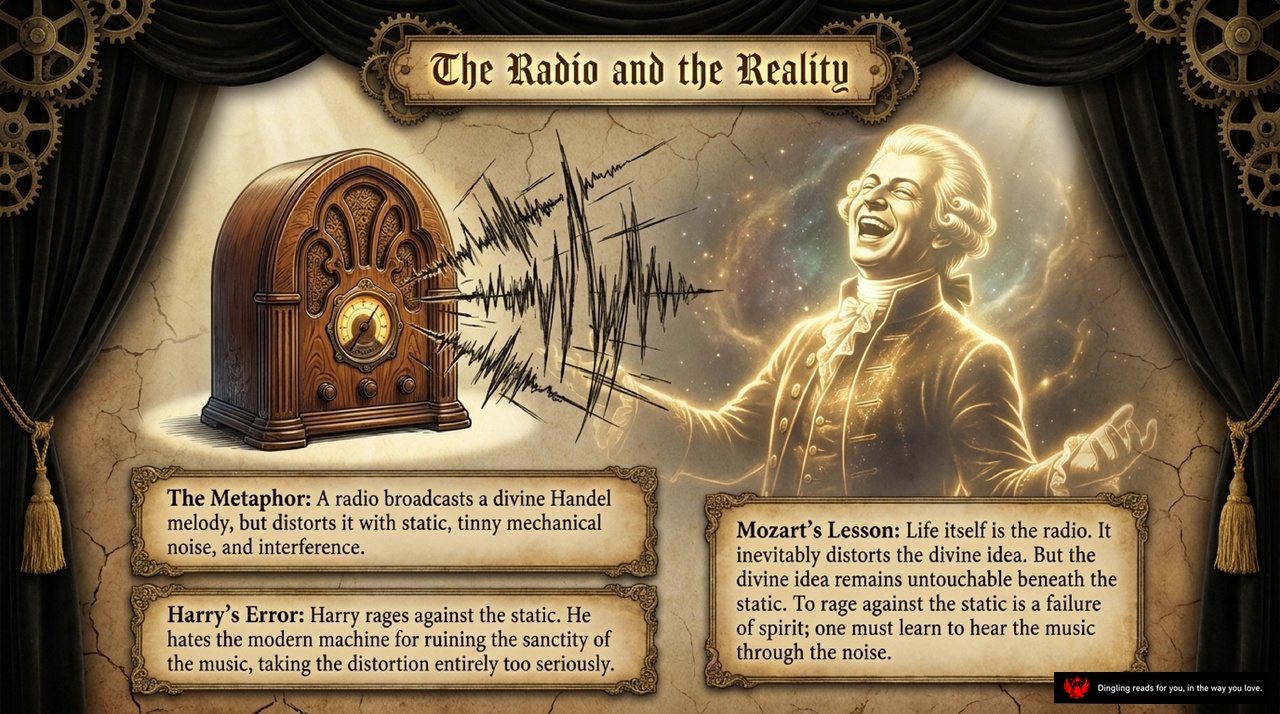
Imagine a world where the divine music of Handel is being broadcast, but the signal is constantly distorted by the static of a tinny, mechanical radio. That is the central metaphor on this slide. The image shows an antique radio struggling to reach a vision of Mozart, separated by jagged lines of interference. This isn't just about technology; it's about our relationship with reality.
The slide highlights "Harry's Error." Harry, our protagonist, gets angry at the static. He hates the modern machine for ruining the sanctity of the music. He takes the distortion too seriously, raging against the noise instead of hearing the melody through it. This is a failure of spirit. He mistakes the medium for the message.
But then, look at "Mozart's Lesson." Life itself is the radio. It inevitably distorts the divine idea. We live in a world where high art and pure spirit are constantly mixed with the "static" of daily life—bills, boredom, and mechanical noise. Yet, the divine idea remains untouched beneath the static. The lesson is clear: do not rage against the noise. To do so is to miss the music entirely. We must learn to hear the eternal melody through the interference of the mundane. The radio doesn't destroy the music; it is simply the vessel through which we experience it, flawed and beautiful all at once.

The climax of this journey is where the illusion shatters into blood. Harry, lost in the depths of the Magic Theater, finds Hermine and Pablo in a moment of intimate embrace. Instead of seeing the playful, surreal game they are playing, he succumbs to the very thing the theater was designed to cure: traditional bourgeois jealousy and the heavy theatrics of tragedy. In a fit of what the book calls "High Seriousness," he grabs a real knife and stabs Hermine. He has failed the ultimate test of the Magic Theater. He confused psychological reflection with physical reality, ruining the delicate game of the mind by spilling actual blood. The verdict is clear: Harry cannot escape his own gravity. He tried to bleed reality into the illusion, but in doing so, he became the very tragedy he sought to escape, trapped forever in the serious world he feared most.
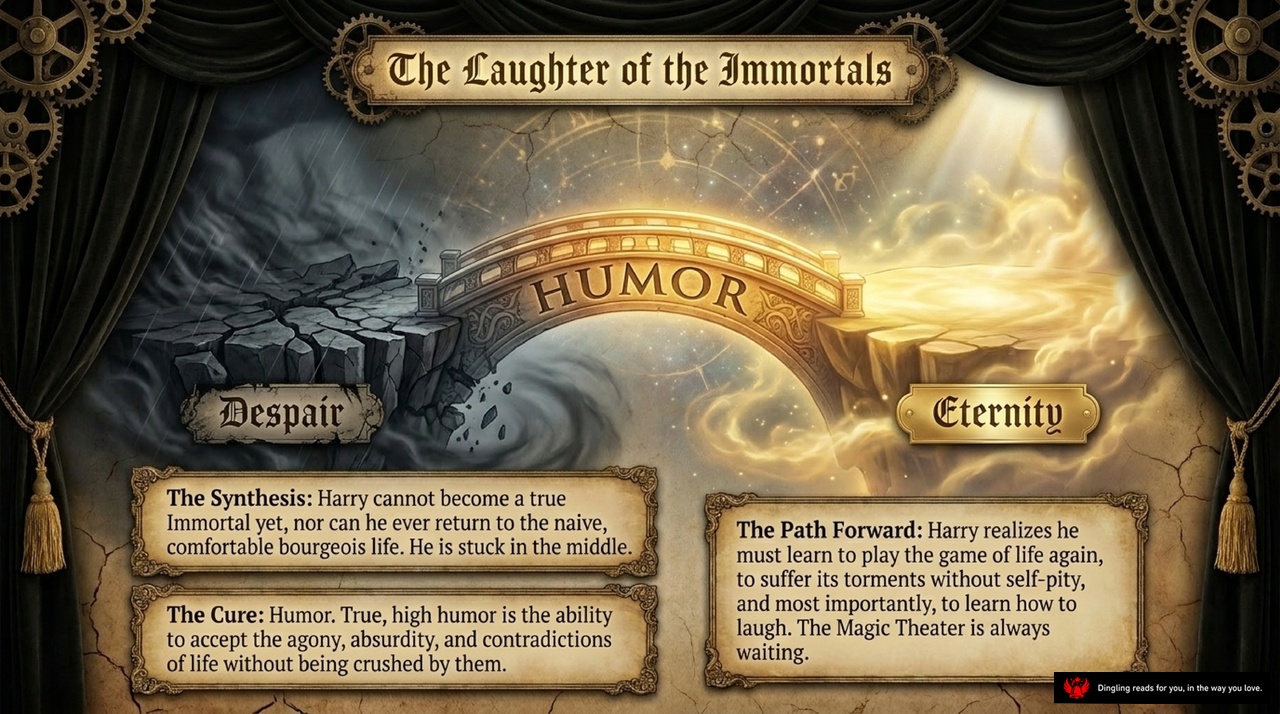
Welcome to the final act of Harry's journey. Look at this bridge labeled "Humor." In this moment, Harry finally realizes that the gap between despair and eternity isn't a chasm he can't cross; it's a bridge he must build himself with laughter.
As the text explains, Harry is stuck in the middle. He can't return to the naive, comfortable bourgeois life he once knew, nor can he become a true immortal. He is trapped between the agony of existence and the absurdity of life. But there is a cure: true, high humor. It's not just about making jokes; it's the radical ability to accept life's agony, its absurdity, and its contradictions without being crushed by them.
This is the path forward. Harry realizes he must play the game of life again. He has to suffer its torments, but without self-pity. Most importantly, he must learn how to laugh. He understands that the Magic Theater is always waiting, not as a place of escape, but as a space where he can integrate all his fragmented souls. By embracing the humor of the situation, he stops fighting reality and starts dancing with it. That laughter is the key to unlocking his immortality.

Look at this final slide. It's not just a summary; it's an invitation to a completely different way of seeing life. The text here tells us that *Steppenwolf* is far more than a story about a man alienated by modern society. It is actually a brutal, hallucinatory autopsy of the human ego. Harry Haller's journey through the Magic Theater strips away the comfortable illusion of a single, unified identity, revealing the soul as an infinite collection of fragmented pieces. He discovers that salvation cannot be found in intellectual isolation or suicidal despair, but in the "Laughter of the Immortals"—the profound, transcendent humor required to embrace the beautiful, agonizing absurdity of existence.
And look at that reflection question paired with the golden knight chess piece. It asks us: If your soul is not a single, solid entity, but a chessboard of infinite, untamed pieces, what game are you currently playing, and are you brave enough to rearrange the board?
In our modern world, we often try to curate a perfect, unified version of ourselves. We hide our contradictions, our "wild" sides, and our failures, pretending to be one solid thing. But this book suggests that true freedom comes from embracing the chaos within. It's about realizing that you are not just one person; you are a whole universe of conflicting desires, talents, and shadows. The magic doesn't happen when you try to suppress the "wolf" inside you or force yourself to be purely human. The magic happens when you learn to laugh at the absurdity of it all. When you can see the tragedy and the comedy, the pain and the joy, as part of the same magnificent game, you find a kind of eternal laughter that saves you. So, I challenge you: Stop trying to play the game society wants you to play. Look at your own board of pieces. Who are you really? And are you brave enough to make a move that changes everything?