
Steve Jobs: Complete Chapter-by-Chapter Summary
Welcome to the story of Steve Jobs, the creative genius whose relentless pursuit of perfection didn't just change one industry, but revolutionized six.
This isn't just a biography; it's the definitive account of a man whose journey began with a profound sense of being both abandoned and chosen. Born to an unmarried student and adopted by a couple who promised to send him to college, Steve grew up knowing he was an outsider, yet he was fiercely loved. That unique tension shaped his entire life—his obsession with control, his demand for perfection, and his ability to see what others couldn't.
From a garage in Silicon Valley where he learned to care about every detail, even the back of a cabinet, to his time at Reed College where he dropped out but kept taking calligraphy classes that would later define the Macintosh, Steve's path was unconventional. He traded a stable job at Atari for a spiritual quest in India, only to return with a new clarity.
Then came the partnership with Steve Wozniak. Together, they built the Apple I and II in a garage, proving that a simple idea could become a global phenomenon. But Steve's vision never stopped. He fought for the Macintosh, launched the NeXT computer, and co-founded Pixar, transforming animation into an art form.
Today, we're diving into the life of the man who taught the world that simplicity is the ultimate sophistication, and how his relentless drive turned a small garage startup into a legacy that still shapes our digital lives.

Today's slide captures the very heart of Steve Jobs' genius: The Core Duality. Look at this Venn diagram. On the left, we have Technology—engineering, microprocessors, and that intense hacker culture of Silicon Valley. On the right, we have Liberal Arts—Zen Buddhism, counterculture, Bauhaus design, and the humanities.
Jobs realized that true innovation doesn't happen in just one circle. It only occurs at the exact intersection where these two worlds collide. This insight was inspired by the founder of Polaroid, Edwin Land. Jobs understood that intuition must meet engineering. He believed that to create something truly revolutionary, you need the rigor of science combined with the soul of the arts. That is why he spent so much time meditating in India and studying calligraphy at Reed College. Without that blend of the spiritual and the technical, Apple's products would have been nothing more than cold machines. It was this unique fusion that allowed Jobs to transform technology from a utility into an expression of human creativity.

The Anatomy of a Partnership isn't just a metaphor; it's the exact blueprint that built Apple. Look at the split on this slide. On the left, we have the Engineer, Steve Wozniak. He represents brilliant circuitry, open expansion slots, and raw technological capability. Woz was driven by a pure desire to share engineering marvels with hobbyists. He wanted to build machines that anyone could tinker with. On the right stands the Visionary, Steve Jobs. He represents enclosed systems, built-in keyboards, integrated power supplies, and consumer-friendly packaging. Jobs wasn't interested in tinkerers; he was obsessed with commercializing technology and changing the world.
The text at the bottom captures the essence of their dynamic perfectly. As Regis McKenna famously said, "Woz designed a great machine, but if it hadn't been for Steve Jobs, it would still be sitting in hobby shops today." Woz created the brain, but Jobs built the body and gave it a soul. Without Jobs' vision to package this raw genius for the masses, the Apple I might have remained a niche curiosity for electronics enthusiasts. Together, they balanced the need for technical excellence with the demand for user experience, creating a partnership that defined an entire industry.

Look at this slide titled "The Apple Marketing Philosophy (1977)." It breaks down the core strategy that Steve Jobs and his team built at Apple back then, focusing on three pillars: Empathy, Focus, and Impute.
First, let's talk about Empathy. The image highlights that you must understand customer needs better than any other company. This wasn't just about selling products; it was about deeply knowing what people actually wanted, even before they could articulate it themselves.
Next is Focus. The slide says to "ruthlessly eliminate all unimportant opportunities to excel at what remains." This was the essence of Jobs' genius. Instead of trying to be everything to everyone, Apple decided to say "no" to almost everything. They cut away the clutter to focus entirely on perfecting a few key things, ensuring they were the best in the world at exactly what they did.
Finally, we have Impute. The text reminds us that people judge a book by its cover. Packaging and presentation signal the quality inside. For Apple, this meant that the unboxing experience, the design of the box, and the visual identity were just as important as the technology itself. If it didn't look premium, it wouldn't feel premium.
Together, these three concepts formed the foundation of Apple's rise. By empathizing with users, focusing relentlessly on the essentials, and ensuring every detail of the presentation screamed quality, Apple didn't just sell computers; they sold a feeling of perfection.
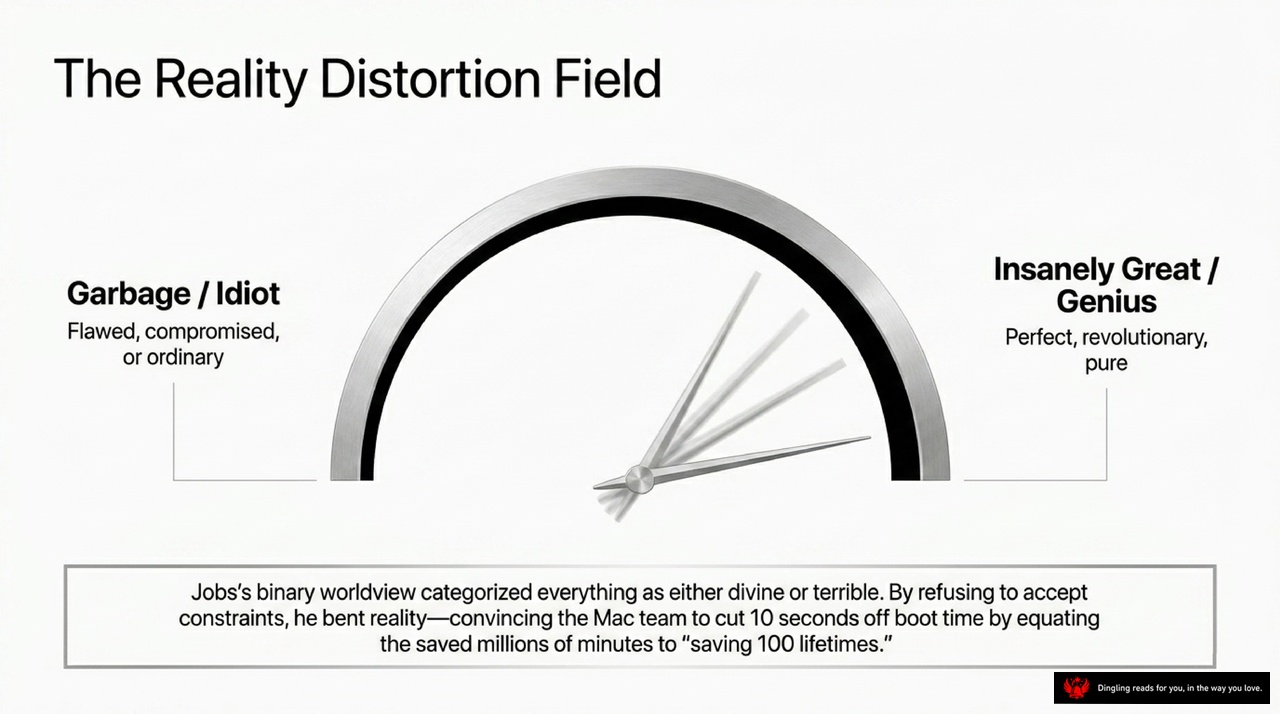
Have you ever felt like reality is just a suggestion? Steve Jobs famously called it the "Reality Distortion Field," a binary worldview where everything was either divine genius or total garbage. There was no middle ground. As this slide illustrates, he categorized the world into two extremes: on one side, the "Garbage"—the flawed, compromised, or ordinary; and on the other, the "Insanely Great"—the perfect, revolutionary, and pure. Jobs refused to accept the constraints of normal reality. He didn't just ask for things to be done; he convinced the world they were already done. A prime example was when he pressured the Mac team to cut just 10 seconds off the boot time. To everyone else, that seemed like a tiny, impossible detail. But to Jobs, he equated those saved millions of minutes to "saving 100 lifetimes." By refusing to accept the status quo and bending reality to his will, he turned the ordinary into the extraordinary, proving that sometimes, the only limit is the one you believe in.

Welcome back to the story of Steve Jobs. Today, we're looking at the pivotal chapter known as "The Wilderness Years." This timeline captures the critical arc from his firing in 1985 to his triumphant return in 1997.
In 1985, Jobs was fired by Sculley. It was a devastating blow, but as the text highlights, this period wasn't a dead end; it was a necessary evolution. During these years, he founded NeXT. While the hardware failed due to a closed ecosystem, the software—NeXTSTEP—proved to be a triumph, eventually becoming the foundation for Mac OS X. Simultaneously, he acquired Pixar. Here, he found the true victory: merging digital technology with pure storytelling and art. This era taught him that while he couldn't control the world, he could master the intersection of art and tech.
Then came the moment of redemption. In 1997, Jobs returned to Apple. He didn't come back empty-handed. He returned with a mature software architecture forged in the fires of NeXT and a deeper, profound understanding of content from his time at Pixar. This return wasn't just about saving a company; it was about bringing a refined vision home to change the world forever.

Think Different. This isn't just a slogan; it's the DNA of Apple. Look at the faces on this slide: Einstein, Gandhi, and Bob Dylan. To Steve Jobs, Apple wasn't just a computer company; it was a lineage of rebels. When Jobs saved Apple from bankruptcy 90 days before collapse, he made a radical choice. He didn't advertise processor speeds or technical specs. Instead, he sold a counter-cultural identity. By aligning the brand with these historical icons, he signaled to the world that Apple stood for creative empowerment. It was about being different, not just doing things differently. It was about the spirit of rebellion that drove innovation.
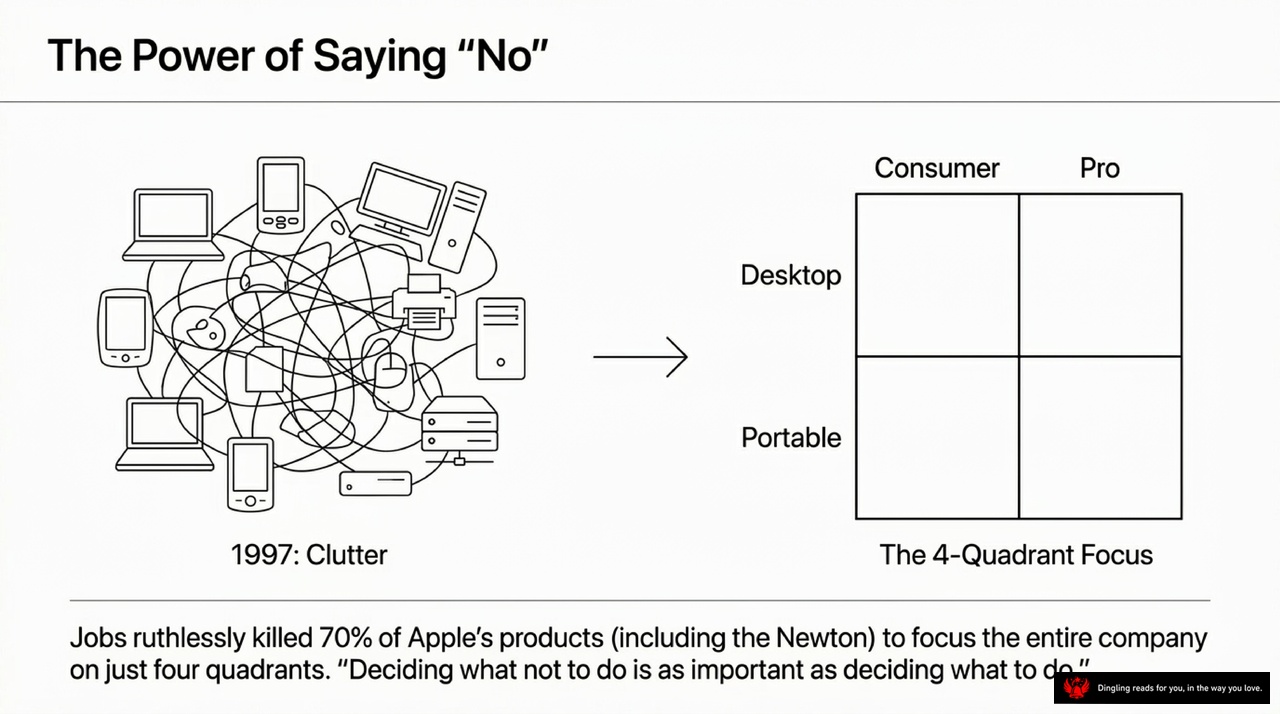
Look at this slide. On the left, we see 1997: Clutter—a chaotic mess of tangled wires and disconnected devices. On the right, we see The 4-Quadrant Focus: a clean, simple matrix dividing products into Consumer, Pro, Desktop, and Portable categories.
This visual perfectly captures Steve Jobs' most radical act of leadership: the power of saying "No."
In 1997, Apple was drowning in confusion. They had launched too many products, none of which were truly great. Jobs knew that trying to do everything meant doing nothing well. So, he made a ruthless decision. He cut 70% of Apple's product lines, including beloved but failing projects like the Newton.
His goal was to strip away the noise and focus entirely on four specific quadrants. He wanted to create one killer consumer desktop, one killer pro desktop, one killer consumer portable, and one killer pro portable. By deciding what *not* to do, he cleared the path for what he *would* do.
This philosophy of extreme focus is what saved Apple from bankruptcy and set the stage for the iMac, the PowerBook, and eventually, the iPhone. As Jobs famously said, "Deciding what not to do is as important as deciding what to do." It wasn't just about cutting products; it was about freeing up the company's soul to create something truly revolutionary.
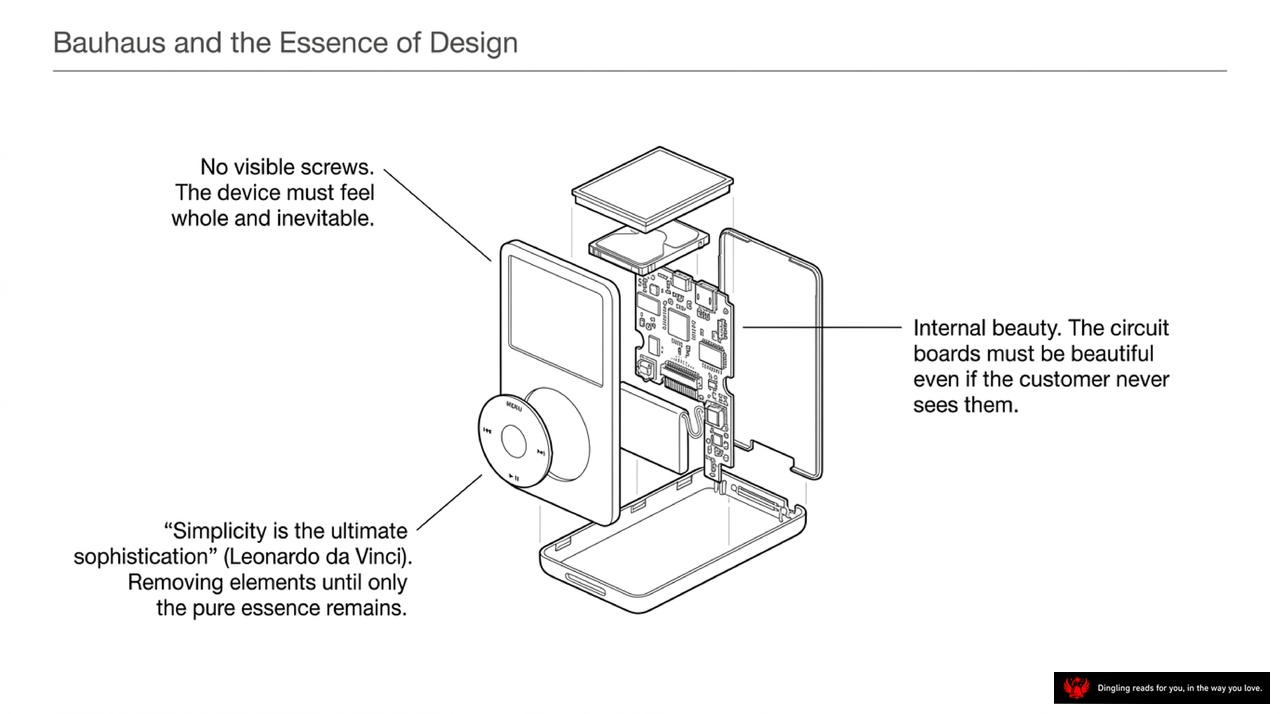
Look at this exploded view of the iPod. It's not just a gadget; it's a masterpiece of design philosophy. Notice the text pointing to the internal components: "Internal beauty. The circuit boards must be beautiful even if the customer never sees them." This captures the Bauhaus spirit perfectly—beauty isn't just on the surface; it's inherent in the function.
Then look at the exterior notes. "No visible screws. The device must feel whole and inevitable." This is about removing the unnecessary until only the pure essence remains. It echoes Leonardo da Vinci's famous quote found right here: "Simplicity is the ultimate sophistication."
Steve Jobs didn't just build a music player; he applied a rigorous design standard where every hidden part had to be as elegant as the visible ones. By stripping away visible screws and focusing on a seamless, unified form, he created a device that felt inevitable. It wasn't just a tool to hold music; it was an object of desire because it was so perfectly simple. This dedication to "internal beauty" and external simplicity is exactly what defined the Apple aesthetic and changed how we think about technology forever.
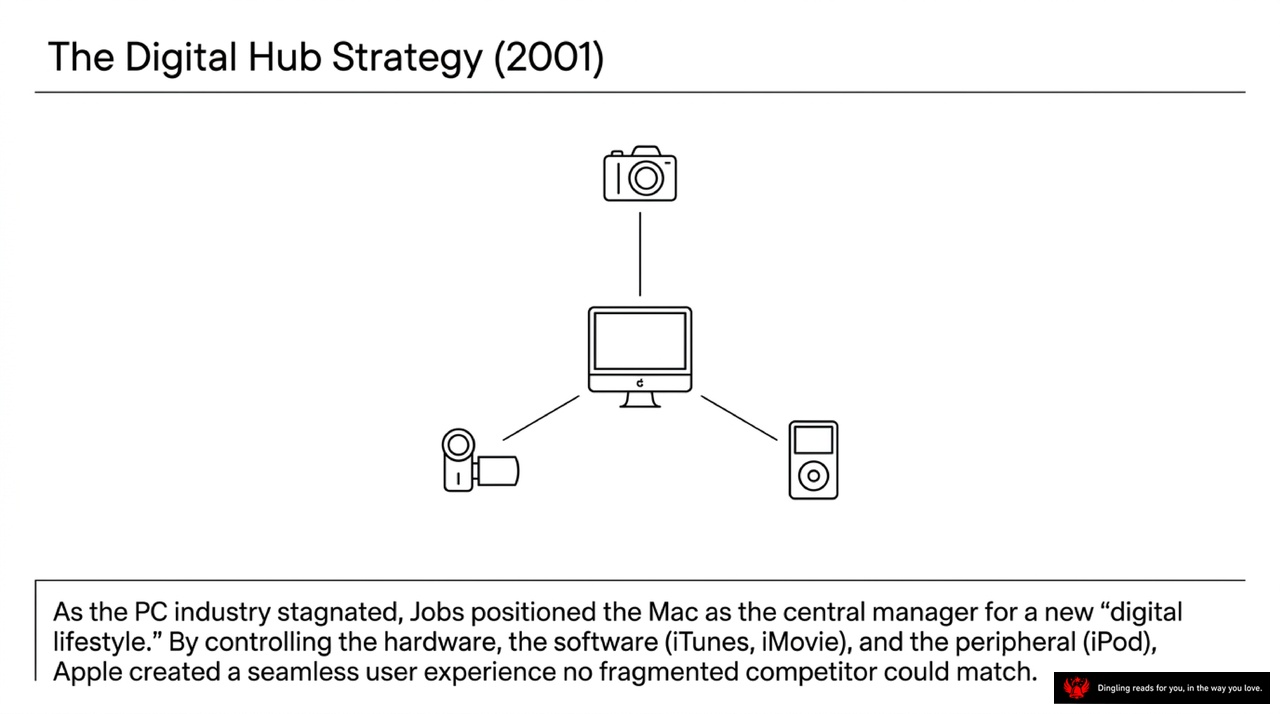
In 2001, Steve Jobs introduced a bold vision that would redefine how we live with technology: The Digital Hub Strategy. As shown in this diagram, the Mac computer isn't just a standalone device anymore; it becomes the central manager for your entire digital life. At the top, you have your camera; to the side, your video camera; and connected seamlessly is your iPod. The genius of this approach was that Apple controlled every piece of the puzzle—the hardware, the software like iTunes and iMovie, and the peripherals. This created a flawless, integrated experience that fragmented competitors simply couldn't match. By positioning the Mac as the hub that organizes your music, photos, and videos across all your devices, Apple transformed from a computer company into a lifestyle brand, making technology feel effortless and personal for the first time.
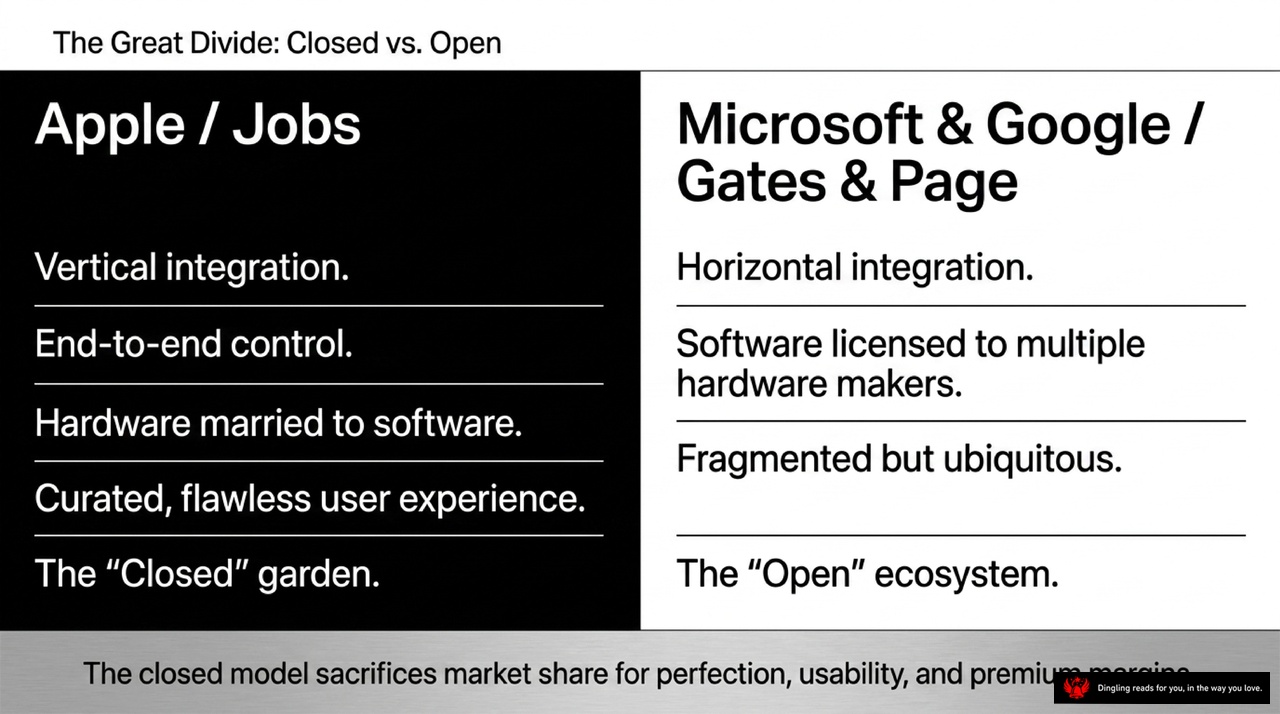
The slide in front of us clearly illustrates the fundamental philosophical divide that has shaped the entire tech industry: The Great Divide between Closed and Open. On the left, we see the path of Apple and Steve Jobs, defined by vertical integration and end-to-end control. This is the model of a "closed garden," where hardware is married to software to create a curated, flawless user experience. It's a strategy that prioritizes perfection and premium margins over sheer market share.
On the right, we see the approach of Microsoft and Google, led by Gates and Page, which relies on horizontal integration. Here, software is licensed to multiple hardware makers, creating a fragmented but ubiquitous ecosystem. While this open model sacrifices the tight control Jobs cherished, it achieves massive scale and reach.
This visual contrast captures the core tension of our story. Throughout his career, Steve Jobs was obsessed with this "closed" model because he believed that only by controlling every layer of the stack could he deliver the true, seamless experience users deserved. He famously clashed with Bill Gates over this very issue, arguing that while Windows might dominate the market, it was ultimately a "trifling product" compared to Apple's integrated perfection. This divide wasn't just about business strategy; it was a battle of philosophies regarding what it means to truly serve the user.
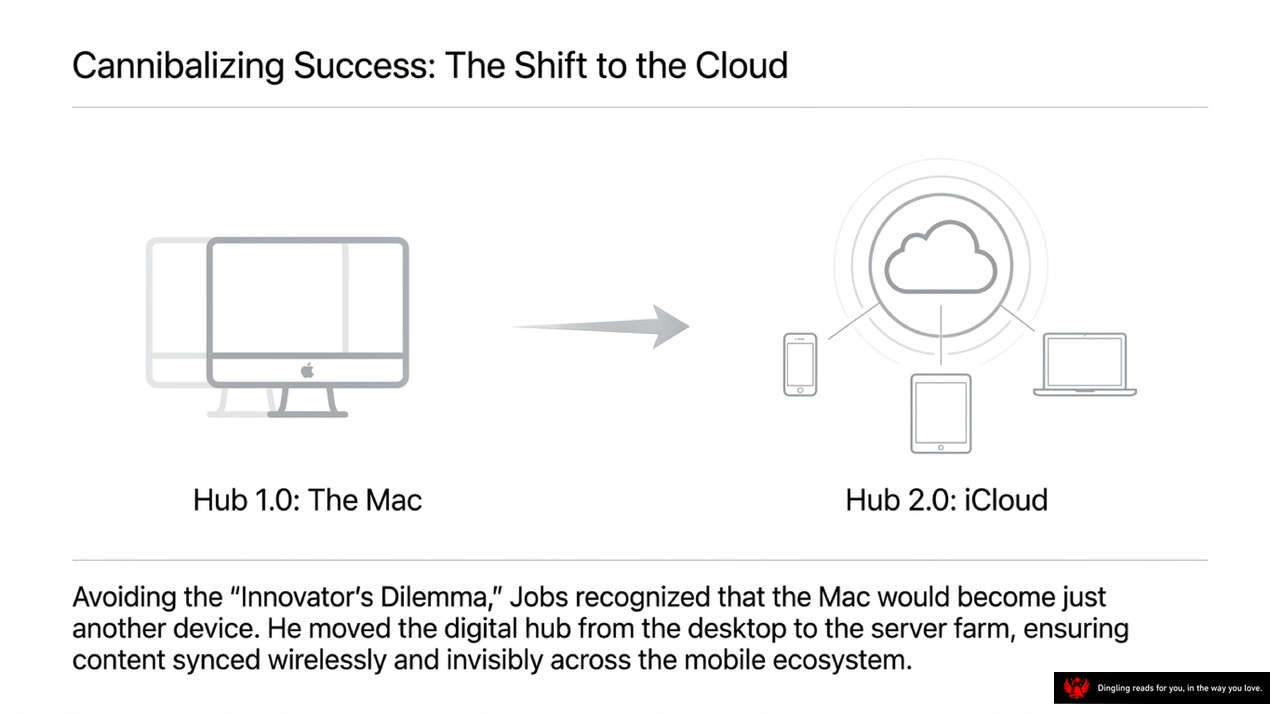
Hub 1.0 was the Mac, the undisputed digital hub of the early days. But as the mobile ecosystem exploded, clinging to a single desktop device became a trap. Steve Jobs recognized that the Mac would eventually become just another device in a crowded market. To avoid the "Innovator's Dilemma," he made a radical decision: he moved the digital hub from the desktop to the server farm. This shift birthed Hub 2.0, iCloud. By ensuring content synced wirelessly and invisibly across the mobile ecosystem, Apple didn't just protect its success; it redefined it. Instead of fighting for one device, Apple conquered the entire cloud, turning every screen into a seamless extension of the user's life.
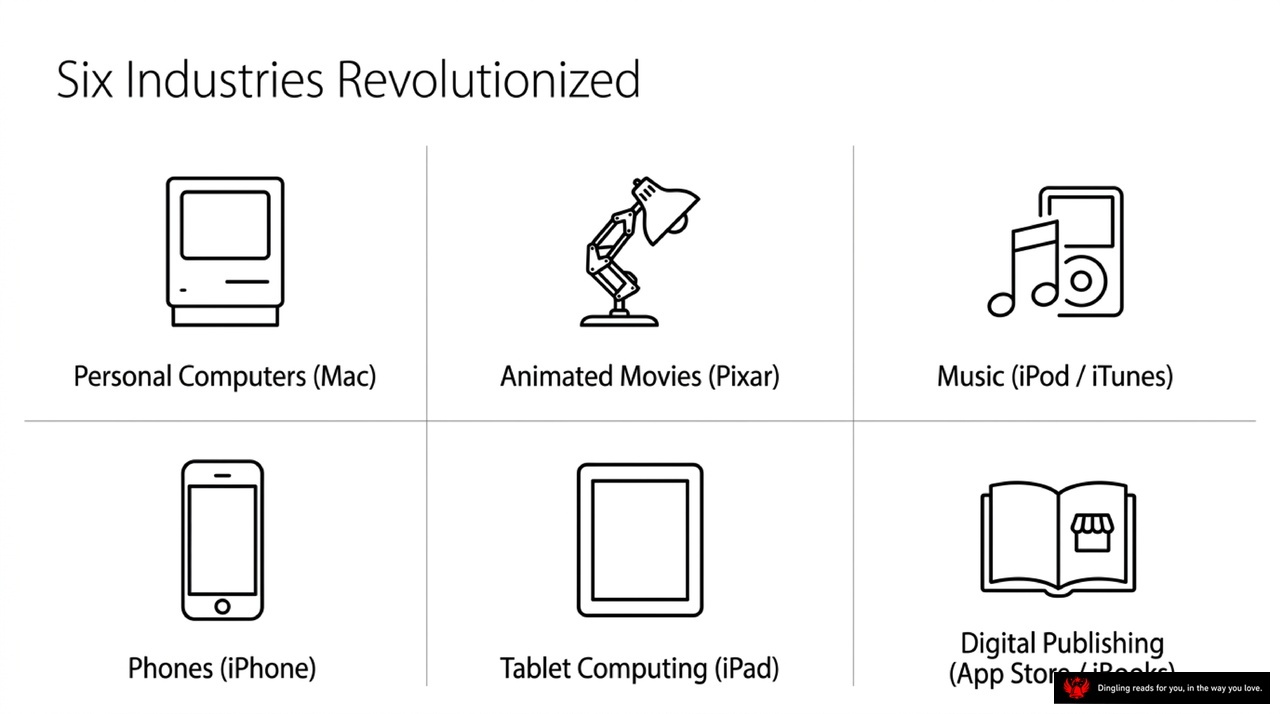
Imagine a world where the rules of business are completely rewritten overnight. This is the story of Steve Jobs, and his legacy is written in six industries that were revolutionized by his relentless pursuit of perfection. Look at the grid before us: it's not just a list of products; it's a map of a digital revolution.
First, we see the Personal Computer with the Mac. Before Jobs, computers were clunky machines for experts. He transformed them into tools of creativity and joy, making them accessible to everyone. Then, there's Animated Movies with Pixar. Jobs saw that technology could serve art, turning computer graphics into a medium for storytelling that moved millions of hearts.
Next, Music with the iPod and iTunes. He didn't just sell a player; he dismantled the entire music industry, turning a decade-long struggle with piracy into a thriving legal marketplace. One device, one store, and the world changed forever.
Then came the Phones with the iPhone. It wasn't just a phone; it was a pocket-sized computer that connected us to everything. It redefined communication, photography, and how we live our daily lives. Alongside that, Tablet Computing with the iPad. This device bridged the gap between a phone and a laptop, creating a new category of productivity and entertainment that we now take for granted.
Finally, Digital Publishing with the App Store and iBooks. Jobs democratized information, allowing anyone to be a creator and giving readers instant access to a universe of knowledge. From the garage to the global stage, these six industries prove that when you combine technology with human desire, you don't just build products; you change the world.

Steve Jobs didn't invent the computer, the MP3 player, or the smartphone. Instead, he fused the humanities with science, obsessing over simplicity and end-to-end control to create magical, integrated experiences that fundamentally changed how humanity interacts with technology. In a world obsessed with adding endless features and open complexities, do you have the courage to say "no" to a thousand things to achieve one moment of perfect simplicity? This is the core of his legacy. While others chased more, Jobs chased less, stripping away the unnecessary until only the essential remained. It wasn't about having the most options; it was about creating a seamless, intuitive experience where technology disappears, leaving only the magic. In an era of clutter and confusion, his genius lay in the radical act of subtraction, proving that true innovation often comes from knowing exactly what not to build.