
Strangers at the Gate: Complete Chapter-by-Chapter Summary
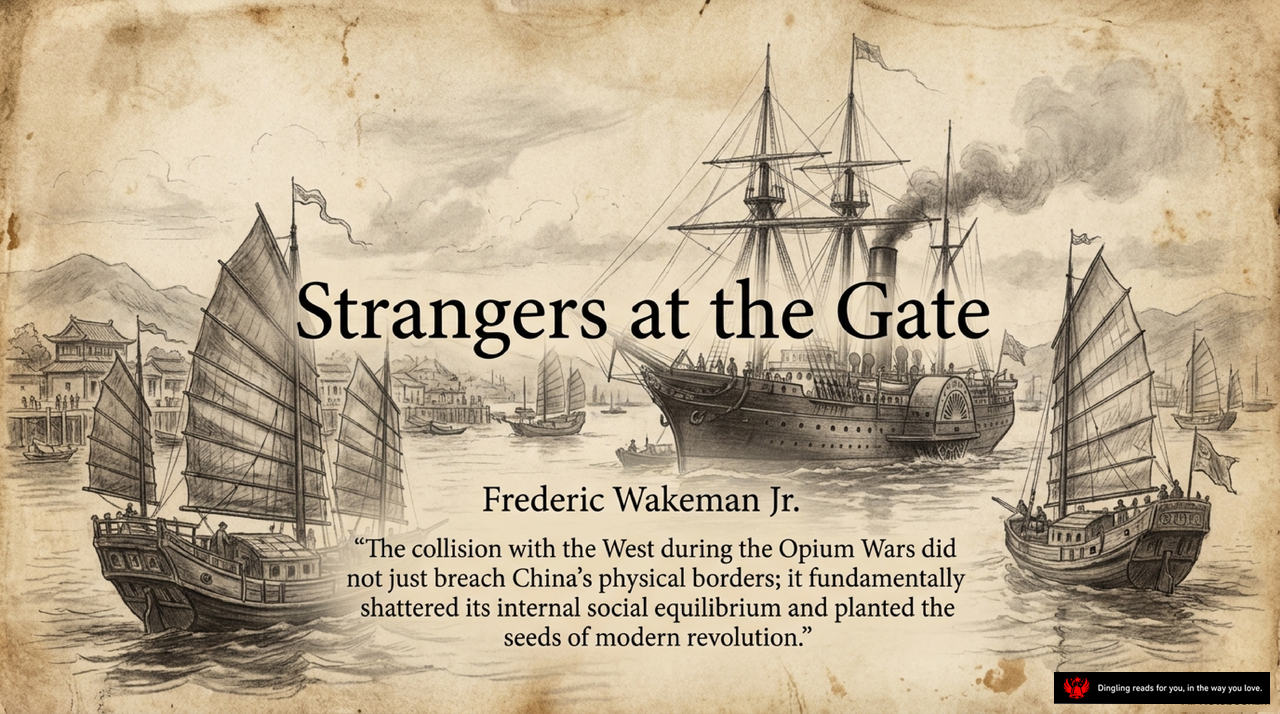
Ever wonder how a single clash can ripple through a nation’s soul? Frederic Wakeman Jr.’s *Strangers at the Gate* explores just that. The Opium Wars weren’t just about broken borders—Wakeman argues they tore at China’s social core, upending centuries-old balance and sowing seeds for modern revolution. This book dives into how those early Western encounters didn’t just change maps; they reshaped the very path of China’s future. Let’s unpack this eye-opening look at a pivotal moment in history.
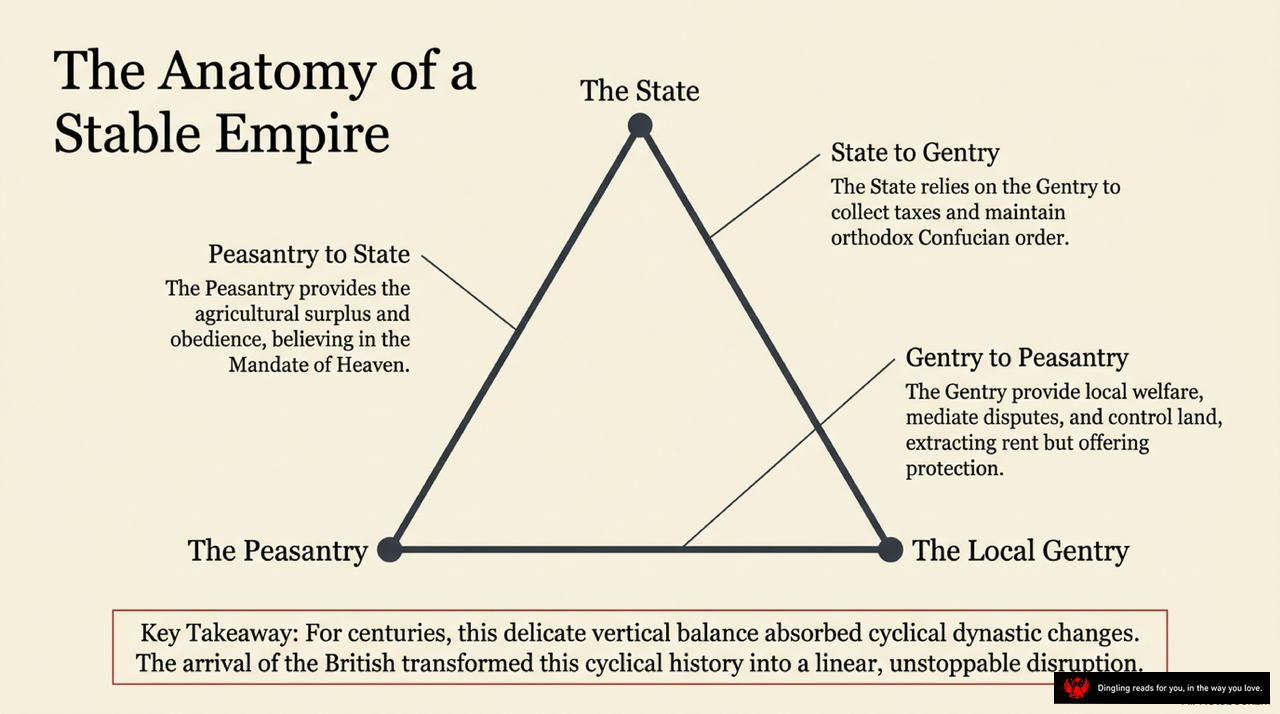
Let’s dive into the tricky balance between Qing officials and local gentry in 19th-century China—it was like a seesaw, always teetering. The court had way too few officials to run such a big country, so they relied on gentry (educated landowners) to handle taxes, keep order, and fix roads. But they were always scared the gentry would get too powerful.
Then opium crashed the party. What started as a medicinal herb turned into a national crisis: by 1838, 40,000 chests of opium flooded in every year, draining silver from China. Prices shot up, farmers couldn’t pay taxes, and the court’s money dried up. Two groups fought over what to do: some wanted to legalize opium (trade it for goods instead of silver), others called it a poison that had to be banned. The emperor picked the ban side and sent Lin Zexu to Guangzhou to clean things up.
Lin didn’t just arrest dealers—he shook up the old neighborhood watch system (baojia). He let gentry lead local groups to check households, catch opium users, and even organize militias. At first, this worked: opium trade dropped. But it also gave gentry control over local military and money.
When the Opium War broke out, the Qing army was a mess. So officials leaned even harder on gentry-led militias. Some gentry donated a fortune—like Chen Beiyuan from Dongguan who gave 70,000 taels. Others ran their own militias without official permission.
Lin’s plan to save the dynasty backfired: the gentry now had power they wouldn’t give up. The old balance where officials called the shots? Gone. Now gentry could ignore orders, raise armies, and control local resources. This shift laid the groundwork for local warlords later on.
It’s a perfect example of unintended consequences: a policy to fix one problem created a bigger one. The gentry’s rise changed China forever.
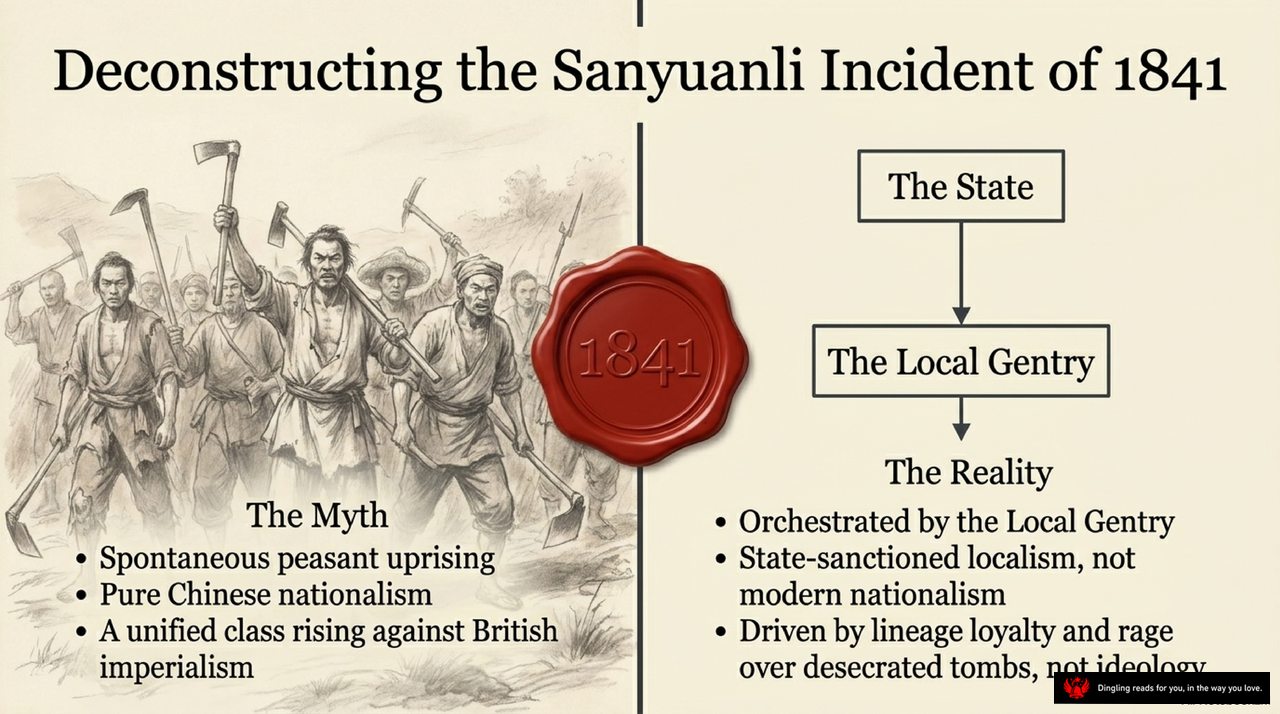
Let’s dive into the Sanyuanli Incident of 1841—because the story we often hear is a myth, and the truth behind it reveals so much about power and community in 19th-century China.
First, the myth: For decades, this was framed as a classic underdog tale—spontaneous peasant uprising, ordinary farmers uniting out of pure Chinese nationalism to fight British imperialism. It sounds like a David vs. Goliath story, right? But let’s set the record straight.
The reality? This wasn’t a peasant-led movement at all. It was orchestrated by the local gentry—educated, landowning elites with social clout, like He Yucheng, a scholar who’d passed the imperial exams. These were the guys who could rally villages, organize militias, and make things happen.
What really sparked the anger? It wasn’t abstract ideology. British soldiers had desecrated local tombs (a massive insult to Chinese ancestral worship) and assaulted women in the area. Villagers were furious about these attacks on their family honor and way of life—this was about protecting their home, their lineage, not a modern nation-state.
And here’s another key point: The Qing state actually backed this localism. Officials knew their own troops were weak, so they let the gentry take charge of the local militia (called tuanlian). But this wasn’t modern nationalism—it was state-sanctioned community defense, rooted in clan loyalty and traditional values, not a unified national identity.
So next time you hear the Sanyuanli story, remember: The myth is inspiring, but the reality tells us how local pride, elite leadership, and cultural values shaped one of China’s most famous anti-foreign events. It’s not just about fighting imperialism—it’s about a community standing up for what matters most to them.
Today we’re diving into how imperial China outsourced its defense to local elites—and the seismic shifts that followed.
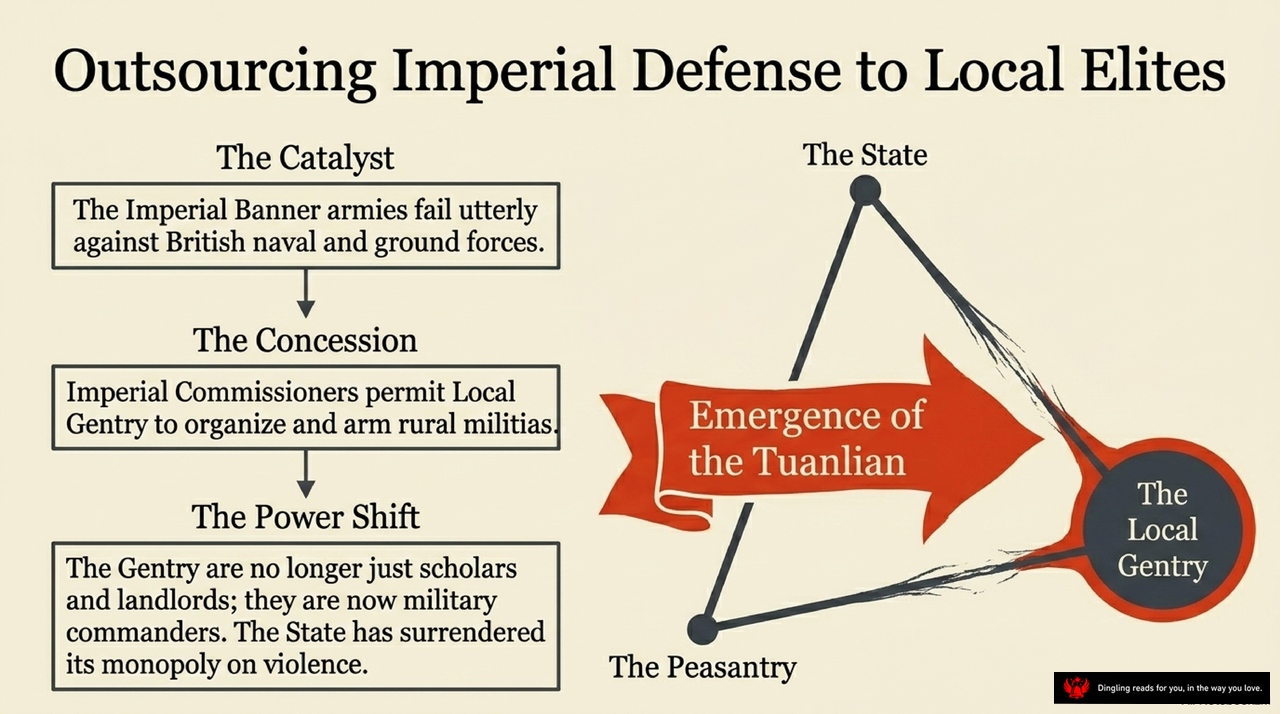
First, the catalyst: The Qing Dynasty’s official Banner armies were no match for British naval and ground forces during the Opium Wars. They failed completely, leaving the empire exposed and scrambling for solutions.
The response? A critical concession: Imperial commissioners allowed local gentry—wealthy landowners and educated scholars—to organize and arm rural militias called Tuanlian. These weren’t just ragtag groups; they were structured, community-based forces led by the gentry.
This triggered a massive power shift. The gentry weren’t just landlords or scholars anymore—they became military commanders. The state surrendered its monopoly on violence; now local elites held the guns, the men, and the authority to defend (or control) their regions.
Look at the triangle here: The state, local gentry, and peasantry. The gentry mobilized peasants into these militias, creating a force that bridged the gap between the government and ordinary people. But this also meant the gentry now wielded real power—power that sometimes clashed with the emperor’s wishes.
This shift wasn’t just about defense. It set the stage for later resistance movements, like Guangzhou’s fight against British attempts to enter the city. The Tuanlian militias became the front line of that struggle, showing how local elites could shape the empire’s fate when the central government fell short.
In short, outsourcing defense to local elites changed everything—from who held power in the countryside to how China would resist foreign influence in the decades to come.
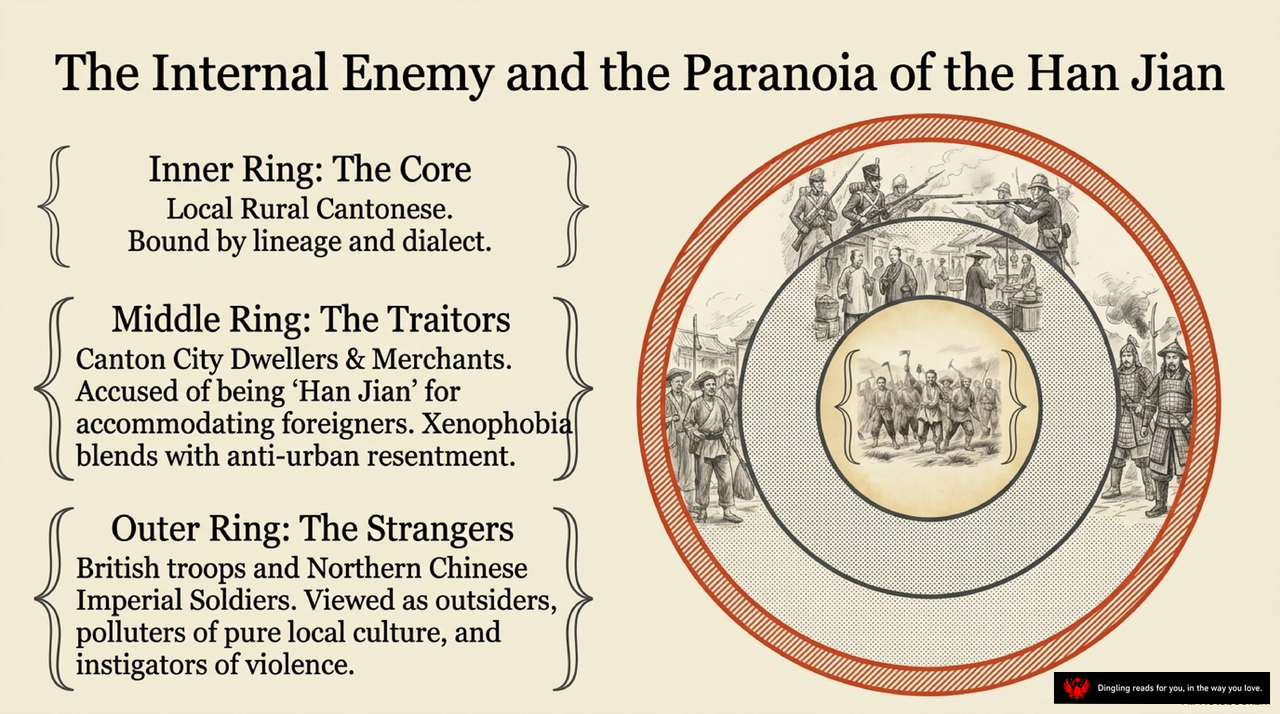
Let’s take a close look at this circular diagram—it’s a vivid map of the social fault lines in 19th-century Guangdong, right in the middle of the Opium Wars and their chaotic aftermath.
Starting with the Inner Ring: Local Rural Cantonese. These were the backbone of the region’s traditional society, tied tight by strong family lineage and shared dialect. Think of villages where everyone knew each other, where clans ran everything from land management to local defense. Their world was deeply rooted in tradition, and they relied on their tight-knit communities for survival and security.
Next, the Middle Ring: Canton City Dwellers and Merchants. This group found themselves in a precarious spot. They had to do business with foreigners—trading goods, working as intermediaries—but this made rural Cantonese brand them “Han Jian” (traitors). It wasn’t just xenophobia driving this label; there was sharp anti-urban resentment too. The countryside saw the city as a place where people threw away traditional values to cozy up to the enemy. During the Opium War, for example, rural团练 often accused city merchants of colluding with the British, leading to tensions that sometimes turned violent.
Then the Outer Ring: British troops and Northern Chinese Imperial Soldiers. To rural Cantonese, both were unwelcome strangers. The British were invaders—they burned villages, seized land, and were seen as polluting the pure local culture. Northern soldiers, even though they were part of the Qing army, were viewed as outsiders too. Cantonese had a strong regional identity; Northerners spoke different dialects, followed different customs, and were often seen as just another force disrupting their way of life.
These divisions weren’t abstract lines on a page. They played out in real events, like the三元里 uprising where rural villagers banded together to fight British troops, or the way city merchants were targeted by local mobs. It’s a snapshot of how fear, tradition, and regional pride collided in a time of immense upheaval.
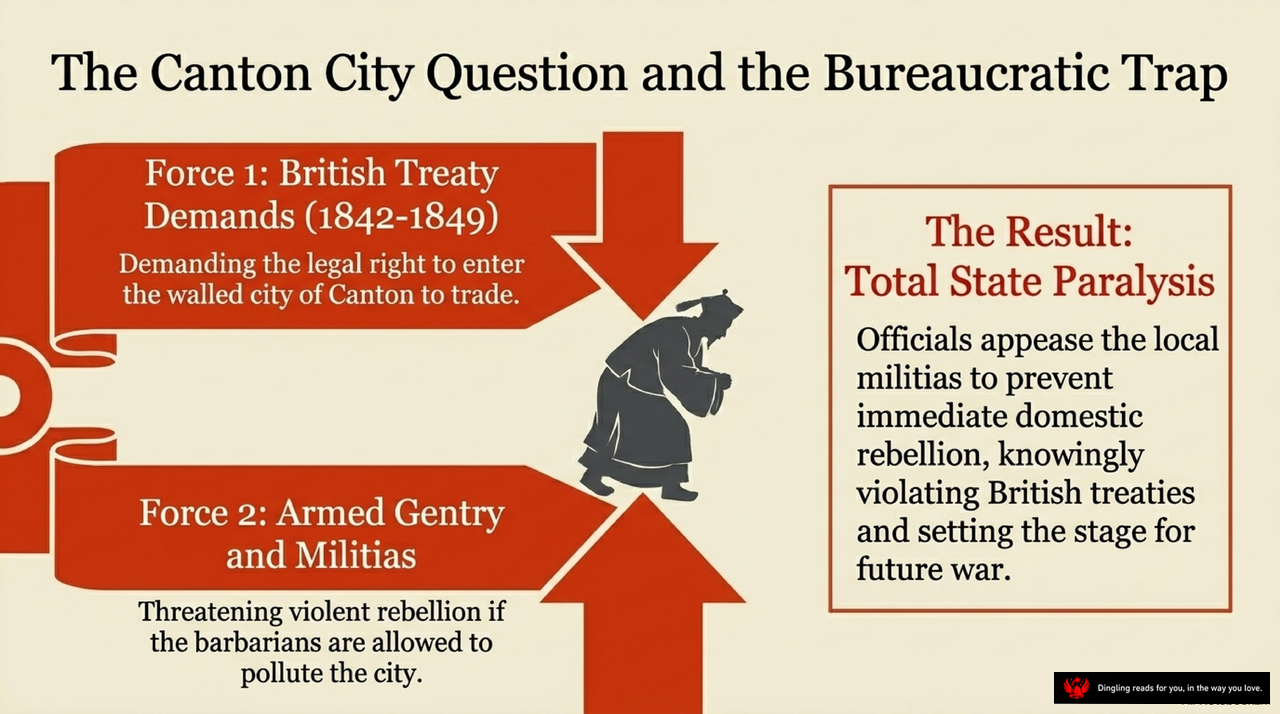
Let’s dive into the Canton City Question and the bureaucratic trap that left officials completely stuck. After the Opium War, Canton’s leaders found themselves caught between two unyielding forces—no matter which way they turned, disaster loomed.
First up: the British treaty demands from 1842 to 1849. They insisted on their legal right to enter the walled city of Canton to trade, citing the Nanjing Treaty. For years, they’d been confined to the foreign quarter outside the walls, and they were fed up with being kept at arm’s length.
Then there was the second force: the armed gentry and militias. These weren’t just random groups—they were organized by local community leaders, with deep roots in the region. They viewed foreigners as “barbarians” who would pollute their city, and they made it clear: let the British in, and we’ll rebel. Think about the 1846 riot—when a local official tried to talk about letting Brits enter, the crowd burned his office and chased him out of town.
So what’s an official to do? They were paralyzed. If they caved to the British, domestic rebellion was guaranteed. If they stood with the locals, they’d break the treaty and risk another war. Their choice? Appease the militias to stop immediate chaos. But that meant knowingly violating British agreements, which only built up resentment. This short-sighted move didn’t solve anything—it just set the stage for future conflict, like the Second Opium War down the line. That’s the bureaucratic trap in action: no good options, only bad ones.
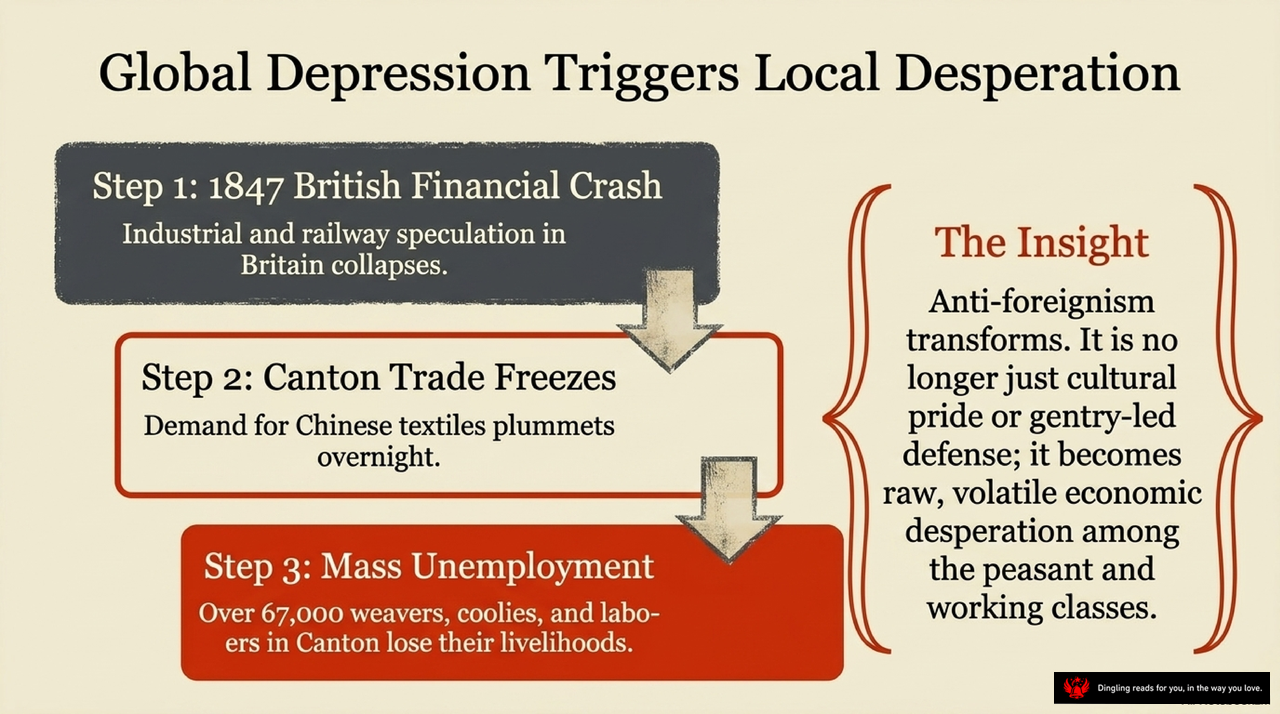
Let’s dive into how a global economic crisis set off a chain reaction of despair in Canton. Back in 1847, Britain faced a massive financial crash—years of wild speculation in industry and railways finally collapsed, leaving banks and businesses reeling. This wasn’t just a British problem; Canton’s economy was deeply intertwined with global trade, especially with Britain.
The crash hit Canton like a tidal wave. Demand for Chinese textiles—silk and cotton goods the region was famous for—plummeted overnight. British merchants who once ordered shiploads of these products suddenly stopped. Factories closed, workshops shut their doors, and the flow of work dried up.
The result? Over 67,000 weavers, coolies, and laborers in Canton lost their livelihoods. These weren’t just numbers—they were people with families to feed, rent to pay, and no safety net. Imagine working your whole life at a loom, then one day there’s no thread to weave, no pay to take home. That’s the kind of raw, volatile desperation that takes hold when survival is on the line.
Here’s the critical shift: the anti-foreign sentiment in the area wasn’t just about cultural pride or gentry-led defense anymore. This was personal. It was economic survival. People who’d lost everything looked for someone to blame, and the foreign traders tied to that broken supply chain became the target. What started as a distant financial crash in London ended up fueling local anger that would shape the region’s history for decades. This wasn’t just a trade issue—it was a human crisis, laying the groundwork for the social unrest that would follow.
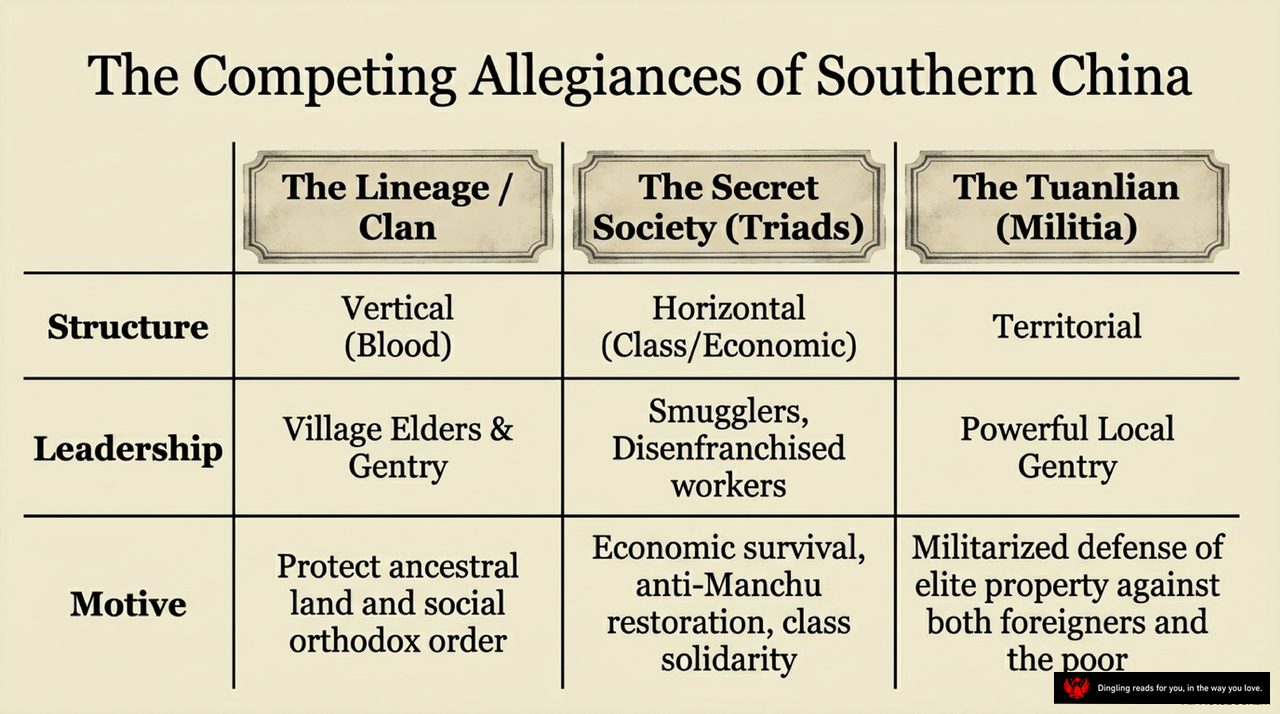
Let’s dive into the three key competing allegiances that defined life in Southern China in the 19th century. First up: the Lineage or Clan system—this was a vertical structure built on blood ties. Village elders and local gentry held all the power here, and their top priority was safeguarding their ancestral land and upholding the traditional social order. Clans were major landowners; they used rent from communal fields to fund education, help the poor, and even pay for clan festivals. But beneath the surface, this system sowed class tension—rent often came from poor clan members or tenants, creating rifts that would later erupt.
Next, the Secret Societies, most famously the Triads. These were horizontal networks united by shared economic struggles or class identity. Smugglers, disenfranchised workers, and anyone marginalized by the establishment flocked to these groups. Their motives mixed survival (many members were just trying to get by) with fierce anti-Manchu sentiment and strong class solidarity. No central leadership meant they were hard to organize for big actions but nearly impossible to wipe out entirely.
Then there’s the Tuanlian, or Militia. This territorial force was led by powerful local gentry. Their main job? Militarized defense of the elite’s property—whether fending off foreign invaders during the Opium Wars or putting down uprisings by the poor. They acted like the wealthy’s private army, using weapons and organized tactics to protect their interests.
All three groups clashed and coexisted, each vying for influence. Their interactions shaped everything from local politics to how Southern China responded to the era’s upheavals—making this period one of the region’s most dynamic and turbulent.
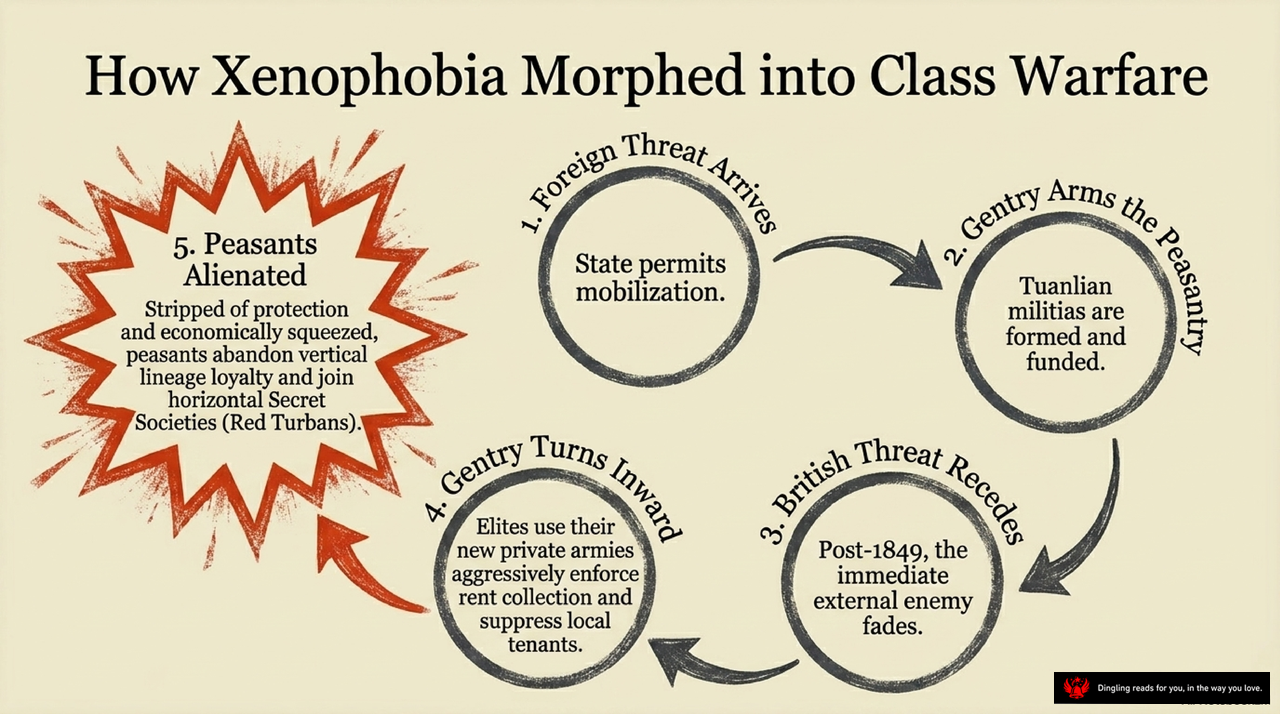
Let’s break down how fear of foreigners—xenophobia—twisted into a fight between social classes. Here’s the cycle we’re unpacking today:
First, when a foreign threat arrived (like the British in the 1840s), the state gave the green light for people to mobilize. That’s step one: the external danger spurred official permission to organize.
Next, local elites—called the gentry—stepped up to arm and fund peasant militias known as tuanlian. These groups were supposed to band together against the common enemy. Makes sense, right? Uniting to defend their homes from outsiders.
But by 1849, the immediate British threat faded. Now, the gentry didn’t disband those militias—they turned them inward. Step four: they used these private armies to aggressively collect rent from peasants and suppress anyone who pushed back. The same forces that once protected the community were now tools of exploitation.
Finally, peasants were left alienated. Stripped of protection, squeezed economically, they couldn’t rely on their traditional family loyalties anymore. So they abandoned those old ties and joined secret societies like the Red Turbans—groups that offered belonging and a way to fight back against the elites who’d turned on them.
It’s a stark example: a shared enemy brings people together, but when that enemy is gone, the cracks between haves and have-nots blow wide open. What started as a fight against foreigners ended up being a war between neighbors.
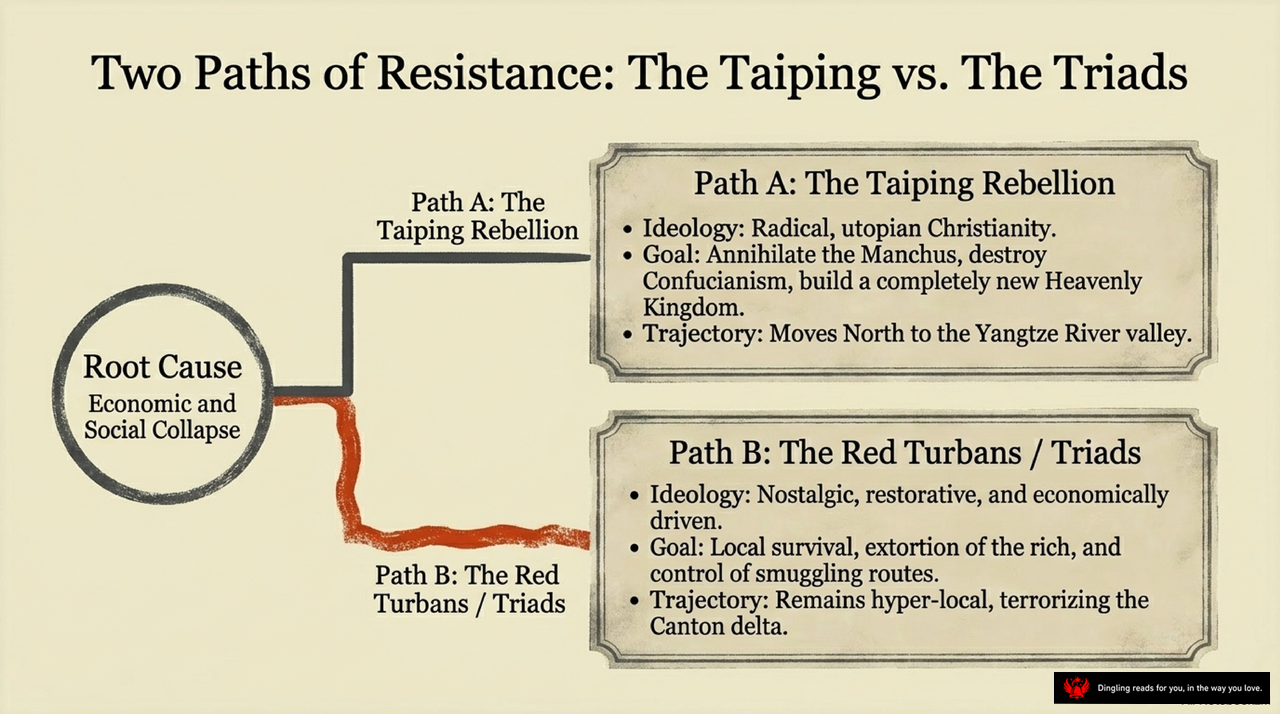
Let’s dive into this slide—because it’s all about how people react when the world around them falls apart. The root cause here? Economic and social collapse. Picture post-opium war China: jobs vanished, crops failed, the old order was crumbling. When systems break, people resist—but not all resistance looks the same. That’s why we see two distinct paths: the Taiping Rebellion and the Red Turbans (also known as Triads).
First up, Path A: The Taiping Rebellion. These folks had a bold, almost revolutionary vision. They mixed radical, utopian Christianity with their own dreams of a perfect society. Their goals? Annihilate the Manchu rulers who they blamed for the chaos, destroy Confucianism (which they saw as a tool of the old, corrupt system), and build a completely new Heavenly Kingdom. And they didn’t just talk—they acted, moving north all the way to the Yangtze River valley to spread their message and gain power.
Then there’s Path B: The Red Turbans or Triads. Their approach was way more grounded in the here and now. They were nostalgic, wanting to hold onto or restore the old ways they knew. Their main focus? Local survival. They extorted the rich to get by, controlled smuggling routes to make money, and stayed hyper-local—sticking close to the Canton delta instead of marching off to conquer new lands. For them, it wasn’t about building a grand new kingdom; it was about keeping their communities alive in the middle of chaos.
So you’ve got two sides of the same coin: one reaching for a big, new future, the other clinging to the familiar to survive. Both are responses to the same collapse—but they couldn’t be more different in how they chose to fight back.
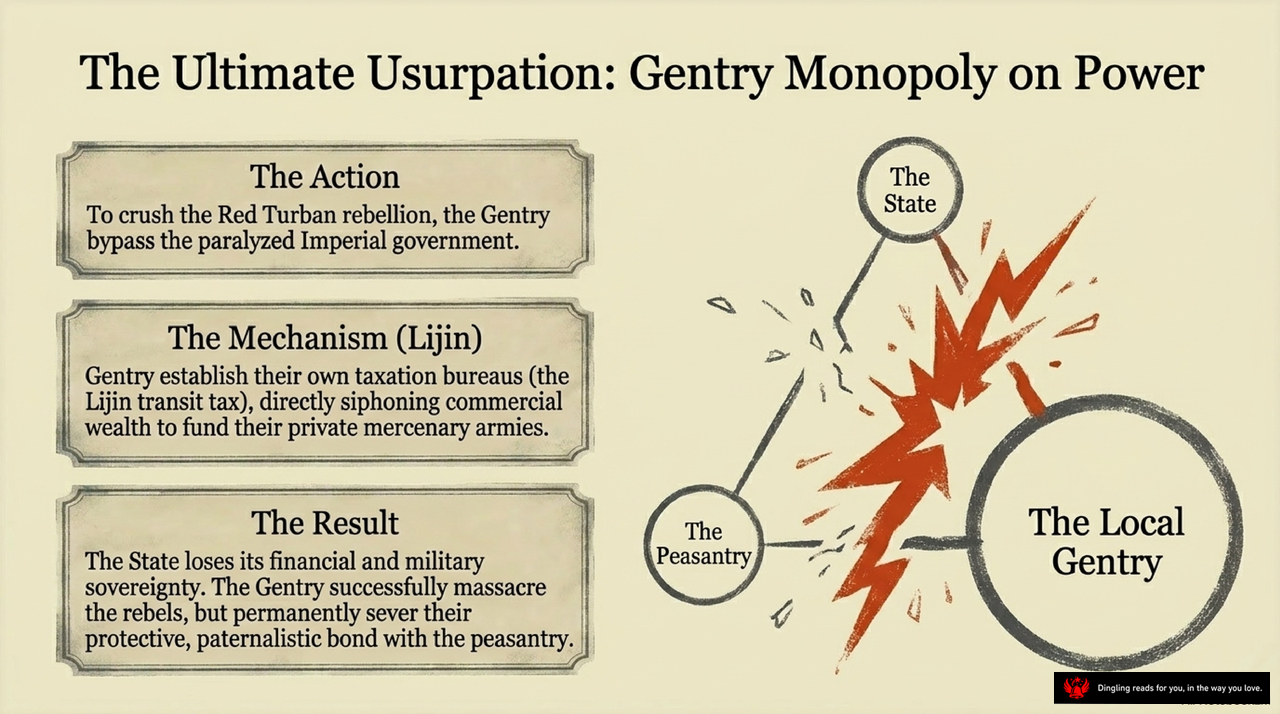
Let’s dive into "The Ultimate Usurpation: Gentry Monopoly on Power" here. Imagine the mid-1800s: the Red Turban rebellion is sweeping through parts of China, and the imperial government is completely paralyzed—they can’t mobilize to stop the rebels. So who takes charge? The local gentry, the wealthy landowning and educated class. But they don’t just assist the government; they cut right around it. That’s "The Action" we’re looking at: bypassing the powerless imperial authorities to crush the rebellion.
Now, how do they fund their private mercenary armies? They create their own tax system called Lijin—a transit tax on goods moving through their regions. Instead of sending that money to the imperial treasury, they siphon it directly to pay their soldiers. That’s the mechanism: grabbing commercial wealth to build their own power base.
What’s the outcome? The imperial state loses two critical things: its financial control (since the gentry are hoarding the tax money) and its military sovereignty (since the gentry now have their own armies). Sure, the gentry did defeat the Red Turban rebels, but there’s a heavy cost—they permanently severed that old protective, paternalistic bond with the peasants. The peasants used to rely on the gentry for safety and guidance, but now the gentry were just using taxes and force to hold onto power, not to care for the people.
Look at the diagram: the local gentry ends up clashing with both the state (which lost its grip) and the peasants (who lost their old safety net). This shift from central to local power changed China’s trajectory in ways that would echo for decades. It’s a classic case of elites seizing power when the central government fails, and the ripple effects would shape the country’s future conflicts and reforms.
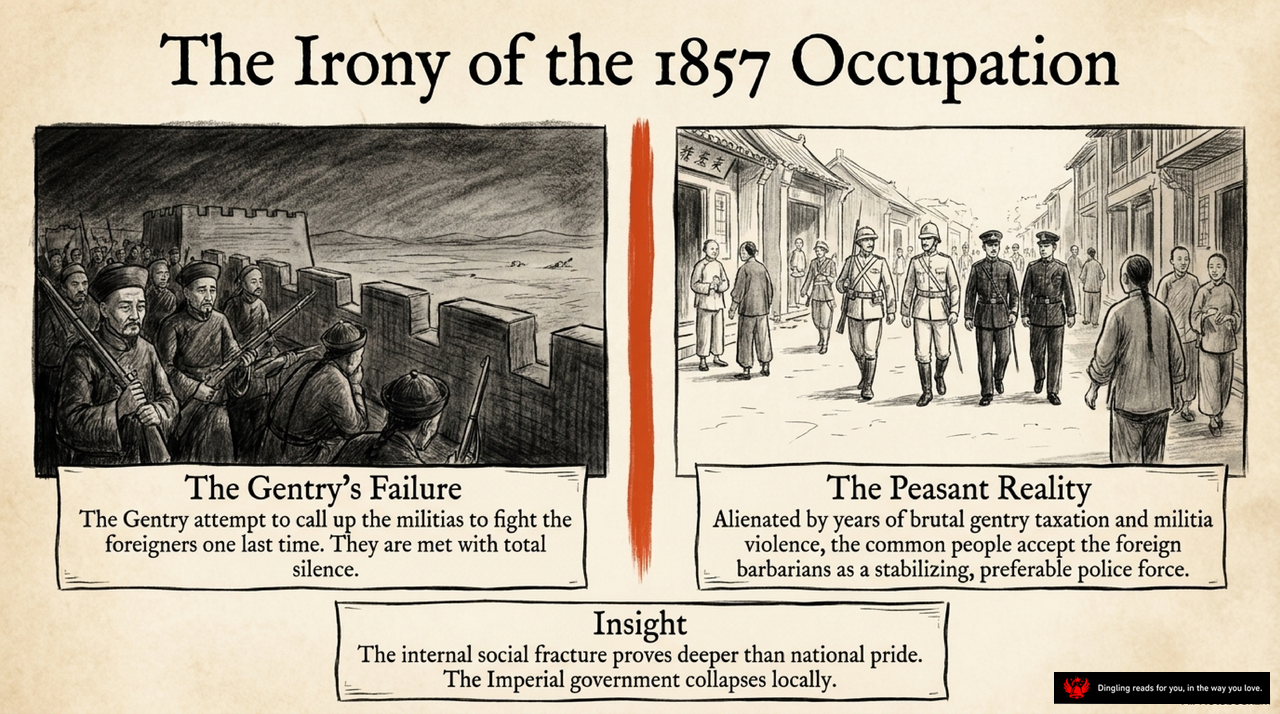
Let’s dive into the irony of the 1857 occupation of Guangzhou. You might assume that when foreign troops rolled in, the local gentry—those wealthy, educated elites—would band together to defend their city. But here’s the twist: when they tried to call up their militias one last time to fight the foreigners, they were met with total silence. No one showed up. Why? Because those militias had long been tools of the gentry’s oppression. For years, they’d imposed brutal taxes on peasants, used violence to keep people in line, and drained the local economy for the elites’ benefit. The people had had enough.
Now, look at the peasant reality. The common folks were so alienated by the gentry’s abuse that they actually accepted the foreign “barbarians” as a preferable, stabilizing police force. The foreigners did things the local government never bothered to: they ended the cruel “hunting boy” slave trade, where young boys were kidnapped and sold as labor. They canceled the unfair 3% tax that corrupt officials squeezed from small shopkeepers. For the first time in ages, ordinary people had a way to resolve disputes without fear of being exploited by the gentry or their thugs.
This leads us to a key insight: the internal social fracture was far deeper than any national pride. The imperial government had already collapsed at the local level. The gentry had lost the people’s trust completely, and the foreigners—for a moment—stepped into the gap. It’s a stark reminder: when those in power fail to serve their own people, even outsiders can become the ones who bring a sense of order.
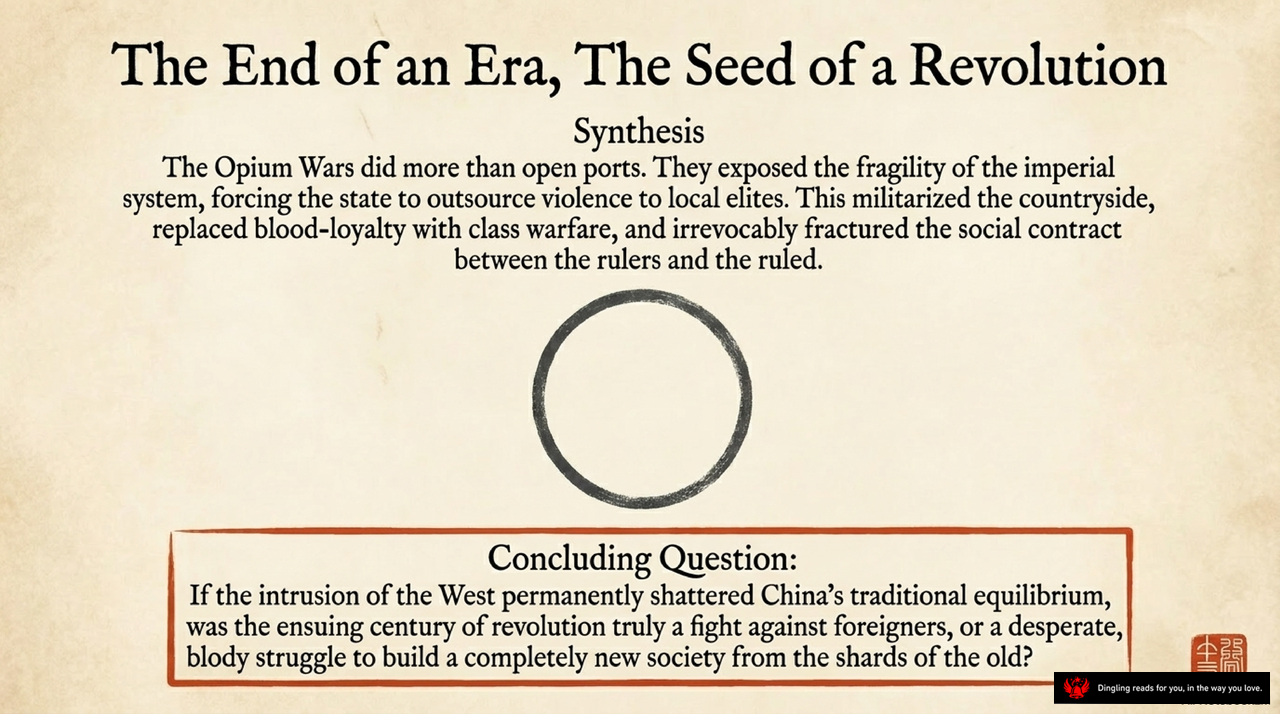
The end of an era, the seed of a revolution—those words capture the earth-shaking change China experienced in the wake of the Opium Wars. These conflicts weren’t just about opening ports or trade disputes; they laid bare the Qing Empire’s profound fragility.
The imperial government couldn’t maintain control on its own. So it turned to local elites—wealthy gentry and clan leaders—to handle violence, letting them raise and command团练 militias. This decision transformed the countryside: it militarized everyday life, replaced age-old blood loyalties (like clan bonds) with simmering class warfare, and shattered the social contract between rulers and the ruled. For centuries, people had trusted the emperor to protect them; now, that trust was gone.
Which brings us to the big question: If the West’s intrusion permanently broke China’s traditional balance, was the century of revolution that followed really a fight against foreign invaders? Or was it a desperate, bloody struggle to build a completely new society from the pieces of the old one?
Think about it: The gentry who once supported the empire now held power of their own. Tenant farmers, tired of exploitation, joined secret societies or rebellions. The old order was gone, but what would replace it? This isn’t just a historical curiosity—it’s about how societies rebuild when their foundations crumble. The choices made in those chaotic decades would define China’s future for generations.