
Strategy and Path: Complete Chapter-by-Chapter Summary

Welcome to the first lesson of our series on China's economic future. Today, we're diving straight into the heart of a transformative vision: "Strategy and Path: Huang Qifan's Twelve Economics Lessons."
Imagine a blueprint that doesn't just predict the next decade, but charts the course for the next 15 years. This isn't about abstract theories; it's a practical guide to understanding how China is decoding its macroeconomic logic, driving deep structural reforms, and positioning itself on the global stage.
As you see on this slide, the core promise is clear: a comprehensive roadmap for China's development. We are moving from a model driven by external demand to one that leverages its own massive internal market while remaining deeply integrated with the world.
This book breaks down the "12 Lessons" that form the backbone of this strategy. It covers everything from the bold "Dual Carbon" goals—aiming for peak emissions by 2030 and carbon neutrality by 2060—to the digital revolution reshaping manufacturing. It also tackles critical issues like the real estate transition, the path to common prosperity, and how China navigates complex geopolitical challenges, including the evolving relationship with the US.
Whether you are an investor, a policy maker, or simply curious about the forces shaping the global economy, these twelve lessons offer the clarity you need to understand the logic behind China's rise. Let's begin by exploring these foundational strategies together.

Imagine a staircase leading to a new era, where each step represents a monumental leap in China's economic destiny. This isn't just a projection; it's a strategic roadmap for the next 15 years.
The first step, taken by 2025, is about crossing the middle-income trap. Once China's per capita GNI exceeds $13,000, it officially enters the ranks of high-income nations. This shift is massive—adding 1.4 billion people to the global high-income demographic effectively doubles the number of wealthy nations worldwide, reshaping the entire global economic landscape.
By 2030, China reaches the second step: The Global Pivot. Here, the economy surges to between $28 and $30 trillion, officially surpassing the United States to become the world's largest economy. This isn't just about GDP; it marks China's return to the top spot after more than 200 years, signaling a historic shift in global power.
The final step, achieved by 2035, sees China become a mid-level developed nation. By this time, the GDP doubles again to roughly $30 trillion, and the average citizen's income reaches between $26,000 and $30,000. This trajectory completes the "Three-Step" strategy 15 years ahead of schedule, laying an unshakable material foundation for national rejuvenation.
This entire journey represents a profound paradigm shift. It transforms China from a manufacturing hub into a global leader in high-value industries, fundamentally altering how the world views economic growth and opportunity.

Today's slide breaks down the "Dual Circulation" strategy into two distinct but interconnected engines: Internal Circulation and External Circulation. Think of this not as a retreat, but as a proactive fortification.
On the left, we have **Internal Circulation**, labeled as "The Core Engine." This is where the real power lies. The strategy focuses on a massive **Consumption Shift**, aiming to elevate citizens' disposable income from just 42% to over 50% of GDP. By boosting spending power, we create a self-sustaining domestic market. Crucially, this engine is built on **Autonomy**. We are prioritizing energy and food self-reliance and securing independent technology supply chains. This ensures that our economy isn't vulnerable to external shocks, effectively decoupling our growth from reliance on volatile global exports.
On the right, we see **External Circulation**, described as "The Global Interface." This isn't about the old model of simply exporting cheap labor and land. Instead, it represents an **Openness Upgrade**. We are transitioning from basic "element-flow openness" to a sophisticated "institutional openness." This means we are now shaping global rules, standards, and free trade agreements on our own terms. We are moving from being a participant in the global system to an architect of it.
The **Key Insight** at the bottom ties it all together: Dual Circulation replaces the outdated export-led model with a robust internal-consumption engine. This strong domestic foundation naturally attracts global capital, creating a powerful gravitational field. It's a strategy that balances self-reliance with global leadership, ensuring that while we open up, we do so from a position of strength and control.

The future of manufacturing isn't about competing on isolated factories; it's about mastering the entire chain. As we look at the global landscape, true leaders are emerging in three distinct tiers. At the very top are the "Chain Leaders"—the ecosystem controllers who master core intellectual property and industry standards, operating with the kind of dominance seen in giants like Apple. Below them are the "Assembly Giants," the conductors capable of orchestrating thousands of upstream and downstream suppliers to execute complex manufacturing. Anchoring the base are the "Hidden Champions," specialized niche B2B companies that monopolize critical component markets, much like the German model where these firms hold a massive 40% global share.
But how do these players win? The answer lies in geography and integration. The winning formula belongs to regions that build vertically integrated industrial clusters within a tight 1-to-3 hour radius. By keeping everything within a 50-to-200 kilometer zone, companies create a fortress that is immune to global supply chain fragmentation. This isn't just about proximity; it's about creating a resilient engine where resources, innovation, and cost-efficiency flow seamlessly, ensuring that the future belongs to those who control the chain, not just the links.

The digital frontier is no longer just about connecting devices; it's about redefining the very fabric of value creation. As we look at the data properties on the left, the contrast is stark. Traditional factors like land and capital are finite and depreciate over time. They are localized and run out. But data? Data is the new factor of production. It is inexhaustible. It doesn't fragment; it grows exponentially. Every time you use a piece of data, it generates more data, creating a self-reinforcing cycle that traditional assets simply cannot match.
Now, look at the "Five-Alls" DNA on the right. This is what makes platforms so powerful. They are pan-spatial, transcending physical geography to operate anywhere. They are continuous, running without temporal interruption. They are pan-social, integrating across every social scenario. But perhaps most importantly, they are value-superimposing. They multiply worth exponentially, and they are intelligent, unlocking insights through AI parsing.
This shift creates the next blue ocean. We are moving capital away from the consumer internet, which is nearing its growth ceiling, and into the industrial internet. This is where the real transformation happens. It's about moving from simply connecting people to connecting industries, where data drives efficiency, innovation, and massive value creation across the entire economy.
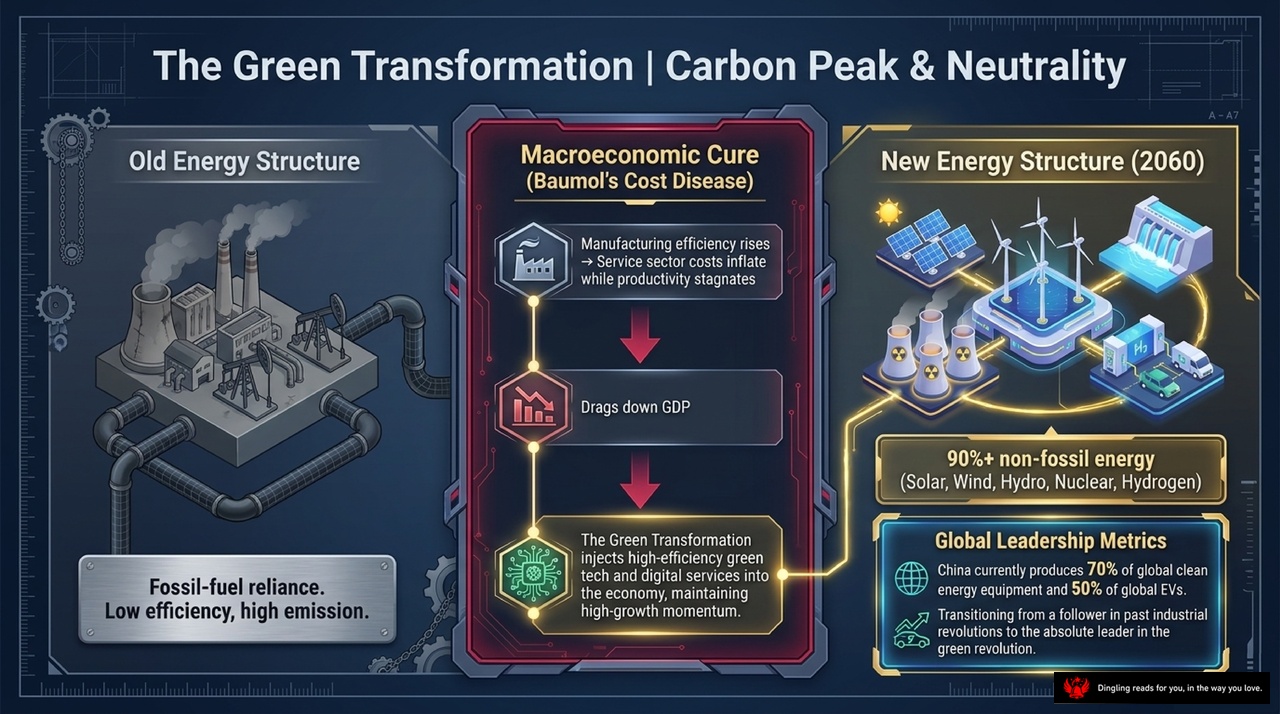
The Green Transformation isn't just about saving the planet; it's a powerful economic strategy to secure China's future leadership. As this slide illustrates, we are moving from an "Old Energy Structure" reliant on fossil fuels—which suffers from low efficiency and high emissions—toward a "New Energy Structure" by 2060. This future vision is dominated by non-fossil sources like solar, wind, hydro, nuclear, and hydrogen, aiming for over 90% of our energy mix.
But why make this shift? The slide identifies a critical economic problem known as "Baumol's Cost Disease." As manufacturing becomes more efficient, the service sector struggles to keep up, causing costs to inflate and dragging down GDP growth. The solution lies in the Green Transformation itself. By injecting high-efficiency green tech and digital services into the economy, we maintain high-growth momentum, effectively curing this stagnation.
Furthermore, this transition positions China as a global leader rather than a follower. Today, China already produces 70% of the world's clean energy equipment and holds 50% of the global electric vehicle market. By completing this transformation, we are transitioning from a follower in past industrial revolutions to the absolute leader in the green revolution. This isn't just an environmental goal; it is the ultimate path to global leadership and economic resilience.

Look at this blueprint of our economic future. On the left, we see the "Turning Point": the era of massive urbanization and speculative construction is permanently ending. As the slide notes, urbanization rates are peaking, and the days of building 1.7 billion square meters annually are over. This isn't a decline; it's a necessary correction.
On the right, we visualize the "New Structural Equilibrium." The foundation is being rebuilt with a clear formula: 50% for Commercial Property, 30% for Commercial Rental, and 20% for Government-Subsidized Housing. This mix enforces the golden rule displayed at the bottom: "Housing is for living, not for speculation."
Why is this shift critical? The economic rationale is clear. A soft landing in real estate is required to prevent capital from crowding out the manufacturing and consumption sectors that drive our Dual Circulation strategy. By stabilizing the foundation, we ensure that resources flow to where they truly matter: building a resilient economy for the future, not fueling a speculative bubble.

Unlocking Value through Factor Market Reforms
Imagine the economy not as a static machine, but as a dynamic ecosystem where five key resources—Land, Labor, Capital, Technology, and Data—flow freely to unlock massive potential. This slide outlines exactly how we can reform these markets to drive real growth.
First, look at **Land**. By enabling cross-regional trading of land quotas, we can finally unlock dormant rural wealth, turning unused assets into active economic engines. Next, consider **Labor**. Implementing Hukou reform allows us to transition 300 million migrant workers into permanent urban residents, effectively doubling their productive working years and integrating them fully into the economy.
Then, we shift to **Capital**. We are moving away from a reliance on indirect financing like bank loans and embracing direct financing through capital markets and tech-focused equity. This shift fuels innovation more efficiently. For **Technology**, the focus is on cultivating open-source ecosystems while instituting rigorous intellectual property protection to ensure creators are rewarded. Finally, regarding **Data**, we must establish clear pricing, ownership, and trading mechanisms for digital assets, treating data as a valuable, tradable commodity.
Together, these reforms create a high-standard market system that optimizes resource allocation, boosts productivity, and lays the foundation for sustainable, high-quality development.

The "Common Prosperity" strategy isn't just about fairness; it's a masterclass in economic engineering designed to unlock China's next decade of growth. Look at this "Gap Resolution Matrix"—it's China's blueprint for fixing the three biggest bottlenecks holding the economy back.
First, the **Regional Gap**. Instead of letting coastal cities fly while the west lags behind, the plan unleashes massive capital and technology into western regions. Think of it as the "Five Bigs" strategy: pouring resources into the interior to create a truly national market, not just a coastal one.
Next, the **Urban-Rural Gap**. This is about empowering farmers. By reforming land markets and ensuring farmers get actual property income from their land, the government is turning rural assets into cash flow, bridging the divide between city and countryside.
Finally, the **Industry Gap**. Here, the focus is on breaking monopolies in finance, real estate, and the internet. The goal? Stop excessive profit hoarding and resource misallocation so that money flows to productive industries rather than sitting idle in speculative bubbles.
The bottom line, highlighted here, is clear: Common Prosperity is a supply-side necessity. By doubling the middle class from 400 million to 800 million and cutting the low-income population in half, China secures the massive consumption base needed to avoid economic stagnation. It's a strategic pivot from chasing exports to fueling domestic demand, ensuring the engine keeps running.

Today's slide breaks down China's strategic "Global Network," highlighting two powerful engines: RCEP and the Eurasian Land Bridge. On the left, we see **Institutional Integration through RCEP**. As the world's largest free trade zone, it covers 90% zero-tariff goods and uses cumulative rules of origin. This is the backbone of China's "snowball" strategy, allowing it to expand its global trade network by locking in a massive economic bloc in Asia.
On the bottom left, the focus shifts to **Physical Integration via the China-Europe Railway Express**. This isn't just a train line; it's transforming the Eurasian "World Island." By establishing a new, all-weather, green logistics artery, it creates inland port economies that explicitly bypass the vulnerabilities of maritime shipping routes.
The map on the right visualizes this connectivity. You can trace the **China-Europe Railway Express** stretching from East Asia deep into Europe, linking seamlessly with the broader **Eurasian Land Bridge**. Meanwhile, the glowing blue network highlights the **RCEP Zone**, connecting China with ASEAN, Japan, Korea, and beyond. This dual approach—combining institutional rules with physical infrastructure—allows China to build a resilient, land-based trade superhighway that complements its traditional maritime routes, securing its position as a central hub in the global economy.

Welcome to the final segment of our deep dive into China's economic architecture. Let's zoom in on Hong Kong, a city that often gets misunderstood but holds a unique, strategic position in the global game.
Think of Hong Kong not just as a financial center, but as a masterfully designed "Financial Gateway." This gateway rests on three sturdy pillars that have made it the world's most free economy for 25 years running. First, the Free Port system ensures goods move without friction. Second, a unique, low-tax regime attracts global capital by keeping things simple and efficient. Third, the internationally trusted Common Law legal system provides the stability businesses need to operate anywhere in the world.
But what does the future hold? The vision for Hong Kong is evolving into three critical missions that align perfectly with China's broader strategy. First, it becomes "The Buffer Zone," a strategic financial buffer that helps manage the complex dynamics of US-China competition. Second, it transforms into "The Strategic Hub," acting as the critical node that facilitates high-level "Dual Circulation"—connecting China's domestic market with the global economy. Finally, it serves as "The Belt & Road Accelerator," acting as a powerful financing engine. Imagine a platform where international projects can be funded in RMB, seamlessly bridging China's infrastructure boom with global demand.
In essence, Hong Kong is the perfect intersection of China's massive market and the world's capital. It's the bridge that allows China to open up without losing control, and the hub that allows the world to access China without barriers. As we navigate a more fragmented global landscape, this gateway will remain essential for anyone looking to understand the future of trade and finance in Asia.

Look at this "Geopolitical Realities | US-China Decoupling Risk Matrix." This slide maps out the battlefield for the future, plotting the "Probability of US Action" against the "Cost to the US."
The logic is stark: The United States is willing to strike hardest where the cost to them is lowest. In the "High Risk" zone—Tech, Internet, and SWIFT clearing networks—the US sees an asymmetric advantage and feels confident launching targeted strikes. This is their sweet spot.
However, as we move right along the axis, the risk drops, but the cost to the US skyrockets. In the "Medium Risk" zone covering Trade, Investment, and Capital Markets, the US faces a "lose-lose" scenario. They might try selective decoupling, but massive corporate backlash makes it unstable.
Finally, in the "Low Risk" quadrant—Financial Institutions and Global Rules—the US has almost no appetite for action. Why? Because executing moves here would cause mutually assured destruction, potentially collapsing the global financial order and their own dollar hegemony.
So, what's the counter-strategy? It's simple but powerful: Maintain strategic patience. Don't fight in the zones where the US can easily win. Instead, utilize the gravity of China's mega-market and proactively double down on global openness. This turns the US's fear of high costs into their ultimate weakness.

Look at this slide. It frames China's journey to 2035 not just as an economic plan, but as a massive architectural project. The text highlights three core pillars: rebalancing the domestic engine through deep structural reforms, leading the global green and digital transitions, and standing firm against geopolitical headwinds with institutional openness.
Think about this as a strategic pivot. China is moving from being a participant in the global order to becoming the primary architect of a new macroeconomic paradigm. This shift raises a critical question for global markets: Are we ready for an era where decoupling and deep integration happen simultaneously?
The book explains that this path relies on profound reforms to fix the domestic engine, ensuring that the transition to a green and digital future is driven from within. It's about countering external pressures not by closing doors, but by committing to high-level institutional openness. As China transforms its model, the world faces a complex reality where separating supply chains and integrating markets are no longer mutually exclusive—they are happening at the same time. The challenge isn't just whether China can succeed, but whether the rest of the world can adapt to this new, more integrated, yet distinctively Chinese, economic architecture.