
Successes and Failures of Historical Economic Reforms: Complete Chapter-by-Chapter Summary
Welcome to today's session on *Gains and Losses of Economic Changes in Successive Dynasties* by Wu Xiaobo. This isn't just a history lesson; it's a 2,000-year blueprint revealing the cyclical economic logic that has governed China's past, present, and future.
Think of Chinese economic history as a pendulum swinging between two extremes. On one side stands Guan Zhong, the master of commerce. In the Spring and Autumn period, while others looked down on merchants, Guan Zhong did the unthinkable: he treated business as the bedrock of the nation. He didn't just tax trade; he made it profitable for everyone. By monopolizing salt and iron but letting private entities operate them, he created a model where the state captured profits without crushing the people. He even encouraged luxury consumption to boost the economy, a strategy that sounds shockingly modern. His goal? To make the state rich without raising taxes, proving that a powerful economy could fund a powerful empire.
Fast forward three centuries, and the pendulum swings hard to the other side: Shang Yang of Qin. Where Guan Zhong celebrated commerce, Shang Yang crushed it. Facing a backward, agrarian state, Shang Yang made a radical choice: sacrifice the market to build a war machine. He privatized land to motivate farmers but banned private trade, imposing heavy taxes on merchants and restricting their movement. He replaced the old aristocracy with a merit-based military system, turning the entire population into soldiers. The result was a "wolf state" that conquered the world. While Guan Zhong sought wealth through trade, Shang Yang sought power through control.
These two reformers set the stage for every major economic shift in Chinese history. Whether it was the Han Dynasty's attempt to balance private enterprise with state control, or the Song and Ming eras, the tension between "developing the economy" and "maintaining stability" has never changed. Sometimes, letting the market run wild leads to local warlords and chaos, forcing the state to step in and seize control. Other times, excessive state control stifles innovation, leading to stagnation. From the glory of the Tang Dynasty to the decline of the Qing, the story remains the same: a constant struggle between releasing the market's energy and tightening the state's grip. Understanding this cycle is the key to understanding not just China's history, but the fundamental challenges of economic governance that echo through time.
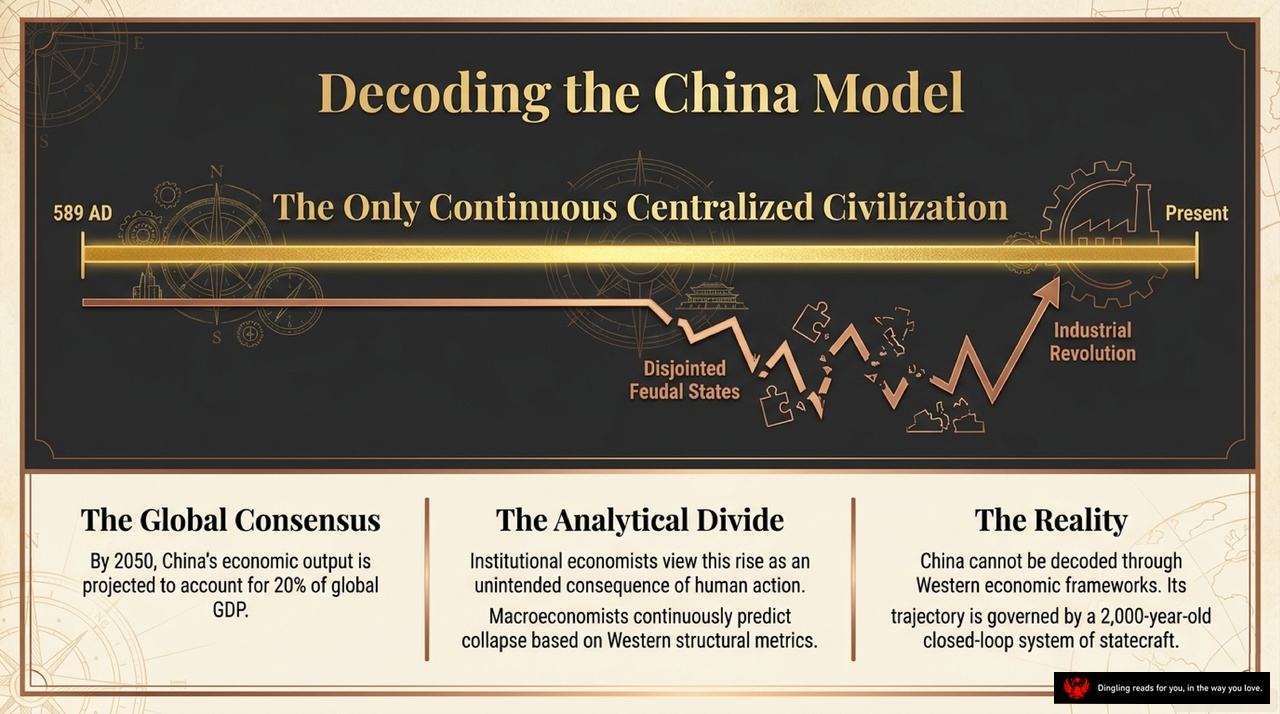
Look at this timeline: from 589 AD to the present, China stands as the only continuous centralized civilization in history. While the world fractured into disjointed feudal states, China evolved through an industrial revolution, driven by a unique 2,000-year-old closed-loop system of statecraft.
This is the core of the "China Model." The global consensus sees China's rise as inevitable, projecting it to account for 20% of global GDP by 2050. But here lies the analytical divide: Western economists often try to force China's trajectory into their own frameworks, predicting collapse based on Western structural metrics. They view China's success as just an unintended consequence of human action.
That's the problem. The reality is that China cannot be decoded through Western economic models. Its path isn't about random market forces; it's governed by a deliberate, historical logic of centralization. Whether it was Guan Zhong's early reforms or later imperial policies, the pattern remains the same: the state controls the most profitable sectors—like salt, iron, and finance—to fund its goals and maintain stability. This isn't a market failure; it's a feature of a civilization built on continuity and state power.

Decoding the China Model: The Quadrant Tension-Map reveals the delicate balance at the heart of Chinese governance. This isn't just about politics; it's a constant negotiation between four distinct interest groups, each pulling in a different direction. At the top sits the Central Government, whose primary goal is Ultimate Control and Revenue. They must keep the empire unified and the coffers full. On the right, we see the Propertied Class—Merchants and Entrepreneurs—driven by the desire for Free Markets and Profit. They want to innovate and grow, but they pose a threat if they become too powerful. Opposite them, on the left, are the Propertiless Class—Peasants and Workers—whose sole goal is Survival and Equity. They need stability and fair treatment, but they can become a source of unrest if pushed too far. Finally, at the bottom, are the Local Governments, seeking Autonomy and Local Wealth. They want to build their own power bases, which creates a risk of fracturing the central authority.
The equation of Chinese governance is simple yet incredibly complex: every economic reform or crisis over the past two millennia is the direct result of bargaining, conflict, or compromise between these four groups. The core conflict lies in the central government's impossible task: it must empower merchants to generate wealth, yet simultaneously suppress them to prevent local governments from growing strong enough to challenge the center. It's a tightrope walk where the state constantly balances between encouraging economic dynamism and maintaining strict political control, ensuring that no single group ever becomes dominant enough to break the system.

Look at this diagram: "Decoding the China Model." It visualizes the Centralized Empire as a grand structure supported by four critical pillars: County Administration, Confucian Ideology, Imperial Examinations, and State Monopoly. The message is stark—if any single pillar crumbles, the entire structure fractures.
Let's focus on that fourth pillar, State Monopoly, which acts as the economic backbone of this system. The text reveals that this wasn't just about simple government ownership. It was a sophisticated strategy to capture profit for the state. Take the Han Dynasty under Emperor Wu; he implemented salt and iron monopolies. Instead of just taxing people directly, which would cause unrest, the state controlled the supply and price of these essential goods. By adding a hidden tax into the price of salt and iron, the government could double its revenue without the people feeling the burden. This "tax-in-price" approach allowed the empire to fund massive wars and build infrastructure without collapsing under the weight of high taxes.
Later, during the Song Dynasty, the state took control of retail markets and even set prices for daily items like fruit and sesame seeds. In the Ming and Qing eras, merchant families like the Jin and Hu merchants didn't rise through innovation; they thrived because they held exclusive trading rights granted by the government. Their wealth came from political privilege, not market competition. This created a unique dynamic where the state and private capital were fused. The merchants became extensions of the state, and the state became the ultimate merchant. This system ensured stability and centralized power for centuries, but it also stifled the independent growth of a vibrant private sector, locking the economy into a cycle where the state always prioritized its own revenue over the market's natural evolution.

Look at this slide, "The Genesis of Reform." It contrasts two opposing blueprints for state power: The Blue Model and The Black Model.
On the left, we have Guan Zhong in the 7th century BC. His philosophy was pro-commerce, embracing what we might call Keynesian macroeconomic control. He used hidden taxation, letting the state control wholesale salt and iron while private merchants handled retail. He encouraged consumption, free trade, and urbanization, turning his capital into the world's largest city.
On the right stands Shang Yang in the 4th century BC. His model was the exact opposite: pro-agriculture and a command economy. He relied on direct extraction and anti-merchant policies. His society was defined by totalitarian control, closed borders, and an agrarian populace atomized and tied to military merit.
The key insight at the bottom is crucial. The Black Model built the ruthless efficiency required to conquer and unify China, establishing the template for absolute state power that would last for millennia. While Guan Zhong's approach was vibrant and flexible, Shang Yang's harsh efficiency became the dominant logic for the Chinese state.

Look at this blueprint of the State Monopoly. It shows how the government, led by innovators like Emperor Han Wudi and Sang Hongyang, turned the nation into a centralized economic machine. On the left, you see strategic resources—salt, iron, and liquor—feeding directly into a massive industrial core labeled "Junshu" for state procurement and "Pingzhun" for price controls. This isn't just about collecting taxes; it's about hidden taxation. By monopolizing these essentials, the state enriched itself without raising visible tax rates, effectively pocketing wealth that would have otherwise gone to private merchants.
The output of this machine flows into the Central Treasury, filling it with gold, while the pipes leading to the population are deliberately broken. This represents a strategy of starving the merchant middle class and the general populace to fund the state's survival. The image poses a critical question from Sang Hongyang: if the state doesn't monopolize commerce, how can it fund defense, prevent local warlords, and maintain national unity? This graphic perfectly captures the logic of "state capitalism"—where the government acts as the ultimate entrepreneur, controlling the market to ensure stability and power, often at the expense of private enterprise and consumer choice.

The Fatal Flaw of Total Control: The Ultimate Command Economy of Wang Anshi
Look at this scale. On one side, we have "State Revenue," weighed down by a heavy, golden block. On the other, the "Free Market" is shattering into pieces. This visual perfectly captures the tragic outcome of Wang Anshi's reforms in the Northern Song Dynasty.
The policies were aggressive. The state monopolized all retail trade through the Trade Directorate and replaced private credit with state loans under the Green Sprout Law. But this top-down control backfired spectacularly. Government agencies morphed into profit-driven monopolies. State loans became predatory, enforced by arrest, and the market completely collapsed under bureaucratic corruption.
The legacy of this failure is profound. The catastrophic failure of this reform permanently traumatized Chinese statecraft, forcing future dynasties into deeply conservative governance. From then on, the fear of disrupting stability outweighed the need for innovation, creating a cycle of stagnation that would define centuries to come.
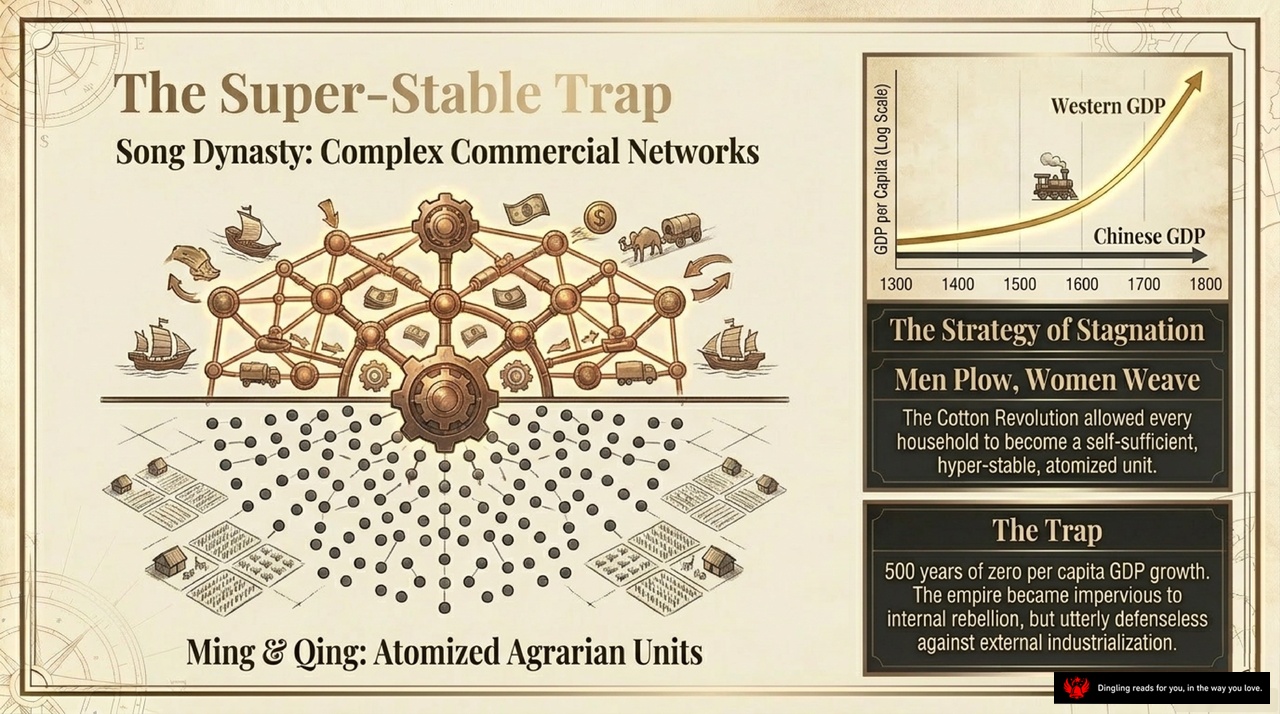
The Super-Stable Trap begins to take shape, illustrating a stark divergence in economic destiny. Look at the graph on the right: while Western GDP rockets upward thanks to industrialization, Chinese GDP remains flat for five centuries, a phenomenon known as the "Super-Stable Trap." This stagnation wasn't accidental; it was the result of a deliberate strategy. As the slide explains, the empire shifted from the Song Dynasty's complex commercial networks to the Ming and Qing era's "Atomized Agrarian Units."
The core mechanism was the "Strategy of Stagnation," epitomized by the phrase "Men Plow, Women Weave." The state promoted the Cotton Revolution not to boost efficiency, but to make every household a self-sufficient, hyper-stable unit. By ensuring families could produce their own food and clothes, the government eliminated the need for a large urban workforce or a vibrant market economy. This turned the population into isolated, atomized units—like the dots at the bottom of the diagram—rather than a connected, innovative society.
The result was a "Trap" of 500 years of zero per capita growth. The empire became incredibly impervious to internal rebellion because everyone was too busy surviving in their small village, yet it was utterly defenseless against external industrialization. While Europe was building factories and global trade networks, China deliberately retreated into a closed loop of self-sufficiency, creating a stable but stagnant system that would eventually choke the nation's potential for modernization.

The image before us vividly captures a century of turmoil, titled "The Painful Modernization" from 1840 to 1949. It illustrates a fractured timeline where China's path to industrialization was repeatedly shattered by external shocks and internal contradictions.
Let's start at the beginning: The Exogenous Shock of 1840. As the graphic shows, the Industrial Revolution arrived not through trade, but via gunboats. This forced China out of its 500-year closed loop. This external pressure eventually triggered the Self-Strengthening Movement in the late Qing Dynasty. They tried to build heavy industry using "Government-Supervised, Merchant-Managed" models. However, this approach resulted in severe crony capitalism, where bureaucrats acted as referees while playing the game themselves, undermining the very system they tried to protect.
Moving forward to The Nationalist Era between 1927 and 1949, the strategy shifted dramatically. The state moved from laissez-faire to State Capitalism. Post-WWII, the government confiscated enemy assets to build monopolies, which alienated the capitalist class. This centralization of power ultimately led to The Collapse. Disastrous fiat currency reforms caused hyperinflation, resulting in the total loss of urban support by 1948.
The visual metaphor of the breaking road perfectly encapsulates this historical reality. From the initial shock to the eventual collapse, the era was defined by a struggle between necessary modernization and the destructive consequences of forced, state-led industrialization.
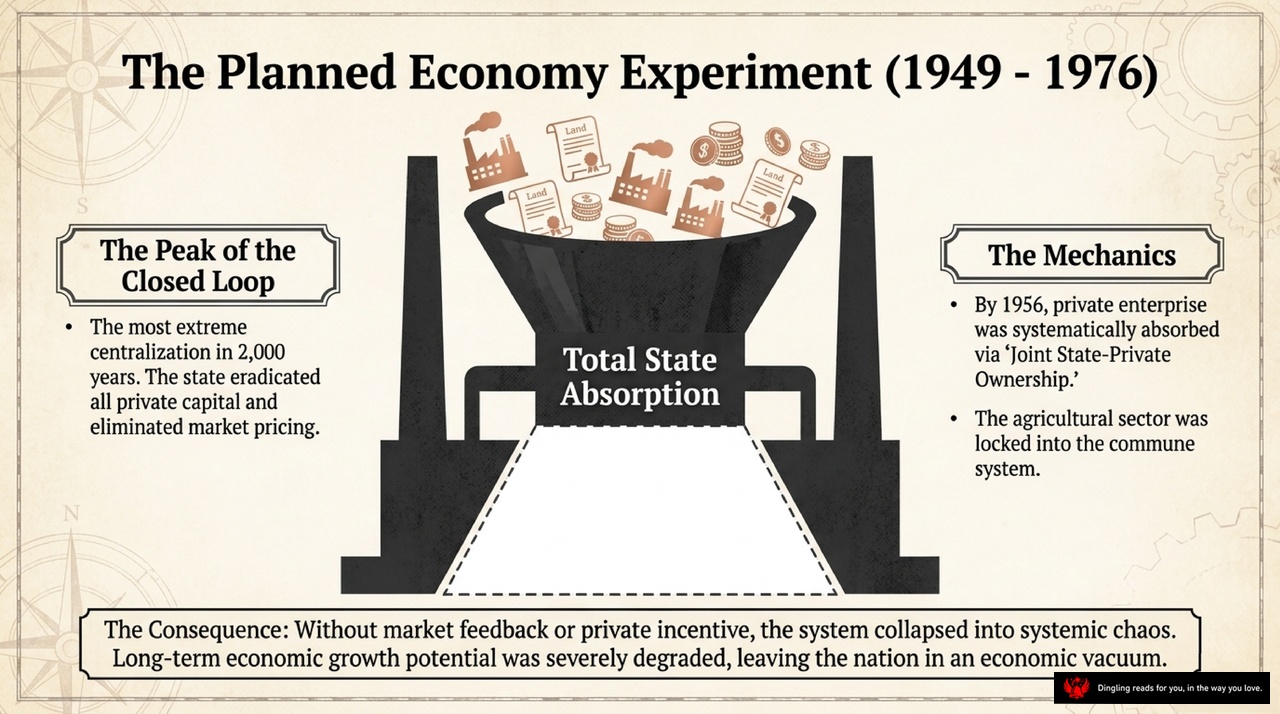
The slide before us captures the dramatic turning point of China's economic history: The Planned Economy Experiment, spanning from 1949 to 1976. This wasn't just a policy shift; it was the most extreme centralization attempt in two millennia. As the graphic illustrates, the state moved toward "Total State Absorption," systematically eradicating private capital and eliminating market pricing to create what the slide calls "The Peak of the Closed Loop."
How did this happen? The mechanics were ruthless and systematic. By 1956, private enterprise was completely absorbed through a strategy of "Joint State-Private Ownership," effectively ending the private sector. Meanwhile, the agricultural sector was locked into the commune system, removing individual incentive. The visual metaphor of the funnel pouring everything into the state is powerful—it shows how all resources, from land to industry, were funneled into a single, closed system.
But what was the cost? The slide clearly states the consequence: without market feedback or private incentives, the system collapsed into systemic chaos. Long-term economic growth potential was severely degraded, leaving the nation in an economic vacuum. This era, while ambitious in its pursuit of rapid industrialization, ultimately proved that a closed loop without the dynamic forces of the market and private initiative could not sustain itself, setting the stage for the profound changes that would follow.

Look at this visual: a rigid grid labeled "The Planned Economy Structure" represents the old system, while golden roots and arrows breaking through symbolize "The Grassroots Engine." This perfectly captures the first phase of Reform & Opening Up, from 1978 to 1993.
Unlike the top-down planning of the past, this era was defined by "Decentralization." The government didn't have a master plan; instead, it delegated power and shared profits, allowing wealth to be generated from the bottom up. Think about the farmers and rural township enterprises that started breaking the mold. By 1986 alone, 15 million of these township enterprises were generating 20% of the entire country's GDP.
This was a "Non-Equilibrium Strategy." The state deliberately allowed extreme regional imbalances to break the stagnation of the planned economy. While the central grid remained, the grassroots engine created a powerful force from below, proving that when you let the market breathe, even the most rigid structures can be pushed aside. This wasn't about perfect equality; it was about using uneven development to jumpstart the whole economy.
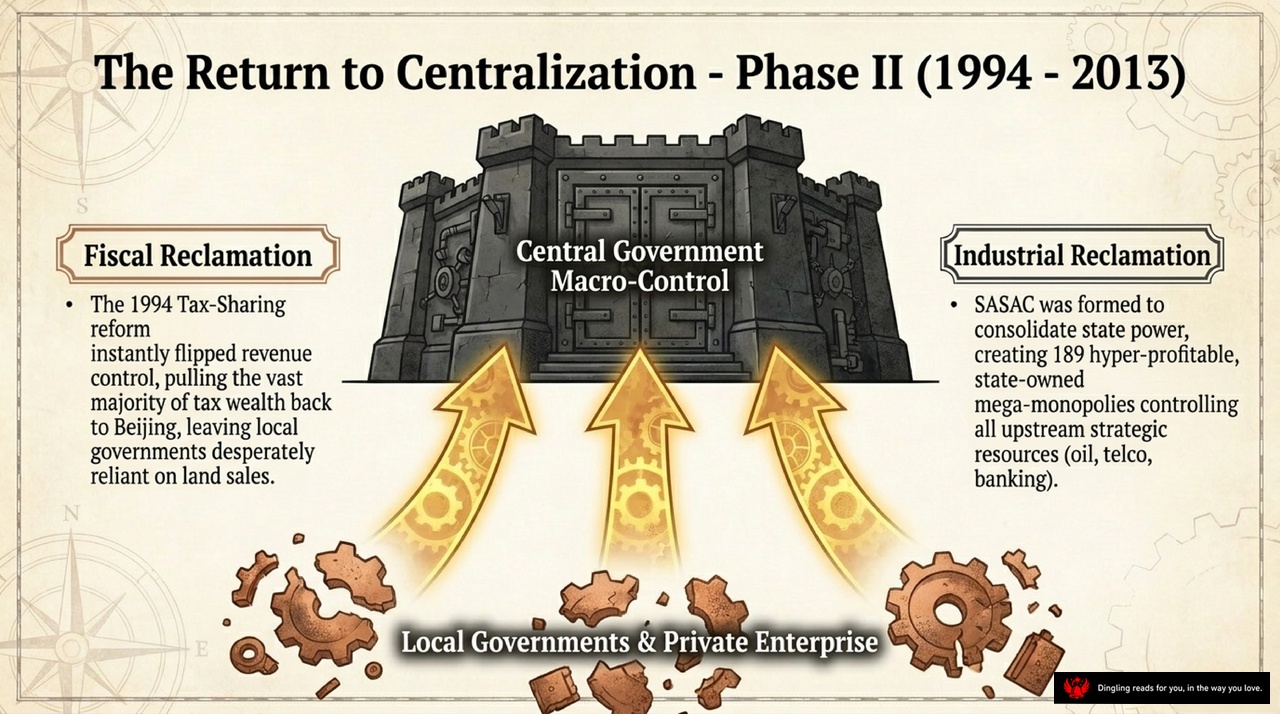
Look at this slide, titled "The Return to Centralization - Phase II (1994-2013)." This period marks a decisive shift where power and resources flowed decisively back to the center. The image clearly illustrates two main pillars driving this transformation: Fiscal Reclamation and Industrial Reclamation.
On the left, under Fiscal Reclamation, we see the impact of the 1994 Tax-Sharing reform. This pivotal moment instantly flipped revenue control, pulling the vast majority of tax wealth back to Beijing. As the graphic shows with the arrows pointing upward, this move left local governments desperately reliant on land sales to balance their books.
On the right, under Industrial Reclamation, the focus shifts to corporate power. The formation of SASAC consolidated state power, creating 189 hyper-profitable, state-owned mega-monopolies. These giants now control all upstream strategic resources, including oil, telecommunications, and banking.
The visual metaphor at the bottom is powerful: Local Governments and Private Enterprises are depicted as broken gears, while the Central Government's Macro-Control stands as a fortified castle at the top. The golden arrows rising from the bottom to the top symbolize how resources and control were systematically extracted from the local and private sectors to fuel the central state. This era fundamentally reshaped the economic landscape, prioritizing national control over local autonomy and private initiative.

The State Advances, Private Retreats Matrix isn't just a chart; it's a two-thousand-year loop of history repeating itself. Look at the timeline: from Emperor Han Wudi confiscating merchant wealth in 119 BC to the 2008 stimulus heavily favoring State-Owned Enterprises, the pattern is unmistakable. Every time the state needs short-term fiscal power—whether to fund wars, suppress rebellion, or expand its empire—it systematically retreats the private sector.
Notice the recurring outcome at the bottom: short-term gain for the state, but long-term suffocation of private innovation. In 1945, the Nationalist government seized industrial assets; in 2008, the state took control of credit and resources. While this boosts the government's balance sheet immediately, it starves the very private sector that drives long-term growth. This structural reflex, often called "Guojin Mintui," has prevented China from developing a truly dynamic market economy, leaving it trapped in a cycle where the state survives at the expense of the future.

The Three Battlegrounds of the Future: State-Owned Enterprises, Land Ownership, and Financial Deregulation.
Look at this slide. It maps out the three critical conflicts shaping our economic destiny. First, we have State-Owned Enterprises. The core tension here is between upstream state monopolies that extract rent from downstream private manufacturers. The necessary shift? Moving from monopoly control to public welfare funding.
Second, consider Land Ownership. We are facing the exhaustion of local government land finance. The required shift is clear: move from state land sales to sustainable property taxes and privatization experiments.
Finally, look at Financial Deregulation. The issue is state banks suppressing private credit. To fix this, we must shift from a state banking monopoly to private financial deregulation.
These three areas represent the friction points where the old model is breaking down, and where the future of our economy will be decided.
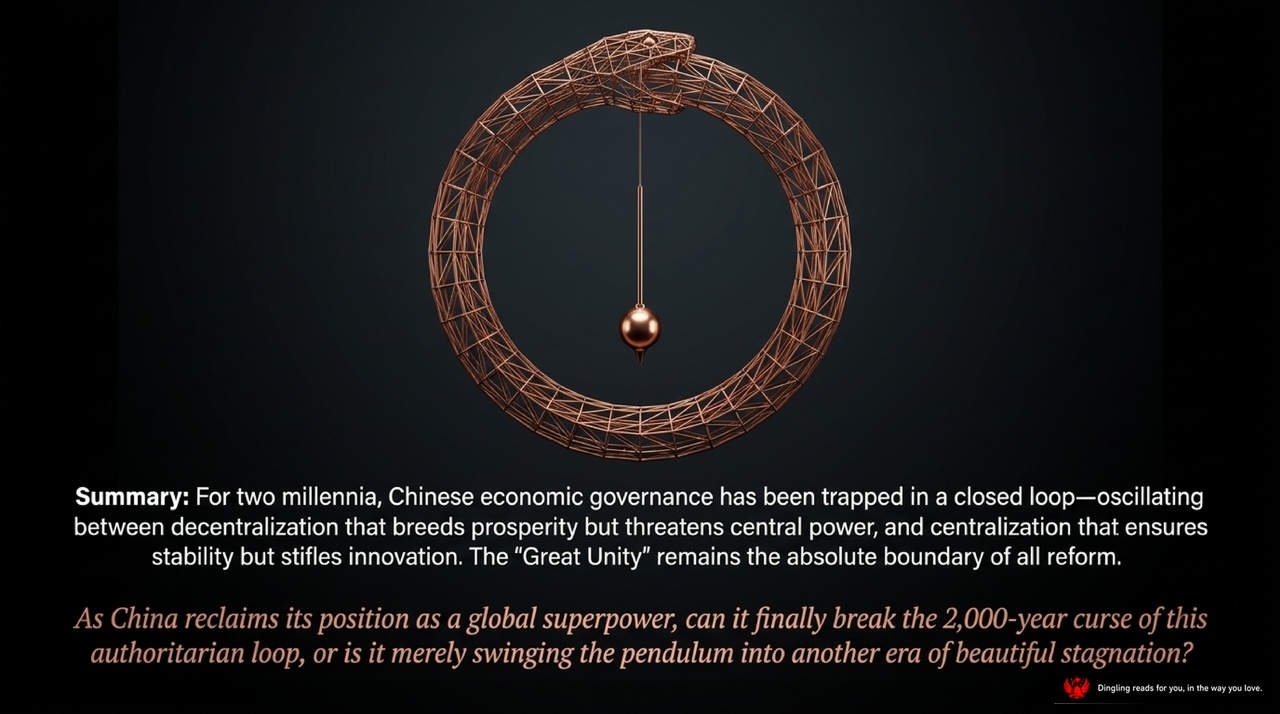
Summary: For two millennia, Chinese economic governance has been trapped in a closed loop—oscillating between decentralization that breeds prosperity but threatens central power, and centralization that ensures stability but stifles innovation. The "Great Unity" remains the absolute boundary of all reform.
As China reclaims its position as a global superpower, can it finally break the 2,000-year curse of this authoritarian loop, or is it merely swinging the pendulum into another era of beautiful stagnation?