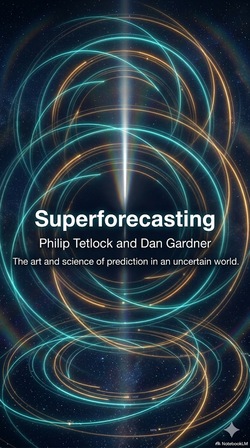



The book explains how experts fail often when making predictions about complex events like market trends or political shifts, relying too much on reputation instead of data. It introduces superforecasters who are regular people using specific methods to break down big questions into smaller, verifiable parts called Fermi Decomposition, which helps turn overwhelming uncertainty into manageable steps. Instead of guessing vaguely with words like likely or probable, superforecasters assign numerical probabilities between one and one hundred, using everyday benchmarks like rain chances to calibrate their numbers accurately. This forces them to take even low-probability risks seriously when stakes are high, like cyber attacks, rather than ignoring them because they seem unlikely. The text also covers Bayesian updating, a simple mindset where you start with an initial belief and adjust it incrementally as new evidence arrives, avoiding traps like clinging too tightly to your first guess or overreacting to noise. By treating predictions as testable hypotheses and updating them based on verified data, you learn from mistakes instead of hiding behind vague language, which builds confidence in navigating life's uncertainties through structured thinking rather than luck or genius.