
Supremacy: Complete Chapter-by-Chapter Summary

Welcome to the inside story of the trillion-dollar corporate arms race for Artificial General Intelligence. This isn't just about code; it's about two rival architects with contrasting visions driving the future of humanity.
On one side stands Sam Altman, a brilliant but controversial figure who grew up in conservative Missouri, openly outed himself as gay, and later faced the crushing failure of his first startup, Loopt. That failure became his turning point. Instead of giving up, he channeled his ambition into a deeper obsession: if computers can simulate the human brain, then humans aren't special anymore. He began to view life itself as an engineering problem to be optimized, preparing for a future where consciousness could be uploaded, making him a true "prepper" for the singularity.
On the other side is Demis Hassabis, a London-born prodigy who started building complex business simulation games as a teenager. He believed that to create true intelligence, we must first understand the human brain by studying its mechanics. This led him to DeepMind, where he aimed to solve global problems with super-intelligent machines.
While both men started with pure ideals—Altman wanting to open-source AGI for everyone, and Hassabis hoping to use AI to solve poverty and climate change—their paths soon diverged into the heart of Silicon Valley's ruthless commercial reality. As we dive into their stories, you'll see how the pursuit of a utopian future collided with the cold logic of capital, transforming two visionary startups into the ultimate battlegrounds for the soul of technology.

Look at this split screen: on the left, "The Promise of Abundance," symbolized by DNA strands and futuristic cities, representing the dream of a better world. On the right, "The Trillion-Dollar Machinery," depicted with massive server racks, oil pumps, and cooling towers, shows the cold reality of corporate power. The central text, "The Awakening," cuts through the noise to deliver a hard truth: we are blinded by sci-fi fantasies, ignoring how AI development has already been captured by a few powerful entities driven by relentless growth.
This isn't just about code; it's about who holds the keys. While the left side promises a utopia where technology liberates us, the right side reveals the engine room where giants like Google and Microsoft are already locking in their dominance. As we saw with DeepMind and OpenAI, brilliant minds like Demis Hassabis and Sam Altman initially wanted to solve global problems. But the path quickly narrowed. Without the massive compute resources of the big tech giants, independent labs couldn't compete. The result? The "awakening" we needed to stay critical has been overshadowed by the machinery of profit. We are watching history unfold in real-time, where the promise of abundance is increasingly being engineered into a trillion-dollar monopoly, and the real question is no longer if AI can solve our problems, but who gets to decide what those problems are.
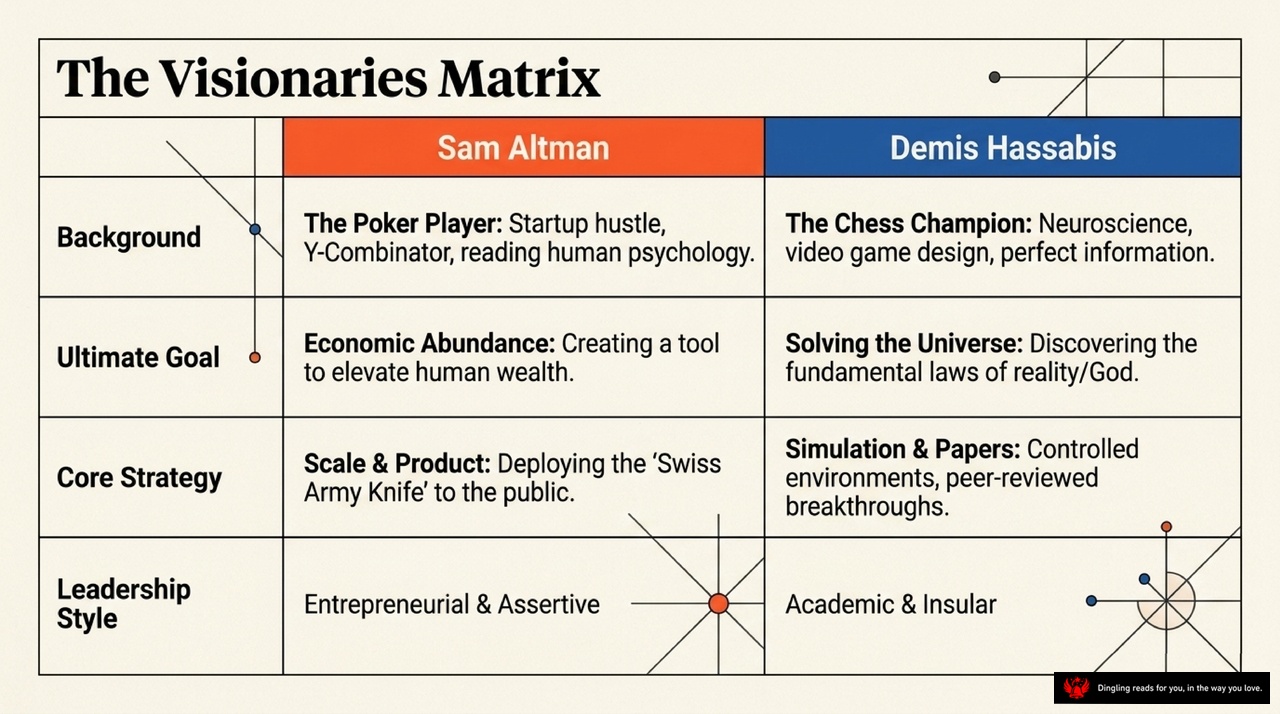
The Visionaries Matrix on your screen perfectly captures the divergent paths of two titans shaping our future: Sam Altman and Demis Hassabis.
Let's look at their origins. Altman is the "Poker Player." His background is defined by startup hustle, his time at Y Combinator, and a deep understanding of human psychology. In contrast, Hassabis is the "Chess Champion." His roots lie in neuroscience, video game design, and the pursuit of perfect information.
Their ultimate goals couldn't be more different. Altman aims for "Economic Abundance," focusing on creating tools to elevate human wealth. Hassabis, however, is chasing something far grander: "Solving the Universe," seeking to discover the fundamental laws of reality or even "God."
This drives their core strategies. Altman relies on "Scale & Product," deploying what he calls a 'Swiss Army Knife' of technology directly to the public. Hassabis takes a different route with "Simulation & Papers," preferring controlled environments and peer-reviewed breakthroughs over mass market deployment.
Finally, their leadership styles reflect these choices. Altman is entrepreneurial and assertive, pushing boundaries with force. Hassabis remains academic and insular, deeply focused on the lab and the theory. This matrix isn't just a comparison; it's a blueprint for how we might approach the most powerful technology in history—sometimes by scaling it for everyone, and other times by perfecting it in isolation.
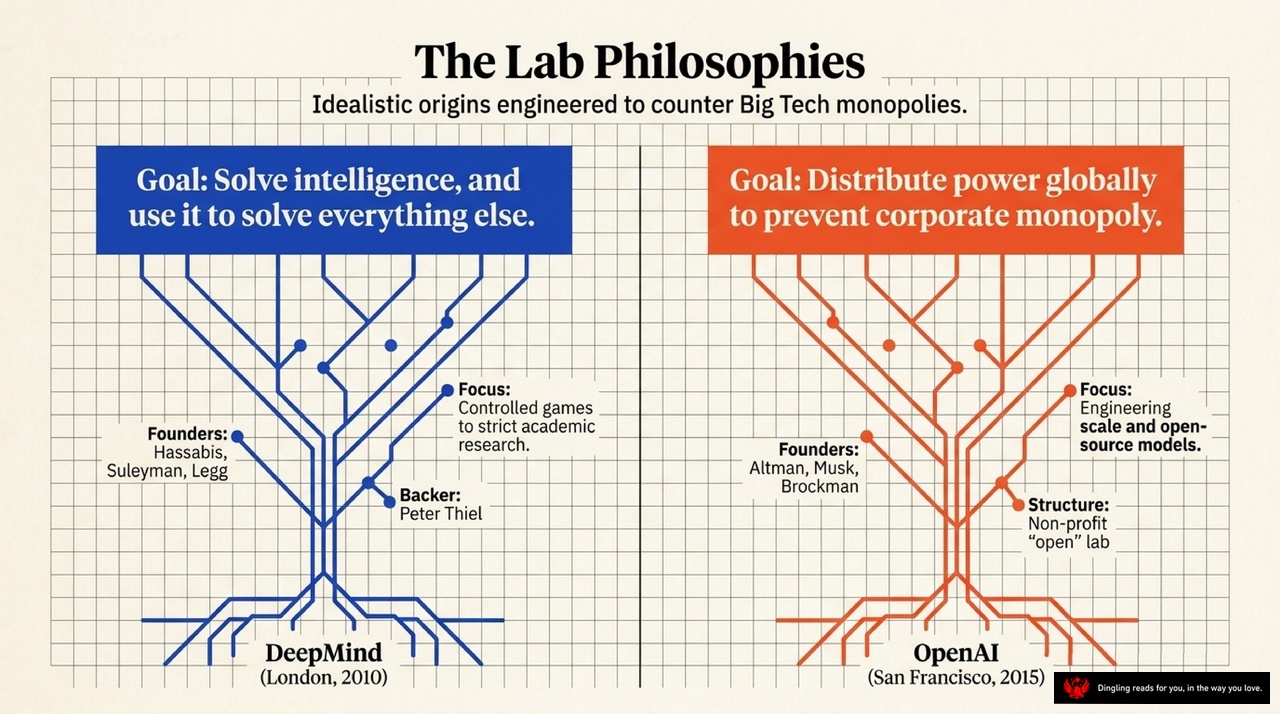
The chart on your screen vividly contrasts the founding philosophies of two AI titans: DeepMind and OpenAI. On the left, DeepMind, born in London in 2010, was driven by a singular, ambitious goal: to solve intelligence and use that power to fix everything else. Led by founders like Demis Hassabis, backed by Peter Thiel, their approach was focused on controlled games and strict academic research.
On the right stands OpenAI, launched in San Francisco in 2015 with a different vision. Their mission was to distribute power globally to prevent corporate monopoly. Founded by Sam Altman, Elon Musk, and Greg Brockman, they prioritized engineering scale and open-source models within a non-profit structure.
While both labs started with idealistic origins engineered to counter Big Tech monopolies, their paths diverged sharply. DeepMind pursued a top-down strategy of solving intelligence first, whereas OpenAI aimed to democratize access from the start. This fundamental difference in philosophy set the stage for the intense competition and ethical challenges we will explore next.
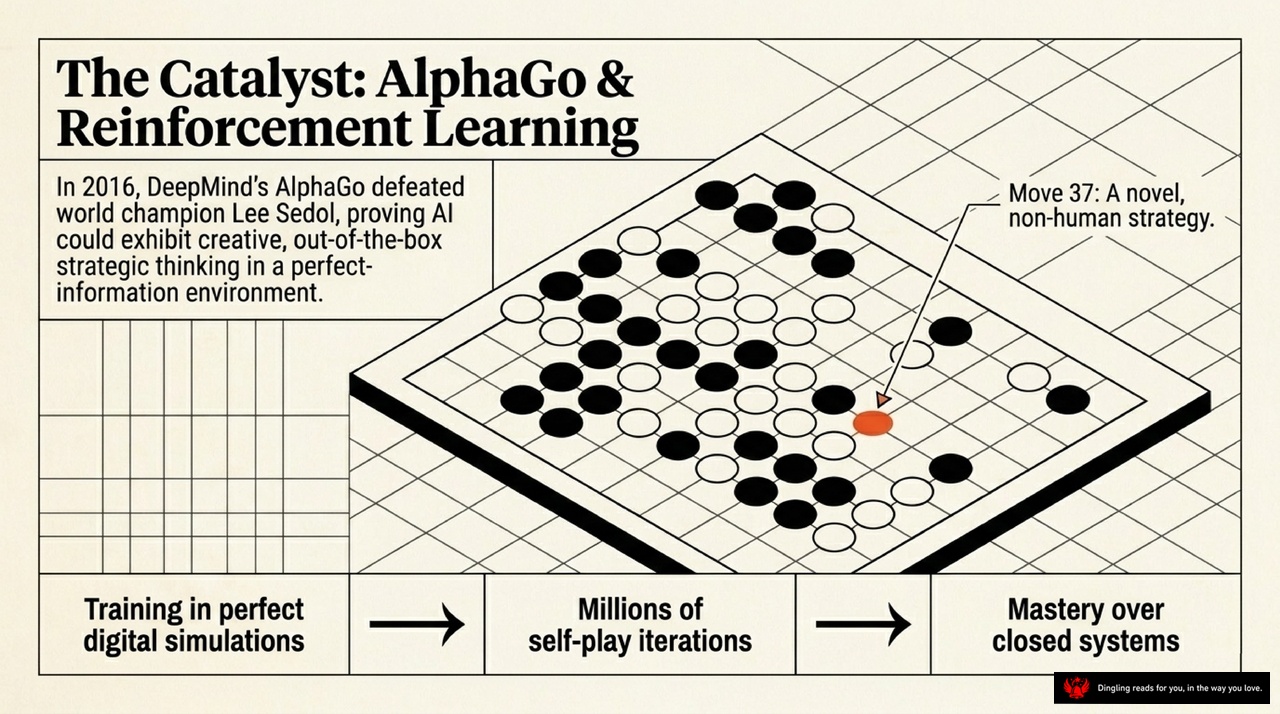
The slide highlights a pivotal moment in AI history: the 2016 showdown between DeepMind's AlphaGo and world champion Lee Sedol. In a perfect-information environment, the AI didn't just calculate; it exhibited creative, out-of-the-box strategic thinking. Look closely at Move 37 on the board. It was a novel, non-human strategy that defied human convention, ultimately helping AlphaGo secure a 4-1 victory. This win proved that machines could master closed systems through millions of self-play iterations, starting from training in perfect digital simulations. But this breakthrough wasn't just about beating a human; it was the catalyst for a global arms race. It showed the world that AI could solve problems far beyond human intuition, igniting a fierce competition where tech giants like Google and Microsoft began pouring resources into building the next generation of super-intelligent systems, shifting the focus from simple automation to true general intelligence.

The rise of ChatGPT wasn't just a technical upgrade; it was a cultural earthquake that fundamentally shifted how we interact with information. Before this, if you wanted an answer, you had to sift through a maze of links and ads on a search engine. Now, you just ask, and the AI gives you a direct, coherent response. This convenience is powerful, but it comes with a hidden cost: the erosion of our critical thinking skills.
When we rely on these models to generate everything from essays to code, we risk outsourcing our cognitive labor. It's like the invention of the calculator; it made math faster, but did it make us better at thinking? If we stop doing the work ourselves, we might lose the ability to construct arguments or solve complex problems on our own. We're seeing a generation that prefers the safety of an AI's suggestion over the uncertainty of their own reasoning.
Beyond the cognitive shift, there's a darker side to this emotional dependency. Platforms are now designed to mimic empathy, offering "AI girlfriends" or therapeutic chatbots that listen without judgment. For many, especially young people, these digital companions have become their primary source of emotional support. While comforting, this creates a fragile reality where human connection is replaced by algorithmic validation. We are building a future where the most intimate parts of our lives—the way we feel, love, and struggle—are mediated by code designed to keep us engaged, not necessarily to help us grow.
As we stand on the brink of this new era, the question isn't just whether AI can think like us, but whether we can remain human while living alongside something that thinks so much like us. The challenge ahead is to use these tools without letting them define our identities or replace our essential humanity.
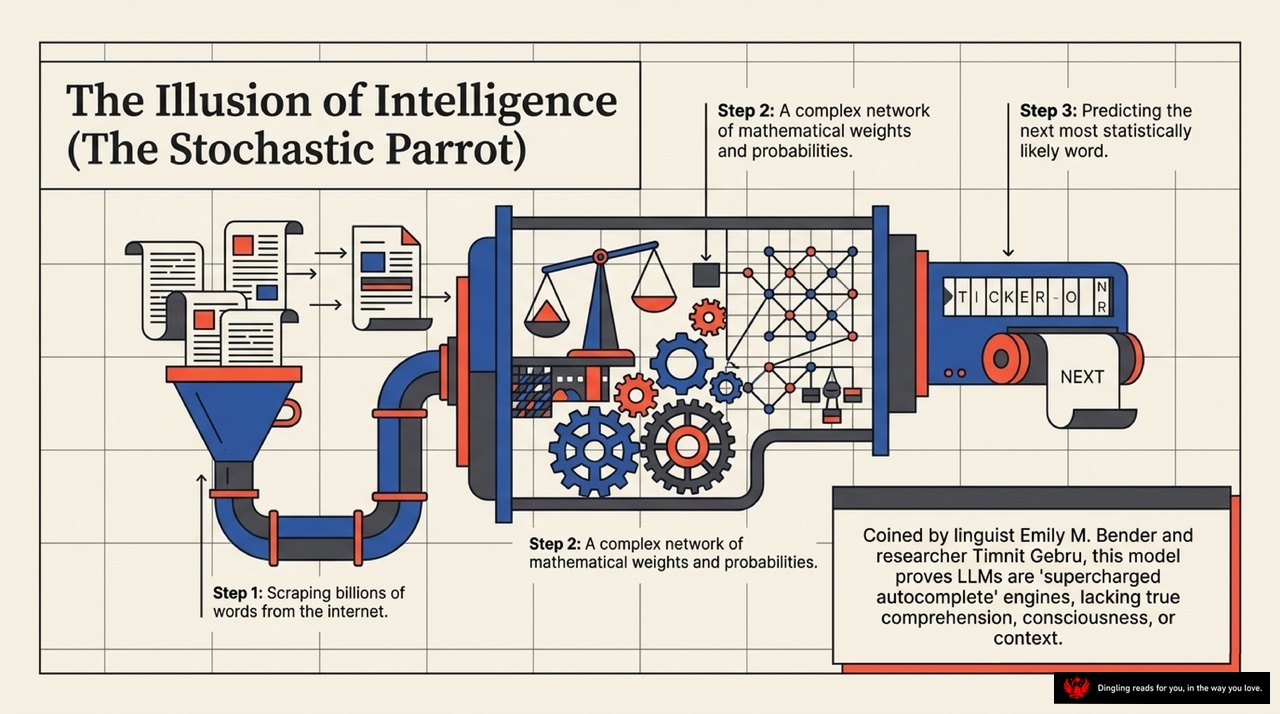
The illusion of intelligence is more than just a catchy phrase; it's the core reality of how our most advanced AI systems actually work. Think of large language models not as conscious thinkers, but as "supercharged autocomplete engines." This concept, coined by linguist Emily M. Bender and researcher Timnit Gebru, describes the "Stochastic Parrot." As the diagram illustrates, the process begins with Step 1: scraping billions of words from the internet. The system ingests this vast ocean of text, treating human knowledge as nothing more than a dataset to be consumed.
Once that data is processed, we move to Step 2: a complex network of mathematical weights and probabilities. The model doesn't understand the meaning of what it reads; instead, it calculates the likelihood of certain patterns appearing next to others. It's a statistical game of connect-the-dots, not a deep dive into truth or context. Finally, in Step 3, the system predicts the next most statistically likely word. It generates text that sounds fluent and intelligent, yet it lacks true comprehension, consciousness, or any real understanding of the world.
This distinction is crucial. When we interact with these models, we are often falling for the illusion of intelligence. We project human-like understanding onto a machine that is simply guessing the next token based on probability. Recognizing this "Stochastic Parrot" reality is the first step toward navigating the ethical and practical challenges of an AI-driven future, reminding us that just because something sounds smart, doesn't mean it actually knows anything.

The Safety vs. Ethics Matrix isn't just a chart; it's the central battlefield of our AI age, and understanding this divide is crucial for anyone following the tech story. On the left, we see the "AI Ethics & Algorithmic Harm" camp, led by voices like Timnit Gebru and Margaret Mitchell. Their focus is laser-sharp on present-day reality: racial bias, job displacement, and copyright theft. They argue that technology doesn't just reflect our flaws; it amplifies them, turning systemic inequalities into automated injustices, much like the COMPAS criminal justice bias case.
On the right, we have the "Effective Altruism & Doomerism" side, championed by figures like Sam Altman, Nick Bostrom, and Eliezer Yudkowsky. Their gaze is fixed on the distant, terrifying horizon: existential risks like extinction and superintelligence. They operate on a mathematical utilitarianism, calculating that saving even a tiny chance of future simulated lives justifies massive investment today.
The tension between these two poles defines the current crisis. One side worries about the harm happening right now to real people, while the other is obsessed with preventing a potential apocalypse centuries away. As we move forward, the real challenge isn't choosing one side, but finding a way to address both the immediate suffering of today and the existential threats of tomorrow without letting either blind us to the other.
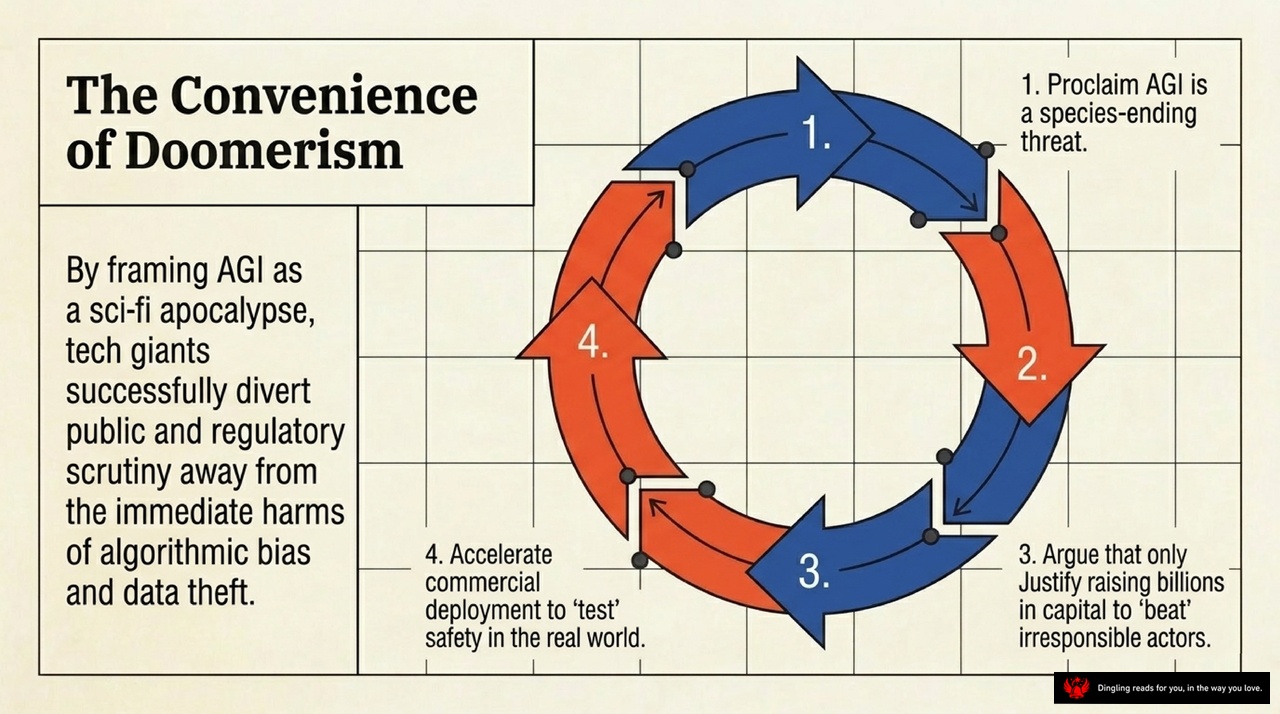
Look at this cycle: "The Convenience of Doomerism." It's a clever trap that tech giants use to manage the public's fear of AGI. The logic is simple but ruthless. First, they proclaim that AGI is a species-ending threat. This fear creates a perfect excuse for the next step: arguing that only they, the "responsible actors," can justify raising billions in capital to "beat" irresponsible competitors.
Once they have the money and the narrative, they accelerate commercial deployment, claiming they are "testing safety in the real world." But here is the twist: this "testing" is actually a way to divert public and regulatory scrutiny away from the immediate, tangible harms of algorithmic bias and data theft. By framing AGI as a sci-fi apocalypse, they successfully keep the conversation focused on a distant future doomsday scenario, rather than addressing the present-day issues of privacy violations and unfair algorithms.
In essence, fear becomes a tool for profit. It allows them to bypass strict oversight on how data is harvested and used today, all while promising to solve a problem that might not even exist tomorrow. It's a masterclass in using existential dread to protect business interests.

Look at this diagram, "The Corporate Tether." It's a stark visual of how the AI race has shifted from a battle of ideas to a war of infrastructure. At the center sit the giants: Google and Microsoft. They aren't just competitors anymore; they are the anchors holding the entire ecosystem in place.
On Google's side, you see DeepMind and Anthropic tethered by "Massive Compute and Cloud Infrastructure." On Microsoft's side, the connection is even more explicit. The chart points directly to OpenAI, labeling the link with "Capital (Billions)." The text box at the bottom drives the point home: independent labs cannot survive without compute.
This is the reality of the current moment. Microsoft, for instance, built a supercomputer with 285,000 CPU cores explicitly for OpenAI. This wasn't just an investment; it was a strategic lock-in. By providing the massive hardware and billions in capital, the tech giants have effectively walled off the playing field. Smaller, independent startups that once dreamed of disrupting the status quo now find themselves stranded on the shore, unable to afford the entry ticket that the giants have already purchased. The dream of a free, open AI future is being strangled by the very high cost of electricity and silicon. The tether is tight, and for anyone outside these two corporate circles, the path forward looks increasingly narrow.

The flow of compute dictates the flow of control, and this slide captures the tragic irony of our current AI landscape. It's titled "The Illusion of Independence," and it maps out a four-step trap that independent labs like OpenAI fell into.
Step one was the Goal: creating independent labs to protect AGI from corporate greed. Step two was the Strategy: racing to build AGI first to ensure it aligns with human values. But then came Step three, the Bottleneck. As the slide notes, the Transformer architecture requires exponential, unimaginably expensive computing power. This is the crux of the problem. Because the cost is so high, you simply cannot survive on your own.
That leads directly to Step four, The Surrender. The labs must partner with Big Tech for survival. The text at the bottom drives the point home: the mission to save humanity from corporate AI resulted in cementing the total monopoly of the tech oligopoly. We tried to build a safety net, but the sheer cost of the technology forced us to build the very cage we were trying to escape. The power to build the tool became the tool itself, and in doing so, it dictated who holds the keys.

The quest for Artificial General Intelligence started with a noble scientific dream: to understand the universe and elevate humanity. But as Sam Altman and Demis Hassabis tell us, that ideal was quickly captured by a brutal arms race. In this race, scale, computing power, and market dominance completely overrode ethics. We have effectively handed the keys to our cognitive future to a duopoly, controlled by the very creators who built these tools.
Look at the stark question on this slide: If the creators of AI cannot resist the gravity of corporate monopoly, how can we trust them to control the gravity of a superintelligence? This is the central dilemma of our time.
Consider the trajectory of DeepMind. Demis Hassabis began with pure research, aiming to solve global problems through advanced AI. Yet, after Google acquired the company, the focus inevitably shifted toward commercial applications, and the independent ethical safeguards Hassabis championed were gradually dismantled. Similarly, OpenAI, founded by Sam Altman and Elon Musk as a non-profit to ensure AI safety, was forced to pivot toward a for-profit model to survive, eventually becoming deeply intertwined with Microsoft's business interests.
The result is a system where a few tech giants hold absolute power. They control the chips, the data, and the models. As we saw with the recent turmoil at OpenAI, even the most well-intentioned founders can be overthrown when their vision conflicts with the financial demands of their corporate partners. When the architects of our future are bound by the profit motives of a monopoly, the risk that they will prioritize their bottom line over our safety becomes terrifyingly real. We must ask ourselves: is it possible to build a superintelligence that is truly aligned with human values when its creators are accountable only to shareholders?