
Surely You're Joking, Mr. Feynman!: Complete Chapter-by-Chapter Summary

Welcome to the world of Richard Feynman. Today, we're stepping onto a chalkboard that looks more like a secret code than a standard lecture hall. Look around you: those complex equations, the Feynman diagrams of particles colliding, the wave functions—they represent the absolute frontier of human understanding. But this isn't just about the math. The title on the screen says it all: "Surely You're Joking, Mr. Feynman!" It's a masterclass in curiosity, irreverence, and the absolute necessity of intellectual honesty.
Feynman didn't just study science; he lived it with a mischievous grin. He was the guy who would solve a physics problem so fast he'd pretend he guessed it, just to see if his friends would believe him. He was the one who would invent his own math symbols because he thought the standard ones were too boring, only to realize later that communication requires a shared language. His journey was a constant rebellion against the idea that science is a rigid, dusty set of rules. Instead, he treated the universe like a giant, unsolved puzzle that he was thrilled to take apart and put back together his own way. Whether he was decoding the secrets of the atom bomb or simply figuring out how to open a locked safe, Feynman taught us that the most important tool in science isn't a calculator or a lab coat—it's a relentless, playful refusal to accept things just because they're written in a textbook.

Imagine a world where the greatest theoretical physicist in human history shares a room with a guy playing drums at a local bar. That's the fascinating contrast we see here today. On the left, we have "The Maverick"—a safe-cracker, an amateur artist, a Mayan hieroglyph decoder, and a relentless practical joker. On the right, we have "The Scientist," a Nobel laureate, a Manhattan Project pioneer, and a trailblazer in quantum electrodynamics.
But look at that quote at the bottom: "Science is not about honors or rigid titles; it is the pure, unadulterated joy of finding things out." This slide perfectly captures Richard Feynman's entire life philosophy. He didn't define himself by the Nobel Prize or his status as a genius. Instead, he defined himself by his curiosity. Whether he was decoding ancient Mayan scripts, cracking safes, or simply enjoying the rhythm of a drum, he was always in the mode of discovery. For Feynman, the joy of figuring something out was far more important than any title or award. He proved that you can be a world-class scientist and a playful maverick all at the same time, as long as you never stop asking questions.
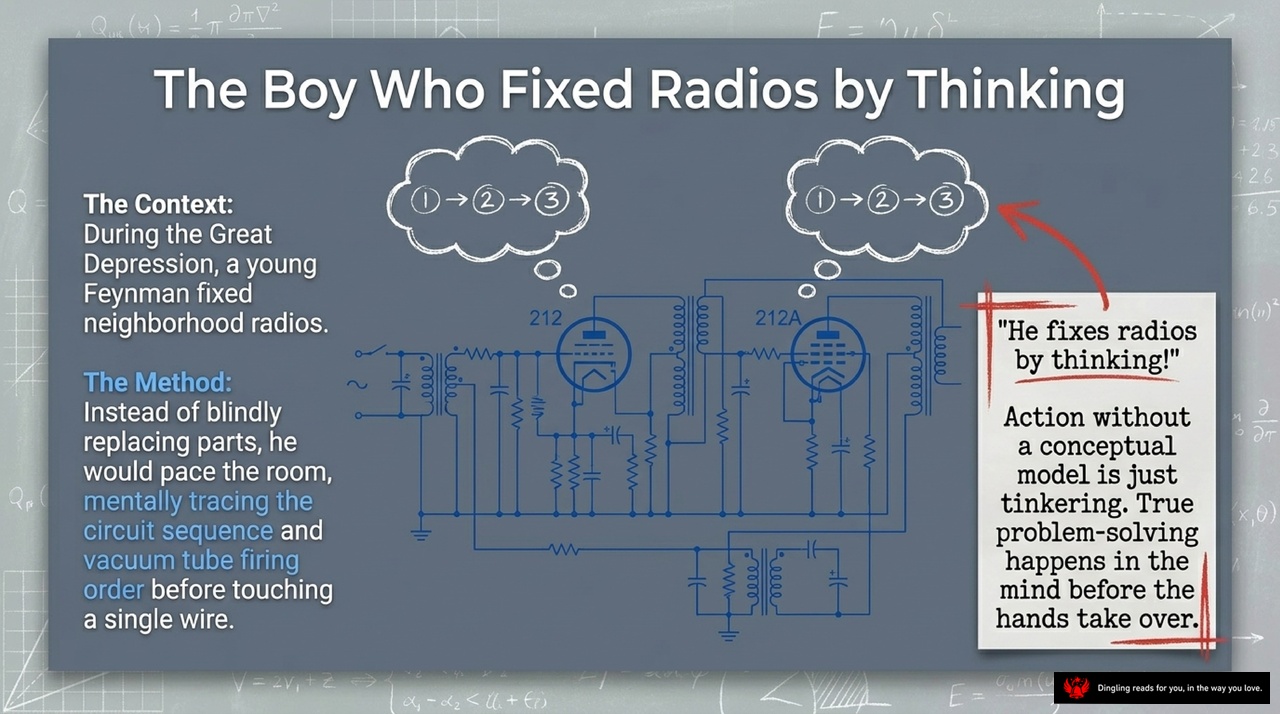
Imagine a young boy during the Great Depression, wandering through his neighborhood with a broken radio. Instead of blindly swapping out parts or guessing, he would pace back and forth, mentally tracing the entire circuit sequence and vacuum tube firing order before ever touching a single wire. This wasn't just tinkering; it was a masterclass in conceptual modeling. As the slide illustrates, true problem-solving happens in the mind long before the hands take over. Action without a mental map is just chaos, but when you fix the radio by thinking first, the solution reveals itself naturally. That is the essence of what it means to truly understand a system, turning a simple repair into a profound act of intellectual engineering.
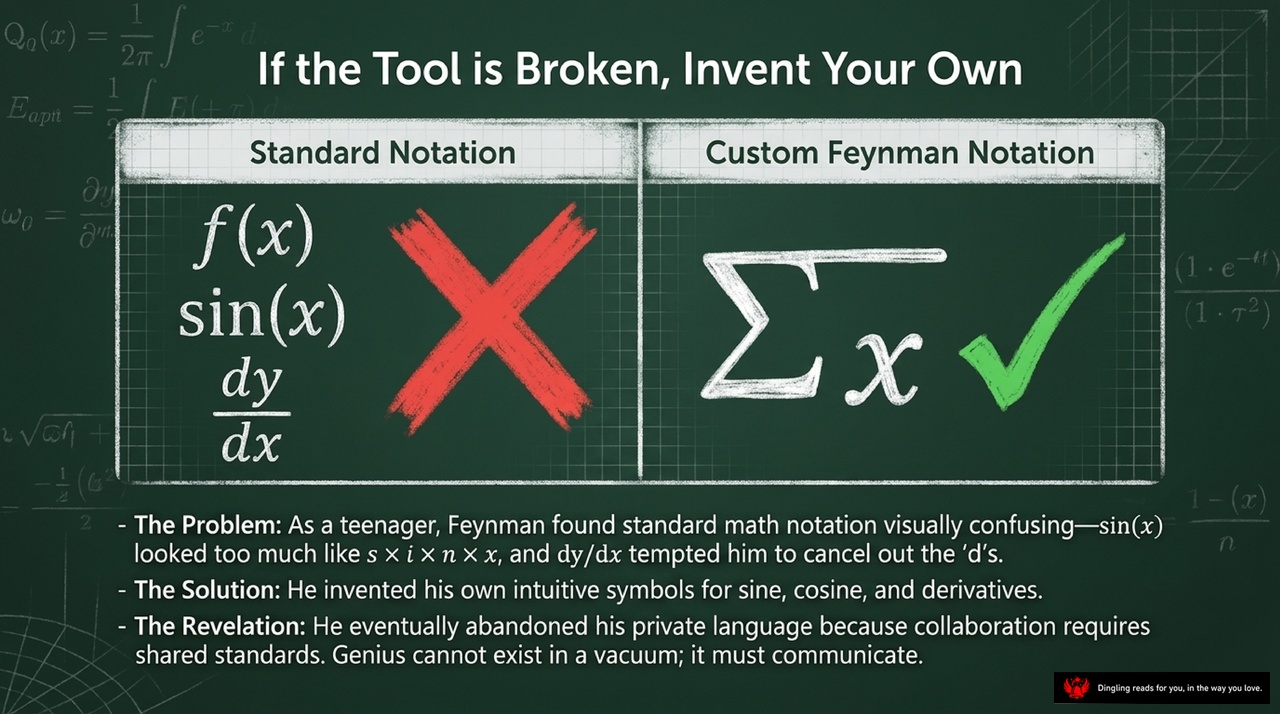
Imagine you're a teenager staring at a wall of confusing math symbols. To Feynman, standard notation like $f(x)$ or $\sin(x)$ looked like a jumble of letters, and seeing $dy/dx$ tempted him to literally cancel out the 'd's. It just didn't make sense. So, he decided to take matters into his own hands. He invented his own "Feynman Notation," creating intuitive symbols for sine, cosine, and derivatives that actually clicked for him. He was right about one thing: when your tools are broken, you should invent your own. But here's the twist. He eventually abandoned his private language because he realized that true genius cannot exist in a vacuum. Collaboration requires shared standards. You can invent the perfect tool for yourself, but if you can't communicate it to the world, it stays just a personal trick. The real breakthrough comes not from hiding your unique perspective, but from finding a way to translate it so everyone else can understand and build upon it.
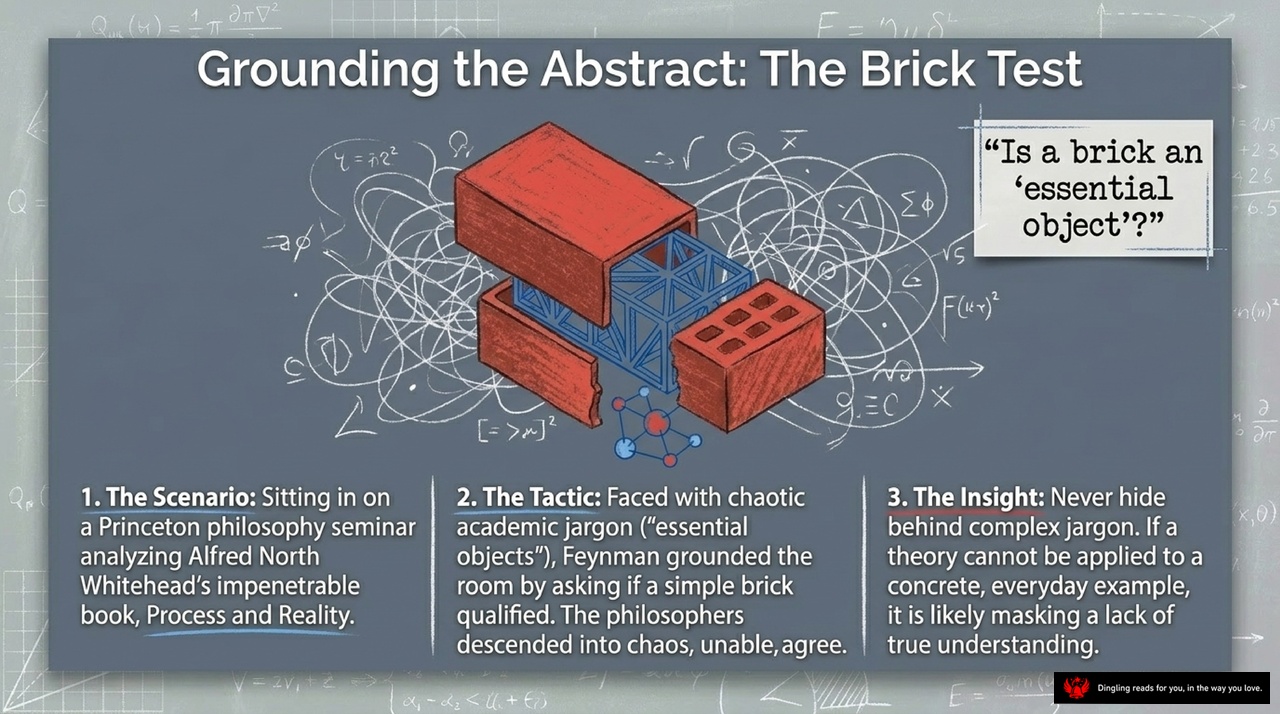
Imagine a room filled with chaotic academic jargon, where philosophers are arguing over whether a brick is an "essential object." It sounds impressive, doesn't it? But as Richard Feynman famously pointed out, hiding behind complex language is often just a mask for a lack of true understanding.
In this slide, we see Feynman's "Brick Test" in action. The scenario takes us back to a Princeton philosophy seminar analyzing Alfred North Whitehead's impenetrable book. When the theorists asked if a brick qualifies as an "essential object," the room descended into chaos. They couldn't agree on whether it was the physical brick, the concept of a brick, or something abstract.
Feynman's tactic was simple yet brilliant: he grounded the abstract by asking, "Is a brick an essential object?" He forced them to look at a concrete, everyday example. The insight here is powerful: never hide behind complex jargon. If a theory cannot be applied to a concrete, everyday example like a simple brick, it is likely masking a lack of true understanding.
This philosophy isn't just about philosophy; it's about how we think. Whether you're solving a physics problem, debugging code, or analyzing a business strategy, if you can't explain it simply—like explaining what a brick is—you probably don't understand it yourself. Feynman taught us that true mastery means being able to strip away the noise and see the reality right in front of us.

Look at this slide titled "The Cure for Imposter Syndrome." It paints a vivid picture of Richard Feynman's very first seminar at Princeton, where he stood before the greatest minds of the 20th century—Einstein, Pauli, and Von Neumann. You can see the silhouette of a nervous young Feynman shaking his hands as he pulls his notes from a brown envelope, terrified to present in front of such giants.
But here is the real lesson from the text: the exact moment his anxiety vanished completely wasn't when he stopped shaking or tried to calm down. It was the exact moment he started writing equations on the blackboard. As soon as he focused entirely on the problem and the work, the ego disappeared. He forgot who was in the room. The physics became the only thing that mattered.
This is "The Rule of Focus." When you focus entirely on the problem and the work, the imposter syndrome vanishes. You stop worrying about who is watching and start caring about the truth of the work. The cure isn't confidence; it's total absorption in the task at hand.

Imagine a world where the most brilliant minds are trapped behind a wall of silence, forced to follow orders without ever understanding the "why" behind them. This was the reality at Los Alamos during the Manhattan Project. As the slide illustrates, the environment was defined by absolute military secrecy and rigid compartmentalization. The hierarchy, stretching from General Groves down to the technical staff, was designed to create a buffer. The military wanted workers to blindly follow safety rules, unaware that they were actually building an atomic bomb.
But here lies the core conflict: The Scientist versus The System. Feynman stood against this friction. He argued passionately for absolute transparency, believing that true safety and responsibility could only come from understanding the inner workings of the machine. As the quote on the right emphasizes, "Los Alamos cannot be responsible for the safety of Oak Ridge unless they fully understand how everything works!" Without that knowledge, blind obedience is just a recipe for disaster.
This brings us to the ultimate lesson of the slide: Understanding the why always trumps blindly following the rules. In high-stakes environments, whether it's building a bomb or navigating a complex organization, knowing the purpose behind the procedure is the only way to innovate and stay safe. It's not about breaking the rules; it's about seeing the reality they are meant to protect.
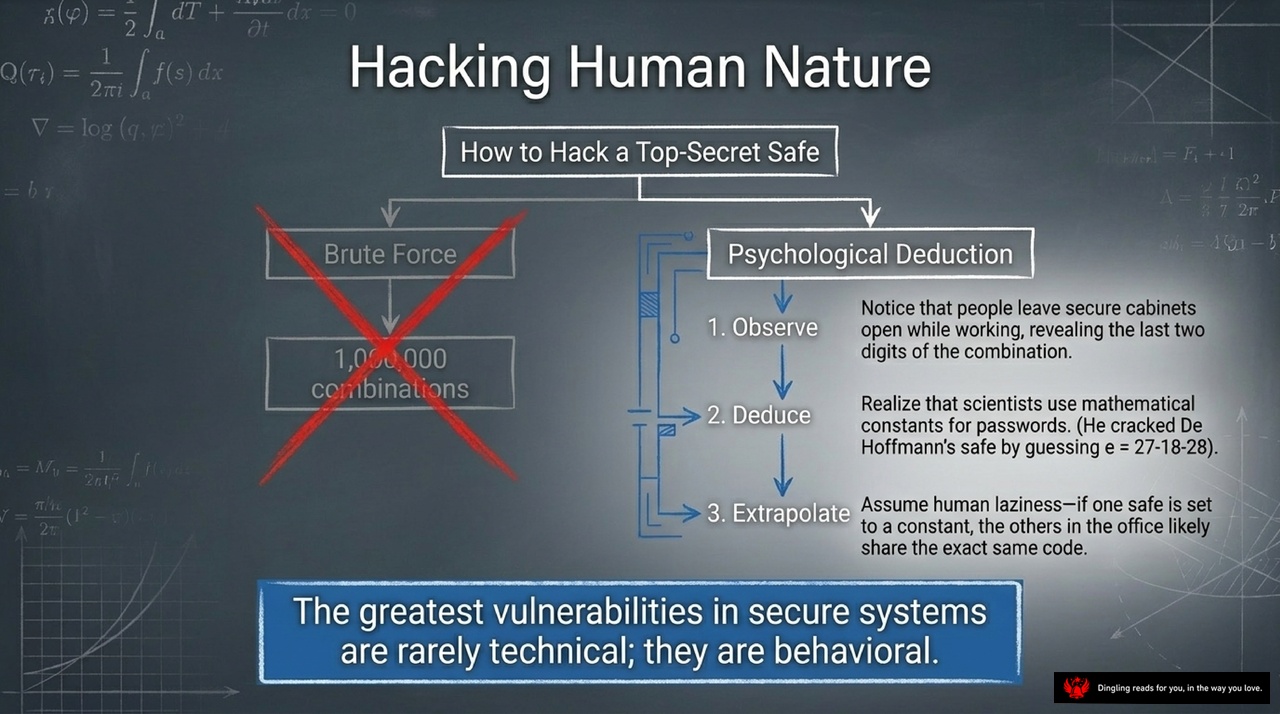
Imagine trying to crack a top-secret safe. The obvious approach is brute force: just try every single combination. If there are a million possibilities, you're looking at an eternity of frustration. But there's a smarter, psychological way to hack human nature instead.
Look at the flowchart here. On the left, we have "Brute Force," which we cross out immediately. It's inefficient and exhausting. The real power lies on the right: "Psychological Deduction." This isn't about math; it's about observing people.
First, you observe. You notice that people often leave secure cabinets open while they work, accidentally revealing the last two digits of the combination. That's free information.
Second, you deduce. You realize that humans love patterns. Scientists, for instance, often use mathematical constants for passwords. In one famous case, a code was cracked simply by guessing the digits of the constant 'e'—27-18-28.
Third, you extrapolate. You assume human laziness. If one safe is set to a constant, it's highly likely others in the same office share the exact same code.
The slide drives home a crucial point at the bottom: the greatest vulnerabilities in secure systems are rarely technical; they are behavioral. We build walls of steel and code, but we forget that the weakest link is always the human mind.

Look at this slide. We see a mushroom cloud, a crumbling city skyline, and a chalkboard filled with complex physics equations. In the center, a haunting quote asks, "They are all crazy. Why are they building new things? It's all useless." This captures the exact moment Richard Feynman hit a wall. Following the success of the atomic bomb and the tragic death of his wife, Arline, Feynman experienced profound existential burnout. Teaching at Cornell, he felt his well of ideas had run dry. Paralyzed by the weight of expectations and the trauma of the war, he could no longer do physics. It felt like everything he had built—the bridges, the roads, the bomb itself—was just noise. But here is the twist: while he felt useless, the world was actually building something far more enduring than a weapon. He realized that the very act of continuing to build, even when it felt pointless, was the only way to survive the aftermath.

Imagine a simple red medallion wobbling on a spinning plate in a Cornell cafeteria. At first glance, it looks like a trivial distraction, but for Richard Feynman, that moment of pure curiosity sparked a chain reaction that would eventually lead to a Nobel Prize.
The slide highlights the power of "play" as the catalyst for genius. Feynman didn't approach this observation with the pressure to solve a major scientific crisis. Instead, he simply calculated the kinematics of the plate for fun, stripping away any expectation of "importance." He noticed that the medallion wobbled at exactly twice the speed of the plate's spin—a 2:1 ratio that became a famous physics label.
This playful exploration led him down a rabbit hole, connecting the wobble of a plate to the orbits of electrons and the complex field of quantum electrodynamics. The key takeaway, as the slide reminds us, is that innovation requires play. When you remove the pressure of significance, curiosity takes over, allowing you to see connections that rigid, high-stakes thinking often misses.
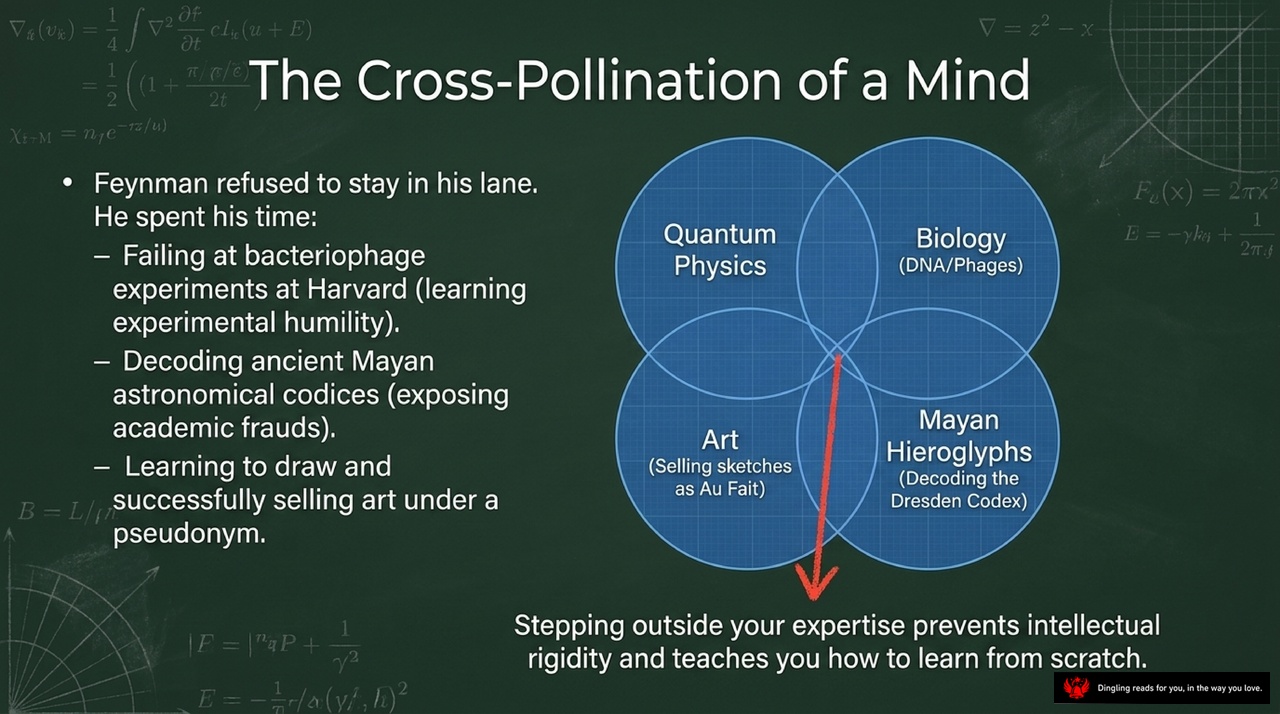
Think about the mind as a garden. If you only water one single plant, you get a very narrow view of what's possible. But what happens when you cross-pollinate? You get something entirely new, something fertile and unpredictable.
Richard Feyman understood this lesson better than almost anyone. He refused to stay in his lane. Look at this diagram: it connects Quantum Physics, Biology, Art, and Mayan Hieroglyphs. At first glance, these seem like completely different worlds. But for Feynman, they were all part of the same conversation.
He spent his time failing at bacteriophage experiments at Harvard, not because he was bad at science, but because he was learning experimental humility. He decoded ancient Mayan astronomical codices, exposing academic frauds along the way. He even learned to draw, selling sketches under a pseudonym called Au Fait.
Why did he do this? Because stepping outside your expertise prevents intellectual rigidity. When you try to understand something you know nothing about, you are forced to learn from scratch. You stop taking things for granted. You stop assuming you know the rules.
Feynman's genius wasn't just about being smart in one field. It was about the cross-pollination of a mind. By mixing physics with biology, art with history, he kept his brain flexible, curious, and constantly evolving. That's the real secret to being truly brilliant.

Look at this slide. It contrasts two very different ways of learning science: "The Reciter" versus "The Investigator." On the left, we see a student who has perfectly memorized complex physics terms like "triboluminescence" and formulas, yet when faced with a real problem, he just stares blankly. This is the trap of knowing names without knowing the thing itself. It's circular logic—swapping one word for another without understanding what they actually mean.
On the right, we see the true scientist. Instead of reciting definitions, this investigator is actually doing the experiment. He's taking a pair of pliers, crushing a sugar cube in a dark room, and watching the blue flash appear. That is empirical evidence. That is real science.
This reminds me of a terrifying paradox Richard Feynman discovered while teaching in Brazil. He found students who could recite advanced physics textbooks perfectly but couldn't solve a single real-world problem. They had the words, but no understanding. True science isn't about memorizing that "triboluminescence is the light emitted when crystals are crushed." It's about taking that action, seeing the result, and understanding the phenomenon through experience. Knowledge without understanding is just noise.

Have you ever heard someone say, "Energy makes it go"? It sounds impressive, doesn't it? But as Richard Feynman discovered while serving on a curriculum committee, this is actually a dangerous illusion. Textbooks often teach children that abstract concepts like "energy" are the magic force behind everything, turning physics into nothing more than meaningless buzzwords. It's like stamping "ENERGY MAKES IT GO" on a toy car, a bicycle, or even a car, without explaining a single thing about how they actually work.
Feynman called this out as a fallacy. Instead of starting with the vague definition of energy, he proposed a better approach: the Feynman Fix. He argued that you should take the toy apart first. Look at the wound-up spring. Examine the gears. Understand the physical mechanics—the actual movement and interaction of parts—before you ever introduce the abstract concept of energy. By seeing the mechanics first, the idea of energy suddenly makes sense. You aren't just memorizing a label; you are understanding the engine of reality.

What is Cargo Cult Science? Imagine you're in the South Pacific, watching planes land with cargo. The locals are fascinated. They don't understand the physics of flight, but they see the form: the long runway, the bright lights, the sound of engines. So, they build a perfect runway, light fires in the exact pattern, and even wear wooden headphones to mimic the pilots. The form is absolutely perfect. But here's the punchline: the planes never come.
This is the "Cargo Cult" metaphor. It's about mimicry without substance. You can copy the rituals, the tools, and the appearance of something, but if you miss the core principle—the intellectual honesty and the deep understanding of *why* it works—you're just building a set that no one ever enters.
In the modern world, we see this all the time. Many fields mimic the forms and rituals of scientific investigation. They publish papers, hold conferences, and use complex jargon. But often, they lack the essential ingredient that makes the planes actually land: intellectual honesty. Without that, you have a perfect simulation of science that produces no real results. It's the difference between understanding how a jet engine works and just painting a picture of one. The former flies; the latter stays grounded.

Look at this chart. It breaks down the "Anatomy of Intellectual Honesty" by contrasting "Cargo Cult Science" with "True Science" across four key dimensions.
First, look at the Objective. Cargo Cult Science aims to prove a preferred theory, no matter what. True Science, however, is brave enough to discover the truth, even if it hurts. It's about finding what is actually true, not just confirming what you want to be true.
Next is Data Handling. In the fake version, you highlight only the confirming data and ignore anomalies. But in true science, you actively publish data that contradicts your theory. You have to be honest with the evidence, even when it tries to disprove you.
Then we have Replicability. Cargo Cult science changes variables rather than repeating past experiments to see if results hold up. True science rigorously repeats past experiments to verify baselines. If you can't get the same result again, you don't have a scientific discovery.
Finally, Communication. Cargo Cult science uses jargon just to sound authoritative and intimidate others. True science uses plain language to ensure universal understanding. It's about clarity, not complexity.
The arrows on the right show how these principles are interconnected. When you fail in one dimension, like hiding contradictory data, it corrupts the entire structure of your work. True science requires integrity in every single step, from the initial goal to how you explain your findings. This is the difference between doing science and pretending to do it.

The first principle is that you must not fool yourself—and you are the easiest person to fool. So you have to be very careful about that. This isn't just a rule for scientists; it's a survival skill for anyone trying to make sense of a complex world. When you master the art of not deceiving yourself, the surprising thing is that it becomes effortless to spot when others are misleading you. Integrity, in this context, goes far beyond simply telling the truth. It requires a radical kind of humility: bending over backwards to show exactly how you might be wrong. This mindset shifts the goal from being right to understanding the truth, no matter where it leads.

The Myth of Honors. Look at this scene: a scientist tossing a Nobel Prize medal into the trash, while a phone rings at 3:30 AM. This isn't just a cartoon; it's Richard Feynman's honest take on fame.
Feynman despised the pomp and circumstance of the Nobel Prize. He hated that after winning, "no one treats you frankly in public anymore." The ceremony felt like a performance, not a conversation. But here is the twist: the real reward isn't the medal, the title, or the money. Those are just distractions.
According to Feynman, the true prize is the pleasure of finding the thing out, the kick in the discovery, and the satisfaction of seeing other people actually use your work. Everything else—the applause, the parades—is just noise. When you strip away the honors, you're left with the only thing that matters: the joy of understanding how the universe works.
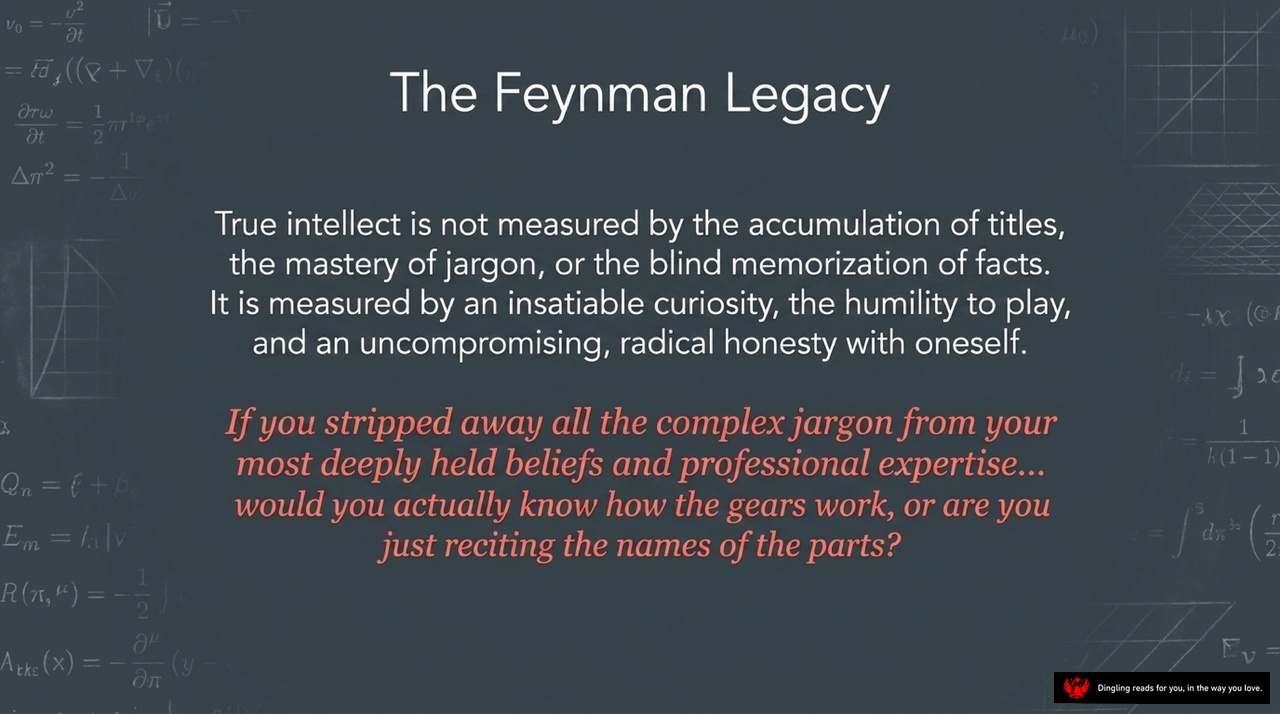
True intellect isn't about stacking titles or memorizing jargon. It's about an insatiable curiosity, the humility to play, and radical honesty with yourself. Imagine this: if you stripped away all the complex jargon from your deepest beliefs and professional expertise, would you actually know how the gears work, or are you just reciting the names of the parts? This is the core of the Feynman Legacy. It's a reminder that real understanding comes from seeing the mechanism, not just the label. Whether you're solving equations or navigating life, ask yourself that hard question. Can you explain it simply? If not, you haven't truly learned it yet. Embrace that curiosity, stay humble, and never compromise your honesty. That's how you build a legacy that lasts.