



The rider elephant path model makes sense for changing habits without relying on endless discipline.
Your Review
The rider elephant path model makes sense for changing habits without relying on endless discipline.

The Rider-Elephant-Path model explains why my gym habits fail and how to fix them by guiding my rational mind, fueling my emotional drive, and reshaping my environment to make healthy choices the easy default instead of relying on exhausting willpower battles that always leave me depleted by evening.

I thought my lack of discipline was the problem but this book showed it is actually about my environment.

This book finally explained why my gym goals failed because willpower is a tired muscle, not a superpower.

The Rider-Elephant-Path framework completely changed how I approach my own procrastination habits.

Willpower is a finite muscle that gets tired.

The Rider Elephant Path model finally makes sense to me and I stopped blaming myself for lack of willpower.

Finally a book that explains why relying on willpower alone always leads to failure and exhaustion.

The strategies for guiding the rider and motivating the elephant make complex changes feel much more manageable.

The Rider Elephant and Path framework gives me a clear plan to stop relying on sheer force of will alone.

The concept of shaping your environment to make good habits easier is a game changer for my daily routine.

Willpower is a finite resource that burns out quickly during a long day.

I finally understand why I keep procrastinating because the emotional elephant in my brain always overrides my rational plans.

The idea that willpower is a muscle that gets tired makes total sense for my daily struggles.

Learning about the path component helped me redesign my workspace to support my focus without needing extra effort.

This book explains perfectly why I keep failing at my fitness goals despite trying so hard every single time.

The idea that willpower is a finite muscle tired by small decisions explains so much about my daily failures to stick to healthy habits or focus on work tasks when I am exhausted after a long day of resisting distractions, making me realize that relying on sheer discipline is a flawed strategy for lasting change. I now see that I must stop blaming myself for giving up and instead start designing my environment and emotional triggers to support my rational planning side, so that the right choice becomes the easy one without needing to force myself through every obstacle or battle against my own instincts and cravings for instant gratification.

The explanation of the Rider, Elephant, and Path helped me finally understand why my gym streaks always fail.

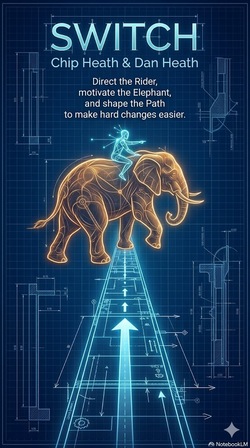
I struggled to stick to my healthy eating plan until I read this. The authors explain that relying only on willpower is a mistake. They argue that our brain has three parts that control behavior. First, there is the rational side called the Rider, which plans but gets stuck overthinking details. Second, there is the emotional side called the Elephant, which drives us based on feelings and hates discomfort. Finally, there is the Path, which is our environment that makes choices easy or hard. The book uses real examples to show how these parts interact. For instance, they describe a study where students who resisted cookies had no energy left for puzzles. This proves that willpower is a limited resource that gets tired. The authors suggest guiding the Rider by finding bright spots instead of overanalyzing problems. They also say we should motivate the Elephant by celebrating small wins to build confidence. Lastly, we must shape the Path by changing our surroundings to reduce friction. One example is placing healthy food on the counter and hiding junk food away. When all three parts align, change becomes easier and lasts longer without constant struggle. I now understand that I cannot just try harder but need to design my life for success. This framework is practical and based on science rather than generic advice. It helps me stop blaming myself for past failures and start taking smart actions today.

Fresh angles that made me rethink a few assumptions.