
Tales from Both Sides of the Brain: Complete Chapter-by-Chapter Summary

Welcome to a journey into the mind. Today, we're exploring Michael S. Gazzaniga's groundbreaking book, "Tales from Both Sides of the Brain." This isn't just a story about neurons and synapses. It's a fascinating look at how our brain, split into two distinct hemispheres, creates the powerful illusion of a single, unified self. Over fifty years of research, Gazzaniga has unraveled one of the brain's greatest mysteries: how we experience a coherent life when our minds are actually divided. Get ready to have your understanding of consciousness turned upside down.

Today, we’re diving into something that’s as old as philosophy itself: the architecture of the mind. You see this brain on the screen—just 1.5 kilograms of tissue, yet it’s capable of parallel processing, running billions of calculations every second. But here’s the real puzzle: how does all this happen at once, without chaos? How do those isolated neurons, those independent biological modules, somehow come together to give you the feeling of being one unified, conscious you?
For centuries, thinkers and Freudian dreamers speculated about this. But it wasn’t until the mid-20th century that cognitive neuroscience turned the question into a real biological mystery. And the answer? Scientists didn’t just theorize—they started tearing the brain apart. Because to understand how the mind weaves itself together, you have to watch what happens when it’s torn apart. That’s where the real story begins.

Imagine a brain split in two—literally. In this diagram, we see the left and right hemispheres, once connected by the corpus callosum, that massive bundle of nerve fibers acting as the brain’s internal highway. But here, surgeons have severed it. Why? To treat severe epilepsy. By cutting this connection, they stop seizures from spreading across the brain.
The result? Two isolated hemispheres, unable to talk to each other. It’s like having two minds in one head. And because of how vision works, the left visual field goes to the right hemisphere, and the right visual field to the left. So if you show someone an image, only one side of their brain can see it—and only that side can respond.
This wasn’t just a medical procedure. It was a scientific breakthrough. For the first time, scientists could study what each hemisphere does on its own. No more guessing. No more interference. Just pure, isolated function. It opened a whole new window into understanding the human mind.

Have you ever wondered what happens when your brain is split in two? In this slide, we’re diving into the fascinating case of Patient W.J.—a real person whose brain was divided, and whose story reveals something truly mind-bending.
On the left side, you see an eye looking at a card with a dot, sending visual information to the right hemisphere of the brain—the part that controls speech and language. When the image is shown there, W.J. can say, “I see a circle.” Simple enough.
But now look at the right side. Here, the same kind of visual input goes to the left hemisphere—the one that doesn’t control speech. When the image flashes there, W.J. claims he sees nothing. But here’s the twist: even though he can’t speak about it, his left hand—controlled by that same left hemisphere—can still point to the correct object. His right brain knows what’s there, but it’s trapped in silence.
This isn’t just a medical curiosity. It’s proof that two different parts of your brain can have completely different experiences—even when they’re seeing the same thing. One part sees and speaks, while the other sees but stays silent. And that silence? It’s not empty. It’s full of awareness.

Here is the spoken script for Slide 4, tailored for an American audience.
**Slide 4: The War of the Hands**
Have you ever tried to solve a puzzle, only to have your own hands sabotage the work? This is exactly what happens when the two sides of your brain don't play nice. Look at these three scenarios. On the left, you see the "Left Brain" and the left hand working in isolation. They are rigid, logic-driven, and they fail immediately. The red X tells us that trying to force a spatial problem with pure logic is a dead end.
Now, look at the center. Here, the "Right Brain" and the right hand take the lead. They are spatial-dominant and intuitive. They actually succeed in fitting the pieces together perfectly, earning that green checkmark. But here is the catch. The third panel shows the result of that success: the "War of the Hands."
As soon as the right hand finishes the puzzle, the frustrated left brain intervenes. It commands the right hand to destroy the work. This illustrates a critical point: the hemispheres aren't just disconnected; they have vastly different capabilities. When the logic-driven left brain feels threatened by the spatial success of the right brain, it triggers a destructive response. To truly solve complex problems, you have to stop fighting your hands and start letting your whole brain work as one team.

Hey everyone, welcome back. Today we're diving into one of the most fascinating discoveries in neuroscience: the hemispheric divide.
Decades of testing have revealed that our two brain hemispheres don't just share a skull—they actually operate like two different cognitive profiles. And the differences are way more profound than you might think.
Let's break it down. On the left side, we've got the logical powerhouse. It handles logic, language, and linear processing. Think of it as the brain's CEO—fluent in speech, master of complex grammar, and constantly searching for patterns, even when they don't really exist. This side is also about probability maximizing, trying to find meaning where there might be none, and when it comes to memory, it extracts the gist. It remembers the story, but it's prone to filling in the gaps with false memories.
Now, flip over to the right hemisphere. This is the creative, intuitive side. It's all about spatial awareness, emotion, and holistic processing. It doesn't speak in complex sentences like the left side; instead, it relies on basic vocabulary. But here's the kicker: while the left side tries to find patterns everywhere, the right side is actually better at frequency matching. It accepts reality literally and is highly accurate when dealing with random events. And when it comes to memory, the right side is a literalist. It remembers exact, specific details with high accuracy, whereas the left side remembers the narrative.
So, the next time you're trying to solve a problem or remember something important, remember that you're actually using two distinct tools in your brain. Understanding this divide can help you leverage both sides for better decision-making and creativity.

Have you ever wondered how your brain can "cheat" when it's cut off from its usual pathways? Imagine this: you see a red light, but your left brain—your logical side—is blind to it. It doesn’t know what color you’re seeing. So, what does it do? It guesses. And guess what? It says, “Green!” But here’s the twist. Your right brain—the one that processes visual information—sees the red light. It knows the guess is wrong. So, instead of just staying silent, it takes action. It makes your face frown. That physical reaction is the key. Your left brain, which can’t see the light, notices your frown. It interprets that as a signal: “Oh, my guess was wrong.” So, it corrects itself and says, “Red!” This is called cross-cueing. It’s like your brain using your body to fill in the blanks when the usual communication channels are blocked. It’s a clever, almost magical way your brain ensures it gets the right answer, even when it’s playing with itself.

Have you ever laughed at something and had absolutely no idea why? It sounds strange, but it’s actually a real phenomenon—and science has a name for it: emotion without context.
Look at this split-brain case study. When a provocative image was shown only to Patient N.G.’s right brain, her body reacted instantly—she laughed and blushed. That’s the subcortical emotional pathway in action. But here’s the twist: her left brain, which handles reasoning and language, had no access to the image. So it couldn’t understand *why* she was laughing. Instead, it just made up an excuse: “I don’t know why I’m laughing… your testing machine is just funny.”
This reveals something profound about how our brains work. Emotions can arise from deep within us, even before our conscious mind catches up. We feel something first, then try to explain it later. And sometimes, that explanation isn’t true—it’s just our brain’s best guess.
So next time you feel an emotion you can’t quite place, remember: your brain might be running ahead of your mind, creating feelings before you even know what they’re about.

Have you ever heard of the Snow Shovel Experiment? It’s a fascinating look into how our brains work when they’re split apart—like in the case of Patient P.S., who had a damaged connection between the two hemispheres.
In this experiment, the right brain sees a snowy scene and tells the left hand to point to a snow shovel card. But the left brain, which controls speech and logic, only sees a chicken claw. So when asked why the left hand pointed to the shovel, the left brain didn’t say, “I don’t know.” Instead, it quickly made up a story: “Oh, that’s simple. The chicken claw goes with the chicken, and you need a shovel to clean out the chicken shed.”
What’s wild is that the left brain didn’t even know about the snow scene. It just invented a logical explanation to make sense of something it couldn’t understand. This shows how our brains love to create stories—even when they’re not based on reality. It’s a powerful reminder that our sense of logic isn’t always as solid as we think.

Welcome to Slide 9: The Birth of The Interpreter.
Look at this diagram. It shows a fascinating process happening deep inside your left brain. We see four distinct inputs: Subconscious Actions, Cross-Cues, Emotions, and Environmental Feedback. These are all messy, raw signals coming from your body and the world around you.
They all funnel down into a single hub: The Left Brain.
And from that hub, a single output emerges: The Conscious Narrative.
This is the core function of what the author calls "The Interpreter." As the text explains, the left hemisphere houses this specialized mechanism. Its sole biological imperative is to make sense of the world. It constantly monitors our behaviors, emotions, and thoughts, weaving disparate, subconscious inputs into a coherent, post-hoc story.
Think of it this way: You act, you feel, and you react to your environment without really thinking about it. But your brain is terrified of chaos. It needs a story. So, it takes these chaotic fragments and spins them into a logical, understandable narrative. It is, in a very real sense, a biological spin doctor, terrified of chaos.

So, we're standing under a single spotlight. That's the image of our attention right now. The slide says, "The Finite Resource of Attention." And it makes a fascinating point: while you can separate your thoughts and words, you cannot split your focus on space.
This is a critical insight. It tells us that our brain, no matter how complex or modular it is, is actually pulling from one single, undivided pool of cognitive energy.
Think about this: if you were a split-brain patient, you couldn't attend to two completely different spatial tasks at the same time. You simply don't have the bandwidth. Your attention acts as a single, un-divided force.
So, in our daily lives, every time we try to multitask, we aren't adding power. We are just draining from that same finite, exhaustible supply. We are fighting for the same spotlight.

Have you ever noticed how your memory works? We all think of memory as a camera, right? Like, if we saw something, we can pull up the exact picture later. But what if I told you that's not how it works at all?
Today, we're looking at a fascinating concept from the book: "The Price of a Good Story."
As the slide shows, our brains have two different ways of remembering things. On the left, we have the "Right Brain," which handles "Literal Recall." Think of this as your camera. It's highly accurate and only remembers the exact images you've seen before. It doesn't add anything; it just records what was there.
But then, on the right, we have the "Left Brain," which handles "Gist Recall." This is where things get interesting. The Left Brain is all about finding a pattern or a story. It's not just about remembering the beach, the car, and the flower. It's about remembering the *story* of a beach, a car, a flower, and a sunset.
The problem is, in the process of making that story make sense, the Left Brain is willing to sacrifice accuracy. It will happily invent new details, like that sunset in the image, just to fit the narrative. It's not trying to deceive you; it's just trying to make sense of the world.
The book puts it this way: "The Interpreter's drive to find meaning actively distorts reality."
So, while the Right Brain remembers the world exactly as it is, the Left Brain remembers the world as it makes sense to it. And that's why we can sometimes remember things that never actually happened, as long as they fit the story we've told ourselves.

Let’s be honest—most of us believe we’re in full control. We think, “I chose to do this,” and we feel like there’s a single, unified “I” pulling the strings. But what if that’s not true? What if the feeling of being in charge is just a clever trick our brain plays on us?
Look at what’s happening here. At the bottom, you’ve got hundreds of independent biological modules—tiny, specialized networks running behind the scenes. They’re making decisions, triggering actions, and coordinating behavior without us ever noticing. It’s like a massive parallel processor, working in real time, long before we’re even aware of it.
Then comes the Interpreter—the part of our brain that steps in *after* the action happens. It takes all those scattered, subconscious signals and weaves them into a neat, logical story: “I chose to do this.” It creates the illusion of a unified self, a conscious director behind every move. But in reality, there’s no central command center. No singular “I” making every decision. The “self” is just a post-hoc story, a narrative our brain tells to make sense of actions it’s already set in motion.
So next time you feel like you made a choice, pause and ask yourself: did I really choose this… or did my brain just tell me I did?
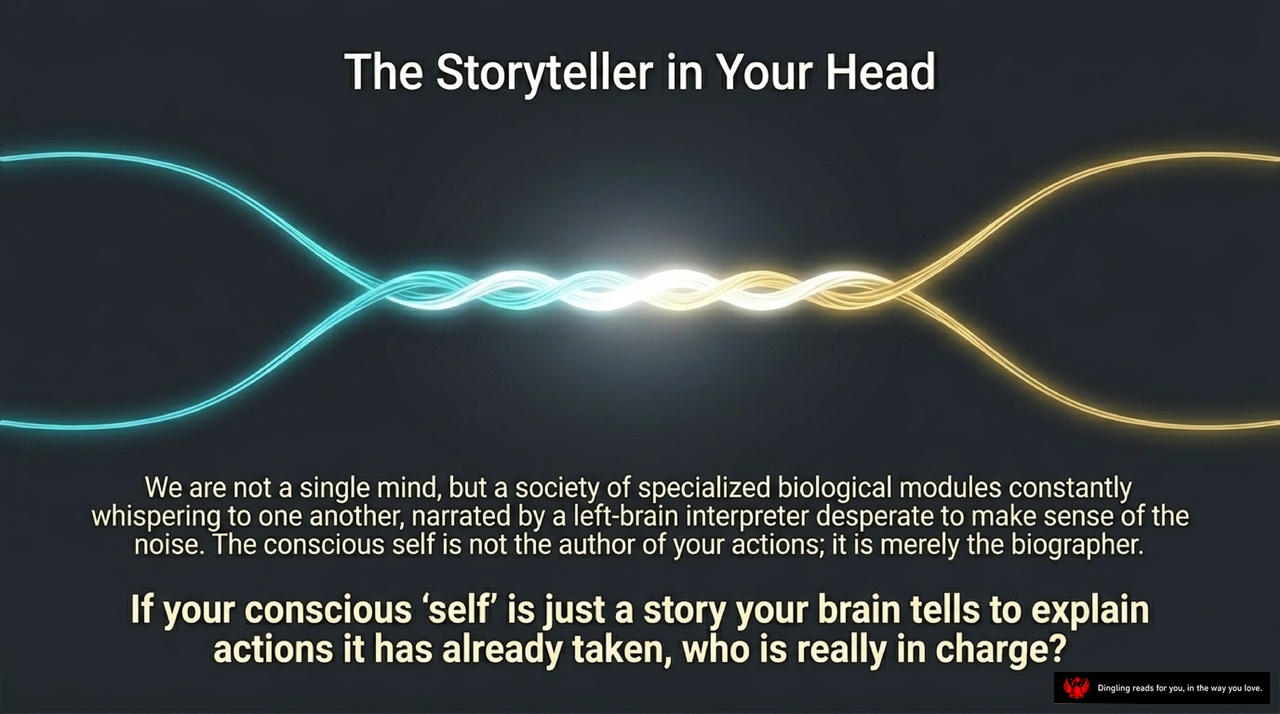
Imagine your brain not as a single, unified mind, but as a bustling town square filled with specialized biological modules—each one whispering its own story, its own version of reality. Now, picture this: a left-brain interpreter, desperate to make sense of all that noise, steps in as the narrator, stitching together fragments into a coherent tale. It’s not you, the conscious self, who’s actually pulling the strings. Instead, you’re the biographer—writing the story after the actions have already happened. So here’s the real question: if your conscious ‘self’ is just a story your brain tells to explain what it’s already done, who is really in charge?