
Teach Like Your Hair's on Fire: Complete Chapter-by-Chapter Summary
Welcome to a masterclass on transforming ordinary classrooms into extraordinary spaces of trust, excellence, and lifelong character. Today, we are diving into the heart of Rafe Esquith's philosophy from his book, *Teach Like Your Hair's on Fire*.
The image before us captures the essence of this journey: an open book overlaid with architectural blueprints. This isn't just about building walls or arranging desks; it is about designing the very foundation of a child's life. Esquith argues that the difference between a cramped, fearful classroom and a space filled with infinite possibility lies not in the physical room, but in what flows between the teachers and students.
The core message here is clear: education has no shortcuts. True excellence requires sacrifice, resilience, and the courage to be vulnerable. Esquith shares that even the most dedicated teachers face sleepless nights and failures, but it is through these struggles that real growth happens. He challenges the notion that we can control classrooms through fear or shortcuts. Instead, he advocates for replacing fear with trust. When a teacher becomes a reliable shoulder, speaking their promises and acting with integrity, students feel safe enough to take risks, learn deeply, and develop into confident, ethical individuals.
Ultimately, this is a call to action for educators and parents alike. It reminds us that while we may not be superhuman, our consistent commitment to kindness, fairness, and belief in every child can create miracles. Let's move forward not by chasing quick fixes, but by building a legacy of trust that lasts a lifetime.
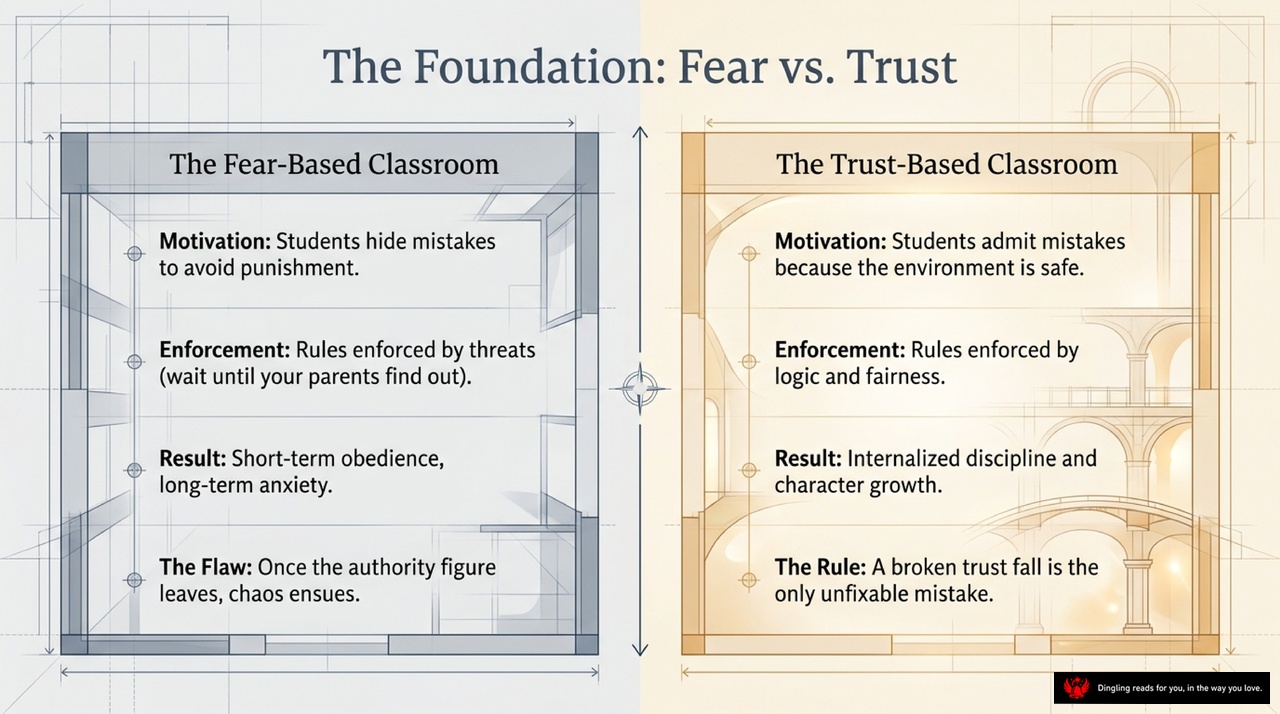
Look at the blueprint on the screen. We are comparing two completely different foundations for a classroom: one built on fear, and the other built on trust.
On the left, we have the Fear-Based Classroom. Here, the motivation is simple but toxic: students hide their mistakes just to avoid punishment. The enforcement relies on threats, like the classic "wait until your parents find out." The result? You get short-term obedience, but you pay a heavy price with long-term anxiety. The fatal flaw? The moment the authority figure leaves, chaos ensues. It's a house of cards.
Now, look at the right side: The Trust-Based Classroom. The motivation shifts entirely. Students admit mistakes because the environment is safe. Enforcement isn't about threats; it's about logic and fairness. The result is internalized discipline and real character growth. This is the most powerful rule of all: a broken trust fall is the only mistake that cannot be fixed. Once you lose that trust, the foundation crumbles.
So, how do we move from the left to the right? We have to realize that fear is a cheap shortcut that destroys potential. When a room is controlled by fear, students are too busy looking over their shoulders to actually learn. They aren't developing critical thinking or moral courage; they are just surviving.
In the 56th Classroom, we replaced fear with trust. We made it clear that while breaking a promise is unforgivable, making a mistake is human and fixable. We taught them that rules should be logical, not arbitrary. We showed them that doing the right thing matters far more than avoiding punishment or chasing a reward. When we build a classroom on trust, we don't just get compliant students; we get responsible, confident, and kind people who are ready to face the world.

Imagine a staircase representing the journey of moral development, where most classrooms get stuck at Level 4, simply teaching children to follow rules. But true education demands we push them higher, toward Level 6: Character. This is the realm of Martin Luther King Jr. and Rosa Parks, where individuals follow a personal code of behavior because it is right, not because they fear punishment or crave a reward.
While many schools stop at Level 4, relying on external rules to dictate behavior, the 56th Classroom aims for a deeper transformation. We teach students that rules are necessary, but they shouldn't be the ceiling of their moral compass. If we only train children to obey because they are told to, we miss the opportunity to build empathy and integrity. As we move up the steps, we encourage students to think about others, to understand perspectives different from their own, and eventually, to act with conscience even when no one is watching.
The goal isn't just to create students who can pass a test on civics, but to raise young people who will stand up for what is right in the real world, long after they've left the classroom. That is the difference between a student who obeys and a person who possesses true character.
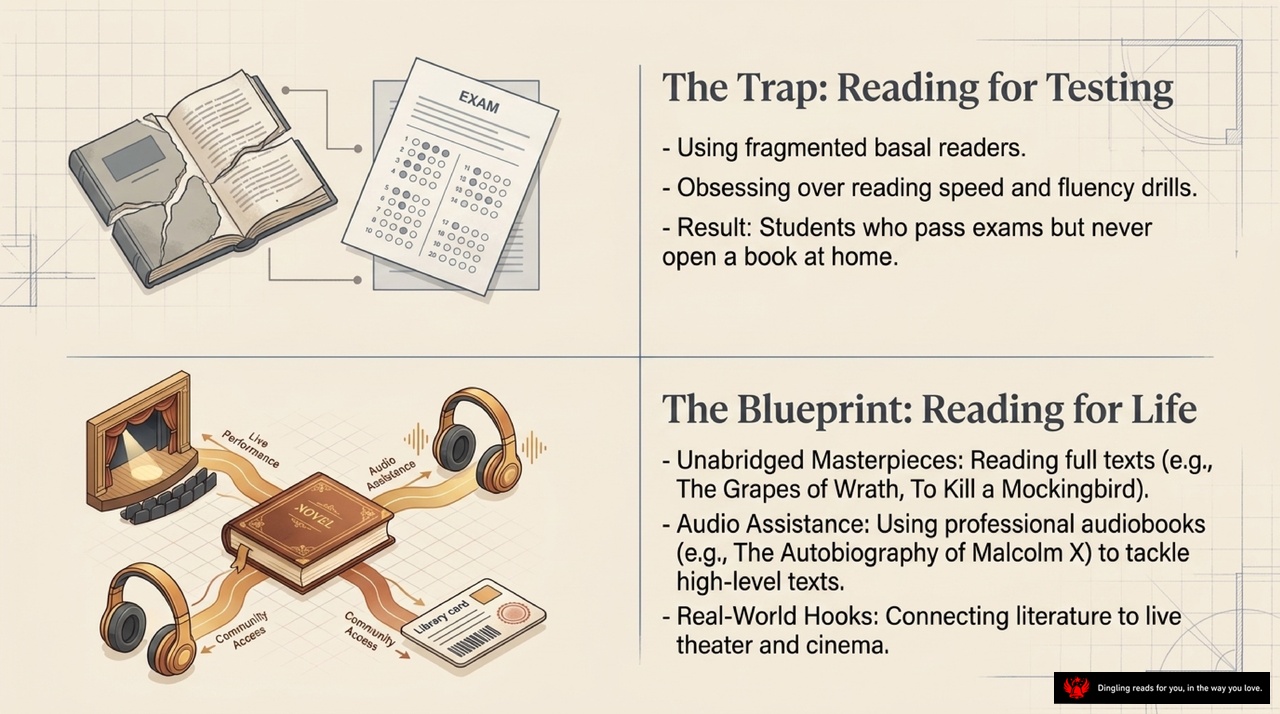
The slide clearly contrasts two opposing approaches to education: the "Trap" of reading for testing versus the "Blueprint" for reading for life. On the top half, we see a broken book leading to an exam sheet, symbolizing how fragmented basal readers and an obsession with speed drills create students who pass tests but never truly open a book at home. This is a system that prioritizes metrics over mastery.
But look at the bottom half; that is where the real magic happens. This is the blueprint for reading for life. Instead of isolated drills, we embrace unabridged masterpieces like *The Grapes of Wrath* or *To Kill a Mockingbird*. We use audio assistance, like professional narrations of *The Autobiography of Malcolm X*, to help students tackle high-level texts without getting overwhelmed. We connect literature to real-world hooks, linking books to live theater and cinema. And crucially, we leverage community access through libraries. As the image shows, reading isn't just about sitting alone; it's about being part of a culture where books are accessible and celebrated. This approach doesn't just teach students how to read; it teaches them why reading matters, transforming them from test-takers into lifelong learners.

Look at this architectural blueprint for writing. It's not just about putting words on a page; it's about building a sturdy structure that can stand the test of time. In Stage 1, we start with the foundation: Daily Grammar. We spend 30 minutes every morning drilling down until students reach 90% accuracy. It's about immediate feedback and mastering the rules so they become second nature.
Once the foundation is set, we move to Stage 2: Weekly Essays. Every Friday, students tackle one-page thematic essays, with a hard deadline on Monday. This isn't just about writing; it's a lesson in time management and structural precision. They learn that good writing requires planning and discipline.
As they grow, we enter Stage 3: Monthly Reports. Here, the focus shifts from mechanics to meaning. Students perform a deep analysis of character, conflict, climax, and theme. We take classic texts like *The Wizard of Oz* and deconstruct them, teaching them to see the architecture of a story.
Finally, we reach the grand arch of Stage 4: The Young Authors Project. This is a year-long pursuit where students write, illustrate, and physically bind a complete, original book. It's the ultimate test of their skills, transforming them from learners into creators. This entire process proves that with the right architecture, any student can build their own masterpiece.

Pillar III: Demystifying Mathematics. Look at this slide. We're moving away from the fear-based math classrooms that so many of us know too well. Instead, we're building a space where numbers feel like a language, not a weapon.
First, let's talk about mental math. It's not about rote memorization; it's about rapid-fire arithmetic chaining. Imagine starting with the 50 states and instantly adding a dozen, then subtracting the number of Supreme Court Justices. This isn't just calculation; it's cross-disciplinary thinking that keeps the brain engaged and curious.
Next, we have The Buzz Game. This is a rapid-fire counting challenge where students must count to 100, but every time they hit a multiple of a chosen number—or any number containing that digit—they shout "Buzz." It forces them to stay hyper-focused, turning a simple counting exercise into a high-energy game of concentration.
Finally, look at Marcy Cook Tiles. These physical 0-9 tiles transform math into a spatial puzzle. Students have to evaluate multiple constraints simultaneously to fit the numbers correctly. This eliminates rote memorization and teaches them that math is about logic, reasoning, and seeing patterns in the world around them.
The goal here is simple: make math fun, make it relevant, and absolutely, make it fearless.
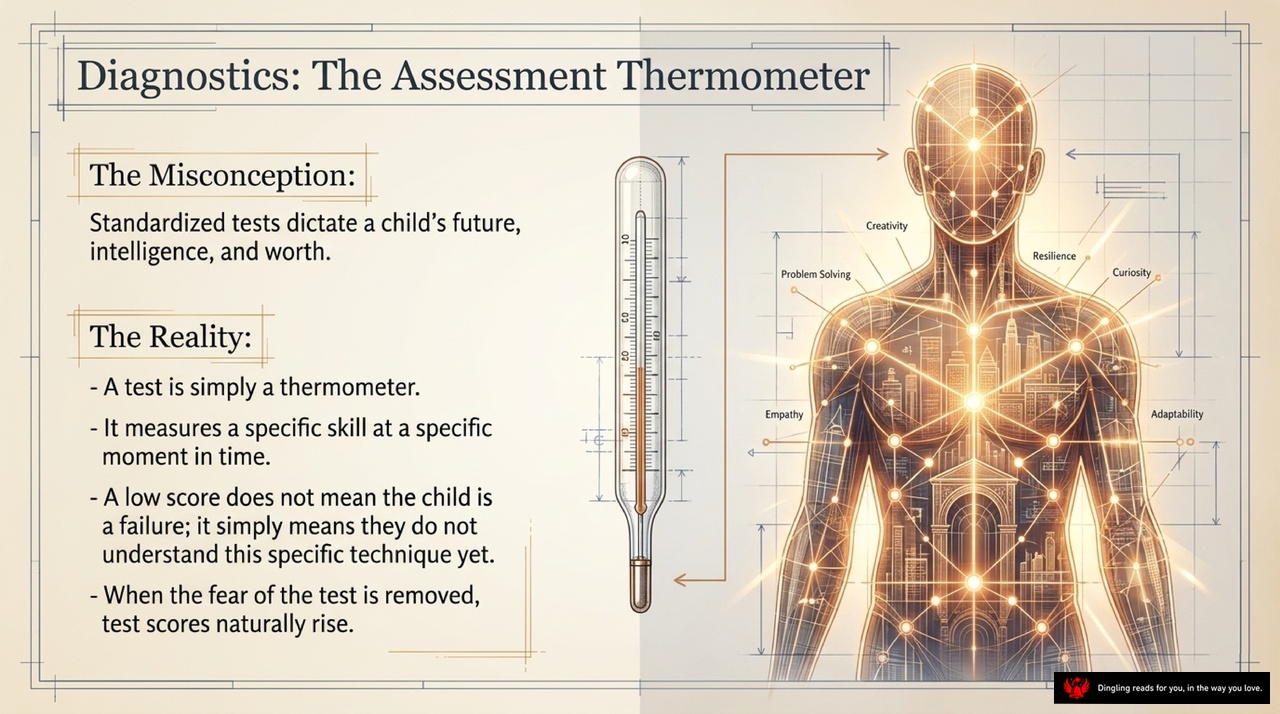
Imagine a world where a single test score defines a child's entire future, their intelligence, and their worth. That is the dangerous misconception we often see in schools. But what if I told you that a test is nothing more than a thermometer? Just like a thermometer measures your body temperature at a specific moment without judging your overall health, a test simply measures a specific skill at a specific time. It does not measure a child's potential, character, or value.
When we remove the fear of the test from the classroom, something remarkable happens: scores naturally rise. Why? Because children stop fighting against the pressure and start focusing on the actual skill being measured. A low score doesn't mean failure; it just means the child hasn't mastered that specific technique yet. In our classroom, we teach students that a test is just a tool for feedback, not a verdict on their life. By shifting our perspective from "pass or fail" to "what can I learn now?", we unlock a level of performance that fear could never achieve. Remember, a thermometer doesn't break your arm when it shows a fever; it just tells you what's happening. Let's stop treating our students like fragile instruments and start helping them understand that their worth is far greater than any number on a page.

Imagine a classroom where students aren't just memorizing answers, but learning to think like detectives. This slide introduces a powerful strategy called "The Detective Method," designed to help students master tests without simply drilling flashcards. Instead of passively studying, we teach students to reverse-engineer the exam itself. Think of a standard 20-question test as if it were an 80-question puzzle: you have to find the 20 right answers and, crucially, identify the 60 traps hidden within.
Look at the example problem here: 63 plus 28. The correct answer is C, which is 91. But notice the other options? They aren't random guesses; they are specific traps designed to catch common mistakes. Option A, 35, is the trap for the student who accidentally subtracted instead of adding. Option B, 81, catches the student who forgot to carry the 1. And Option D, 811, is the trap for anyone who just adds the digits straight down without considering place value.
By analyzing these traps, students stop fearing the test and start understanding the logic behind the errors. They learn that every wrong answer reveals a specific thinking mistake, turning a scary exam into a solvable mystery. This approach shifts the focus from rote memorization to deep understanding, empowering students to navigate any challenge with confidence.

The ultimate goal of education isn't just about acing the SAT to get into college; it's about building character and opening up broad horizons for life. As we look at the big picture, three pillars stand out: Global Awareness, Cultural Fluency, and Active Empathy.
First, let's talk about Global Awareness. It's not enough to just live in your neighborhood; true education means understanding that the world is much larger than your immediate surroundings. Imagine being able to identify 150 countries on a blank map. That kind of spatial understanding helps children realize there is a vast, interconnected world beyond their doorstep.
Next, we move to Cultural Fluency. This goes beyond just knowing facts; it's about how you engage with the world. It's demonstrated by things like attending the Oregon Shakespeare Festival and immersing yourself in different stories, or simply mastering the art of perfect etiquette and active listening. When you can navigate different cultural contexts with grace and curiosity, you become more adaptable and respectful.
Finally, and perhaps most importantly, is Active Empathy. This is where character truly shines. It's not about waiting to be asked; it's about taking initiative. Think of the moment you cross the street to help a stranger pick up trash from an overturned truck, without expecting a reward or even a "thank you." That spontaneous act of kindness defines a person more than any test score ever could.
When we combine these elements—knowing the world, respecting its diversity, and caring for its people—we create students who are not just academically successful, but truly human. That is the real magic of the 56th Classroom.

Great education isn't about passing a test; it's about building something far more enduring. As we look at the core of what truly matters, we see that great education transcends standardized testing. It is the deliberate construction of trust, the laying of rigorous academic foundations, and an unwavering commitment to personal character.
But here is the hard question we all need to face: If our ultimate goal is to raise exceptional human beings, why are we still designing our classrooms around the fear of a test? When we let the fear of a grade drive our daily decisions, we aren't just teaching math or reading; we are teaching children that their worth is tied to a number. This fear creates an environment where kids are too busy worrying about getting caught or pleasing an authority figure to actually learn how to think, how to empathize, or how to be kind.
True transformation happens when we shift the focus from external validation to internal growth. We need to move away from the idea that education is a series of hurdles to clear for a test, and instead view it as a journey to build character. When we prioritize trust over fear, and character over scores, we create a space where children feel safe enough to take risks, make mistakes, and ultimately, become the extraordinary people they were meant to be.