
Team of Teams: Complete Chapter-by-Chapter Summary

Welcome to "Team of Teams." If you've ever felt that your organization is moving too slowly while the world is spinning wildly around it, you're not alone. In today's unpredictable environment, the old rules of engagement simply don't work anymore.
This book, written by Stanley McChrystal and his team, argues that to survive, organizations must dismantle their rigid, top-down hierarchies and rebuild themselves as agile, interconnected networks. Think of it as a fundamental shift from a machine to a living ecosystem.
The core idea is simple but revolutionary: instead of relying on a central command to dictate every move, you need to create a "Team of Teams." This means breaking down the silos that separate departments and empowering small, self-contained units to make their own decisions based on a shared vision and real-time information.
Just like the U.S. Special Operations forces learned in Iraq, when you stop waiting for permission and start trusting your people with the full picture, you gain a speed and flexibility that your opponents can't match. It's about shifting from control to collaboration, and from planning to adaptation. In a complex world, the most powerful weapon isn't a better plan—it's a team that can think and act as one, instantly.
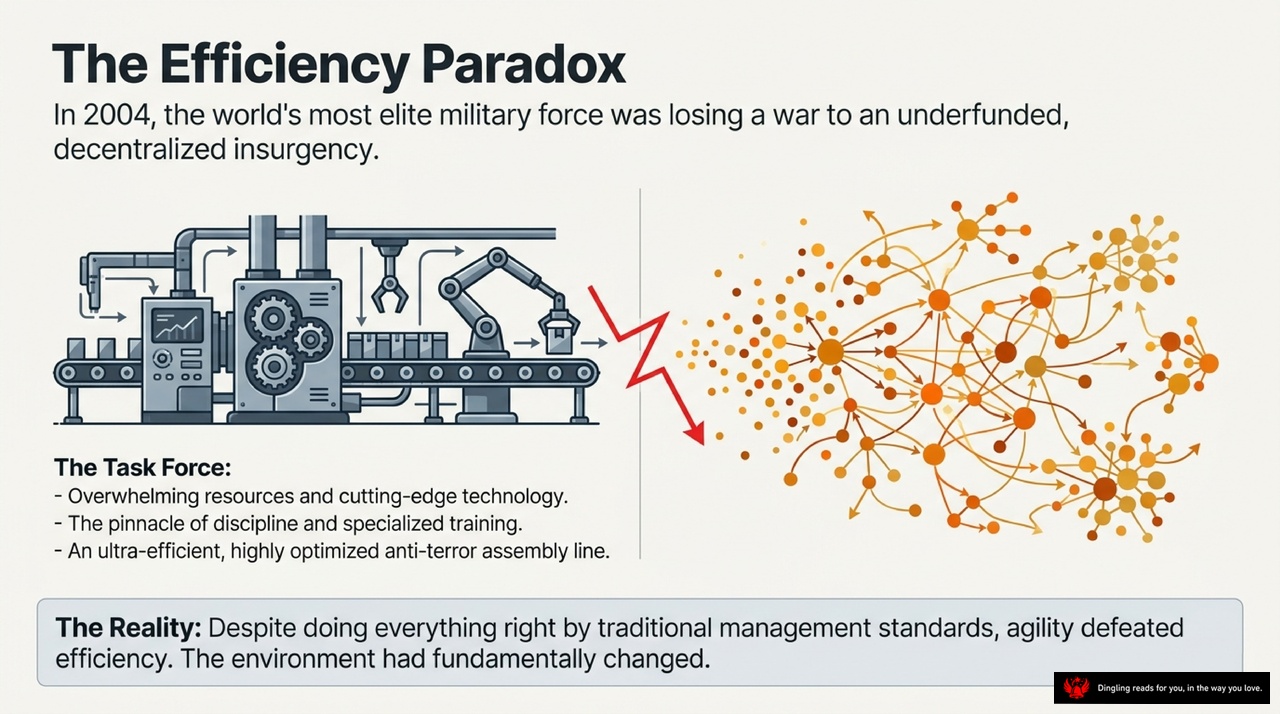
Imagine a high-tech assembly line on the left, representing the "Task Force"—a machine built for peak efficiency with overwhelming resources, cutting-edge technology, and an ultra-optimized anti-terror process. It was the pinnacle of 20th-century management, designed to predict and control every outcome. But look at the right side: a chaotic, interconnected web of dots and arrows. This represents the enemy, an underfunded, decentralized insurgency that refused to play by the rules of the assembly line.
Here lies the Efficiency Paradox. In 2004, the world's most elite military force, armed with everything "right" according to traditional standards, was losing a war to a ragtag group. The reality was stark: despite our rigid, highly optimized systems, agility defeated efficiency. The environment had fundamentally changed. We were trying to use a factory blueprint to fight a living, breathing network. The lesson was clear: when the world becomes too complex and interconnected for prediction, the only way to win is to stop trying to control everything and start building an organization that can adapt just as fast as the chaos around us.

For over a century, we've been running our organizations like giant, rigid clockwork machines. This is the legacy of Taylorism: breaking complex work into tiny, isolated tasks where workers just execute orders while top management does all the thinking. We optimized everything for maximum efficiency, creating silos that were Mutually Exclusive and Collectively Exhaustive—MECE. It worked beautifully in a predictable world, but here's the flaw: this structure relies entirely on predictability. When the environment shifts rapidly, the clockwork shatters.
Look at the diagram on your screen. We divided our world into separate boxes, assuming that if we just optimized each part perfectly, the whole would work. But the reality of the 21st century is chaos and connection. The enemy we faced in Iraq wasn't a predictable army with a clear hierarchy; it was a fluid, networked force that could adapt instantly. Our rigid, top-down command structure was too heavy to turn. We were trying to fight a fluid war with a rigid machine.
The lesson here is profound: efficiency is not the same as effectiveness. Being efficient means doing things right; being effective means doing the right thing. Our traditional model could do things right, but it couldn't pivot fast enough to do the right thing when the situation changed. When the world moves faster than our planning cycles, the entire system becomes obsolete. We realized that to survive in a complex, unpredictable environment, we had to stop building clockwork organizations and start building living, breathing networks where information flows freely and decisions happen at the edge, not at the top.

We've long treated the modern world like a clockwork machine—predictable, linear, and solvable with a detailed blueprint. But the slide makes it clear: we've mistaken a "complicated" engine for a "complex" ecosystem. Look at the contrast. On the left, we have the engine: many parts, yes, but they interact in a straight line. If part A moves, part B follows. It's predictable. The solution there is simple: detailed planning, efficiency, and optimization. That was the logic of the industrial age, the era of Taylorism where we believed we could engineer the perfect outcome by controlling every variable.
But look at the right side. That's the weather. This is our reality today. Here, nature is defined by dense interdependencies and high volatility. Behavior isn't predictable; a tiny shift can trigger a cascading butterfly effect. You can't just plan your way through this. The slide points out that the solution here isn't more control, but resilience, agility, and continuous adaptation. We are no longer fighting a war against a static enemy; we are navigating a dynamic environment where the enemy adapts faster than our rigid plans. The traditional top-down command structure that worked for a machine simply cannot survive in an ecosystem. To win, we have to stop trying to engineer the future and start learning how to dance with it.
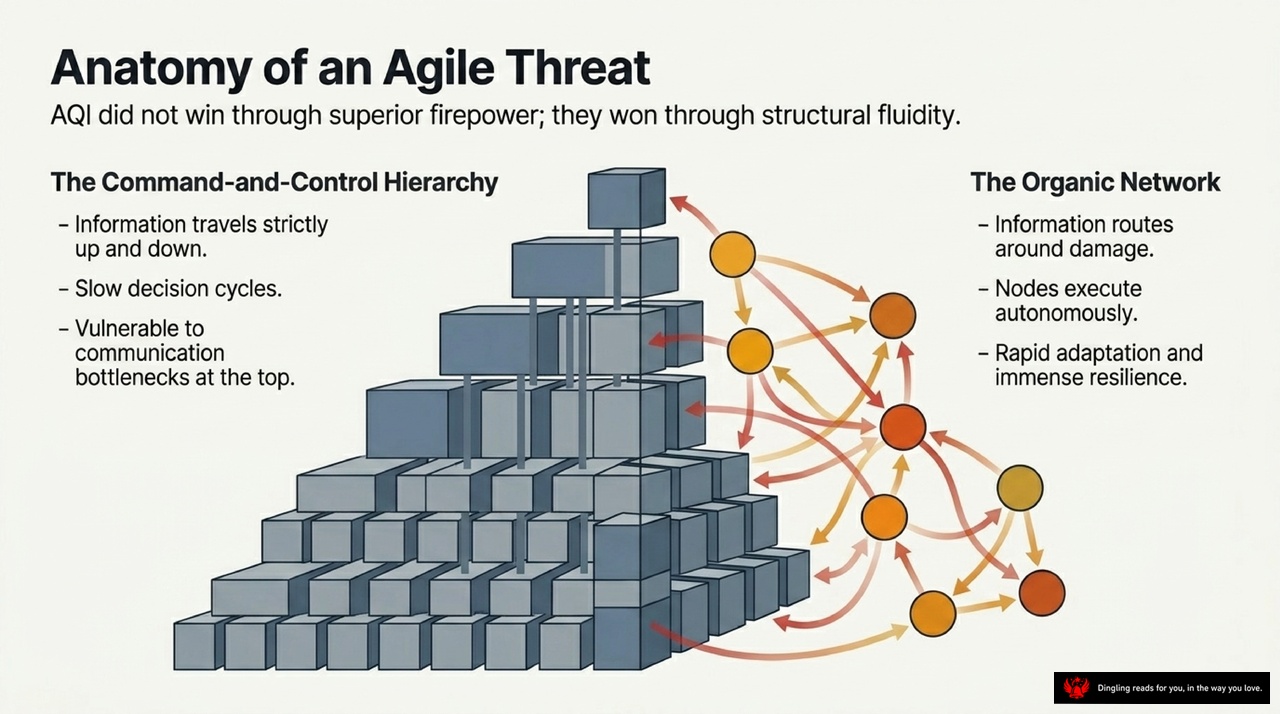
Look at this diagram: on the left, we see the "Command-and-Control Hierarchy"—a rigid pyramid where information travels strictly up and down, creating slow decision cycles and leaving the organization vulnerable to bottlenecks at the top. On the right, we see the "Organic Network," where information routes around damage, nodes execute autonomously, and the system boasts rapid adaptation and immense resilience.
The slide captures a brutal truth: AQI didn't win through superior firepower; they won through structural fluidity. While our forces were trapped in that heavy, mechanical pyramid, trying to predict every move, the enemy operated like a living network. They were decentralized, meaning that even if we destroyed a leader, the network simply reconnected and kept moving.
This wasn't just a military problem; it was a crisis of management for the entire 21st century. Traditional models, built for predictable industrial environments, simply couldn't keep up with the speed and complexity of the modern world. To defeat an organic threat, we had to stop acting like a machine and start acting like a network. We had to break down the walls between departments, empower our frontline teams to make decisions, and build a culture where everyone shared information freely. Only by transforming ourselves from a rigid hierarchy into a flexible, interconnected team could we finally match the enemy's speed and win the fight.

The DNA of the Small Team isn't just a catchy phrase; it's the difference between a group of individuals and an elite unit. As the slide illustrates, elite forces like the Navy SEALs don't succeed because they are super-soldiers; they succeed because they are super-teams. This adaptability already exists at the micro-level, but it requires two core traits to function: Extreme Trust and Shared Purpose.
First, look at that web of connections. Extreme Trust is built through shared hardship, allowing for seamless, intuitive action without top-down commands. Think about the SEALs' "Hell Week" or their joint training exercises. It's not about physical endurance alone; it's about creating a bond so deep that team members can rely on each other implicitly. When one teammate is under fire, another knows exactly what to do before the first person even speaks. This trust eliminates the need for hesitation, turning a group of ten people into a single, fluid organism.
Second, we have Shared Purpose. The graphic shows every node connected to every other node, symbolizing a holistic understanding of the mission. This isn't just about knowing your specific job; it's about understanding the entire objective well enough that any member can pivot and do the right thing as circumstances change. In a rigid hierarchy, if the leader goes silent, the team freezes. But in a true small team, everyone sees the full picture. If the original plan fails, someone else instantly fills the gap because they understand the "why" behind the mission, not just the "what."
This is the secret to beating a decentralized enemy. When you combine extreme trust with a shared purpose, you create an organization that is as agile and resilient as the threats you face. You stop waiting for orders and start making the mission happen, together.
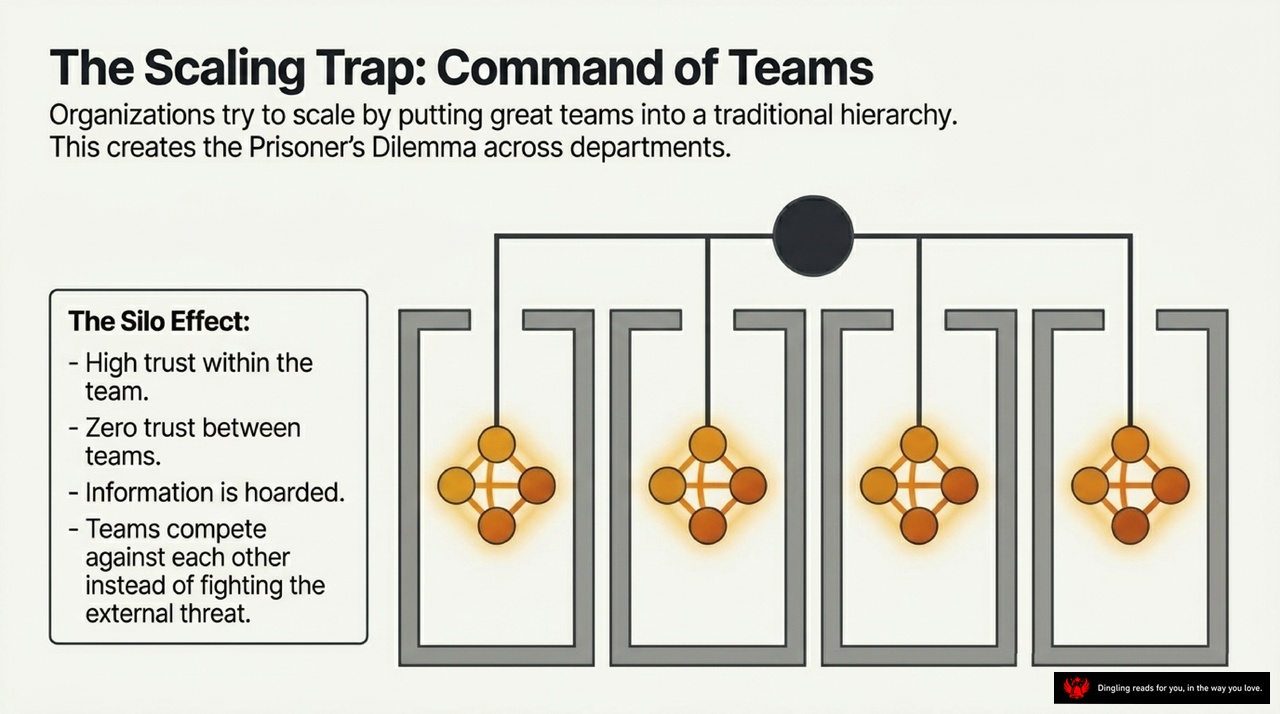
We are trapped in a "Scaling Trap" that most organizations fall into. We try to grow by stacking great teams into a rigid, traditional hierarchy. But this creates a Prisoner's Dilemma across departments. Look at the diagram: inside each silo, there is high trust and strong bonds. But between those silos? Zero trust. Information gets hoarded, and teams end up competing against each other instead of fighting the real enemy together.
This is the "Silo Effect." It happens because we treat our organization like a machine where parts should be isolated and predictable. But the world isn't a machine; it's a chaotic, interconnected web. When we lock our brilliant teams in these boxes, we lose the ability to adapt. We stop sharing what we know, and we waste our collective intelligence. To win in today's complex world, we have to break down these walls. We need to move from a command-and-control structure to a network of small, trusted teams that can see the whole picture and act instantly. Only then can we stop fighting each other and start solving the problems that actually matter.

To defeat a networked threat, you must become a network. This slide outlines our ultimate solution: a "Team of Teams." The core goal was ambitious yet clear—scale the trust and purpose of a small, 10-person unit all the way up to a massive 7,000-person organization.
We achieved this through a specific architecture built on three pillars. First, we preserved the specialized excellence of our small teams. We didn't dissolve them; instead, we kept them tight and agile. Second, we forged robust, horizontal relationships across team boundaries. We stopped letting teams operate in silos and started connecting them directly. Third, and most critically, we melted those rigid bureaucratic walls into a single, cohesive ecosystem.
By breaking down the barriers between intelligence, operations, and logistics, we created a system where information flowed freely and decisions happened instantly at the point of action. This allowed us to adapt faster than our enemy, turning a fragmented collection of individuals into a unified, unstoppable force.
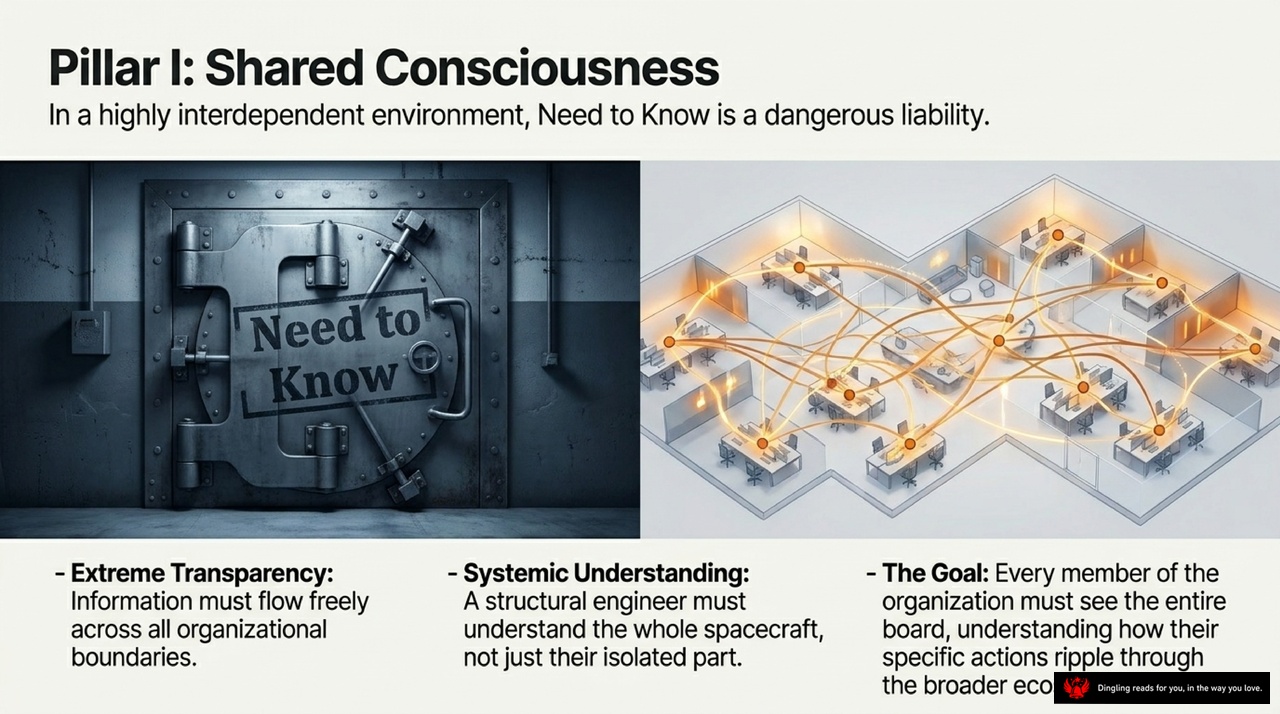
Pillar I: Shared Consciousness. In a highly interdependent environment, "Need to Know" isn't a security feature—it's a dangerous liability. Look at that vault door on the left; it represents the old way of hoarding information, but in today's connected world, locking knowledge away guarantees failure.
We need to shift to extreme transparency. Information must flow freely across all organizational boundaries, just like the glowing network on the right. Imagine an office where every desk is connected by a web of light; that's our goal. A structural engineer can't just know their isolated beam; they must understand the whole spacecraft. Every member of the organization must see the entire board, understanding how their specific actions ripple through the broader ecosystem.
This isn't about blind trust; it's about systemic understanding. When we break down those walls, we unlock a collective intelligence that no single leader could ever possess alone.
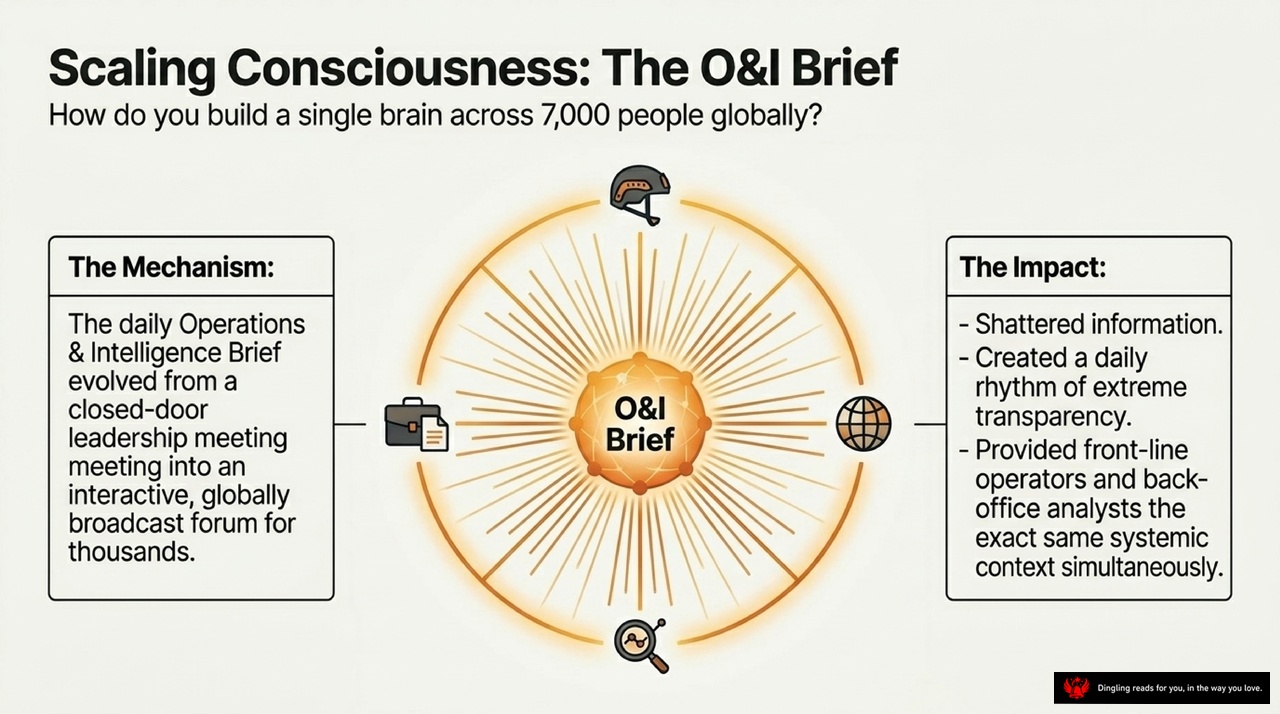
Imagine a world where 7,000 people across the globe act not as isolated units, but as a single, unified brain. That was the ultimate challenge we faced in Iraq. To achieve this, we had to evolve our entire operating model.
On the left, you see "The Mechanism." It all started with the Operations & Intelligence Brief. Originally, this was just a closed-door meeting for leadership. But we transformed it into an interactive, globally broadcast forum accessible to thousands. By connecting everyone—from the front lines in Syria to the analysts in the US—we created a daily rhythm of extreme transparency.
This shift led directly to the impact shown on the right. First, we shattered the "silos" that usually trap information. Second, we established a culture where everyone sees the same picture simultaneously. And most importantly, we provided front-line operators and back-office analysts with the exact same systemic context at the same time.
When you remove the barriers between departments, the whole organization becomes faster, smarter, and far more resilient than the sum of its parts. That is how you scale consciousness.

Defeating the Prisoner's Dilemma isn't just about being nice; it's about engineering a system where trust becomes the only logical choice. As we saw earlier, our elite units were trapped in a "deep well" mentality, viewing each other as rivals rather than partners. We realized that transparency alone wasn't enough to break this deadlock. We needed a structural fix.
This is where the "Embedding Program" changed everything. We stopped keeping our best people in silos and instead took the absolute best operators from one elite unit and forced them to work inside a rival unit for six months. We created a permanent empathetic bridge. When these operators returned, they didn't just bring back stories; they brought back trust. Unit A no longer viewed Unit B as an abstract enemy or a bureaucratic obstacle; they saw them as trusted partners. This human connection transformed our entire network, turning a fragmented collection of "deep wells" into a cohesive, super-team capable of defeating a decentralized enemy.
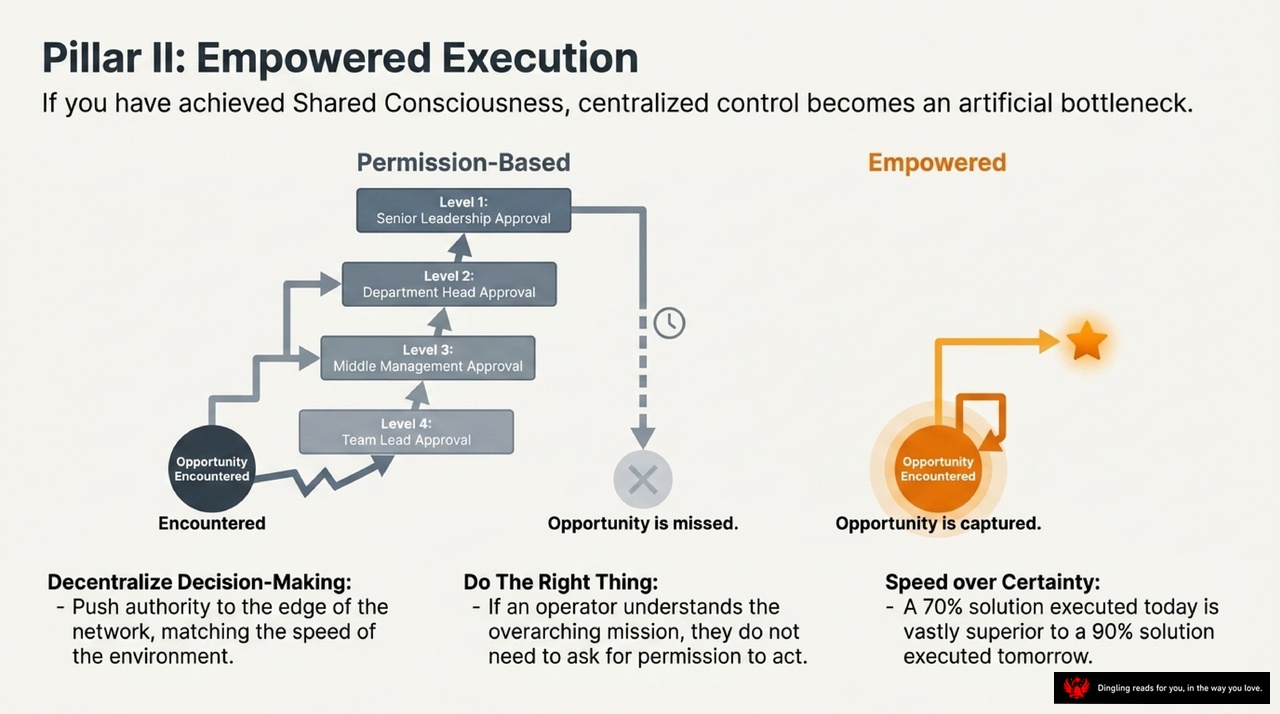
Pillar II: Empowered Execution. If you've built a team with shared consciousness, centralized control stops being a leader's superpower and becomes an artificial bottleneck.
Look at the left side: the permission-based trap. When an opportunity is encountered, it gets stuck in a maze of approvals—Team Lead, Middle Management, Department Head, all the way up to Senior Leadership. By the time you reach the top, the opportunity is often missed. It's too slow.
Now look at the empowered approach on the right. The same opportunity is captured instantly. Why? Because we decentralized decision-making. We pushed authority to the edge of the network so it matches the speed of the environment. If an operator truly understands the mission, they don't need to ask for permission to act.
This is about speed over certainty. A 70% solution executed today is vastly superior to a 90% solution delayed until tomorrow. In a complex world, waiting for perfect information is a luxury we can't afford. We need to move from a command-and-control hierarchy to a flexible network where everyone acts like a leader, not just a follower.
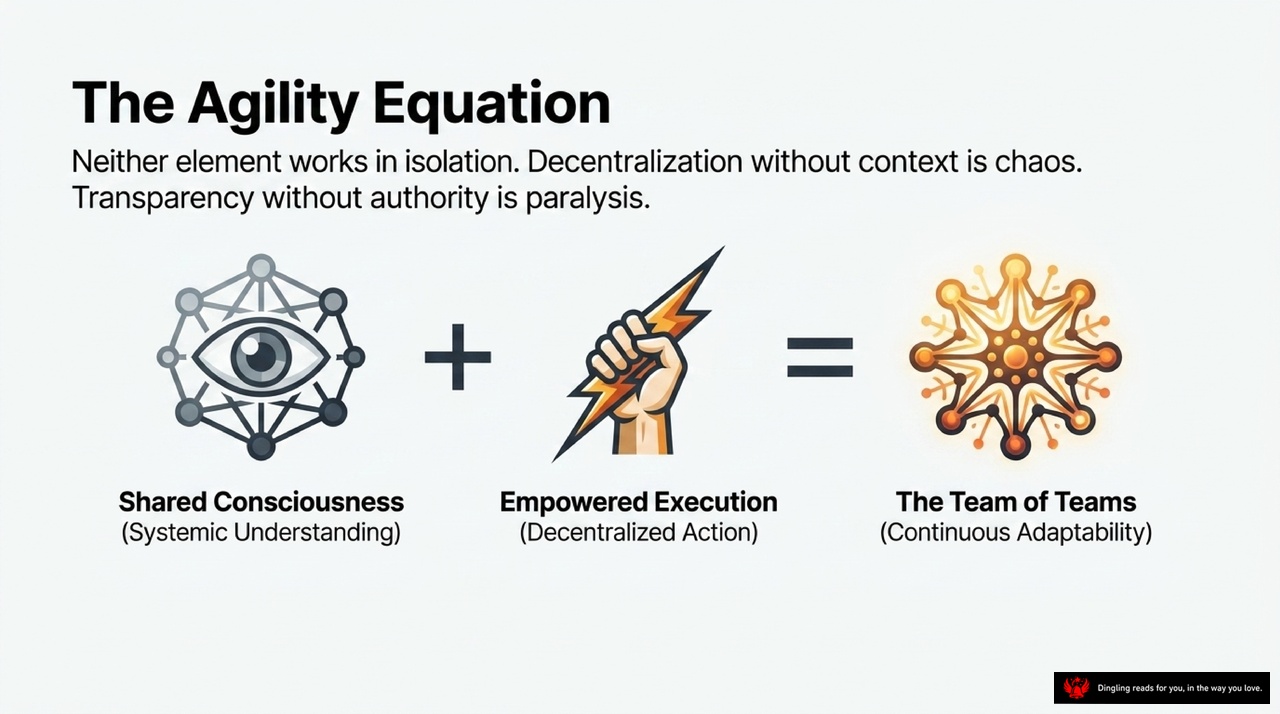
The Agility Equation is the secret to winning in a chaotic world. As the slide illustrates, true agility isn't about just one thing; it's the perfect blend of two forces: Shared Consciousness and Empowered Execution.
Think of Shared Consciousness as the "Systemic Understanding." It's the shared mental model where everyone sees the same reality. Without this context, decentralization doesn't lead to freedom; it leads to chaos. It's like a team of brilliant players running on the wrong field—they have skill, but no direction.
On the other side, you have Empowered Execution, or Decentralized Action. This is the ability for teams to move fast without waiting for permission. But here's the catch: Transparency without authority is just paralysis. If people see the whole picture but can't act, you're stuck.
When you combine these two, you get the final result: The Team of Teams. This isn't just a group of people; it's a living, breathing organism capable of continuous adaptability. It's a network where every node can sense changes and react instantly, just like the enemy we faced in Iraq. By building this equation, we transformed a rigid military machine into a flexible force that could outmaneuver a decentralized enemy. It's the only way to thrive when the rules are constantly changing.

Leadership is no longer about being the chess master who controls every move. In today's complex world, that kind of control is actually a dangerous illusion. Look at the contrast here: on the left, we have the Chess Master of the Industrial Era. This is the old-school leader who focuses on moving pieces, dictating strict tactics, and maintaining total control over the board. It worked when the world was predictable, but it fails when the game changes faster than you can calculate.
Now, look at the right side. This is the new definition: The Gardener. In the Network Era, the leader's primary job isn't to control the outcome, but to shape the ecosystem. Instead of pulling every thread, a Gardener focuses on cultivating the culture, maintaining the flow of information, and actively pruning organizational boundaries. They create an environment where the network can act autonomously and adaptively.
The shift is clear: stop trying to be the puppet master controlling every action, and start building the soil where your team can thrive. True leadership now means empowering your people to make decisions, trusting them to find the best path forward, and simply ensuring the conditions for success are there. That is how you win in a world that refuses to stay still.
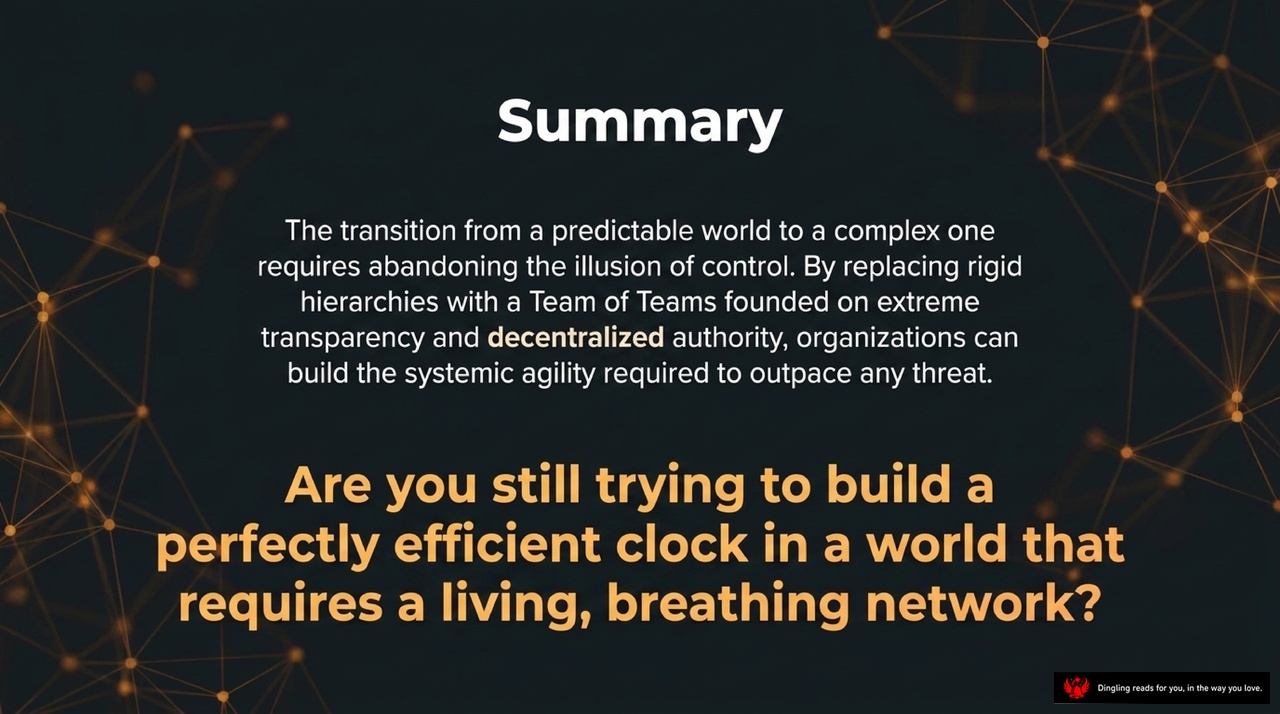
So, let's bring it all together. We've journeyed from the rigid, predictable world of the industrial age to the chaotic, living reality of the 21st century. The core takeaway is this: to survive in a complex world, you must stop chasing the illusion of total control.
As we've seen, trying to build a perfectly efficient clock in a world that demands a living, breathing network is a recipe for failure. Whether it's the rigid hierarchies that failed in Iraq or the siloed departments that crippled big corporations, the old model of top-down command simply can't keep up. The enemy today isn't just a specific group; it's uncertainty itself.
The solution lies in a radical shift. We need to replace those stiff, vertical structures with what we call a "Team of Teams." This means grounding your organization in two powerful pillars: extreme transparency and decentralized authority. When everyone has access to the full picture and the power to make decisions on the spot, you create systemic agility. You stop waiting for permission to act and start responding instantly to threats.
So, the final question we have to ask ourselves is: Are you still trying to run a factory in a world that requires an ecosystem? Or are you ready to evolve into a network that can outpace any threat? The choice is yours.