
Tear Down the Walls in Your Mind: Complete Chapter-by-Chapter Summary
Welcome to today's session. We are diving into Gu Dian's powerful psychological blueprint, *Tear Down the Walls in Your Mind*.
Imagine a thick, gray concrete wall representing the invisible barriers of security that trap us. Today, we are here to learn how to smash through that wall and let the light in.
The book challenges us to dismantle the fear of failure, redefine what success truly means, and grow into our most authentic selves. Instead of living as slaves to safety—clinging to houses, partners, or stable jobs that offer false comfort—we are invited to find true security within ourselves.
By breaking down these mental walls, we stop waiting for the perfect moment and start living our truest lives. Let's explore how to tear down the walls in your mind and embrace a life of freedom and purpose.

Look at this blueprint. It visualizes something we all face but rarely admit: The Invisible Architecture of Limitation. The image shows a person standing inside a structure, completely surrounded by walls. The text makes a powerful point: "We are trapped not by circumstances, but by our own mental models." This is the core idea. Your reality isn't built by the world around you; it's built by the story you tell yourself about the world.
The slide highlights three specific walls that block our potential. First, "The Illusion of Security." Think about this. Many of us believe that buying a house, getting a stable job, or relying on a partner will make us safe. But often, these things become cages. We end up sacrificing our dreams just to feel secure, building a fortress that eventually imprisons us. Second, "The Trap of Success." We chase external validation—titles, money, status—believing that reaching these milestones will make us happy. But when we finally get there, we find we've just built a new wall, waiting for the next one to fill the void. Third, "The Victim Mentality." This is the wall where we believe life happens *to* us. We blame the economy, our bosses, or bad luck, refusing to take control. We become victims of our own circumstances, waiting for rescue that never comes.
The graphic shows a person standing right in the middle of these barriers, unable to move forward. This is the human condition when we ignore our mindset. If we want to change our lives, we can't just try to climb over these walls; we have to realize they aren't made of concrete. They are made of our beliefs. Once we see that the architecture is invisible, we realize we have the power to redesign it. We can choose to break down the illusion of security, reject the trap of superficial success, and stop playing the victim. True freedom starts the moment we realize the walls are in our mind, not in the world.

We've all been there: that feeling of being trapped, not by bars, but by the very things we bought to feel safe. Look at the bird in the cage on the left. That's the illusion of security. We think mortgages, dead-end jobs, and stable relationships are our safety net, but in reality, they're just a cage we built for ourselves. True security isn't about hoarding assets; it's about what you give to the world.
Now, let's look at the decision branch on the right, inspired by a real moment in history: Warren Buffett and his wife Susan in 1952. They had $10,000 and faced a choice. Option A was to buy a house—spend the money on external security. Option B was to invest it in an early business, even if it meant renting a rat-infested apartment. If you choose the cage, you buy a house and sell your potential. If you choose the sky, you invest and say, "A house can destroy a Warren Buffett."
The point isn't to mock homeownership, but to question our mindset. When we rely on external objects for safety, we become their prisoners. We trade our freedom for a false sense of stability. So, instead of building walls, let's build wings. What would you choose if the cage wasn't so comfortable?
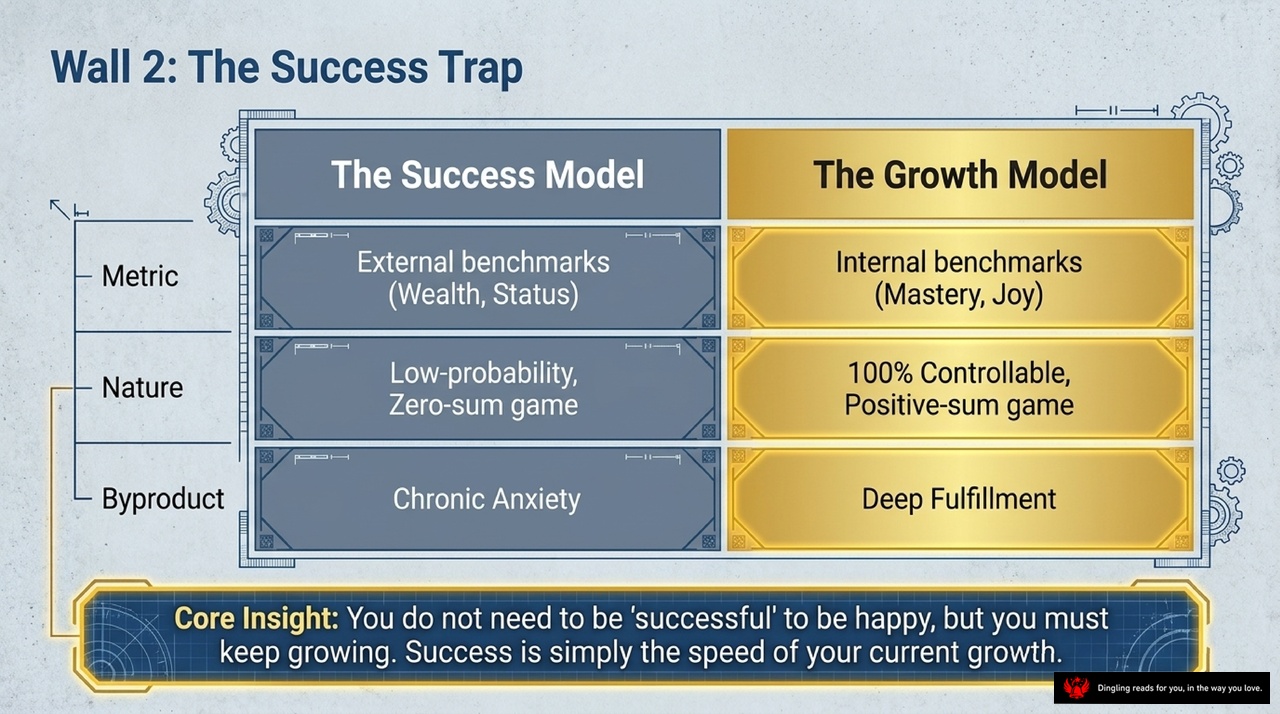
Look at this slide titled "Wall 2: The Success Trap." It lays out a stark comparison between two ways of living: "The Success Model" versus "The Growth Model."
On the left, the Success Model relies on external benchmarks like wealth and status. It treats life as a low-probability, zero-sum game where someone's gain is your loss. The byproduct? Chronic anxiety. You're constantly worried about falling behind, because your worth is tied to things you can't fully control.
But look at the golden column on the right: The Growth Model. Here, the metrics shift to internal benchmarks—mastery and joy. It's a 100% controllable, positive-sum game. When you grow, you win without anyone losing. The result isn't anxiety; it's deep fulfillment.
The core insight at the bottom drives this home: You do not need to be 'successful' to be happy, but you must keep growing. Success is simply the speed of your current growth.
Think about it: If you define success as reaching a specific destination, you'll spend your whole life anxious about whether you've arrived. But if you define success as the act of moving forward, then you are already successful every single moment you take a step. The trap of the Success Model is that it makes happiness feel like a prize you might never win. The power of the Growth Model is that it makes happiness the byproduct of your daily effort. Stop chasing a static label of "success" and start embracing the dynamic process of growth. That's where real freedom lives.

Wall 3: The Victim vs. The Controller. Look at this split screen. On the left, we have The Victim, and on the right, The Controller. The question isn't just who you are, but who holds the button to your happiness.
On the left, The Victim is depicted here. The emotional gain? Sympathy, avoiding responsibility, and feeling morally superior. It's a comfortable trap. But look at the hidden loss: total loss of control over life. As the image says, "If it's their fault, they hold your power." This mindset creates a "Victim Paradise" with five dangerous rules. First, shifting blame to save face. Second, making excuses for bad behavior. Third, sharing misery stories to feel better than others. Fourth, trading victimhood for sympathy. And fifth, self-harming to manipulate others. It's a cycle where you give your emotional switch to everyone else—your boss, your kids, traffic. You become an emotional black hole, stuck in the past, unable to see the future.
Now, look at the right side. The Controller. This is the person holding the remote, taking charge. The emotional gain here is ultimate agency, rapid problem-solving, and resilience. Yes, the hidden loss is harder: you must face reality head-on and take the blame for failures. But that's the price of freedom. The Victim asks, "Why is this happening to me?" while The Controller asks, "What can I do about it?"
The difference is simple but profound. The Victim waits for permission to feel happy, while The Controller decides their own state. Think about it: when you complain about a bad day, you are feeding the Victim mode. When you ask, "How can I turn this around?", you are activating The Controller. True power doesn't come from changing the world, but from changing your response to it. Stop waiting for the world to fix you. Grab the remote. Take the control. Your happiness is the only thing no one can take away from you if you decide to keep it.
Have you ever noticed how your mood seems to switch like a lightbulb, depending entirely on who you're with or where you're going? Just like that taxi driver who felt depressed after a trip to Wangjing but instantly happy heading to Zhongguancun? Most of us live this way, handing the remote control of our emotions to the world. We call ourselves "victims" because we've surrendered the power to choose our own happiness.
But here's the hard truth: victims don't just suffer; they operate under a hidden set of five rules that keep them trapped. First, they shift blame to protect their ego, blaming bosses, teachers, or even gravity for their failures. Second, they feel entitled to do bad things if they claim to be victims. Third, they love sharing tragic stories, finding comfort only in someone else's misery. Fourth, they trade their dignity for sympathy, acting helpless to get what they want. And finally, they even use self-harm to manipulate others, believing their fate is controlled by someone else.
This "victim mindset" is dangerous because it amplifies the cost of waiting. Think about the woman who spent six months worrying about retaking an exam she already failed. She wasted 900 hours of anxiety, which was nearly double the time she actually spent studying. She was waiting for a perfect moment that would never come. Or consider the salesperson who panicked for a week before calling a client, only to find the deal was already waiting for her. Waiting isn't just passive; it's an active cost that drains your confidence and energy.
The solution is simple but radical: stop waiting and start crossing. Life isn't meant to be waited upon; it's meant to be traversed. Even if you stumble, even if your first attempt is clumsy, you are still moving forward. As the author Shi Tiesheng discovered, accepting that the worst outcome is just "living" allows you to find freedom in the process. Don't let fear of failure keep you in a waiting room. Take the call, make the move, or start the project today. Your life is yours to cross, not to wait.

Most of us spend our entire lives acting out a script written by our parents. We wear their unfulfilled dreams like heavy backpacks, telling everyone "Yes" while screaming "No" inside. It's a lose-lose game where the parents feel satisfied, but we feel hollow. You might think you're being filial or doing what's best for the family, but the truth is, a life without your own identity has no meaning at all.
Think of your life as a public company. You are the biggest shareholder, while your parents and friends are just board members with partial stakes. They have the right to offer advice based on their experience, but you hold the final voting power. The person responsible for the company's future isn't the advisors; it's you.
Many of us live as actors, performing for our parents, friends, and colleagues, forgetting how to simply "be ourselves." We chase wealth and status to fit external standards, like a person with hands but no stomach, filling a room with food but never nourishing their soul. True happiness isn't about performing a role; it's about converting the material world into inner peace.
We also lose our happiness through comparison. Just hearing that a classmate got a higher bonus can instantly drain your joy. Or we fall into the "Pakhom trap," endlessly chasing more—higher titles, bigger houses, fancier cars—until we collapse, realizing we only have enough for a grave. We grow up with brains but no hearts, possessing success in others' eyes while our insides remain empty.
To reclaim your life, you must balance the social system with your own. Work hard to stand in the world, but stop to root yourself in what makes you happy. Don't let the world's standards become your only metric. When you stop acting and start living for yourself, true happiness returns.
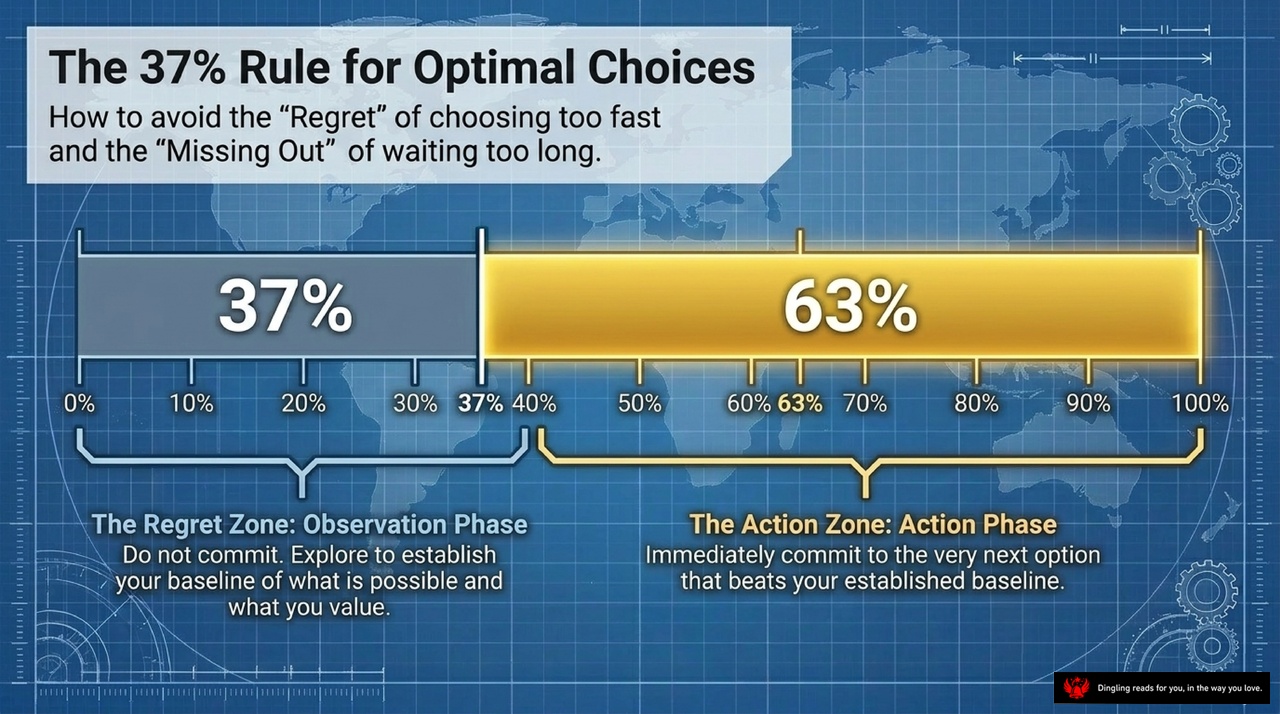
Look at this chart. It visualizes a powerful strategy for making life-changing decisions: the 37% Rule.
The graphic splits our decision-making process into two distinct zones. The first, shaded in blue, represents the initial 37% of your exploration period. This is "The Regret Zone," or the Observation Phase. Here, the rule is simple: do not commit yet. Use this time to explore your options, establish a baseline of what is possible, and understand what you truly value. It's about gathering data without the pressure of a final answer.
Once you pass that 37% mark, you enter the golden yellow section: "The Action Zone," which makes up the remaining 63% of your timeline. This is where you must immediately commit to the very next option that beats your established baseline.
The core insight here is balancing two painful emotions. If you choose too fast, you risk "Regret" because you might have missed a better option. If you wait too long, you suffer from "Missing Out" because you've wasted time on suboptimal choices. By sticking to this 37-63 split, you mathematically optimize your choices. You explore enough to be smart, but act fast enough to be decisive.
Think of your career or a major life choice as this timeline. Spend the first third observing and learning. Then, trust your data and move forward with confidence. This isn't just about finding the perfect job; it's about avoiding the paralysis of analysis and taking control of your destiny.

Have you ever felt like you're trapped in a relationship or a career just because you've already invested so much time and effort? It's a common trap we all fall into, often called the "sunk cost" fallacy. Imagine you bought a ticket to a movie, only to realize halfway through that it's terrible. Would you stay until the end just because you paid for the ticket? Probably not. You'd leave to save yourself two more hours of misery. That's exactly what this slide is telling us: never let a "water cup"—a metaphor for past investments—restrict your future.
Look at that rusty anchor labeled "Sunk Cost." It represents the past money, time, or emotions we've already spent. Once that's gone, it's mathematically irrelevant. Staying in a bad situation just because you've invested in it doesn't make sense; it only drags down your future value. The golden star on the other side represents your "Future Value." This is what truly matters. Every decision you make should be based entirely on where it takes you from now on, not where you've been.
The text on the screen drives this home: "The fear of loss creates the greatest losses." When we cling to what we've already lost, we often sacrifice even more potential happiness and success. Whether it's a failed relationship, a dead-end job, or a hobby you no longer enjoy, the smartest move is to cut your losses. Base every choice on the future value you stand to gain, not the past value you've already paid. Let go of the anchor, and you'll finally be free to sail toward the opportunities that truly matter.

Look at this slide. It draws a sharp line between two ways of living: The Drifter and The Navigator.
The Drifter is the person who runs away from pain. They quit bad jobs, flee bad bosses, and constantly avoid discomfort. But because they have no defined destination, they end up trapped in a loop of Brownian motion—just moving randomly without ever going anywhere. It's exhausting and pointless.
In contrast, The Navigator runs toward a goal. They might face storms, unfairness, and friction on Path B, but they endure it because they know the destination is worth it. This is the difference between avoiding problems and solving them.
The slide reminds us that the moment you define your true target, "IMPOSSIBLE" transforms into "I'M POSSIBLE." It's not about being fearless; it's about having a clear enough goal that you are willing to push through the fear to get there. Without a target, you're just drifting. With one, you're navigating.

Look at this diagram. It perfectly captures the trap we all fall into. On the left, we have Engine A, the Social System. It runs on fuel like money, status, and titles. But look at the output: it produces comparison and anxiety. It's a machine that burns your soul just to make you feel like you're not enough.
But on the right, we have Engine B, the Inner System. This is where real happiness lives. Its fuel isn't external; it's meaning, growth, and love. When you feed this engine, the output isn't anxiety—it's pure joy and fulfillment.
The text warns us clearly: we often mistakenly use our Social System to try and feed our Inner System. We think buying a bigger house or getting a higher title will make us happy. But happiness is actually a conversion skill—the ability to turn external material into internal fulfillment.
Here is the most important takeaway from this slide: Do not use prices to measure the value of your soul. If you start valuing yourself by what you earn or what you own, you will never be satisfied. True happiness comes when you stop looking at the price tag and start listening to your own heart.

Imagine a house lifted into the sky by a cluster of golden balloons, escaping the ground that holds it down. This isn't just a whimsical dream; it's a powerful metaphor for the cost of waiting versus the cost of crossing. We often find ourselves trapped in a "waiting to die" mode, endlessly postponing big moves—starting a business, leaving a toxic relationship, or chasing a passion—until we imagine a perfect moment that never arrives. But let's be honest: waiting for life is essentially waiting for death.
The slide highlights a crucial insight: the cost of waiting is always greater than the cost of crossing. Think about it. A bad start is worth a third of success. You have to spend a piece of your past to purchase your future. If you wait for the perfect conditions, you risk losing your entire future. As the image suggests, you must launch the house now. Don't let the fear of a messy beginning stop you from taking flight. The only true failure is staying grounded while the world moves on.
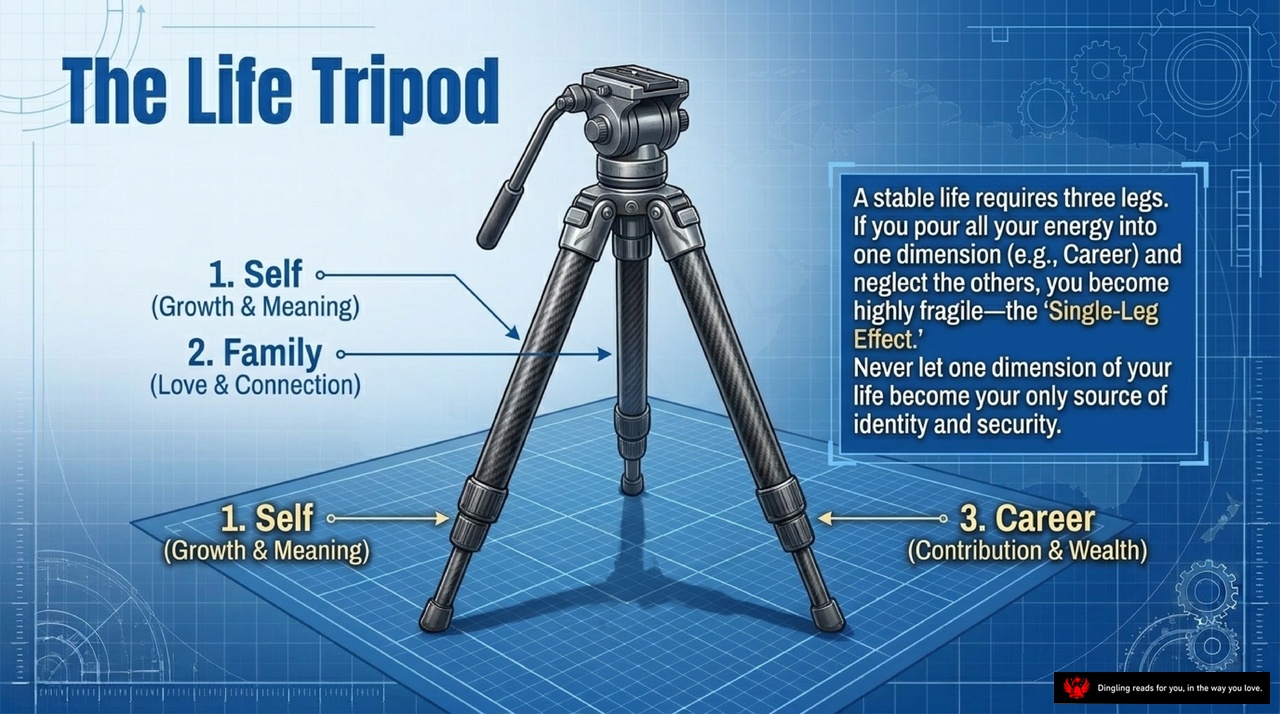
Look at this image of "The Life Tripod." It's a powerful metaphor for building a stable life. Just like a camera tripod needs three legs to stand firm without wobbling, our lives need three distinct pillars to avoid the "Single-Leg Effect."
The slide breaks these three legs down clearly. First, we have **Self**, focused on Growth and Meaning. Second, **Family**, centered on Love and Connection. And third, **Career**, which drives Contribution and Wealth.
The text on the right warns us of a common trap. Many of us pour all our energy into just one dimension, like obsessing over our career while neglecting our personal growth or our family. When we do that, we become incredibly fragile. We might feel secure today, but if that one leg of our life collapses, the whole structure falls down.
True stability isn't about having more money or a higher title. It's about balance. Never let one dimension of your life become your only source of identity and security. If you want a life that can handle the inevitable storms, you need to strengthen all three legs of your tripod equally.
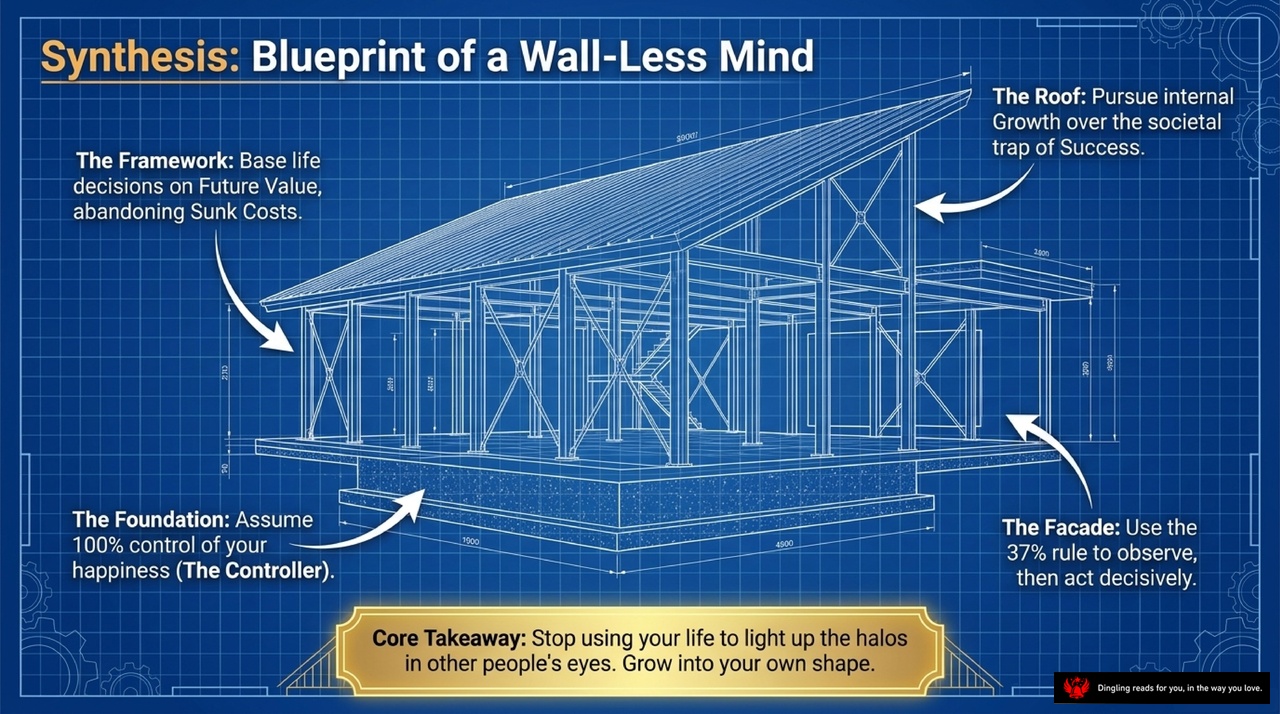
Synthesis: Blueprint of a Wall-Less Mind. Imagine your mind as a structure under construction, where every decision you make either builds a sturdy home or traps you in a cage. Let's walk through this blueprint together.
Start with the Foundation. This is about assuming 100% control of your happiness. Think of yourself as The Controller. Instead of waiting for the world to give you security, you decide that your inner state is up to you. This shifts the entire game from being a victim of circumstances to being the architect of your life.
Next, look at The Framework. This is where you make your base life decisions based on Future Value, not the past. It means having the courage to abandon Sunk Costs. Many of us stay in dead-end jobs or toxic relationships because we've already invested so much time and money. But true wisdom is realizing that what you've spent is gone; only your future matters. Stop pouring water into a leaking bucket.
Now, move up to The Facade. This is your external behavior, governed by the 37% rule. Don't rush into the first option you see. Use the first 37% of your time or resources to observe, learn, and gather data. Once you've built a clear baseline, act decisively on the remaining 63%. This prevents you from making impulsive mistakes and ensures you make informed choices.
Finally, reach The Roof. This is the most critical part: Pursue internal Growth over the societal trap of Success. Society tells you to chase titles, money, and status, but these are just decorations. Real freedom comes from becoming the person you want to be, regardless of what others think.
The Core Takeaway is simple but powerful: Stop using your life to light up the halos in other people's eyes. When you stop performing for an audience and start growing into your own shape, you unlock a level of confidence and peace that no external validation could ever provide. Build your wall-less mind, and watch how limitless your world becomes.

Look at this open cage against the sunset. It's a powerful visual: the door has been open for a long time, yet we often choose to stay inside. Why? Because the walls that confine us aren't made of brick and mortar. They are built from inherited mental models, sunk costs, and the illusion of security.
We tell ourselves we need to feel "ready" before we act, or that we need a perfect foundation before we can fly. But true freedom comes from shifting from a victim to a controller. It means valuing personal growth over societal success and daring to act before we feel fully prepared. By dismantling these invisible barriers, we reclaim the architecture of our own lives.
So, ask yourself: The door to the cage has always been open. So why are you still sitting inside?