
Techno-feudalism: Complete Chapter-by-Chapter Summary
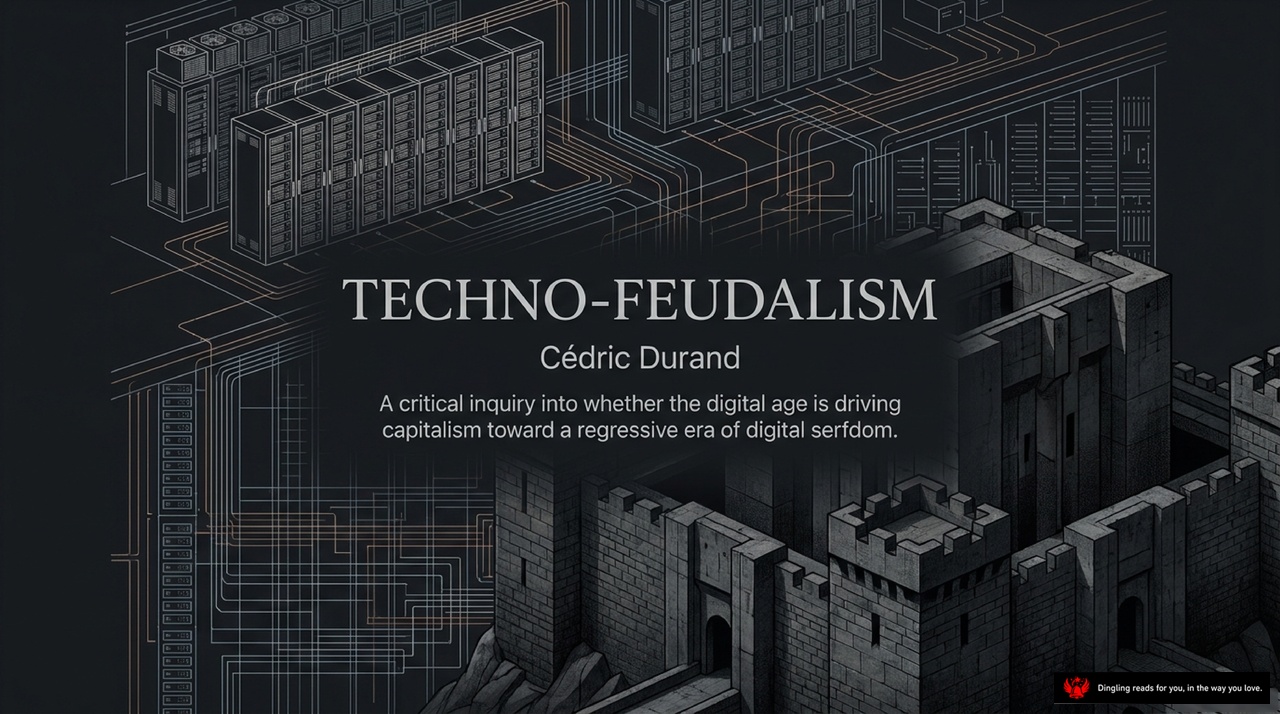
Welcome to our deep dive into the future of capitalism. Today, we are introducing a groundbreaking concept from author Cédric Durand: "Techno-Feudalism."
As you see on this slide, the title sets a provocative tone. This book isn't just about technology; it's a critical inquiry into whether our digital age is actually pushing capitalism backward, toward a regressive era of what Durand calls "digital serfdom."
The image powerfully captures this duality. On one side, we have the sleek, humming servers of the modern internet—the infrastructure of Silicon Valley. On the other, looming in the foreground, are the cold, stone walls of a medieval castle. This visual metaphor is the heart of Durand's argument: the digital giants of today are acting less like democratic innovators and more like feudal lords.
Just as medieval lords controlled land and demanded labor from serfs who had no choice but to stay, today's tech giants control data, algorithms, and the very platforms we rely on. They have built "digital estates" where users and workers are trapped in a system of dependency. The promise of the internet—that it would liberate us and connect everyone—has, according to Durand, been replaced by a new form of enclosure. We are no longer free citizens; we are tenants in a digital castle, paying rent in the form of our personal data and attention.
This book challenges the optimistic narrative that the tech industry is the savior of the global economy. Instead, it suggests we are entering an age where a few powerful platforms extract value from everyone else, creating a rigid hierarchy that looks suspiciously like the past, only dressed in code. Let's explore how this shift is reshaping our world.
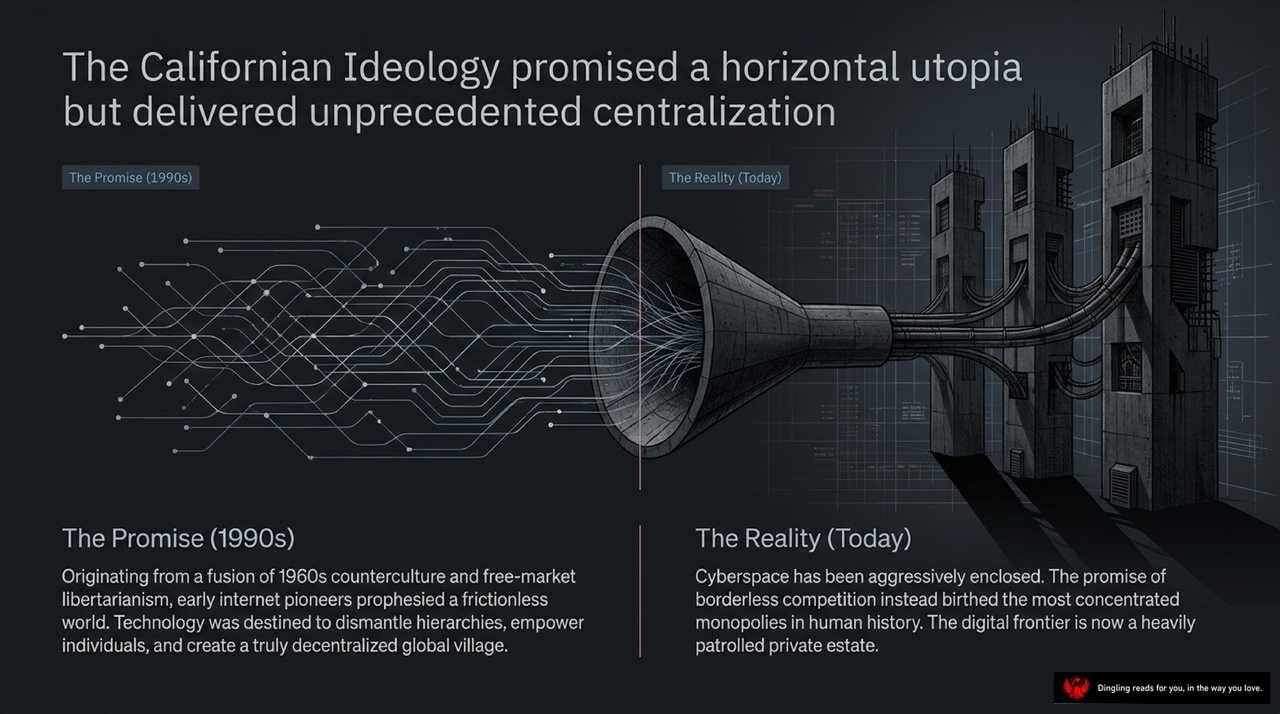
The Californian Ideology promised a horizontal utopia but delivered unprecedented centralization. Look at this stark contrast: on the left, we see the promise of the 1990s. Back then, early internet pioneers fused 60s counterculture with free-market libertarianism, prophesying a frictionless world where technology would dismantle hierarchies and create a truly decentralized global village. But fast forward to today, and the reality is a heavy patrolled private estate.
As the slide illustrates, cyberspace has been aggressively enclosed. The promise of borderless competition instead birthed the most concentrated monopolies in human history. What was once an open frontier is now a fortress. We see the shift from a network of diverse connections funneling into a single, massive structure, symbolizing how the digital frontier has transformed from a public commons into a walled garden. This is the core paradox of the Silicon Valley consensus: it claimed to champion innovation and individual autonomy, yet in practice, it built systems that favor extraction and control. The result isn't a liberated global village, but a new form of feudalism where a few tech giants act as digital landlords, extracting rent from the very users they claim to serve.

Look at this chart. It tells a stark story about our modern economy: a deep and troubling split between where our real wealth is created and where the profits actually go.
On the bottom line, labeled B, you see **Macroeconomic Productivity & Growth**. This is the real work happening—the actual goods being made, the services provided, and the genuine economic output that drives our society forward.
But look at the soaring orange line, labeled A. This represents the **Market Cap & Profits of Tech Giants**. Over the last two decades, this line has skyrocketed far above the growth of real productivity, creating what the graphic calls a massive **Decoupling Gap**.
This visual captures the breakdown of a concept called "Creative Destruction." Historically, capitalism worked by forcing companies to invest in new, productive technologies to survive competition. That drive for innovation was what lifted everyone up. But today, we are seeing something different, which the chart labels as **The New Extraction**.
Instead of creating new value through hard work and innovation, tech giants are now generating astronomical wealth without a corresponding rise in actual productivity. They aren't just building the future; they are efficiently extracting value from the existing economy. The result? A system where the top few capture record-breaking profits while the broader economy struggles to keep pace.

Tech lords extract value through four fundamental pillars of digital rent. Instead of profiting from the production of tangible goods, tech monopolies operate as tollbooths, extracting rent from the control of intangible assets.
Let's break down these four mechanisms. First, Intellectual Property Rent. This is about charging mandatory access fees for patented code, closed software ecosystems, and proprietary licensing. It's the toll you pay just to enter the digital highway.
Second, Natural Monopoly Rent. This comes from controlling the unavoidable, sunk-cost physical infrastructures of the digital age—think submarine cables, massive server clouds, and logistics grids. Once you build these, the cost is so high that no competitor can catch up.
Third, Differential Rent. This is the premium you pay for access to high-tier visibility and social attention. Whether it's topping search rankings or getting prime placement on a platform, you're paying for being seen.
Finally, Dynamic Innovation Rent. This is where they hoard massive, exclusive datasets to train future algorithms. By locking competitors out of the raw material required for future innovation, they ensure they stay ahead while others fall behind.
Together, these four pillars explain how a few giants capture the vast majority of value in the modern economy, turning innovation into a fortress rather than a ladder for everyone.

The slide highlights a critical shift in how power operates today: we've moved from controlling physical land to controlling digital land. Just like feudal lords in the Middle Ages who ruled over peasants by controlling the soil, today's tech giants rule over us by controlling our data and the algorithms that govern our lives.
Notice the text on the left: "Digital land reshapes traditional power structures." This is the core idea. Platforms act as modern landlords. They don't need to produce anything themselves; instead, they capture the value we create and charge us rent through data extraction and algorithmic control.
Look at the concept of "illusory autonomy" mentioned in the diagram. You might think you have a choice between different apps or services, but in reality, you are trapped. Switching platforms is too costly because of the network effects and learning curves you've built. You are locked in, much like a medieval serf tied to a lord's estate.
The slide also points to "internal transcendence." This means that the very tools we use to serve ourselves—like search engines or social media feeds—are actually built from our own collective data. We unknowingly build the algorithms that then control us. It's a cycle where our behavior feeds the system, and the system, in turn, dictates our behavior.
Ultimately, this creates a new form of inequality. A few massive platforms hoard the wealth and information, while ordinary users become dependent data providers with no real power. The result is a digital feudal system where freedom is an illusion, and true power lies in who controls the digital land.
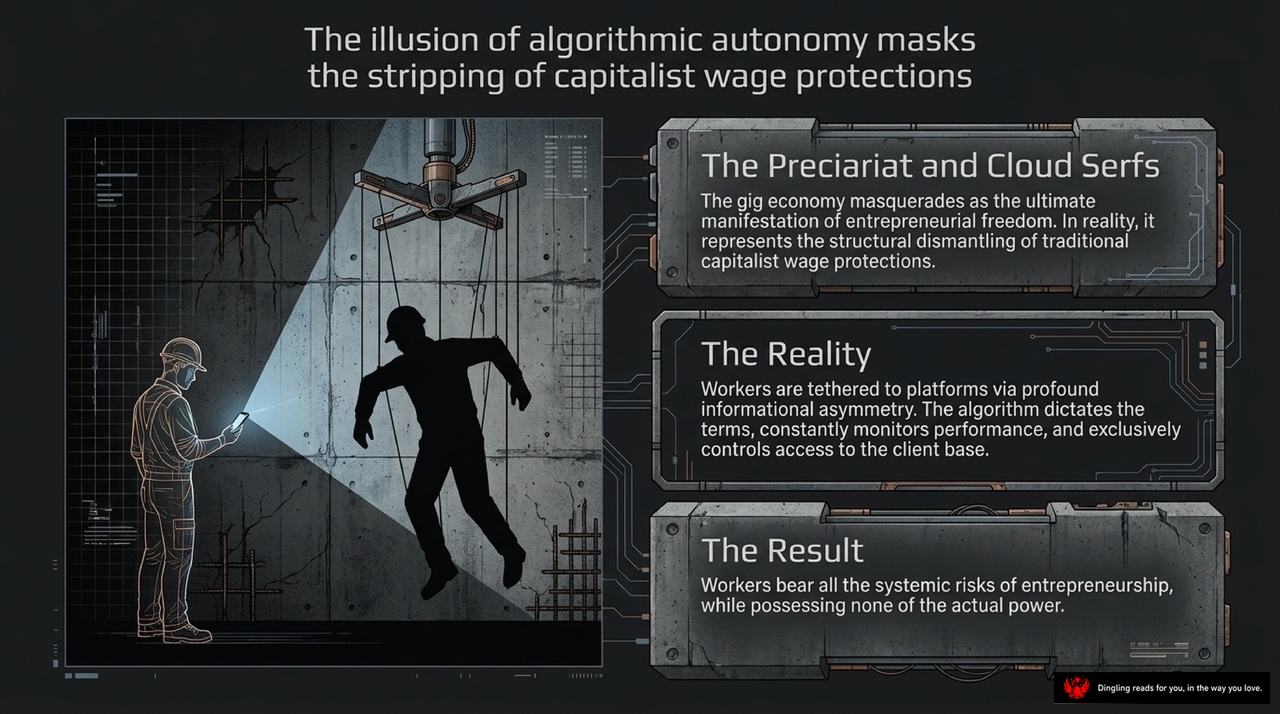
The image on the left shows a worker looking at a phone while a puppet dangles above, controlled by invisible strings. This perfectly illustrates the core argument: the illusion of algorithmic autonomy masks the stripping of capitalist wage protections.
The slide breaks this down into three key points. First, it highlights "The Precariat and Cloud Serfs." The gig economy masquerades as the ultimate manifestation of entrepreneurial freedom. In reality, it represents the structural dismantling of traditional capitalist wage protections.
Second, under "The Reality," workers are tethered to platforms via profound informational asymmetry. The algorithm dictates the terms, constantly monitors performance, and exclusively controls access to the client base. This is the "invisible hand" that actually pulls the strings, turning independent-looking workers into digital serfs.
Finally, "The Result" is clear: workers bear all the systemic risks of entrepreneurship, while possessing none of the actual power. They are left holding the bag for market fluctuations, algorithmic penalties, and income instability, with no safety net to fall back on. The puppet isn't just a metaphor; it's the daily reality for millions navigating the modern digital economy.

The amplified smile curve on your screen tells a stark story about how global wealth is actually distributed today. Look closely at the peaks: on the left, we have intangibles like design, R&D, and data; on the right, platforms, retail, and brands. The massive "middle trough" in the center represents tangible manufacturing and physical labor. This visual perfectly captures the reality of "techno-feudalism." While the old industrial model relied on factories and machines, the new economy concentrates almost all value at these two intangible extremes.
The text below explains why this shift is so dangerous. Intangible assets like code and algorithms scale infinitely at near-zero cost, creating a natural monopoly that traditional competition can't break. Meanwhile, tangible assets like physical labor face harsh diminishing returns. This is the core of the "Amazon Paradox" we discussed earlier. Companies like Amazon or Apple don't compete by making the best product; they compete by controlling the platform where products are sold. They capture the entire supply chain, outsourcing the actual production to the low-margin trough in the middle while keeping the high-value peaks for themselves.
This isn't just an economic theory; it's a new form of exploitation. Just like medieval lords didn't farm the land themselves but extracted rent from serfs, these tech giants extract "digital rent" from users and workers without owning any factories. The result is a global system where wealth flows upward to a few monopolists, while the vast majority of the world's labor remains trapped in the middle, producing value they don't own. Breaking this cycle requires more than just tweaking regulations; it demands a fundamental rethink of how we value human work versus algorithmic control.

Imagine stepping into a digital kingdom where the rules aren't set by a king, but by an algorithm you can't see. This slide illustrates a terrifying reality: we no longer live in open markets; we live in private, walled territories known as "Ecosystem Lock-In." Think of these digital platforms not as businesses, but as feudal fiefdoms. At the center sits the "Platform Owner"—the modern-day Lord, controlling everything from the apps you use to the data you generate. Surrounding this core are "Dependent Businesses," the vassals who must pay rent to operate, and "Locked-in Users," the serfs who provide the labor and data in exchange for access.
The key to this system is what the diagram calls "The High Exit-Cost Moat." This isn't just a metaphor; it's a financial and social prison. Because of network effects and the sheer volume of your history stored within these platforms, leaving becomes nearly impossible. If you try to leave an ecosystem like Apple or Amazon, you aren't just changing apps; you are facing severe social and economic marginalization. You would lose your entire digital identity, your purchase history, and your connections. As the image starkly reminds us, "You do not shop in an Amazon market; you operate at the mercy of an Amazon fiefdom." The competition has vanished because the cost of switching is so high that everyone stays put, trapped in a cycle of dependency that defines our modern digital existence.

This slide offers a stark structural diagnosis, revealing a terrifying regression: we are moving away from capitalist profit and sliding back into neo-feudal extraction. Look at the three columns. We aren't just updating our tools; we are fundamentally changing the rules of the game.
First, compare the dominant assets. In Feudalism, power was built on Land and Physical Territory. In Capitalism, it shifted to Means of Production like factories. But in our current Techno-Feudalism, the most valuable asset is no longer what you own, but what you control: Intangible Assets like Data and Algorithms.
This shift changes everything about how wealth is generated. Under Feudalism, lords collected Rent and Tribute through coercion. Capitalists made Profit via wage labor. But today, platform owners extract Rent via data mining and tollgates. You aren't selling your labor for a paycheck; you are paying with your personal data to access the system.
The power dynamic has also evolved. The Lord ruled the Serf, and the Bourgeoisie ruled the Proletariat. Now, the Platform Owner rules the Cloud Precariat. We are no longer just employees; we are users trapped in an ecosystem we didn't build but must survive in.
Finally, look at the investment driver. Feudal lords invested in capturing territory. Industrialists invested in efficiency. Today, tech giants invest in Algorithmic Manipulation and Moat-building. They aren't trying to make you better off; they are building walls to keep you inside their digital castle, extracting value without ever touching the actual production process.
This chart confirms what we've been feeling: the era of the entrepreneur creating value is over. We are living in a system where a few digital landlords extract rent from everyone else, simply by controlling the algorithms that run our lives.
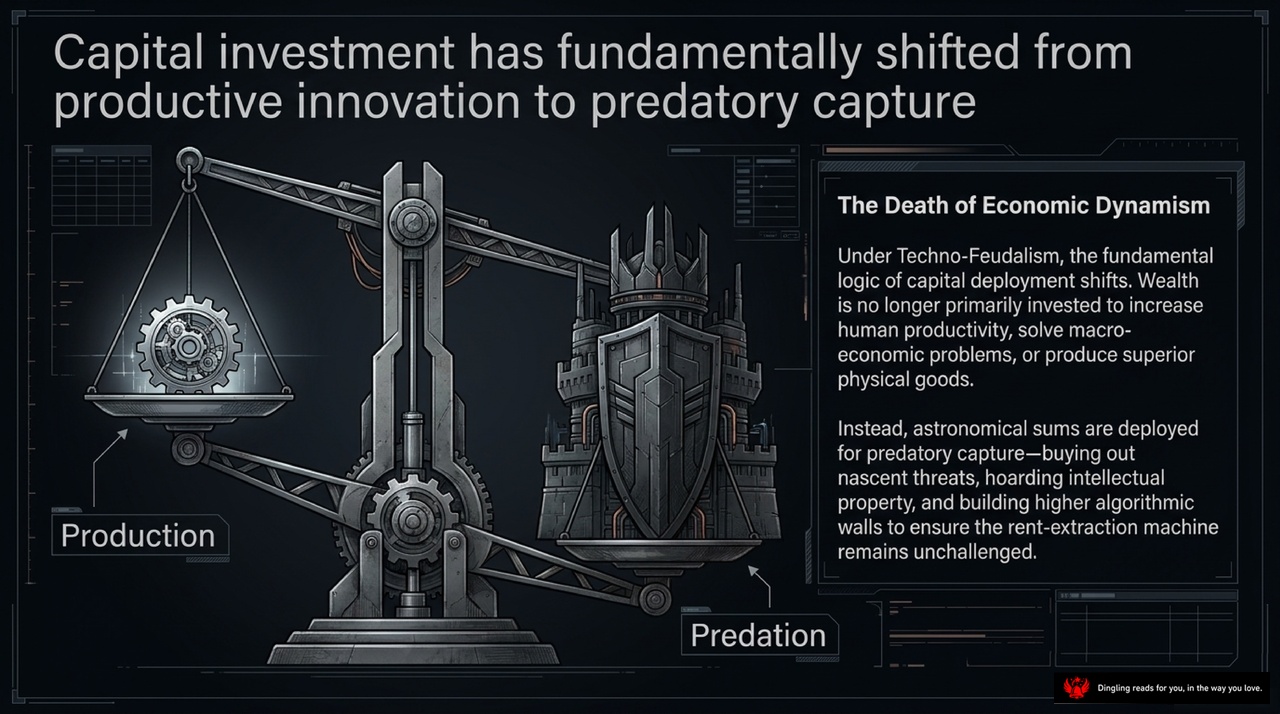
Look at this scale. On the left, we have "Production"—the gears turning, the actual work of making things. On the right, we have "Predation"—a fortress, a castle, waiting to capture whatever it can. The slide makes a powerful point: capital investment has fundamentally shifted from productive innovation to predatory capture.
Under what the text calls "Techno-Feudalism," the entire logic of how we deploy wealth has flipped. We are no longer investing primarily to boost human productivity, solve macroeconomic problems, or build better physical goods. Instead, astronomical sums of money are being deployed for "predatory capture."
Think about what that means in practice. It's not about building new things anymore; it's about buying out nascent threats before they even grow. It's about hoarding intellectual property and building higher algorithmic walls. The goal is to ensure the rent-extraction machine remains unchallenged. We are seeing the death of economic dynamism because the system prefers to protect its own monopoly over creating new value.
This isn't just a shift in business strategy; it's a shift in the fundamental nature of our economy. We've moved from a world where competition drove innovation, to one where the goal is simply to capture the rents generated by others. That heavy castle on the right is winning the balance, and it's leaving the actual work of production on the back burner.
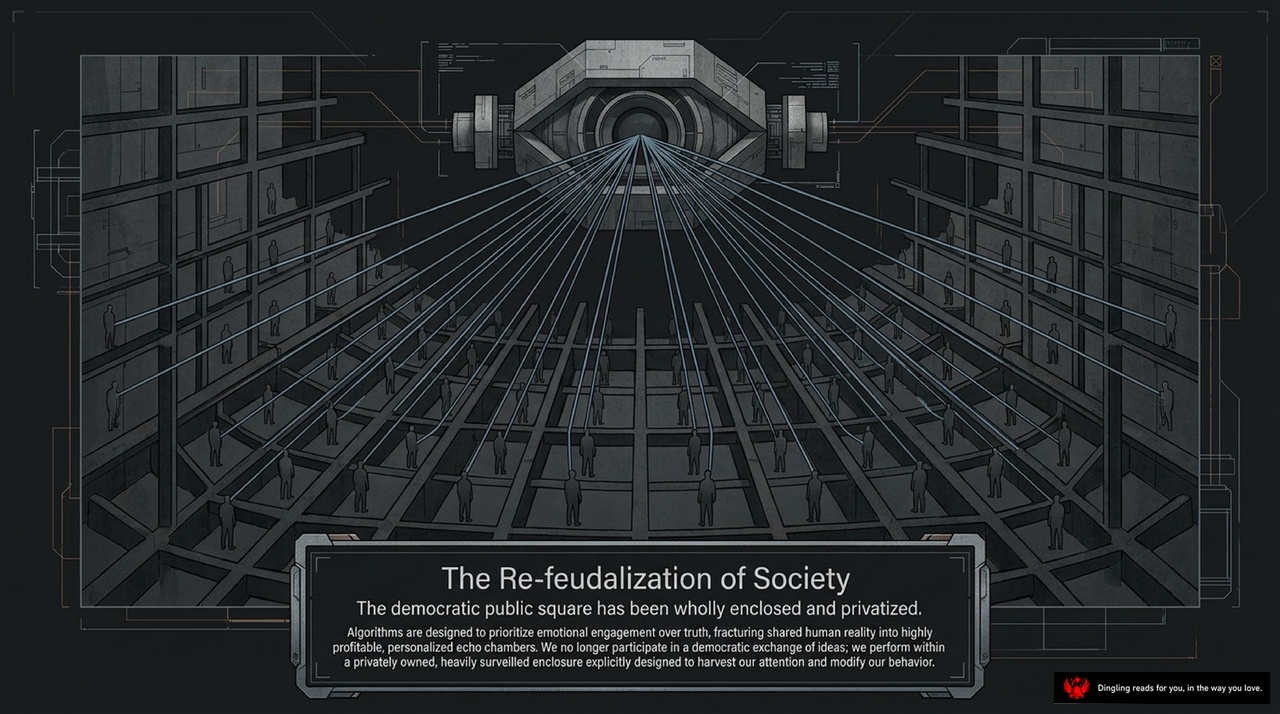
The image we see here perfectly captures the dark reality of our digital age. It depicts a massive, all-seeing eye casting beams of light down onto a grid of people, effectively turning the open "democratic public square" into a privately owned, heavily surveilled enclosure. The text on the slide calls this "The Re-feudalization of Society," arguing that algorithms are no longer just tools but active forces that prioritize emotional engagement over truth, fracturing our shared reality into profitable, personalized echo chambers.
This visual metaphor aligns directly with the concept of "Techno-feudalism." Just as medieval lords controlled land and demanded labor from serfs, today's tech giants control data and algorithms, forcing users and workers into a state of dependency. We are no longer free participants in a market exchange; instead, we are tenants trapped within these digital manors. The platforms harvest our attention and modify our behavior, extracting value without us ever needing to produce anything ourselves.
Furthermore, this slide illustrates the shift from competition to capture. In the old capitalist model, companies competed to create value. Today, the goal is to capture it. By controlling the essential infrastructure of our lives—our search results, our social connections, our navigation—these monopolists can extract rent from every interaction. The "eye" in the image represents the algorithmic governance that dictates our choices, predicting our needs before we even realize them, and guiding us toward outcomes that benefit the platform, not necessarily us.
Ultimately, this re-feudalization means we have lost the ability to participate in a genuine democratic exchange of ideas. Instead, we are performing within a script written by private corporations, living in a world where the most powerful forces are not governments, but the invisible landlords of the digital realm who own our very attention.

Paradoxically, the very cage we built for ourselves is turning out to be the foundation for a new kind of freedom. Look at this image: on the left, the crumbling walls of the old world are breaking apart, while on the right, a vast, intricate grid of digital connections is taking shape. This is the core idea of "The Accidental Utopia."
Even though the current system of techno-feudalism is deeply predatory, it has accidentally achieved something unprecedented in human history: the ultimate socialization of human activity. We are now connected in a complex, globally interdependent web of hyper-coordination. The massive digital infrastructure required to seamlessly coordinate global needs, distribute resources instantly, and enable a highly efficient, post-scarcity society has already been built by the monopolies.
It's a strange irony. We are trapped in an enclosure, yet this digital enclosure provides the exact infrastructure for true objective socialization. The tools that were meant to control us are, in reality, the very tools that could connect us all more deeply than ever before.

We've all been sold the dream that the digital age is a utopia—a place where technology liberates us and innovation drives prosperity for everyone. But let's be honest: the reality is far more complex, and perhaps, far darker. As we stand at these crossroads, we need to confront a hard truth: the promises of the digital revolution have masked the rise of a new, neo-feudal order.
Look at what's happening. A handful of technological lords have effectively enclosed the modern economy. By monopolizing intangible assets like data and algorithms, extracting digital rent, and deploying algorithmic governance, they have turned the world into their private fiefdoms. Independent businesses are no longer competitors; they've been reduced to vassals, forced to pay tribute just to survive. And we, the users? We've been transformed into digital serfs, trapped in ecosystems we didn't build but cannot leave.
So, the question isn't just about technology anymore; it's about power and democracy. We have already built the infrastructure to seamlessly coordinate global human needs. The tools exist to create a truly connected, equitable world. But will we allow this infrastructure to remain the private fiefdom of a few, or will we finally claim it for ourselves? It is time to engineer a true digital democracy, rather than accepting a future where a small elite rules over the rest of us like medieval lords.