
TED Talks: Complete Chapter-by-Chapter Summary

Welcome to TED Talks, a definitive guide to the art of public speaking and planting powerful ideas in the minds of others. This isn't just about performance; it's about connection. At its core, a great talk is never a show of tricks, but the transmission of a vital thought. Whether it's a simple solution to a problem, a touching human story, or a vision for the future, the goal is to shift how people see the world. When we do this right, we don't just entertain; we transform. We take an idea that matters deeply to us and gently plant it in the hearts of others, allowing it to grow into something permanent and life-changing.

Today's slide defines the true north of public speaking: it's not about confidence or stage presence; it's about the miraculous transfer of a mental construct. Think of it as a beam of light traveling from one mind to another. As the graphic shows, an "Idea" isn't just a fact—it's any pattern of information that changes how people understand the world.
So, how does this transfer actually happen? The mechanism is simple yet powerful: using the shared tool of language, a speaker reconstructs their worldview inside the minds of strangers. It's like taking a complex, personal landscape and building a replica of it in the audience's brain. But here is the golden rule you must remember: you must give, not take. If your talk is a pure gift, the audience will gladly accept it.
Many speakers fail because they try to sell themselves or their products, turning the stage into an advertisement. But the moment you stop asking "What can I get?" and start asking "What can I give?", everything changes. When you focus on transferring a valuable thought—whether it's a new perspective, a solution to a problem, or a piece of wisdom from your life—you stop being a performer and become a connector. The audience doesn't need a perfect actor; they need a generous guide who helps them see the world differently. That is the ultimate goal.

Let's be honest: most of us have been there. We've walked onto a stage or stood in front of a group, only to feel like we were walking into a trap. Today, we're going to identify those traps before they can destroy your credibility.
Look at this framework. It breaks down four specific formats that kill your impact. Think of it as a map to avoid the pitfalls that turn a powerful message into a forgetable moment.
First, let's talk about **The Sales Pitch**. This happens when your preparation is low, and your focus is entirely on yourself. The flaw here is simple: you are taking instead of giving. You're trying to sell a product or a service, and the audience's reaction is instant disengagement. They tune out because they know they are being sold to. The fix? Stop talking about what you want and start sharing the "why" and "how" behind your work. Give them value, not just a product.
Next, we have **The Fake Inspiration**. This is the trap where you have high preparation but zero authentic focus on the audience. The flaw? You are performing emotion without actually earning it. You might think you're being inspiring, but the audience feels manipulated. It triggers that instant "cringe" factor. The fix is to embrace authentic vulnerability. Don't pretend to be someone you're not; let your real struggles and passions shine through.
Then, we have **The Org Bore**. This is the classic corporate mistake. You have high preparation—lots of data and history—but your focus is inward, stuck on internal company jargon and history. The flaw is focusing on how your company does things rather than the ideas behind the work. The audience gets severely bored because they aren't part of your internal story. The fix is to shift your focus outward. Don't talk about your department; talk about the universal ideas and solutions your work represents.
Finally, there is **The Ramble**. This is the danger zone where you have low preparation and low focus. The flaw is a lack of clear direction. You start with "I was just driving and thought of this," and end up listing random ideas. The audience feels their time is disrespected. The fix is to craft a single, unifying throughline. You need a central theme that ties everything together so the audience knows exactly where you are going.
So, before you build your talk, ask yourself: Am I falling into one of these four traps? Eliminate the sales pitch, the fake inspiration, the org bore, and the ramble. When you avoid these credibility-destroying formats, you clear the path for your true message to land.
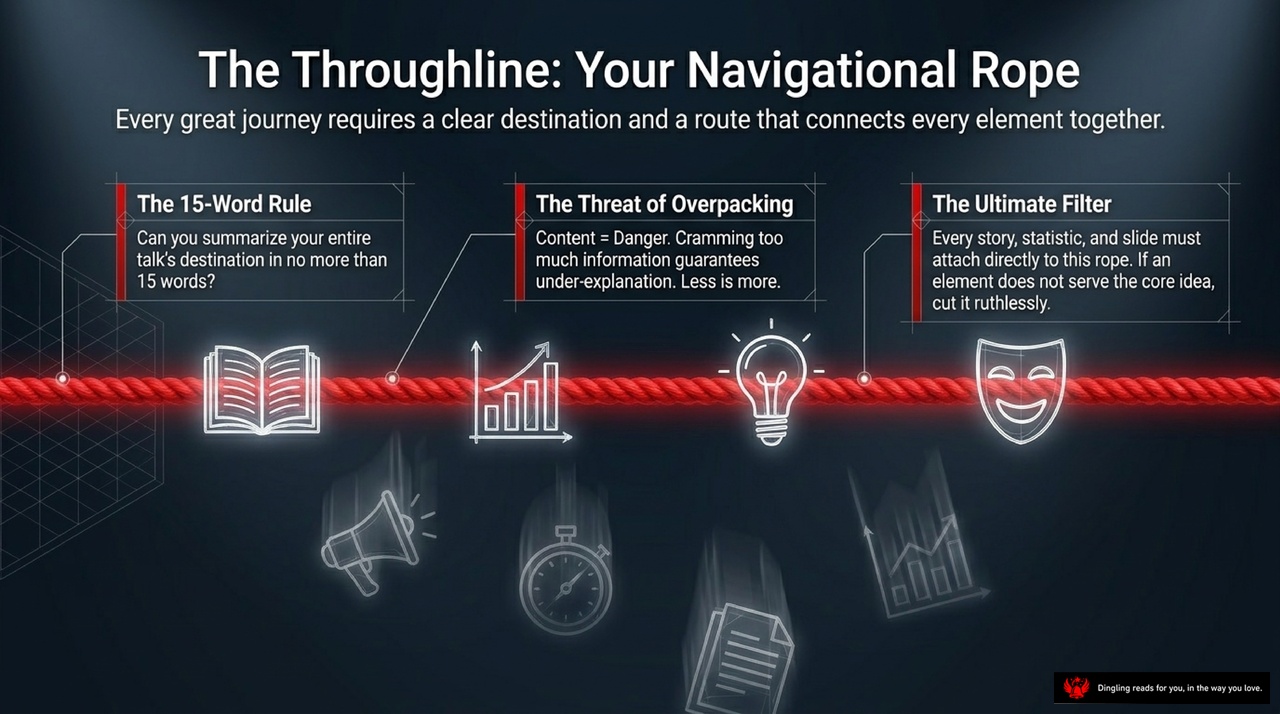
Think of your entire talk not as a random collection of ideas, but as a journey along a single, strong red rope. This is what we call the Throughline. Without it, your speech is just a string of pearls with no thread to hold them together. As the book reminds us, every great journey requires a clear destination and a route that connects every element.
Let's look at how to build this rope. First, we have the 15-Word Rule. Can you summarize your entire talk's destination in no more than 15 words? This forces you to cut the fluff. Next, we face the Threat of Overpacking. The book warns us that content equals danger; cramming too much information guarantees under-explanation. Remember, less is more. You don't need to carry every piece of luggage you own; you only need what is essential for the trip.
Finally, we apply the Ultimate Filter. Every story, statistic, and slide must attach directly to this red rope. If an element does not serve the core idea, cut it ruthlessly. Look at the icons on the screen: the book, the chart, the lightbulb, and the mask. If they don't hang securely on your Throughline, they belong in the bin. Your goal is to create a clear path that leads your audience from where they are to where you want them to be, without getting lost in the noise.
Imagine a speech not as a rigid lecture, but as an immersive adventure. To truly captivate your audience, you need to move beyond simple explanation and design a "fantasy journey." Think of it as leading them on an expedition where every new image, fact, and story feels like a fresh discovery. For instance, a speaker named David Gallo didn't just talk about the ocean; he showed us glowing deep-sea creatures and videos of octopuses changing color instantly. He dropped a bombshell: "We've only explored 3% of the ocean." In just five minutes, he transported us into the unknown.
But there's another powerful tool: the live demonstration. Instead of explaining how something works, let them see it happen right before their eyes. Remember Jeff Han in 2006? He didn't lecture about multi-touch technology. He simply touched the screen with two hands, zooming and rotating, and the crowd gasped. Or consider Michael Pritchard, who poured muddy, fecal water into a bottle, filtered it, and drank it live to prove a point about water purification. The core principle here is drama. You must build anticipation with a few words, then shatter expectations with a real, tangible result.
Finally, don't forget the power of dreams. Great speeches often sell a vision of what could be. Martin Luther King Jr.'s "I Have a Dream" didn't just list grievances; it painted a vivid picture of a future where people are judged by character, not skin color. Similarly, Salman Khan showed us a world where every child learns at their own pace using video, and Chris Milk used virtual reality to let us walk through a Syrian refugee camp. Whether it's a magical journey, a shocking demo, or an inspiring vision, the goal remains the same: create an emotional connection. When your audience feels curious, amazed, or moved, you've successfully planted the seed of your idea in their minds.
Welcome to the final chapter of our journey into the art of public speaking. Today, we're stepping into the future of speaking and asking a crucial question: Is it time to break the mold?
For decades, the standard formula for a talk has been simple: a speaker, a microphone, and a slide deck full of bullet points. But the world has changed, and so has our need for connection. We are living in an era of knowledge reconstruction, where the ability to simply know facts is no longer enough. Artificial intelligence can read thousands of papers in seconds, and machines can now perform tasks once reserved for experts. So, what is left for us? The answer lies in what machines cannot do: connect with us on a human level.
This is where the concept of the "Full Spectrum Talk" comes in. It's about breaking free from the old constraints. Instead of just relying on words and static images, a Full Spectrum Talk invites the audience to engage with all their senses. Think of it as an immersive experience rather than a lecture. Imagine a speaker using dance to visualize complex physics, releasing live mosquitoes to make the threat of malaria feel real, or using dual screens to show the rational and emotional sides of a story simultaneously. These aren't just gimmicks; they are powerful tools to make abstract ideas tangible and unforgettable.
However, innovation without substance is just noise. The most important rule here is simple: the idea is the soul. Every prop, every technology, and every creative twist must serve the core message. If you spend more time on the spectacle than the story, you've lost the audience.
But why does this shift matter beyond just being cool? Because our world is interconnected, and so should our thinking. The real power of public speaking today isn't about displaying expertise; it's about building bridges. It's about taking the deep, specialized knowledge you've spent years mastering and translating it into a language everyone can understand. It's about showing how the dots connect across different fields—how an artist's perspective can solve an engineer's problem, or how a scientist's discovery can inspire a new design.
In a world saturated with information, the most valuable thing you can offer is perspective. You don't need to be a world-famous inventor to have something worth sharing. Your unique experiences, your failures, your specific observations of the world—these are the treasures that only you possess. When you step onto that stage, you aren't just delivering information; you are weaving a new thread into the global tapestry of human understanding.
So, are you ready to stop just speaking and start connecting? The future of public speaking isn't about perfection; it's about authenticity and impact. It's about finding your voice and using every tool at your disposal to make sure your message doesn't just get heard, but truly felt. The stage is open, and your unique perspective is waiting to be shared.
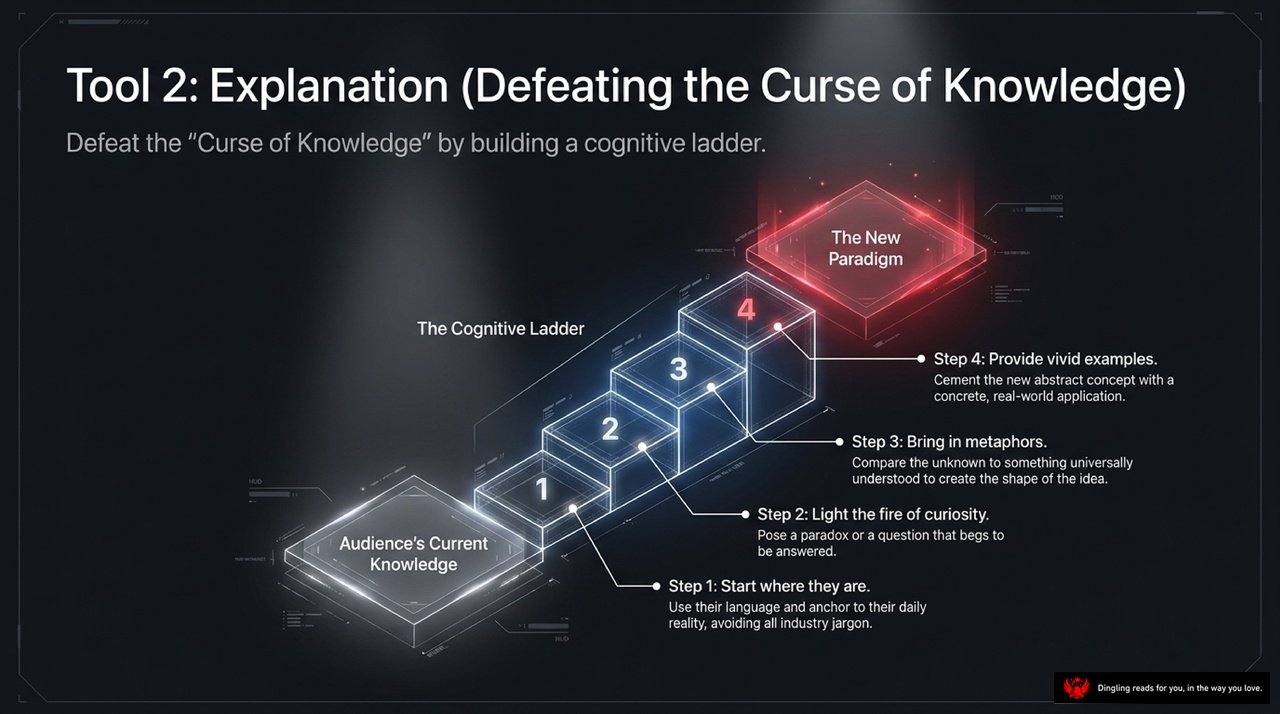
Tool 2: Explanation—Defeating the Curse of Knowledge. We all suffer from the "Curse of Knowledge": once we know something, we forget what it feels like *not* to know it. This makes us terrible teachers, constantly drowning our audience in jargon and skipping the crucial steps that bridge the gap. But there is a way out. The solution is building a "Cognitive Ladder."
Imagine this ladder as a four-step journey to take your audience from their current reality to your new paradigm.
Step 1: Start where they are. Don't lead with your expertise; lead with their experience. Use their language, anchor your ideas in their daily reality, and strictly avoid industry jargon. If you don't meet them where they stand, they will never climb up.
Step 2: Light the fire of curiosity. Once you've connected, don't just state facts. Pose a paradox or ask a question that begs to be answered. You need to create a gap in their understanding that only your explanation can fill.
Step 3: Bring in metaphors. This is where magic happens. Compare the unknown concept to something universally understood. Create a mental shape for your idea so it becomes tangible and memorable.
Step 4: Provide vivid examples. Cement that abstract concept with a concrete, real-world application. Show them exactly how this works in practice.
By climbing these four rungs, you stop talking *at* your audience and start guiding them to a new way of thinking.

Tool 3: Persuasion, or the art of changing minds. Imagine you are a detective solving a mystery. You don't tell the audience the solution immediately; instead, you guide them through a shared investigation until they discover the truth themselves. This is the power of persuasion.
First, prime the mind by starting with a massive mystery. Don't state your conclusion first. Let the audience feel the puzzle. Then, walk them through the process of elimination. Just like our detective story, dismantle the wrong answers together. Show them why the other paths lead to dead ends, making the final choice feel inevitable. When only one logical path remains standing, the audience doesn't just accept your idea; they discover it alongside you.
But logic alone isn't enough. You need an intuition pump. Inject stories and visual proof to make that logical conclusion feel deeply true. Without emotion, logic fails to stick. By blending rigorous reasoning with compelling narrative, you transform a simple argument into a movement that changes how people see the world.

Let's talk about the power of visuals in your presentation. The golden rule is simple but often overlooked: visuals must enhance your message, never distract from it. If a slide doesn't do cognitive work, delete it. Look at the example on the left. Using bullet points, cramming in complex charts, or simply repeating what you're saying is a trap. It forces the audience to read ahead, stopping them from listening to you. That's why we mark that approach with a big red "X."
Now, look at the right side. This is the "Do." Instead of walls of text, use full-bleed, high-resolution imagery. Notice the stark, powerful "82%" against a dramatic landscape. That single image communicates a core idea instantly without needing a paragraph of explanation. Limit each slide to one core idea, and use the black screen strategically to pull attention back to your face. By reducing cognitive load, you don't just show data; you create a moment of clarity that sticks in the audience's mind. Remember, your slides are there to support your story, not replace it.

Have you ever felt that strange disconnect where you've memorized every word, yet the moment you step up, you sound robotic, your eyes dart around searching for the next line, and your anxiety spikes? You've hit what we call "The Valley of Awkwardness."
This slide illustrates a critical trap known as "The Scripting Dilemma." On the far left, we see Stage 1: Reading. Here, you remember the words, but because you are so focused on reading, you kill the vital metadata of speech—your passion, your eye contact, and your vulnerability. It has low impact.
If you keep pushing through without internalizing the message, you fall into that middle valley. You sound mechanical, and your audience can tell you aren't connecting with them.
But look at the far right: Stage 3, Total Internalization. This is where the magic happens. You know the script so deeply that you stop thinking about the words entirely. You focus purely on the meaning. To the audience, it sounds completely improvised, natural, and powerful. This is high impact.
The lesson here is clear: you must commit fully to memorization, or do not memorize at all. There is no middle ground where you half-heartedly recite lines. Alternatively, you can choose a different path: speak dynamically from a structured bulleted outline. This allows you to avoid the middle valley entirely, giving you the freedom to be spontaneous while staying on message. Don't get stuck in the awkward middle; aim for that peak of total connection.
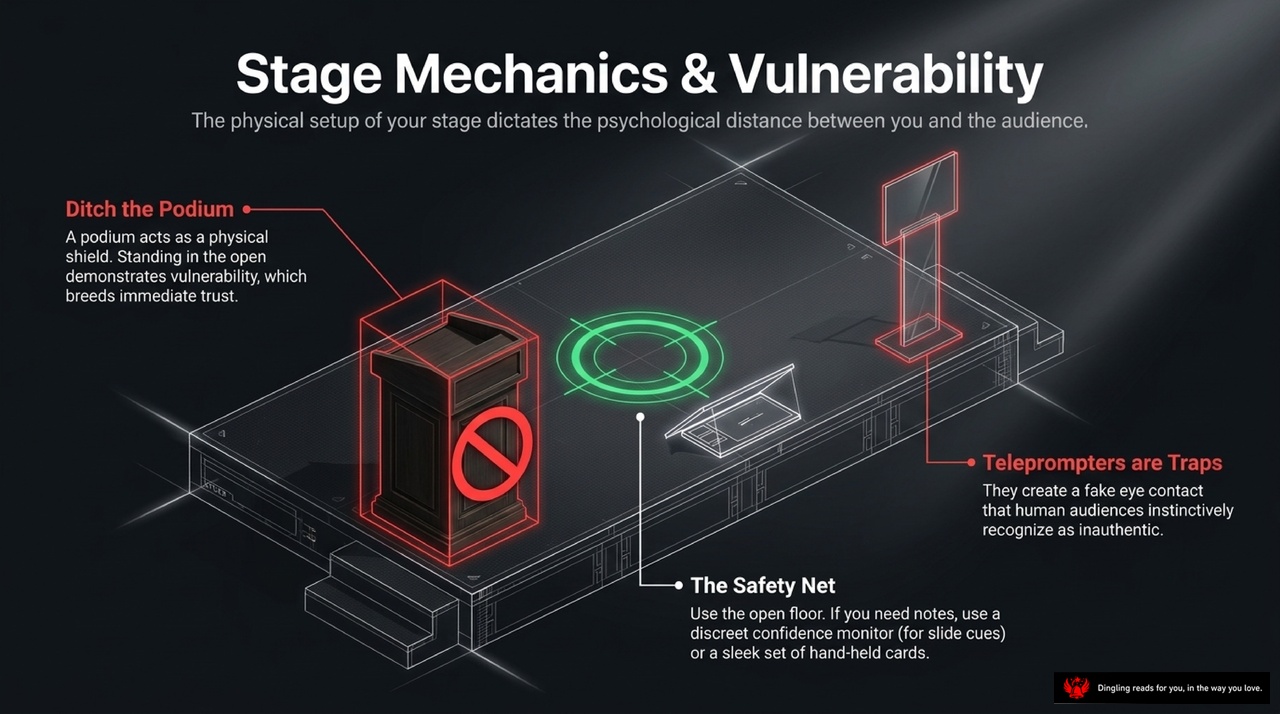
Today's slide, "Stage Mechanics & Vulnerability," highlights a simple but powerful truth: your physical setup dictates your psychological distance from the audience. Let's break down these three critical traps that can sabotage your connection.
First, ditch the podium. As the image shows, a podium acts as a physical shield. Standing behind it hides your body language and creates a barrier, making you appear distant and unapproachable. Instead, stand in the open. This demonstrates vulnerability, which breeds immediate trust. When you expose yourself, you invite the audience in.
Second, avoid teleprompters. The slide warns that they are traps. While they seem helpful, they create fake eye contact. Human audiences instinctively recognize this as inauthentic. It breaks the connection because your eyes are looking at a screen, not at the person in front of you.
Finally, use the open floor as your safety net. If you need notes, don't hide behind a desk. Use a discreet confidence monitor for slide cues or a sleek set of hand-held cards. This keeps you grounded without hiding.
Remember, the goal isn't to hide behind props; it's to stand tall, look people in the eye, and share your ideas directly. Your presence is your most powerful tool.

Think of your voice not just as a carrier of words, but as the very vessel for meaning and passion. While printed text transfers data, your voice transfers the human element. As you see on this screen, that raw sound wave connects directly to the beating of a heart. This is the metadata of speech—the invisible layer that transforms information into connection.
To master this, you must vary your tone. Avoid the hypnotic drone of a single pitch. Instead, highlight key words with volume, speed up for anecdotes to build momentum, and slow down when explaining complex concepts to let them sink in. Then, harness the power of the pause. Silence is a highly engineered tool. Use it after a profound statement to let the idea physically settle into the audience's mind, giving them space to process the weight of what you've just said. Finally, embrace purposeful movement. Don't pace nervously or rock back and forth. Stand grounded to show authority; move only when transitioning to a new point to signal a shift in thought. When you align your voice, your silence, and your movement, you stop performing and start connecting, turning your speech into a living, breathing conversation.

Imagine your speech as a conversation that happens twice: once at the very beginning to grab attention, and once at the very end to ensure you're remembered. You have exactly one minute to hook them, and one final moment to leave a lasting legacy.
On the left, we look at how to open. The goal is to hook the mind immediately. You can drop right in with a dramatic, counter-intuitive statement that stops the scroll. You can ignite curiosity by asking a question that demands an answer. You can use a stunning visual that requires immediate explanation, or you can use the tease—hinting at a massive revelation to come later. These aren't just tricks; they are essential tools to break through the noise and say, "I need to hear more."
On the right, we focus on how to close. This is where you leave a legacy. Instead of just fading out, use a camera pull-back to show the grand, future possibilities of your idea. Give a clear call to action, asking your audience to do one very specific thing. And perhaps most importantly, practice narrative symmetry. Return beautifully to the exact story or image you showed in your opening. This creates a satisfying loop, proving that your entire message was a cohesive journey, not just a random collection of points.
Mastering these bookends transforms your speech from a fleeting moment into a memorable experience. It ensures that when the lights go down, your audience doesn't just leave the room—they take your idea with them.

The ultimate rule for any great speaker is simple, yet incredibly hard to master: Be Authentic.
The biggest trap in public speaking isn't your nerves or your slides; it's trying to be someone else. Many of us feel pressured to mimic famous speakers, to copy their style, or to hide who we really are. But here is the truth: if you are a nerd, be a nerd. If you are emotional, let that show. If you are analytical, lean into that. Your unique personality is your superpower, not a flaw to hide.
Think about nervousness. Instead of viewing it as a curse, see it as harnessable energy. The audience doesn't want a perfect robot; they want a real human. They actively want you to succeed because they connect with your vulnerability. When you focus entirely on the idea you are sharing—when the message becomes bigger than your ego—that fear naturally disappears.
Don't try to be Winston Churchill or Nelson Mandela. If you are a scientist, use your logic. If you are an artist, share your inspiration. If you are just a regular person, speak with your heart. As the story of Richard Turrey, a young boy from Kenya, shows, you don't need to invent a "Lion Lamp" to be impactful. You just need to be real. When you stop performing and start sharing your genuine self, your authentic voice becomes the most powerful tool you have.
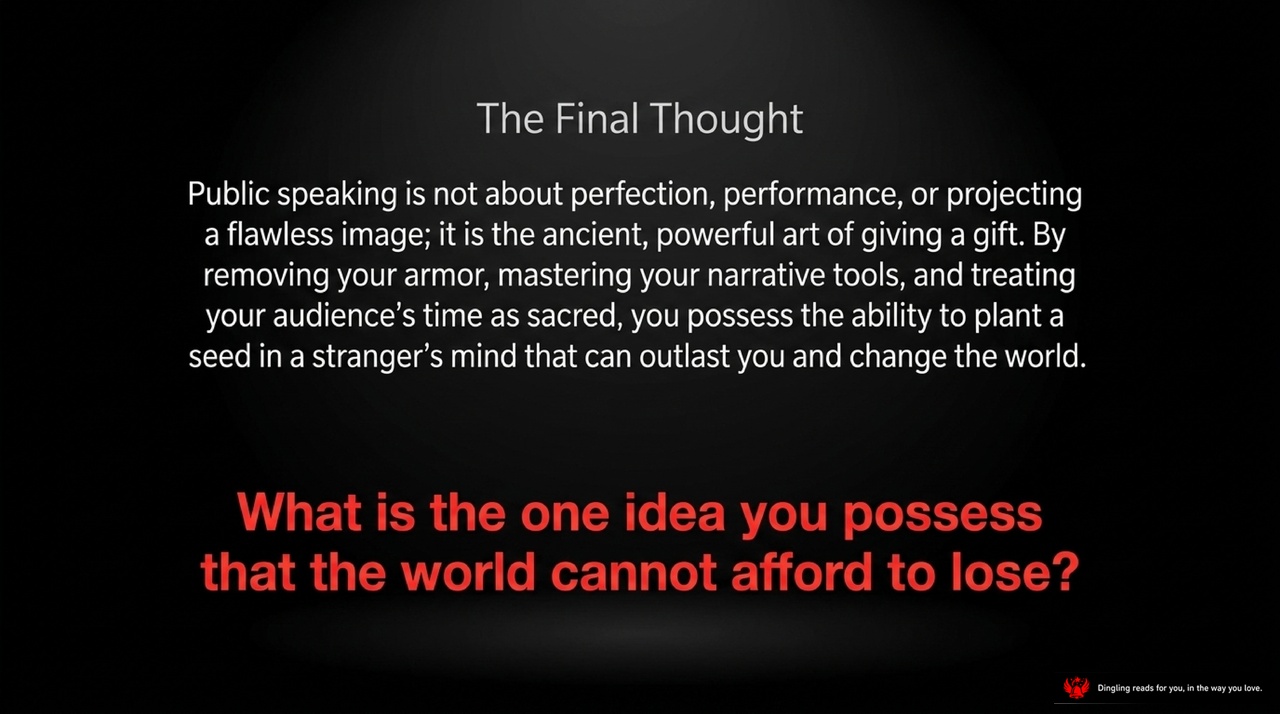
So, what is the one idea you possess that the world simply cannot afford to lose?
Let's be honest: public speaking isn't about being perfect. It's not a performance where you have to project a flawless image. In fact, trying too hard to be perfect is often the biggest barrier to connection.
True power comes from something much more ancient and profound: the art of giving a gift. When you step onto that stage, you aren't there to show off your skills. You are there to remove your armor, to master your story, and to treat the audience's time as sacred.
Think about it this way: by sharing your truth, you have the unique ability to plant a seed in a stranger's mind. That seed might grow into something small, but it has the potential to outlast you and even change the world.
So, look around you. What is that one idea inside you that could shift someone's perspective? What is the lesson from your life that you are most excited to share? Don't wait for a grand invention or a complex theory. The world doesn't need another performance; it needs your unique voice, your real story, and the gift of your insight.
What is your idea? The stage is ready. It's time to give.