
The 21 Irrefutable Laws of Leadership: Complete Chapter-by-Chapter Summary

Welcome to our deep dive into John C. Maxwell's timeless classic, *The 21 Irrefutable Laws of Leadership*. Today, we aren't just reading a book; we are unlocking the blueprint for transforming your potential, empowering your team, and leaving a legacy that outlasts your tenure.
Imagine leadership not as a title or a job description, but as a compass guiding you through the chaos of the modern world. Maxwell's core message is simple yet profound: mastering the art of influence is the key to everything. It's about shifting from simply having authority to truly inspiring action. Whether you are leading a global corporation or a small team, the principles remain the same. This journey will help you navigate the complexities of leadership, turning your raw potential into tangible, lasting results. Let's begin by exploring how these laws can reshape your approach and define your impact.
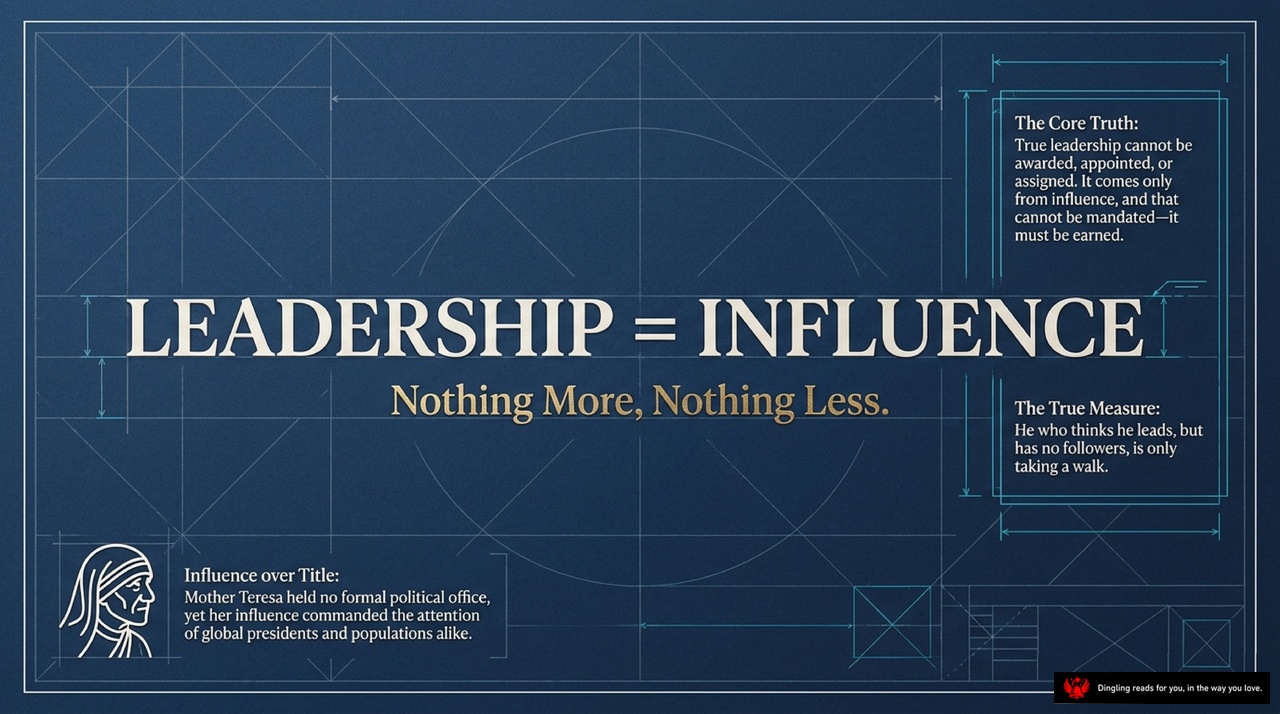
True leadership isn't about the title on your business card or the corner office you occupy. As the blueprint on your screen reminds us, leadership equals influence, nothing more, nothing less. It's a core truth that cannot be mandated; it must be earned. Think about Mother Teresa. She held no formal political office, yet her influence commanded the attention of global presidents and populations alike. That is the real measure.
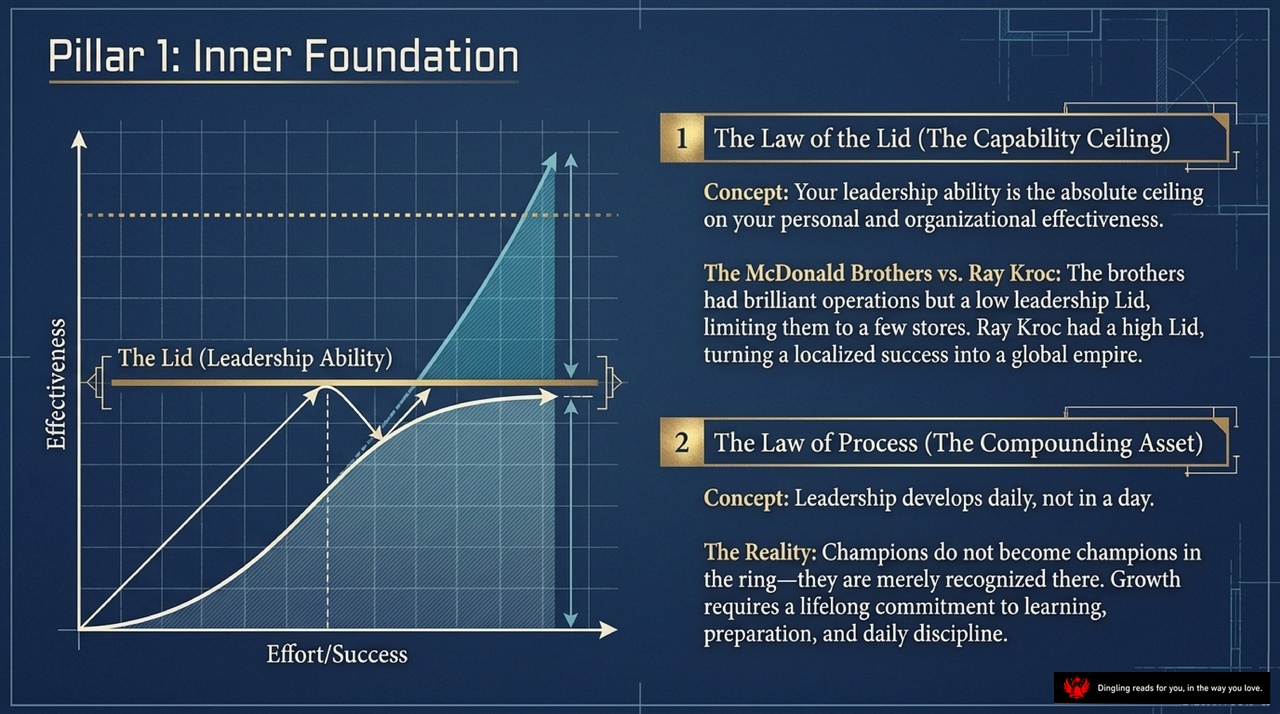
But here is the hard reality: if you think you are leading but have no followers willing to follow you, you are only taking a walk. Influence is the only currency that matters. Consider the story of McDonald's. The original brothers were great managers, but their leadership "lid" was too low, capping their potential. It wasn't until a true leader, Ray Kroc, took the helm that the brand exploded into a global giant. Or look at Steve Jobs versus Steve Wozniak at Apple. Wozniak was the technical genius, but Jobs possessed the leadership influence that built an empire.
So, how do we measure this? It's not about your personality or your resume. It's about who chooses to follow you when you have no power to force them. If your core team leaves the moment you lose your title, you were never a leader in the first place. True leadership is the ability to move people to action, to inspire them to achieve more than they thought possible, simply because they trust in you. Without that influence, you are just an employee with a paycheck, not a leader with a legacy.
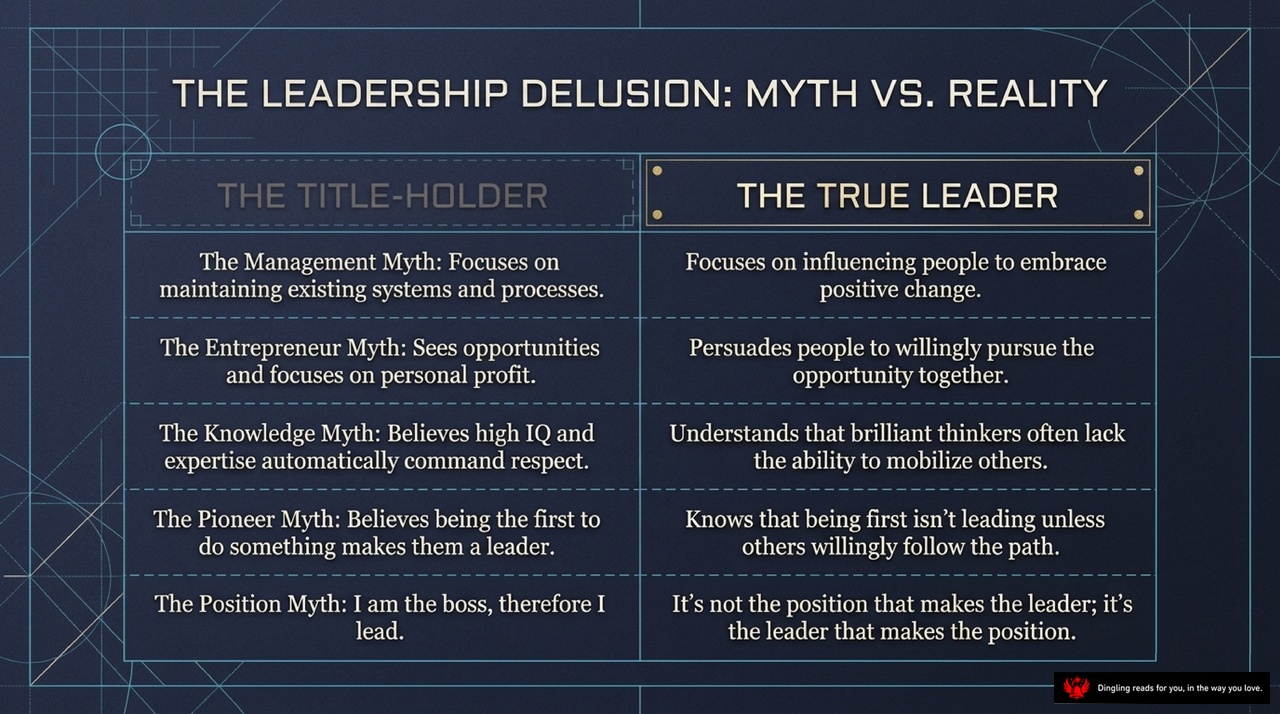
Have you ever wondered why some people with titles and high IQs fail to inspire, while others with no formal power command armies? The slide you see right now breaks down the difference between a "Title-Holder" and a "True Leader." It exposes what we call the Leadership Delusion: the gap between the myths we believe and the reality of effective leadership.
Look at the first row. The Management Myth suggests that leaders just maintain the status quo. But a True Leader focuses on influencing people to embrace positive change. Think about the McDonald's story. The original brothers were great managers who kept the system running, but their "lid" of leadership was too low to scale the business. It wasn't until they met Ray Kroc, a true leader who didn't just manage the system but influenced thousands to join a new vision, that McDonald's exploded globally.
Next, consider the Entrepreneur Myth. Many believe leadership is about spotting opportunities for personal profit. However, the reality is that a True Leader persuades people to willingly pursue those opportunities together. It's not about taking the gold; it's about convincing the team to run the race with you.
Then we have the Knowledge Myth. We often think high IQ and expertise automatically command respect. But as the slide correctly points out, brilliant thinkers often lack the ability to mobilize others. Steve Wozniak was a technical genius, but it was Steve Jobs' leadership that mobilized the world. True leadership isn't about knowing everything; it's about making others feel capable of achieving more.
Finally, look at the bottom two rows. The Pioneer Myth tells us that being first makes you a leader. But being first is just being early; it doesn't make you a leader unless others willingly follow the path behind you. And the Position Myth is perhaps the biggest delusion of all: "I am the boss, therefore I lead." The slide hits the nail on the head with the counter-truth: "It's not the position that makes the leader; it's the leader that makes the position."
So, the next time you look at an organizational chart, ask yourself: Are you just holding a title, or are you actually influencing people to create change? Because true leadership isn't about the seat you sit in; it's about the impact you leave on everyone around you.
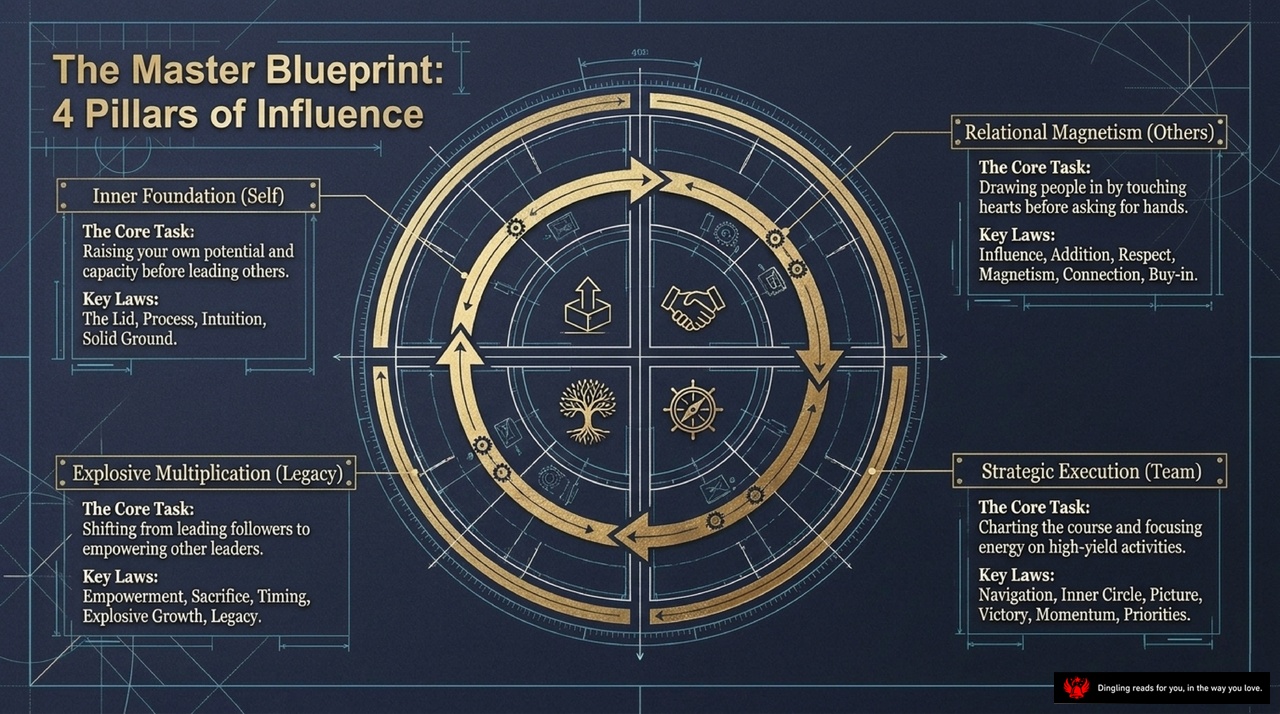
Look at this blueprint. It's not just a diagram; it's the master plan for building influence, broken down into four essential pillars. Let's walk through how these pieces fit together to create a leader who truly moves the needle.
First, we start with the Inner Foundation, which is all about you. Before you can lead others, you have to raise your own potential. This is where you build your solid ground, sharpen your intuition, and master the process. You can't pour from an empty cup, so the core task here is simply raising your capacity.
Next, we move to Strategic Execution, which is about your team. Once you have your foundation, you need to chart the course. Your job is to focus energy on high-yield activities. Think of yourself as the navigator setting the direction. The key laws here are about vision and momentum—using things like the "Inner Circle" and clear "Priorities" to ensure everyone is rowing in the same direction toward victory.
Then, we shift to Relational Magnetism, focusing on others. This is the art of drawing people in by touching their hearts before asking for their hands. It's not about manipulation; it's about genuine connection. When you practice laws like Addition, Respect, and Buy-in, you create a magnetic pull that makes people want to follow you willingly.
Finally, the goal of all this is Explosive Multiplication, which is your legacy. This is where you shift from just leading followers to empowering other leaders. Instead of trying to do everything yourself, you invest in others to grow. By focusing on empowerment, timing, and sacrifice, you create a ripple effect. You aren't just building a business or an organization; you are building a movement that continues long after you're gone.
These four pillars work in a cycle. You build yourself, you lead the team, you connect with people, and you multiply your impact. That is the blueprint for lasting influence.
Imagine a world where the quality of your team is a direct reflection of your own character. This is the essence of the Law of Attraction. You don't get the people you wish for; you get the people you are. If you possess high integrity, strategic vision, and a passion for growth, you will naturally attract leaders who mirror those traits. Conversely, if you lack these qualities, you will inevitably draw in those who are equally unprepared to lead.
Think about the history of great movements. Robert E. Lee, a military genius, chose to join the Confederacy because his heart belonged there. The result? The South's most talented generals rallied around him, creating a formidable force simply because they were attracted to his leadership. In my own experience at the Skyline Church, my predecessor, Dr. Orville Bach, was a musical prodigy. Because he was a musician, he attracted other musical geniuses, turning the church into a national music hub. But when I took over, my focus shifted. I wasn't a musician myself, so I couldn't attract more musicians. Instead, I attracted other leaders. By the time I left, the church wasn't just filled with musicians; it was overflowing with hundreds of emerging leaders who were ready to take the stage themselves.
This principle applies to every aspect of your life. Your attitude sets the tone for everyone around you. Optimistic people gravitate toward other optimists; cynical people pull in the same. Your values act as a magnet. Idealists like John Kennedy attract dreamers who want to change the world, while those with destructive values attract followers who share that darkness. The lesson is clear: you cannot recruit the leader you wish to be unless you first become that leader yourself. If you are dissatisfied with the caliber of your team, stop looking outward and start looking inward. Elevate your own standards, sharpen your skills, and embody the leadership you desire. When you do that, the right people will not just follow you; they will flock to you, creating a powerhouse of talent that can achieve anything.
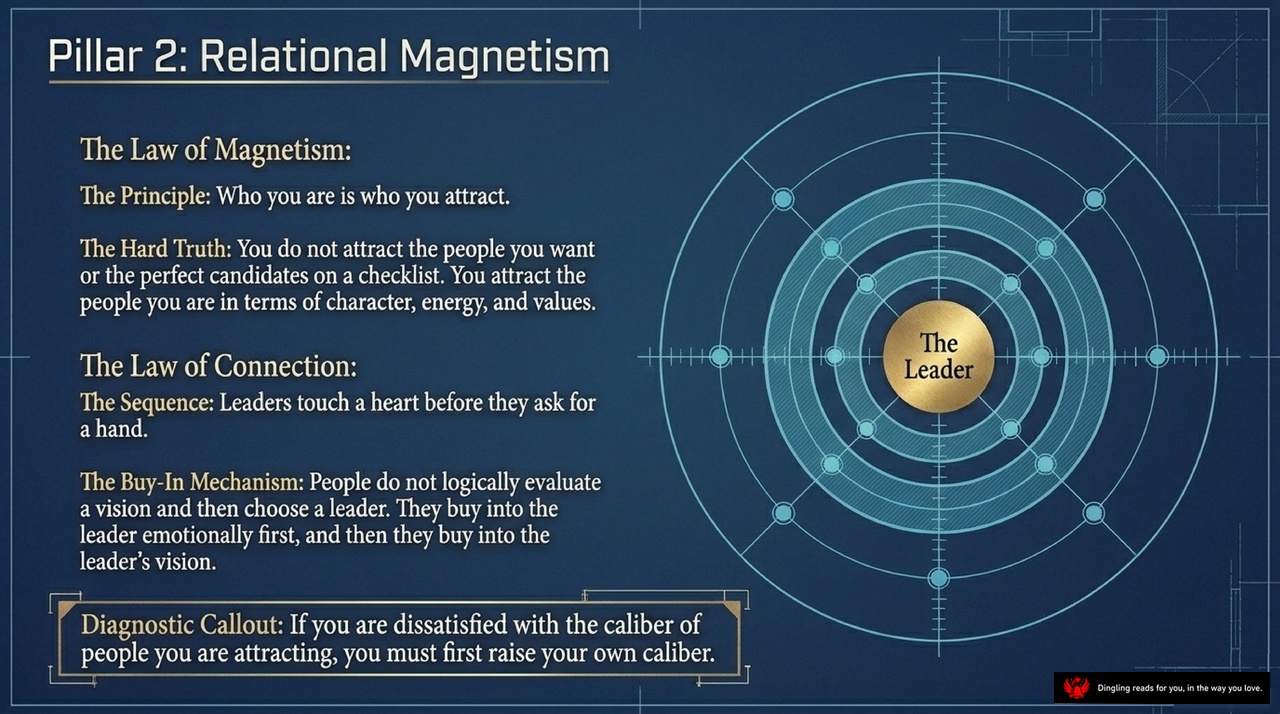
Pillar 2: Relational Magnetism. Think about this: who you are is exactly who you attract. It's not about making a checklist of the perfect candidate and hoping they walk through the door. The hard truth is that you don't attract the people you want; you attract the people you are. Your character, your energy, and your values create a gravitational field. If you want high-caliber people, you have to raise your own caliber first.
Look at the diagram here. The leader is the center, and everyone else orbits around that energy. This is the Law of Connection. Leaders must touch a heart before they ever ask for a hand. People do not logically evaluate a vision and then choose a leader. They buy into the leader emotionally first, and only then do they buy into the vision. If you are dissatisfied with the caliber of people you are attracting, stop blaming them and start raising your own.

Look at this compass and the "Sweet Spot" in the center. This visual perfectly captures the third pillar of our journey: Strategic Execution. Think of it as the Law of Navigation. Anyone can steer the ship, but only a true leader can chart the course. Leaders see farther, see more, and see things before others do. That's the difference between just being busy and actually accomplishing something.
Now, let's dive into the Law of Priorities, or what we call the 3R Matrix. Here is the trap we all fall into: confusing activity with accomplishment. Being busy isn't being productive. To break free from this trap, you need to find your "Sweet Spot"—the intersection of three circles. First, look at Requirement. What must you do that nobody else can do? If someone else can do it 80% as well, delegate it immediately. Second, focus on Return. What yields the highest return on your unique strengths and talents? Don't just work hard; work on what you are best at. Third, consider Reward. What gives you the greatest personal satisfaction and passion?
Your strategic execution happens only when these three align. If you are doing something that isn't your strength, doesn't give you a return, and offers no personal reward, you are just spinning your wheels. True leaders navigate by identifying where these three circles overlap and commit their energy there. That is how you move from a follower who just steers to a leader who charts the course.
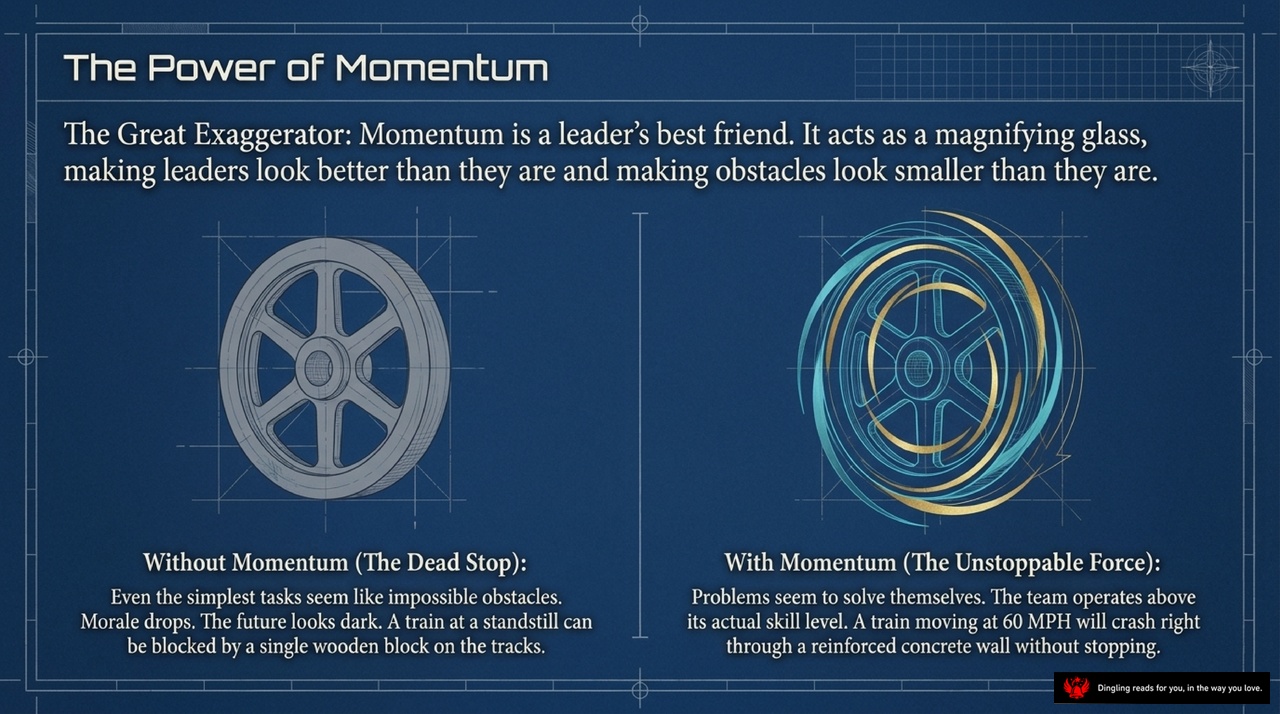
Momentum is often called a leader's best friend, and for good reason. Think of it as a powerful magnifying glass that reshapes reality for everyone around you. When a leader has strong momentum, they look better than they actually are, and obstacles shrink until they seem almost manageable.
Look at the visual contrast on this slide. On the left, we see a wheel without momentum, labeled "The Dead Stop." In this state, even the simplest tasks feel like impossible mountains. Morale crashes, the future looks dark, and a team is so stationary that a single, tiny wooden block on the track can stop a train dead in its tracks. That is the danger of stagnation.
Now, look at the right side. This is the wheel with momentum, representing "The Unstoppable Force." Suddenly, the dynamics change completely. Problems begin to solve themselves. The team operates on a level far above their actual skill set because the energy is carrying them forward. The slide makes a striking point: a train moving at 60 MPH will crash right through a reinforced concrete wall without stopping.
The lesson is clear. Momentum isn't just about speed; it's about the ability to overcome barriers that would otherwise be insurmountable. As a leader, your job is to create that initial push so that your team can ride the wave of momentum, turning impossible challenges into routine victories.

Imagine a blueprint for organizational growth where the difference between stagnation and explosion lies in one simple choice: are you building followers or leaders? Today's slide breaks this down into two distinct paths. On the left, we see "Leading Followers," or the path of Addition. Here, the psychology is rooted in a need to feel needed, often focusing 80% of time on the bottom 20% of the team to fix weaknesses. The treatment is uniform—treating everyone exactly the same—which limits impact to only those physically touched. This approach yields a linear, additive growth curve.
But look at the right side: "Leading Leaders," the path of Multiplication. The psychology shifts to a desire to be succeeded and made obsolete. The focus moves to spending 80% of time on the top 20%, maximizing their strengths. Treatment becomes personalized, tailored to individual impact. The result? An exponential curve that extends influence far beyond your physical reach.
The paradigm shift is clear: to grow by addition, lead followers. To grow by multiplication, lead leaders. It's about trading the safety of a flat line for the explosive potential of a curve that keeps climbing.
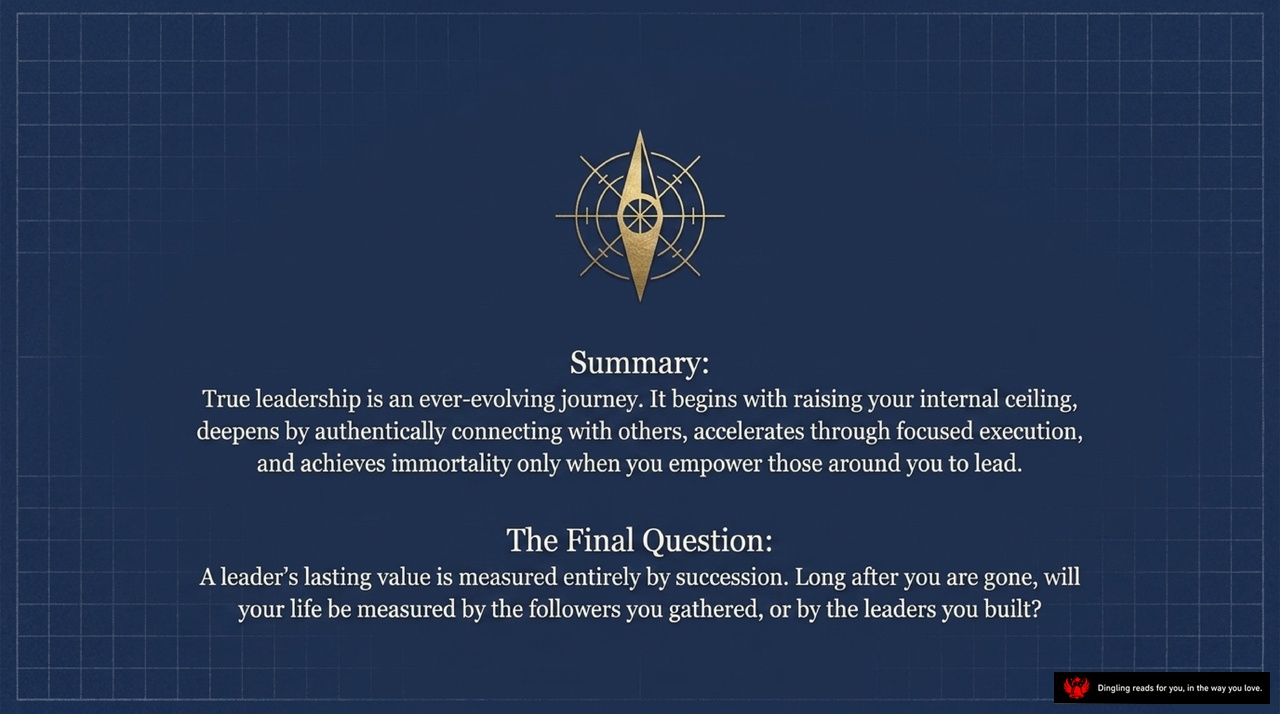
True leadership isn't about the title you hold or the room you sit in; it's about the legacy you leave behind. As we wrap up this journey, remember that leadership is an ever-evolving path. It starts by raising your own internal ceiling, grows deeper through authentic connections, speeds up with focused execution, and only achieves true immortality when you empower others to lead. Think about it: a leader's lasting value is measured entirely by succession. Long after you are gone, the real question is, will your life be defined by the followers you gathered, or the leaders you built? The greatest success isn't standing at the top; it's creating the people who can stand there when you're no longer there.