
The 4-Hour Workweek: Complete Chapter-by-Chapter Summary

Welcome to the 4-Hour Workweek. Imagine a life where you escape the traditional 9-to-5 grind, live anywhere you choose, and join what Tim Ferriss calls the "new rich." This isn't about being the wealthiest person in the room; it's about having the freedom to decide what you do, when you do it, and where you do it. While many of us are trapped in a "delayed life," constantly postponing happiness for a distant retirement, true wealth is measured by your choices, not just your bank balance. As Ferriss explains, a person working just 20 hours a week can often enjoy a higher quality of life than someone working 80 hours for double the salary. The goal isn't to accumulate more stuff, but to simplify your life so you can focus on what truly matters.

Imagine a world where money is actually obsolete, and the true currencies of success are simply time and mobility. This slide illustrates a massive paradigm shift: the battle between the traditional "Deferrer" and the emerging "New Rich."
On the left, you see the Deferrer. This is the classic mindset we've all been taught: work for yourself, delay your life until you can retire early, hoard piles of cash, and try to be the boss. It's a strategy of accumulation, but it often leads to a life where you work harder just to save more, only to find yourself trapped by the very wealth you built.
Now, look at the right side: The New Rich. They operate on a completely different logic. Instead of working for themselves, they have others work for them. Instead of waiting for a distant retirement, they distribute "mini-retirements" throughout their lives, enjoying freedom now. They don't just hoard money; they generate specific cash flows to fund specific dreams, whether that's a car, a home, or a trip. Most importantly, they don't just want to be the boss; they own the system. Think of it like owning a train and hiring the conductor—you control the direction without having to drive every single car.
The bottom line is clear: stop chasing more money and start buying back your time. The New Rich realize that the ability to choose where to be, when to do, and with whom to do it is the ultimate power.

Look at this "D.E.A.L. Transformation Engine." This isn't just a chart; it's the blueprint for escaping the trap of living on "autopilot" while your dreams stay parked.
First, we hit **Definition**. We have to overturn the old assumption that wealth equals working harder. True wealth is about redefining what success actually looks like.
Next comes **Elimination**. This is where most people fail. We spend our lives killing obsolete time-management illusions—chasing busy-ness instead of results. We need to strip away the noise to find the signal.
Then, **Automation**. This is the magic step. It's about putting your income on autopilot so it works for you, not the other way around.
Finally, **Liberation**. This is the ultimate goal: escaping the office and designing a mobile lifestyle. You aren't just changing jobs; you're designing a life where you choose where you are, when you work, and who you spend your time with.
But here's the twist in the bottom right corner: **The Employee Bypass**. If you're currently employed, you can't just follow the standard D-E-A-L sequence. You have to flip it to D-E-L-A. You must create geographical freedom first—get the liberation—before you can finally cut your hours and automate. You have to escape the cage before you can start building the key. This is how you go from being an employee who waits for orders to a creator who designs freedom.

Look at this timeline. It visualizes the terrifying gap between how we imagine quitting and what reality actually looks like. On the far right, we see "The Illusion": we often picture quitting as a catastrophic "10," a permanent ruin that destroys everything. But the slide forces us to confront "The Reality." Most worst-case scenarios—like taking a temporary bartending job or moving to a smaller apartment—are actually only a 3 or a 4 on this scale. They are minor, temporary impacts that are highly reversible.
The key takeaway here is simple but powerful: inaction is the greatest risk. By measuring our "worst-case scenario," we destroy vague anxiety and realize the risk is far lower than we think. While the upside of a lifestyle change could be a permanent 9 or 10, the fear of a temporary 4 keeps us stuck. So, stop waiting for permission. Define your fears, realize they are manageable, and take the step that leads to freedom.

Welcome to Phase 1: Definition. Today, we're introducing a powerful metric called the Dreamline Metric. As you can see on the screen, the formula is simple yet transformative: your Target Monthly Income equals your Daily Expenses plus your Dream Expenses.
Most of us fall into "The Millionaire Illusion," believing that true wealth means hoarding a million dollars in a bank account just to feel rich. But that's a trap. Look at the reality on the right. True wealth is about financing the lifestyle you desire. For example, instead of saving millions, you could finance a used Aston Martin DB9 for about $2,000 a month and add a round-the-world flight for just $1,399.
Here's the breakthrough: You don't actually want a million dollars; you want the lifestyle that a million dollars buys. And here's the secret—luxury costs far less per month than hoarding millions requires over a lifetime. By focusing on what you actually want to experience today, rather than saving for a fantasy tomorrow, you can achieve your dream life much faster and with less stress.
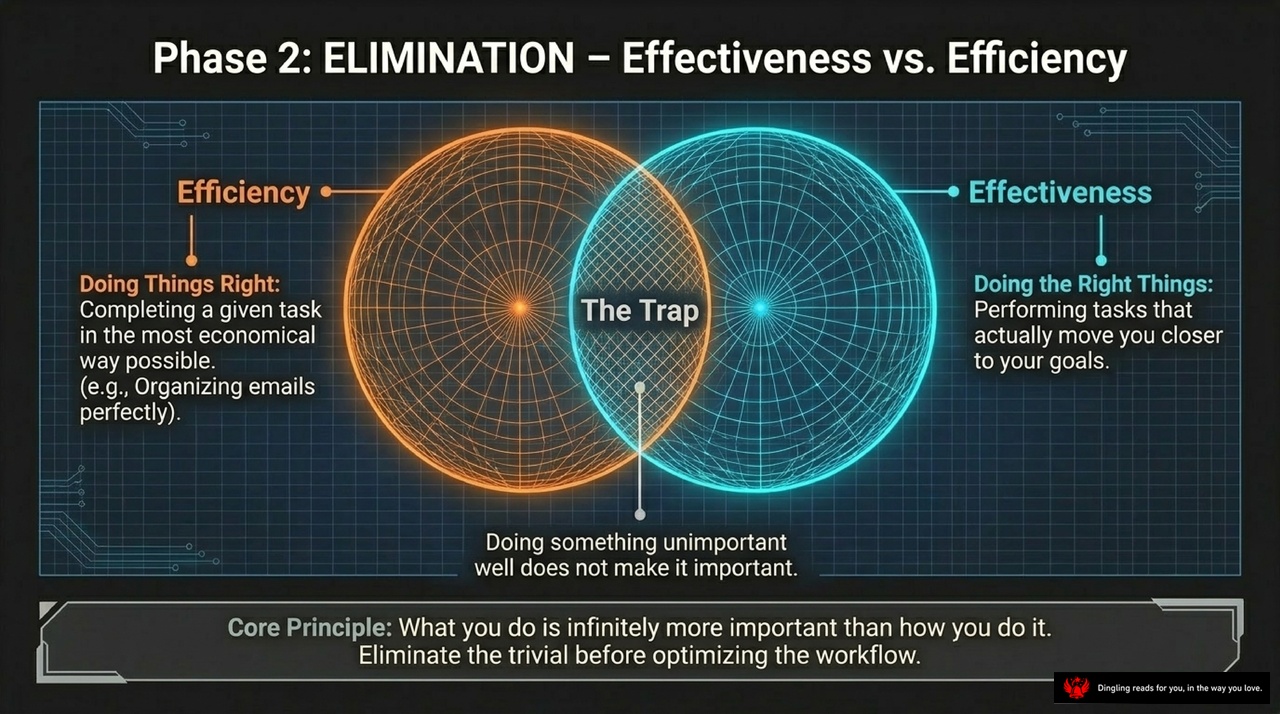
Let's dive into the core of what it means to actually be productive. Look at this diagram: we often confuse Efficiency with Effectiveness. Efficiency is simply "doing things right"—completing a given task in the most economical way possible. Think about organizing your emails perfectly or polishing a report until it's flawless. That is efficiency. But Effectiveness is about "doing the right things"—performing tasks that actually move you closer to your goals.
Here lies the trap. The trap is doing something unimportant well. Just because you can do something quickly and perfectly doesn't mean it matters. As the slide reminds us, doing something unimportant well does not make it important. What you do is infinitely more important than how you do it. So, before you even think about optimizing your workflow, you must eliminate the trivial. Don't just work faster; work on things that actually matter.
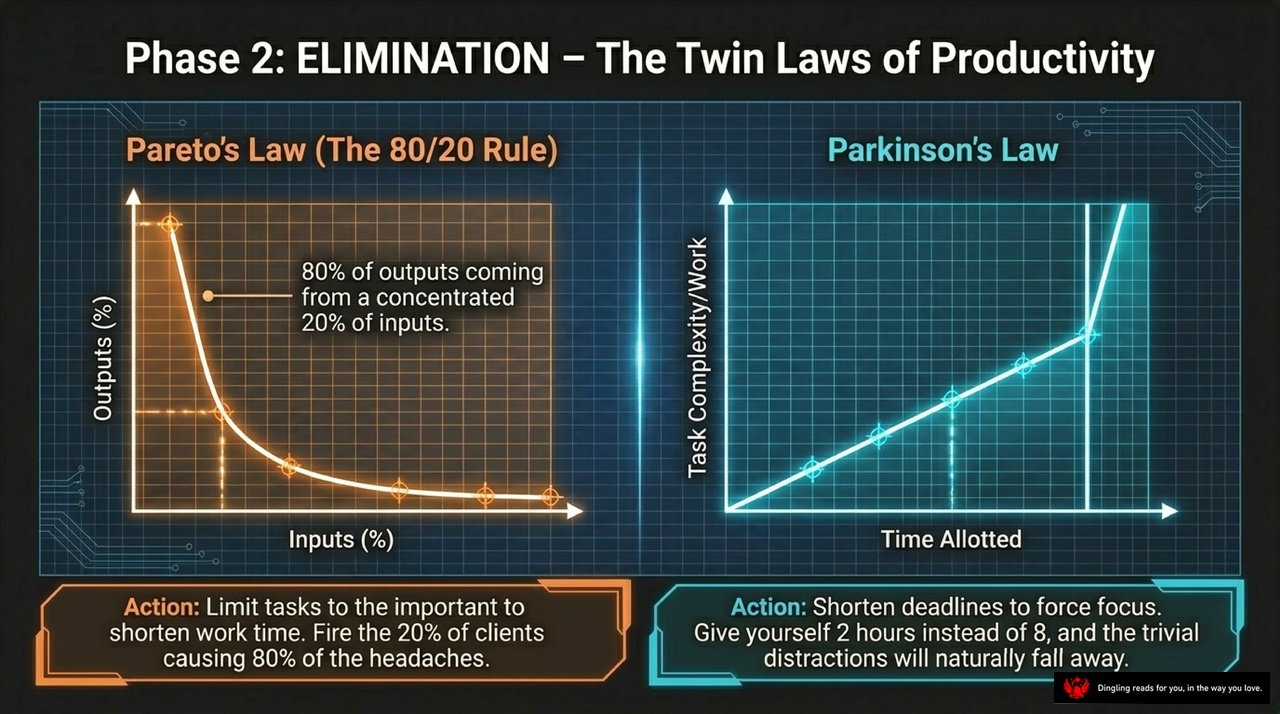
Imagine you're running on a treadmill that's set to go faster and faster, yet you're not actually moving forward anywhere meaningful. That's the trap many of us fall into. We confuse being busy with being productive. But as the ancient Roman philosopher Seneca famously said, "The busy man is busy with anything but life." It's a harsh reminder that our frantic pace often keeps us trapped in a cycle of trivial tasks, completely disconnected from what truly matters.
Consider the story of Steve Jobs. Years ago, he stood on the stage at Stanford and asked a simple, life-altering question: "If you were to die today, would you want to have done the things you are about to do?" When the answer was a resounding no, he knew it was time to change course. He realized that all the external noise—the expectations, the pride, the fear of failure—vanishes when you face the ultimate truth of mortality.
This perspective shift is the key to unlocking a better life. We often spend our lives trying to solve a puzzle that doesn't exist, chasing a finish line that keeps moving away. But life isn't a competition to win; it's an experience to enjoy. When we stop obsessing over the race and start listening to the music, everything changes.
Think about the little moments we often rush past. Have you ever hurried through a day, so focused on the destination that you missed the scenery? Or perhaps you've promised yourself you'd call a friend later, only to let that connection fade away forever? We run so fast to get somewhere that we forget to stop and smell the roses. We treat our days like unopened gifts, tossing them aside before we even have the chance to unwrap them.
The solution is simple but profound: slow down. Don't just move your body; slow your mind. When you realize that time is fleeting, you naturally start prioritizing what brings you joy and fulfillment. You stop letting the fear of missing out dictate your actions and start living in the moment. So, take a deep breath. Stop running. And before the song ends, really listen to the music of your own life.

Imagine you are constantly bombarded by a flood of information, and you're tired but still feel like you're drowning. That's exactly where we are. Today, we're tackling Phase 2 of our transformation: The Low-Information Diet. Think of it as an elimination phase. The core principle here is simple yet powerful: eliminate the trivial before you try to optimize your workflow. Selective ignorance isn't a weakness; it's actually a massive power-up.
Let's look at the decision-making flow on your screen. Ask yourself one critical question: Is this information immediately necessary for a specific task right now? If the answer is no, the move is clear—IGNORE it. We need to cultivate what I call "Selective Ignorance." If the answer is yes, then ask a second question: Can this be consumed in a batch? Instead of checking your email every time it pings, set specific times, like noon and four PM. This turns chaos into control.
But rules alone aren't enough; we need a strategy for non-completion. Here are the rules we must follow. First, stop watching the news constantly. Instead, ask informed friends for summaries. Second, put down bad books or movies immediately. Do not finish them just because you started; if it doesn't serve you, let it go. Third, limit your reading to one hour of fiction before bed. By strictly adhering to these boundaries, you reclaim your mental bandwidth for what truly matters.

Welcome to Phase 3: Automation, where we finally stop outsourcing our lives and start outsourcing our time. Think of this as a three-tier funnel for reclaiming your freedom. At the very top, you must Eliminate. Before you automate or delegate anything, ask yourself: can this be cut out entirely? If you automate a task that shouldn't exist, you've just created a machine to do useless work. Never automate what can be eliminated.
Once you've stripped away the unnecessary, move to the middle tier: Automate. This is where software, auto-responders, and digital tools take over the repetitive, low-value grunt work. But here is the real game-changer at the bottom: Delegate. This is the power of Geoarbitrage. Look at the math on the right. If your time is worth $25 an hour, but you are stuck doing a task that only pays $10 an hour, you are literally losing money every minute you spend on it. The smart move isn't to work harder; it's to hire a Virtual Assistant in a different economy to buy back your time. By shifting that low-cost task to someone else, you instantly upgrade your hourly rate and buy yourself the freedom to focus on high-impact work that only you can do.

Phase 3 is all about Automation, and we're building what I call the "Muse" Architecture. The goal here isn't to build a massive corporation or become the boss of everything; it's to create a time-free cash-flow engine. Think of yourself as the "ghost in the machine"—you are the system, not the bottleneck.
Let's break down the three steps to make this happen. First, we start with a Micro-Test. Before you ever manufacture a single product or spend a dime on inventory, you use Pay-Per-Click ads to test market demand. This ensures you're only building what people are actually willing to buy. Second, you implement Premium Pricing. We're talking about pricing your product between $50 and $200. Why? Because higher margins mean you need to sell fewer units to hit your goals, and more importantly, it attracts lower-maintenance customers who aren't haggling over pennies. Finally, you Outsource Fulfillment. You utilize contract manufacturers and drop-shipping to handle the heavy lifting.
The core rule here is simple: don't try to do everything yourself. Your time is your most valuable asset, so let the system run while you stay in control.
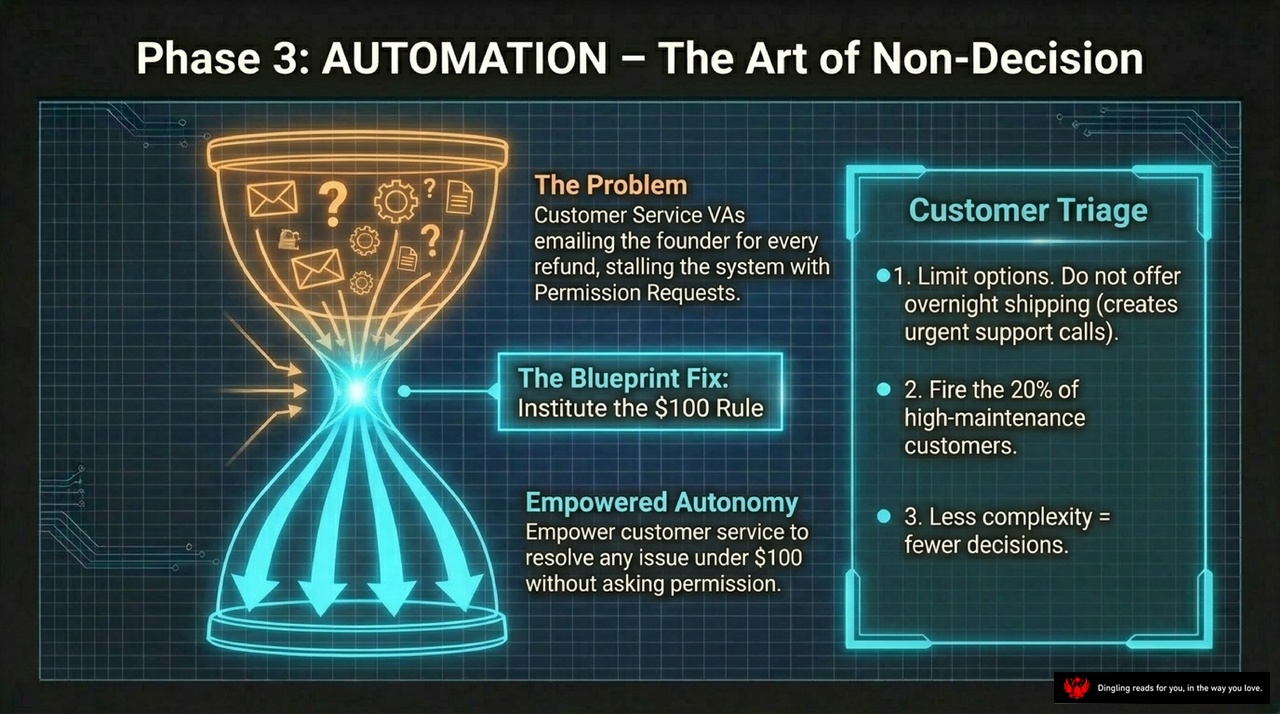
Phase 3 is all about Automation, or what we call the Art of Non-Decision. Think of your customer service team as a filter. Right now, many founders are stuck because their Virtual Assistants are emailing them for permission on every single refund request. This bottleneck stalls the entire system. The fix? Implement the $100 Rule. Empower your team to resolve any issue under $100 without asking you first. This isn't just about saving time; it's about building autonomy.
But automation isn't just about letting people decide; it's about designing the system so they don't have to decide at all. Look at the Customer Triage strategy on the right. First, limit options. If you offer overnight shipping, you'll instantly create a flood of urgent support calls. Second, make the hard choice to let go of the top 20% of high-maintenance customers who drain your resources. Finally, remember that less complexity equals fewer decisions. By stripping away unnecessary choices and empowering your team with clear boundaries, you stop the chaos and start building a machine that runs smoothly on its own.

Phase 4 is all about Liberation—specifically, escaping the office. Think of this as "The Puppy Dog Close." It's a strategy borrowed from pet stores: you ask for a trial run, not a permanent commitment. Your motto here is simple: ask for forgiveness, not permission.
Let's walk through the four steps. First, the Setup. You secretly increase your productivity while reducing your visibility in the office. Next, the Spike. You call in sick on a Tuesday or Wednesday, work from home, and deliver twice your normal output. You leave a paper trail proving you can do it. Then, the Pitch. You propose a two-day-a-week remote trial, saying, "Just to see how it goes," and show the data from that sick day. Finally, the Expansion. You consistently over-deliver on those remote days and gradually expand to full remote work.
The key is to treat this like a negotiation where you've already won. By proving your value first, you make it easy for your boss to say yes, because you've already asked for forgiveness rather than begging for permission.

Imagine a life where you don't grind for 40 straight years just to end up in a quiet, diminished retirement with waning energy. That's the trap of the "Deferred-Life Plan." But there's a better way, a blueprint for the "New Rich." Instead of one long, exhausting sprint, you embrace bursts of intense, effective work interspersed with 1 to 6 month "mini-retirements." Think of it as relocating to low-cost, high-quality global locations like Buenos Aires or Berlin for those breaks. Here's the game-changer: you don't need a million dollars to travel the world. Through geoarbitrage, living luxuriously in an exotic locale often costs less than paying rent at home. This is your Phase 4: Liberation. It's not about working less; it's about working smarter and living richer, turning your life into a series of adventures rather than a single, static career.

SYNTHESIS – Filling the Void. When the noise of the 9-to-5 finally stops, that sudden silence can trigger a real existential panic. Here's the hard truth: simply removing the bad doesn't automatically create the good. You have to actively build something new.
To fill that void, you need two main pillars. First, continual learning. This means engaging both your brain and your body. Think about learning a new language or mastering a martial art, like Judo in Brazil. It keeps you grounded and sharp.
Second, service. You need to contribute to a cause larger than yourself. By shifting your focus outward, you cure those inward-looking anxieties that come with sudden wealth and too much free time. Don't just sit there; get out there and make a difference.

Let's talk about what actually matters in life. We often think money is the ultimate currency, but the truth is far more liberating: the real wealth we should chase is the freedom of time and mobility. It's not about how much you earn, but how much control you have over your own schedule and location.
So, I want you to pause and ask yourself a hard question: If today were the very last day of your life, would you want to do exactly what you are about to do today? Be honest with yourself. If the answer is no, then you need to stop and ask what you are actually waiting for. Are you waiting for the perfect moment? Waiting for more money? Or are you simply letting fear keep you stuck in a routine that drains your soul?
Remember, life isn't a race to be won or a problem to be solved. It's a gift to be experienced. Too often, we run so fast trying to get somewhere that we miss the journey itself. We trade our time for things we don't really need, forgetting that time is the one resource we can never get back. So, take a deep breath, slow down, and listen to the music of your own life before the song ends.