
The Absorbent Mind: Complete Chapter-by-Chapter Summary
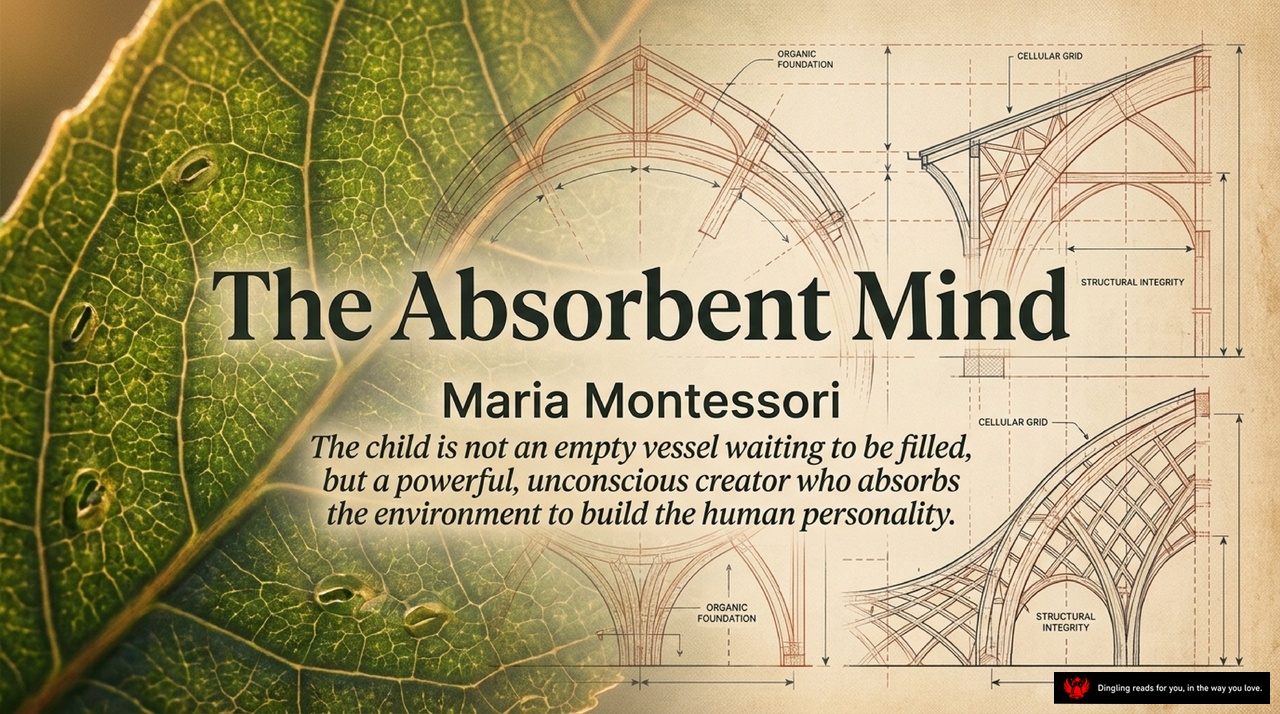
Welcome to our journey into the heart of human development with Maria Montessori's groundbreaking concept: The Absorbent Mind. Look at this image, where the delicate veins of a living leaf mirror the intricate architecture of a child's developing psyche. Just as this leaf naturally grows from an organic foundation into a complex structure of cellular grids and structural integrity, so too does the child. Montessori teaches us a profound truth: the child is not an empty vessel waiting to be filled, but a powerful, unconscious creator who absorbs the environment to build the human personality. This is the core of her philosophy. Unlike adults who learn through conscious effort and logic, the young child possesses a unique, magical ability to soak up knowledge from the world around them effortlessly. They don't just memorize; they integrate language, culture, and behavior into their very being, shaping their character before they even realize it. This period of unconscious absorption is the most critical time in human life, far more significant than any university education. If we want to understand how to nurture a healthy, capable human being, we must first respect and protect this incredible, silent power of the absorbent mind.

The slide you're looking at captures a pivotal moment in our thinking about education: it's not just about teaching facts, but about recognizing a fundamental shift in how we view the child. On the left, we see "The Traditional Illusion"—a system that treats children as passive vessels, isolated from the real world, and driven by rigid schedules and standardized tests. It assumes learning happens only after age six, focusing exclusively on the conscious mind.
But on the right, the slide presents "The Biological Reality." This is the truth we've been missing. It recognizes that ages 0 to 6 are the most critical period for intelligence formation. During these years, the child isn't an empty container waiting to be filled; they are an active, independent worker constructing the adult. They integrate physical movement, environment, and psychological growth into one seamless process.
The core message here is clear: our entire educational paradigm needs to shift. Instead of forcing children into molds, we must align our methods with the natural biological laws of human development. When we stop viewing the child as a passive receiver and start honoring them as a creative force, we unlock a potential that traditional schooling has long ignored. This isn't just about better test scores; it's about nurturing the very essence of who we are.

Look at this timeline we call "The Architecture of Human Development." It breaks the first eighteen years of life into three distinct phases, each with a unique purpose.
First, we have Phase 1: The Period of Creation, from age zero to six. This is where the magic happens. From birth to three, the child is an unconscious creator, absorbing everything from the environment without realizing it. Between three and six, they become a conscious worker, actively shaping their own personality. This entire period is crucial because it builds the foundation of intelligence and character from nothing.
Next is Phase 2: The Period of Stability, spanning ages six to twelve. During these years, children are calm, healthy, and emotionally stable. This is the ideal time for acquiring culture and academic knowledge. Most school systems naturally align with this window, starting children in school around age six.
Finally, we reach Phase 3: The Period of Reconstruction, from age twelve to eighteen. This is a time of physical and psychological instability. Adolescents are essentially rebuilding their identities to prepare for entry into adult society.
The key takeaway here is that education must respect these natural stages. We cannot force a child into a mold that doesn't fit their developmental phase. By understanding that the first six years are about building the self, the middle years are about stability and learning, and the teen years are about reconstruction, we can create an education system that truly supports human growth rather than stifling it.

We often misunderstand the role of movement in a child's development, treating it merely as physical exercise or play, when in reality, it is the bridge between their inner mind and the outer world. Think of the human body as a precise system where the brain, senses, and muscles work together; movement is how the mind finally expresses itself. Without this connection, even the most brilliant thoughts remain trapped inside.
Unlike animals, whose movements are fixed by nature, human children start with a unique potential to learn any action. Their hands, in particular, are not just for holding things; they are extensions of the brain and the soul. A child's hand activity is the best indicator of their mental and character development. If we allow them to work with their hands—sorting, building, or crafting—they build strength, intelligence, and a resilient character. Conversely, if we constantly interfere or over-help them, we stunt this growth.
This is especially true during the first three years, known as the "spiritual embryo" phase. Just as a physical embryo develops in the womb without conscious memory, a young child's language, movement, and senses develop independently and unconsciously. If we interrupt their natural efforts—like stopping them from carrying heavy objects or climbing stairs out of pity—we damage their character. True education isn't about forcing them to be perfect; it's about providing a real environment where they can move, explore, and build themselves. When we respect this natural rhythm, we don't just raise healthy bodies; we nurture minds capable of creating a better future.

The slide contrasts two fundamental ways of learning: the "Absorbent Mind" of a child versus the "Conscious Learning" of an adult. On the left, we see a vase being filled with water, representing how adults acquire knowledge. It's a mechanical process—we consciously study, memorize facts, and store them like water in a container. The knowledge stays separate from us; it's something we *have*, not something we *are*.
In stark contrast, the bottom half of the slide shows a complex root system drawing nutrients from the soil. This illustrates the child's unconscious absorption. Unlike the adult, the child doesn't just receive information; they live it. Their environment becomes their very brain. As the text describes, this is a form of "mental chemistry." A child absorbs the world so deeply that language, culture, and even their personality become the physical and psychological fabric of their being. They don't just learn to speak; they become speakers. They don't just learn to be kind; they become kind. This deep, transformative integration is what makes the child's mind so uniquely powerful and why protecting this early, effortless growth is the most critical task of education.

We've just explored how children's hands and feet develop in sync with their psychological growth, laying the groundwork for their independence. Now, let's dive into the heart of this developmental journey: the period from ages three to six, which Maria Montessori calls the "absorbing mind" phase. This isn't just a time for play; it's a critical window where a child's entire personality is being woven, much like the warp and weft of a tapestry. Once this fabric is set, it's incredibly difficult to change later in life.
During these formative years, children don't learn through rote memorization or abstract lectures. Instead, they learn through real movement and interaction with the actual world. Imagine giving a child tools that fit their size—small chairs, real dishes, authentic tools—and watch them transform. They become intensely focused, working with a joy and concentration that adults often envy. They aren't just playing; they are constructing their own character. This is why traditional methods that rely on toys or over-protection often fail; they disconnect the child from reality.
This stage also shapes their moral compass and social habits. Children absorb the culture, language, and even the moral norms around them like a sponge. A child raised in a specific environment will internalize its values, just as a plant adapts to its soil. If we want to raise children who are kind, independent, and socially responsible, we must provide an environment that reflects those values. We can't simply lecture them on what is right or wrong; their character is built through their own choices and experiences in a supportive setting. By respecting their natural need to work and explore, we help them become the best versions of themselves, ready to contribute to a harmonious society.

Language: The Camera vs. The Painter. On this slide, we see a powerful metaphor comparing how children and adults learn. The adult is depicted as a painter, carefully assembling vocabulary, syntax, and grammar piece by piece—a slow, conscious effort. In contrast, the child is the camera, absorbing the entire scene instantly and effortlessly.
This isn't just a cute illustration; it's the core of Montessori's philosophy. Children possess what we call the "absorbent mind." Unlike adults who must study and memorize rules, a child's internal mechanism effortlessly captures the whole structure of a language—their accent, their grammar, their rhythm—simply by existing in the environment. It is as if they are photographing reality, storing the entire picture in their mind without realizing it.
Think about the implications. This is why a child can move from a primitive state to mastering complex modern languages in just a few years, while an adult struggles for decades. The child doesn't just learn facts; they internalize the very essence of their culture. As the text reminds us, education for the young isn't about filling a bucket with data. It is about preparing an environment where the child can naturally capture the world. If we treat children like empty vessels to be filled, we miss the magic. We must step back and let them be the photographers, capturing the world in their own unique, perfect way.

The Instrument of Intelligence isn't just a metaphor; it's the very engine of human evolution. Look at this cycle of movement: it starts with Observation, where the child first sees the world, sparking that intrinsic curiosity we often overlook. From there, the brain processes these stimuli, forming a conscious intent to act. But here is the crucial shift: true intelligence isn't found in the mind alone; it is physically manifested through Execution, or The Hand.
Notice how the hand physically manipulates the environment. Movement *is* the physical manifestation of intelligence. When a child builds a tower or sorts blocks, they aren't just playing; they are translating their mental concepts into reality. This is the "Symphony of Movement" at work. We often mistake sitting still for learning, but the text reminds us that the mind and body are one system. Without the hand to interact with the world, thought remains trapped and useless. By engaging in this loop of observing, thinking, and doing, the child doesn't just absorb information; they construct their own understanding, turning abstract ideas into tangible reality. This active engagement is what truly builds the instrument of intelligence we all possess.
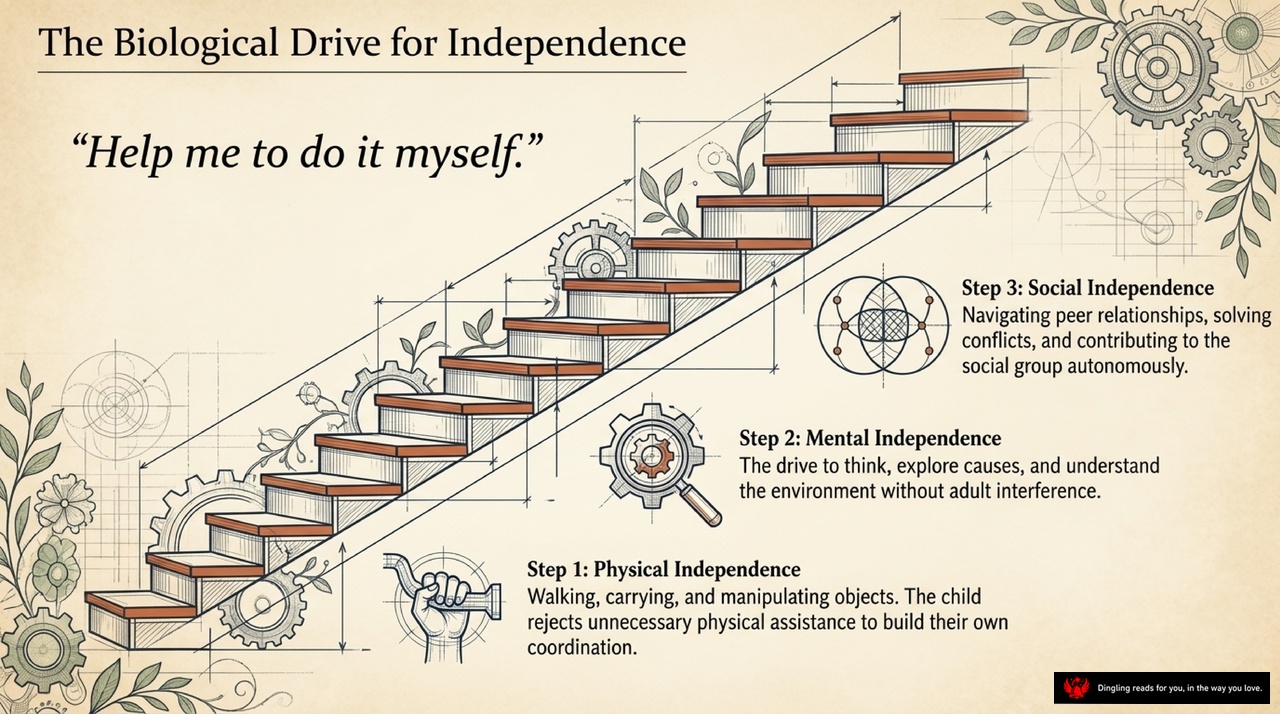
The Biological Drive for Independence is a fundamental truth about human development, rooted in the child's innate desire to say, "Help me to do it myself." This isn't just a plea for assistance; it is a powerful, biological imperative that drives the entire journey from infancy to adulthood. As we climb the steps of growth, we see this drive manifest in three distinct stages, each building upon the last to create a truly autonomous individual.
It all begins with Step 1: Physical Independence. From the moment a child can walk, carry, or manipulate objects, they are actively rejecting unnecessary physical help. This isn't about stubbornness; it is the child's way of building their own coordination and mastering their body. When we respect this need and step back, we allow them to develop the strength and confidence needed to conquer their physical world.
As they grow, they move into Step 2: Mental Independence. Here, the drive shifts to the internal realm. Children begin to think, explore causes, and understand their environment without adult interference. They are no longer just following instructions; they are asking "why," connecting dots, and constructing their own understanding of reality. This mental autonomy is the foundation for critical thinking and true learning.
Finally, we reach Step 3: Social Independence. This is where the child learns to navigate peer relationships, solve conflicts, and contribute to their social group autonomously. They move from simply interacting with others to understanding their place within a community, resolving disputes, and collaborating without needing constant supervision.
Throughout this entire process, the child's voice remains constant: "Help me to do it myself." This simple phrase encapsulates the essence of Montessori education. It reminds us that the child is not a passive vessel to be filled, but an active creator of their own life. By supporting this biological drive at every stage—physical, mental, and social—we do more than just teach skills; we help children become fully capable, independent, and confident human beings ready to shape their future.

The slide contrasts two vastly different approaches to raising children: the "Traditional Dictator" versus the "Montessori Servant." On the left, we see the authoritarian model where the adult stands as the center of attention, actively transmitting knowledge through commands, rewards, and punishments. This method, while common, often suppresses a child's natural creative drive. On the right, we see the Montessori ideal. Here, the adult acts as a passive observer and a meticulous designer of the environment. Instead of dictating behavior, the teacher removes obstacles, provides precise tools, and protects the child's deep concentration. This shift unlocks spontaneous and joyful work.
This visual perfectly captures the core message from our text: education isn't about filling an empty vessel or forcing obedience. It's about understanding that children possess a unique "absorbent mind." Just as a child naturally masters language without being explicitly taught, they thrive when given the right conditions to explore. When we stop treating them like passive recipients of rules and instead create an environment where they can work independently, we don't just teach them skills—we nurture their character. The traditional approach tries to control the child, while the Montessori approach trusts the child's inner drive to grow. By stepping back and serving as a guardian of the environment rather than a dictator of behavior, we allow the child's true potential to emerge, transforming them from a follower into a confident, independent creator.

Imagine the chaotic energy of a child's early years—their caprice, timidity, or even destructive tendencies—as raw, unrefined material pouring into a funnel. This is the starting point of what we call "The Alchemy of Normalization." Without purposeful work, a child might exhibit these very deviations, struggling to find their place in the world. But here is the transformation: when a child freely chooses engaging, purposeful work with their hands, a deep concentration takes over. This intense focus acts as the catalyst, triggering a profound psychological shift. The result? The deviations vanish. The child emerges transformed, displaying spontaneous discipline, joy, patience, and a deep, abiding love for their environment. This isn't just about behavior; it's about unlocking the child's natural potential through the right kind of work, turning chaos into a harmonious, normalized personality.

Look at this beautiful metaphor: "The Fabric of Social Cohesion." It illustrates how society isn't built by force, but woven together like cloth. Imagine a cotton plant as the raw material—that's the individual child. Just as cotton needs to be spun into thread, a child must first develop their own personality through focused, isolated work. They aren't empty bottles waiting to be filled; they are active weavers creating their own character.
Next, picture the spinning wheel. This represents the prepared environment. Just as raw cotton becomes thread, the environment's rules naturally shape isolated individuals into capable, patient members. It's not about strict control, but about setting the right conditions so children can spin themselves into something strong and useful.
Finally, look at the loom weaving the final cloth. This is spontaneous cohesion. Without adults constantly pushing or forcing them, children naturally weave together. They help the weak, respect hard work, and form a harmonious, self-governing society. True social unity doesn't come from top-down orders, but from nurturing the innate potential of every child to connect and cooperate. When we respect this natural process, we don't just build a school; we weave a better world.

The Evolution of Obedience isn't just about following orders; it's about how a child's inner drive transforms from raw instinct into a joyful partnership. As we see here, obedience evolves through three distinct levels. At the foundation is Level 1: Subconscious Obedience. Here, the child is driven purely by biological impulse. Their compliance is sporadic and entirely dependent on their current developmental urge. It's a reflex, not a choice.
Moving up, we reach Level 2: Conscious Cooperation. This is where the child's will is fully developed. They can now intentionally choose to follow directions and sustain focus. They understand the "why" behind the action and have the mental strength to stick with it.
But the ultimate goal is Level 3: Joyful Obedience. This is the pinnacle of development. The child understands the value of the rule and joyfully anticipates the requests of the guide. It's no longer about control; it's an expression of love and social cohesion. When we nurture this progression, we aren't just creating compliant followers; we are raising individuals who are eager to contribute to the harmony of their community.

The Architecture of the Complete Human isn't just a diagram; it's a blueprint for how we actually build a better world. Look at this Venn diagram. It shows that a fully developed human isn't created by forcing knowledge into a child's mind. Instead, it emerges from the powerful intersection of three forces: Biological Potential, the Prepared Environment, and Social Cohesion.
Think about the "Spiritual Embryo." This is the child's unconscious power to absorb the universe. Unlike adults who have to memorize facts, a child's mind is like a sponge. They don't just learn; they integrate. They take in language, culture, and even moral values naturally, without being told. This is why a child can master a new language effortlessly while an adult struggles.
Then, look at the "Prepared Environment." This is where the magic happens. The text emphasizes that "purposeful movement and concentrated work forge the intellect." Children aren't passive subjects waiting to be filled; they are active architects. When we provide a space with real tools and meaningful work—like a child washing dishes or polishing a metal object—we aren't just teaching a skill. We are stimulating their brain. This "work" is actually the fuel for their intellect and character.
Finally, there is "Social Cohesion" or Love. When children engage in this kind of self-directed work in a community, something incredible happens. As the slide notes, "from normalized individuals emerges a spontaneous, peaceful social order." When kids feel capable and respected, they naturally develop empathy and cooperation. They don't need strict rules to be good; they create harmony because they feel connected.
Put it all together, and you get the synthesis: The Complete Human. The bottom line is profound: "The child is not a passive subject of education, but the active architect of humanity." If we want to fix our society, we have to stop treating children like empty vessels and start respecting their innate drive to grow. By nurturing their biological potential with the right environment, we don't just raise students; we build the future leaders who will heal our world.

Education is not merely the transmission of knowledge, but the defense and guidance of human life itself. This profound truth lies at the heart of how we must rethink our approach to raising the next generation. Look at that young sprout breaking through the soil—it represents the silent, unconscious minds of our infants, where the future of humanity and the foundation of world peace are currently being constructed. If we want to protect the sanctity of their environment, we must first understand what we are actually building within them.
Traditional education often fails because it treats children as empty vessels to be filled with facts and high ideals. Yet, wars and conflicts persist because we have neglected the spiritual and human factors that truly shape character. Children possess a unique, "absorbent mind" that allows them to naturally master language and culture without forced instruction, much like how a plant grows naturally when given the right conditions. They are not passive recipients; they are active creators of their own personalities.
The critical insight here is that the environment we provide—whether it is a chaotic home, a rigid classroom, or a nurturing community—becomes the blueprint for their future behavior, values, and even their capacity for peace. If we fail to offer a protected, enriching environment during these formative years, we risk planting seeds of conflict rather than harmony. True education, therefore, is about safeguarding this delicate developmental process. It is about guiding the child's innate drive toward independence and perfection, ensuring that the minds of our infants are built on a foundation of love, understanding, and respect for life. Only by protecting this sacred environment can we hope to cultivate a generation capable of defending and guiding human life itself.