



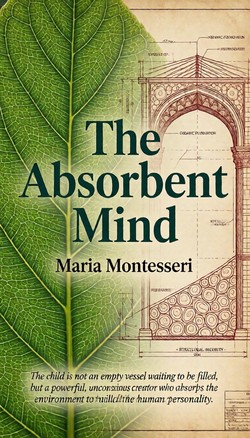
The idea that children are active creators, not empty vessels waiting to be filled, finally makes sense to me.
Your Review
The idea that children are active creators, not empty vessels waiting to be filled, finally makes sense to me.

A brilliant explanation of how children truly learn through observation.

Montessori explains how young children learn so well.

This book explains why forcing kids to sit still kills their natural ability to learn.

Montessori's view on the absorbent mind changes how I see toddlers.

Montessori explains the absorbent mind perfectly. The section on epigenesis and the shift from unconscious to conscious learning in the 3-6 year stage clarified why my child suddenly started asking endless questions and fixing toys in order. I realized our traditional school forces them to sit still, ignoring their need to move and explore with real objects to build neural pathways. The book argues that movement is how they think, not just a break from thinking. By using prepared environments with real tools like small brooms or water pitchers instead of plastic toys, kids absorb social norms and problem-solving skills naturally. This contrasts sharply with the empty vessel model where teachers dictate facts. I now understand that respecting sensitive periods and allowing child-led work reduces anxiety and fosters normalization. The insights on mixed-age classrooms mentoring each other also show how empathy grows better than in competitive same-age settings. Ultimately, aligning education with the absorbent mind creates resilient, curious individuals ready for a changing world.

This book explains why our kids fail school. It shows they learn best when free to explore their world without strict rules.

The concept of the spiritual embryo changes how I see my child's development forever. Understanding that the first six years are for building the mind, not just the body, was a revelation. Maria Montessori explains that children are not empty vessels waiting to be filled with facts by adults, but active creators of their own personalities who absorb their environment unconsciously. The book details how traditional schools often fail because they ignore these sensitive periods and force rigid schedules on kids who need to move and explore to think. I learned that movement is not a distraction but a tool for the mind, connecting sensory input to problem-solving skills. The example of the Patagonian girl who jumped from the Stone Age to the atomic age by simply absorbing her new culture showed me the immense power of a prepared environment. Instead of correcting mistakes with rewards or punishments, Montessori materials let children find their own errors, building resilience and independence. This approach creates calm, focused children who contribute to their community rather than acting out. I now realize that my child's intense focus on sorting rocks or repeating phrases is not misbehavior but a signal that their absorbent mind is working hard to construct their identity. By respecting these natural rhythms and providing real-world materials instead of plastic toys, we can help children thrive without anxiety or disengagement. The book challenges us to shift from an adult-centric model to one that honors the biological reality of how humans grow, proving that when we align education with the absorbent mind, we unlock a world of potential for every child.

Montessori's insight on the spiritual embryo stage changed how I view my six-year-old's intense focus on sorting rocks, showing it is not just a phase but a critical biological window for building their identity where traditional schools often force rigid schedules that stifle this natural absorption of cultural and social norms instead of nurturing it, leading to disengagement and anxiety when children are treated as empty vessels rather than active constructors of their own minds who need real-world materials and movement to truly thrive.

Montessori explains how movement builds thinking, proving why forcing kids to sit still actually blocks their natural learning process.

Montessori explains how the absorbent mind builds identity through environment rather than instruction, making me rethink early education failures.

Montessori explains how movement builds the mind. Her idea that children are active creators of their own identities rather than empty vessels waiting to be filled with facts is a powerful shift from traditional education models. She uses examples like a Patagonian girl absorbing European culture without formal schooling to prove this unconscious learning capacity exists. Understanding the difference between the physical embryo stage and the spiritual embryo stage helps parents realize why forcing early academic drills fails. The book argues that sensitive periods, like language explosion around age three, require freedom to explore rather than rigid instruction. By respecting these windows, we allow the absorbent mind to construct a strong foundation for later logical reasoning. This approach addresses achievement gaps caused by ignoring early developmental needs. It also offers a solution for screen time issues by emphasizing hands-on interaction over passive consumption. Ultimately, the text provides a blueprint for creating prepared environments where children normalize their behavior through purposeful work. I feel hopeful that shifting our focus to child-led learning can reduce anxiety in classrooms and foster resilient, empathetic individuals ready to thrive in a changing world.

Respecting sensitive periods helps my child learn with joy.

Mixed age classrooms solve social problems better than same age groups.

This book explains why my child struggles with rigid school rules.

Normalization explains how purposeful work reduces anxiety and anger.

The book changed how I see my child's growth.

I finally understand why sitting still hurts my child's learning.
Montessori explains how the absorbent mind builds identity before age six. Understanding that children are active creators of their own personalities rather than empty vessels waiting for facts was a major shift in my perspective. The explanation of the spiritual embryo stage clarified why forcing early academic skills often fails, showing that true learning requires a rich environment where kids can naturally absorb culture and social norms through interaction. This insight helps parents stop correcting grammar or behavior too early, allowing children to integrate language and manners into their being without stress or explicit instruction, which creates a stronger foundation for future logical thinking and social empathy in later developmental stages.

The idea of the absorbent mind changes how I see my toddler.