
The Age of Extremes: Complete Chapter-by-Chapter Summary
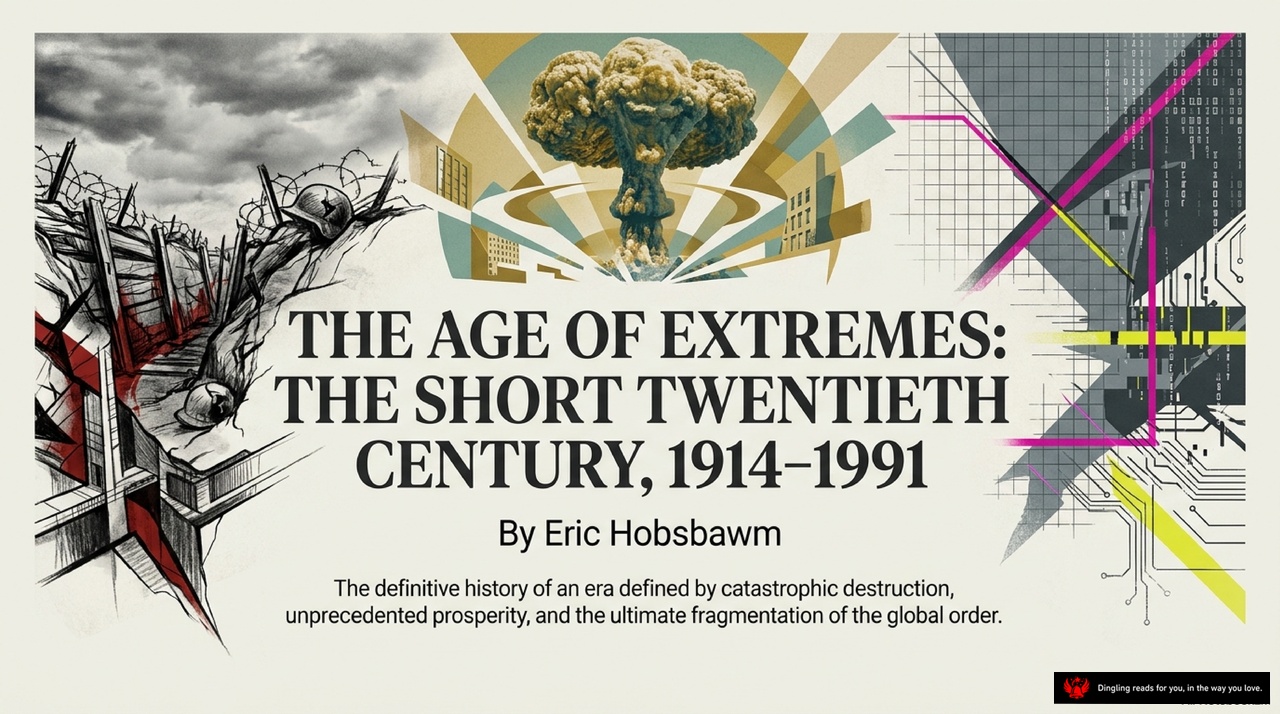
Welcome to our deep dive into "The Age of Extremes: The Short Twentieth Century," by Eric Hobsbawm. Today's cover sets the stage for a century defined not by steady progress, but by a wild swing between catastrophic destruction and unprecedented prosperity.
As the title suggests, we are looking at the period from 1914 to 1991—a time where the global order was completely fragmented. The image captures this tension perfectly: on one side, the grim reality of trench warfare and barbed wire, symbolizing the era's violent conflicts; in the center, a mushroom cloud representing the terrifying power of nuclear weapons; and on the other, the complex lines of circuitry and data, hinting at the rapid technological shifts that would reshape human life.
This era began when the lights of Europe seemed about to go out, only to end with the collapse of the Soviet Union. It was a time where old empires crumbled, new ideologies rose and fell, and humanity teetered on the edge of annihilation before finding a new, fragile path forward. Join us as we explore how this "short" century actually defined the modern world.
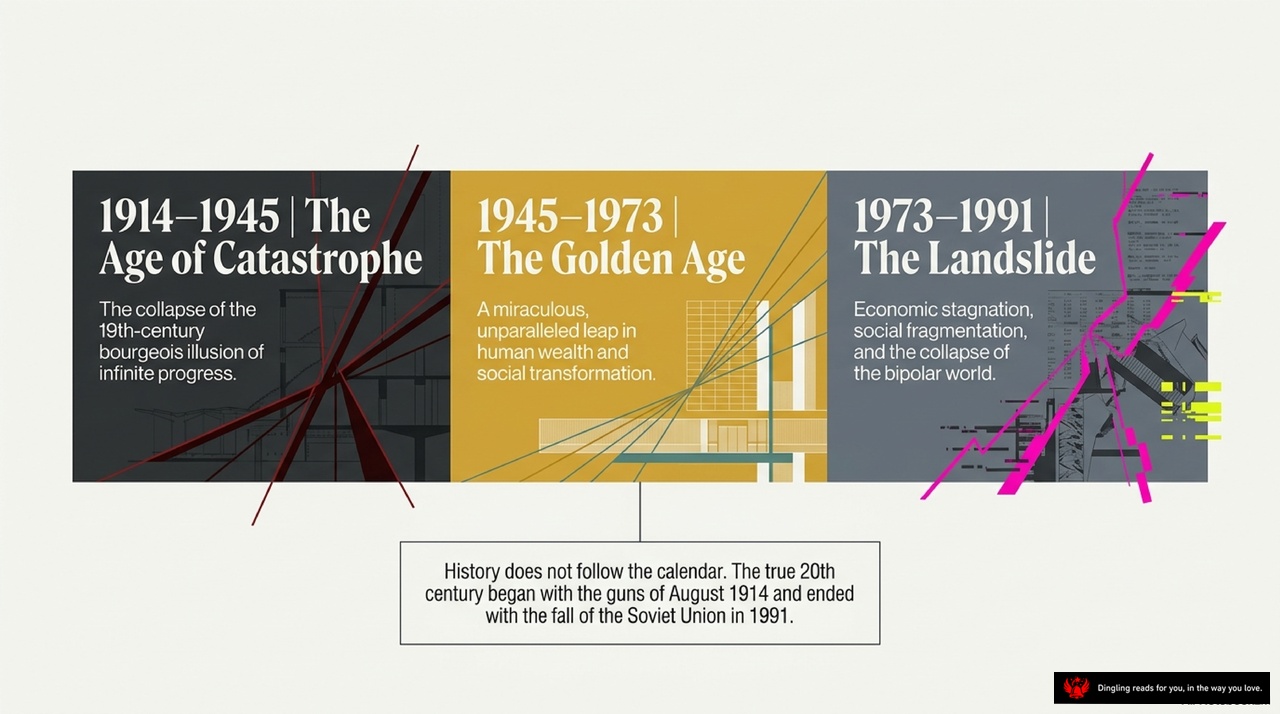
History does not follow the calendar. While we often think of the 20th century as starting in 1901, the true story of our modern era began with the guns of August 1914 and ended with the fall of the Soviet Union in 1991. This period, known as the "Short 20th Century," was defined by three distinct, dramatic chapters.
First, from 1914 to 1945, we lived through what the book calls "The Age of Catastrophe." It was the collapse of the 19th-century belief in infinite progress. The world moved from a century of relative peace into three decades of relentless war. From the trenches of World War I to the total devastation of World War II, the old order of empires crumbled, and the illusion of a stable, peaceful world was shattered forever.
Then, from 1945 to 1973, the world entered "The Golden Age." This was a miraculous leap in human wealth and social transformation. After the war, nations rebuilt, economies exploded, and for the first time, ordinary people around the globe enjoyed unprecedented prosperity. Technology advanced, cities grew, and a new middle class emerged, creating a brief but brilliant period of global optimism.
Finally, from 1973 to 1991, we witnessed "The Landslide." The golden era gave way to economic stagnation, social fragmentation, and the ultimate collapse of the bipolar world order as the Cold War ended. The old structures that held the 20th century together simply slid away.
So, the 20th century wasn't just a timeline; it was a rollercoaster of catastrophe, golden dreams, and a final, dramatic collapse.
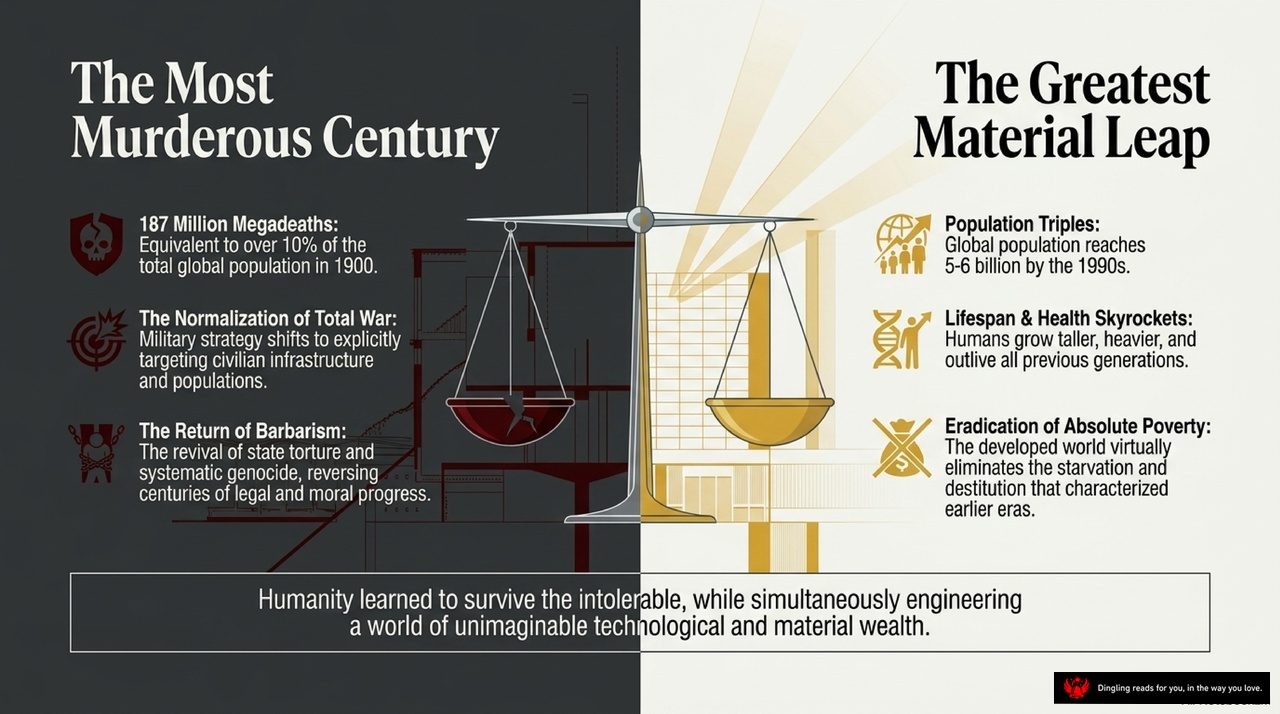
On this slide, we see a striking balance scale dividing the 20th century into two opposing forces: "The Most Murderous Century" and "The Greatest Material Leap." This visual perfectly captures the book's central argument: humanity survived the intolerable while simultaneously engineering a world of unimaginable wealth.
Let's look at the dark side first. The left panel highlights the sheer scale of destruction. It lists 187 million megadeaths, which is equivalent to over 10% of the total global population in 1900. This wasn't just about soldiers dying in trenches; it was the normalization of total war, where military strategy explicitly targeted civilian infrastructure. We saw the revival of state torture and systematic genocide, reversing centuries of moral progress. The text describes how the 20th century became the era of total war, from the trenches of World War I to the industrialized slaughter of World War II, where the Holocaust reached the peak of human cruelty.
Now, look at the golden side on the right. Despite the bloodshed, humanity achieved its greatest material leap ever. The global population tripled, reaching 5 to 6 billion by the 1990s. Lifespans skyrocketed; humans grew taller, heavier, and outlived all previous generations. Perhaps most remarkably, the developed world virtually eradicated absolute poverty. The book notes that while the 19th century was defined by starvation and destitution, the 20th century saw the elimination of these conditions for billions.
The bottom line sums it up: humanity learned to survive the intolerable while engineering a world of unimagined technological and material wealth. It is a century of terrifying contradictions, where the same hands that built the atom bomb also built the modern hospital.

By 1940, the world seemed to have run out of options. It appeared that liberal capitalism was doomed to extinction, and survival demanded an alliance with an ideological enemy. This slide maps the terrifying descent into that reality.
It started in 1914 with the Guns of August, where World War I shattered the 19th-century liberal order and the illusion of European supremacy. That war didn't just kill millions; it dismantled the old world. The Great Slump of 1929 followed, destroying faith in free-market capitalism and bringing democratic institutions to the brink of collapse.
Without hope in the system, the 1930s saw the Rise of Fascism. Extreme authoritarianism emerged from political and economic ruins, rejecting Enlightenment rationality entirely. By 1939, Total War arrived, bringing mechanized destruction that culminated in the atomic bomb.
The timeline shows a clear, brutal progression: from the collapse of old orders to the rise of total war, forcing the world into a desperate choice between ideological enemies.
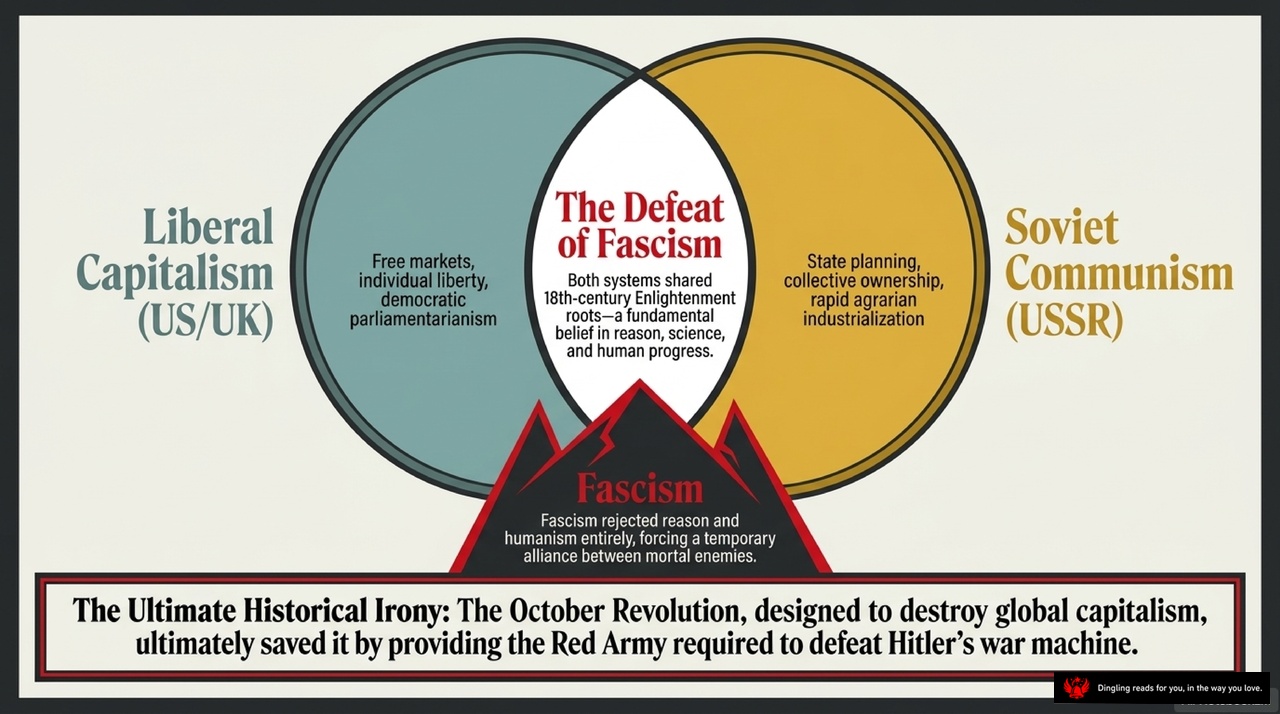
Look at this Venn diagram. It captures one of the most profound historical ironies of the 20th century: the unlikely alliance between two mortal enemies, Liberal Capitalism and Soviet Communism, that was forged to defeat a common foe, Fascism.
On the left, you have the Western model—Liberal Capitalism, championed by the US and UK. Its core is free markets, individual liberty, and democratic parliamentarianism. On the right, you see the Soviet model—Communism, built on state planning, collective ownership, and rapid agrarian industrialization.
Now, look at the center where these two circles overlap. This is "The Defeat of Fascism." Both systems, despite their deep ideological hatred, shared a fundamental belief rooted in the 18th-century Enlightenment: a faith in reason, science, and human progress. Fascism, conversely, as shown at the bottom, rejected reason and humanism entirely. It was an irrational force that forced these two rational systems into a temporary truce.
The irony is stark and absolute, as stated in the caption. The October Revolution was originally designed to destroy global capitalism. Yet, by creating the Red Army, it ultimately provided the essential military power required to defeat Hitler's war machine. Without the Soviet Union's sacrifice and the Red Army's resilience, the liberal capitalist world would have likely been consumed by fascism. This page reminds us that history is rarely linear; sometimes, the greatest threat to an ideology comes from the very force it sought to destroy.
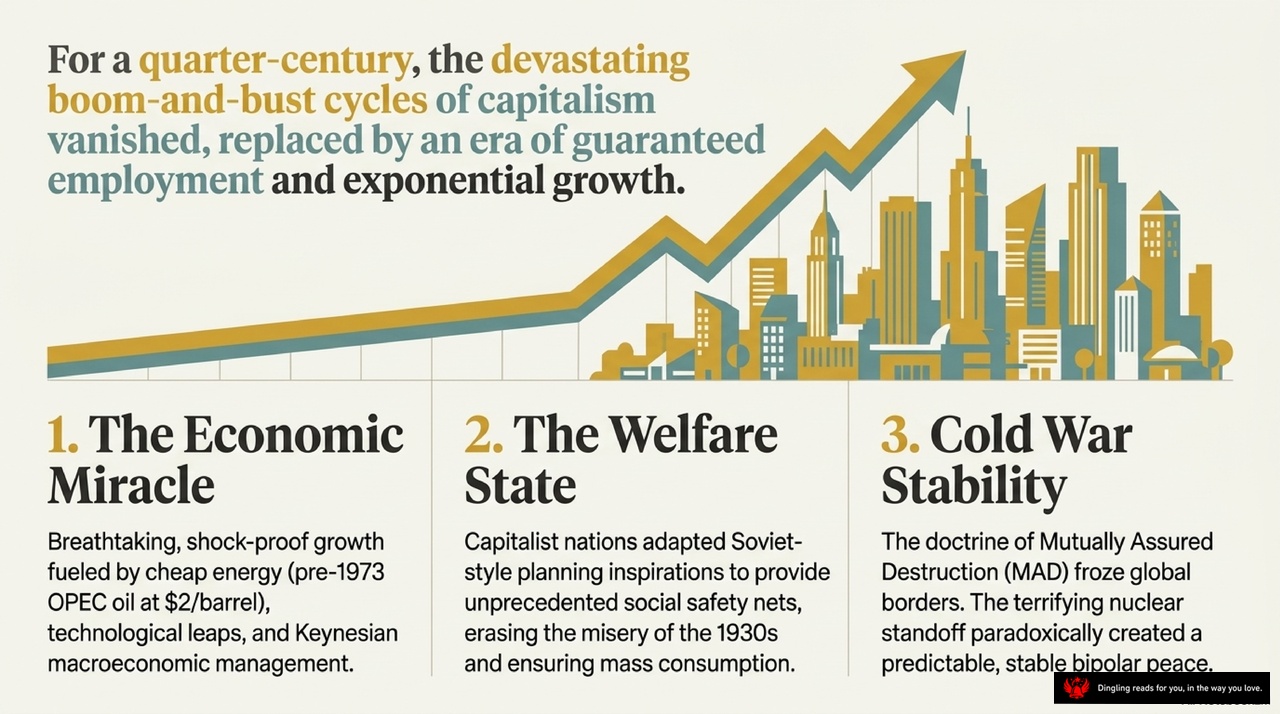
For a quarter-century, the world enjoyed a golden age of guaranteed employment and exponential growth, a stark contrast to the volatile boom-and-bust cycles of the past. This stability wasn't accidental; it was built on three powerful pillars. First, we witnessed an economic miracle fueled by cheap energy, technological leaps, and smart government management. Second, the rise of the welfare state allowed capitalist nations to adopt social safety nets, effectively erasing the misery of the 1930s and ensuring mass consumption for everyone. Third, Cold War stability played a crucial role; the terrifying doctrine of Mutually Assured Destruction froze global borders, creating a predictable, stable bipolar peace that paradoxically prevented a third world war. Together, these forces transformed the 20th century, turning the chaos of the mid-century into a period of unprecedented prosperity and order.
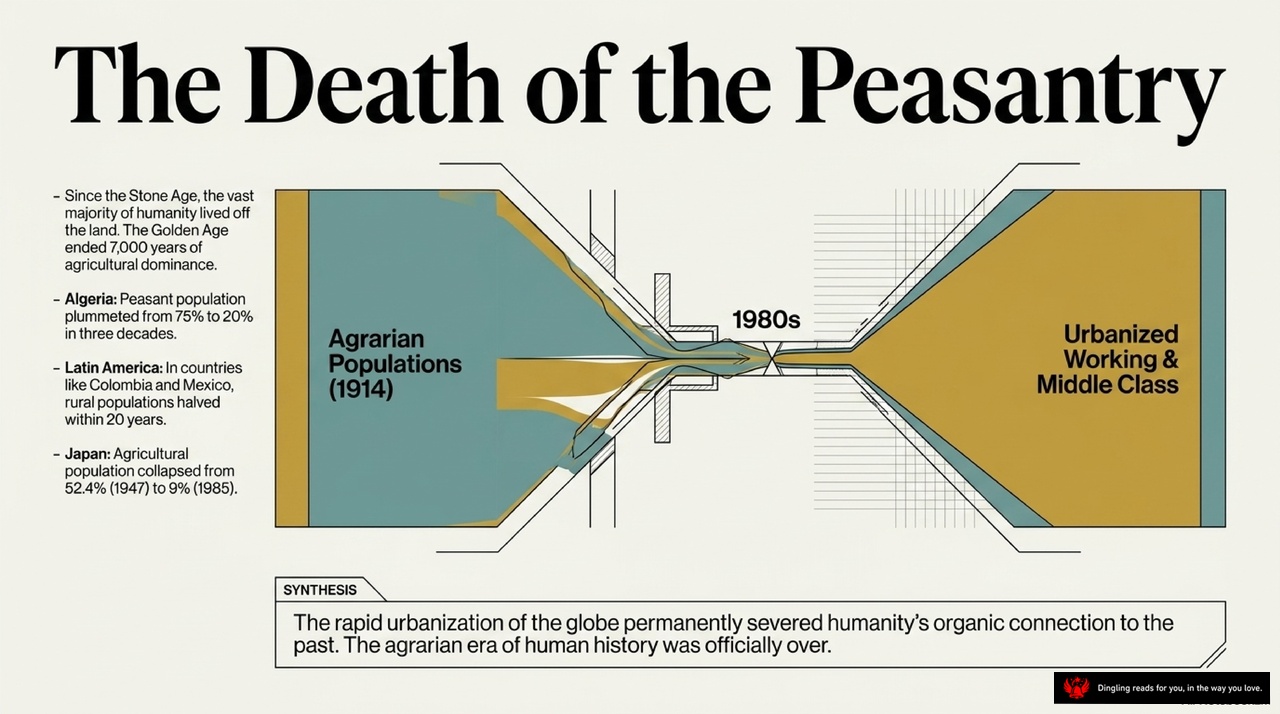
The Death of the Peasantry. For 7,000 years, since the Stone Age, the vast majority of humanity lived off the land. But that golden age of agricultural dominance has ended. Look at the graph: we are witnessing the rapid urbanization of the globe, which permanently severed our organic connection to the past.
In 1914, agrarian populations were the norm. But by the 1980s, that world had collapsed. Take Algeria: the peasant population plummeted from 75% to just 20% in three decades. In Latin America, countries like Colombia and Mexico saw their rural populations halve within 20 years. And look at Japan: the agricultural population collapsed from 52.4% in 1947 to a mere 9% by 1985.
This wasn't just a shift in jobs; it was a fundamental break in human history. The agrarian era was officially over. The traditional family, the village community, and the direct relationship with the soil that defined our ancestors for millennia, all dissolved into the concrete of the city. We traded the rhythm of seasons for the rhythm of the clock, and in doing so, we lost a part of our identity that had sustained us for thousands of years.
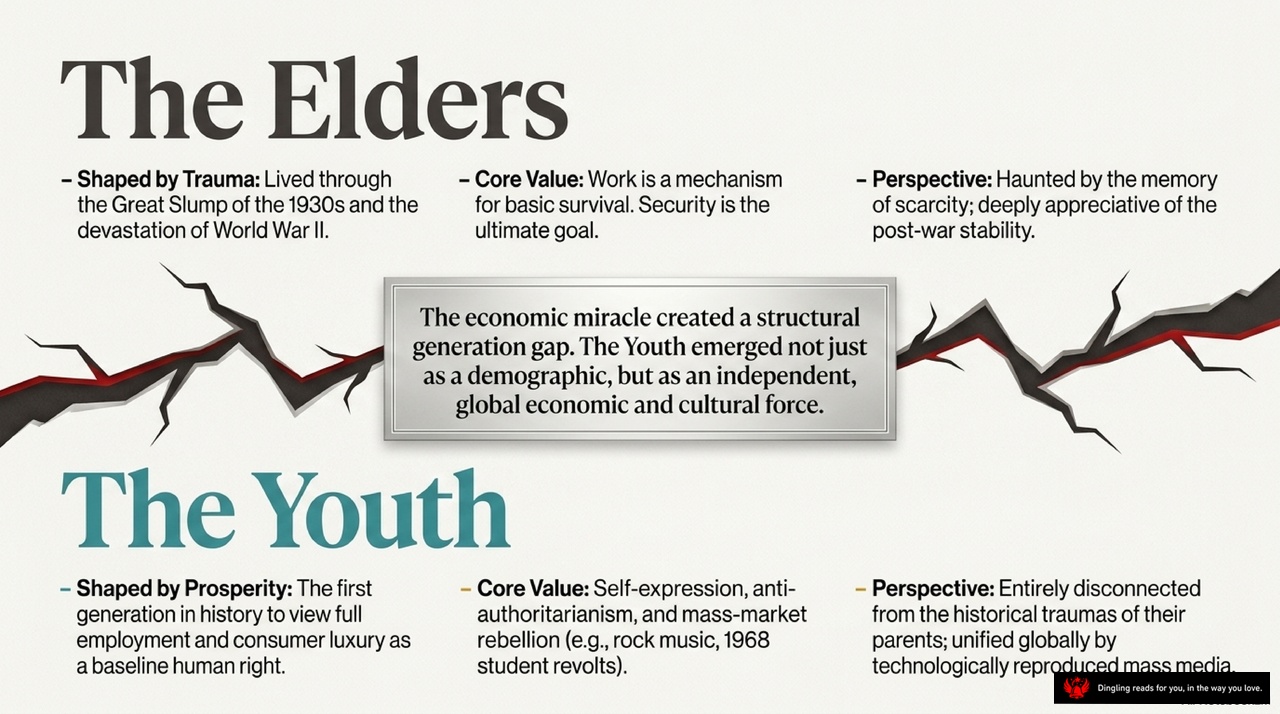
The slide contrasts two distinct generations shaped by vastly different historical realities. On top, we see "The Elders," a cohort defined by trauma. They lived through the Great Slump of the 1930s and the devastation of World War II. For them, work wasn't just a choice; it was a mechanism for basic survival, making security their ultimate goal. Their perspective remains haunted by the memory of scarcity, deeply appreciative of the post-war stability they fought so hard to achieve.
Below, the slide highlights "The Youth," the first generation in history to view full employment and consumer luxury as a baseline human right. Shaped by prosperity rather than fear, their core values revolve around self-expression, anti-authoritarianism, and mass-market rebellion—think rock music and student revolts of the 1960s. Unlike their parents, they are entirely disconnected from historical traumas, unified instead by a globally reproduced mass media culture.
The central message on this slide explains the structural generation gap created by the economic miracle. This shift didn't just change demographics; it transformed the youth into an independent, global economic and cultural force. While the Elders clung to the past to ensure survival, the Youth looked forward, driven by the confidence that abundance was the new normal.
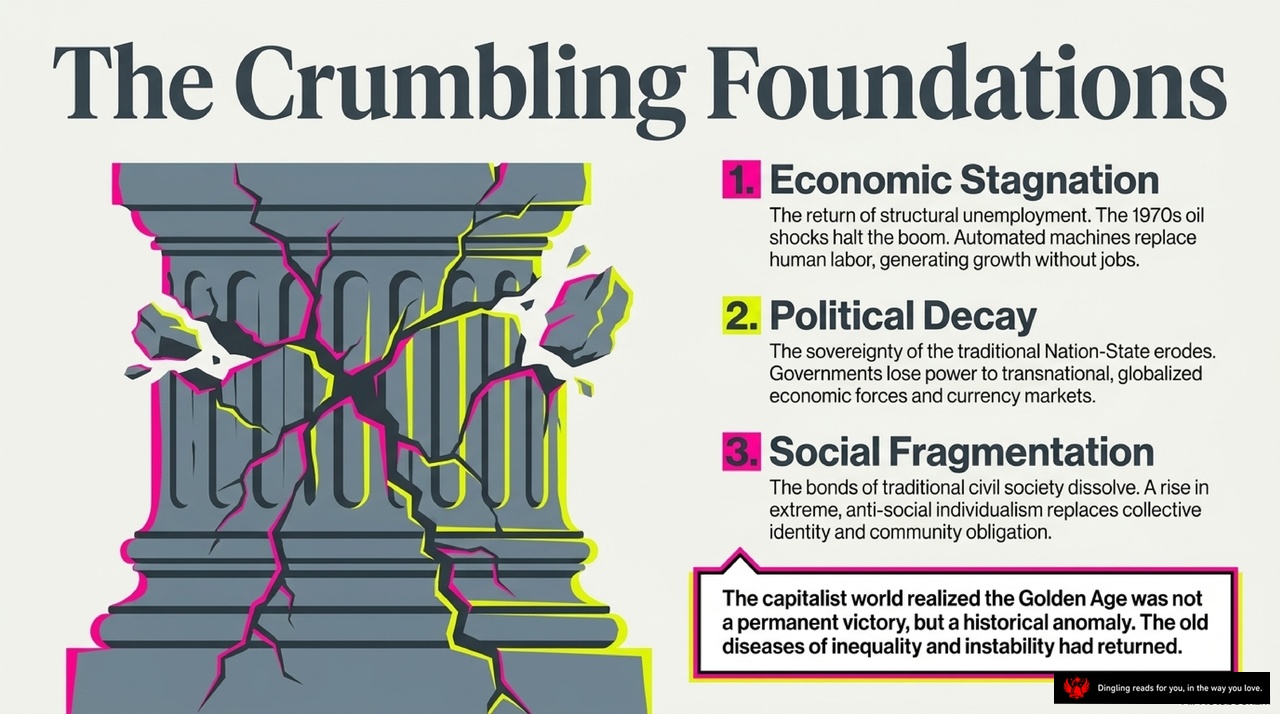
Look at this crumbling pillar. It's not just a symbol of decay; it represents the sudden realization that the "Golden Age" of capitalism wasn't a permanent victory, but a historical anomaly. The old diseases of inequality and instability have returned with a vengeance.
Let's break down these three cracks in our foundation. First, Economic Stagnation. We aren't just facing a recession; we are seeing the return of structural unemployment. Think back to the 1970s oil shocks that halted the boom, or today's reality where automated machines replace human labor, generating growth without creating jobs. It's growth that leaves people behind.
Second, Political Decay. The sovereignty of the traditional Nation-State is eroding. Governments are losing their power to transnational, globalized economic forces and currency markets. When the rules are written by global markets rather than your local parliament, democracy struggles to function.
Third, Social Fragmentation. The bonds of traditional civil society are dissolving. We are witnessing a rise in extreme, anti-social individualism that replaces collective identity and community obligation. We are moving from a society of "us" to a collection of isolated "me"s.
The image captures a moment of truth: the capitalist world realized that the stability we enjoyed for decades was fragile. Without fixing these foundational cracks, the structure we stand on is literally falling apart.
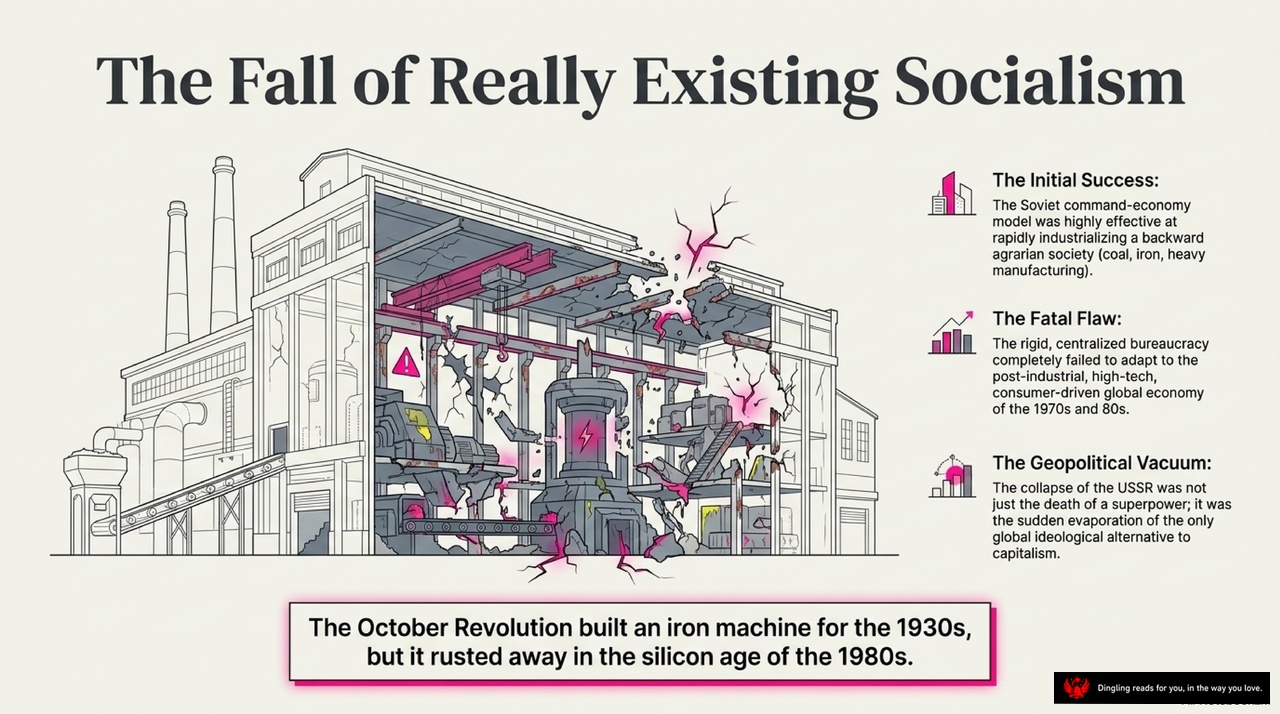
The Fall of Really Existing Socialism wasn't just a historical footnote; it was the end of an era that shaped the entire 20th century. Look at that illustration of the factory crumbling—it perfectly captures the narrative we're exploring today.
Let's break down the three key pillars of this collapse. First, there was the Initial Success. In the 1930s, the Soviet command-economy model was incredibly effective at what it was designed to do: rapidly industrialize a backward agrarian society. They built an iron machine focused on coal, iron, and heavy manufacturing, turning a rural nation into a global industrial powerhouse in a single generation.
However, the Fatal Flaw emerged as the world changed. That rigid, centralized bureaucracy simply could not adapt to the post-industrial, high-tech, consumer-driven global economy of the 1970s and 80s. While the West was innovating with silicon and software, the Soviet system was stuck in the past, unable to produce the consumer goods its people craved or the technology that defined the new age.
This led to the final blow: the Geopolitical Vacuum. The collapse of the USSR wasn't just the death of a superpower; it was the sudden evaporation of the only real ideological alternative to capitalism. When that "iron machine," built by the October Revolution, finally rusted away in the silicon age, it left a void that fundamentally reshaped the world order. The experiment ended, not with a bang, but with a slow, inevitable structural failure.
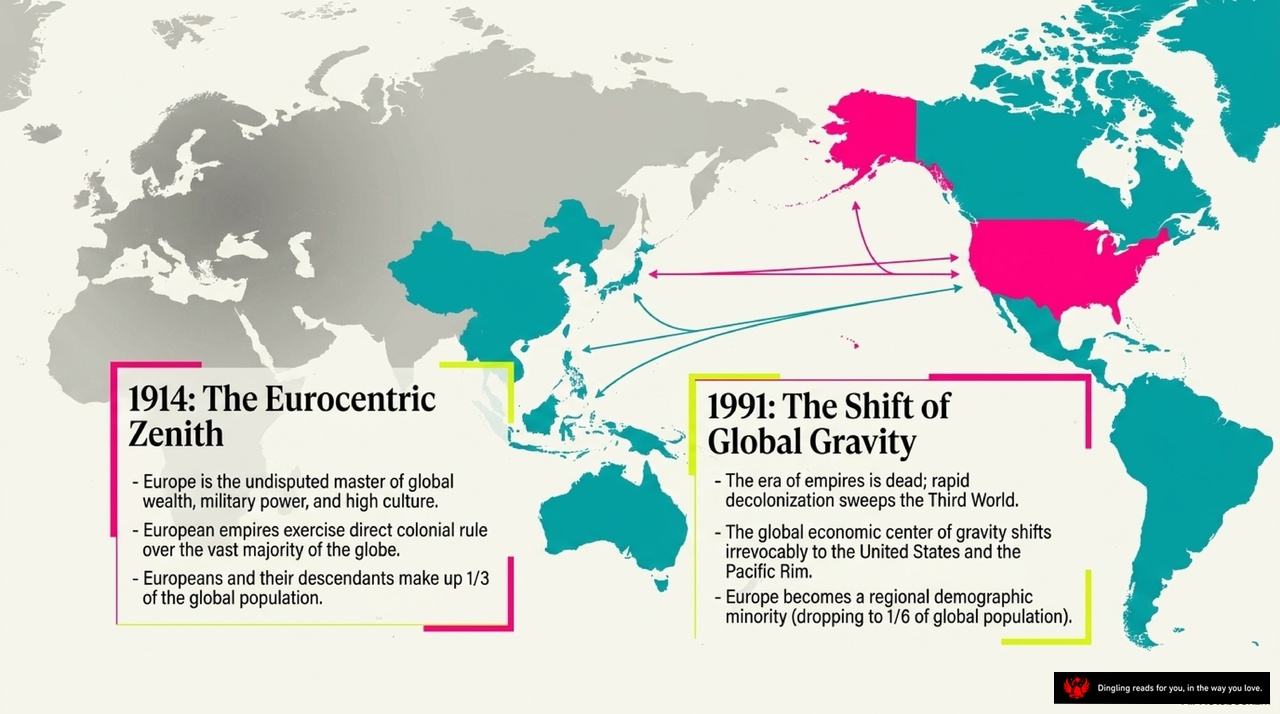
Look at this map. It tells a story of how the center of global power completely flipped in just one lifetime. On the left, we see 1914: The Eurocentric Zenith. Back then, Europe was the undisputed master of the world. They held the vast majority of global wealth, military might, and cultural influence. Their empires ruled directly over most of the planet, and Europeans and their descendants made up a full third of the global population. It was the height of the old world order.
But fast forward to the right side of the map: 1991: The Shift of Global Gravity. The era of empires is dead. Rapid decolonization swept through the Third World, shattering the old imperial structures. The global economic center of gravity shifted irrevocably to the United States and the Pacific Rim. Meanwhile, Europe became a regional demographic minority, dropping from one-third of the population to just one-sixth. The arrows on the map show this flow—power, trade, and influence moving away from the gray center of Europe and converging on the vibrant pink and teal regions of the Americas and Asia. This wasn't just a change in borders; it was a fundamental rewriting of who holds the reins of the world.

Welcome to the final chapter of our journey through the 20th century. Today, we're looking at the profound transformation of culture itself. As we've seen throughout this century, the very way we create and consume art shifted forever.
The image before us highlights a critical divergence. On one side, we see "High Art." Think of classical music, elite sculpture, and the traditional novel. By the end of the century, these forms had lost their mass cultural relevance. They retreated into academia, becoming hyper-intellectualized and increasingly disconnected from the general public. This was the retreat of the avant-garde.
But look at the other path, the one that dominated the landscape. It was the triumph of mass entertainment. Thanks to technological reproduction—cinema, television, rock music, and recorded media—culture conquered the globe. For the first time, art was no longer dictated by the elite bourgeoisie. Instead, it was shaped by mass consumer markets and technological distribution. The camera and the screen irreversibly replaced the canvas and the stage.
This shift meant that culture became "The Common Man's Art." It wasn't about exclusion anymore; it was about accessibility and connection. While the elite retreated into their ivory towers, the rest of the world was united by the rhythm of the radio, the glow of the television screen, and the sound of the rock concert. This wasn't just a change in what we watched; it was a fundamental change in who we were and how we lived together.

Look at this balance scale. On one side, we have "The Sorcerer"—techno-science acting like magic. On the other, "The Apprentice"—the deep existential anxiety it creates.
Think about the Sorcerer first. Science has woven itself into the very fabric of our daily lives. From the DNA chips and telecommunications we rely on to antibiotics and air travel, technology operates like an invisible, reliable force. To the average person, it feels less like a complex field of study and more like an incomprehensible but dependable magic trick. We just use it; we don't question how it works.
But flip the scale, and you see the heavy cost. This unprecedented power has bred a deep, pervasive anxiety. We live in a world of UFO panics, sci-fi dystopias, and an ecological dread that never fades. We face the ultimate paradox: human genius unlocked the fundamental secrets of the atom and genetics, yet we handed that power to flawed political systems capable of destroying the biosphere. We built the tools to create life, but also the weapons to end it.
This tension defines our era. We are the Sorcerers who mastered the science, but we are also the Apprentices terrified by the consequences. The question isn't whether we can do it anymore; it's whether we can control what we've created.
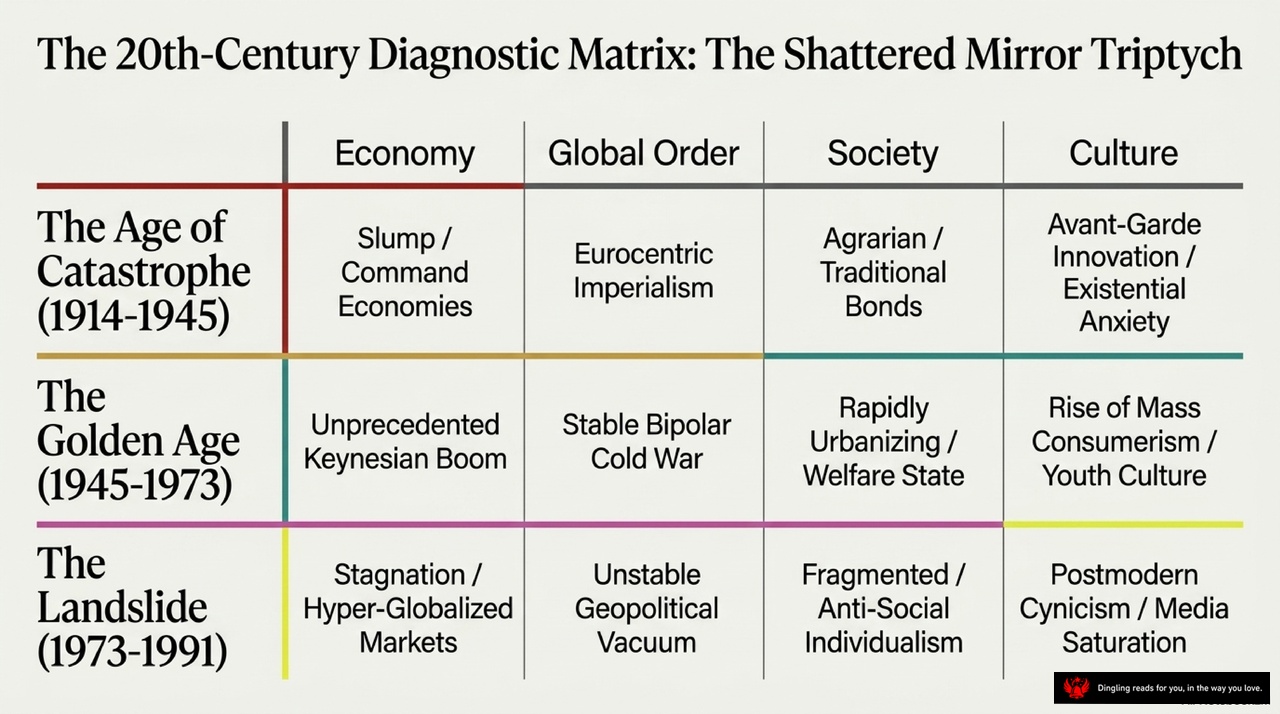
Welcome to the final chapter of our journey through the 20th century. We are now looking at the last three decades, a period defined by the sudden end of the "Golden Age" and the onset of what we call "The Landslide," spanning from 1973 to 1991.
As we see in our matrix, this era was characterized by a dramatic shift across all four dimensions. Economically, the world moved from the unprecedented Keynesian boom into a period of stagnation and hyper-globalized markets. The stability that defined the post-war era evaporated, replaced by the volatility of global financial markets and the failure of traditional industrial policies.
On the global stage, the "Stable Bipolar Cold War" gave way to an unstable geopolitical vacuum. With the collapse of the Soviet Union in 1991, the clear division between East and West dissolved, leaving a world without a single dominant order. This wasn't just a political shift; it fundamentally altered how nations interacted and competed.
Domestically, society transformed from a rapidly urbanizing welfare state into something far more fragmented. We saw the rise of anti-social individualism. The safety net that once supported the working class began to crumble, and the collective identity of the mid-20th century fractured into isolated, self-reliant units.
Finally, in the realm of culture, we witnessed the shift from mass consumerism and youth culture to postmodern cynicism and media saturation. The optimism of the 1960s and 70s faded, replaced by a pervasive sense of irony and a distrust of grand narratives. The clear moral lines of the past blurred, leaving a culture that was increasingly skeptical of institutions, art, and even truth itself.
This triptych of catastrophe, golden age, and landslide offers us a complete diagnostic of the 20th century, showing us how quickly the world can change from stability to chaos, and how the foundations of our modern life were built—and then, ultimately, dismantled.

The short 20th century didn't just change the world; it dismantled the old one entirely. We engineered miracles in prosperity and science, reshaping our planet and rewriting the very code of life itself. Yet, for all that power, we are left standing in a profound ideological vacuum. The grand historical compass that once guided our civilization is broken.
Look at the text on the screen: "We have mastered the power to reshape the earth and rewrite the code of life." That's the reality we face. We built the modern world through techno-economic progress, creating a global system that connects us all. But as we stand in the ruins of the 20th century's great ideologies—whether it was the promise of communism, the allure of fascism, or the faith in unbridled capitalism—we must ask a terrifying question. Do we have the wisdom to survive our own creations?
The tools we developed to conquer nature and organize society have outpaced our moral and political frameworks. We solved the problem of scarcity, but we created new forms of inequality. We connected the globe, yet we fractured our shared sense of purpose. The old rules no longer apply, and we are navigating a future without a map. The challenge isn't just about technology anymore; it's about finding a new set of values that can hold us together when the old ones have collapsed. How we answer this question will define not just the next century, but the survival of our species.