
The Age of Intelligence: Complete Chapter-by-Chapter Summary

Welcome to our deep dive into "The Intelligence Era" by Wu Jun. Today's opening slide sets the stage for a profound transformation: we are moving from the mechanical causality that defined the industrial age to a data-driven correlation that will define the future.
The image beautifully illustrates this shift. On one side, we see the rigid, predictable gears of the mechanical era—symbolizing the old world where cause and effect were clear, like a clockwork universe. On the other, we see a dynamic, interconnected network of nodes. This represents the new reality where success isn't about finding the perfect logical formula, but about spotting powerful correlations within vast amounts of data.
Wu Jun argues that this is not just a technical upgrade, but a fundamental paradigm shift. To survive the coming societal restructuring, we must radically adapt our thinking. We are leaving behind the era where we needed to understand the "why" behind every outcome, and stepping into an age where knowing the "what" and the "how" through data is enough. The future belongs not to those who can predict the future with perfect logic, but to those who can harness the power of data to navigate uncertainty with unprecedented precision.

On the left, we see the perfect clockwork universe of the past—a solar system built on gears, epicycles, and the belief that everything follows a simple, elegant rule. For three hundred years, this "Mechanical Thinking" drove our progress. We assumed the world was certain, predictable, and governed by clear cause-and-effect chains. If you understood the mechanism, you could solve any problem.
But look at the right side. That scatter plot represents the reality we actually live in today: a cloud of infinite uncertainty. The modern world isn't a neat machine; it's a complex, messy system where perfect causality is often impossible to find.
This slide captures the death of Mechanical Thinking and the birth of a new way to solve problems. For decades, we tried to force the world into neat formulas, like the ancient Greeks or Newton did. But as we've seen, when data is too complex, chasing a single "perfect model" often fails. Instead, the breakthrough comes from embracing probability and using massive datasets to find strong correlations.
We stop asking "why" and start asking "what is linked." Whether it's predicting traffic jams, diagnosing diseases, or optimizing ad spending, the new rule is simple: abandon the pursuit of perfect causality and embrace the power of data. When you have enough information, you don't need to understand the entire machine to predict its behavior—you just need to know how the parts correlate. This shift from certainty to probability is the core of the data-driven revolution.

The slide you see here perfectly captures the fundamental shift that defines our modern era: the move from Mechanical Thinking to Data-Driven Thinking. For centuries, our entire scientific and industrial world was built on the "Mechanical" paradigm. We followed the footsteps of Newton and Descartes, operating under a philosophy of certainty and determinism. We believed the universe was a giant, predictable machine. If we could just find the right "Why"—the causal link between events—we could explain everything and control the future. This was the era of elegant, simple rules and small, highly targeted samples. Think of it as trying to understand a complex city by studying just one perfect street.
But today, we are living in the future of Data-Driven Thinking, championed by figures like Claude Shannon and giants like Google. The core philosophy has flipped. We no longer chase the elusive "Why"; instead, we embrace uncertainty and probability. We are obsessed with finding the "What"—the correlations. Instead of seeking a single elegant rule, we use brute-force statistical models and massive, comprehensive datasets. We accept that with enough data, we don't need to understand the underlying mechanism to get the right answer.
This shift isn't just theoretical; it changes everything. In the past, if your variables increased beyond your simple model's capacity, you failed. Today, if your data is biased or incomplete, we fail. But when we have the volume, the power is immense. We can solve problems that were previously impossible, not by understanding the deep physics of a situation, but by spotting the statistical patterns that lead to success. This is the true paradigm shift: moving from a world of rigid cause-and-effect to a dynamic landscape of powerful correlations.
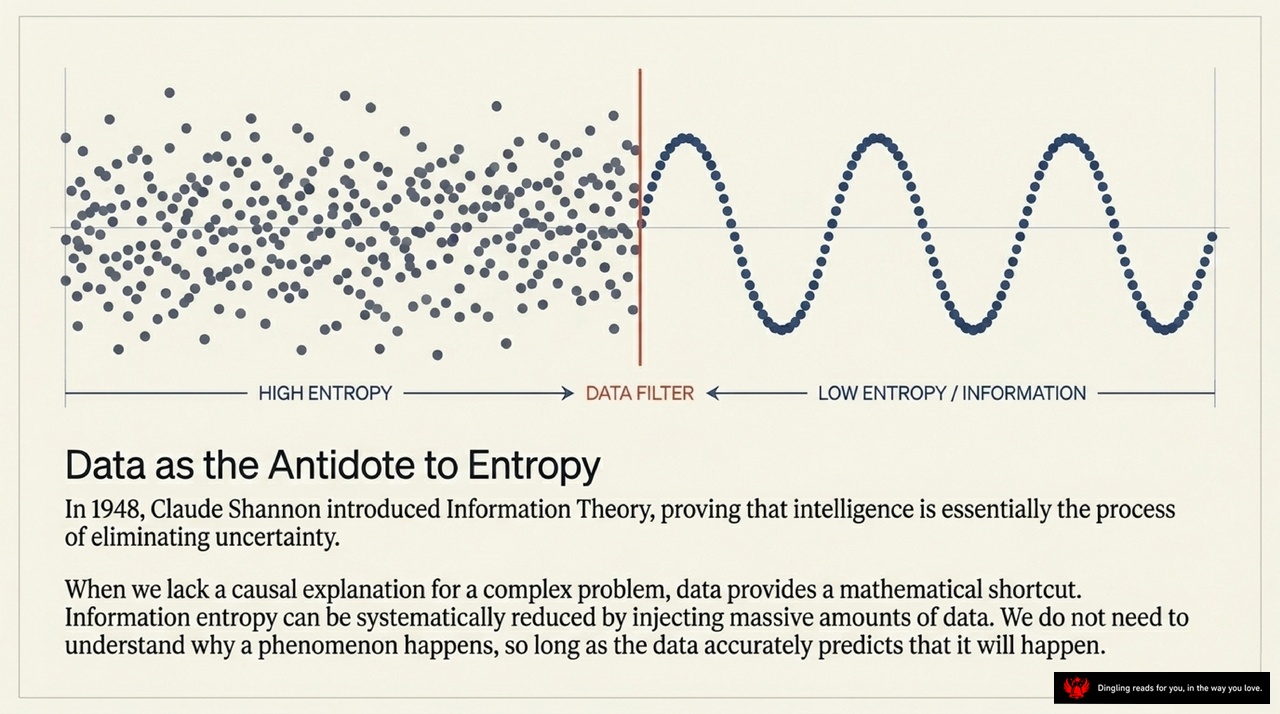
Imagine a world where chaos transforms into clarity. On your screen, you see a stark visual of this transformation: on the left, a cloud of scattered dots labeled "High Entropy," representing pure uncertainty and noise. On the right, a smooth, predictable wave labeled "Low Entropy / Information." The dividing line? A simple "Data Filter."
This graphic perfectly illustrates the core insight from Claude Shannon's 1948 work: intelligence is essentially the process of eliminating uncertainty. When we face complex problems without a clear causal explanation, data offers a powerful mathematical shortcut. We don't always need to understand *why* something happens; we just need enough data to accurately predict *that* it will happen.
Think of it this way: raw data is often messy and full of noise—just like that scattered cloud of dots. But by injecting massive amounts of high-quality data and applying the right filters, we systematically reduce entropy. We turn that chaotic mess into a reliable signal. This is the essence of the data-driven approach. Instead of getting stuck trying to build perfect theories or understand every underlying cause, we let the data speak. When we have enough of it, patterns emerge from the noise, turning what seemed like random chance into predictable, actionable information. This shift—from chasing causes to leveraging correlations—is the key to unlocking the true power of the modern age.
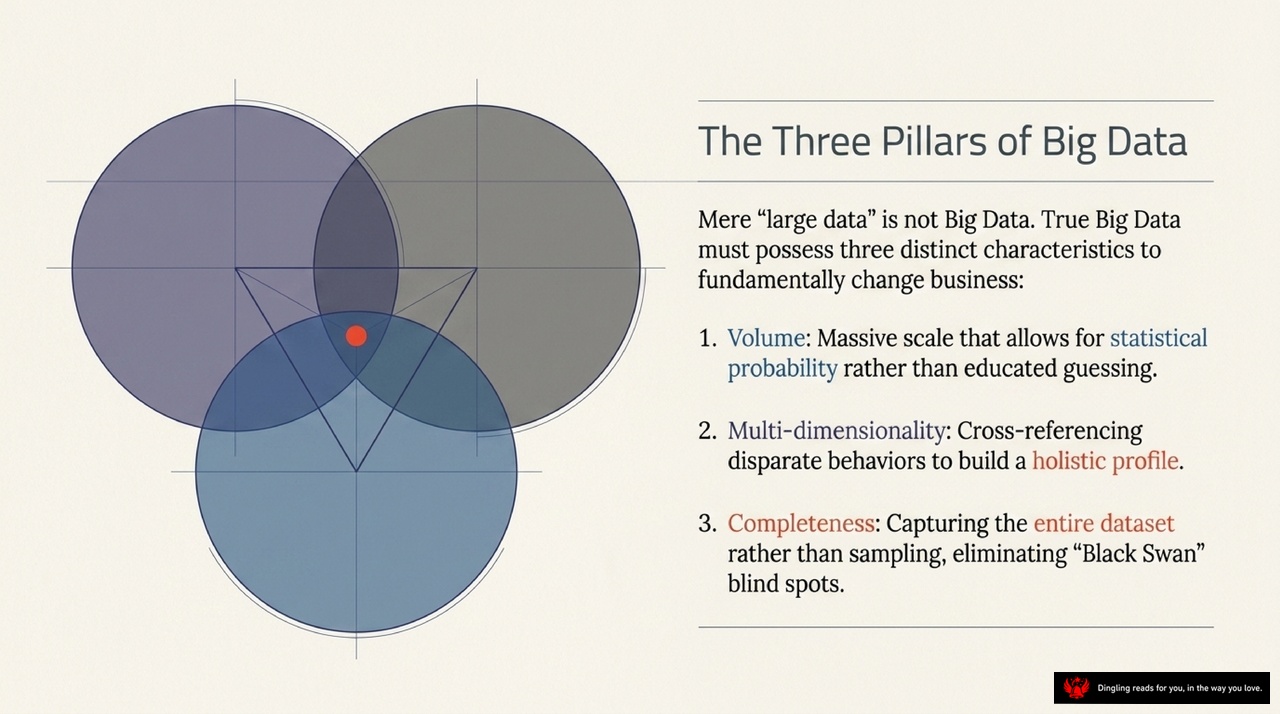
So, here is the reality check: just because you have a massive amount of data doesn't automatically make it "Big Data." True Big Data needs three specific pillars to actually transform your business.
First is **Volume**. It's not just about being big; it's about having a massive scale that allows for statistical probability. Without enough data, you're left making educated guesses rather than relying on hard facts.
Second is **Multi-dimensionality**. You need to cross-reference disparate behaviors to build a holistic profile. Looking at data from a single angle gives you a limited view, but connecting different dots creates a complete picture of the user or the market.
Finally, there is **Completeness**. This is about capturing the entire dataset rather than just sampling it. By avoiding sampling, you eliminate those dangerous "Black Swan" blind spots—those unpredictable events that traditional sampling methods simply miss.
If you can align these three pillars—Volume, Multi-dimensionality, and Completeness—you stop treating data as just a number and start leveraging it as a fundamental driver for real change.

Back in the 1970s, the AI community hit a wall. They were trying to build intelligence by mimicking human logic—teaching machines grammar, syntax, and rigid rules. It was a dead end. The systems couldn't grasp context without human common sense, and progress stalled.
But then, a new path emerged: Statistical AI. Instead of forcing machines to think like us, researchers treated intelligence as a communication problem. They used Markov models and probability to simply guess the next word based on patterns. It was a radical shift. By leveraging massive data accumulation, statistical probability eventually defeated human-coded logic.
This breakthrough turned the tide. While the old rule-based approach failed, this data-driven method led to exponential success. It laid the foundation for everything we see today, proving that you don't need to copy the human brain to solve human problems; you just need enough data and the right statistical models.

When quantity becomes quality, we witness a true revolution. Look at this chart: for decades, institutions painstakingly coded tens of thousands of bilingual grammar rules to build translation engines. It was a game of manual craftsmanship, relying on "Decades of Rule-Based Development." But then, in 2005, Google entered the field with no linguistic background whatsoever. Their lead scientist, Franz Och, used a brute-force statistical approach. Instead of writing complex rules, they relied entirely on massive data correlation. The result? Google instantly outperformed systems that had been in development for a generation.
The chart clearly shows the shift: Google's 2005 Statistical Approach utilized 6-gram models trained on datasets 10,000 times larger than the competition. This was the moment when sheer volume overpowered traditional logic. By leveraging the power of big data, simple statistical models could do what complex, rule-based systems could not. This victory proved that in the age of data, quantity truly becomes quality, reshaping the entire landscape of artificial intelligence.

Look at this formula: Existing Industry plus Machine Intelligence equals a New Paradigm. This isn't just a simple equation; it's the blueprint for the industrial transformation we are living through. Think about it: every major technological revolution in history has followed this exact path. The steam engine didn't just make faster trains; it transformed the entire textile and shipping industries into global powerhouses. Electricity didn't just light up our homes; it birthed the modern entertainment and manufacturing sectors we rely on today.
Now, we are at the next critical juncture. By applying Big Data and Machine Intelligence to our legacy businesses, we aren't just tweaking old processes; we are fundamentally altering the DNA of entire industries. Imagine a traditional manufacturing plant that was once stuck in generalized mass-market production, churning out the same product for everyone. Today, that same factory, armed with data and smart algorithms, can shift to hyper-personalized, predictive service. It can anticipate what a customer needs before they even ask, tailoring every product and interaction specifically to them.
This shift moves us from a world of one-size-fits-all solutions to one where every interaction is uniquely optimized. The old industries are still there, but they are being permanently upgraded. The core technology driving this change is data, combined with the computational power of machine intelligence. As we embrace this new paradigm, we are not just upgrading tools; we are redefining what is possible in commerce, healthcare, and beyond. The future belongs to those who understand that the old industry plus the new intelligence creates something entirely new and far more powerful.
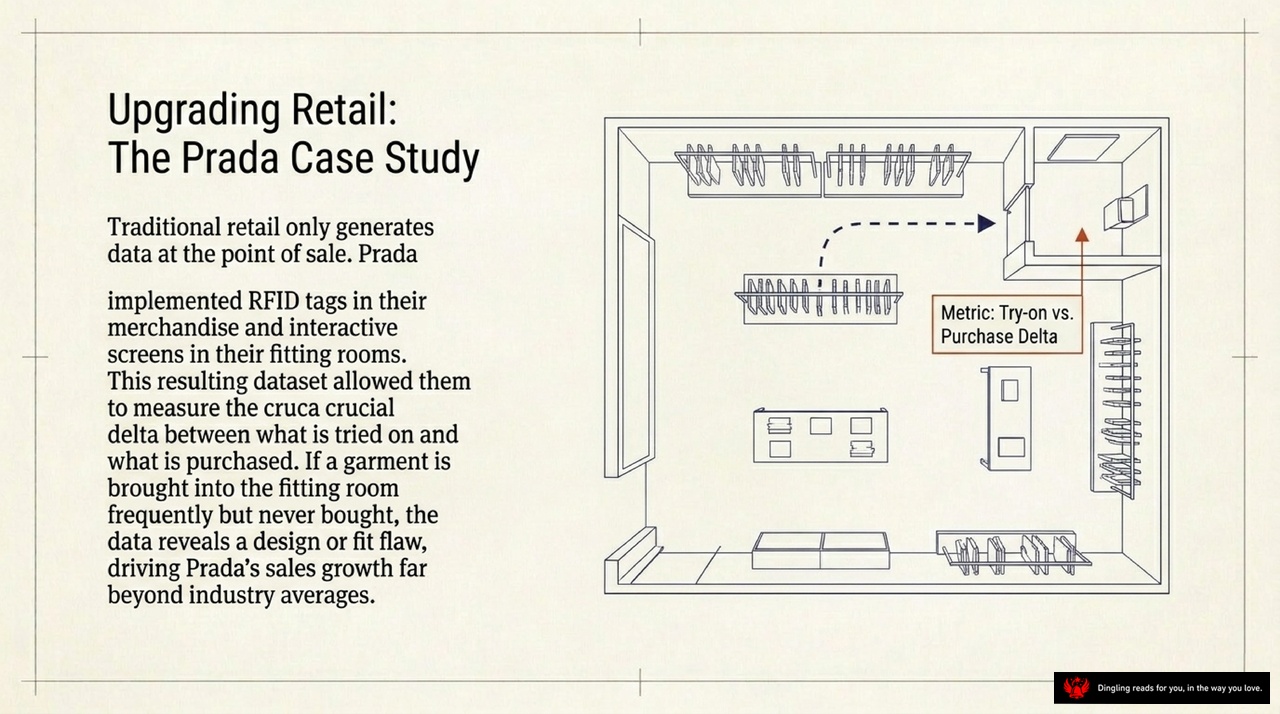
Imagine walking into a Prada store today. It feels different, doesn't it? You're not just shopping; you're part of a sophisticated data experiment. While traditional retail only tracks a sale once money changes hands, Prada has completely reimagined the fitting room. By embedding RFID tags in their merchandise and installing interactive screens, they've turned a private moment into a powerful data source.
This allows them to measure something crucial: the delta between what you try on and what you actually buy. If a garment is brought into the fitting room repeatedly but never purchased, the system flags it immediately. This isn't just about tracking; it's about insight. The data reveals design flaws or fit issues that customers silently reject, allowing Prada to fix them before they hit the market.
The result? A massive shift in performance. By leveraging this "try-on vs. purchase" metric, Prada has driven sales growth far beyond industry averages. They didn't just upgrade the store; they upgraded the entire decision-making process by turning invisible customer behavior into actionable intelligence.
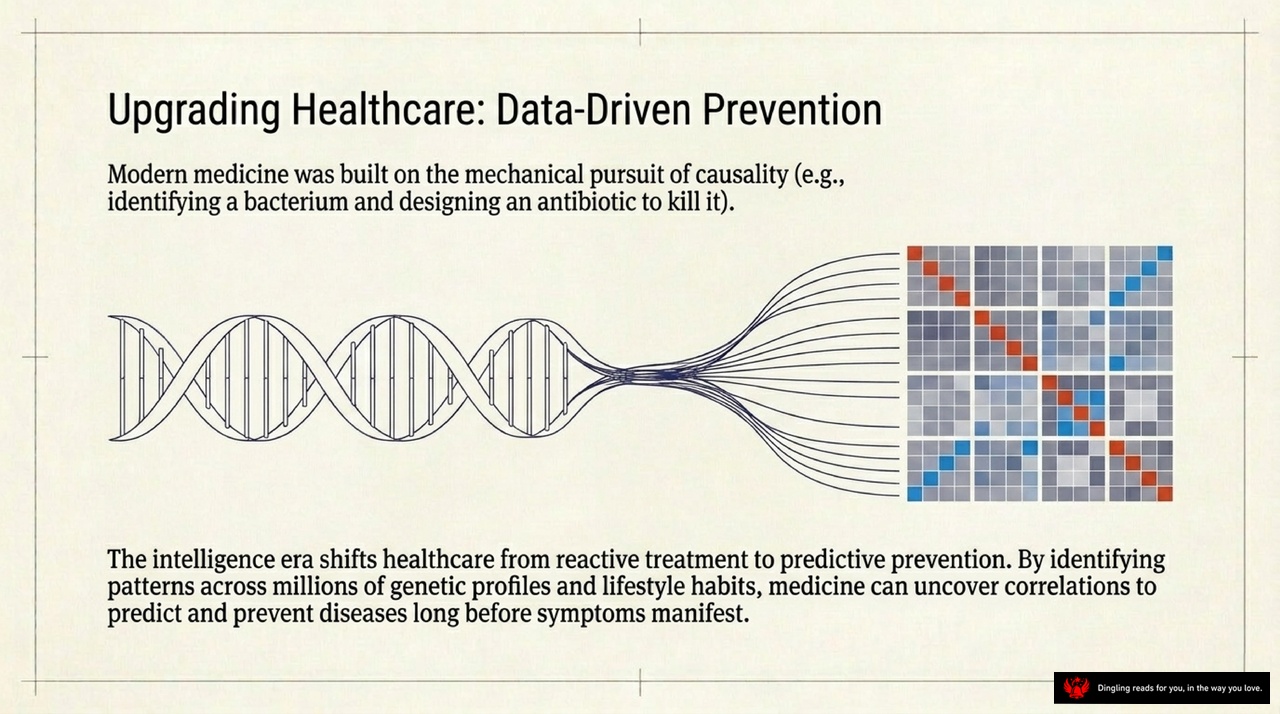
Imagine a world where healthcare stops being a reactive emergency room and becomes a proactive shield. For centuries, modern medicine operated on a simple, mechanical logic: find the cause, like a specific bacterium, and design a solution, like an antibiotic, to kill it. It was a straight line of cause and effect. But today, we are upgrading that entire system with data-driven prevention.
Look at this visual transformation. On the left, you see the familiar DNA double helix, representing the raw, complex data of our genetic profiles. These strands don't just sit there; they flow into a massive, intricate grid on the right. This grid represents the power of identifying patterns across millions of genetic profiles and lifestyle habits. Instead of waiting for symptoms to manifest and then treating the disease, the intelligence era allows us to uncover hidden correlations. By analyzing these vast datasets, we can predict health risks long before they become critical.
This shift moves us from reactive treatment to predictive prevention. We are no longer just fixing broken machines; we are using the power of data to anticipate problems and prevent them entirely. This is the core of the new healthcare revolution: using the patterns in our data to protect our future health before we even know we are in danger.

Look at this diagram illustrating how machine intelligence is fundamentally reshaping the white-collar world. The title, "Upgrading Cognitive Labor: The Law," captures the core shift: AI isn't just replacing manual tasks; it's automating the cognitive pattern-matching that has long defined professional jobs.
Consider the legal industry as a prime example. In the past, firms relied on armies of junior lawyers to manually read millions of documents during corporate litigation. Today, natural language processing algorithms can analyze and categorize those same documents instantly. The impact is staggering: this reduces legal discovery costs by 99%.
The visual on the right perfectly depicts this disruption. Where we once had a steep pyramid structure—relying on layers of human judgment at the bottom—machine intelligence now acts as a powerful beam of light, illuminating and processing the entire dataset at once. This efficiency fundamentally threatens the traditional pyramid structure of white-collar professions. By automating the pattern-matching that junior associates used to do, the demand for large teams of entry-level workers collapses, forcing the entire industry to rethink how work gets done.
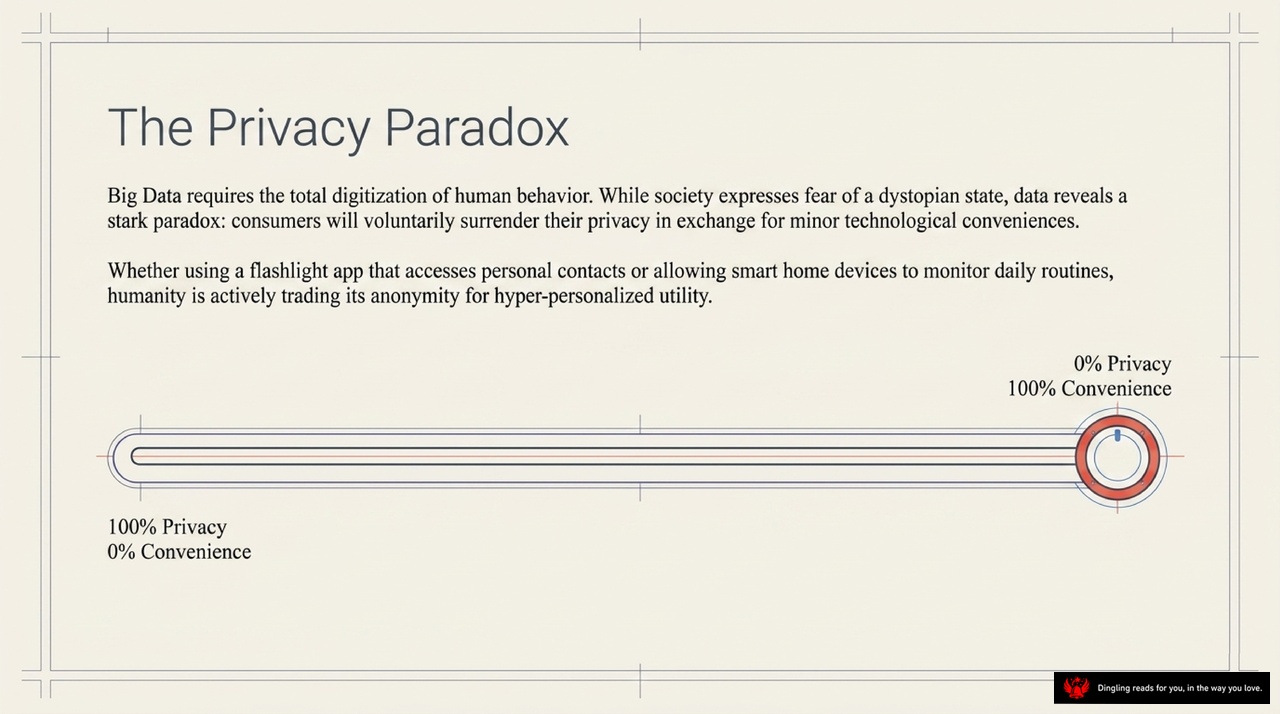
The Privacy Paradox is a concept that hits close to home for all of us. As we navigate our digital lives, we often tell ourselves we care deeply about our privacy, yet our actions tell a different story. We willingly hand over our personal data—our contacts, our daily routines, even our search history—in exchange for the convenience of a flashlight app that remembers your contacts or a smart home device that knows when you're coming home.
The slide illustrates this trade-off perfectly. On one end, you have 100% privacy but zero convenience; on the other, you have maximum convenience but zero privacy. The graph shows us where humanity currently stands: almost entirely on the right side. We are actively trading our anonymity for hyper-personalized utility. While society fears a dystopian future where big data dictates our every move, the reality is that we are the ones driving this change. We are voluntarily surrendering our privacy because, for now, the small tech conveniences we gain feel worth the cost. It's a stark paradox: we claim to value privacy, but we consistently vote with our data for convenience.

Look at this chart titled "The Economic Decoupling." It paints a stark picture of what's coming in the 21st century. On the left, you see a clear divergence: while GDP and productivity soar upward, median wages flatten out and then dip. This visualizes the core argument: throughout the 20th century, productivity and wages grew together, but the Intelligence Era is severing that link.
As machines take over cognitive and routine tasks, overall productivity and corporate wealth will skyrocket. However, the labor force will polarize. The vast majority of workers will see their traditional skills devalued, resulting in wage stagnation. Only a fraction of the workforce will capture the economic benefits of this new paradigm. This isn't just a prediction; it's a warning about the future of work in our data-driven economy.
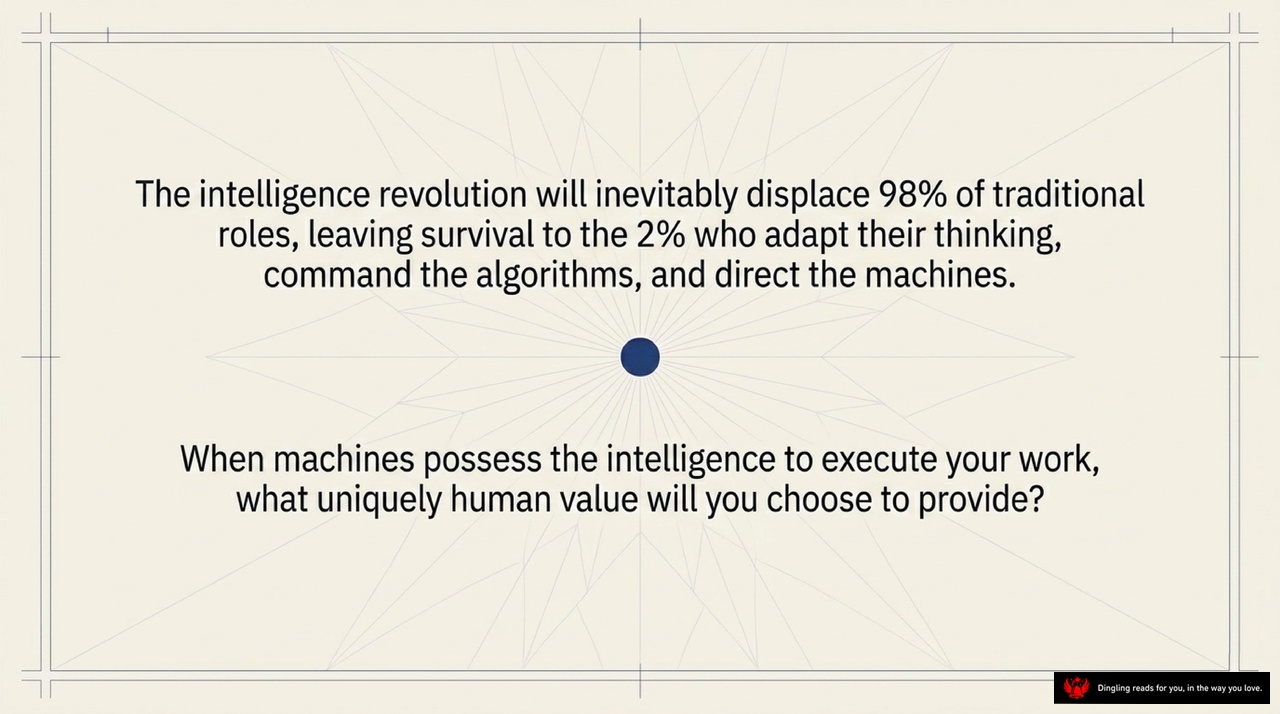
Imagine a future where the very nature of work is rewritten by code. The slide presents a stark, binary reality: the intelligence revolution will inevitably displace 98% of traditional roles, leaving survival solely to the top 2%. These aren't just the lucky few; they are the 2% who fundamentally adapt their thinking, learn to command the algorithms, and ultimately direct the machines.
But here is the critical question for us all: When machines possess the intelligence to execute your work, what uniquely human value will you choose to provide?
Think about the industries transforming right now. We see this in the legal world, where software can review millions of documents in seconds, or in healthcare, where AI diagnoses patterns faster than any human specialist. The machine is no longer just a tool for our hands; it is becoming the engine for our minds.
So, if the machine can calculate, analyze, and even create with unprecedented speed, where does the human fit in? The answer lies not in competing with the algorithm, but in leveraging it. The future belongs to those who stop trying to out-calculate the computer and instead focus on what we do best: setting the vision, making ethical judgments, empathizing with people, and defining the problems that need solving. The challenge isn't about being smarter than the machine; it's about being wise enough to guide it.