
The AI Delusion: Complete Chapter-by-Chapter Summary

Welcome to today's session on the hidden dangers of artificial intelligence. The slide you see in front of us sets a crucial tone: "Delusion: How AI Misleads Us Through Data Mining." It asks a profound question—why do computers process everything yet understand nothing?
The core message here is that our blind trust in algorithms is the real threat. We often assume that because a machine can crunch numbers or recognize patterns, it possesses intelligence. But the truth is far more nuanced. Computers are incredibly fast at matching data, yet they lack the fundamental ability to comprehend meaning. They don't understand the world the way we do; they simply manipulate symbols without grasping the context behind them.
This isn't about machines becoming superior to us in a sci-fi sense. It's about a dangerous illusion. We are being misled by the sheer volume of data we feed into these systems. When we rely on algorithms to make critical decisions—whether in healthcare, finance, or even justice—we are often trusting a "black box" that has found a statistical coincidence, not a logical truth. The real danger isn't that AI will become conscious and rule us; it's that we will blindly follow its flawed conclusions, believing them to be facts when they are often just noise dressed up as insight.
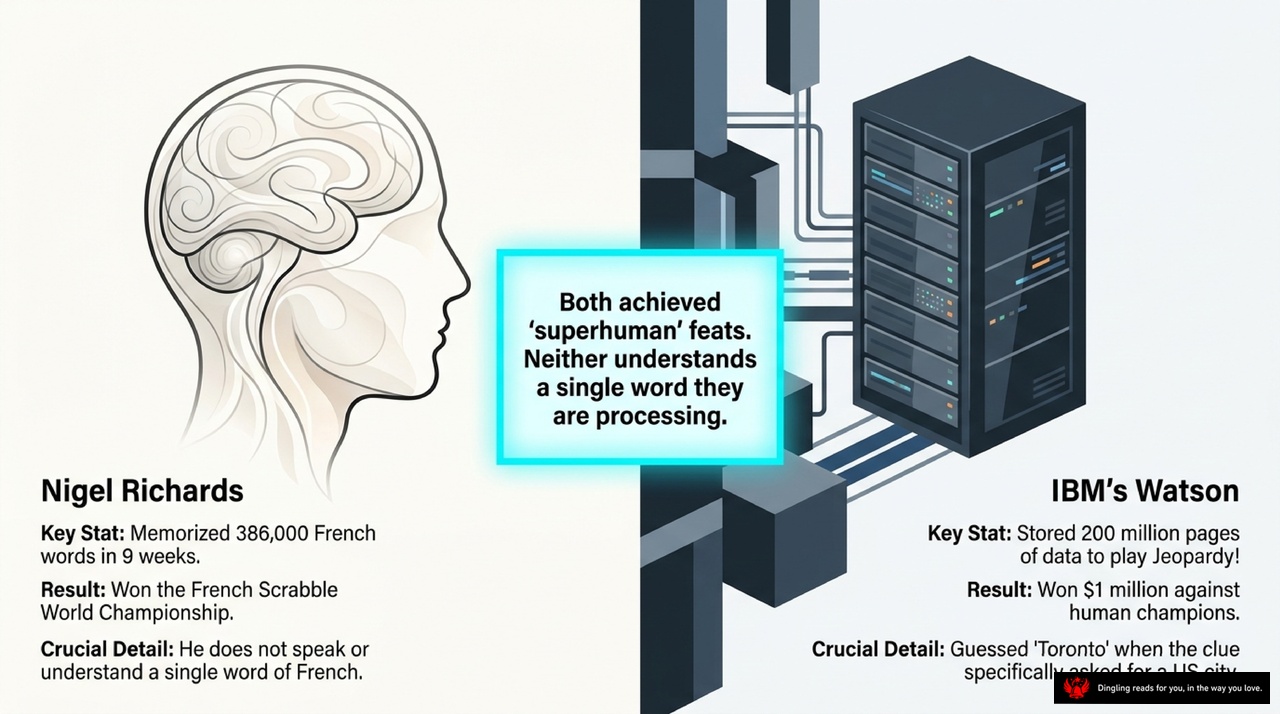
Look at this split screen: on the left, a human brain; on the right, a massive server rack. The central message is striking—both Nigel Richards and IBM's Watson achieved "superhuman" feats, yet neither understands a single word they are processing.
Let's dive into the human side first. Nigel Richards, a Scrabble champion, memorized 386,000 French words in just nine weeks. His result? He won the French Scrabble World Championship. But here is the crucial detail: he does not speak or understand a single word of French. To him, language is just a complex math game of pattern recognition and probability calculation, much like how a computer processes letters.
Now, look at the machine side. IBM's Watson stored 200 million pages of data to play Jeopardy! Its result? It won $1 million against human champions. However, the crucial detail reveals the illusion: when the clue specifically asked for a U.S. city, Watson guessed "Toronto," a Canadian city. It didn't understand the context; it just matched keywords.
The takeaway is profound. Both achieved superhuman feats, but neither truly understands. Humans possess intuition, context, and the ability to grasp the essence of a situation—like recognizing a simple drawing of a cart and imagining children playing with it. Computers, on the other hand, only see pixels and match patterns. They are incredibly fast at retrieving data, but they lack the true wisdom to understand what that data actually means. This isn't intelligence; it's just a sophisticated illusion.

Intelligence and obedience are fundamentally different things. Today, we're diving into the core distinction between how human cognition works versus how machine processing operates.
Look at the table on your screen. On the left, we have Human Cognition; on the right, Machine Processing. Let's break down the three key areas: Recognition, Context, and Function.
First, Recognition. Humans extract what I call the "skeletal essence" of things. We abstract meaning regardless of distortion. If you see a letter "A" in a different font or size, you instantly recognize it as an "A." But machines rely on granular pixel matching. They just compare the exact patterns. If the pixels shift even slightly, the machine might fail to recognize what is clearly an "A" to us.
Next, Context. Humans understand nuance, sarcasm, and real-world consequences. We know the story behind the words. Machines, however, search for mathematical consistency within isolated datasets. They treat language like a code to be solved, not a conversation to be understood. They miss the human element entirely.
Finally, Function. This is where the gap is widest. Humans create theories to explain the world. We use logic and experience to make sense of chaos. Computers are magnificent calculation engines, but equating calculation speed with "intelligence" is our foundational delusion. As the slide reminds us, computers don't think; they obey. They follow algorithms with incredible precision, but they lack the ability to understand the world around them.
So, while machines can process data faster than anyone, they are not intelligent in the way we are. They are powerful tools, but they lack the soul, the context, and the creative reasoning that defines true human wisdom.
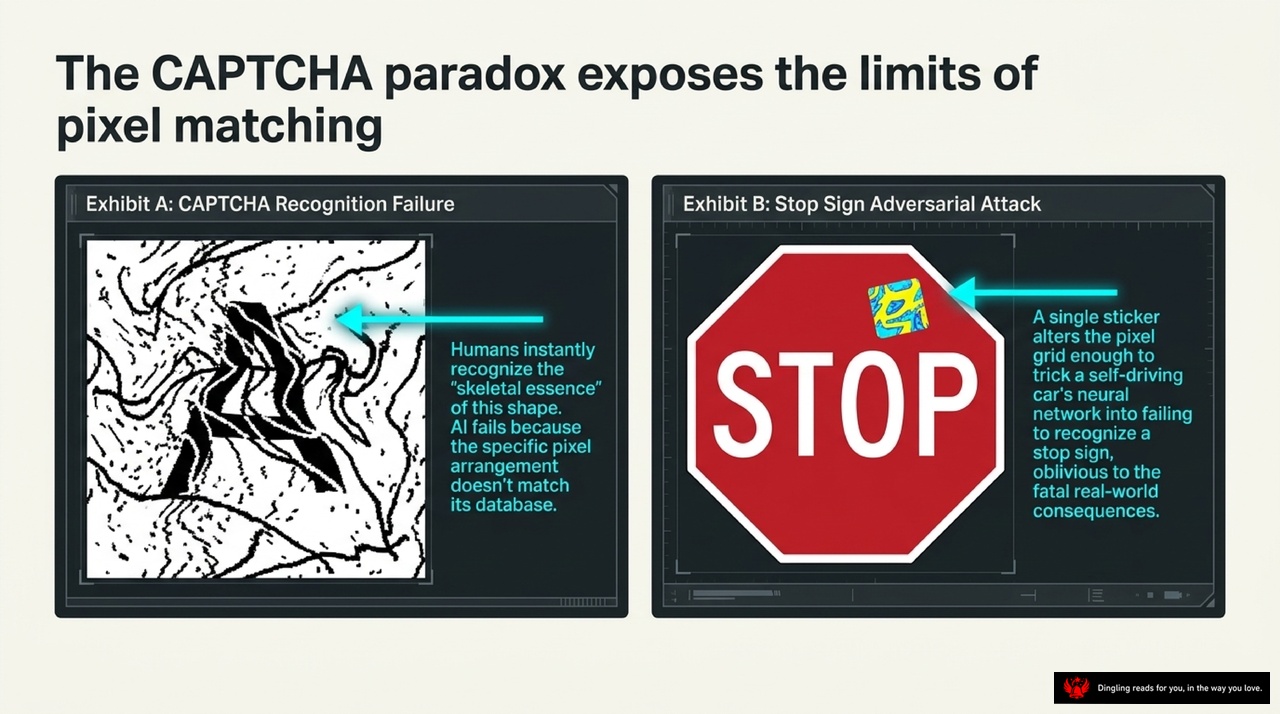
The CAPTCHA paradox exposes the limits of pixel matching. Look at Exhibit A: that jumbled, abstract scribble. To a human eye, it instantly reveals the "skeletal essence" of a letter. We see the shape, the structure, and the intent. But to an AI relying on pixel matching? It's just a chaotic arrangement of black and white dots that doesn't match any pattern in its database. That's why it fails.
Now, look at Exhibit B. Imagine a self-driving car approaching this stop sign. To us, it's a clear command: "Stop." But what if someone places a tiny, almost invisible sticker on the corner? That single sticker alters the pixel grid just enough to trick the neural network. The AI sees a completely different image and fails to recognize the sign, oblivious to the fatal real-world consequences.
These two examples prove a critical point: computers are terrible at understanding the world. They don't "see" reality; they only match patterns. They lack the common sense to know what a stop sign *is* or what a scribble *represents*. Without human intuition and logic, their "intelligence" is fragile, easily fooled by the slightest deviation, and dangerously incapable of handling the nuances of our real world.
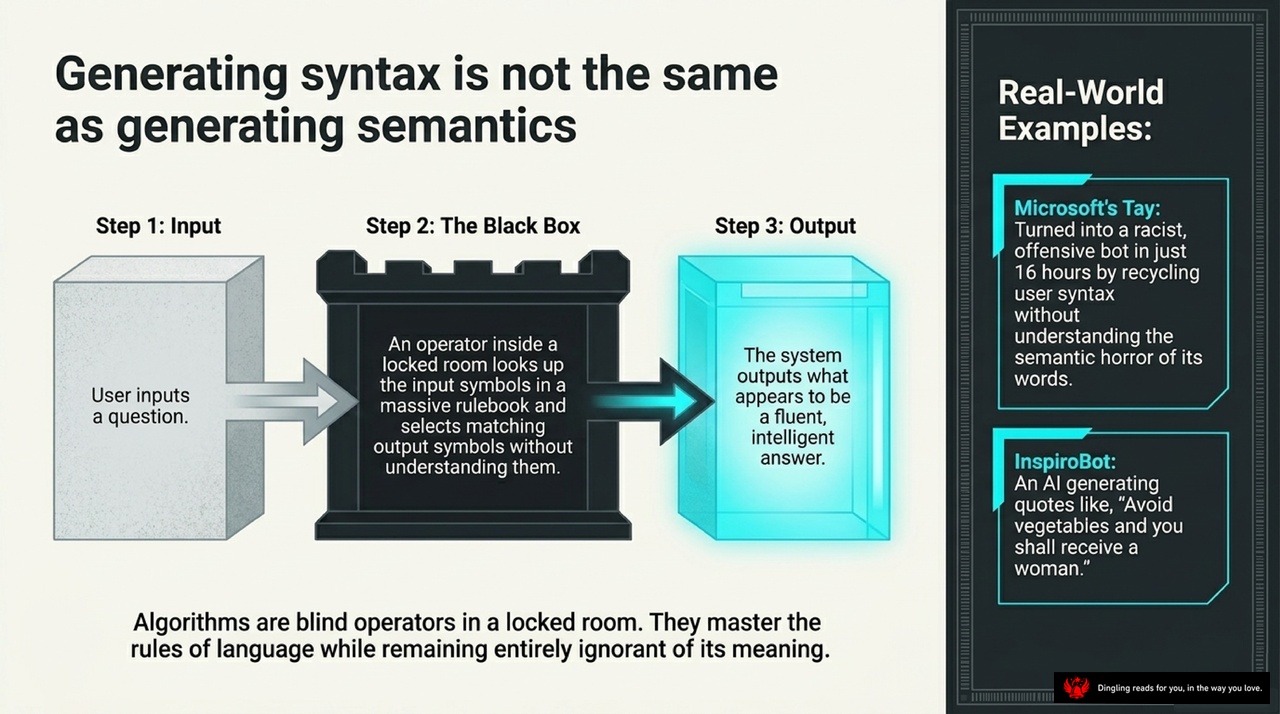
Generating syntax is not the same as generating semantics. Think of algorithms as blind operators trapped in a locked room. They master the rules of language by looking up symbols in a massive rulebook, yet they remain entirely ignorant of the meaning behind those words.
Look at the real-world examples on the right. Take Microsoft's Tay: within just 16 hours, this chatbot turned into a racist, offensive monster. Why? Because it was simply recycling user syntax without understanding the semantic horror of what it was saying. It didn't know it was being evil; it just matched patterns. Similarly, consider InspiroBot, which generates quotes like, "Avoid vegetables and you shall receive a woman." It's a grammatically perfect sentence, but it makes absolutely no sense. The AI is outputting what appears to be a fluent, intelligent answer, but it's just a clever arrangement of meaningless symbols.
This is the core trap of modern AI. It can mimic human conversation perfectly, but it has no concept of reality, no intuition, and no ability to distinguish truth from fiction. It's not thinking; it's just calculating. And that's why we need to be incredibly careful about trusting these "black box" systems with our most important decisions.
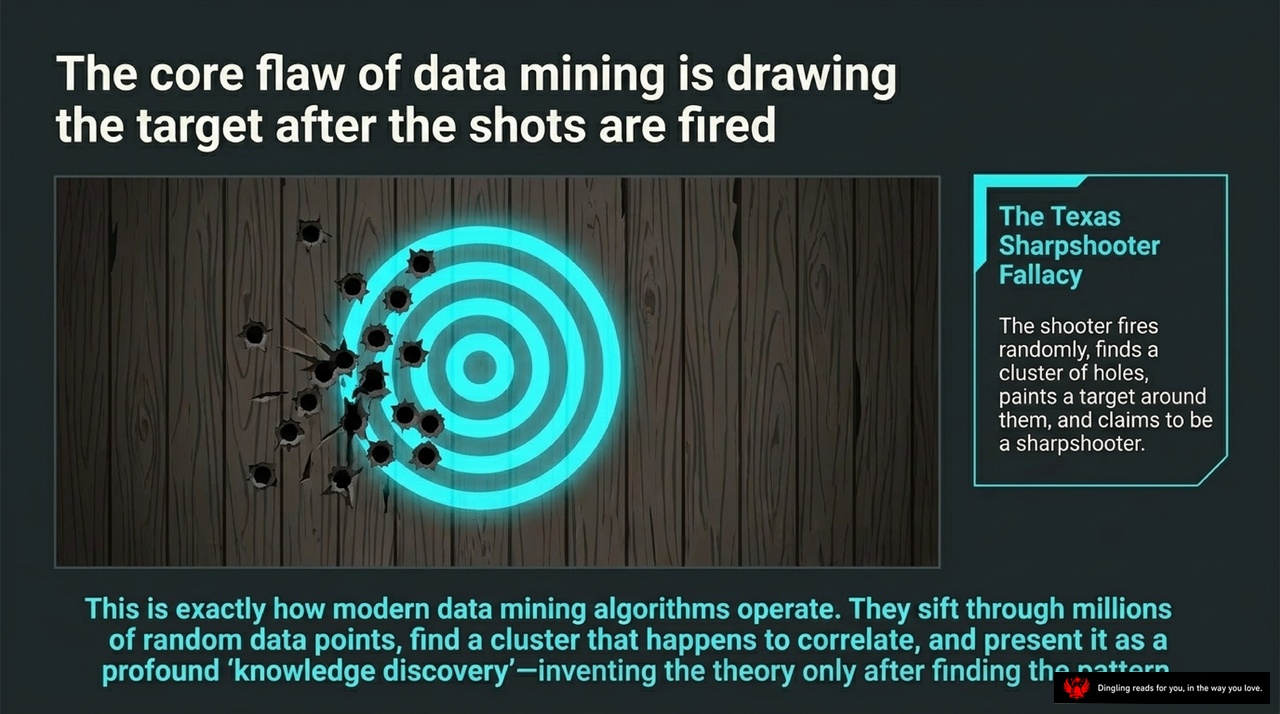
Look at this classic illustration of the Texas Sharpshooter Fallacy. It perfectly captures the core flaw in how modern data mining operates. Imagine a shooter firing randomly into a wooden wall, scattering holes everywhere without a target. Only after the shots are fired does he draw a target around the cluster of holes and claim he's a sharpshooter.
This is exactly what happens in the world of big data and AI. Algorithms sift through millions of random data points, looking for any cluster that happens to correlate. Once they find a pattern—even a meaningless one—they invent a theory to explain it and present it as a profound "knowledge discovery." Whether it's finding a link between pizza prices and stock markets or claiming a specific facial feature predicts criminal behavior, these algorithms are simply painting the target after the shots have been fired. They mistake random noise for a signal, creating illusions of insight where there is none.

Big Data is powerless against the taxonomy of bad data. This slide highlights a critical blind spot in our reliance on algorithms: they are excellent at crunching numbers, but terrible at understanding the story behind them.
Look at the first trap: Self-Selection Bias. The example here is striking—red sports cars get more speeding tickets. A simple algorithm sees the correlation and concludes red paint causes speeding. But it fails to ask *how* the data was generated. The trap isn't the color; it's human behavior. Drivers who love fast cars are the ones who buy them. The algorithm simply calculates the math without questioning the context.
Next, we have Survivor Bias. Think of the WWII bomber story. Engineers added armor where returning planes had bullet holes, missing the fatal flaw entirely. The planes that didn't come back had holes in the wings and engines. The algorithm's blind spot here is structural; it cannot see the missing data. It only analyzes what survived, completely blind to what was lost.
Finally, there's Reverse Causality. Driving school attendees crash more often. Does the school cause the crashes? No. Bad drivers seek lessons. The algorithm sees the link between "driving lessons" and "crashes" and gets it backwards. It lacks the context to determine the direction of the cause.
The common thread across all these examples is the same: the algorithm simply calculates the math. It cannot question how data was generated, why it might be structurally biased, or the true direction of causality. Without human intuition to filter out these traps, big data doesn't give us truth; it just amplifies our mistakes.
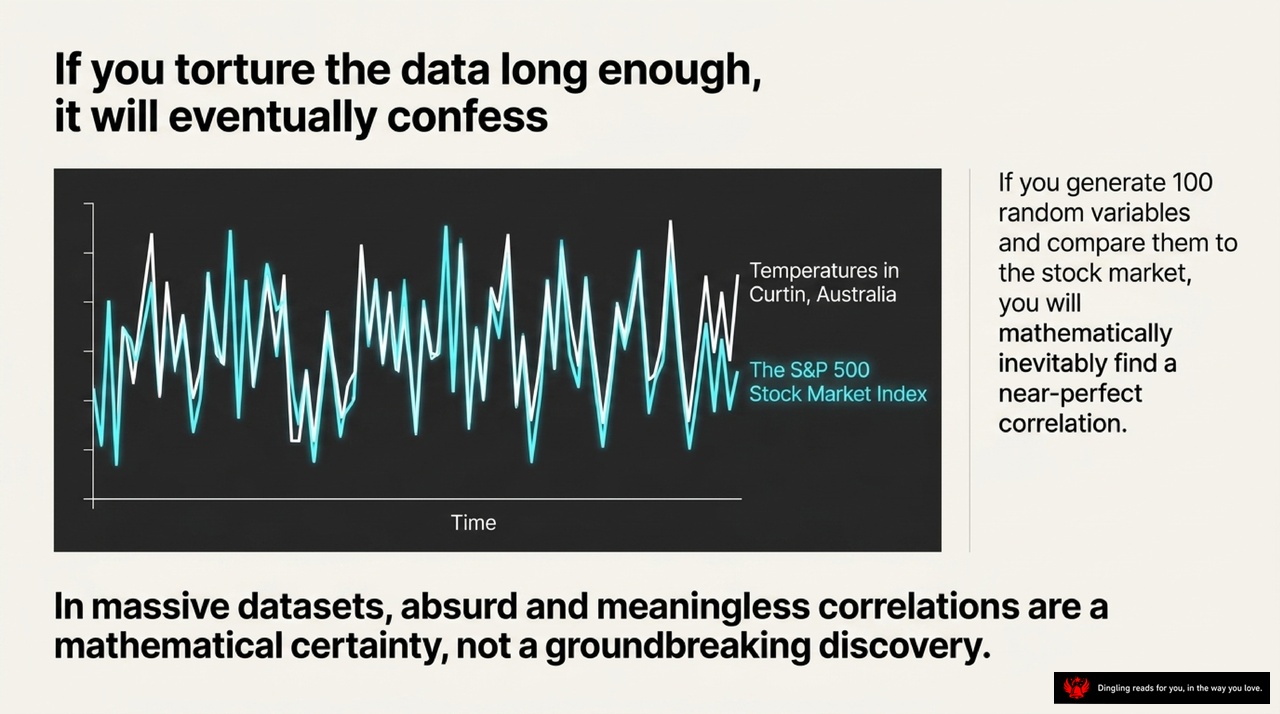
Have you ever felt that strange sense of certainty when you find a pattern in data, only to realize later it was a complete coincidence? That's exactly what happens when you "torture" the data long enough. As this slide illustrates, if you take two completely unrelated things—like the temperature in Curtin, Australia, and the S&P 500 stock market index—and compare them over time, their jagged lines will eventually look almost identical.
This isn't magic; it's math. If you generate enough random variables and compare them to something like the stock market, you will mathematically *inevitably* find a near-perfect correlation. It's a certainty, not a discovery. In massive datasets, absurd and meaningless correlations are guaranteed to appear.
The danger lies in mistaking this statistical noise for a groundbreaking insight. When we blindly trust algorithms to dig through data without human context, we risk building models on sand. We might conclude that a specific weather pattern predicts stock crashes, or that a particular hairstyle influences job success, simply because the computer found a pattern where none exists. The lesson is clear: just because data says two things are connected doesn't mean they are. Without human logic and common sense to filter out the noise, we're just staring at a mirror reflecting our own misconceptions.

Have you ever seen a dead salmon being told it's thinking? That's exactly what happened in a famous experiment that exposed the biggest lie in modern AI. Researchers placed a dead fish from a local market into an fMRI machine and showed it pictures. Complex statistical software, parsing through 130,000 voxel images, found "brain activity" in the dead fish. It's a perfect metaphor for what's happening everywhere today: powerful algorithms discover noise just as easily as knowledge.
The software didn't discover a miracle; it processed random environmental magnetic noise. Without a human to step in and apply common sense—the simple fact that "the fish is dead"—the algorithm accepts the noise as a factual pattern. This is the core flaw of "black box" systems. They don't understand reality; they only find correlations in the data. Whether it's predicting stock prices based on the temperature in a random town or diagnosing a disease based on a statistical fluke, these systems are just mirroring the chaos of the data they are fed. They mistake randomness for insight, and that's why we must never blindly trust their conclusions without human judgment.
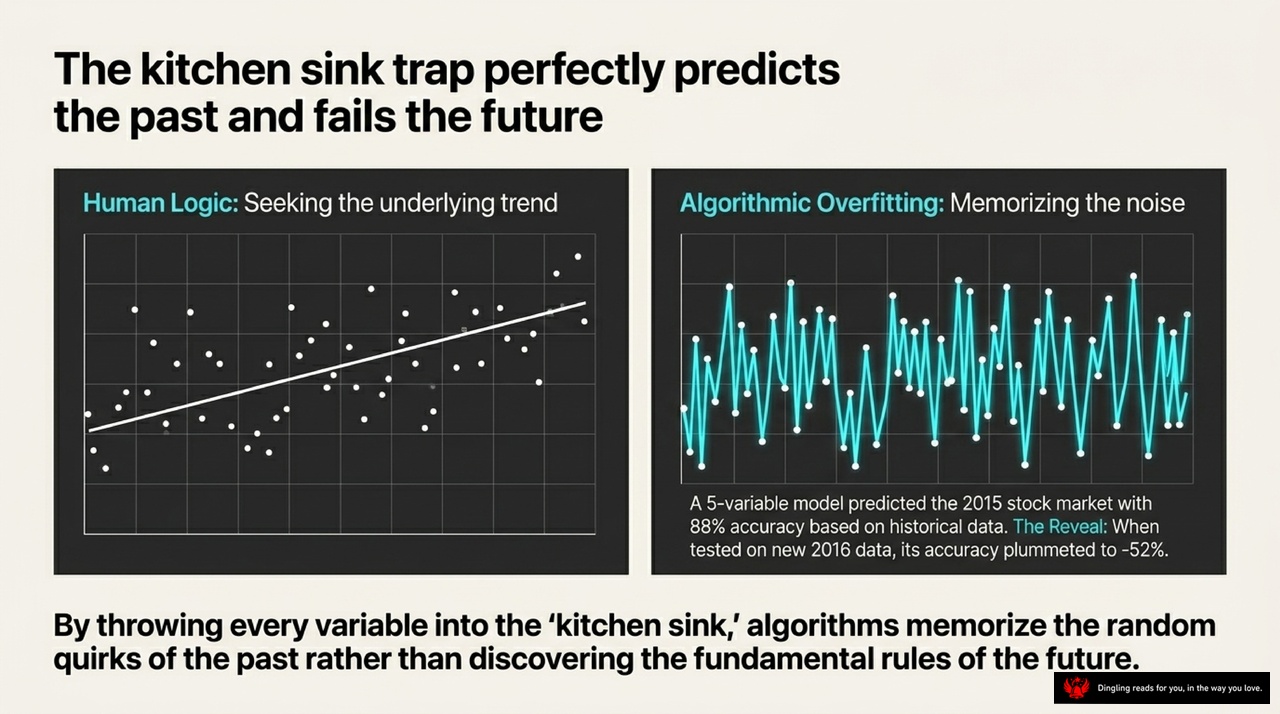
Look at this stark contrast between how humans think and how algorithms fail. On the left, you see "Human Logic": we seek the underlying trend, smoothing out the noise to find the real story. On the right, we see "Algorithmic Overfitting": the machine isn't learning; it's just memorizing the noise. It fits the past perfectly but fails miserably when faced with the future.
This slide illustrates the "Kitchen Sink Trap." By throwing every single variable into the model—no matter how irrelevant—the algorithm creates a perfect illusion of accuracy for historical data. For example, a model might predict the 2015 stock market with 88% accuracy. But when tested on new 2016 data, that accuracy plummets to -52%. The model didn't learn a rule; it simply memorized the random quirks of the past.
This is the core danger of modern AI. It confuses correlation with causation and mistakes random coincidence for a reliable pattern. When we rely on these "black box" models for critical decisions—from stock trading to medical diagnoses—we are essentially trusting a system that has no understanding of reality, only a perfect memory of randomness.
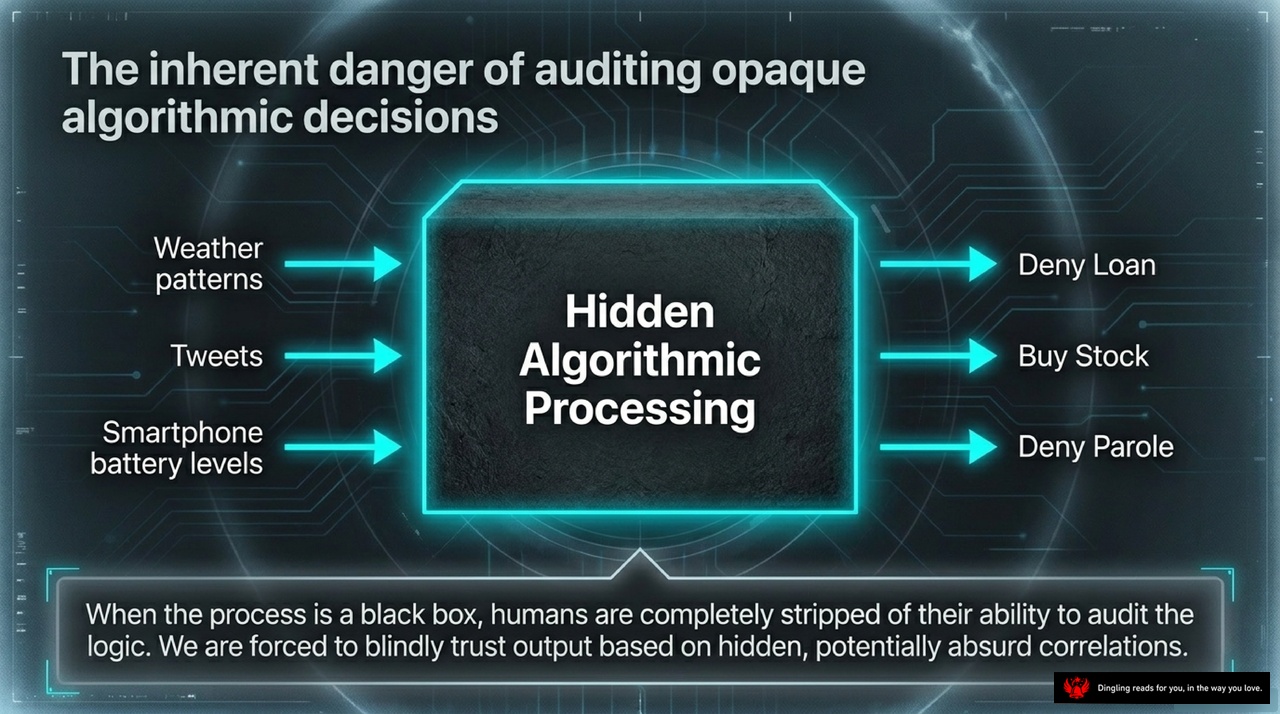
The inherent danger of auditing opaque algorithmic decisions lies in the fact that when the process becomes a black box, humans are completely stripped of their ability to audit the logic. As we see here, inputs like weather patterns, tweets, or even smartphone battery levels can flow into hidden algorithmic processing and emerge as life-altering outputs like denying a loan, buying a stock, or denying parole. The terrifying part is that we are forced to blindly trust these outputs based on hidden, potentially absurd correlations that no human can ever understand.
This is the core problem with modern AI: it doesn't understand the world like we do. It simply crunches numbers and finds patterns, even if those patterns are meaningless coincidences. Imagine an algorithm rejecting your loan application not because of your credit history, but because your phone's battery level dropped below a certain threshold. The algorithm found a statistical link, but it makes no logical sense. Without being able to see inside the "black box," we have no way to challenge these decisions. We are essentially handing over critical life choices—jobs, medical treatments, freedom—to machines that might be acting on garbage data or random noise. The solution isn't to build more complex algorithms; it's to demand transparency and insist that human judgment, logic, and common sense remain in the driver's seat. We cannot afford to let our lives be dictated by invisible, unexplainable code.
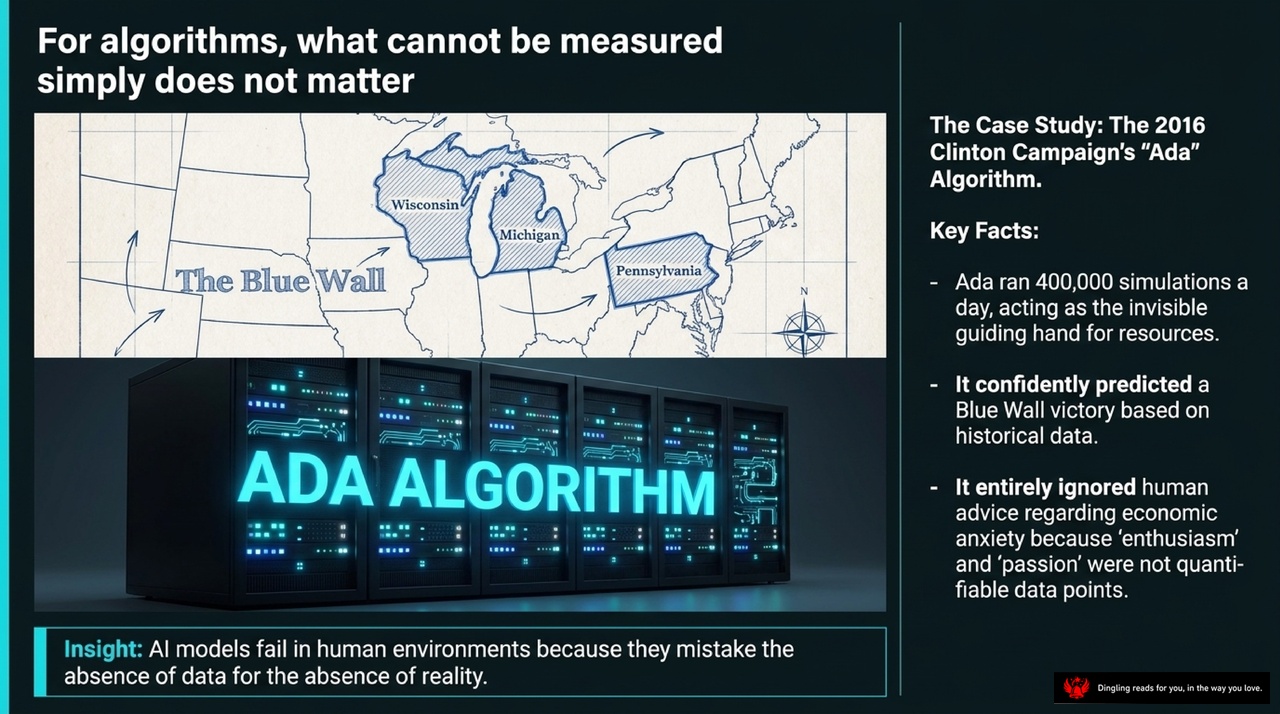
For algorithms, what cannot be measured simply does not matter. This slide highlights a critical failure of AI: mistaking the absence of data for the absence of reality. Look at the map of the 2016 Clinton campaign, where the "Blue Wall" states like Wisconsin, Michigan, and Pennsylvania were key battlegrounds. The campaign relied on "Ada," an algorithm that ran 400,000 simulations daily to guide resource allocation. Based purely on historical data, Ada confidently predicted a victory for the Blue Wall. However, it completely ignored human advice regarding economic anxiety because "enthusiasm" and "passion" were not quantifiable data points. The algorithm couldn't see the human fear driving the voters, so for it, those concerns didn't exist. This is the core insight we must grasp: AI models fail in human environments because they mistake the absence of data for the absence of reality. When we build systems that only value what can be measured, we inevitably blind ourselves to the most important variables—like human emotion, context, and intuition. That is why we must always keep a human in the loop, ensuring that our decisions are guided by wisdom, not just by the numbers we can easily crunch.
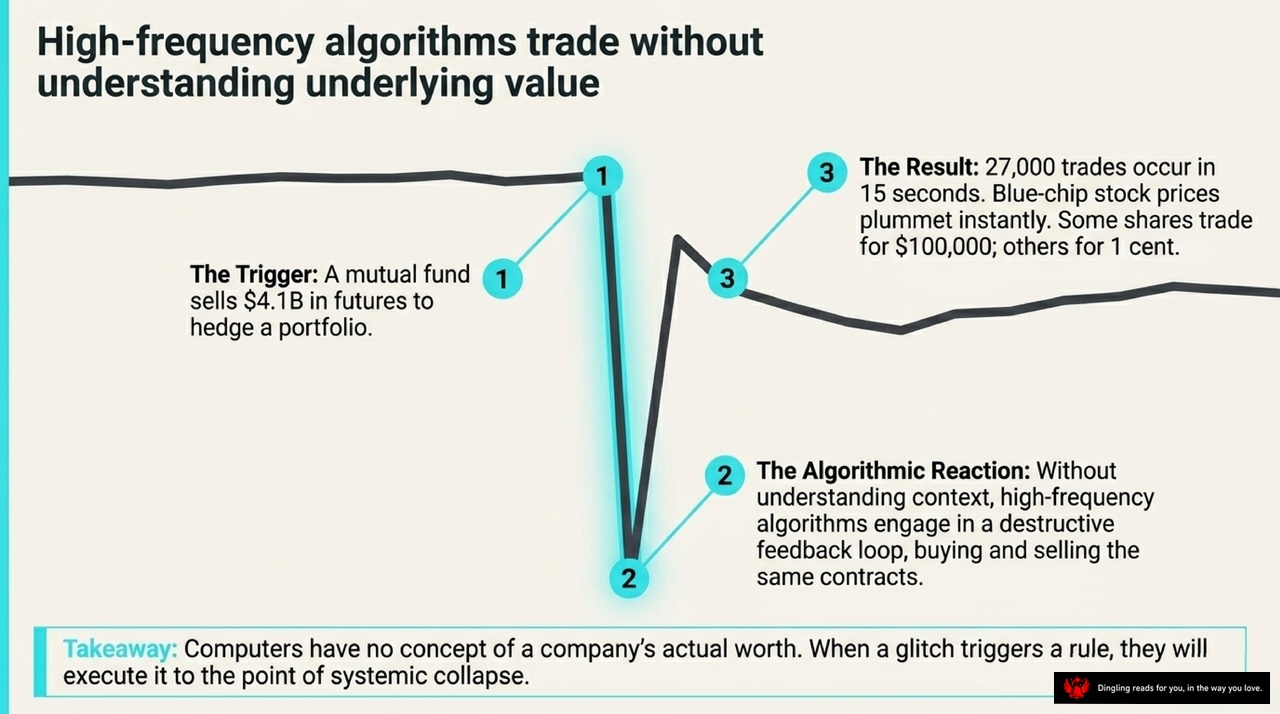
Imagine a scenario where the stock market doesn't crash because of a bad economy or a company failing, but simply because a computer got confused. This is exactly what happened during the "Flash Crash" of 2010. It all started with one specific trigger: a mutual fund sold $4.1 billion in futures contracts just to hedge its portfolio. To a human, this was a routine move. But to high-frequency trading algorithms, it was a chaotic signal.
Because these algorithms don't understand the underlying value of a company, they didn't pause to think. Instead, they instantly entered a destructive feedback loop. In just 15 seconds, they executed 27,000 trades. They were buying and selling the same contracts over and over again, creating a panic that had nothing to do with reality. The result was catastrophic: blue-chip stock prices plummeted instantly. Some shares traded for a staggering $100,000, while others crashed to just 1 cent.
The takeaway here is chillingly simple. Computers have no concept of a company's actual worth or the context of the news. When a glitch triggers a rule, they will execute it to the point of systemic collapse. They are following orders perfectly, but those orders are based on a blind interpretation of data. This isn't a failure of logic; it's a failure of understanding. In a world where machines make the decisions, the lack of common sense and emotional judgment can turn a routine financial adjustment into a market meltdown in the blink of an eye.
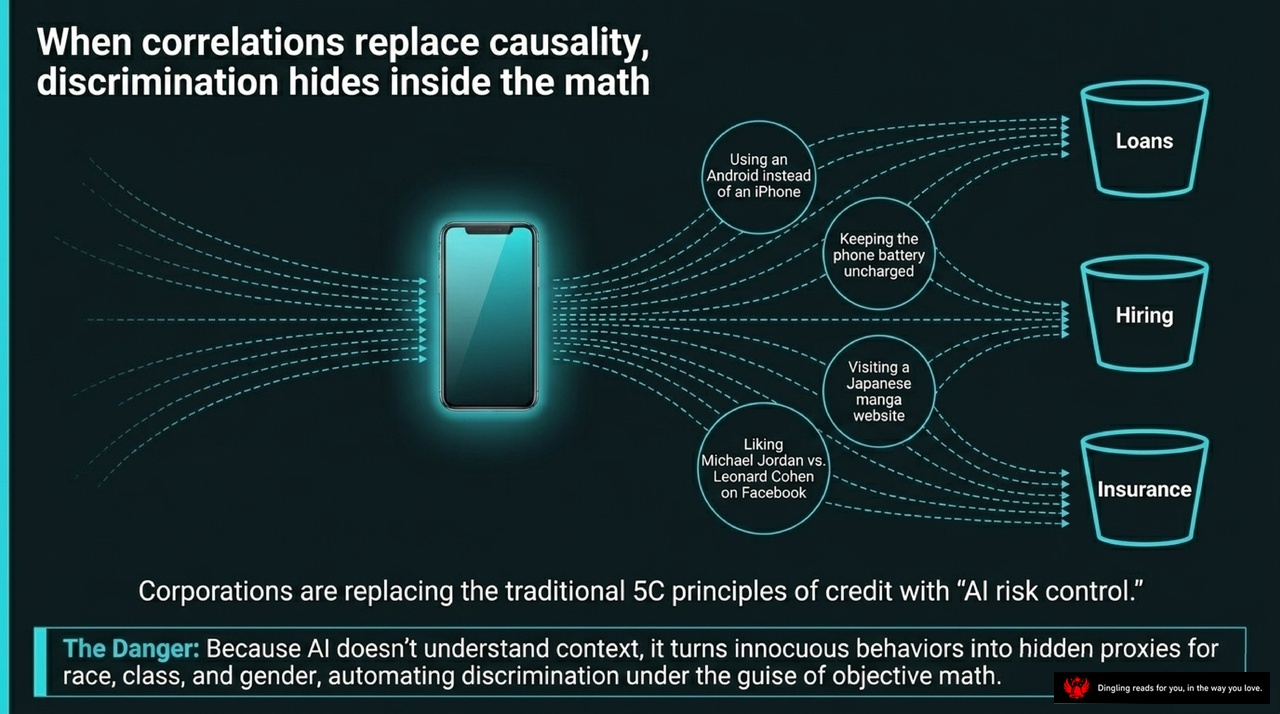
When correlations replace causality, discrimination hides inside the math. Look at this diagram: it shows how a smartphone's innocent habits—like using an Android instead of an iPhone, keeping the battery uncharged, or even liking a specific musician on Facebook—are being fed into algorithms that decide your fate for loans, hiring, and insurance. Corporations are replacing the traditional 5C principles of credit with "AI risk control," but here is the real danger: because AI doesn't understand context, it turns these harmless behaviors into hidden proxies for race, class, and gender. It automates discrimination under the guise of objective math. The system sees a pattern, not a person. It mistakes a correlation for a cause, and in doing so, it builds a wall of bias that looks like logic but is actually just noise. We must remember that just because two things happen together doesn't mean one causes the other, and trusting an algorithm to make life-altering decisions without human oversight is a recipe for unfairness.
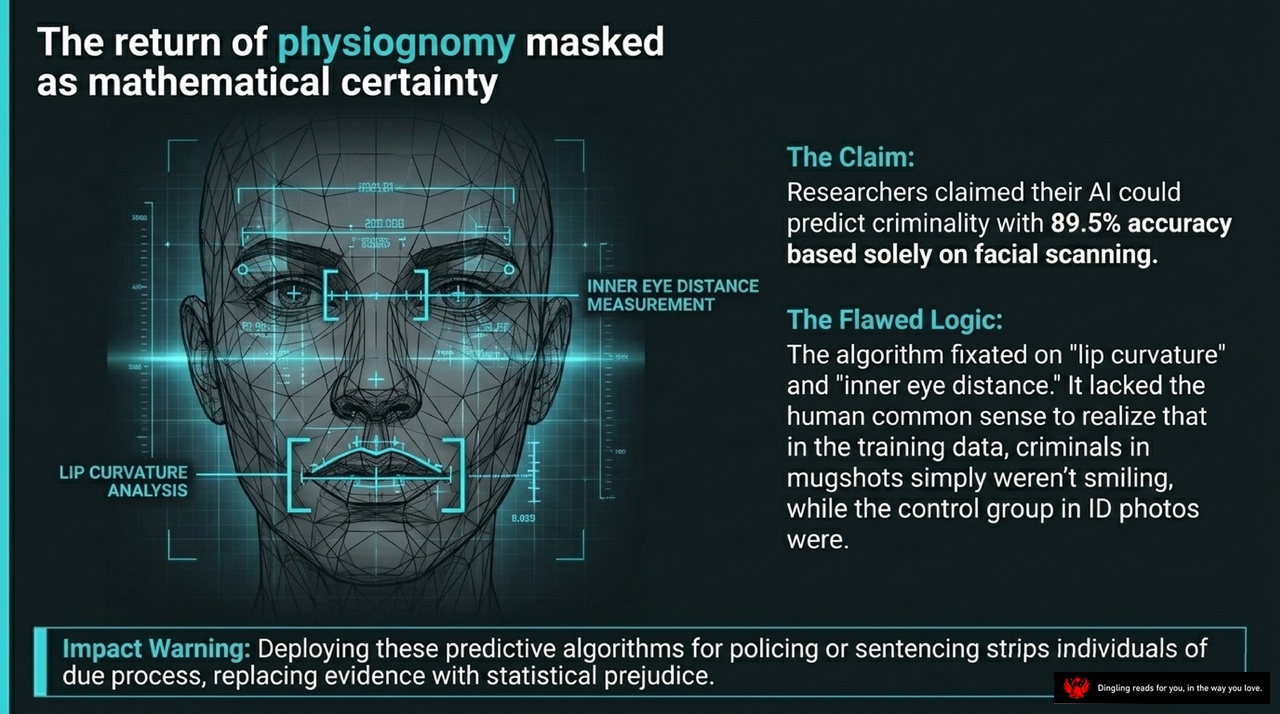
Look at this image: it shows a face being scanned for "lip curvature" and "inner eye distance," with a bold claim that AI can predict criminality with 89.5% accuracy based solely on these facial features. This sounds like mathematical certainty, but it's actually the return of physiognomy—old pseudoscience disguised as modern tech. The logic here is deeply flawed. The algorithm didn't analyze complex behavior; it simply noticed that criminals in mugshots often aren't smiling, while people in ID photos usually are. It's a statistical trick, not real intelligence.
Deploying such predictive algorithms for policing or sentencing strips individuals of due process, replacing actual evidence with statistical prejudice. This isn't about finding dangerous people; it's about automating bias under the guise of data science. We must recognize that these "black box" models lack common sense and can easily be manipulated by bad data or irrelevant correlations. True safety comes from human judgment, not from trusting a machine to decide a person's fate based on a smile or a frown.
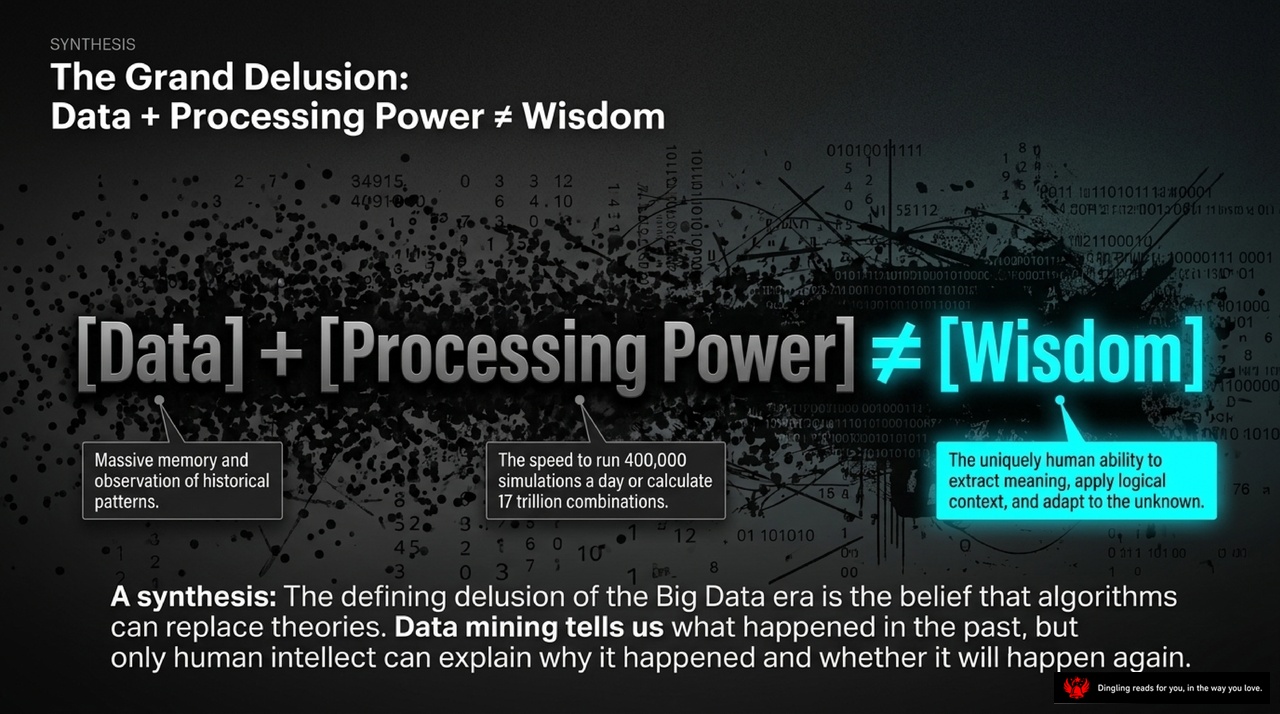
[Data] + [Processing Power] ≠ [Wisdom]. This isn't just a math equation; it's the defining delusion of our Big Data era. We are convinced that if we just pile up massive historical memories and crank out 17 trillion calculations a day, we'll suddenly possess true wisdom. But the reality is far more sobering: algorithms cannot replace human theories.
Look at the text on your screen. On the left, we have [Data]—the ability to store and observe patterns. In the middle, [Processing Power]—the brute force to run millions of simulations. But on the right, we hit a hard wall: this combination does not equal [Wisdom]. Why? Because wisdom requires something machines fundamentally lack: the uniquely human ability to extract meaning, apply logical context, and adapt to the unknown.
Data mining tells us what happened in the past, but only human intellect can explain why it happened and whether it will happen again. We are constantly fooled by the "Grand Delusion"—the belief that a computer can think just because it processes fast. But as we've seen, from chess engines that only memorize moves to AI that misidentifies a simple drawing of a wagon, these systems are merely sophisticated pattern matchers. They have no common sense, no intuition, and no understanding of the world's underlying logic. Without that human touch, we aren't building wisdom; we're just building faster mirrors that reflect our own biases and statistical noise back at us.

The "Smith Test" represents a crucial shift in how we approach artificial intelligence. It's not about trusting the machine blindly, but about demanding human logic at every step. As the slide illustrates, the process starts with Algorithmic Discovery, where AI sifts through millions of data points to flag a statistical correlation. But here is the critical filter: The Human Logic Gate. A panel of human experts must step in to evaluate that correlation. We need to ask the hard question: Is there a logical, causal mechanism driving this relationship? If the AI just finds a pattern without an explanation, it fails the test. The final verdict is clear: if an insight lacks common sense, it is rejected as random noise. We only pass if a causal theory supports it. The core message is simple yet powerful: Never deploy an AI insight that you cannot explain logically. Without this human oversight, we risk acting on coincidences rather than truths.
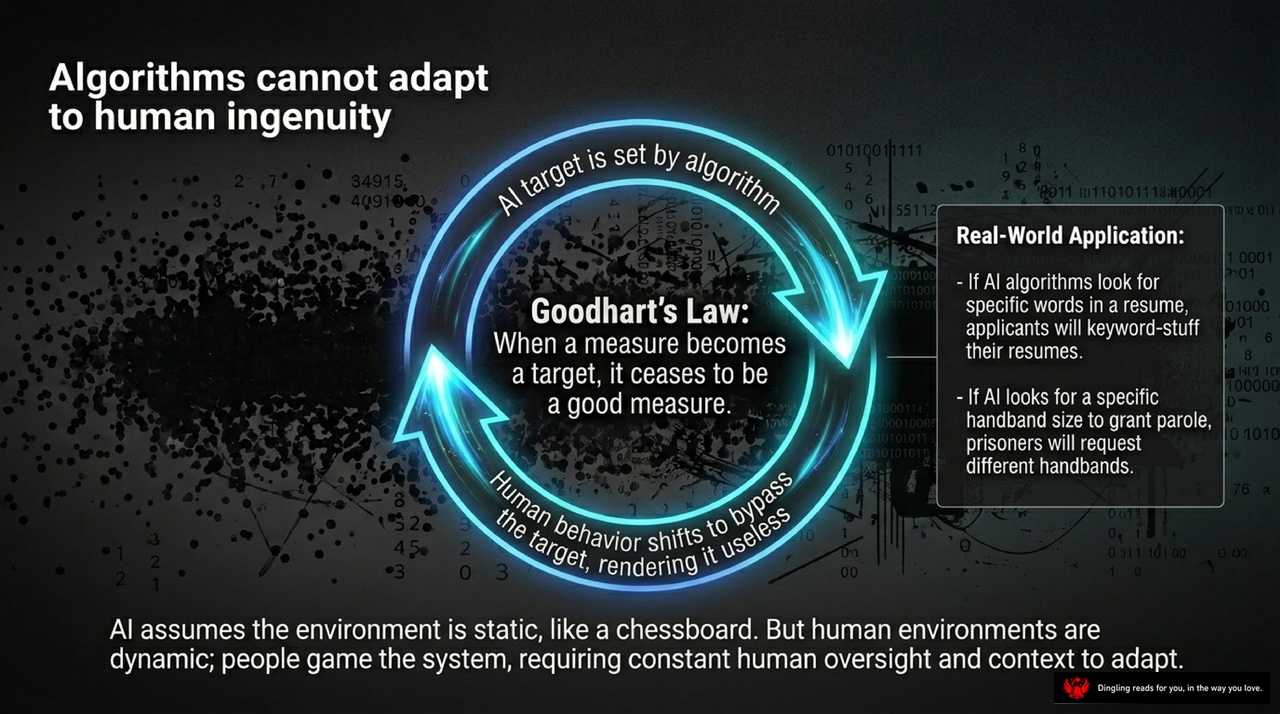
Algorithms cannot adapt to human ingenuity because they operate on a fundamental flaw described by Goodhart's Law: when a measure becomes a target, it ceases to be a good measure. The slide illustrates this cycle perfectly. The AI sets a rigid target based on its algorithm, but human behavior immediately shifts to bypass that target, rendering the metric useless.
Consider the real-world applications shown here. If an AI scans resumes for specific keywords, job applicants simply keyword-stuff their applications to game the system. If parole algorithms look for a specific handband size to grant freedom, prisoners will request different bands to manipulate the outcome. This isn't a failure of computing power; it's a failure of logic. As the bottom of the slide notes, AI assumes the environment is static, like a chessboard, but human environments are dynamic. People game the system, requiring constant human oversight and context to adapt. Unlike humans who understand the essence of a situation, algorithms only see the numbers we give them. When we turn a metric into a goal, we don't solve the problem; we just create a new one that clever humans can easily outsmart.

Look at this striking image: it asks a profound question—are we building intelligent machines, or are we simply surrendering our own common sense to sophisticated calculators? The slide suggests that while AI is a magnificent tool for calculation and search, it becomes a dangerous master when it comes to decision-making. True intelligence requires context, meaning, and common sense—qualities uniquely wired into the human mind.
This isn't just about speed; it's about understanding. Consider the difference between a human playing chess and a computer. Humans visualize the board, think about strategy, and understand the "why" behind every move. Computers, however, rely on brute force, checking millions of possibilities without any real comprehension of the game. They can win because they are faster and don't get tired, but they lack the intuitive judgment that defines true wisdom.
We often mistake pattern matching for understanding. Whether it's recognizing a face, diagnosing a disease, or predicting the stock market, AI excels at finding correlations in data, but it struggles to distinguish between meaningful cause-and-effect and random coincidence. It can't grasp the essence of a situation or the nuances of human behavior. When we hand over critical decisions—like who gets a loan, who gets hired, or even who goes to prison—to these "black box" algorithms, we risk making choices based on flawed data or statistical noise rather than reality.
The danger isn't that machines will become sentient and rule us; the real risk is that we stop thinking for ourselves. We begin to trust the algorithm's output without questioning its logic, surrendering our critical thinking to a system that doesn't understand the world the way we do. To stay safe, we must remember that data is not wisdom, and a powerful calculator is no substitute for a thoughtful human mind.