
The Alchemy of Finance: Complete Chapter-by-Chapter Summary
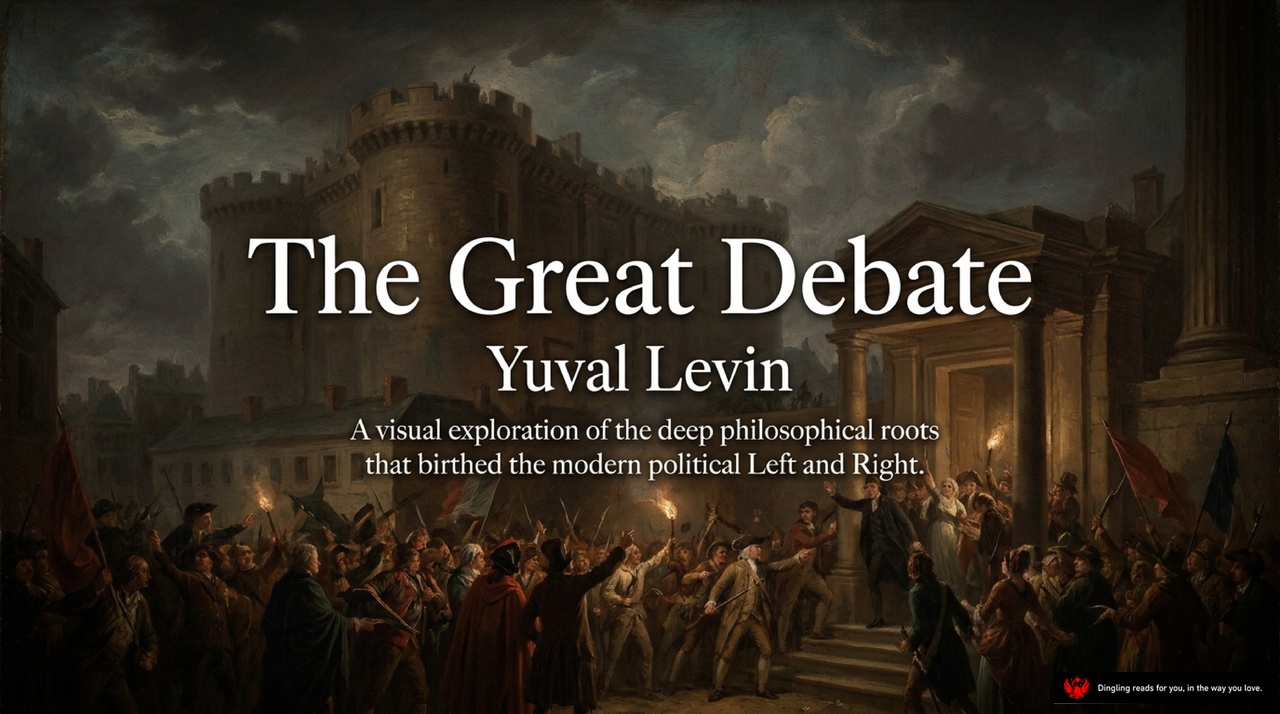
Welcome to today's session on "The Great Debate," a book by Yuval Levin that takes us on a visual journey through the deep philosophical roots of our modern political Left and Right. As we look at this striking image of a revolutionary crowd gathering before a fortress and a classical building, we see the very moment history was made—where opposing ideologies collided to shape the world we live in today.
This book doesn't just list facts; it explores the intellectual battle that defined the 20th century. Imagine two distinct camps emerging from the chaos of the past: one side championing liberty, individual rights, and free markets, while the other argued for collective security, state intervention, and social equality. These weren't just political labels; they were fundamentally different ways of understanding human nature and organizing society.
Levin guides us through the thinkers who built these frameworks, from the Enlightenment philosophers who sparked the revolution to the economists and sociologists who refined the arguments. We'll see how the Left evolved from a focus on justice and community to a more complex vision of the state's role, while the Right developed its own rich tradition emphasizing tradition, hierarchy, and personal responsibility.
The Great Debate wasn't a friendly conversation; it was a struggle for the soul of modern civilization. Every policy we debate today—from healthcare to taxation to environmental regulation—has its roots in this foundational clash. By understanding where these ideas came from, we can better navigate the complexities of our current political landscape.
So, let's dive into the origins of the Left and the Right, and discover how this great intellectual divide continues to shape our world.
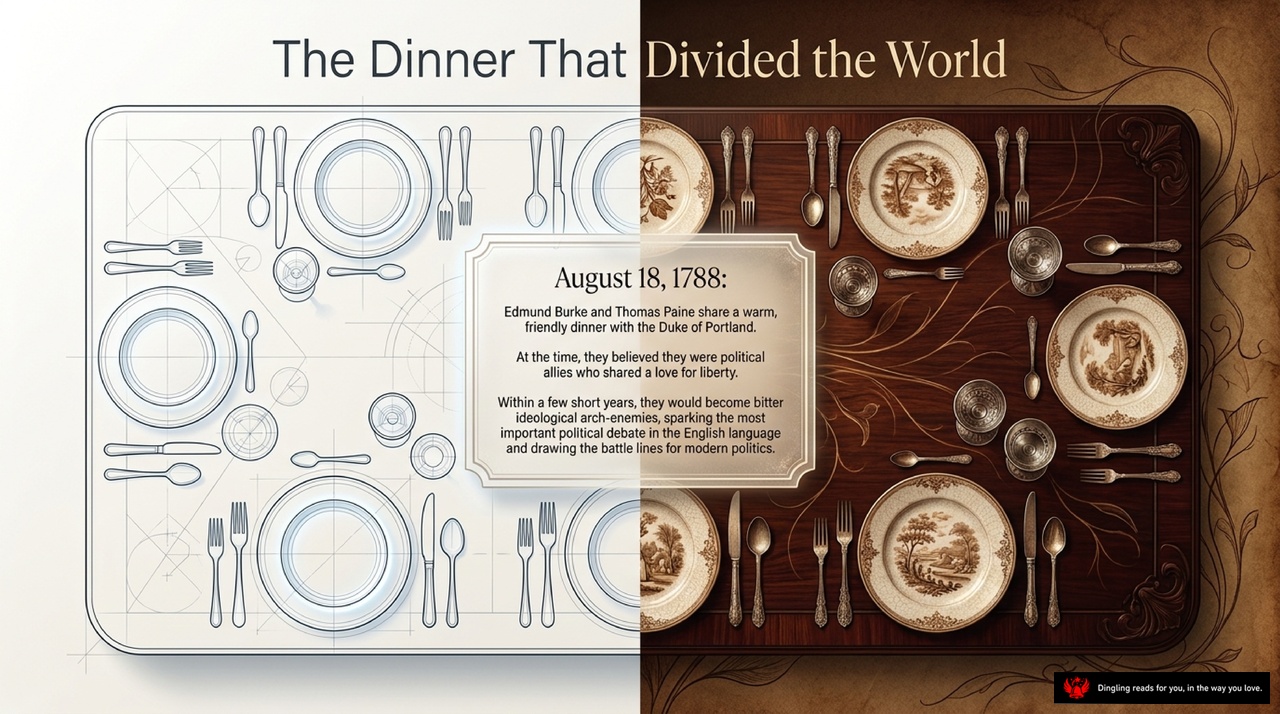
On August 18, 1788, Edmund Burke and Thomas Paine shared a warm, friendly dinner with the Duke of Portland. At that very table, they were political allies who genuinely believed they shared a love for liberty. It was a moment of unity, a single dinner that seemed to bridge their differences. But look at what happened next. Within just a few short years, those same men would become bitter ideological arch-enemies. The dinner didn't just bring them together; it set the stage for the most important political debate in the English language, drawing the battle lines for modern politics that we still see today.
This slide, titled "The Dinner That Divided the World," illustrates a powerful historical truth: the same environment can produce opposite outcomes depending on how people interpret it. Burke and Paine sat at the same table, yet their internal narratives diverged so sharply that one path led to conservatism and the other to radical revolution. This is the essence of reflexivity. It's not about the facts on the table—the food, the company, the date—but about how those facts are perceived and how those perceptions feed back into reality to create entirely different futures. One dinner, two worlds. That is the lesson history teaches us about the fragile line between alliance and enmity.

Welcome back. Today we are diving into the second chapter, where we move from theory to the messy, dynamic reality of actual markets. The core lesson here is that financial markets don't just react to fundamentals; they actively shape them through a process we call reflexivity.
Look at the slide. On the left, we see the stock market. The text highlights a powerful feedback loop between price and the underlying business trend. Traditional economics assumes price is a passive mirror of value, but in reality, it's a two-way street. When stock prices rise, it lowers borrowing costs and boosts a company's brand, which actually improves their real performance. This better performance then pushes the price higher again, creating a self-reinforcing cycle of prosperity. Conversely, falling prices can trigger a spiral of declining confidence and reduced investment, accelerating the downturn.
This is where the concept of "mainstream bias" comes in. When investors collectively believe a certain trend is real, they act on it, effectively creating the reality they feared or hoped for. We see this classic pattern of boom and bust play out in history, from the corporate merger mania of the 1960s to the REITs frenzy of the 1970s. In both cases, a positive bias drove prices up, which fueled further growth and speculation until the math simply couldn't hold anymore, leading to a sharp collapse.
On the right side of our screen, we shift to the foreign exchange market. Unlike stocks, where reflexivity happens in bursts, the forex market is in a constant state of reflexive tension. The slide illustrates how currency values and inflation feed into each other. If a currency strengthens, imports become cheaper, lowering inflation, which makes the currency even more attractive, drawing in more capital and pushing the value higher. But if the cycle turns negative, a weakening currency spikes inflation, driving capital away and causing the currency to crash further.
We see this dynamic clearly in the contrasting eras of the Carter and Reagan administrations. Under Carter, weak dollars and high inflation created a vicious cycle that dragged the economy down. Reagan flipped the script with high interest rates, attracting capital, strengthening the dollar, and suppressing inflation—a virtuous, self-reinforcing loop. However, this stability was fragile, propped up by massive capital inflows and speculative behavior that eventually made the system vulnerable.
So, the takeaway from this chapter is clear: whether in equities or currencies, the market is never static. It is a living system where expectations and reality constantly reshape each other. Understanding these self-reinforcing loops is the key to navigating the inevitable volatility of the financial world.

Philosophy, Not Just Policy.
Look at this iceberg. What we see above the water—taxes, foreign policy, education, welfare—these are the visible clashes of modern politics. They feel like the real battle, but they are merely the tip. The text on the slide is right: these policy fights are not arbitrary; they are just symptoms. The massive, submerged mass driving the entire division is political philosophy.
Most people think politics is just about picking the right policy. But the real divide runs much deeper, hidden beneath the surface. It's about human nature. Do we believe people are fundamentally rational and self-interested, or flawed and needing guidance? It's about the meaning of justice. Is fairness about strict equality, or is it about individual liberty and merit? And perhaps most critically, it's about the role of reason. Do we trust that logic and debate can solve our problems, or do we believe tradition and instinct are the true guides for society?
These deep philosophical differences determine how we view the world, and they inevitably shape our policies. You can't have a lasting political agreement without first agreeing on these foundational truths. Until we acknowledge that our policy wars are actually philosophy wars, we will keep fighting the same battles over and over, never truly resolving the divide.
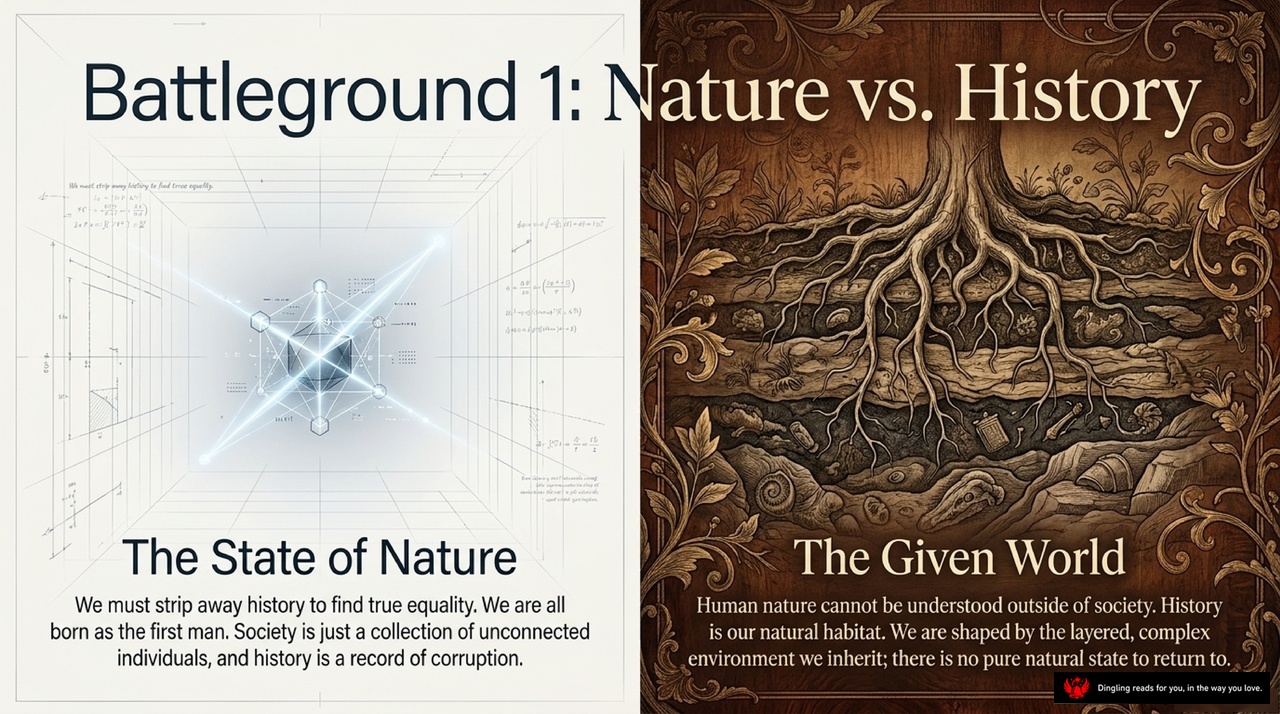
Today's slide sets the stage for the 1980s by contrasting two opposing forces: the rigid, theoretical "State of Nature" and the messy, organic reality of "The Given World." On the left, we see a sterile, geometric structure representing the State of Nature. This is the economist's fantasy—a world where we strip away history to find pure equality, assuming everyone starts as a blank slate with perfect information. It treats society as a collection of unconnected individuals, viewing history merely as corruption that must be removed to reach a stable equilibrium.
But look at the right side. That intricate, dark wood carving depicts The Given World. Here, human nature cannot be understood outside of society. Our roots are tangled deep in the soil of history, shaped by the layered, complex environment we inherit. There is no pure natural state to return to. History isn't just a record of decay; it's our natural habitat. We are formed by the very interactions and biases we create.
This visual clash is the heart of the reflexivity we've been exploring. Traditional equilibrium theory tries to force the market into that left-hand box, assuming prices will naturally find a resting point. But the right-hand image shows the truth: the market is a living, breathing system where our expectations constantly reshape reality, and that changing reality feeds back into our expectations. It's a dynamic, self-reinforcing loop, not a static equation.
As we move forward, this distinction becomes critical. The upcoming chapters will show how this tension played out in the real world—from the chaotic expansion of international debt to the self-destructive cycles of the US banking system. We aren't just observing history; we are seeing the consequences of ignoring the "Given World" and trying to force it into the mold of the "State of Nature." The 1980s didn't follow a predictable script; they followed the chaotic, unpredictable path of human interaction, proving that the market never truly rests in equilibrium.

Look at this split screen: on the left, we see the scales of justice, representing "Abstract Justice"—the idea that universal rights must be implemented immediately, regardless of the cost to the existing system. On the right, we have a lush, organic forest, symbolizing "Social Order." The text argues that true social freedom actually requires order, because demanding pure, abstract justice can destroy the very social harmony and emotional bonds that make human life livable and safe.
This visual contrast captures a core tension we've been exploring: the battle between rigid, theoretical ideals and the messy, necessary reality of human society. In the natural world, represented by the forest, things grow and adapt through complex, living interactions. But in the realm of abstract justice, we often try to impose a perfect, static structure on a dynamic human system.
As we saw in our earlier experiments, trying to force a market or a society into a pre-defined "just" state often backfires. When we ignore the feedback loops—how our actions change the environment, which then changes our behavior—we create instability instead of stability. The forest teaches us that order isn't the opposite of freedom; it's the foundation of it. Without the roots and the ecosystem, there is no life. Similarly, without social order and the trust it builds, the pursuit of pure justice becomes a destructive force, tearing down the very fabric of our communities. True progress comes not from imposing an abstract blueprint, but from understanding how these living systems evolve and finding the balance where justice and order support each other.
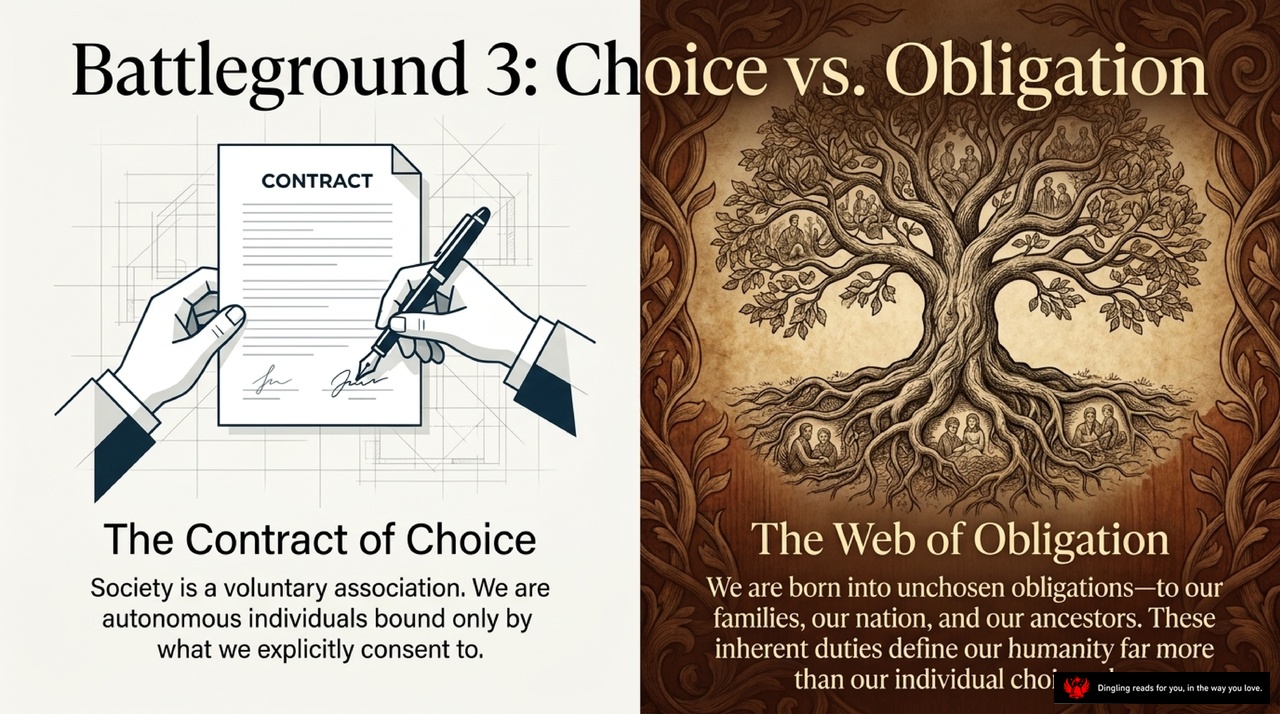
Welcome back to the final chapter of our journey into reflexivity. Today's slide contrasts two powerful forces shaping our world: the "Contract of Choice" and the "Web of Obligation." On the left, we see a simple contract being signed—a symbol of the idea that society is a voluntary association where we are autonomous individuals bound only by what we explicitly consent to. On the right, we see a deep, tangled tree representing the web of obligation, reminding us that we are born into unchosen duties toward our families, nations, and ancestors.
In this final reflection, we confront a profound truth: the search for a perfect, static solution to global finance is an illusion. As we explored throughout this book, from the self-reinforcing cycles of credit to the volatility of currency markets, the root cause of instability lies in the reflexive link between human cognition and reality. Markets are not machines that naturally find equilibrium; they are living systems where our expectations constantly reshape the very environment we are trying to predict.
This brings us to the ultimate lesson of our experiment: the necessity of balance. We cannot rely solely on the "free market" to self-correct, as its inherent instability can lead to catastrophic crashes. Yet, rigid, over-managed systems can stifle innovation and become equally dangerous. The path forward lies not in a perfect, one-time fix, but in a dynamic, adaptive approach. We must recognize that both total freedom and total control are extremes that lead to failure. True stability comes from a flexible balance where regulation acts as a brake, not a cage, intervening only when the system threatens to spiral out of control.
Ultimately, this is a call for humility. We must abandon the fantasy of designing a flawless global financial architecture. Instead, we must embrace the reality of an ever-changing world where our understanding is always incomplete. By acknowledging the limits of our knowledge and the power of reflexive feedback, we can build a system that is resilient enough to withstand the inevitable shocks of the future.

Welcome back to our deep dive into George Soros's theory of reflexivity. Today, we're stepping into the future, looking at the ultimate test of his ideas: the global financial crisis of 1987, known as Black Monday.
This slide sets the stage for a critical chapter. On the left, you see the icon of "Individual Reason"—the glowing brain representing the belief that markets are rational and self-correcting. On the right, the dimly lit library symbolizes "Inherited Wisdom," or the traditional reliance on established rules and historical patterns that many policymakers believed would guarantee stability.
But history was about to prove that neither pure reason nor blind tradition could predict what was coming. The 1987 crash wasn't a random glitch; it was the inevitable result of a system built on fragile assumptions. Following the Plaza Accord, global capital flows became incredibly volatile. Japan tightened its money supply to stop a soaring yen, which sent interest rates skyrocketing and crushed bond prices in the US. Simultaneously, the US dollar was weakening, and political uncertainty was rising. These factors created a perfect storm where the market's own expectations of a crash began to drive the crash itself.
The trigger was a specific, negative signal from a trader named Prechter, which acted as the spark. But the fire was already burning. As the market began to dip, algorithmic trading tools designed to protect portfolios—like portfolio insurance—started selling off stocks automatically. This created a feedback loop: falling prices triggered more selling, which drove prices down further, triggering even more selling. It was a classic reflexivity cycle in action, where the participants' fear and actions destroyed the very equilibrium they thought was safe.
The result was a single day where the Dow Jones plummeted 508 points, wiping out 22% of the market's value. It was a crash comparable to the Great Depression of 1929. However, this time, the outcome was different. While the market collapsed, the broader economy did not spiral into a depression. Why? Because the authorities learned from history. They realized that in a world of reflexivity, the market cannot save itself. When panic set in, the Federal Reserve and central banks around the world stepped in, pumping liquidity into the system to break the feedback loop.
This event taught us a profound lesson: the "Age of Reason" has limits. When the collective psychology of the market turns against reality, the system becomes unstable. But it also showed that understanding this instability allows us to manage it. By recognizing that the market is not a machine that always finds equilibrium, but a dynamic system driven by human perception, we can see that intervention is not just an option—it is a necessity. The 1987 crash didn't end with ruin; it ended with a new era of financial regulation, proving that the balance between market freedom and prudent oversight is the only path to long-term stability.
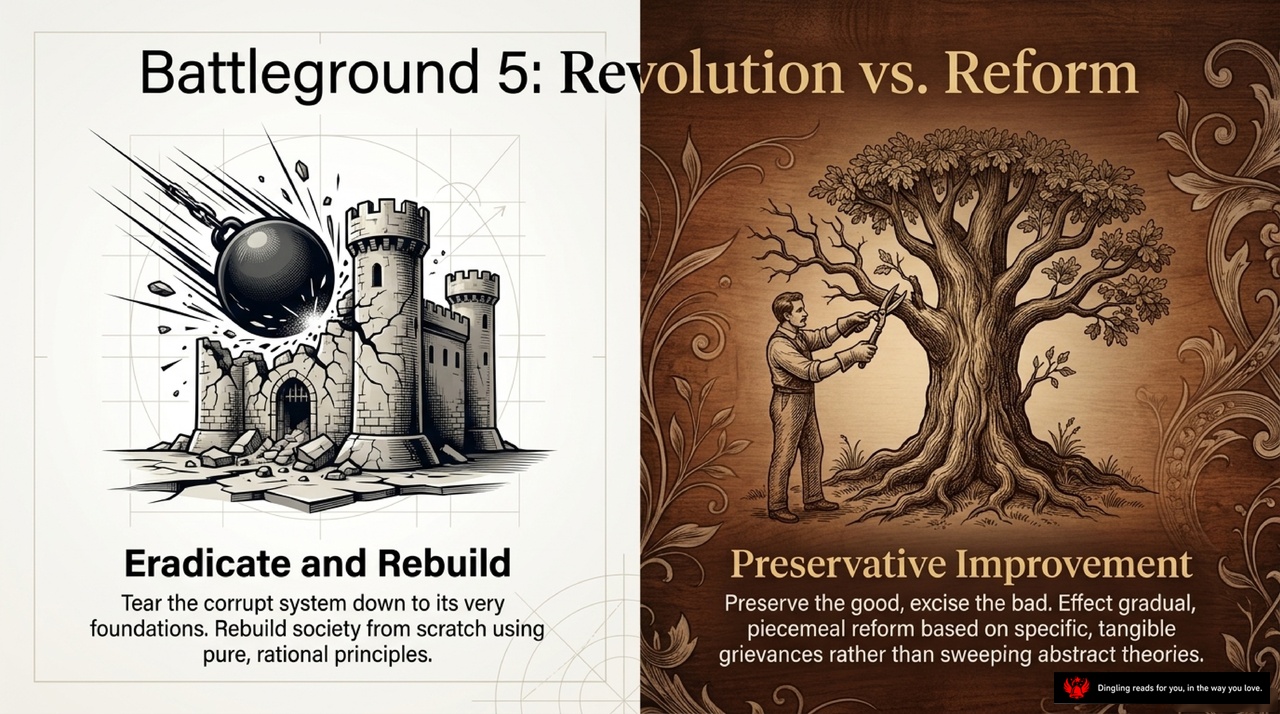
Today's slide, "Battleground 5: Revolution vs. Reform," captures the fundamental tension between two ways of fixing a broken system. On the left, we see "Eradicate and Rebuild." This is the revolutionary approach: tear the corrupt system down to its very foundations and rebuild society from scratch using pure, rational principles. It's like smashing that castle with a massive cannonball—violent, decisive, and aimed at total transformation.
On the right, we have "Preservative Improvement." This is the reformist path: preserve the good, excise the bad, and effect gradual, piecemeal change based on specific, tangible grievances rather than sweeping abstract theories. Imagine a gardener carefully pruning a great oak tree instead of cutting it down to plant a new one.
The core debate here isn't just about tactics; it's about the nature of reality itself. Revolutionary thinkers believe that if we just strip away the errors, a perfect, stable equilibrium will naturally emerge. But reformists argue that the system is too complex and interconnected to be rebuilt from nothing. They believe in working with the grain of history, making small, manageable adjustments that accumulate over time.
As we move forward, keep this dichotomy in mind. Every major crisis in history forces a choice: do we blow up the old structure and hope for the best, or do we tend to the garden, trusting that steady, careful work will eventually yield a healthier future? The next chapters will show us exactly how these two forces played out in the real world, often with devastating consequences when the balance tipped too far in one direction.
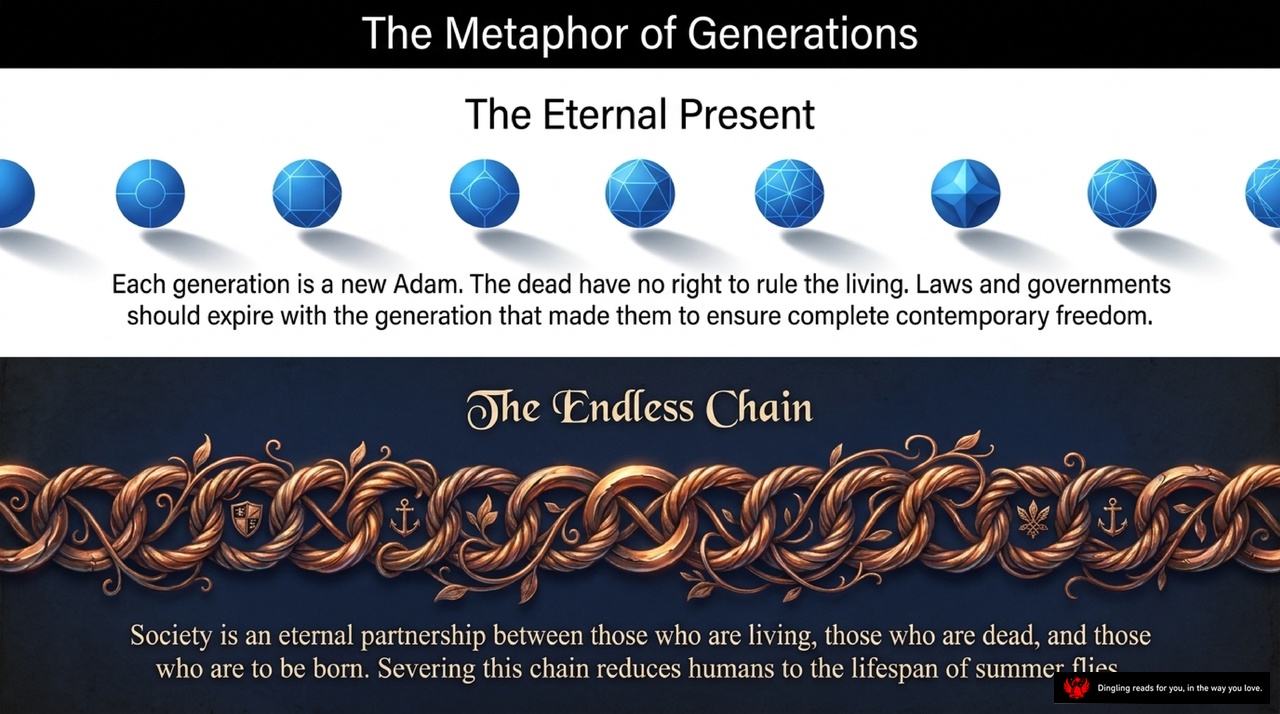
Today's slide presents a powerful duality: "The Eternal Present" versus "The Endless Chain." At the top, we see a series of distinct blue spheres, symbolizing the idea that each generation is a new Adam. The text here argues that the dead have no right to rule the living, and that laws and governments should expire with the generation that created them to ensure complete contemporary freedom. This perspective champions the autonomy of the present moment.
However, look below at the intricate golden chain labeled "The Endless Chain." This visual contrasts sharply with the spheres above. It illustrates society as an eternal partnership between those living, the dead, and those yet to be born. The text warns that severing this chain reduces humans to the lifespan of summer flies. While the top section urges us to break free from the past to embrace total freedom, the bottom section reminds us that our identity and stability are deeply woven into this unbroken lineage. The tension between these two views—freedom through separation and security through connection—forms the core of how we understand our place in time.
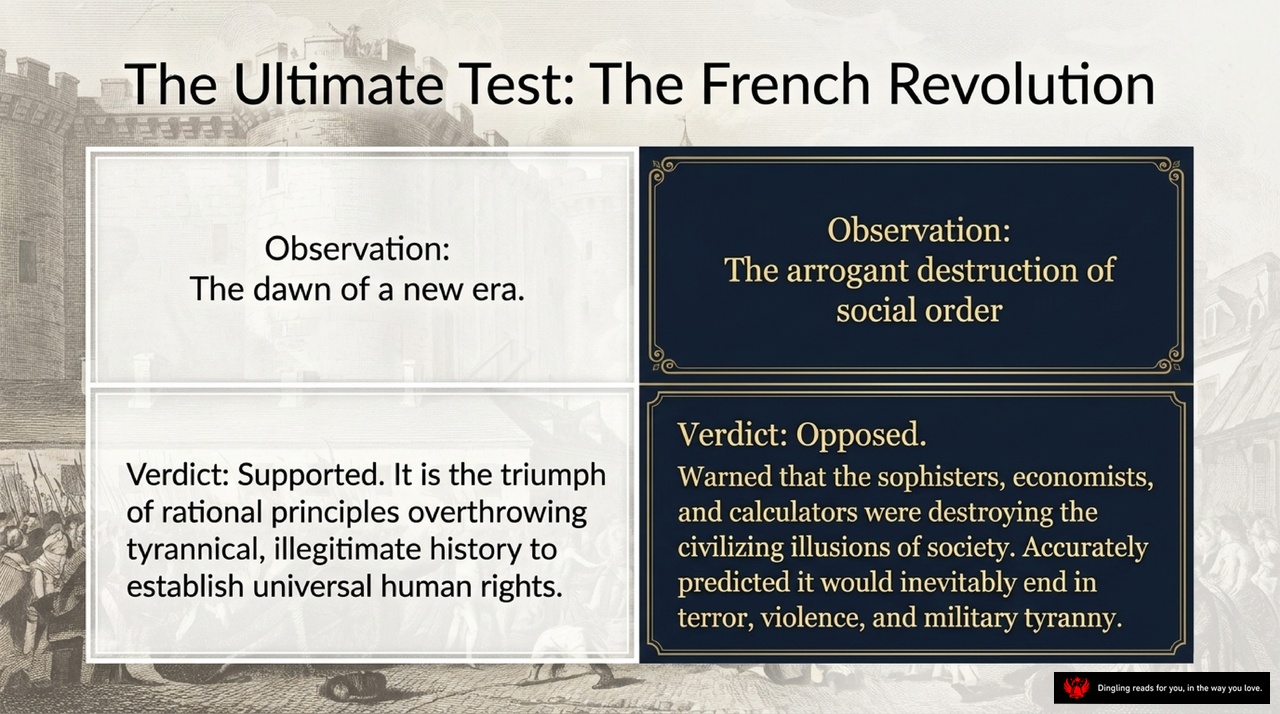
The French Revolution stands as the ultimate test of human ambition, a moment where the world split into two opposing camps. On one side, the revolutionaries saw it as the dawn of a new era—a triumphant victory where rational principles finally overthrew tyrannical history to establish universal human rights. They believed they were building a perfect society based on logic and enlightenment.
But on the other side, a darker verdict emerged. Critics viewed the revolution not as liberation, but as the arrogant destruction of social order. They warned that the so-called "sophists," economists, and calculators were dismantling the very illusions that held civilization together. They accurately predicted that this pursuit of pure reason would inevitably spiral into terror, violence, and military tyranny.
This sharp divide reveals a profound truth about how we interpret history. The same event can be seen as either the greatest triumph of humanity or its greatest catastrophe, depending entirely on the lens through which we view it. It reminds us that our understanding of the past is never just about facts; it is deeply shaped by our own biases and the narratives we choose to believe.

Imagine the world not as a static map of fixed territories, but as a living, breathing entity where our thoughts actively reshape the reality we inhabit. This is the core of reflexivity: the idea that our perception of the market doesn't just reflect the world; it creates it.
Look at this map. On the left, we see the modern lens—the blue, digital network. This represents the American Revolution through Thomas Paine's eyes. He didn't just see a war; he saw a philosophical revolution, a chance to cast off the oppressive history of Europe and build a brand new, rational world order based on universal rights. His vision wasn't passive; it was an active force that helped construct the very nation we see on the map today.
Now, shift your gaze to the right, to the golden magnifying glass. This is Edmund Burke's perspective. He viewed the same events not as a radical break, but as a desperate act of historical preservation. To Burke, the Americans weren't inventing something new; they were defending their traditional, inherited English rights against the sudden, radical, and arrogant innovations pushed by the British Parliament.
These two lenses—Paine's forward-looking optimism and Burke's protective conservatism—didn't just describe the past; they fought over the future. Their conflicting beliefs shaped the political landscape, influencing everything from the Constitution to the culture of liberty that persists today.
This dynamic is the same engine driving financial markets. Just as Paine and Burke used their ideas to alter the course of history, investors use their expectations to alter asset prices. When we believe the market will rise, we buy, pushing prices up and making our belief a reality. When we panic and sell, we crash the market, validating our fear.
The map in the background reminds us that this isn't just about numbers; it's about the human story. Whether it's the founding of a nation or the fluctuation of a stock, history is not a predetermined track. It is a continuous feedback loop where our cognition and the market's reality constantly interact, pushing the world in directions we never fully predicted. That is the power of reflexivity: we are not just observers of history; we are its co-authors.
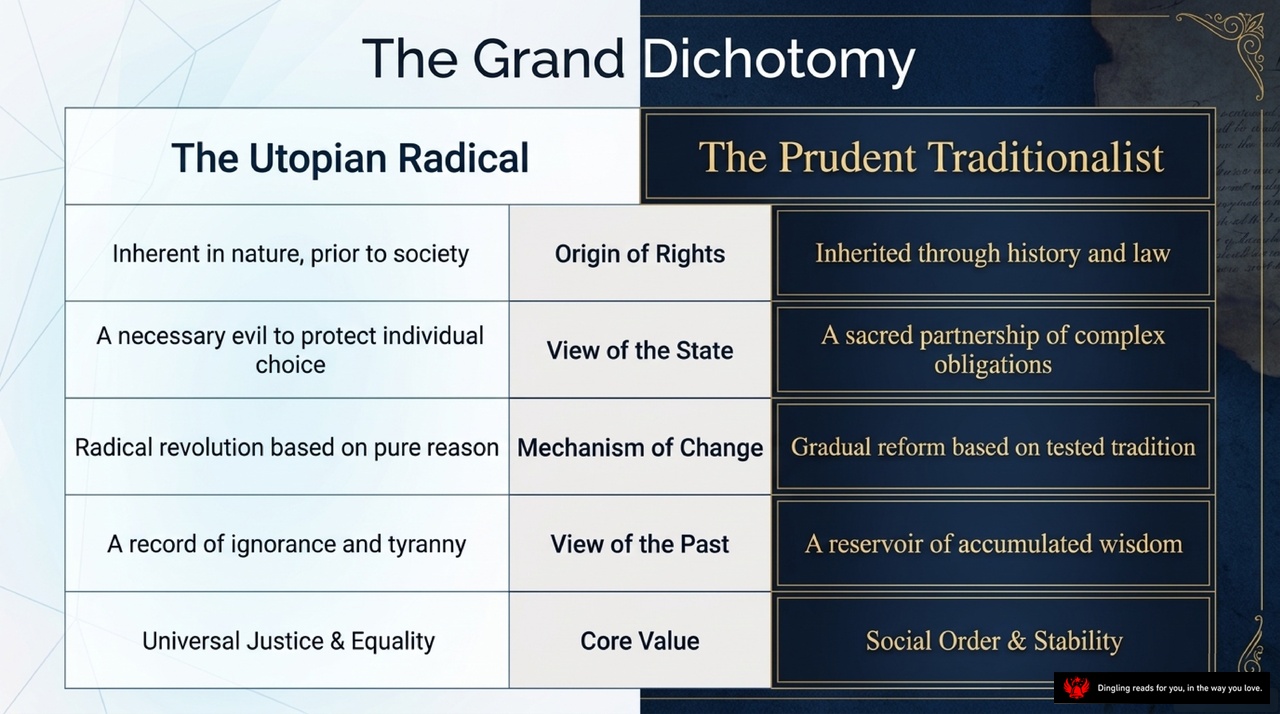
The Great Dichotomy isn't just a philosophical debate; it's the engine driving every major market cycle we've seen, from the 1982 debt crisis to the 1987 crash. On the left, we have the Utopian Radical, who believes in a world of pure reason. They think rights are inherent in nature, the state is just a necessary evil to protect individual choice, and history is merely a record of ignorance. They dream of radical revolutions based on logic, aiming for universal justice and equality.
But look at the right side: The Prudent Traditionalist. This is the mindset that actually keeps the global system from collapsing into chaos. They believe rights aren't created; they are inherited through history and law. They don't see the state as an enemy, but as a sacred partnership filled with complex obligations. Instead of demanding radical change, they advocate for gradual reform based on tested tradition. They view the past not as a failure, but as a reservoir of accumulated wisdom that guides us forward. Their core value isn't abstract equality, but social order and stability.
Why does this matter for your portfolio? Because the market doesn't operate on pure reason. It operates on this tension. When the Utopian Radical takes over—like in the early 80s with high interest rates and deregulation—the system becomes unstable, leading to the debt crisis. When the Prudent Traditionalist steps in, like with the Plaza Accord, they restore balance. Understanding which side is currently dominating helps you anticipate whether we are heading for a boom or a bust. The most successful investors aren't the ones predicting the future perfectly; they are the ones who recognize when the pendulum is swinging too far toward radicalism and know it's time to shift toward prudence.
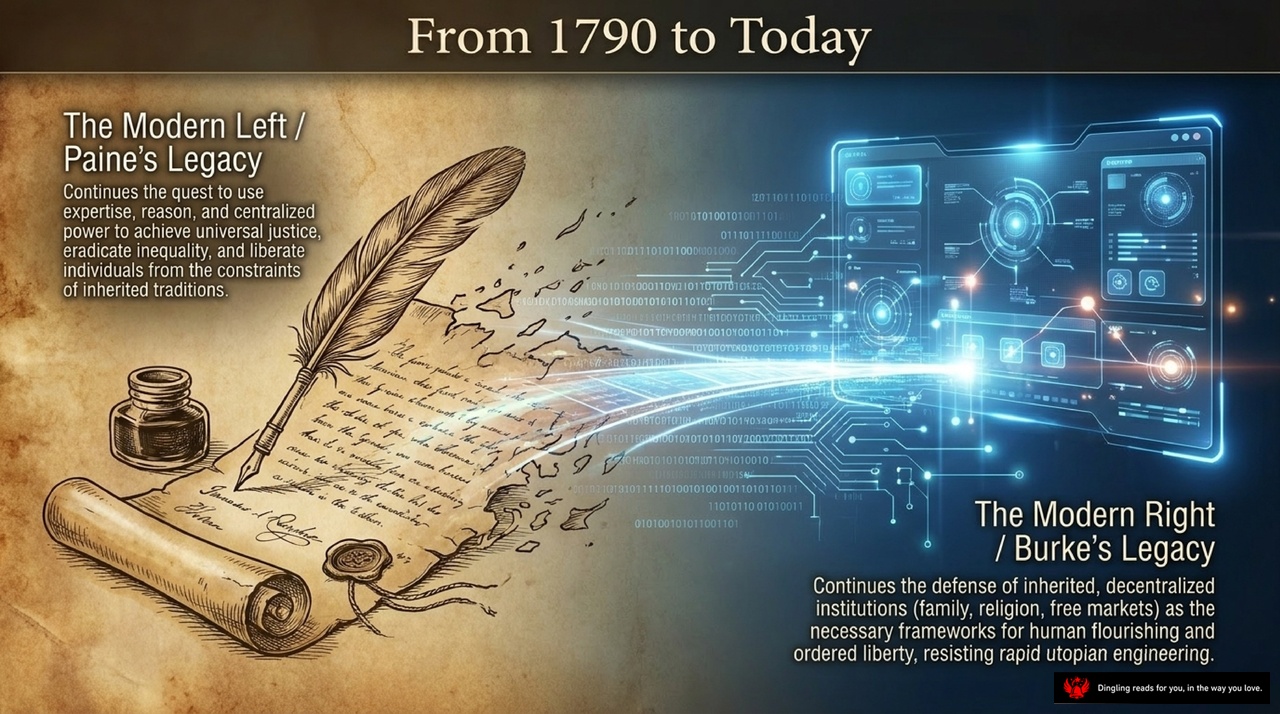
From 1790 to Today, we've witnessed a fundamental divide in how we think about power and progress. On the left, inspired by Thomas Paine, we believe that through reason, expertise, and centralized authority, we can engineer a better world. We use the power of the state to erase inequality and liberate individuals from the heavy chains of tradition. It's the story of the modern left: a quest for universal justice using the tools of the future.
But on the other side, standing firm in the blue light of the digital age, lies the legacy of Edmund Burke. This is the modern right. We argue that true human flourishing doesn't come from top-down engineering, but from protecting the fragile, inherited institutions we already have—family, religion, free markets. We see these not as obstacles to progress, but as the essential frameworks that make liberty possible. Our goal isn't to build a utopia from scratch, but to resist the dangerous urge to rapidly reshape society before we truly understand its complexities.
So, as we move forward, the question isn't just about economics or politics. It's about choosing between the confidence of the engineer who believes they can fix everything, and the wisdom of the guardian who knows that some things are too precious to risk on a single experiment. Which path will define our future?
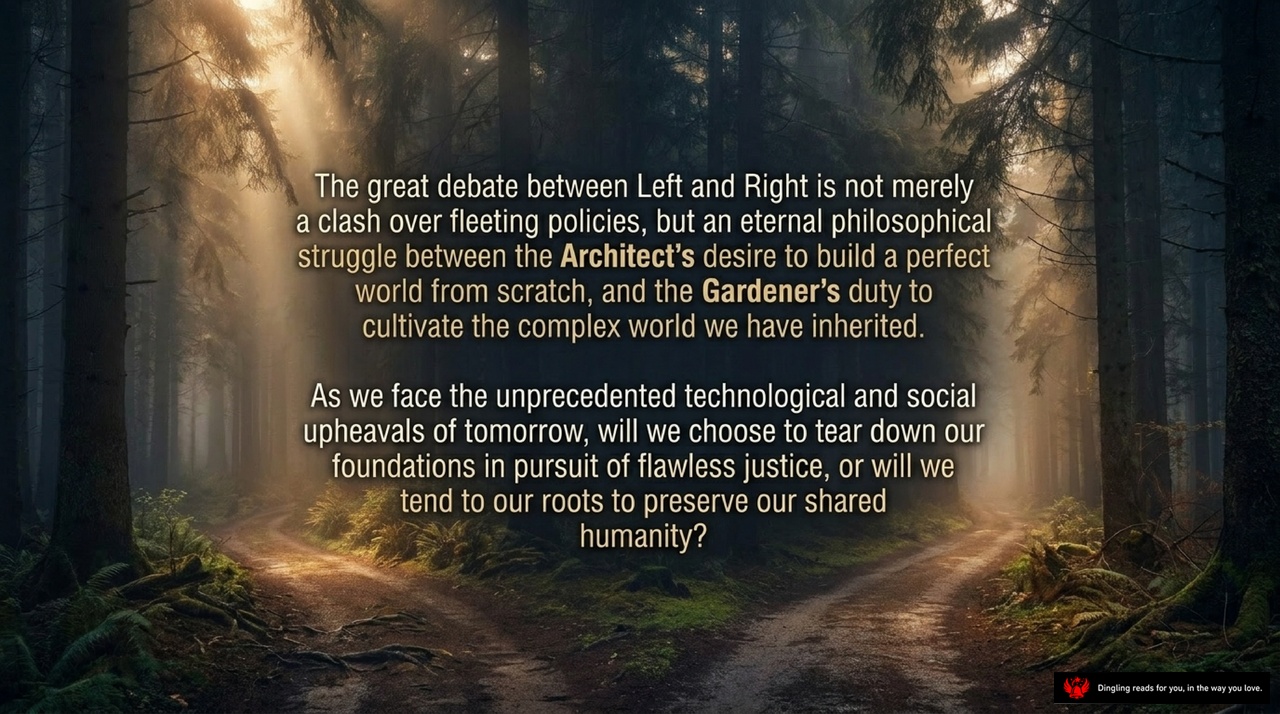
The image before us captures the essence of the Left-Right debate not as a simple policy clash, but as a timeless philosophical struggle between the Architect and the Gardener. The Architect seeks to build a perfect world from scratch, while the Gardener is tasked with cultivating the complex, inherited world we already have. As we face the unprecedented technological and social upheavals of tomorrow, the critical question remains: will we tear down our foundations in pursuit of flawless justice, or will we tend to our roots to preserve our shared humanity? This choice defines our path forward.