
The Almanack of Naval Ravikant: Complete Chapter-by-Chapter Summary

Welcome to the first chapter of our journey into wealth and happiness. Today, we're diving into *The Almanack of Naval Ravikant*, a guide that cuts through the noise to reveal what truly matters.
Imagine a calm ocean at sunrise, stretching out to the horizon. This image sets the tone for what Naval teaches us: life is about finding your own rhythm, not chasing the waves. The book promises a path to both wealth and happiness, but it starts with a hard truth that most people ignore.
Naval makes it clear that making money isn't just about working harder; it's a skill you can learn. Many believe that grinding eighty hours a week in a restaurant will lead to riches, but that's a myth. Real wealth comes from understanding the core logic of value creation. You need to distinguish between money, which is just a tool to exchange time, and actual wealth, which are assets that earn you money while you sleep.
The key to unlocking this potential is to productize yourself. This means leveraging your unique skills, responsibility, and judgment to create something scalable. Whether it's through code, media, or capital, the goal is to stop renting out your time and start owning equity. When you do this, you align your efforts with the laws of the universe, creating value that compounds over time.
So, as we begin this exploration, remember that the goal isn't just to accumulate more, but to build a life where your time is free, and your impact is lasting. Let's explore how to turn these principles into reality.

We often hear society whisper a dangerous lie: that wealth is just a roll of the dice, and happiness is something you're either born with or you're not. This slide challenges that entire narrative. It argues that both wealth and happiness are actually skills you can learn, not genetic lotteries.
On the left, we see the concept of Wealth. The text reminds us that making money isn't about how hard you grind; it's a skill you learn. Society treats wealth as luck, but the truth is, you need to master the core logic of creating assets that earn money while you sleep. It's about finding your unique leverage—whether that's capital, labor, or code—and building something scalable that the world needs but can't find elsewhere.
On the right, we find Happiness. The slide emphasizes that happiness is highly personal and, just like wealth, it is a highly learnable skill. We often chase external validation or material success, thinking that will bring us peace. But the reality is that true happiness comes from an internal state of acceptance. It's about removing the sense of lack and realizing that happiness isn't about being constantly positive, but about finding a deep, quiet contentment with who you are right now.
The core message here is empowering: you have the agency to build a life well-lived. You can learn to generate wealth through smart leverage and responsibility, and you can cultivate happiness by mastering your own mind. Stop waiting for luck to find you, and start learning the skills that create a fulfilling life.
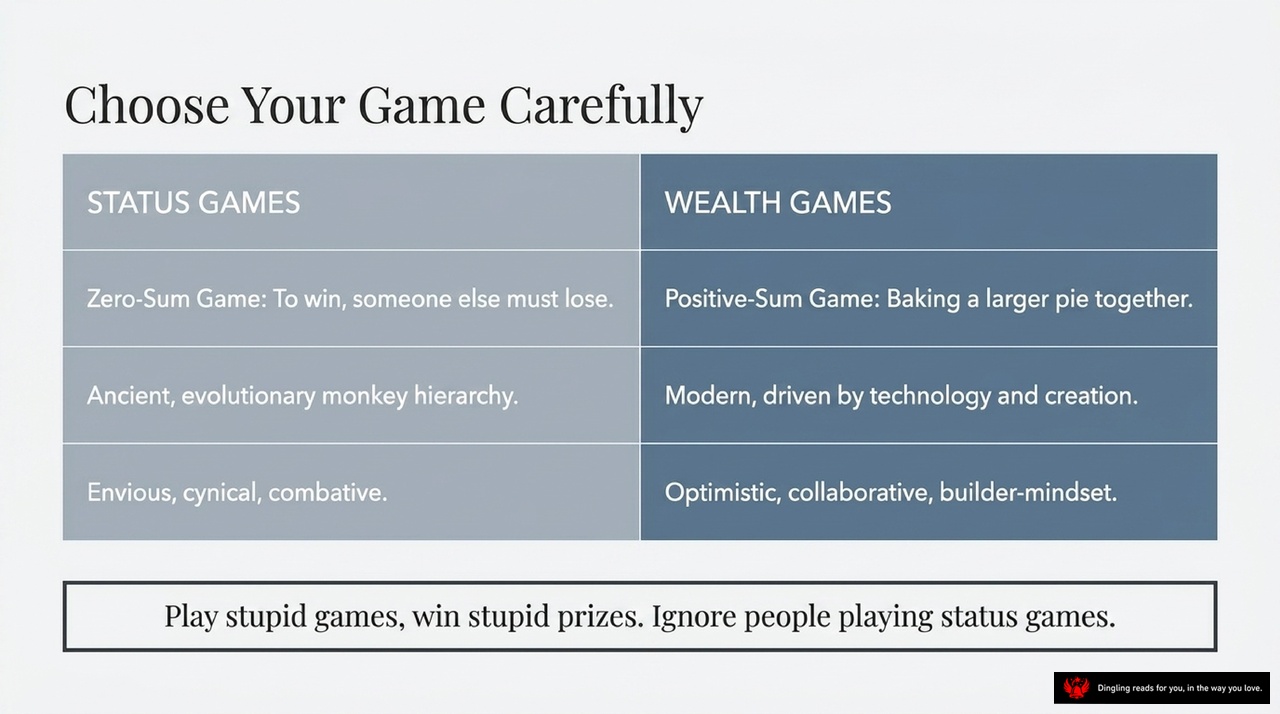
Let's talk about the game you're actually playing right now. Are you stuck in a "Status Game," or are you playing a "Wealth Game"? The slide makes it crystal clear: Status games are zero-sum, ancient, and driven by that old monkey hierarchy where someone else has to lose for you to win. It's envious, cynical, and combative. That's the trap of trying to climb a ladder that's already full.
But on the other side, we have Wealth Games. These are positive-sum games where the goal is baking a larger pie together. They are modern, driven by technology and creation, and fueled by an optimistic, collaborative builder mindset. Here, you aren't fighting for a seat; you're creating value that didn't exist before.
Remember this golden rule at the bottom: if you play stupid games, you only win stupid prizes. So, ignore the people obsessed with status games. Your job is to stop competing for a limited spot and start building something that scales. Choose your game carefully, because the rules of the game determine the quality of your life.

Wealth isn't just about the money in your bank account; it's about building assets that work for you while you sleep. As the slide perfectly illustrates, true wealth is a formula: Specific Knowledge plus Accountability plus Leverage.
First, let's talk about Specific Knowledge. This is the kind of expertise that society simply cannot train you to have. If you learn something on the job that anyone else can pick up in a few weeks, you're replaceable. Real wealth comes from skills that are deeply personal—things you've practiced for years, often out of pure passion, that make it effortless for you but incredibly difficult for everyone else. Think of it as your unique superpower.
Next is Accountability. This is the willingness to take business risks under your own name. Society rewards this responsibility with equity. Unlike a high-paying job where you trade time for money and stop earning when you stop working, owning equity means you own a piece of the pie. You're no longer just an employee; you're an owner.
Finally, there's Leverage. This is the multiplier of your effort. While capital and labor are traditional forms of leverage, the most powerful modern lever is code and media. Unlike hiring people or raising money, which require permission from others, code and media can scale infinitely without your constant input. A podcast you record once can generate revenue for years; a piece of software you write can serve millions of users instantly.
When you combine these three elements—your unique, untrainable knowledge, the courage to take ownership, and the power of scalable leverage—you create a system that generates wealth independently of your time. That is how you get rich without getting lucky.

The New Aristocracy of Leverage isn't just a catchy title; it's the blueprint for how wealth actually gets created in the modern world. Look at this pyramid. At the bottom, we have Labor. This is the old model: other humans working for you. It's messy, ancient, and requires constant permission—you have to convince people to follow you. Move up one level to Capital. Money working for you is powerful, but it still needs permission. Someone has to trust you enough to give you funds.
But here is the game-changer. The dashed line you see in the middle? That is The Permission Barrier. Above it lies the true wealth of the new billionaires: Code and Media. These are products with zero marginal cost of reproduction. Think about it. You write a line of code or record a podcast episode, and then you can sleep. While you're dreaming, that asset is still working for you, scaling infinitely without needing anyone's permission or approval.
This is the difference between renting out your time, which has a hard ceiling, and owning equity in a leveraged asset that never sleeps. The old aristocracy built their power on land and labor; the new aristocracy builds theirs on code and media. It's the ultimate equalizer, turning a single person's effort into a global asset.

So, we've spent a lot of time talking about building wealth through leverage, equity, and taking responsibility. But before we close, we need to ask the ultimate question: What are we actually building this for? The slide you see here breaks it down into a simple rule for finding your unique edge. On the left, under "Look For," it highlights the sweet spot: things that feel like play to you but look like hard work to everyone else. It's knowledge found at the very edge of what we know, deeply linked to your genuine obsessions. On the right, under "Avoid," it warns us to steer clear of hot trends, college majors that anyone can get, and skills that can be taught in a standardized corporate manual. If society can easily train someone else to do what you do, you're replaceable. The core message at the bottom is powerful: escape competition through authenticity. No one can compete with you on being you. Your unique combination of curiosity and obsession is your uncopyable asset.

In the modern economy, we are often told that wealth comes from grinding harder, working longer hours, or chasing the latest trends. But as this slide illustrates, that linear approach to "hard work without leverage" yields diminishing returns. The real game-changer is shifting from trading time to trading judgment.
Look at that curve labeled "Exponential Output." It represents the formula of High Judgment multiplied by High Leverage. In an age of infinite leverage—where code, media, and capital can amplify your impact—a single correct decision can create $100 million in value. Direction matters infinitely more than speed. As the quote on the right reminds us, if you have high leverage, your judgment is far more important than how hard you work.
So, how do we apply this? The actionable advice here is simple but powerful: set an aspirational hourly rate for your time, say $5,000 an hour. Then, use that number as a filter. If solving a problem costs less than your rate, outsource it or ignore it entirely. Don't waste your most valuable asset—your attention—on low-value tasks. Instead, focus your mental energy on the 1% of decisions that truly move the needle. When you combine this ruthless prioritization with the right leverage, you stop selling your time and start multiplying your value.

So, here is the reality check: happiness isn't that high-energy rush we call euphoria. It's not the spike of getting what you want. True happiness is actually peace.
Look at this visual. On the left, we have a chaotic mess of noise and desires—everything society tells you to chase. But the goal isn't to feed that noise. The goal is to filter it out, like this funnel, until you're left with just one solid circle: peace and simplicity.
Society tricks us into thinking happiness is about filling a void. But the truth is, happiness is what remains when you remove the feeling that something is missing from your life. When your mind stops projecting into the future or regretting the past, you finally find peace right here in the present. It's not about doing more; it's about stopping the noise so you can hear the quiet.
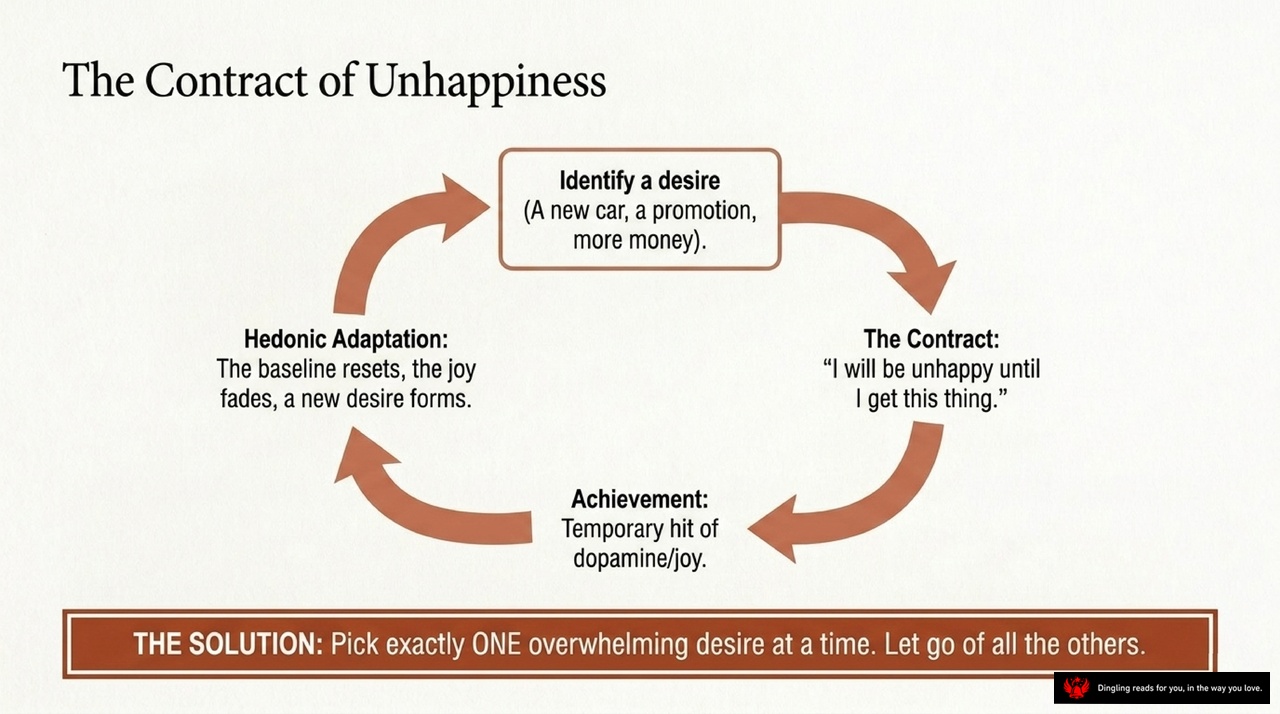
Have you ever felt like you're stuck in a never-ending cycle of wanting something new? Maybe it's that new car, that dream promotion, or just more money. You tell yourself, "I won't be happy until I get this." But here's the hard truth: once you get it, the joy fades almost immediately. This is what the slide calls "Hedonic Adaptation"—your baseline resets, and suddenly, you're chasing the next thing again.
This is the "Contract of Unhappiness." We make a deal with ourselves: we promise to be miserable until we achieve our latest desire. We identify a goal, feel a temporary rush of dopamine when we hit it, and then the cycle starts all over again. It's a trap that keeps us running on the treadmill of life without ever actually arriving.
But there is a way out. The slide offers a simple, powerful solution: Pick exactly ONE overwhelming desire at a time. And then, let go of all the others. It sounds counterintuitive in a world that tells us to want everything, but true fulfillment comes from focusing your energy on one thing, rather than diluting it across a dozen fleeting cravings. By breaking this contract, you stop the endless chase and start living in the present.

Let's talk about the ultimate goal of life, and look at the Venn diagram on your screen. We often think we need to balance time, health, and wealth perfectly to win. But the reality is much starker. Look at the three circles: Youth has time but lacks wealth; Middle Age has wealth but lacks time; Old Age has neither time nor health. Each phase sacrifices something vital for the next. The only true "Ultimate Winner" is the small intersection in the center—where you possess Time, Health, and Wealth simultaneously.
Naval calls this state "retirement," and he offers a powerful definition that changes everything: "Retirement is when you stop sacrificing today for an imaginary tomorrow." Most of us are living in the past, saving money we don't need to buy a future we might not even want. But true freedom isn't about waiting for age 65 or hitting a specific bank balance. It's about having the capacity to live fully right now. You can achieve this by earning enough passive income to cover your lifestyle, scaling your expenses down to zero, or simply doing work you love so much that money becomes a byproduct. The key is realizing that life is a single-player game. Once you stop competing for status and start building a life where you have the time to enjoy it, the health to experience it, and the wealth to support it, you've already won.

Have you ever felt stuck in a situation, wanting to change it but unable to, wanting to leave but staying, or simply refusing to accept what is? This is where most of our suffering actually comes from. Today, I want to share a simple framework for navigating any scenario you face: the three choices.
When you encounter a situation, you have exactly three paths. First, you can choose to change it. This is driven by desire, but be warned: it often brings temporary suffering until you achieve what you want. Second, you can choose to leave it. This means walking away and removing the situation entirely from your life. And third, you can choose to accept it. This doesn't mean giving up; it means embracing reality as it is, without judgment.
Look at the diagram here. It clearly shows that our pain usually stems from being stuck in the middle—wanting to change but not doing it, wanting to leave but staying, or refusing to accept the truth. True freedom comes from making a conscious choice among these three. Do you fight against reality, or do you align with it? The moment you stop resisting and start accepting, you reclaim your power. So next time you feel overwhelmed, ask yourself: which of these three choices am I making right now?

Happiness isn't a lucky break; it's a choice you make every single day. Think of it less like a destination and more like a skill you actively practice. We often chase happiness by trying to fix the outside world—getting that new car, landing the perfect job, or winning the argument. But true peace comes from within, from the ability to simply accept reality as it is.
To build this, we need to flip a few switches in our daily lives. First, turn on **Meditation**. It's not about emptying your mind; it's about fasting from thoughts. Imagine clearing the inbox of your brain until you reach a state of zero unread emails. When you stop fighting your internal noise, you create space for clarity.
Next, switch on **Reading**. This is the ultimate meta-skill. Don't read to check boxes; read what you love until you fall in love with the act of reading itself. It builds the mental muscle you need to understand complex truths.
Then, prioritize **Health First**. Remember the hierarchy: Health comes before Happiness, and Happiness comes before Wealth. If you sacrifice your body for money, you've already lost the game. Embrace the "hard mode"—exercise, cold showers, and tough habits. Paradoxically, making life difficult in the short term makes it infinitely easier in the long run.
Finally, and perhaps most importantly, turn on the switch to **Cut the 'Shoulds'**. Society is full of guilt-driven expectations telling you what you *ought* to do. Strip those away. Stop trying to be who the world wants you to be and start living as your authentic self. When you stop performing for others, the weight lifts, and that is when real freedom—and real happiness—begins.
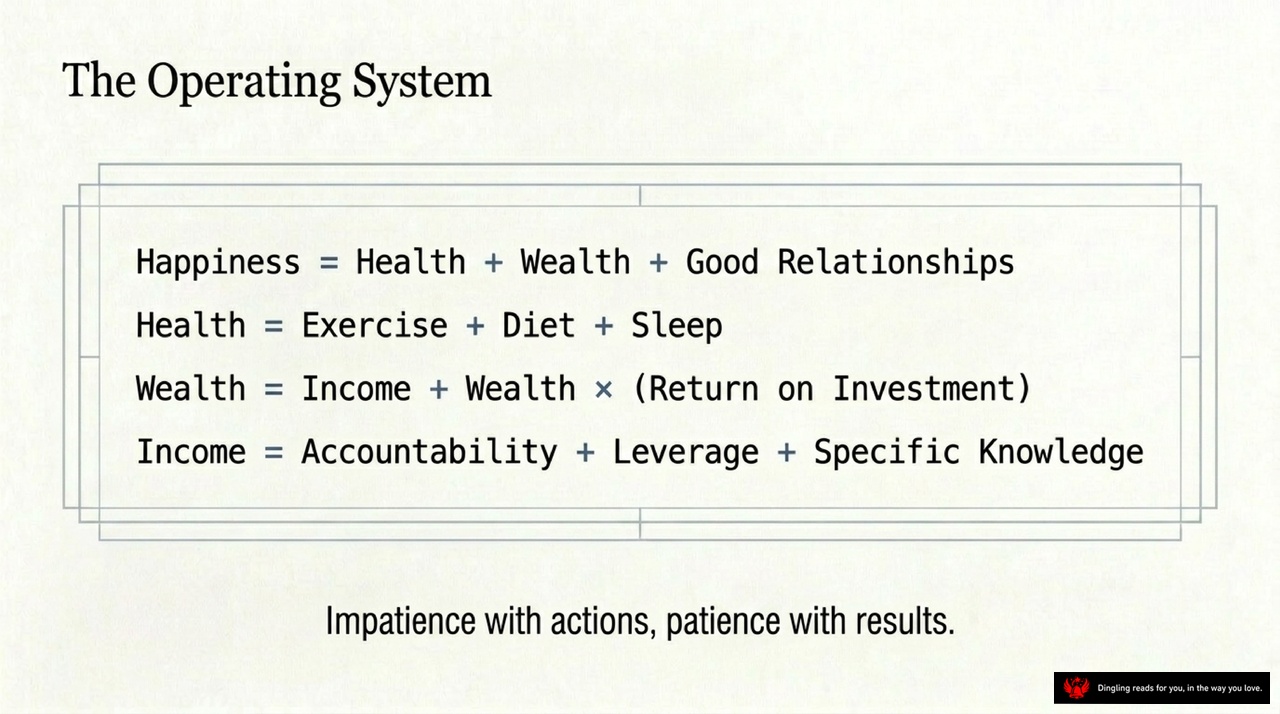
Look at this slide titled "The Operating System." It breaks down the complex equation of a good life into four simple layers. At the top, we see that Happiness isn't just a feeling; it's the sum of Health, Wealth, and Good Relationships. To get there, you need to build your personal operating system correctly.
First, look at Health. It's not magic; it's just Exercise plus Diet plus Sleep. If you skip any of these, your foundation crumbles. Next is Wealth. The slide makes a crucial distinction: Wealth isn't just cash in your pocket; it's Income combined with Wealth multiplied by Return on Investment. This means you need assets that work for you while you sleep, not just a paycheck.
But where does Income come from? The slide reveals the secret: Accountability plus Leverage plus Specific Knowledge. Most people fail because they rely only on their time. To truly succeed, you must find a unique skill that is hard to teach, take full responsibility for the outcome, and then use leverage—like code or media—to scale your impact without scaling your hours.
Finally, don't forget the bottom line: "Impatience with actions, patience with results." You can do the right things today, but the wealth and happiness you see on this slide will only materialize if you stay consistent. Build this system, trust the process, and let the results follow.

Imagine a world where reality is completely neutral, like the calm ocean behind us. Happiness isn't something you find out there; it's entirely a choice you make right here, right now. But if that's true, why are we still signing a contract with unhappiness every single day?
The slide asks a hard question: "If reality is completely neutral and happiness is entirely a choice, what contract of unhappiness are you still choosing to sign today?"
The answer lies in how we live. We often chase wealth by trying to control the world, constantly comparing ourselves to others, and letting our desires dictate our peace. But true wealth is built by leveraging your unique, specific knowledge—something no one else can replicate. True happiness, however, comes from stripping away those endless desires to discover peace in the present moment.
Remember, you have only one life. No one else can play your game better than you. The moment you stop fighting reality and start accepting it, the mental noise fades away. You stop waiting for the future to bring you joy, and you realize that the power to be happy was in your hands all along. So, today, tear up that contract of unhappiness. Choose the peace that is already available, and play your own game with freedom.