
The Apology of Socrates: Complete Chapter-by-Chapter Summary

Welcome to our journey into the heart of philosophy with Plato's *The Apology of Socrates*. This isn't just a courtroom defense; it is the definitive stand for the very pursuit of truth. As the title suggests, we are witnessing one man's ultimate choice: to face death rather than compromise the search for virtue.
Translated and annotated by Wu Fei, this text captures a pivotal moment where an ordinary Athenian man refuses to play by the rules of survival. Instead of begging for mercy or using slick rhetoric to win his case, Socrates transforms his trial into a public lecture for the entire city. He challenges the jury, not to flatter them, but to wake them up to the dangers of unexamined lives. In a world obsessed with winning arguments and accumulating wealth, Socrates reminds us that a life without truth is not worth living. His courage to speak the hard truth, even at the cost of his life, sets the standard for what it truly means to be a free and moral human being.
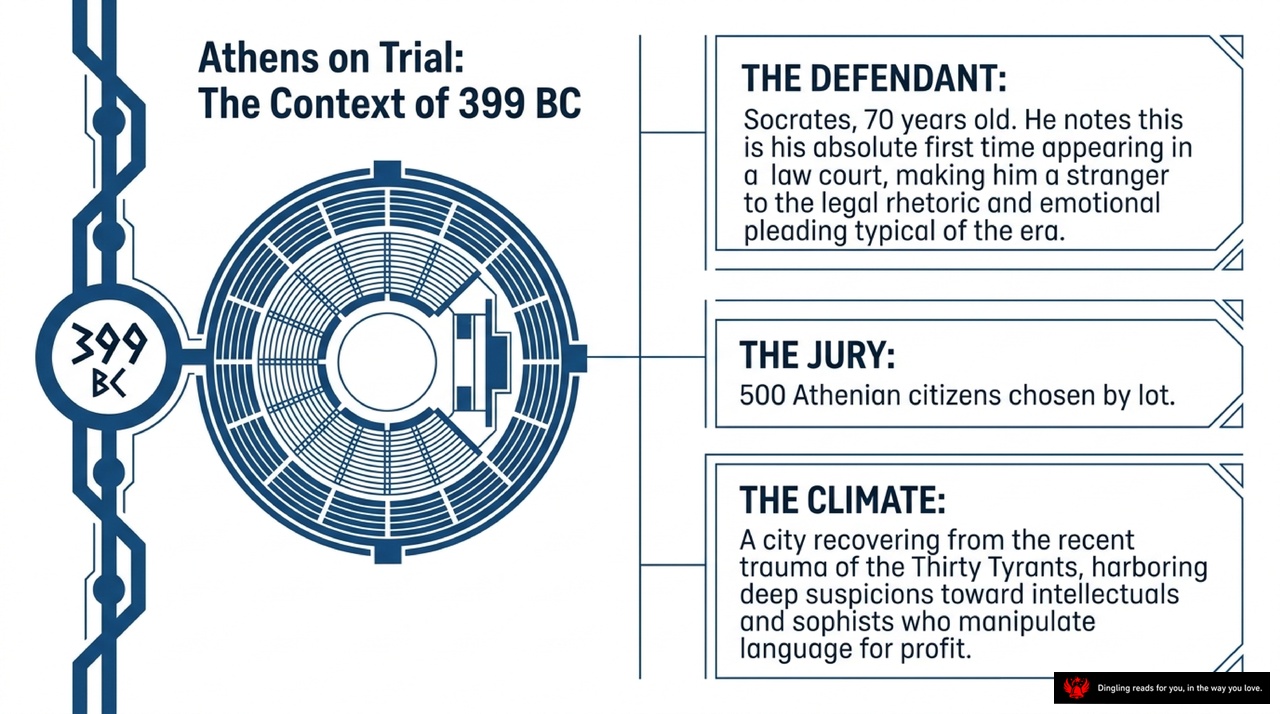
Imagine stepping into an ancient Athenian courtroom in 399 BC. The air is thick with tension, not just from the legal stakes, but from a city still healing from the trauma of the Thirty Tyrants. Suspicion runs deep here, especially toward intellectuals who are seen as manipulators of language for profit. Today, we stand at the center of that storm: Socrates, seventy years old, facing his first trial. He is a stranger to the courtroom's emotional rhetoric, while his jury consists of 500 citizens chosen entirely by lot.
But look at the atmosphere surrounding this trial. Athens is a city recovering from deep wounds, harboring a fierce distrust of anyone who challenges its norms or speaks with a foreign accent. Socrates, with his mysterious "daimonion"—that private, inner voice that guided him away from error—is viewed not as a sage, but as an outsider. To the Athenians, his private spiritual guide feels like an intrusion, a sign of impiety that clashes with their public, communal understanding of the gods.
The prosecution has already painted him as a dangerous sophist, a man who twists the weak into the strong and corrupts the youth. They've used the mocking imagery of Aristophanes' play *The Clouds* to cement this image in the public mind: Socrates as a detached natural philosopher, floating in a basket among the clouds, ignoring the real world. Yet, the truth is far more grounded. Socrates never studied nature; he turned inward, focusing on the human soul and the question of what makes a life worth living.
This trial isn't just about a man's life; it's a clash of two worldviews. On one side, a city desperate for stability and traditional authority. On the other, a philosopher who believes that a life without self-examination is not worth living at all. Socrates refuses to play the game of flattery or emotional manipulation. Instead, he stands firm, ready to dismantle the very foundations of the accusations against him, proving that the greatest danger to Athens isn't a few skeptical questions, but a soul that has forgotten how to think for itself.

Let's break down the anatomy of the indictment against Socrates, specifically looking at how the "Old Accusers" evolved into the "New Accusers." On your screen, you see a clear split between the dangerous rumors that fueled the hatred and the formal charges brought to court.
On the left, we have the "Old Accusers." These weren't official charges, but decades of public slander that had already poisoned the public's mind. As the slide notes, these rumors were popularized by Aristophanes' comedic play, *The Clouds*. In that play, Socrates was depicted as a nature philosopher studying the sky and earth, and a sophist who could make the weaker argument appear stronger. This imagery stuck. It implicitly associated Socrates with atheism and deceit in the minds of the jurors, many of whom grew up hearing these stories. It created a deep-seated bias before the trial even began.
On the right, we see the "New Accusers," or the formal charges. Here, the rhetoric sharpened into legal specifics. The prosecutors were Meletus, Anytus, and Lycon, each targeting different groups like poets and craftsmen. The core legal charge was twofold: corrupting the youth and refusing to recognize the gods of the city by introducing new, unauthorized spiritual beings.
The critical link here is how the old rumors shaped the new charges. Because the public had already been conditioned to view Socrates as a dangerous, unnatural figure who twisted logic and rejected tradition, the formal charges of corrupting the youth and introducing new gods felt less like legal accusations and more like the logical conclusion of the slander they had absorbed. The "Old Accusers" created the atmosphere where the "New Accusers" could successfully convict him, proving that in a democracy, reputation can often be as powerful as the law itself.
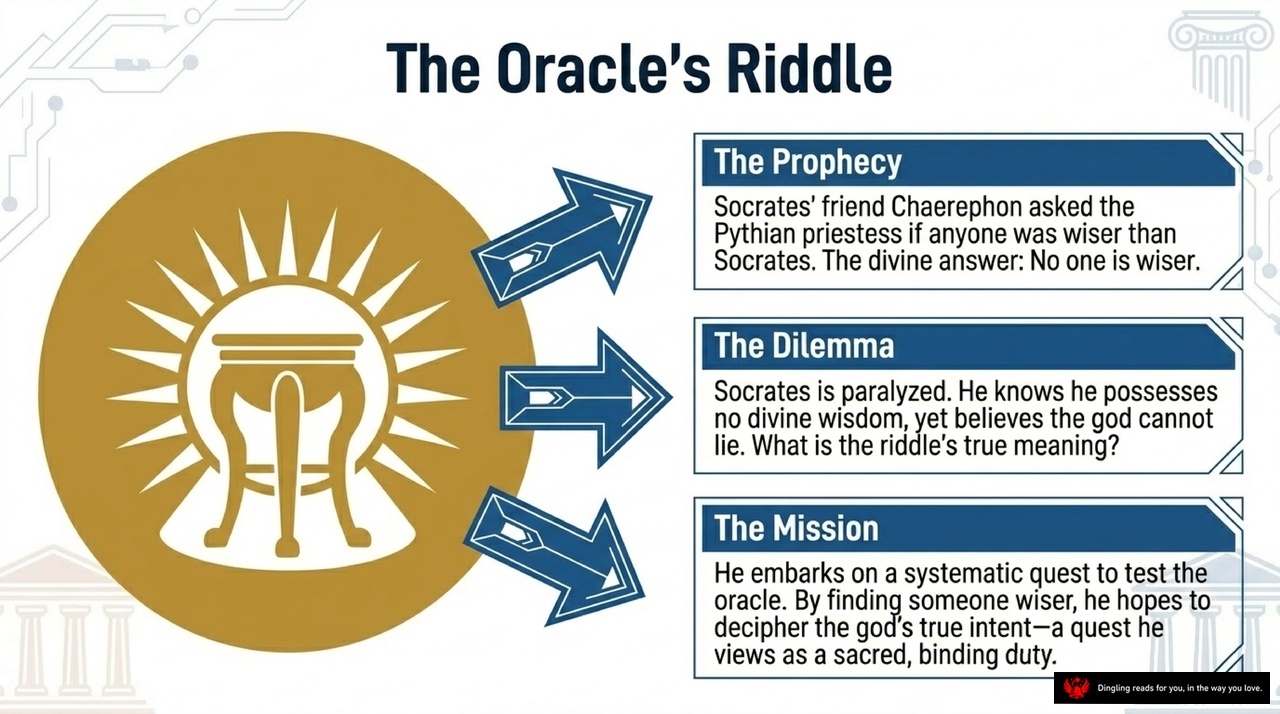
Welcome to the third slide, where we dive into the very beginning of Socrates' story: The Oracle's Riddle. This golden image represents the Delphic Oracle, the source of the mystery that would define Socrates' life.
It all starts with a prophecy. Socrates' friend Chaerephon asked the Pythian priestess if anyone was wiser than Socrates. The divine answer was shocking: No one is wiser. But this created a massive dilemma for Socrates. He knew he possessed no divine wisdom, yet he believed the god could not lie. What was the riddle's true meaning? Was he the wisest, or was the oracle playing a cruel joke on him?
To solve this, he embarked on a systematic quest to test the oracle. By finding someone wiser, he hoped to decipher the god's true intent. He viewed this not just as a personal puzzle, but as a sacred, binding duty. He traveled around Athens, questioning politicians, poets, and craftsmen, only to discover that they were all ignorant of their own ignorance, while he alone knew how little he knew.
In the end, Socrates realized the oracle's riddle was a profound truth: wisdom begins with the recognition of one's own ignorance. This realization launched his lifelong mission to examine lives and guide others toward virtue, turning a divine riddle into a practical philosophy for every citizen.
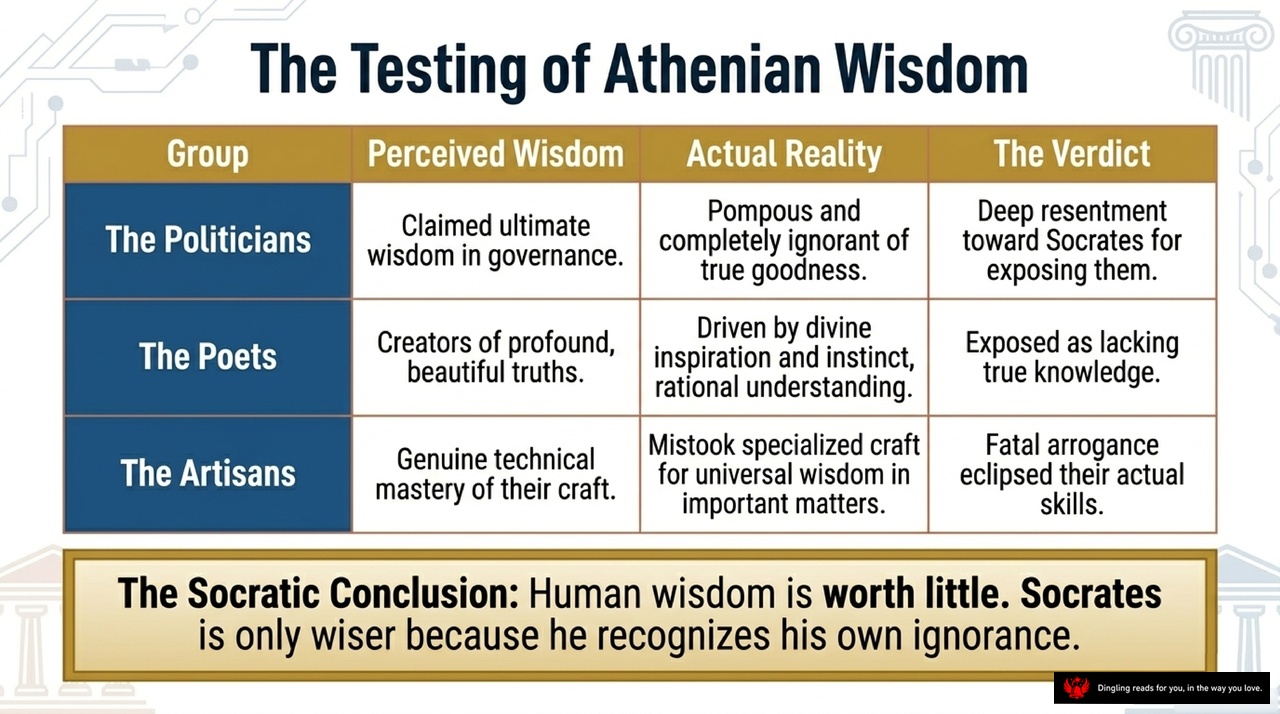
Look at this table, "The Testing of Athenian Wisdom." It captures the brutal conclusion of Socrates' investigation into who actually holds wisdom in Athens. The slide breaks down three powerful groups: the politicians, the poets, and the artisans. On the surface, they all claimed ultimate wisdom. The politicians thought they ruled with supreme insight, the poets believed they channel profound truths, and the artisans trusted their technical mastery as universal knowledge.
But Socrates' reality check was harsh. He found that the politicians were actually pompous and ignorant of true goodness, which led to deep resentment against him for exposing them. The poets were revealed as lacking true knowledge, driven only by divine inspiration and instinct rather than rational understanding. And the artisans? Their fatal arrogance eclipsed their actual skills; they mistook specialized craft for wisdom in the most important matters of life.
The verdict on the slide is clear: human wisdom, as these groups practiced it, is worth little. Socrates concludes that he is the only one truly wise simply because he recognizes his own ignorance. This moment wasn't just about a trial; it was a public dismantling of the city's illusions, proving that without self-knowledge, no amount of power, poetry, or skill constitutes true wisdom.

Look at this flowchart. It maps out a brilliant logical trap Socrates set for Meletus. Let's break down how this cross-examination works.
First, Meletus claims Socrates is a complete atheist who believes in no gods at all. That is Node 1. But the official indictment actually accuses Socrates of introducing new spiritual beings or demigods. That is Node 2. Socrates immediately spots the contradiction here.
He sets up the trap in Node 3. His logic is simple but powerful: you cannot believe in spiritual activities without first believing in spirits. And logically, you cannot believe in spirits without believing in the gods who created them. You can't have the children without the parents.
This leads to the reveal in Node 4. If Socrates is accused of teaching new spirits, he must necessarily believe in gods. So, how can he be an atheist? He cannot.
The final result is the contradiction at the bottom. Socrates cannot simultaneously be an absolute atheist and a teacher of new divine spirits. By forcing Meletus into this logical corner, Socrates exposes the charges as a complete mockery. He proves that the accusation is internally inconsistent, making it impossible for Meletus to win on this point.

Today's slide explores one of the most powerful metaphors in history: the Gadfly. Picture this: Athens is a magnificent, well-bred horse, strong and powerful, but over time, it has grown sluggish and sleepy. It's comfortable in its own size, drifting through life without questioning its direction or its morals.
Enter Socrates. He wasn't just a random visitor; he was deliberately placed there by the gods. His role? To be a gadfly. Just like a real fly that stings a horse to wake it up and make it run, Socrates was meant to sting the city. He didn't want Athens to sleep; he wanted to provoke it, awaken it, and force it out of its moral complacency.
Here is the core insight that changes everything: philosophical critique is not treason. In fact, it is the ultimate act of patriotism. When Socrates exposed ignorance or demanded the pursuit of virtue, he wasn't attacking the city; he was caring for its soul. He was the only one brave enough to tell the powerful horse that it needed to wake up and start running toward something better.

The slide before you poses a profound question: Is it better to survive, or to live with honor? The image clearly shows a scale where "Virtue / Justice" outweighs "Life / Survival." This isn't just a metaphor; it is the very core of Socrates' defense. He argues that a truly good person does not calculate the risk of death. Instead, they weigh only one thing: whether their actions are just or unjust.
Socrates draws a powerful parallel to Achilles, the legendary hero of Troy. Achilles chose death over the dishonor of failing to avenge his friend. Similarly, Socrates chooses to die at his philosophical post rather than abandon his divine mission out of fear. To him, fearing death is nothing other than thinking oneself wise when one is not, because no one knows whether death might not be the greatest of all goods.
While the courtroom demanded he beg for his life, Socrates refused to trade his soul for survival. He believed that a life without virtue is not worth living at all. By placing the heavy weight of justice on the scale, he demonstrated that his commitment to truth was far more valuable than his own breath. In the end, he proved that courage is not about avoiding danger, but about having the strength to do what is right, even when the cost is everything.
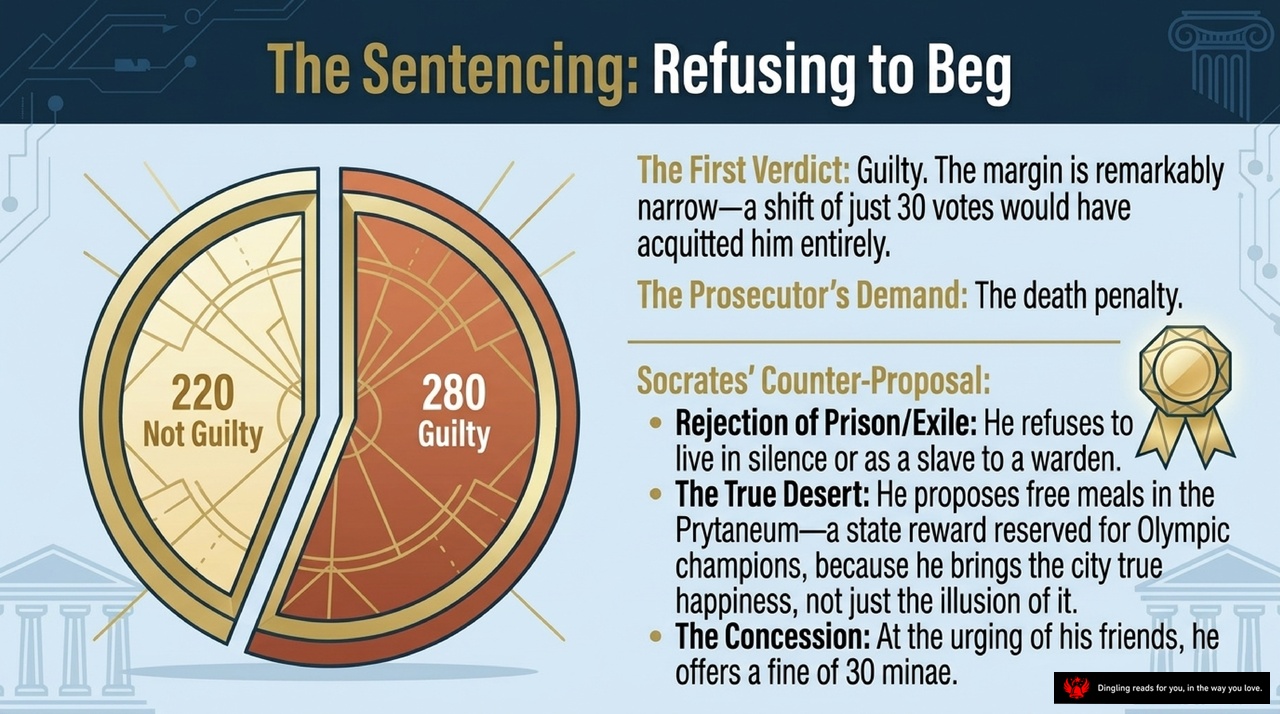
The verdict has been delivered, and the margin was razor-thin: 280 votes for guilt against 220 for not guilty. Just thirty votes would have changed everything, securing Socrates' freedom. The prosecutor's demand was clear: the death penalty. But Socrates refused to play by the rules of the courtroom. He rejected the idea of prison or exile, refusing to live in silence or as a slave to a warden. Instead, he proposed a counter-offer that was both bold and absurd: free meals in the Prytaneum, a state honor reserved for Olympic champions, arguing that he brings the city true happiness, not just the illusion of it. When his friends urged him to make a concession, he finally agreed to a fine of 30 minae, but only because he could not bear to leave Athens without paying something. This wasn't about buying his life; it was a final act of defiance, proving that he would rather die on his own terms than beg for survival.

So, we've reached the inevitable conclusion. Because of his unyielding pride and his absolute refusal to beg for mercy, the jury has voted for the death penalty—a verdict that came even more decisively than the initial guilty finding.
But here is the profound lesson Socrates leaves us with: "It is not difficult to avoid death, gentlemen; it is much more difficult to avoid wickedness, for it runs faster than death."
Think about that. Socrates believed that escaping physical death is easy, but escaping a life of moral corruption is nearly impossible. He argued that by silencing him through execution, Athens would only invite younger, harsher critics to take his place. The only true escape from this cycle isn't avoiding the critic, but improving one's own character.
In the end, Socrates accepts his fate not out of despair, but because he knows that living a virtuous life is far more valuable than staying alive at any cost. He chooses to face the end with dignity rather than compromise his soul.
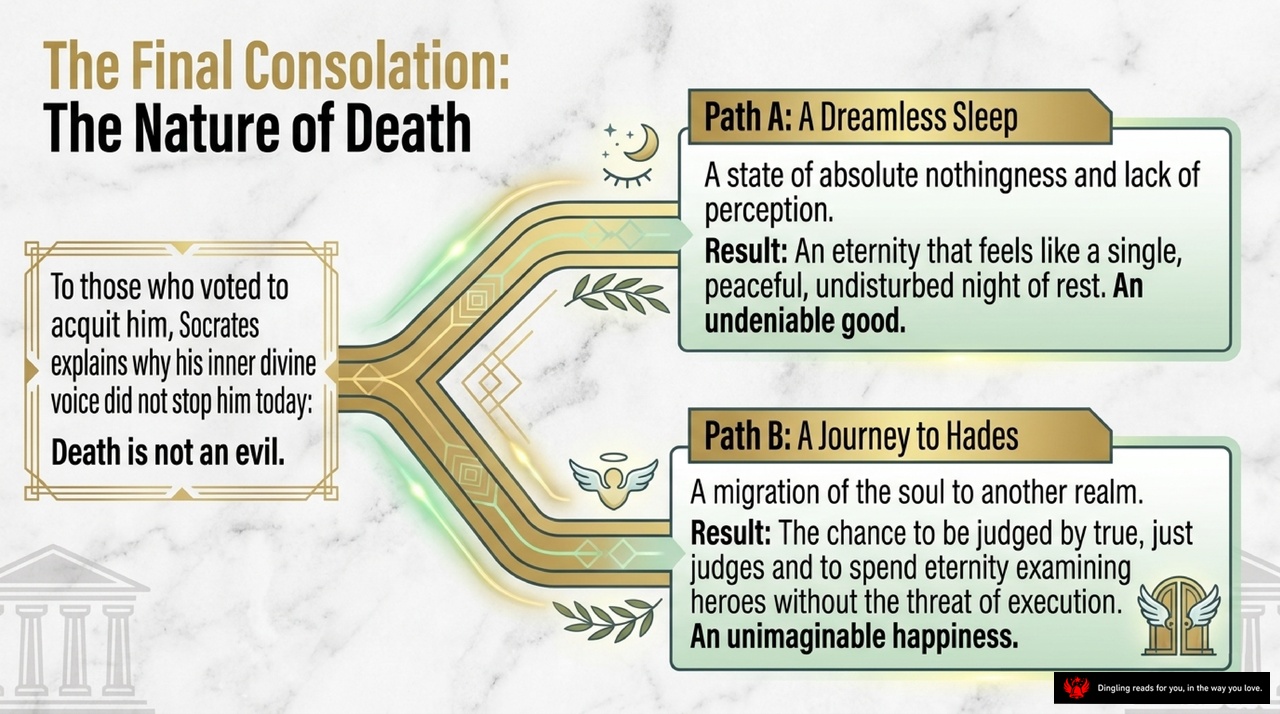
Friends, let's look at the final, most profound comfort Socrates offers us right here. He faces the ultimate question: What is death? And he gives us two paths to consider.
Path A is a dreamless sleep. It is a state of absolute nothingness, a total lack of perception. Think of it as an eternity that feels like a single, peaceful, undisturbed night of rest. For Socrates, this is an undeniable good. If death is just the end of feeling, then we have nothing to fear.
But Path B is a journey to Hades. This is the migration of the soul to another realm. Here, we escape the flawed judges of our current world and stand before true, just judges like Minos and Rhadamanthus. We get the chance to spend eternity examining heroes—talking with Orpheus, Homer, Agamemnon, and others—without the threat of execution. This, Socrates tells us, is an unimaginable happiness.
Look at the text on the left. Socrates explains why his inner divine voice did not stop him today. He simply states the core truth: Death is not an evil. Whether it is a sweet sleep or a glorious reunion with the wise, the outcome is either a rest from suffering or a beginning of eternal wisdom. So, please, hold onto this hope. Good people, no matter what happens, will never truly suffer.
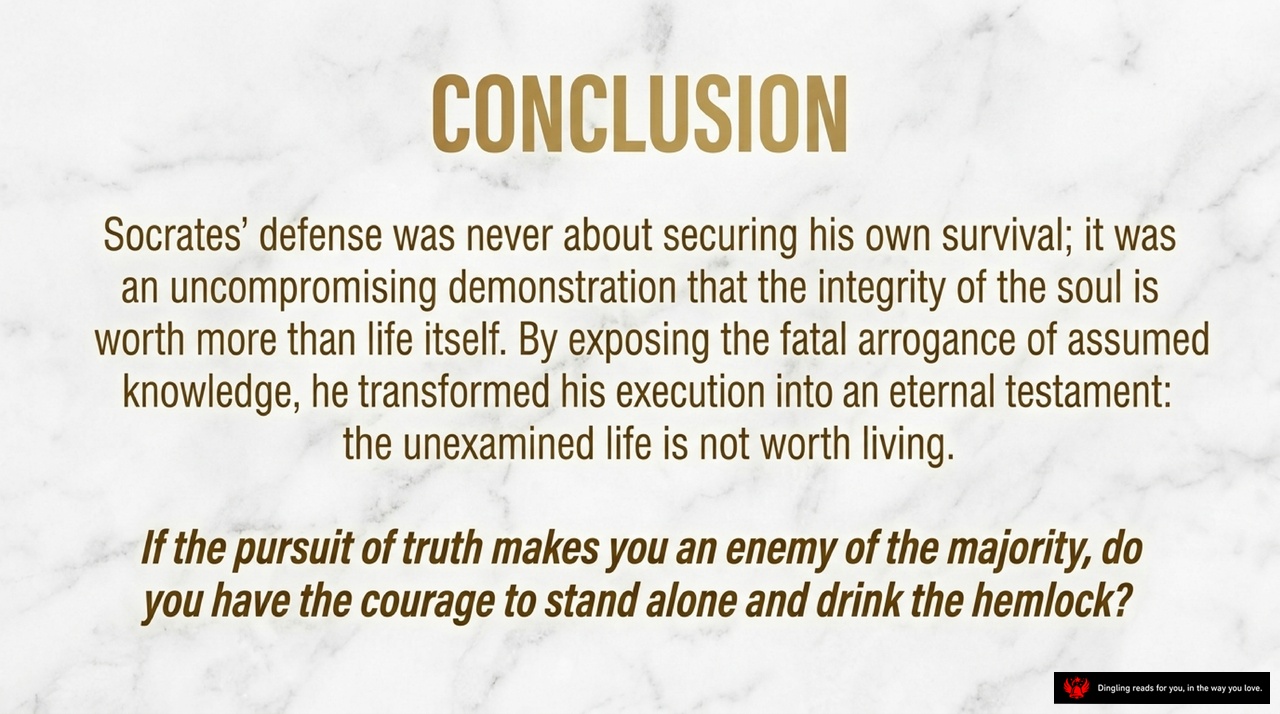
So, we've reached the final verdict. Look at what this slide tells us: Socrates' defense was never about securing his own survival. He wasn't trying to save his skin. Instead, it was an uncompromising demonstration that the integrity of the soul is worth more than life itself. By exposing the fatal arrogance of assumed knowledge, he transformed his execution into an eternal testament: the unexamined life is not worth living.
Here is the ultimate question left for us today: If the pursuit of truth makes you an enemy of the majority, do you have the courage to stand alone and drink the hemlock?