
The Aquariums of Pyongyang: Complete Chapter-by-Chapter Summary

Welcome to *The Aquariums of Pyongyang*. This is the harrowing ten-year journey through the North Korean gulag and one man's relentless pursuit of freedom.
Look at the title on this cover. It represents a life trapped behind glass. The author, Chol-Hwan Kang, was born in Pyongyang into a privileged family. While other children were dreaming of the "Great Leader," Kang was obsessed with fish. His room was lined with ten aquariums, filled with exotic species he couldn't get anywhere else. For him, the fish were a symbol of beauty and freedom, a stark contrast to the gray reality waiting for him.
But that world shattered in 1977. His grandfather, a respected businessman in Japan, was suddenly arrested and disappeared. Within days, Kang and his family were dragged away, their homes ransacked, and their lives confiscated. They were sent to Yodok, a brutal labor camp where the "aquariums" of his childhood were replaced by barbed wire, starvation, and forced labor.
This book details the terrifying transformation from a carefree child to a survivor of one of the world's worst prisons. It is a story of how a single man fought against an entire system designed to break him, and how he eventually found his way back to the sunlight.

The image you see here perfectly captures a terrifying reality: the "Repatriation Trap." It illustrates how North Korea lures wealthy expatriates with a socialist mirage, only to seal their fate behind a wall of surveillance and deprivation.
Look at the left side of the funnel. It represents "The Kyoto Origin." Kang's grandfather built a fortune in Japan through casinos and luxury imports, while his grandmother became a key leader in the pro-North Korean residents' league. They were living the high life, surrounded by Volvo cars and stacks of cash, completely unaware that their success was being used as bait.
Then, the funnel narrows to "The Deceptive Lure." North Korean propaganda promised a utopia—high-ranking government posts, a chance to build a socialist paradise, and even the opportunity for their children to study in Moscow. This promise triggered a mass migration of over 100,000 ethnic Koreans, convincing them that South Korea was a puppet state and that returning home was their only path to glory.
But then, the trap snaps shut. On the right side, the illusion shatters into reality. Upon disembarking, that wealth is immediately stripped away. Immigrants are marked as hostile outsiders, subjected to intense surveillance, and restricted from leaving. They are funneled from a life of privilege into a prison of their own making, lured by false promises and trapped by a regime that views them not as family, but as resources to be exploited and then discarded.

Look at this image. It depicts Kang's childhood in Pyongyang, a stark contrast to the reality of the rest of North Korea. On the left, we see "Artificial Abundance." Kang's bedroom featured ten massive aquariums filled with exotic fish, a luxury impossible for most families. This was the pinnacle of his privileged life, a world of vibrant color and carefree joy, completely isolated from the poverty outside.
But look closely at the right side of the tank. That is a Volvo. It's not just a car; it represents "Capitalist Remnants." This family retained Japanese luxury imports, including this rare Volvo, which was the only one in all of Pyongyang. This wealth created dangerous resentment among local party officials, planting the seeds of their future downfall.
Finally, notice the shadows looming behind the glass. These are the "Invisible Boundaries." Despite their material wealth, the family existed in a tightly controlled bubble. They were viewed with deep suspicion by the regime and their neighbors. Japanese-Koreans were seen as potential spies, creating a constant, suffocating anxiety beneath this luxurious facade. They were trapped in a golden cage built on fragile glass, unaware that the world outside was watching, waiting, and judging them every single day.

In the shadow of Camp 15, survival became a brutal negotiation with hunger and despair. The first winter hit us like a tidal wave, turning our meager diet of corn and acorn porridge into a nightmare. Our bodies wasted away, and a terrifying disease known as Pellagra began to spread, leaving skin cracked and peeling, eyes sunken and sightless. We called it "Dog Meat Disease," a cruel nickname for the suffering it brought.
To stay alive, we had to become scavengers. We ate frogs, newts, and even earthworms. The most harrowing memory involves my father, who, driven by the sheer desperation of starvation, stole a child's lunch. In that place, compassion was a luxury we couldn't afford; empathy often led to death. We saw friends turn on each other, and even guards were forced to eat insects to survive.
But there were moments of twisted reprieve. My older brother, Ah-sik, used his knowledge of chemistry to become the chief technician at the camp's distillery. He managed to produce a forbidden snake wine, a deadly concoction that he had to hide from the guards. Though he walked a tightrope, risking execution for any mistake, his position allowed him to secure extra rations for our family.
Then came the year of my first true friend, Lee Si-bong. A white-skinned boy from Kyoto, he was an anomaly in our world of soot and grime. He spoke of a Japan filled with fresh fruit, steaks, and sitting toilets—a world that felt like a fairy tale. His stories were the only light in our darkness, a reminder that life could be different, even if it was just a memory. Yet, as the years passed, the camp's cruelty would soon test the very limits of our humanity, forcing us to bury our dead in frozen ground and watch our friends fade into madness.

Mapping the Invisible Gulag of Yodok. This isn't just a map of land; it's a map of survival within a prison disguised as a valley.
First, look at the terrain itself: The Natural Fortress. At 900 meters altitude, the camp weaponizes the brutal winter and treacherous mountains. There are no fences needed because the environment is the ultimate barrier. It's an inescapable cage designed to eliminate any hope of flight.
Inside this fortress lies the Revolutionizing Zone. This is where Kang's family was held. Inmates here faced lethal forced labor and extreme indoctrination, yet they clung to a microscopic fraction of hope for eventual release. It was a sector of "potential," where the regime believed they could still be reformed.
But at the center of this map lies the most terrifying area: The Total Control Zone. Often described as a black hole, this sector held the "unredeemable"—political prisoners and their children who were worked to death in mines with zero possibility of release. Here, hope was not just crushed; it was systematically erased.
This graphic captures the brutal hierarchy of Yodok: a place where geography dictated your fate, and every zone served a specific purpose in the machinery of terror.

Imagine a world where childhood isn't about playing or learning, but about surviving a nightmare. This slide captures that brutal reality: the complete subversion of childhood and education in North Korea. On the left, we see what a normal education looks like—a book for knowledge, a swing for freedom, and an apple for simple joy. But a sharp crack splits the screen, revealing the dark truth of the Yodok indoctrination.
Here, the playground is gone, replaced by weapons. Instead of teachers, you have armed instructors like "The Boar," who beat starving children with revolvers for minor mistakes. Instead of studying, children are forced into grueling labor, hauling logs and mining in lethal conditions. And instead of self-expression, they face forced self-criticism, where they must publicly denounce their own survival instincts to prove loyalty.
This isn't just a change in curriculum; it's a total destruction of the human spirit. The system doesn't want to educate children; it wants to break them, turning them into obedient tools of a regime that fears anything that doesn't fit its narrative. In this twisted world, the only thing children learn is how to fear, how to betray, and how to survive at the cost of their own humanity.

Look at this stark contrast between the regime's promise and the brutal reality of the Yodok labor camp. On one side, you see the "Socialist Utopia": a fair society, abundant food, unbreakable comradery, and free healthcare. But on the other, the dark truth of "The Yodok Reality."
Instead of justice, there was arbitrary detention without trial and multi-generational punishment for unproven crimes of relatives. Instead of abundance, prisoners were fed rotting corn that caused pellagra, forcing them to eat rats, frogs, and insects just to survive. The promised social cohesion was a lie; an engineered informant network made starving prisoners betray one another for scraps of food. And instead of free medical care, there was no treatment at all. Lethal epidemics of typhus spread unchecked, and frostbite turned limbs into rotting flesh.
This slide captures the ultimate betrayal: a system that didn't just imprison bodies, it systematically destroyed hope, turning a promised paradise into a machine for survival at any cost.

Imagine a system where human dignity is dismantled not by a single villain, but by three perfectly interlocking gears of terror. This slide illustrates the "Interlocking Gears of Totalitarian Control," a mechanism designed to strip away hope and enforce absolute compliance.
First, look at the top gear: Engineered Starvation. It's not just about hunger; it's a calculated weapon. Caloric intake is meticulously reduced until prisoners are physically exhausted. This isn't just physical pain; it strips away morality itself. When you are starving, you have no strength to resist, no capacity to think critically. You become entirely compliant, desperate, and easy to control. The regime knows that a hungry mind is a broken mind.
Next, the second gear: The Informant Network. Here, trust is weaponized against you. The system appoints prisoners to surveil each other, turning every inmate into a potential spy. Even children are forced to report their own parents to avoid brutal beatings. In this environment, there are no allies. The only way to survive is to betray the person sitting next to you. This creates a society of paranoid isolation where loyalty is impossible.
Finally, the third gear: Public Executions. This is the ultimate tool of terror. The regime maintains fear through mandatory attendance at executions. Escaped prisoners are hanged or stoned, often by other inmates, in front of the entire population. This isn't just about killing; it's about traumatizing the living. It permanently destroys the population's spirit and demonstrates the absolute futility of resistance. If you try to run, you become a spectacle of your own failure.
These three gears—starvation, betrayal, and terror—work together seamlessly. Starvation breaks your body, the informant network breaks your community, and public executions break your soul. Together, they create a prison that exists not just in walls, but in the very air you breathe.

Imagine survival not as a simple act of staying alive, but as a complex, multi-layered strategy. In the darkest corners of the camp, prisoners learned that endurance alone wasn't enough; they had to master a "Hierarchy of Extreme Survival."
At the very foundation lies **Physical Endurance**. This was the non-negotiable baseline. Every day, survival hinged on sourcing illicit calories. It meant hunting rats, trapping snakes for that potent medicinal wine, and enduring freezing cold while wrapped in nothing but scavenged rags. Without this physical grit, nothing else mattered.
Building on that foundation is **Strategic Adaptation**. This is where the game changed. It required navigating the camp's corrupt bureaucracy with ruthless precision. Survival depended on bribing guards and securing "privileged" indoor work details—like rabbit tending or laboring in the distillery—to escape the lethal winter logging. It was about bending the system to your will, turning every rule into a potential loophole.
But the true ultimate tool was **Psychological Detachment**. This sits at the peak of the pyramid. It meant suppressing all empathy, abandoning any hope of systemic justice, and accepting the brutal, animalistic laws of the camp. By detaching emotionally, prisoners protected their minds from shattering, allowing them to endure the horror without losing their sanity.
It is a terrifying yet brilliant framework for surviving hell.

Stepping from a small cage into a macroscopic prison. Kang's journey begins not with a grand escape, but with a shocking, arbitrary release. After ten years of suffering, his family is unexpectedly freed—not because of justice, but simply because the grandfather who originally "sinned" against the state has finally died. This cruel twist reveals the true nature of the regime: loyalty is transactional, and survival depends entirely on the whims of the dead.
But stepping out of the camp in 1987 doesn't mean stepping into freedom. Kang discovers a nation on the brink of total collapse. The public food distribution system has completely failed, leaving millions starving. By the 1990s, ordinary citizens are dying of hunger, and Kang realizes a terrifying truth: the entire country is operating under the exact same mechanics of deprivation and terror as the gulag. The prison walls haven't expanded outward; they have swallowed the whole nation. What looked like a small cage has become a macroscopic prison, trapping everyone in a system where survival is a constant, silent struggle against starvation and fear.

Illicit Frequencies Shatter the Final Illusion. For years, Kang lived in a state of enforced silence, his mind shaped by a decade of brainwashing. But everything changed the moment he secretly acquired a forbidden radio. Under the blanket, late at night, he risked execution to tune into South Korean KBS and Voice of America. Those illicit frequencies didn't just play music; they dismantled decades of indoctrination. The broadcasts revealed the true, brutal origins of the Korean War, exposed the fall of global dictators like Ceausescu, and painted a picture of the immense prosperity waiting in the outside world. This was the truth breaking through the cracks of his reality.
The shock of this new world became the catalyst for flight. When a close friend and fellow listener was reported to the State Security Department, the imminent threat of being sent back to the gulag forced Kang to make a desperate decision. The radio had given him the courage to see the illusion for what it was, but the fear of returning to the camp gave him the final push to flee. In that moment, the static of lies was replaced by the clear signal of freedom.

Look at this map. It charts a treacherous smuggling route to freedom, a journey that took a North Korean defector from the North all the way to South Korea.
The first step, labeled "The Border Crossing," was the most dangerous. It involved bribing border guards to cross the freezing Yalu River into China, facing the constant threat of Chinese authorities who actively repatriate North Korean defectors to certain death.
Once in China, the journey entered its second phase: "Hiding in Plain Sight." This meant surviving in the criminal underworld of Dalian, working illicit jobs, and dodging informants while attempting to secure safe passage.
Finally, the route hit a major obstacle: "The Diplomatic Rejection." The South Korean embassy in Beijing initially rejected their plea for asylum. This forced Kang to take a final, dangerous gamble on a smuggled boat ride across the Yellow Sea to Incheon.
This graphic perfectly illustrates the three deadly hurdles that had to be cleared to escape one of the world's most repressive regimes.

Imagine standing in the heart of Seoul, surrounded by towering skyscrapers and endless traffic, only to feel completely invisible. That is the profound alienation Kang experiences in "Capitalist Abundance." On one side of this slide, we see the city's overwhelming wealth—a stark contrast to the starvation he survived just hundreds of miles away in North Korea. This shock of abundance leaves him paralyzed. On the other side, we see a solitary figure, representing the public apathy he encounters. Kang is devastated to find that many South Koreans are entirely indifferent to the Holocaust occurring across the border, prioritizing their own economic comfort over human rights. Finally, this slide captures the ideological clash that defines his return. Kang faces intense frustration on university campuses, clashing with naive left-wing students who romanticize the North Korean regime, blinding themselves to the grim reality of the gulags. While the world celebrates prosperity, Kang is left questioning where he truly belongs, trapped between a past of survival and a present of uncomfortable truth.
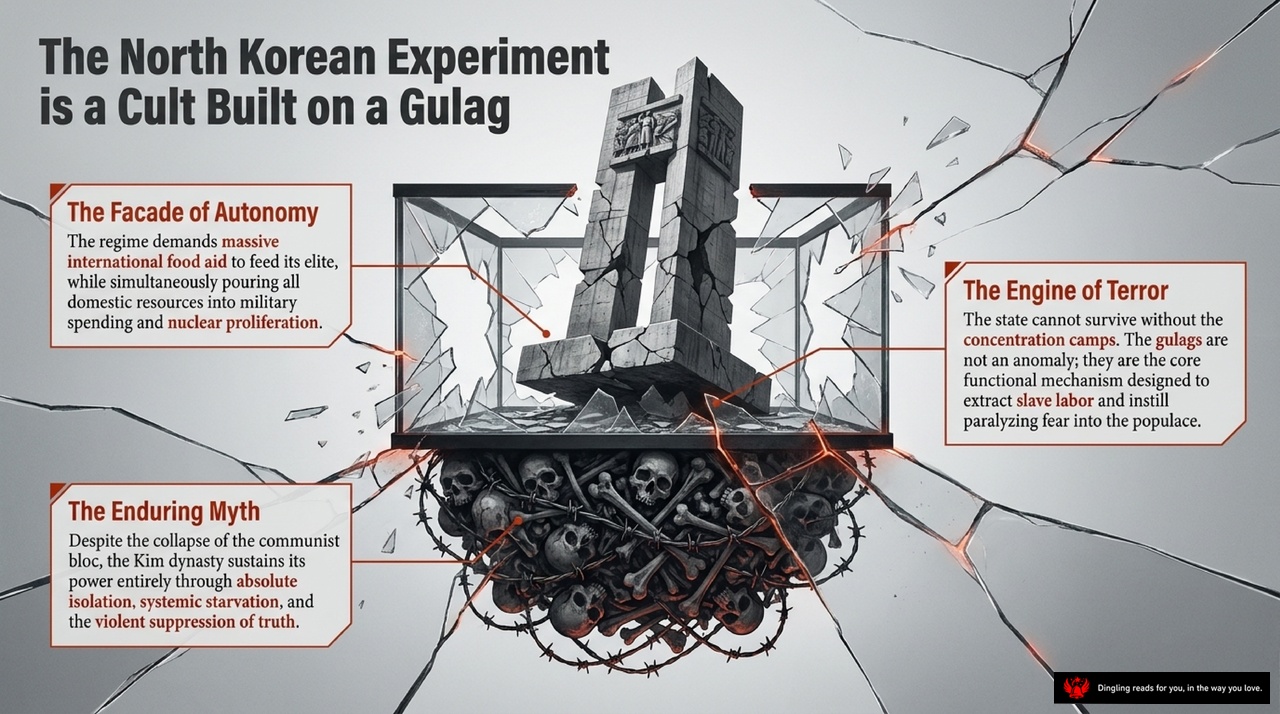
The North Korean Experiment is a Cult Built on a Gulag. What you see here isn't just a political system; it's a machine designed for total control, resting on a foundation of absolute terror.
Look at the top center: the regime's "Facade of Autonomy." On the surface, North Korea demands massive international food aid to feed its elite, all while pouring domestic resources into military spending and nuclear proliferation. It's a performance of power built on a lie.
But beneath that shattered glass lies the reality: The Engine of Terror. The state simply cannot survive without its concentration camps. These gulags aren't anomalies or historical footnotes; they are the core functional mechanism of the entire system. They exist to extract slave labor and instill paralyzing fear into the populace. Without this constant pressure, the regime collapses.
Finally, look at the foundation holding it all together: The Enduring Myth. Despite the collapse of the global communist bloc, the Kim dynasty sustains its power entirely through absolute isolation, systemic starvation, and the violent suppression of truth. They built a monument to their own mythology on a bed of bones. This isn't just oppression; it is a cult that requires the destruction of the human spirit to remain standing.

Kang Chol-Hwan spent ten years in the Yodok concentration camp, enduring starvation, torture, and forced labor. He was a victim of a brutal regime that punishes innocence just to sustain its illusion of utopia. Today, hundreds of thousands of men, women, and children remain trapped in these invisible gulags, hidden from the world. If humanity now holds the undeniable blueprint of this modern-day Holocaust, why do we continue to let the silence endure?