
The Art of Acting Clearly: Complete Chapter-by-Chapter Summary
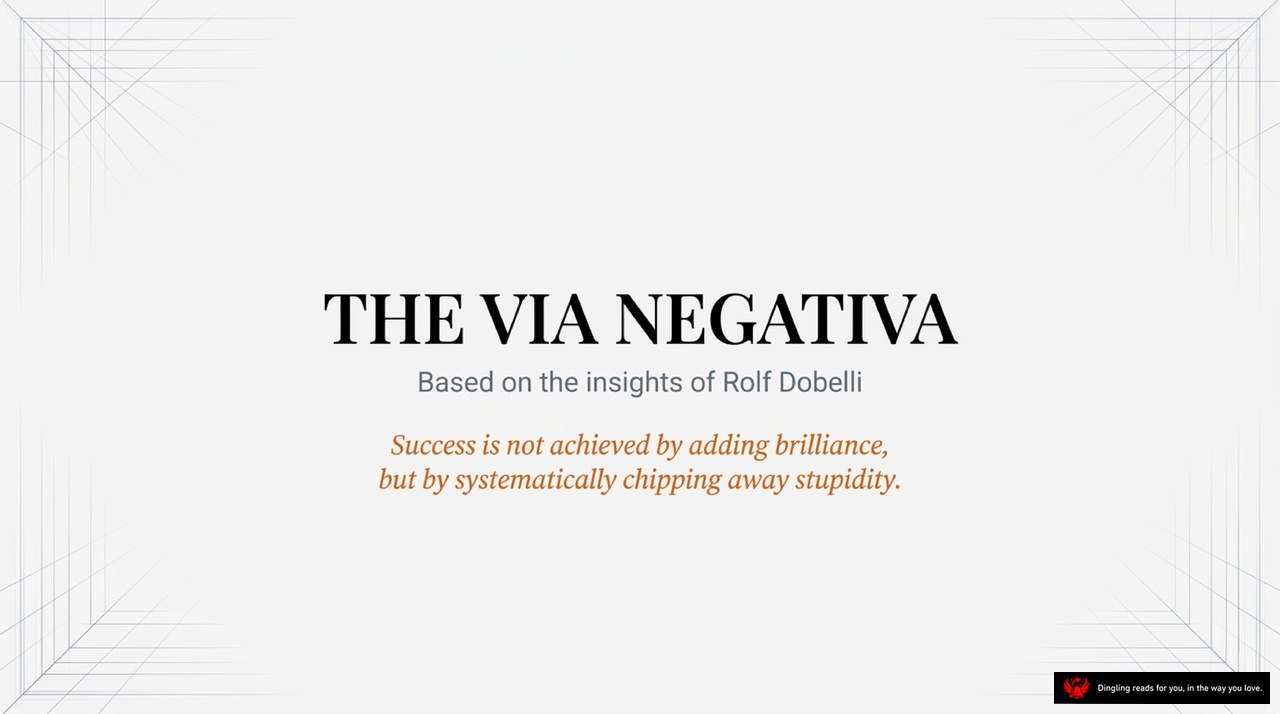
Welcome to today's session on decision-making and cognitive biases. We're diving into the hidden traps that distort our judgment, starting with a powerful concept called the Via Negativa. Inspired by the insights of Rolf Dobelli, this idea challenges a common belief: that success comes from adding brilliance. In reality, true progress often happens by systematically chipping away stupidity. Just as we remove obstacles to move forward, clearing up our mental biases allows us to see the world more clearly. From the next slide, we'll explore how our brains trick us through choice fatigue, association errors, and small-sample fallacies, equipping you with tools to make sharper, more rational decisions in a complex world.
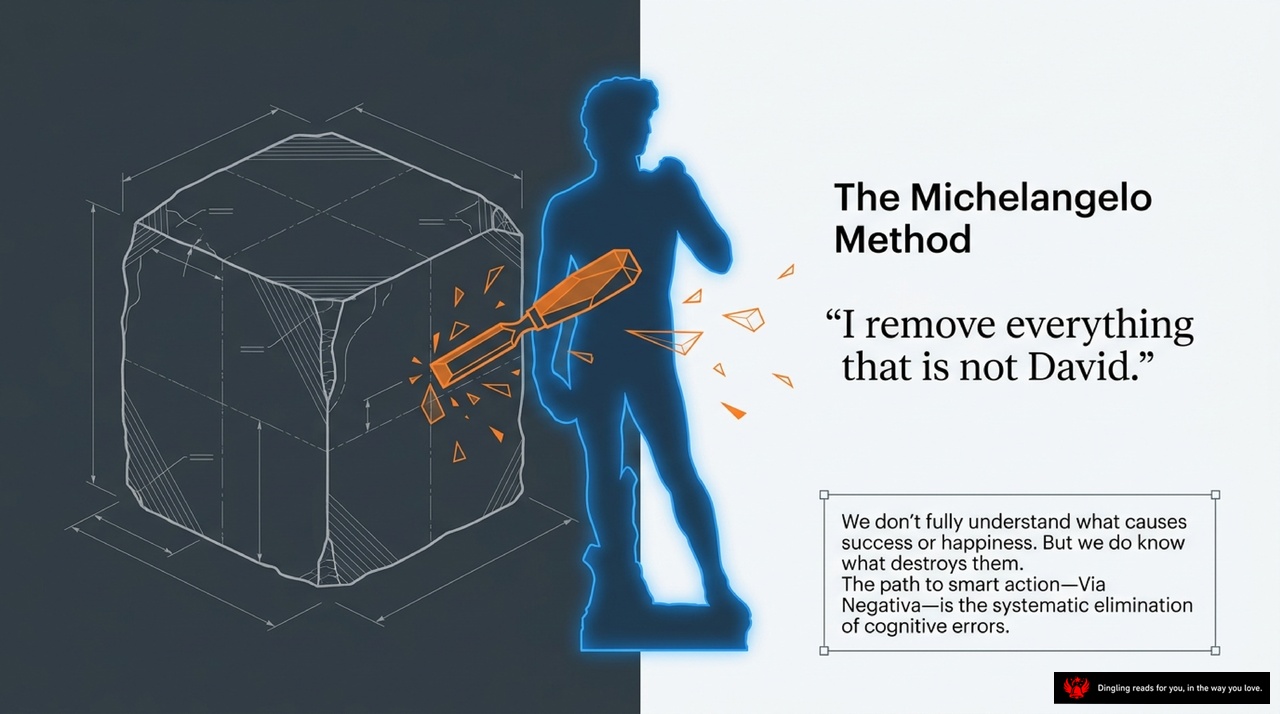
Imagine a giant, rough block of marble sitting on your workbench. To your left, you see the raw stone; to your right, the finished masterpiece of David emerges from the chisel. This visual perfectly captures the essence of what I call the Michelangelo Method. As the image states, the core philosophy is simple yet profound: "I remove everything that is not David."
In our daily lives, we often struggle with this approach. We try to build success by adding more—adding features to a product, adding tasks to our schedule, or adding credentials to our resume. We think that accumulation equals improvement. But true smart action often works in reverse. We don't fully understand exactly what causes success or happiness. We can't easily point to a specific ingredient that guarantees a breakthrough. However, we do know with certainty what destroys them. We know exactly what causes failure, burnout, and poor decisions.
This is the path of Via Negativa. Instead of frantically trying to add the right things, we systematically eliminate the wrong ones. We remove the cognitive errors that cloud our judgment, we cut out the toxic habits that drain our energy, and we strip away the unnecessary distractions that prevent us from focusing. By clearing away the noise, the signal becomes undeniable. The David within us reveals itself not because we sculpted it from nothing, but because we had the courage to chip away everything that wasn't it. So, when you face a complex problem or a major life decision, stop asking "what should I add?" and start asking, "what must I remove?"

Imagine you're a manager asking an employee, "Can I skip this line?" If they just say yes without a reason, compliance drops to a low 60%. But the moment you add the magic word "because"—even if the reason is as weak as "because I want to make copies"—compliance skyrockets to an impressive 93%. This isn't about the logic of the excuse; it's about the power of the word itself.
Humans are psychologically addicted to "because." It acts like a cognitive lubricant, tricking our brains into obeying even when the reason is circular or meaningless. Our minds crave justification, and "because" satisfies that craving instantly, lowering our defenses.
So, how do we protect ourselves from this manipulation? The answer lies in a simple defense mechanism: strip away the word "because." When someone offers a reason, don't just accept it. Instead, judge the action purely by the raw facts that follow. Ignore the emotional hook of the excuse and look at the reality. By refusing to be lubricated by the word "because," you can see through the illusion and make decisions based on truth, not on a cleverly crafted excuse.

Have you ever wondered why you might instinctively reject a perfectly clean wool sweater just because it was once worn by Adolf Hitler? Or why a guest might spit out wine from a cup that once sat in Saddam Hussein's palace, even after being thoroughly cleaned? From a purely physical standpoint, these items are identical to any other on the market. Yet, our brains refuse to separate the object from its history. This is the "Association Fallacy" in action.
As the chart on your slide illustrates, our decision-making is heavily influenced by these invisible connections. We aren't just evaluating the item itself; we are reacting to the story attached to it. Whether it's a celebrity-endorsed product we love or a book we dismiss because we disagree with the author, we are letting irrelevant associations dictate our judgment.
The book warns us that this is a dangerous trap. It causes us to ignore the actual attributes of a thing and instead get swayed by who it was with or where it came from. To make truly rational choices, we must learn to strip away these meaningless narratives and focus on the essence of what we are actually looking at. Don't let the past of an object steal the future of your decision.

The slide highlights a critical trap in our decision-making: the "Illusion of Averages." We often assume that the average person, or the average outcome, tells the whole story. But in a complex world, averages can be a dangerous lie.
Look at the two distributions shown here. On the left, we have a "Normal Distribution," where most people cluster around the center, like passengers on a bus. The average is a reliable representation of reality. But on the right, we see a "Power Law Distribution." Here, a single extreme outlier—a massive spike in wealth, for instance—can completely distort the average. If one person gets incredibly rich, the "average wealth" of the entire group skyrockets, even if everyone else remains poor. This is why the slide warns us: a single outlier can destroy the validity of the mean.
The text on the right illustrates this perfectly with wealth. It shows that average wealth can spike by millions of percent, not because everyone is getting richer, but because one person is becoming a billionaire. This is why the slide suggests a "Defense Mechanism": when you see data following a Power Law—like book sales, venture capital, or wealth—you must ignore the average entirely. Instead, look at the median and the extremes. Relying on the average in these environments will lead you to completely wrong conclusions. Don't let the illusion of averages blind you to the reality of the few who dominate and the many who remain average.
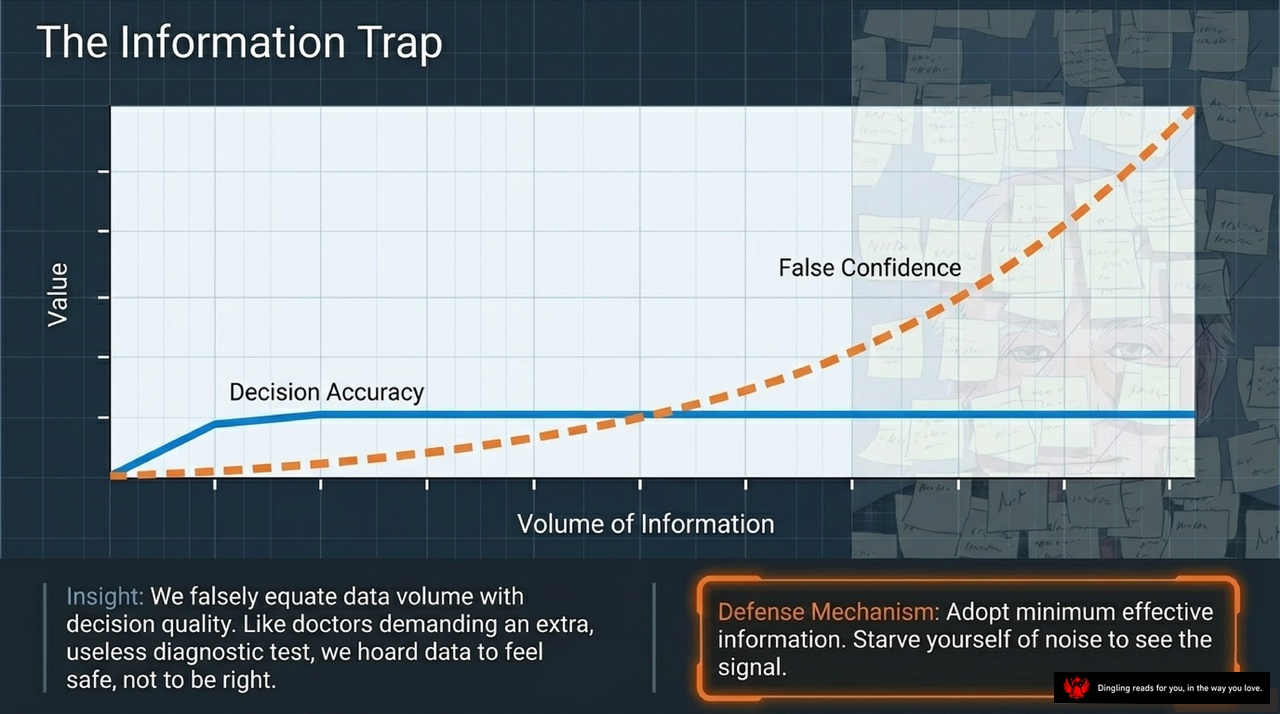
Have you ever made a decision, only to realize later that you spent hours gathering data, yet the outcome was no better than if you had just trusted your gut? You might think that more information equals better decisions. But as the chart on this slide shows, we often fall into a trap called "The Information Trap."
Look at the blue line labeled "Decision Accuracy." It rises quickly at first, but then it flattens out. Adding more information beyond a certain point doesn't improve your accuracy; it just creates noise. Meanwhile, the orange dashed line, representing "False Confidence," keeps climbing. The more data you hoard, the more certain you feel, even though your actual ability to make the right choice hasn't improved.
The insight here is profound: we falsely equate data volume with decision quality. Like a doctor who demands an extra, useless diagnostic test just to feel safe, we hoard data to feel secure, not to be right. We suffer from information bias, mistakenly believing that the quantity of our knowledge is a proxy for its quality.
So, what is the defense mechanism? The answer is right there in the bottom right corner: Adopt minimum effective information. You need to starve yourself of noise to finally see the signal. In a world overflowing with data, the smartest move is often to do less research, trust your initial intuition, and stop feeding your brain unnecessary details that only cloud your judgment.

Look at this cycle: it's a perfect trap of human thinking. We see a patient getting worse, so the doctor applies leeches based on an old theory. The theory gets "validated" by the act of doing something, even though it makes the patient sicker. This is the Bloodletting Effect, and it shows why we cling to broken theories for thousands of years.
Here's the hard truth: we don't abandon a theory just because it's proven wrong. We only let go when a better one comes along. It's far easier to live in comfortable ignorance than to face the terrifying void of saying, "I don't know."
So, what's the defense mechanism? Be your own heretic. When a model fails, discard it immediately. Do not wait 2,000 years for a perfect replacement. Your job isn't to defend the past; it's to protect the future.
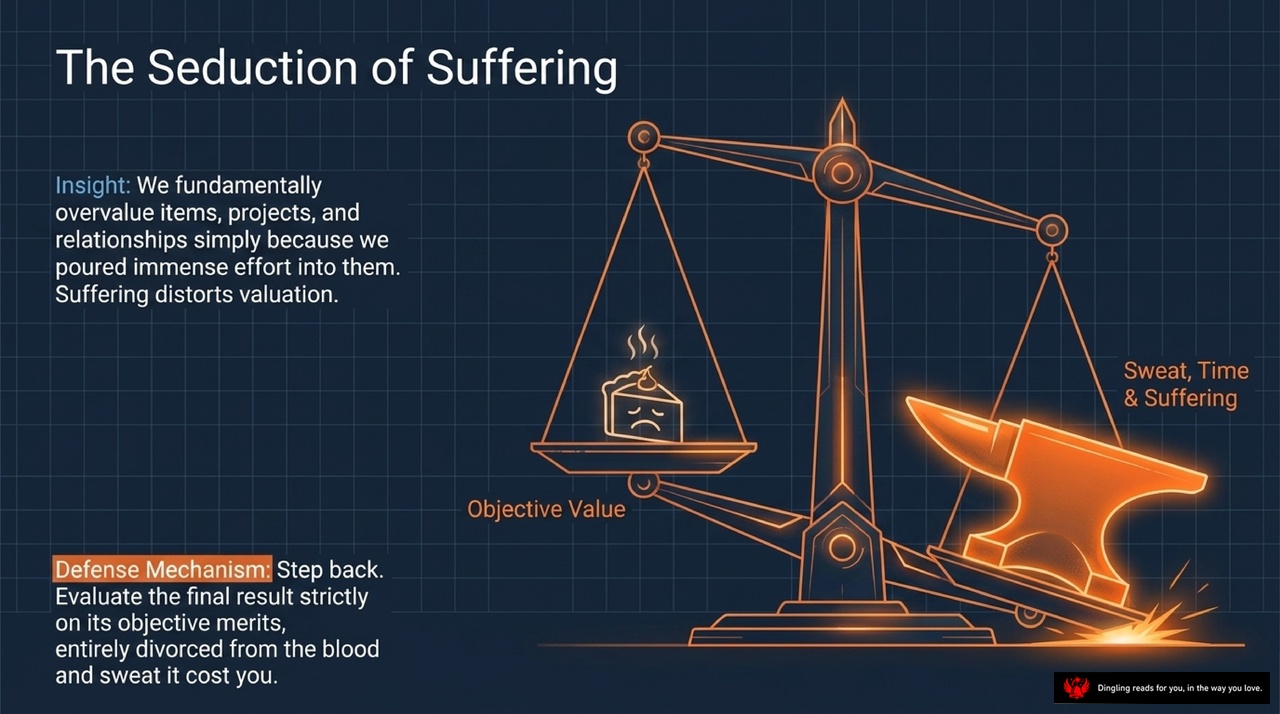
Have you ever looked at a masterpiece you spent years crafting and felt it was worth a fortune, while dismissing someone else's identical work as worthless? That imbalance isn't about the object itself; it's about the pain you poured into it. The image on your screen perfectly illustrates this trap: "The Seduction of Suffering." On one side of the scale, we have the true "Objective Value" of an item—like that modest slice of cake shown. On the other, we have the massive weight of "Sweat, Time & Suffering." When we pour immense effort into something, suffering distorts our valuation, making us fundamentally overvalue our projects, relationships, and even ourselves simply because we bled for them.
This is what psychologists call the "Labor-Justification Phenomenon." Think of John, a soldier who kept a bloody parachute pin for decades, not because of its utility, but because it symbolized the agony he endured to earn it. Or Marco, who refused to sell his restored motorcycle for double its market value because the memories of his sleepless nights made it priceless to him. We unconsciously inflate the worth of anything that cost us blood and sweat.
But here is the hard truth: you must step back. The image suggests a powerful defense mechanism: evaluate the final result strictly on its objective merits, entirely divorced from the blood and sweat it cost you. A five-year novel that no one reads has zero market value, regardless of your suffering. A master's degree that doesn't advance your career is just a certificate, regardless of the sleep you sacrificed. To make rational choices, you must separate the cost from the value. Don't let the weight of your suffering falsely tip the scale of reality.
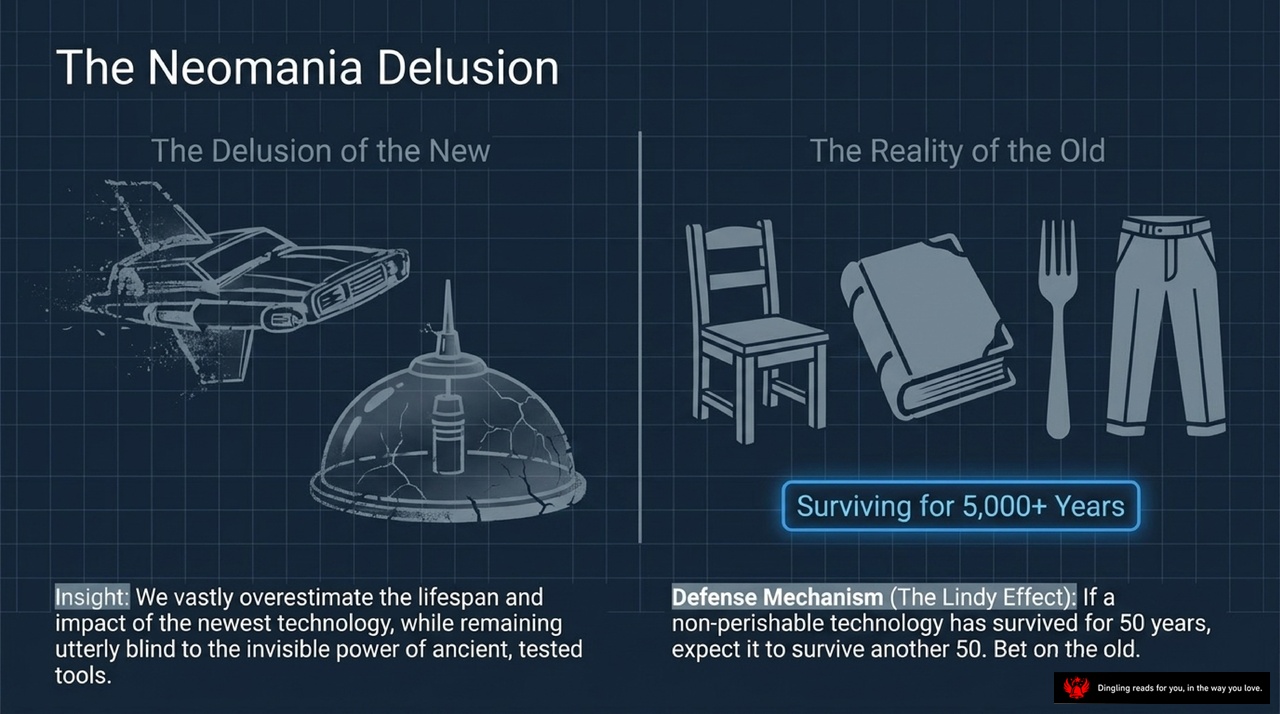
Look at this slide titled "The Neomania Delusion." It contrasts the "Delusion of the New" with the "Reality of the Old." On the left, we see futuristic tech like a flying car and a fragile device under a cracked dome, symbolizing how we vastly overestimate the lifespan and impact of the newest technology. On the right, we see simple, timeless objects: a chair, a book, a fork, and pants. These represent the reality of the old, technologies that have been surviving for 5,000+ years.
This visual perfectly captures the core insight from Nassim Taleb's work: we are blind to the invisible power of ancient, tested tools while obsessing over fleeting trends. The slide introduces a crucial defense mechanism known as the Lindy Effect. This principle states that if a non-perishable technology has survived for 50 years, you can expect it to survive another 50. The logic is simple: the longer something has stood the test of time, the more robust it is.
So, when faced with a choice between a brand-new gadget that might break tomorrow and a chair that has lasted for millennia, the rational bet is always on the old. We need to stop chasing the shiny new and start respecting the durability of what has already proven itself. Bet on the old, because it is the only technology with a guaranteed future.

The graph on this slide illustrates a fascinating psychological phenomenon known as the "Sleeper Effect." It shows two distinct curves over a nine-week period. The blue line represents our memory of the source, which starts high but decays rapidly as time passes. The orange line represents our belief in the message, which actually starts low but climbs steadily over time, eventually surpassing our memory of where the information came from.
This visual perfectly explains why propaganda and advertising are so effective. When we first encounter a message from an untrustworthy source, our skepticism is high. We remember the source and dismiss the content. However, our brains forget the source much faster than they forget the message itself. As the association between the message and the source fades, the message stands alone, and we begin to accept it as truth without questioning its origin.
The slide offers a clear insight: the brain forgets where information came from much faster than it forgets the information itself. This means that untrustworthy sources can slowly poison our convictions over time, even if we know we shouldn't trust them. To defend against this, the slide suggests a simple but powerful mechanism: quarantine your inputs. We need to radically avoid unsolicited advice, ads, and suspect media. Whenever we consume information, we must ask ourselves, "Cui bono?" or, "Who benefits?" By actively identifying the source and questioning their motives before the memory of the source fades, we can protect our beliefs from being hijacked by the sleeper effect.
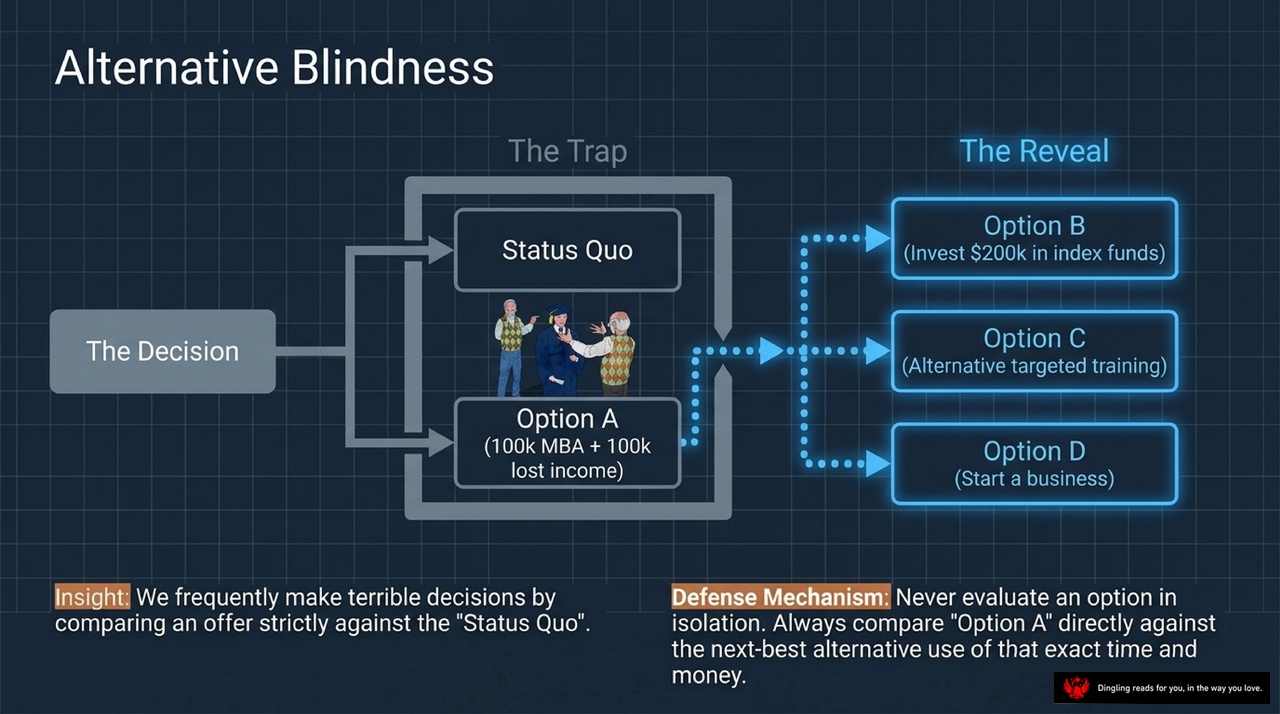
Imagine you're standing at a crossroads, staring at a decision that feels heavy. On one side, you have the "Status Quo"—the safe, familiar path where nothing changes. On the other, there's "Option A," which looks tempting on paper: maybe it's an expensive MBA, a risky business venture, or a career switch that promises a massive payout. It seems like a no-brainer, right? You compare Option A directly against doing nothing, and the numbers scream that you should take the leap.
But here's the trap: this is what psychologists call "Alternative Blindness." We are so fixated on comparing our new idea against the current situation that we completely ignore the other options sitting right next to us. In reality, if you have $200k and two years to invest, your "Option A" might be a terrible deal compared to something else entirely.
Think about it. Instead of comparing that MBA to staying put, what if you compared it to investing in low-cost index funds? Or what if you used that time for targeted, cheaper training? Or even better, what if you used the capital and time to start a business? These are your Options B, C, and D. By ignoring them, you're blind to the true best move. Warren Buffett knows this. He doesn't ask, "Is this stock a good buy?" He asks, "Is this the second-best thing I could have done with this money right now?"
The insight here is simple but powerful: we frequently make terrible decisions because we compare an offer strictly against the "Status Quo" instead of against the next-best alternative. To fix this, you need a defense mechanism. Never evaluate an option in isolation. Always force yourself to look at Option A directly against the next-best alternative use of that exact time and money. Only then can you see the real value and stop falling into the trap of thinking the obvious choice is the smartest one.
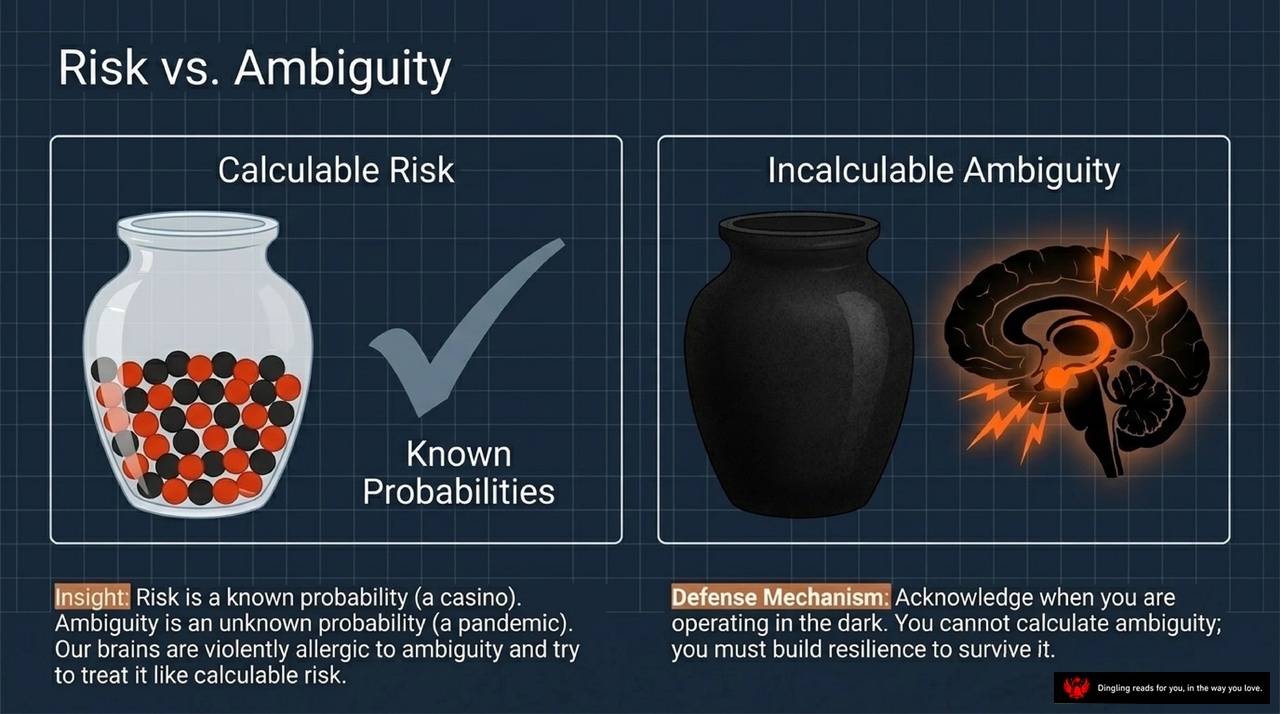
Look at this slide: "Risk vs. Ambiguity." On the left, we have "Calculable Risk," represented by a clear jar filled with red and black marbles. Next to it is a checkmark and the words "Known Probabilities." This is the comfort zone of our brains. It's like walking into a casino where the rules are fixed, the odds are clear, and every outcome is predictable. We feel safe here because we can calculate the cost.
But look at the right side. We see "Incalculable Ambiguity." The jar is pitch black, and next to it is a brain being struck by lightning. This represents unknown probabilities. Think of a pandemic or a black swan event—situations where the rules don't exist yet. Our brains are violently allergic to this. We hate the dark. So, what happens? We try to treat ambiguity like calculable risk. We force a narrative onto chaos, pretending we know the odds when we don't.
The slide calls this a "Defense Mechanism." It warns us: acknowledge when you are operating in the dark. You cannot calculate ambiguity; you can only survive it. The real skill isn't in predicting the unknown, but in building resilience to endure it. Don't mistake your fear of the unknown for a lack of data. Instead, prepare for the worst and build a buffer. That is the only way to navigate true ambiguity.

Now, let's bring this synthesis to life with "The Sculptor's Checklist." Think of your mind as a block of marble and your biases as the traps that distort the shape. On the left, we see "The Marble"—the traps that cloud our judgment, from hoarding useless data to clinging to the past. On the right, we see "The Chisel"—the defensive tools to carve away those distortions and reveal the truth.
Starting with Logic, the trap is Information Bias and Averages, where we drown in data or rely on misleading means. The chisel cuts through this with minimal information and a focus on the median or extreme values that truly matter.
In Action, Decision Fatigue and Effort sap our willpower, leading to sweat bias and low-quality choices. The chisel counters this by ensuring rested decisions and objective valuation, preventing us from making mistakes simply because we are tired.
For Perception, the trap is Neomania and Alternative Blindness, where we obsess over novelty and ignore false dichotomies. The chisel sharpens our view by applying the Lindy Effect to trust what endures and actively seeking hidden alternatives we might have missed.
Finally, in Belief, we fall into Sleeper and Bloodletting Effects, forgetting sources and clinging to bad models. The chisel provides input quarantine to stop misinformation and demands instant model discard when evidence changes.
By using this checklist, you stop being a passive sculptor of your own biases and become the master of your decisions, chiseling away the noise to reveal the clear, rational structure underneath.
You do not need to acquire new wisdom to live a better life. You simply need to systematically carve away the stupidity, the noise, and the biases that obscure your view of reality. Think of your mind like a block of marble; it isn't about finding a new statue, but about chiseling away the flaws already there. Now that you can see those flaws, which piece of your own mind will you chisel away first? Is it the habit of overthinking, the fear of missing out, or the bias that tells you your own ideas are always right? The journey to a clearer life starts with the courage to remove what is blocking your vision, not by adding more rules, but by subtracting the unnecessary weight holding you back.