
The Art of Loving: Complete Chapter-by-Chapter Summary

Welcome to our exploration of *The Art of Loving* by Erich Fromm. Today, we're diving into a profound truth that challenges how we think about romance: love is not a passive emotion to fall into, but an active art demanding profound knowledge and relentless effort.
We often mistake love for a feeling that simply happens to us, something we stumble upon by luck or destiny. But Fromm argues that true love requires discipline, learning, and conscious action. It's about cultivating the capacity to give, to care, to respect, and to understand another person deeply. This isn't about finding the perfect partner; it's about becoming the kind of person capable of loving.
In a world that often treats relationships like transactions or instant attractions, Fromm reminds us that love is a skill. It demands we step out of our comfort zones, overcome our self-centeredness, and commit to the hard work of connecting with others on a genuine level. As we move forward, we'll explore what it truly means to practice this art, moving beyond fleeting infatuation toward a lasting, transformative connection.

Today's slide breaks down a crucial misunderstanding about love: the myth that we simply "fall" into it. On the left, we see "The Object Problem." Society treats love like a commodity to be found, not a skill to be developed. We obsess over being loved by cultivating status, wealth, and attractiveness, assuming that once we secure the "right object," love is easy. This is a transactional mindset, viewing partners as things to be acquired.
But look at the right side: "The Faculty Problem." This is where the real work begins. Love is an art, just like mastering music or painting. It requires stopping the search for the perfect object and dedicating ourselves to the grueling, conscious discipline of the craft. True love isn't about finding a person; it's about developing the capacity to love. It demands that we stop seeking external validation and instead cultivate the internal faculty of giving, respecting, and understanding. We must stop treating love as a passive feeling that happens to us and start treating it as an active practice we choose to master.

Love is often mistaken for a magical accident, a feeling that simply strikes lucky people out of nowhere. But the slide you see here reveals a harsher truth: when humanity evolved beyond pure instinct, we were thrust into a terrifying isolation. We became conscious of our mortality, our powerlessness, and the unbridgeable separateness from nature and each other. This profound aloneness breeds intense anxiety and shame. The diagram illustrates this perfectly—a solitary figure surrounded by a chaotic web of disconnected arrows, trapped in a prison of isolation.
The deepest, most urgent human need is to overcome this separateness and escape the prison of our isolation. Most people try to solve this by trying to be loved, by accumulating status or beauty, but that only deepens the divide. True love isn't about finding the perfect object or escaping into a crowd; it's about overcoming the fear of separateness. It requires a shift from "falling in love"—that fleeting, intense but ultimately fragile infatuation—to "being in love," a mature, active commitment. Only by learning to give, to care, and to truly understand another person while keeping our own identity intact, can we break out of this prison and find the connection that makes us truly human.

Today's slide breaks down three distinct attempts we make to bridge the chasm of existential aloneness. First, there are "Orgiastic States"—trance, drugs, or sexual excess. While they offer a fleeting escape, they ultimately leave us more isolated than before, requiring constant repetition just to feel anything. Second, we have "Conformity." This is the strategy of adopting herd customs and losing our individuality to become an identical automaton. It might feel calm and offer a false sense of unity, but it is a shallow solution that erases who we truly are.
However, the third path—labeled here as "Creative Activity & Love"—is the only sane and satisfactory answer. This isn't just about being productive; it's about fusing with the world while rigorously maintaining our own integrity and individuality. Unlike the other two methods that either numb us or erase us, true love allows us to connect deeply with another person without losing ourselves. It is the only way to overcome loneliness while remaining fully alive as unique individuals.
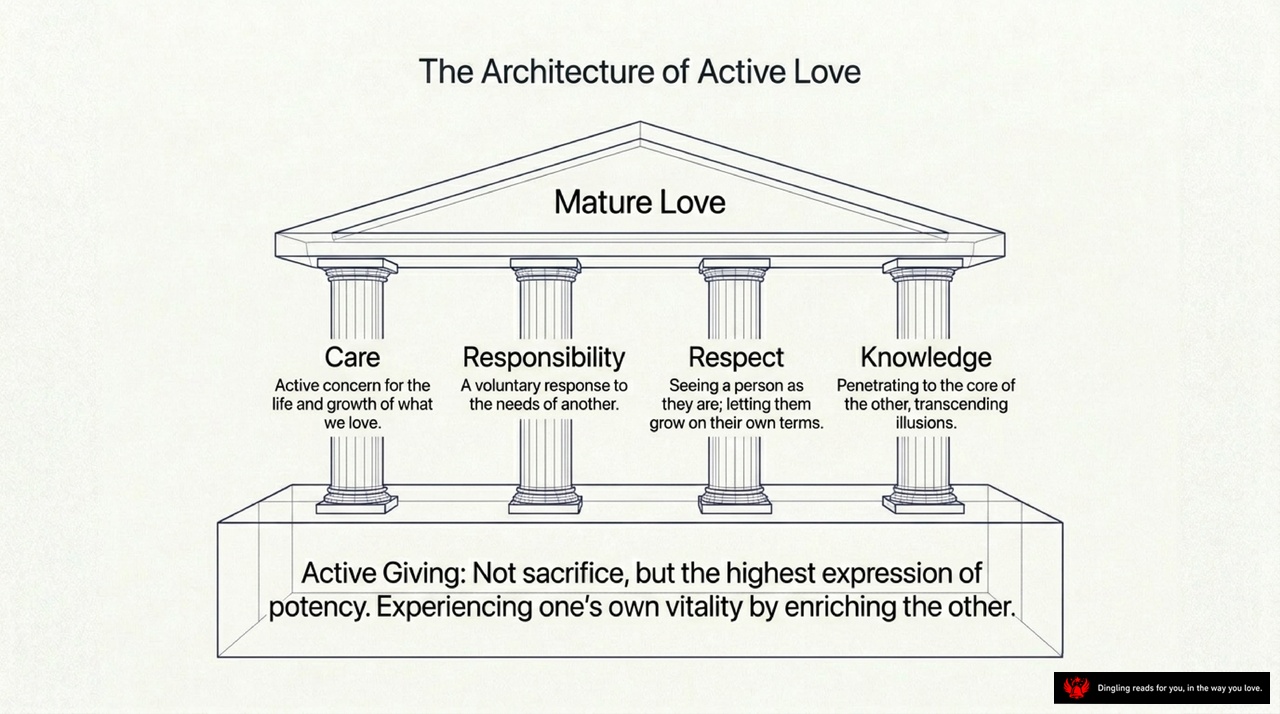
The Architecture of Active Love isn't just a metaphor; it's the blueprint for a relationship that actually lasts. Think of Mature Love as a sturdy temple, built on four essential pillars: Care, Responsibility, Respect, and Knowledge.
First, we have Care. This isn't just saying "I love you"; it's the active concern for the life and growth of the person you cherish. If you claim to love a plant but never water it, that's not love. It's the same with people. True love is about nurturing the other person's potential, just as the Bible suggests that love is tied to the act of creating and cultivating life.
Next is Responsibility. This is the voluntary response to another's needs. But here's the catch: without Respect, responsibility can easily turn into control or even slavery. Respect means seeing the person as they truly are, not as a tool to meet your own needs. It's about letting them grow on their own terms, honoring their unique individuality.
Finally, we have Knowledge. This is the foundation of everything. You can't truly care or be responsible if you don't really know the person. Real knowledge goes beyond surface-level facts; it means penetrating to the core of the other, transcending illusions, and seeing the person from their perspective. Without this deep understanding, your care and responsibility become blind.
But what holds this whole structure up? It's Active Giving. This isn't about sacrifice or giving up who you are. It's the highest expression of your own vitality. True love enriches you by enriching the other. It's about experiencing your own aliveness through the act of giving. When you give freely, without expectation of return, you tap into a profound sense of power and connection. This is how you build a mature love that stands strong against the challenges of life.

Love isn't just a feeling that happens to you; it's an art you have to learn. And to master it, you need two things: discipline and focus. Think about it—how many of us are masters at our jobs, yet completely lost when it comes to relationships? We treat our personal lives like an afterthought, something we "relax into" after a long day of forced labor. But if you want to be a lover, you first have to be disciplined. You need to wake up early, practice mindfulness, and refuse to let your attention scatter. In a world that glorifies multitasking, the ability to sit alone with your thoughts and focus on one thing—your partner, your breath, your moment—is superpower.
But there's another critical ingredient: self-awareness. It's not about over-analyzing yourself like a scientist; it's about being like a mother who instantly knows when her baby is hungry without being told. You need to catch your own moods—when you're angry, confused, or depressed—and ask yourself, "What is really happening here?" instead of just reacting. Most of us are too self-absorbed to do this. We live in a bubble of narcissism, seeing the world only through the lens of how it benefits us. We can't see reality clearly, so we can't truly connect with anyone. To love, you must step out of that bubble. You have to be objective, humble, and willing to see the truth about yourself and others, flaws and all. Only then can you build the trust and depth that real love requires.

Look at this chart titled "The Spectrum of Connection." It maps out four distinct ways we love, breaking down who we love, the balance of power between us, and the core trait of each type.
First, at the bottom is Self-Love. This is the internal foundation. The slide clarifies this isn't about selfishness; it's the prerequisite for respecting humanity. You can't truly respect others if you don't respect yourself.
Moving up, we have Brotherly Love. This is the foundational love of all mankind. It exists between equals and is highly universal. Its defining characteristic is loving the stranger—the idea that everyone is essentially a brother or sister, regardless of status.
Next is Motherly Love. This operates between unequals. It's described as the ultimate selfless act: helping a helpless life grow with the deliberate goal of eventual separation. It's about caring for someone who cannot yet care for themselves.
Finally, at the top is Erotic Love. This happens between equals but is completely exclusive. It's a craving for complete fusion, yet interestingly, it remains rooted in that universal love of mankind mentioned earlier.
Erich Fromm's point here is that these aren't just random feelings; they are specific forms of connection with different rules. Understanding which one you are operating in—and ensuring your self-love is solid—is the first step to connecting deeply with anyone else.

Erotic love is not an illusion, but it is often mistaken for one. We frequently confuse the sudden collapse of barriers—like sexual attraction or intense intimacy—with true love. This is what I call "Egoism à deux," or a false fusion. It happens when two people form an alliance against a hostile world, mistaking their synchronized selfishness for a deep connection. It feels like magic, like everything has disappeared between you, but it is actually just a temporary truce.
However, true fusion is entirely different. True erotic love is an act of will, a deliberate decision, and a sacred promise. It is the beautiful paradox where two beings become entirely one, yet remain definitively two. Unlike that fleeting feeling of falling in love, which often fades as novelty wears off, true love requires you to choose each other every single day. It is not about finding the perfect person who completes you; it is about the courageous commitment to stay connected, to understand, and to care, even when the initial spark dims. Real love isn't a feeling you wait for; it's a practice you build.

Look at this visual contrast between "Selfishness" and "Self-Love." On the left, we see a cracked cup pouring out; on the right, a whole cup overflowing with life. This image perfectly captures Erich Fromm's central argument: true self-love is not a vice, but the very engine that allows us to love others.
The slide explains that selfishness isn't about loving yourself too much; it's the opposite. It's rooted in a lack of self-love. These individuals are like that broken cup—an empty vessel desperately trying to snatch happiness from the world because they lack the internal capacity to generate it themselves. They love themselves too little, which forces them to be greedy and extractive.
Conversely, the right side shows us that true self-love is generative. You cannot pour into others if your own vessel is broken. When you affirm your own life, happiness, and growth, you create the root capacity to love. It is only from a place of wholeness that you can give freely. As Fromm suggests, the ability to love is a skill we must cultivate, and it starts with loving ourselves enough to be whole. Without that foundation, any attempt to connect with others is just another form of emptiness.

In this slide, we see a stark mechanical illustration of "The Commodification of the Human Heart," where emotions are processed on a conveyor belt labeled "The Personality Market." This visual perfectly captures the modern tragedy where we treat our lives like transactions. As the text explains, modern society has alienated us, turning our life energy into capital to be invested for maximum profit. We no longer ask, "How do I learn to love?" Instead, we obsess over, "Am I lovable enough?" and "What package of qualities can I offer?"
This slide highlights the "Partnership Illusion," where we approach marriage like a corporate merger. We scan the market for a "smoothly functioning teammate" to exchange our assets with, rather than seeking a soul-deep connection. The capitalist engine demands standardized, compliant workers, and we have tragically internalized this logic. We believe love is a commodity to be bought or sold based on our exchange value, ignoring the fact that true love is an art that requires discipline, practice, and the courage to give without expecting a return. We are stuck on the conveyor belt, endlessly trading our hearts, completely missing the point that love is about overcoming our isolation through genuine connection, not about closing a deal.

Welcome to the "Gallery of Pseudo-Loves." Today, we're diving deep into the illusions that often masquerade as romance. We've all seen them, and perhaps lived them: the blind worship of a partner, the escape into nostalgia, and the projection of our own unfulfilled dreams onto others.
First, let's look at **Idolatrous Love**. The image shows someone kneeling before a pedestal, worshipping a statue. This represents losing oneself entirely in the blind idolization of another person. We sacrifice our own integrity and project ultimate perfection onto a flawed human, hoping they will be the savior we never found in ourselves.
Next, we have **Sentimental Love**. Here, a figure sits in the dark, watching a bright screen. This is experiencing love only vicariously—through movies, romance novels, or nostalgic memories. Instead of engaging in the friction of present reality, we retreat into stories where love is easy and perfect, avoiding the messy work of loving the real person in front of us.
Finally, there is **Projective Love**. The illustration shows a person using a magnifying glass to scrutinize a small stone. This is evading one's own internal flaws by hyper-focusing on a partner's defects, or projecting one's own unfulfilled life goals onto children. We see our own broken pieces reflected in others and criticize them, all to avoid facing the truth about ourselves.
True love requires us to drop these masks and see people as they are, flaws and all.

So, we've covered the theory of love—what it is, why it matters, and how it differs from mere lust or dependency. But now, let's turn the page and talk about the practical side. If love is truly an art, as we've established, then mastering it requires specific prerequisites. It's not something you stumble into; it's a discipline you cultivate.
Look at this "Mastery Funnel" on your screen. To become a lover who can truly connect, you need to build three specific foundations, starting from the bottom and working your way up.
First, at the very base, is **Discipline**. Now, I don't mean the harsh, rigid kind of discipline we often think of. This is about transforming self-will into a joyful expression. It means overcoming that modern urge to be passive, distracted, and constantly entertained. True discipline is choosing to show up for your life, even when you don't feel like it. It's the commitment to treat your relationships with the same seriousness you'd treat a craft or a career.
Once you have that foundation, you move up to the second step: **Concentration**. This is the rare ability to be fully present. In our world, we are constantly bombarded by notifications and external stimulation. But to love deeply, you must be comfortable alone with yourself and equally comfortable with your partner without needing to fill every silence. You have to escape the constant demand for external validation and focus entirely on the person in front of you.
Finally, at the very top of the funnel, we arrive at **Patience**. This is perhaps the hardest part for us today because our culture is built on the industrial logic of speed and instant results. We want things now. But mastery of any art, including love, requires the dedication of a lifetime. It means rejecting the idea that you can "fix" someone or "get" love in a weekend. It requires acknowledging that building a deep, lasting connection takes time, effort, and the willingness to stay the course even when results aren't immediate.
So, to recap: start with discipline to stop being distracted, add concentration to be truly present, and crown it all with the patience to let love grow at its own pace. Only when you stack these three elements can you hope to move from simply feeling emotions to actually mastering the art of love.

The image on the screen sets the stage for one of the most critical lessons in love: the battle between our distorted self-perception and the reality of the world around us. On the left, we see "The Obstacle: Narcissism," depicted as a shattered mirror. This visual perfectly captures the text's warning that narcissism forces us to experience only our internal fears and desires as real. When trapped in this state, the outside world and the people in it exist only as utilities or threats to our ego. We see ourselves as the center of the universe, and everyone else is merely a prop in our own play.
To the right, the image offers "The Antidote: Objective Reason," showing a clear, expansive landscape. This represents the humility required to see people and things exactly as they are, free from the distortions of our own wishes. True love demands recognizing the limitations of our subjective perception. As the book explains, love is not about projecting our needs onto others; it is about an objective engagement with reality. We must cultivate the ability to look at our partners not as extensions of ourselves, but as distinct, independent individuals with their own lives. Without this shift from narcissistic projection to objective reason, we remain stuck in a prison of our own making, unable to truly connect with the world or the people within it.

Look at this image. We see a chasm separating two cliffs, with a path labeled "Rational Faith" firmly rooted on one side, and a daring arc labeled "The Leap" stretching across the void. This visual perfectly captures the engine of love: the delicate balance between intellectual conviction and the courage to commit.
The slide defines "Rational Faith" not as blind obedience, but as a firm conviction rooted in your own experience. It's about trusting in the reliability of your core and the potential of humanity. You don't need guarantees to believe in love; you simply need to trust that the capacity for connection exists within you.
But faith alone isn't enough. The second part, "The Leap," reminds us that to love is to commit oneself without a guarantee. It is an act of supreme courage to give yourself completely, hoping that your love will produce love in the other. If you insist on absolute safety, you will never master it. True love requires you to step off the edge of certainty and trust in the unknown, bridging the gap between who you are and who you hope to become together.

Love is the only sane and satisfactory answer to the profound problem of human existence. It is not an accident of fate, nor a commodity to be traded on the personality market, but a deliberate, lifelong practice requiring deep discipline, objective reason, and unwavering courage.
If your capacity to love is the ultimate measure of your humanity, are you merely waiting to be chosen by love, or are you actively doing the work to master the art?
Think about this: we often treat love like a consumer product. We scan the market, weigh our worth against someone else's, and hope to find the perfect match that will make us feel complete. We believe love is something that happens *to* us—a lightning strike, a chemical reaction, or a matter of luck. But this mindset is a trap. It turns us into passive consumers, waiting for the right person to arrive and save us from our loneliness.
The reality is far more demanding and, frankly, more liberating. Love is not a feeling you stumble upon; it is a skill you cultivate. Just as a musician must practice scales and a carpenter must learn to use tools, you must learn to love. This requires discipline. It means showing up every day, even when the passion fades. It requires the courage to see your partner clearly, flaws and all, without trying to fix them or hide from them. It demands that you move from being a self-centered observer to an active participant in another person's life.
The question isn't "Who can love me?" but "Am I capable of loving?" When you stop chasing external validation and start mastering the art of giving, respecting, and understanding, you transform your life. You stop waiting for a rescue and become the source of connection yourself. Mastering this art is the only way to truly overcome the fundamental isolation of being human. So, are you ready to stop waiting and start practicing?