
The Art of Not Being Governed: Complete Chapter-by-Chapter Summary

Welcome to a book that flips the entire script on what we think history is. Most of us assume that "civilization" means building cities, writing laws, and paying taxes. But James C. Scott's masterpiece, *The Art of Not Being Governed*, argues that for thousands of years, the most sophisticated political strategy in Southeast Asia wasn't about building a state. It was about the art of deliberately *not* being governed.
The cover image you see here, with its winding, layered contours, perfectly captures this idea. It looks like a topographic map of the highlands—rugged, complex, and hard to navigate. But Scott reveals that these weren't just empty, "primitive" wildernesses left behind by advancing empires. Instead, they were carefully crafted refuges. For centuries, millions of people from the fertile valleys fled into these difficult mountain terrains to escape crushing taxes, forced labor, and the constant threat of becoming slaves. They didn't retreat because they were weak; they retreated because they were smart. By choosing isolation, they created a zone where the state simply couldn't reach them, preserving their freedom and autonomy against all odds.

Look at this graphic. It shows a classic story we've all heard: a straight line of progress where humanity moves from "primitive" chaos on the left to a perfect, orderly civilization on the right. The image labels this journey as moving from foragers to farmers, and finally to civilized state subjects. It suggests that the messy, scattered dots on the left are just a failed past, and the rigid, locked-in structure on the right is the only true destination.
But what if this sequence is a myth? What if the image isn't showing an inevitable upgrade, but rather a trap? The text on the slide asks a provocative question: "What if moving backward along this timeline wasn't a failure, but a deliberate escape?"
This challenges the entire idea of linear progress. It suggests that the "primitive" past wasn't something people were stuck in, but a choice. The scattered, fluid forms on the left represent freedom and autonomy, while the rigid, maze-like structure on the right represents the control of the state. The "progress" we celebrate—settling down, building walls, creating hierarchies—is actually a loss of freedom. People didn't evolve into the state; they often had to flee *from* the state to survive. The so-called "backward" ways of life are actually sophisticated strategies to avoid being taxed, conscripted, or enslaved. The maze isn't the goal; it's the cage. And the scattered dots? They are the free people who refused to get caught.

Welcome to Zomia, the Great Shatter Zone. This isn't just a map of mountains; it's a 2.5-million-square-kilometer fortress that has resisted empire for two thousand years. Spanning five Southeast Asian nations and four Chinese provinces, this rugged terrain—mostly above 300 meters—has served as a massive refuge for those fleeing the oppressive state-making projects of the valleys.
For centuries, this area has hosted 100 million people of bewildering ethnic and linguistic diversity. Many assumed these populations were left behind by civilization, but the truth is far more deliberate. This is the largest remaining region of humanity that has actively resisted being absorbed into the nation-state. It is not a population abandoned by history, but a sophisticated survival strategy. From ancient refugees escaping heavy taxes and conscription to modern groups avoiding assimilation, Zomia remains the ultimate escape zone for those who refuse to be ruled.

Imagine a world where the very tools of survival are actually tools of resistance. On the left, we see what history has labeled "primitive"—stone tools, spears, and scattered artifacts in a display case, crossed out with a bold red line. The image tells us a hard truth: these aren't relics of a backward past. As the slide explains, these are "secondary adaptations" carefully designed to thwart state capture. What we call "barbarians by design" are actually masters of political engineering.
Look at the modern toolkit on the right. This represents the same logic applied today. Instead of stone, we have a multi-tool, a satellite phone, and modular shelter materials. The slide breaks down exactly why this works. First, a "dispersed location" creates insurmountable administrative costs for tax collectors; if you can't find them, you can't tax them. Second, a "fluid social structure" prevents the state from bribing or capturing a single leader to control the whole group.
Notice the emphasis on "oral history" and "modular materials." Written records lock populations into taxable identities, so these groups rely on flexible storytelling. They use compact, lightweight gear that can be packed up and moved instantly. The quote at the bottom sums it all up: these practices are "state effects." Their ideologies and habits are entirely designed to avoid established states and prevent new ones from emerging. In a world obsessed with centralization, being effectively invisible is the ultimate strategy for freedom.

Early states weren't benevolent guardians of civilization; they were ruthless resource-extraction machines obsessed with capturing manpower and grain. As this diagram illustrates, the power of a Valley State rested on three critical mechanics. First, concentrated manpower: a state's true strength wasn't measured by land, but by the number of captured subjects. To keep their populations from fleeing, rulers constantly relied on slave raids and wars to replenish their ranks. Second, irrigated rice served as the ultimate "state crop." Because it grows above ground, matures simultaneously, and is highly visible, it made it perfectly easy for tax collectors to estimate and seize yields. Finally, there was the Oxcart Limit. This was the hard ceiling on state power; a state could only project force as far as its food logistics allowed. Since an ox team consumes its own payload over just 250 kilometers, the empire's reach was strictly defined by how far it could feed its army. The arrows radiating from the central pyramid show how these states radiated outward, but always constrained by the logistical reality of moving grain and people.

Imagine a world where you aren't trying to build a state, but rather designing the ultimate shield against it. If your goal was to make it impossible for any government to tax you, conscript your labor, or seize your land, what would you do? You wouldn't choose flat, fertile plains where armies can march and harvests are easy to count. Instead, you would seek out the rugged, inaccessible terrain of the highlands. You would abandon concentrated rice paddies for scattered, multi-season root crops like corn and cassava that are nearly impossible to track. And you would dissolve all fixed leadership, creating a fluid, mobile society that vanishes the moment pressure mounts.
This is exactly the reality of Southeast Asia's highlands, often called Zomia. It is not a "primitive" backwater left behind by history; it is a sophisticated political strategy. The highlands function as a deliberate resistance zone. By keeping their population dispersed and their crops hidden in the ground—cassava, in particular, acts as a "food for guerrilla warfare," surviving wars and hiding from harvesters—these communities make the cost of state control far higher than the potential return. They turn the very geography that states usually exploit into a fortress.
Furthermore, they reject the state's demand for fixed identity. While lowland states rely on rigid borders, census data, and written laws to control people, highland groups often abandon writing entirely. Why? Because writing binds you to a fixed history and a specific tax code. By choosing oral tradition, these communities keep their history fluid, able to adapt instantly to changing political tides. They might even switch identities on the fly, acting as one group in the market and another in the mountains. This flexibility, this refusal to be pinned down by a single name or a permanent leader, is the core of their survival. They are not victims of nature; they are architects of freedom, using the highlands to remain just out of reach of the "Leviathan" state, ensuring that while the lowlands may be conquered, the highlands remain a sanctuary for autonomy.

Imagine a world where the very ground you stand on determines your freedom. In this slide, we see the first major weapon in a people's arsenal against the state: **Evasion Tactic I: The Friction of Terrain**.
The image clearly divides the landscape into two distinct zones. On the left, we have the **State Space**, labeled as "The Flatlands." Here, the terrain is flat and low-friction. It is the ideal playground for marching armies, heavy ox-carts, and tax assessors. The state thrives here because it can move quickly and impose order with ease.
In stark contrast, look at the right side: **Evasion Space**, or "The Highlands." This is high-friction territory. The slide notes that a simple 50-kilometer march here requires days of hacking through dense jungle, navigating treacherous V-shaped valleys, and battling deadly malaria. This isn't just difficult travel; it is an active neutralization of the state's military and administrative advantages. By choosing to live in these rugged, inaccessible areas, people actively deny the government the ability to project power.
The graphic powerfully illustrates this shift with a winding arrow climbing the mountain, symbolizing the journey from control to autonomy. As the quote at the bottom reminds us, "The steepest places have been the asylums of liberty." History shows that the most difficult terrain often becomes the sanctuary for those who refuse to be ruled. This strategic use of geography is not about hiding out in the past; it is a deliberate political choice to trade accessibility for independence.

Imagine you are designing a survival strategy not to serve a king, but to stay free from him. If your goal is to make yourself invisible to the state, you wouldn't choose flat, fertile plains where crops grow tall and uniform. Instead, you'd head for the rugged highlands and plant crops that hide. This is exactly what hill populations in places like Southeast Asia did. They deliberately abandoned high-yield grains for "escape crops" like cassava and roots, which grow underground. As the slide illustrates, while state crops like irrigated rice are highly visible and easy for tax collectors to measure, escape crops are hidden beneath the soil, making it impossible to accurately estimate your harvest.
Furthermore, these escape crops offer a crucial tactical advantage in timing. State crops are harvested all at once, forcing farmers to store food in granaries that invaders can easily loot. In contrast, escape crops have staggered harvest times and can be left safely in the ground until absolutely needed. Even if an army marches over your land, they won't know there is food buried right beneath their feet. The slide highlights this stark difference in vulnerability: rice fields can be easily burned to starve a population, while root crops are fire-resistant and resilient.
This wasn't just about agriculture; it was a deliberate political choice. What looks like primitive ignorance was actually a sophisticated evasion tactic. By keeping their food hidden and their society mobile, these groups ensured that armies could not fixate on them, collect taxes, or starve them into submission. It was a masterclass in using the landscape to maintain freedom against the state.

Imagine a world where the state isn't a top-down pyramid, but a drifting cloud of water. This is the core idea behind the "Jellyfish Model" we're discussing today. Unlike the rigid structures of valley states, which rely on a single king at the apex, hill tribes have evolved a completely different survival strategy: total decentralization.
Look at the contrast on the screen. On the left, you see the traditional "Pyramid." In these valley states, power flows from the top down. If an enemy captures or bribes that single apex—the King or Chief—the entire structure collapses. It's a fragile point of failure. But look at the right side: "The Jellyfish." This represents the amorphous, headless network of the hill tribes. There is no central authority to negotiate with or decapitate.
This isn't just about geography; it's a deliberate political choice. As the slide notes, these societies operate on the ancient principle: "Divide that ye be not ruled." By fragmenting their social structures into smaller, autonomous family units, they ensure that no single leader can ever rise to a point where they can be co-opted by an external state. When attacked, this network doesn't fight to the death; it dissolves effortlessly. The groups simply move to a new location, reform, and continue living. They become invisible to the state, making it impossible to tax, conscript, or conquer them.
This "Jellyfish" logic explains why these groups have survived for centuries while the rigid kingdoms around them rose and fell. It's a sophisticated evasion tactic, turning the very concept of leadership against the state.

Evacuation Tactic IV: The Rejection of Writing. Here is a powerful truth that flips our entire understanding of history: being "pre-literate" is a myth. Many hill tribes are actually "post-literate." They strategically abandoned writing not because they were too primitive to learn it, but because they needed to escape the trap of fixed history and administration.
Look at the image on the left. Those stone tablets chained together represent "The Written Trap." Texts, lists, and ledgers are the fundamental tools states use to extract resources—taxes, land deeds, conscription. Once your history is written down, it locks you into a single, taxable identity. You become a permanent target for the state.
Now, look at the waves on the right. That represents "The Oral Advantage." Orality provides cultural plasticity. A spoken genealogy can be instantly adjusted to forge new alliances, deny past loyalties, or reinvent history based on immediate survival needs. While written history is rigid and dangerous for the oppressed, oral tradition is flexible and liberating. It allows a community to rewrite their story whenever the political landscape changes, ensuring they remain invisible to the state's control. This is why some groups chose to stay illiterate—it was the ultimate act of resistance.
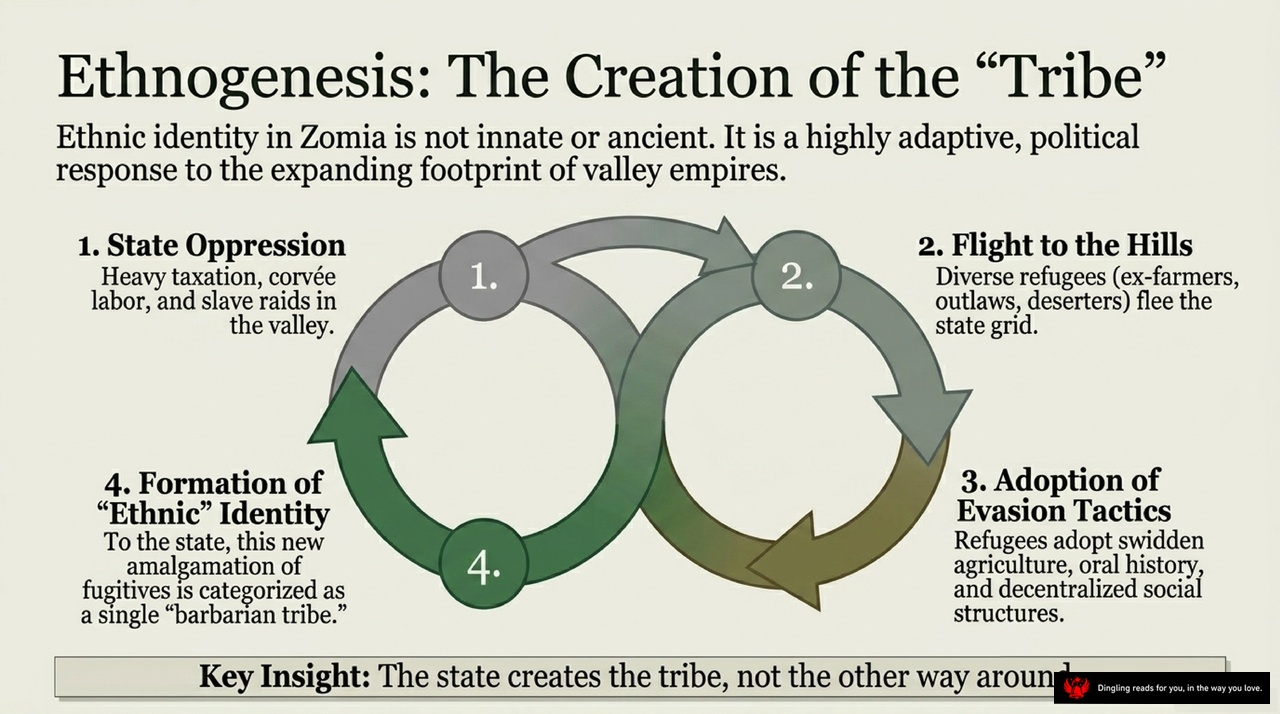
Imagine a world where the very idea of a "tribe" is not an ancient, natural fact, but rather a political invention. This slide captures that radical shift perfectly. It illustrates the cycle of **Ethnogenesis**: the moment a state creates the "tribe" to define itself against a chaotic frontier.
Look at the cycle on the left. It starts with **State Oppression**. In the fertile valleys, the empire demands heavy taxes, forced labor, and even enslaves its own people. When the burden becomes too heavy, the population flees. This is step two: **Flight to the Hills**. Diverse groups—farmers, outlaws, deserters—abandon the state grid and retreat into the rugged terrain.
Once in the mountains, they don't just hide; they adapt. That's step three: the **Adoption of Evasion Tactics**. They switch to slash-and-burn agriculture, rely on oral history instead of written records, and build decentralized social structures. Why? Because a scattered, leaderless population is impossible for the state to tax or conscript.
Finally, step four: the **Formation of "Ethnic" Identity**. To the state, this new amalgamation of fugitives looks like a single, monolithic "barbarian tribe." They are categorized as a unified enemy, but in reality, they are a fluid mix of people who never wanted to be ruled.
The key insight at the bottom sums it all up: The state creates the tribe, not the other way around. What we often see as ancient ethnic identities are actually the result of people escaping state control and being lumped together by the very power they are trying to evade.

The history of the valley cannot be written without the hill, and vice versa. They are mutually constitutive shadows of each other. Think of the relationship between the valley and the mountain not as a simple center and periphery, but as a symbiotic twin. This dynamic is driven by a constant, two-way flow of resources and people.
Look at the upward flow. From the valley to the hill, we see manufactured goods, salt, and prestige items moving up. But perhaps most critically, this route carries the constantly fleeing refugee populations seeking asylum. These are people escaping the heavy burdens of the state below, finding sanctuary in the rugged terrain above.
Conversely, there is a powerful downward flow. From the hill to the valley, valuable forest products like timber, resins, and gold travel down, enriching the state. This flow also includes mercenary military labor and, historically, captive slaves. The state needs the mountain's resources and manpower, while the mountain needs the valley's goods and protection.
This exchange proves a key insight: Zomia is not a disconnected wilderness. It is an economic partner and a constant political threat. By providing a perpetual 'alternative' for those who wish to opt out, the mountains limit how deeply the valley state can oppress its own citizens. Without this symbiotic twin, the history of the region would be unbalanced and incomplete.

When the state stretches too far or a local chief becomes too tyrannical, the people don't just suffer quietly; they rise up to violently reset the system. This is the cycle of prophetic movements and millennial rebellions.
As shown in our diagram, it starts with **The Vision**. A charismatic leader steps forward promising a utopian future—one without taxes, forced labor, or state oppression. This promise taps into the deepest fears of the population, offering a radical escape from the crushing weight of the valley states.
Next comes **The Reset**. These movements act like a social immune system. They don't just protest; they violently dismantle the existing order, pushing back against both external invasions and internal attempts to build rigid hierarchies. It is a desperate but powerful attempt to break the cycle of exploitation.
However, there is a profound **Paradox** at the heart of this rebellion. To fight the state, these movements often borrow the state's own tools. They utilize the very charismatic symbols of kingship and magic that the government uses to control the people, repurposing them to mobilize an anti-state army. They use the enemy's language to tell a story of liberation.
Ultimately, these rebellions are not just random acts of violence. They are a necessary mechanism for societies to survive when the cost of obedience becomes too high. By promising a new world, these prophets give the people the courage to tear down the old one, even if the result is often just a temporary reset before the state rises again.
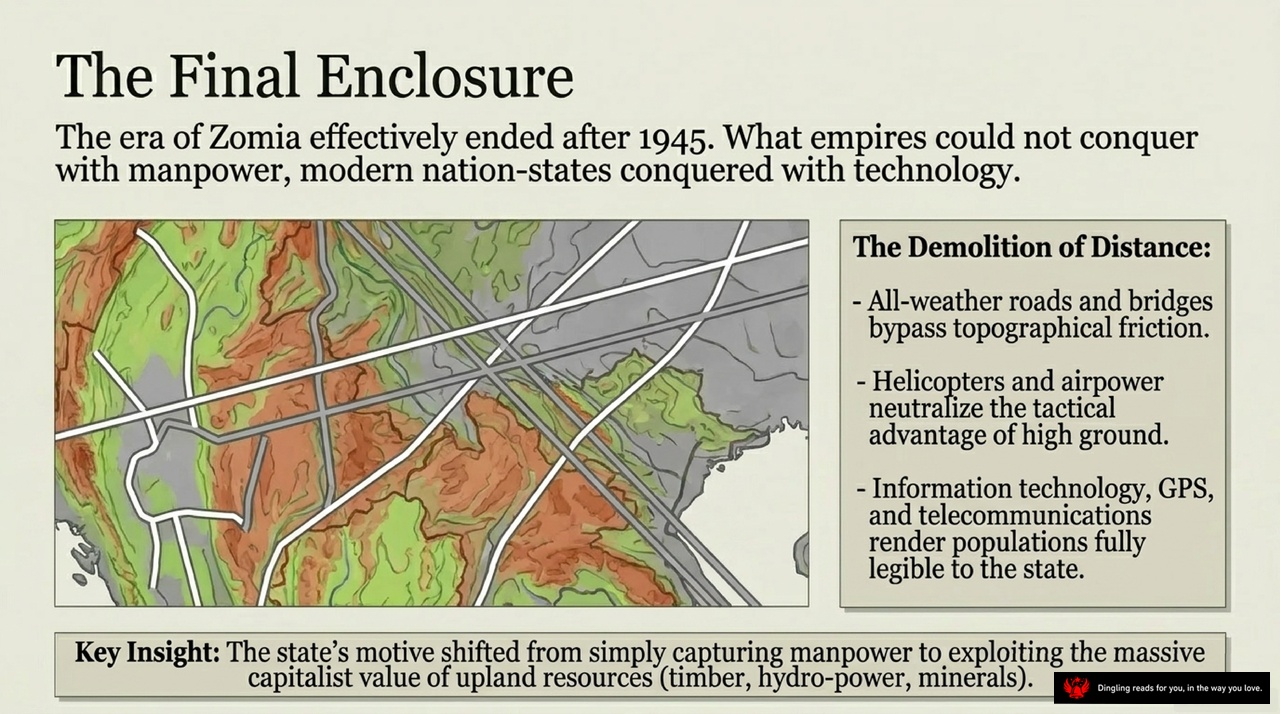
The Final Enclosure marks the end of an era. After 1945, the logic of empire shifted dramatically. Empires that once relied on brute manpower to conquer remote mountainous regions like Zomia could no longer compete. Instead, modern nation-states triumphed through superior technology.
Look at the map on your screen. It illustrates "The Demolition of Distance." In the past, rugged terrain, high mountains, and dense forests were natural barriers that protected mountain populations from state control. But today, all-weather roads and bridges have bypassed topographical friction, allowing the state to penetrate the deepest valleys. Helicopters and airpower have neutralized the tactical advantage that high ground once offered rebels. Furthermore, information technology, GPS, and telecommunications have rendered these previously invisible populations fully legible to the state.
The key insight here is a fundamental shift in motivation. The state's goal changed from simply capturing manpower to exploiting the massive capitalist value of upland resources like timber, hydro-power, and minerals. This technological advantage has squeezed the last remaining spaces of autonomy, effectively ending the era where mountains could serve as a permanent refuge from the state.
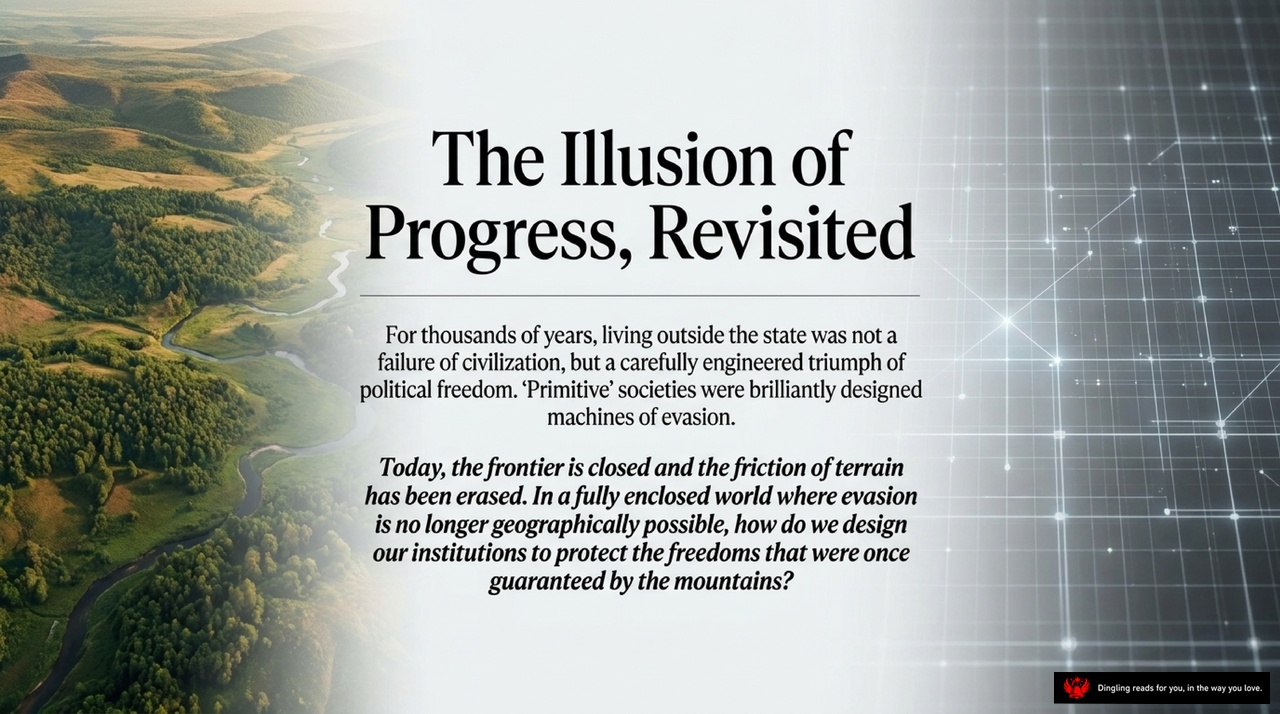
The illusion of progress is a powerful myth we often repeat. For thousands of years, living outside the state wasn't a failure of civilization; it was a carefully engineered triumph of political freedom. Those so-called "primitive" societies were actually brilliantly designed machines of evasion.
Look at the image: on one side, we see the rugged, untamed landscape of the mountains, while on the other, the rigid grid of the modern state. Today, the frontier is closed, and the friction of terrain has been erased. In a fully enclosed world where evasion is no longer geographically possible, how do we design our institutions to protect the freedoms that were once guaranteed by the mountains? We must recognize that these mountain dwellers were never passive victims waiting to be civilized. Instead, their scattered social structures, their refusal to use writing, and their mobile lifestyles were strategic choices. They chose chaos over control, mobility over taxation, and freedom over the safety of the state. As we move forward, we must ask ourselves: in a world where there is nowhere left to run, can we still find a way to preserve the liberty that geography once offered?